Barong

Protective Spirit of the Forest

written by Valis Teoh

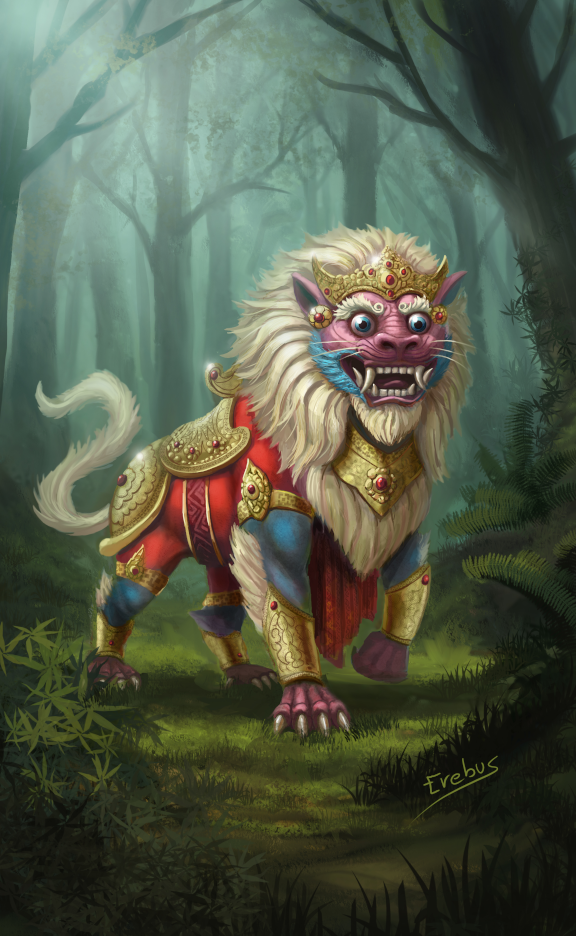
Amidst dense forests roams a mythical creature steeped with magic: The barong, clad in gold jewelry and intricately woven fabric, is often referred to as the King of Spirits.

Many describe it as a fearsome beast—lionlike, with long protruding canines and capable of producing terrifying roars. Yet there is an undeniable gentleness to its other features—large, marblelike eyes that some would consider cute, an ever-glowing fluffy mane that is said to act as a beacon for lost spirits. It is little wonder that settlements that form a bond with a barong revere it, including it in their cultural practices and oral traditions passed down through generations.

Habitat and Behaviors

Barongs reside in mountainous forests and temperate jungles, thriving in places rich in ambient magic (known as dwimmers). Occasionally, a part of the forest’s dwimmer shifts in temper for a short period, attributed to the strong emotions a resident barong is feeling at the time. This phenomenon is rarely dangerous, however, for the barong is typically peaceful and joyful in its temperament.

Those who are fortunate enough to stumble upon a barong usually spy them wandering along riverbanks, in search of spirits with whom they can play.

Cultural Significance

The barong is a shepherd of the deceased and lost spirits, ushering them to the next stage of their existence. To those who know of them, the barong is a symbol of good tidings and fair weather. Spotting a barong in the forest is believed to foretell a bountiful upcoming harvest, or to be a sign that a messenger bearing important news will be arriving shortly.

A common custom at the start of each year is the offering of gold jewelry wrapped in colorful fabrics for the local barong, asking for protection against malevolent beings and blessings for good harvests. Barongs have a fondness for red and yellow gems, along with murals that depict its likeness and relationship with the people.

Some regions tell a story that the barong will visit during the night, when all are asleep, bringing along spirits of the dead to leave messages for the living. Shed fur left in the room from a barong's glowing mane is an indication of a visit; this found fur is a key ingredient in spiritual charms distributed in the many festivals and rituals a town may have. It is most used in the form of braided tassels hanging from a paper ball—a regular sight in the funeral rites of some communities that originated from the Kehai people.

Wards of the Barong

A barong is more than just a guide for lost spirits—it is also a guide for abandoned children, adopting them into its fold and caring for them as if it were their own. Wards of the barong can be identified by the gold jewelry they wear and their ability to see spirits with great clarity compared to most people—two gifts bestowed upon them by the barong when they are brought into the family.

In D&D, a player character with the background of ward of the barong could look like a Grave Domain Cleric, with the barong acting as their patron deity, and their holy symbol the jewelry that was given to them. Alternatively, a player could instead opt for a Circle of Dreams Druid, their connection with the barong akin to that of the creatures of the feywild.
Additional Information

Geographic Origin and Distribution

Temperate and mountainous rainforests of Mor Thia and the Sundered Isles
Barong by Erebus
Origin/Ancestry
Fey
Lifespan
Immortal
This free article is made possible by our crowdfunding supporters. Please consider supporting our Patreon to help fund continued development of Drintera!

Shewstone Publishing, incorporating content from Black Flag Roleplaying Reference Document v0.2, © Open Design LLC d/b/a Kobold Press

Barong CR: 11

Large fey

Armor Class: 17 (natural armor)
Hit Points: 168
Speed: 40 ft., climb 40 ft.
Hit Points: 168
Stealth: 13
Senses: keensense 100 ft.
Perception: 20
Languages: Common, Sylvan, Primordial, Celestial, all local languages
PB:

STR

+3

DEX

+3

CON

+6

INT

+4

WIS

+10

CHA

+7


Barong by Erebus

Special Abilities

Fey Resilience. The barong is resistant to the charmed and unconscious conditions.

Waterwalk. The barong can naturally walk on water as if solid ground.

Spirit Guardian. The barong is attuned to the spirit world and always aware of the spirits around it, capable of communicating freely with them. This functions like the See Invisibility and Tongues spells, always active:

  • See Invisibility. You see invisible creatures and objects as if they were visible, and you can see into the Ethereal Plane. Ethereal creatures and objects appear ghostly and translucent.
  • Tongues. This spell grants the creature the ability to understand any spoken language it hears. Moreover, when the target speaks, any creature that knows at least one language and can hear the target understands what it says

Pounce. If the barong moves at least 20 feet straight toward a creature and then hits it with a Claw attack on the same turn, that target must succeed on a DC 13 STR save or be knocked prone. If the target is prone, the barong can make one Bite attack against it as a bonus action.

Protector. All wards of the barong have the Warding Bond spell applied to them, always active: This spell wards a willing creature you touch and creates a mystic connection between you and the target until the spell ends. While the target is within 60 feet of you, it gains a +1 bonus to AC and saves, and it has resistance to all damage. However, each time it takes damage, you take the same amount of damage. The spell ends if you drop to 0 HP.

Actions

Multiattack. The barong makes two claw or bite attacks. If the target creature is rooted by plants, it knocks them prone until the start of their next turn.

Claw. Melee Weapon Attack: +8 to hit, reach 10 ft., one target. Hit: 10 (2d6 + 8) piercing damage.

Bite. Melee Weapon Attack: +6 to hit, reach 5 ft., one creature. Hit: 17 (3d10 + 4) piercing damage.

Entangle. Grasping weeds and vines sprout from the ground in a 20-foot square starting from a point within range. For the duration, these plants turn the ground in the area into difficult terrain. A creature in the area when you cast the spell must succeed on a STR save or be restrained by tangling plants until the spell ends. A creature restrained by the plants can use its action to make a STR check against DC 16. On a success, it frees itself. When the spell ends, the conjured plants wilt away.

Bestow Blessing. The barong casts one of the following spells on itself or their ward, requiring only verbal components and using WIS as the spellcasting ability (spell save DC 16).

  • Soothing Presence. An ethereal and powerful being, its aura affects other living creatures as it does dwimmers. The barong can cast the Sanctuary spell on targets within 50 ft.: You ward a creature within range against attack. Until the spell ends, any creature who targets the warded creature with an attack or a harmful spell must first make a WIS save vs. DC 16. On a failed save, the creature must choose a new target or lose the attack or spell. This spell doesn’t protect the warded creature from area effects, such as the explosion of a fireball. If the warded creature makes an attack or casts a spell that affects an enemy creature, this spell ends.
  • Bestow Magic Resistance. The target creature has advantage on saves against spells and other magical effects.
  • Death Ward. The first time the target of this spell would drop to 0 HP as a result of taking damage, the target instead drops to 1 HP, and the spell ends. If the target is subjected to an effect that would kill it instantaneously without dealing damage, that effect is instead negated against the target, and the spell ends.
  • Of the Forest. The target creature can travel an additional 15 feet when moving during their turn. In addition, difficult terrain doesn’t cost extra movement.

Bonusactions

Ethereal Jaunt. The barong magically shifts from the Material Plane to the Ethereal Plane, or vice versa.

Description

The Barong is a protective spirit of the temperate rainforest, often revered by nearby people.