
VICUS MILITARIS
The Soldier-Civilian Quarter · District · Castellum Magnum
"The Vicus is where the Legion and the city actually live together, which is different from the fort, where the Legion lives alone, and different from the forum, where the city administers itself. In the Vicus the two populations are mixed in the way of places that have been mixing for twelve centuries: not blurred, the soldier identity and the frontier family identity are both distinct and held deliberately distinct, but occupying the same streets, the same eating houses, the same festivals, with the ease of long familiarity. I have eaten in the Vicus's taverns with soldiers who are the fifteenth generation of their family to garrison this wall. The concept that this is temporary, which is what a posting is supposed to be, has not been relevant to their family for nine centuries."
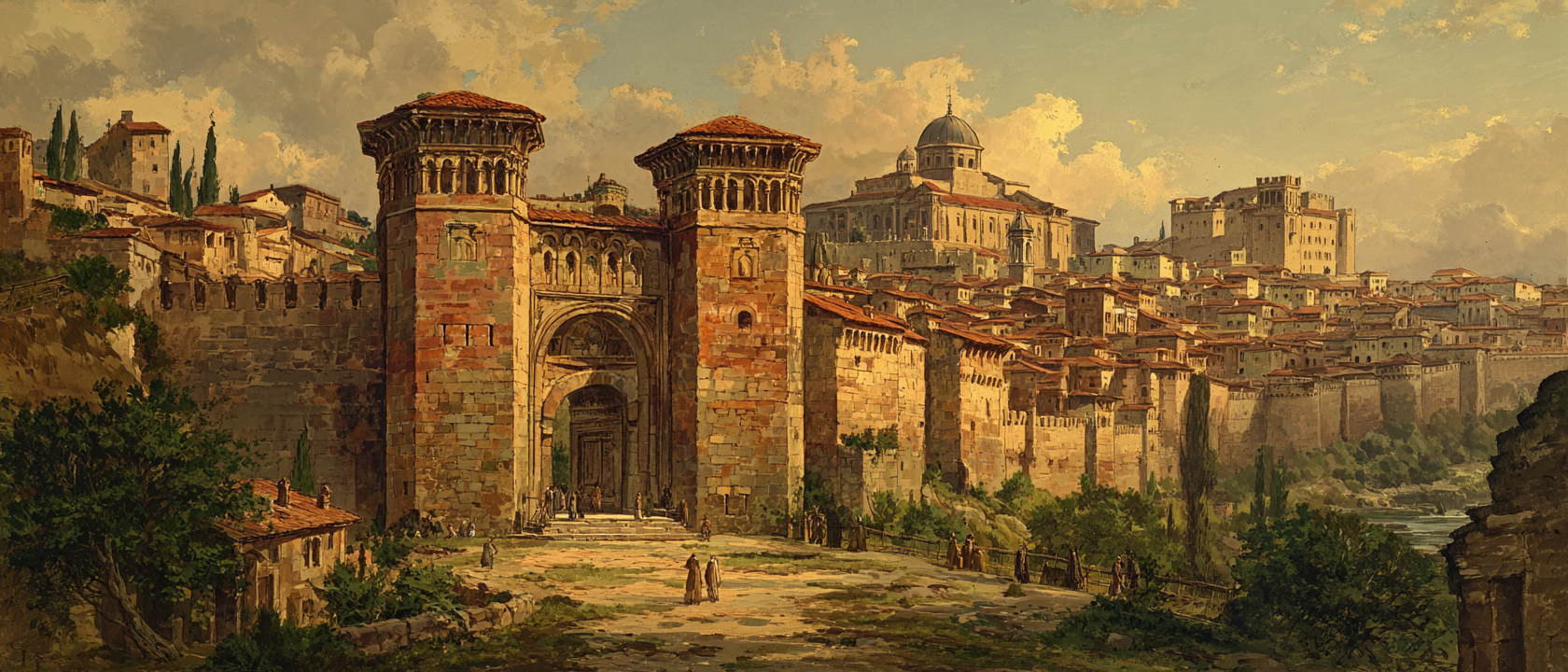
The Vicus Militaris is the district that grew up around the fort's eastern gate in the city's first civilian generation and has been the primary social interface between the Legion and the city ever since. It is where off-duty soldiers spend their money and their time, where Legion families live, where veterans have settled, and where the frontier families' daily lives intersect most directly with the military institution their city exists to support. It is also the most socially complex district in Castellum Magnum — the place where twelve centuries of proximity have produced something that neither pure military culture nor pure civilian culture quite accounts for.
Demographics
The Vicus's permanent population of approximately fifteen thousand is the most socially mixed of any district in the city. Active Legion personnel on leave, Legion families who live off-post, veterans who have remained after service, frontier families who have lived here for generations, and the merchants, artisans, and service workers whose livelihoods depend on all of the above. The half-orc population of approximately five hundred in the Vicus is the district's most discussed demographic — not the largest concentration of half-orcs in the city, but the most visible, living in a neighbourhood where every inhabitant has a position on the frontier and most of them have had occasion to articulate it.
Government
The Vicus falls under the Governor's civic jurisdiction and is administered by the city watch. In practice, the district's self-governance is conducted through the network of tavern owners, veteran associations, and frontier family heads whose informal authority pre-dates and exceeds any formal institution. The watch knows which establishments manage their own problems internally and which require external intervention. The list of establishments that manage their own problems internally is the longer one.
Defences
The Vicus falls under the Governor's civic jurisdiction and is administered by the city watch. In practice, the district's self-governance is conducted through the network of tavern owners, veteran associations, and frontier family heads whose informal authority pre-dates and exceeds any formal institution. The watch knows which establishments manage their own problems internally and which require external intervention. The list of establishments that manage their own problems internally is the longer one.
Industry & Trade
The Vicus's commercial life is organised around off-duty military needs — taverns, equipment maintenance and repair, the specific goods that soldiers spend pay on — and has been for twelve centuries. The quality of the district's craftwork is uniformly high: a swordsmith who has been supplying Legion personnel for three generations understands the difference between equipment that passes inspection and equipment that saves lives, and prices the latter correctly. The taverns are the district's social institutions in the Roman sense of the word: places where information moves, alliances form, and the city's informal governance is conducted over food and wine of reliable quality.
Guilds and Factions
The Veterans' Association and the frontier families' informal network are the Vicus's primary power structures, with the tavern owners' collective interest in a stable and commercially active district providing the practical foundation both operate on. The Speculatores have deep roots in the Vicus — many of their civilian contractors and informants live here, and the cultural sympathy between military intelligence and frontier families makes the district a natural recruitment ground. The Via Obscura is present through the Taberna Prima and several other establishments, operating in the space between what the Speculatores can officially do and what the situation sometimes requires.
History
The Vicus grew in the city's first civilian generation from the informal camp-following settlement that grows around any permanent garrison. By the third century it was formalised as a district with its own aedile. The Taberna Prima's founding date is disputed between the establishment's records and the city's administrative records, and the dispute has been ongoing since the fifth century when someone first noticed the discrepancy. Neither party has found the disagreement sufficiently important to resolve.
For full chronological detail, see: Annales Mundi.
Points of interest
The Taberna Prima — the First Tavern, not its formal name, but the name it has been called since the third century — is the oldest continuously operating eating establishment in Castellum Magnum and possibly in the Empire. Its current building is seventh-century; its operation is unbroken from the second century. The food is good, the wine is better than visitors expect, and the conversation, for someone who knows how to listen, is the most concentrated source of frontier intelligence available outside the Speculatores' files. The Via Obscura has had an operator stationed in the Taberna Prima for sixty years. Different operators, same stool.
The Veterans' Hall, on the Vicus's northern edge, is the meeting place of the Frontier Legions Veterans' Association — the organisation of former Legion personnel who have remained in Castellum Magnum after service. The Association has no formal authority and considerable practical influence: its membership includes the city watch's senior officers, several of the frontier families' heads, and the informal network of people whose expertise and relationships make them the first call for any problem that requires capability rather than paperwork. The Association is aware that the goblin diplomatic situation exists. It does not know the details. It is developing opinions about the general shape of the situation based on what it can observe, and those opinions are being discussed in the Veterans' Hall.
Tourism
Visitors to Castellum Magnum who want to understand the city rather than observe it from the outside are directed to the Vicus — specifically to the Taberna Prima, where eating a meal and listening to the conversations around them will teach them more about frontier culture than any document. The district is fully accessible and entirely indifferent to observation, which is different from welcoming it. Visitors who carry themselves as tourists are treated politely. Visitors who carry themselves as people with a reason to be there are treated as people with a reason to be there, which is better.
Architecture
The Vicus's architecture reflects its social function: practical, dense, and built for people who know how to maintain things. The taverns and eating houses near the fort gate are the oldest commercial buildings still in operation in the city — several have been running since the third century, their current buildings on the foundations of their predecessors. The residential buildings are solid, frequently extended by generations of the same family, their facades in varying states of maintenance that correlate precisely with the financial situation of whoever lives there and not at all with any civic standard.
Geography
The Vicus occupies the ground north and south of the main road from Castellum Primum's eastern gate — the via militaris minor, not to be confused with the Via Militaris road to Nova Romae — extending approximately eight hundred metres east before the district gives way to the Academy neighbourhood to the north and the river quarter to the east. It is the widest district in the city in terms of street variety: the blocks immediately adjacent to the fort gate are dense with military-service businesses, the middle blocks are mixed residential and commercial, and the eastern blocks are predominantly residential in a way that is almost indistinguishable from any frontier family neighbourhood.
Access
Fully publicly accessible. Veterans' Hall — members and invited guests

Comments