



Perfect Delight in Dungeons & Dragons 5e

Perfect Delight
16 Level (0/225000 XP for level-up) Sage Background Tiefling Race / Species / Heritage AlignmentLevel 16
Hit Dice: 16/16
1d6+3 Class 1
Hit Points
Initiative (DEX)
Armor Class (AC)
Prof. Bonus
Speed (walk/run/fly)
Passive Perception
| +10 | Expertise Bonus | |
| +5 | Proficiency Bonus |
| +0 | Strength | |
| +3 | Dexterity | |
| +3 | Constitution | |
| +9 | Intelligence | |
| +7 | Wisdom | |
| +2 | Charisma |
| +3 | Acrobatics | DEX | |
| +2 | Animal Handling | WIS | |
| +9 | Arcana | INT | |
| +0 | Athletics | STR | |
| +2 | Deception | CHA | |
| +9 | History | INT | |
| +2 | Insight | WIS | |
| +2 | Intimidation | CHA | |
| +9 | Investigation | INT |
| +7 | Medicine | WIS | |
| +4 | Nature | INT | |
| +2 | Perception | WIS | |
| +2 | Performance | CHA | |
| +2 | Persuasion | CHA | |
| +4 | Religion | INT | |
| +3 | Sleight of Hand | DEX | |
| +3 | Stealth | DEX | |
| +2 | Survival | WIS |
| Weapon / Attack | AB | Abi | Dmg | Dmg Type | |
|---|---|---|---|---|---|
| Quarterstaff | +5 | STR | 1d6 | Bludgeoning | |
| Dagger | +5 | STR | 1d4 | Piercing | |
| Library Card | +0 | STR | |||
| Light Crossbow | +11 | DEX | 1d8+3 | Piercing | |
| Loading, range, two-handed | |||||
Spell Book
9 Silver
97 Copper
Equipment Copper: 97, Silver: 9, Electrum: 0, Gold: 7249, Platinum: 0 Money
Weapon Proficiencies: Daggers, darts, slings, quarterstaffs, light crossbows
Languages & Proficiencies
™ & © Wizards of the Coast - D & D 5e Character Sheet v2.10, made by Tillerz - Updated: 2026-05-13
To print this sheet: Expand the spell book (if you have any entries there), then click "Print Sheet" at the top, select "Print to PDF" and format A3. Then print the resulting PDF to whichever format you need with "fit to page" selected.
The statblocks of your Weapons, armor and other important/magical equipment
DMG
Bag of Holding
Wondrous Item
Uncommon
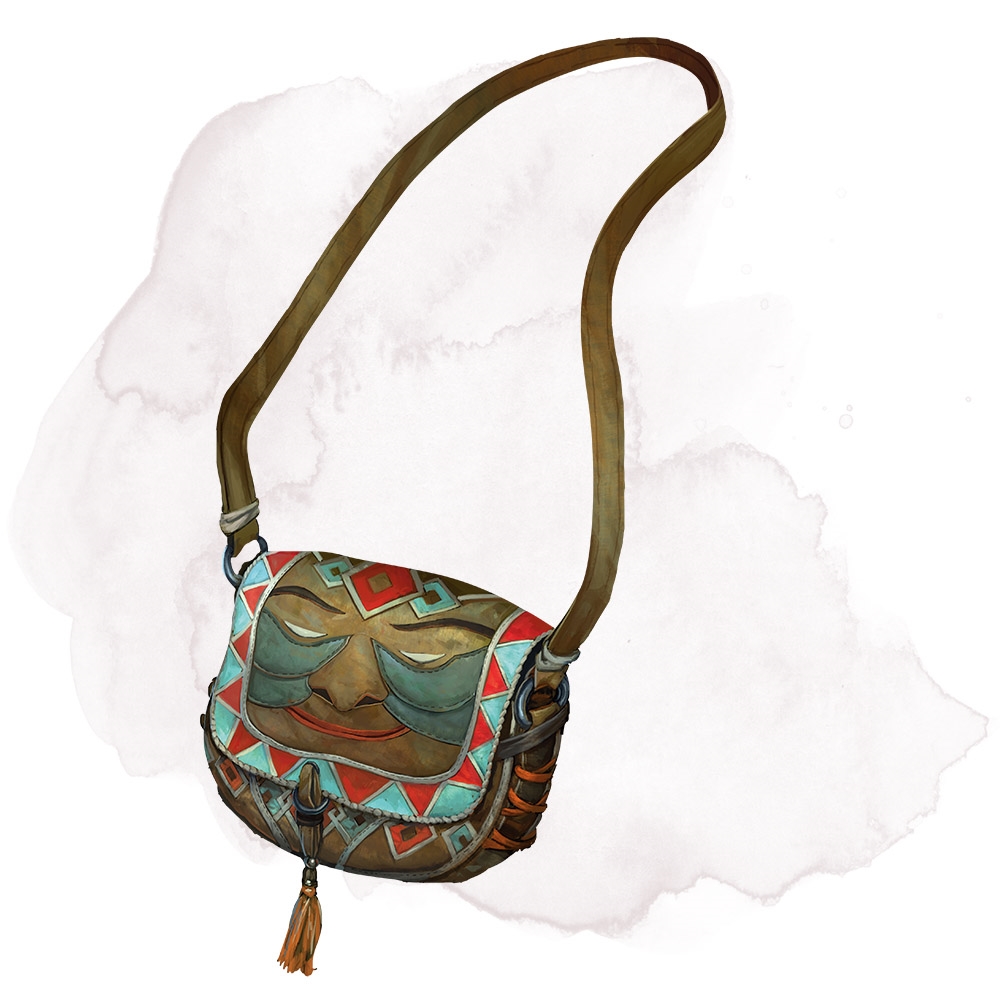
This bag has an interior space considerably larger than its outside dimensions, roughly 2 feet in diameter at the mouth and 4 feet deep. The bag can hold up to 500 pounds, not exceeding a volume of 64 cubic feet. The bag weighs 15 pounds, regardless of its contents. Retrieving an item from the bag requires an action.
If the bag is overloaded, pierced, or torn, it ruptures and is destroyed, and its contents are scattered in the Astral Plane. If the bag is turned inside out, its contents spill forth, unharmed, but the bag must be put right before it can be used again. Breathing creatures inside the bag can survive up to a number of minutes equal to 10 divided by the number of creatures (minimum 1 minute), after which time they begin to suffocate.
Placing a bag of holding inside an extradimensional space created by a handy haversack, portable hole, or similar item instantly destroys both items and opens a gate to the Astral Plane. The gate originates where the one item was placed inside the other. Any creature within 10 feet of the gate is sucked through it to a random location on the Astral Plane. The gate then closes. The gate is one-way only and can't be reopened.
Crafting Blueprint
Materials
- A large 2 x 4 ft. bag woven from the silk of a phase spider
- a handful of void dust (from incorporeal beings like e.g. a shadow)
- remains of a silver cord from the Astral plane
- a small jacinth gemstone
- an uncommon Magical Catalysator
Instructions
Weave an appropriately large bag from phase spider silk. Secure the silver cord and gem at the opening of the bag and pad the bag's inside with void dust. Infuse the bag with conjuration magic, through your magical catalysator. Repeat the last step daily, until the bag is completed.
Cost: 5.000 sp
Weight: 15 lbs
Rafin
Tome of Monster Knowledge
Wondrous Item
Very Rare
At first glance, this book appears to be covered in rather old leather with 2 newer leather straps holding the book closed. Upon further investigation, the leather binding on this book is actually human skin. The book contains 100 pages. Each page is an extradimensional space within the covers of the book. The first two pages contains the tools required to harvest samples from the creatures that are to be logged within the book. The tools that are contained within include: a narrow sharp knife for skinning, a small hatchet, a hollow section of dragon bone that has been sharpened for collecting liquid samples, a writing utensil, and goggles that enhance the wearer’s vision to a distance of 3 feet. Each additional set of pages are broken down into 4 sections. Section 1: contains drawings of the creature and the name of that creature Section 2: contains a detailed description of that creature including physical characteristics and how that creature behaves in and out of combat Sections 3: contains small leather straps to hold physical samples from the creature (ex. skin, claws, hair, teeth, etc.) Section 4: contains 8 vials to store liquid samples from the creature (ex. blood, saliva, urine, etc.) Each page of this book behaves as a regular piece of parchment (ex. turning to the next page, physical weight and thickness, etc.) If a page from this book is removed from the binding, the page turns blank and all samples contained within that page are destroyed leaving behind no evidence of its previous contents. Placing this book within an extradimensional space created by a bag of holding, handy haversack, portable hole, or similar item instantly destroys both items and opens a gate to the Astral Plane. The gate originates where the book was placed inside the extradimensional space. Any creature within 10 feet of the gate is sucked through it to a random location on the Astral Plane. The gate then closes. The gate is one-way only and can’t be reopened. An individual can use the contents of this book to study the behaviors of each creature contained within to help aid in performing specific skill checks against that creature.
Weight: 1lb
DnD 5e DMG
Pearl of Power
Wondrous Item
Uncommon requires attunement by a spellcaster Requires Attunement
While this pearl is on your person, you can use an action to speak its command word and regain one expended spell slot. If the expended slot was of 4th level or higher, the new slot is 3rd level. Once you have used the pearl, it can't be used again until the next dawn.
The statblocks of your class features
Wizard
You start with the following equipment, in addition to the equipment granted by your background:
- (a) a quarterstaff or (b) a dagger
- (a) a component pouch or (b) an arcane focus
- (a) a scholar's pack or (b) an explorer's pack
- A spellbook
As a student of arcane magic, you have a spellbook containing spells that show the first glimmerings of your true power.
Cantrips
At 1st level, you know three cantrips of your choice from the wizard spell list. You learn additional wizard cantrips of your choice at higher levels, as shown in the Cantrips Known column of the Wizard table.Spellbook
At 1st level, you have a spellbook containing six 1st-level wizard spells of your choice.The spells that you add to your spellbook as you gain levels reflect the arcane research you conduct on your own, as well as intellectual breakthroughs you have had about the nature of the multiverse. You might find other spells during your adventures. You could discover a spell recorded on a scroll in an evil wizard's chest, for example, or in a dusty tome in an ancient library.
Copying a Spell into the Book. When you find a wizard spell of 1st level or higher, you can add it to your spellbook if it is of a level for which you have spell slots and if you can spare the time to decipher and copy it.
Copying a spell into your spellbook involves reproducing the basic form of the spell, then deciphering the unique system of notation used by the wizard who wrote it. You must practice the spell until you understand the sounds or gestures required, then transcribe it into your spellbook using your own notation.
For each level of the spell, the process takes 2 hours and costs 50 gp. The cost represents material components you expend as you experiment with the spell to master it, as well as the fine inks you need to record it. Once you have spent this time and money, you can prepare the spell just like your other spells.
Replacing the Book. You can copy a spell from your own spellbook into another book-for example, if you want to make a backup copy of your spellbook. This is just like copying a new spell into your spellbook, but faster and easier, since you understand your own notation and already know how to cast the spell. You need spend only 1 hour and 10 gp for each level of the copied spell.
If you lose your spellbook, you can use the same procedure to transcribe the spells that you have prepared into a new spellbook. Filling out the remainder of your spellbook requires you to find new spells to do so, as normal. For this reason, many wizards keep backup spellbooks in a safe place.
The Book's Appearance. Your spellbook is a unique compilation of spells, with its own decorative flourishes and margin notes. It might be a plain, functional leather volume that you received as a gift from your master, a finely bound gilt-edged tome you found in an ancient library or even a loose collection of notes scrounged together after you lost your previous spellbook in a mishap.
Preparing and Casting Spells
The Wizard table shows how many spell slots you have to cast your spells of 1st level and higher. To cast one of these spells, you must expend a slot of the spell's level or higher. You regain all expended spell slots when you finish a long rest.You prepare the list of wizard spells that are available for you to cast. To do so, choose a number of wizard spells from your spellbook equal to your Intelligence modifier + your wizard level (minimum of one spell). The spells must be of a level for which you have spell slots.
For example, if you're a 3rd-level wizard, you have four 1st-1evel and two 2nd-level spell slots. With an Intelligence of 16, your list of prepared spells can include six spells of 1st or 2nd level, in any combination, chosen from your spellbook. If you prepare the 1st-level spell Magic Missile, you can cast it using a 1st-level or a 2nd-level slot. Casting the spell doesn't remove it from your list of prepared spells.
You can change your list of prepared spells when you finish a long rest. Preparing a new list of wizard spells requires time spent studying your spellbook and memorizing the incantations and gestures you must make to cast the spell: at least 1 minute per spell level for each spell on your list.
Spellcasting Ability
Intelligence is your spellcasting ability for your wizard spells, since you learn your spells through dedicated study and memorization. You use your Intelligence whenever a spell refers to your spellcasting ability. In addition, you use your Intelligence modifier when setting the saving throw DC for a wizard spell you cast and when making an attack roll with one.Spell save DC = 8 + your proficiency bonus + your Intelligence modifier
Spell attack modifier = your proficiency bonus + your Intelligence modifier
Ritual Casting
You can cast a wizard spell as a ritual if that spell has the ritual tag and you have the spell in your spellbook. You don't need to have the spell prepared.Spellcasting Focus
You can use an arcane focus as a spellcasting focus for your wizard spells.Learning Spells of 1st Level and Higher
Each time you gain a wizard level, you can add two wizard spells of your choice to your spellbook. Each of these spells must be of a level for which you have spell slots, as shown on the Wizard table. On your adventures, you might find other spells that you can add to your spellbook.| The | Wizard | Spell | Slots | Per | Level | |||||||
|---|---|---|---|---|---|---|---|---|---|---|---|---|
| level | Proficiency Bonus | Features | Cantrips Known | 1st | 2nd | 3rd | 4th | 5th | 6th | 7th | 8th | 9th |
| 1 | +2 | Spellcasting, Arcane Recovery | 3 | 2 | - | - | - | - | - | - | - | - |
| 2 | +2 | Arcane Tradition | 3 | 3 | - | - | - | - | - | - | - | - |
| 3 | +2 | Cantrip Formulas (Optional) | 3 | 4 | 2 | - | - | - | - | - | - | - |
| 4 | +2 | Ability Score Improvement | 4 | 4 | 3 | - | - | - | - | - | - | - |
| 5 | +3 | - | 4 | 4 | 3 | 2 | - | - | - | - | - | - |
| 6 | +3 | Arcane Tradition feature | 4 | 4 | 3 | 3 | - | - | - | - | - | - |
| 7 | +3 | - | 4 | 4 | 3 | 3 | 1 | - | - | - | - | - |
| 8 | +3 | Ability Score Improvement | 4 | 4 | 3 | 3 | 2 | - | - | - | - | - |
| 9 | +4 | - | 4 | 4 | 3 | 3 | 3 | 1 | - | - | - | - |
| 10 | +4 | Arcane Tradition feature | 5 | 4 | 3 | 3 | 3 | 2 | - | - | - | - |
| 11 | +4 | - | 5 | 4 | 3 | 3 | 3 | 2 | 1 | - | - | - |
| 12 | +4 | Ability Score Improvement | 5 | 4 | 3 | 3 | 3 | 2 | 1 | - | - | - |
| 13 | +5 | - | 5 | 4 | 3 | 3 | 3 | 2 | 1 | 1 | - | - |
| 14 | +5 | Arcane Tradition feature | 5 | 4 | 3 | 3 | 3 | 2 | 1 | 1 | - | - |
| 15 | +5 | - | 5 | 4 | 3 | 3 | 3 | 2 | 1 | 1 | 1 | - |
| 16 | +5 | Ability Score Improvement | 5 | 4 | 3 | 3 | 3 | 2 | 1 | 1 | 1 | - |
| 17 | +6 | - | 5 | 4 | 3 | 3 | 3 | 2 | 1 | 1 | 1 | 1 |
| 18 | +6 | Spell Mastery | 5 | 4 | 3 | 3 | 3 | 3 | 1 | 1 | 1 | 1 |
| 19 | +6 | Ability Score Improvement | 5 | 4 | 3 | 3 | 3 | 3 | 2 | 1 | 1 | 1 |
| 20 | +6 | Signature Spells | 5 | 4 | 3 | 3 | 3 | 3 | 2 | 2 | 1 | 1 |
Arcane Recovery
You have learned to regain some of your magical energy by studying your spellbook. Once per day when you finish a short rest, you can choose expended spell slots to recover. The spell slots can have a combined level that is equal to or less than half your wizard level (rounded up), and none of the slots can be 6th level or higher.For example, if you're a 4th-level wizard, you can recover up to two levels worth of spell slots. You can recover either a 2nd-level spell slot or two 1st-level spell slots.
Arcane Tradition
When you reach 2nd level, you choose an arcane tradition, shaping your practice of magic through one of the following schools. Your choice grants you features at 2nd level and again at 6th, 10th, and 14th level.Cantrip Formulas (Optional)
At 3rd level, you have scribed a set of arcane formulas in your spellbook that you can use to formulate a cantrip in your mind. Whenever you finish a long rest and consult those formulas in your spellbook, you can replace one wizard cantrip you know with another cantrip from the wizard spell list.Ability Score Improvement
When you reach 4th level, and again at 8th, 12th, 16th, and 19th level, you can increase one ability score of your choice by 2, or you can increase two ability scores of your choice by 1. As normal, you can't increase an ability score above 20 using this feature.Spell Mastery
At 18th level, you have achieved such mastery over certain spells that you can cast them at will. Choose a 1st-level wizard spell and a 2nd-level wizard spell that are in your spellbook. You can cast those spells at their lowest level without expending a spell slot when you have them prepared. If you want to cast either spell at a higher level, you must expend a spell slot as normal.By spending 8 hours in study, you can exchange one or both of the spells you chose for different spells of the same levels.
Signature Spells
When you reach 20th level, you gain mastery over two powerful spells and can cast them with little effort. Choose two 3rd-level wizard spells in your spellbook as your signature spells. You always have these spells prepared, they don't count against the number of spells you have prepared, and you can cast each of them once at 3rd level without expending a spell slot. When you do so, you can't do so again until you finish a short or long rest.If you want to cast either spell at a higher level, you must expend a spell slot as normal.
Abjuration
The School of Abjuration emphasizes magic that blocks, banishes, or protects. Detractors of this school say that its tradition is about denial, negation rather than positive assertion. You understand, however, that ending harmful effects, protecting the weak, and banishing evil influences is anything but a philosophical void. It is a proud and respected vocation.
Called abjurers, members of this school are sought when baleful spirits require exorcism, when important locations must be guarded against magical spying, and when portals to other planes of existence must be closed.
Abjuration Savant
Beginning when you select this school at 2nd level, the gold and time you must spend to copy a abjuration spell into your spellbook is halved.Arcane Ward
Starting at 2nd level, you can weave magic around yourself for protection. When you cast an abjuration spell of 1st level or higher, you can simultaneously use a strand of the spell's magic to create a magical ward on yourself that lasts until you finish a long rest. The ward has hit points equal to twice your wizard level + your Intelligence modifier. Whenever you take damage, the ward takes the damage instead. If this damage reduces the ward to 0 hit points, you take any remaining damage.While the ward has 0 hit points, it can't absorb damage, but its magic remains. Whenever you cast an abjuration spell of 1st level or higher, the ward regains a number of hit points equal to twice the level of the spell.
Once you create the ward, you can't create it again until you finish a long rest.
Projected Ward
Starting at 6th level, when a creature that you can see within 30 feet of you takes damage, you can use your reaction to cause your Arcane Ward to absorb that damage. If this damage reduces the ward to 0 hit points, the warded creature takes any remaining damage.Improved Abjuration
Beginning at 10th level, when you cast an abjuration spell that requires you to make an ability check as a part of casting that spell (as in Counterspell and Dispel Magic), you add your proficiency bonus to that ability check.Spell Resistance
Starting at 14th level, you have advantage on saving throws against spells.Furthermore, you have resistance against the damage of spells.
Bladesingers master a tradition of wizardry that incorporates swordplay and dance. Originally created by elves, this tradition has been adopted by non-elf practitioners, who honor and expand on the elven ways.
In combat, a bladesinger uses a series of intricate, elegant maneuvers that fend off harm and allow the bladesinger to channel magic into devastating attacks and a cunning defense. Many who have observed a bladesinger at work remember the display as one of the more beautiful experiences in their life, a glorious dance accompanied by a singing blade.
Training in War and Song
When you adopt this tradition at 2nd level, you gain proficiency with light armor, and you gain proficiency with one type of one-handed melee weapon of your choice.You also gain proficiency in the Performance skill if you don’t already have it.
Bladesong
Starting at 2nd level, you can invoke an elven magic called the Bladesong, provided that you aren’t wearing medium or heavy armor or using a shield. It graces you with supernatural speed, agility, and focus.You can use a bonus action to start the Bladesong, which lasts for 1 minute. It ends early if you are incapacitated, if you don medium or heavy armor or a shield, or if you use two hands to make an attack with a weapon. You can also dismiss the Bladesong at any time (no action required).
While your Bladesong is active, you gain the following benefits:
1)You gain a bonus to your AC equal to your Intelligence modifier (minimum of +1)
2)Your walking speed increases by 10 feet.
3)You have advantage on Dexterity (Acrobatics) checks.
4)You gain a bonus to any Constitution saving throw you make to maintain your concentration on a spell. The bonus equals your Intelligence modifier (minimum of +1).
You can use this feature a number of times equal to your proficiency bonus, and you regain all expended uses of it when you finish a long rest.
Extra Attack
Starting at 6th level, you can attack twice, instead of once, whenever you take the Attack action on your turn. Moreover, you can cast one of your cantrips in place of one of those attacks.Song of Defense
Beginning at 10th level, you can direct your magic to absorb damage while your Bladesong is active. When you take damage, you can use your reaction to expend one spell slot and reduce that damage to you by an amount equal to five times the spell slot's level.Song of Victory
Starting at 14th level, you can add your Intelligence modifier (minimum of +1) to the damage of your melee weapon attacks while your Bladesong is active.Focusing on the manipulation of time, those who follow the Chronurgy tradition learn to alter the pace of reality to their liking. Using the ramping of anticipatory dunamis energy, these mages can bend the flow of time as adroitly as a skilled musician plays an instrument, lending themselves and their allies an advantage in the blink of an eye.
Chronal Shift
At 2nd level, you can magically exert limited control over the flow of time around a creature. As a reaction, after you or a creature you can see within 30 feet of you makes an attack roll, an ability check, or a saving throw, you can force the creature to reroll. You make this decision after you see whether the roll succeeds or fails. The target must use the result of the second roll.You can use this ability twice, and you regain any expended use when you finish a long rest.
Temporal Awareness
Starting at 2nd level, you can add your Intelligence modifiers to your initiative rolls.Momentary Stasis
When you reach 6th level, as an action, you can magically force a Large or smaller creature you can see within 60 feet of you to make a Constitution saving throw against your spell save DC. Unless the saving throw is a success, the creature is encased in a field of magical energy until the end of your next turn or until the creature takes any damage. While encased in this way, the creature is incapacitated and has a speed of 0.You can use this feature a number of times equal to your Intelligence modifier (a minimum of once). You regain all expended uses when you finish a long rest.
Arcane Abeyance
At 10th level, when you cast a spell using a spell slot of 4th level or lower, you can condense the spell's magic into a mote. The spell is frozen in time at the moment of casting and held within a gray bead for 1 hour. This bead is a Tiny object with AC 15 and 1 hit point, and it is immune to poison and psychic damage. When the duration ends, or if the bead is destroyed, it vanishes in aflash of light, and the spell is lost.A creature holding the bead can use its action to release the spell within, whereupon the bead disappears. The spell uses your spell attack bonus and save DC, and the spell treats the creature who released it as the cast for all other purposes.
Once you create a bead with this feature, you can't do so again until you finish a short or long rest.
Convergent Future
Starting at 14th level, you can peer through possible futures and magically pull one of them into events around you, ensuring a particular outcome. When you or a creature you can see within 60 feet of you makes an attack roll, an ability check, or a saving throw, you can use your reaction to ignore the die roll and decide whether the number rolled is the minimum needed to succeed or one less than that number (your choice).When you use this feature, you gain one level of exhaustion. Only by finishing a long rest can you remove a level of exhaustion gained in this way.
As a conjurer, you favor spells that produce objects and creatures out of thin air. You can conjure billowing clouds of killing fog or summon creatures from elsewhere to fight on your behalf. As your mastery grows, you learn spells of transportation and can teleport yourself across vast distances, even to other planes of existence, in an instant.
Conjuration Savant
Beginning when you select this school at 2nd level, the gold and time you must spend to copy a Conjuration spell into your spellbook is halved.Minor Conjuration
Starting at 2nd level when you select this school, you can use your action to conjure up an inanimate object in your hand or on the ground in an unoccupied space that you can see within 10 feet of you. This object can be no larger than 3 feet on a side and weigh no more than 10 pounds, and its form must be that of a nonmagical object that you have seen. The object is visibly magical, radiating dim light out to 5 feet.The object disappears after 1 hour, when you use this feature again, or if it takes any damage.
Benign Transportation
Starting at 6th level, you can use your action to teleport up to 30 feet to an unoccupied space that you can see. Alternatively, you can choose a space within range that is occupied by a Small or Medium creature. If that creature is willing, you both teleport, swapping places.Once you use this feature, you can't use it again until you finish a long rest or you cast a conjuration spell of 1st level or higher.
Focused Conjuration
Beginning at 10th level, while you are concentrating on a conjuration spell, your concentration can't be broken as a result of taking damage.Durable Summons
Starting at 14th level, any creature that you summon or create with a conjuration spell has 30 temporary hit points.The counsel of a diviner is sought by royalty and commoners alike, for all seek a clearer understanding of the past, present, and future. As a diviner, you strive to part the veils of space, time, and consciousness so that you can see clearly. You work to master spells of discernment, remote viewing, supernatural knowledge, and foresight.
Divination Savant
Beginning when you select this school at 2nd level, the gold and time you must spend to copy a Divination spell into your spellbook is halved.Portent
Starting at 2nd level when you choose this school, glimpses of the future begin to press in on your awareness. When you finish a long rest, roll two d20s and record the numbers rolled. You can replace any attack roll, saving throw, or ability check made by you or a creature that you can see with one of these foretelling rolls. You must choose to do so before the roll, and you can replace a roll in this way only once per turn.Each foretelling roll can be used only once. When you finish a long rest, you lose any unused foretelling rolls.
Expert Divination
Beginning at 6th level, casting divination spells comes so easily to you that it expends only a fraction of your spellcasting efforts. When you cast a divination spell of 2nd level or higher using a spell slot, you regain one expended spell slot. The slot you regain must be of a level lower than the spell you cast and can't be higher than 5th level.The Third Eye
Starting at 10th level, you can use your action to increase your powers of perception. When you do so, choose one of the following benefits, which lasts until you are incapacitated or you take a short or long rest. You can't use the feature again until you finish a short or long rest.Darkvision. You gain darkvision out to a range of 60 feet.
Ethereal Sight. You can see into the Ethereal Plane within 60 feet of you.
Greater Comprehension. You can read any language.
See Invisibility. You can see invisible creatures and objects within 10 feet of you that are within line of sight.
Greater Portent
Starting at 14th level, the visions in your dreams intensify and paint a more accurate picture in your mind of what is to come. You roll three d20s for your Portent feature, rather than two.As a member of the School of Enchantment, you have honed your ability to magically entrance and beguile other people and monsters. Some enchanters are peacemakers who bewitch the violent to lay down their arms and charm the cruel into showing mercy. Others are tyrants who magically bind the unwilling into their service. Most enchanters fall somewhere in between.
Enchantment Savant
Beginning when you select this school at 2nd level, the gold and time you must spend to copy a Enchantment spell into your spellbook is halved.Hypnotic Gaze
Starting at 2nd level when you choose this school, your soft words and enchanting gaze can magically enthrall another creature. As an action, choose one creature that you can see within 5 feet of you. If the target can see or hear you, it must succeed on a Wisdom saving throw against your wizard spell save DC or be charmed by you until the end of your next turn. The charmed creature's speed drops to 0, and the creature is incapacitated and visibly dazed.On subsequent turns, you can use your action to maintain this effect, extending its duration until the end of your next turn. However, the effect ends if you move more than 5 feet away from the creature, if the creature can neither see nor hear you, or if the creature takes damage.
Once the effect ends, or if the creature succeeds on its initial saving throw against this effect, you can't use this feature on that creature again until you finish a long rest.
Instinctive Charm
Beginning at 6th level, when a creature you can see within 30 feet of you makes an attack roll against you, you can use your reaction to divert the attack, provided that another creature is within the attack's range. The attacker must make a Wisdom saving throw against your wizard spell save DC. On a failed save, the attacker must target the creature that is closest to it, not including you or itself. If multiple creatures are closest, the attacker chooses which one to target.On a successful save, you can't use this feature on the attacker again until you finish a long rest.
You must choose to use this feature before knowing whether the attack hits or misses. Creatures that can't be charmed are immune to this effect.
Split Enchantment
Starting at 10th level, when you cast an enchantment spell of 1st level or higher that targets only one creature, you can have it target a second creature.Alter Memories
At 14th level, you gain the ability to make a creature unaware of your magical influence on it. When you cast an enchantment spell to charm one or more creatures, you can alter one creature's understanding so that it remains unaware of being charmed.Additionally, once before the spell expires, you can use your action to try to make the chosen creature forget some of the time it spent charmed. The creature must succeed on an Intelligence saving throw against your wizard spell save DC or lose a number of hours of its memories equal to 1 + your Charisma modifier (minimum 1). You can make the creature forget less time, and the amount of time can't exceed the duration of your enchantment spell.
You focus your study on magic that creates powerful elemental effects such as bitter cold, searing flame, rolling thunder, crackling lightning, and burning acid. Some evokers find employment in military forces, serving as artillery to blast enemy armies from afar. Others use their spectacular power to protect the weak, while some seek their own gain as bandits, adventurers, or aspiring tyrants.
Evocation Savant
Beginning when you select this school at 2nd level, the gold and time you must spend to copy a Evocation spell into your spellbook is halved.Sculpt Spells
Beginning at 2nd level, you can create pockets of relative safety within the effects of your evocation spells. When you cast an evocation spell that affects other creatures that you can see, you can choose a number of them equal to 1 + the spell's level. The chosen creatures automatically succeed on their saving throws against the spell, and they take no damage if they would normally take half damage on a successful save.Potent Cantrip
Starting at 6th level, your damaging cantrips affect even creatures that avoid the brunt of the effect. When a creature succeeds on a saving throw against your cantrip, the creature takes half the cantrip's damage (if any) but suffers no additional effect from the cantrip.Empowered Evocation
Beginning at 10th level, you can add your Intelligence modifier (minimum of +1) to the damage roll of any wizard evocation spell that you cast. The damage bonus applies to one damage roll of a spell, not multiple rolls.Beginning at 10th level, you can add your Intelligence modifier (minimum of +1) to the damage roll of any wizard evocation spell that you cast. The damage bonus applies to one damage roll of a spell, not multiple rolls.
OverChannel
Starting at 14th level, you can increase the power of your simpler spells. When you cast a wizard spell of 5th level or lower that deals damage and isn't a cantrip, you can deal maximum damage with that spell.The first time you do so, you suffer no adverse effect. If you use this feature again before you finish a long rest, you take 2d12 necrotic damage for each level of the spell, immediately after you cast it. Each time you use this feature again before finishing a long rest, the necrotic damage per spell level increases by 1d12. This damage ignores resistance and immunity.
Understanding and mastering the forces that draw bodies of matter together or drive them apart, the students of the Graviturgy arcane tradition learn to further bend and manipulate the violent energy of gravity to their benefit, and the terrible detriment of their enemies.
Adjust Density
At 2nd level, as an action, you can magically alter the weight of one object or creature you can see within 30 feet of you. The object or creature must be Large or smaller. The target's weight is halved or doubled for up to 1 minute or until your concentration ends (as if you were concentrating on a spell).While the weight of a creature is halved by this effect, the creature's speed increases by 10 feet, it can jump twice as far as normal, and it has disadvantage on Strength checks and Strength saving throws.
While the weight of a creature is doubled by this effect, the creature's speed is reduced by 10 feet, and it has advantage on Strength checks and Strength saving throws.
Upon reaching 10th level in this class, you can target an object or a creature that is Huge or smaller.
Gravity Well
When you reach 6th level, whenever you cast a spell on a creature, you can move the target 5 feet to an unoccupied space of your choice if the target is willing to move, the spell hits it with an attack, or it fails a saving throw against the spell.Violent Attraction
At 10th level, When another creature that you can see within 60 feet of you hits with a weapon attack, you can use your reaction to increase the attack's velocity, causing the attack's target to take an extra 1d10 damage of the weapon's type.Alternatively, if a creature within 60 feet of you takes damage from a fall, you can use your reaction to increase the fall's damage by 2d10.
You can use this feature a number of times equal to your Intelligence modifier (a minimum of once). You regain all expended uses when you finish a long rest.
Event Horizon
Starting at 14th level, as an action, you can magically emit a powerful field of gravitational energy that tugs at other creatures for up to 1 minute or until your concentration ends (as if you were concentrating on a spell). For the duration, whenever a creature hostile to you starts its turn within 30 feet of you, it must make a Strength saving throw against your spell save DC. On a failed save, it takes 2d10 force damage, and its speed is reduced to 0 until the start of its next turn. On a successful save, it takes half as much damage, and every foot it moves this turn costs 2 extra feet of movement.Once you use this feature, you can't do so again until you finish a long rest or until you expend a spell slot of 3rd level or higher on it.
You focus your studies on magic that dazzles the senses, befuddles the mind, and tricks even the wisest folk. Your magic is subtle, but the illusions crafted by your keen mind make the impossible seem real. Some illusionists – including many gnome wizards – are benign tricksters who use their spells to entertain. Others are more sinister masters of deception, using their illusions to frighten and fool others for their personal gain.
Illusion Savant
Beginning when you select this school at 2nd level, the gold and time you must spend to copy a Illusion spell into your spellbook is halved.Improved Minor Illusion
When you choose this school at 2nd level, you learn the Minor Illusion cantrip. If you already know this cantrip, you learn a different wizard cantrip of your choice. The cantrip doesn't count against your number of cantrips known.When you cast Minor Illusion, you can create both a sound and an image with a single casting of the spell.
Malleable Illusions
Starting at 6th level, when you cast an illusion spell that has a duration of 1 minute or longer, you can use your action to change the nature of that illusion (using the spell's normal parameters for the illusion), provided that you can see the illusion.Illusory Self
Beginning at 10th level, you can create an illusory duplicate of yourself as an instant, almost instinctual reaction to danger. When a creature makes an attack roll against you, you can use your reaction to interpose the illusory duplicate between the attacker and yourself. The attack automatically misses you, then the illusion dissipates.Once you use this feature, you can't use it again until you finish a short or long rest.
Illusory Reality
By 14th level, you have learned the secret of weaving shadow magic into your illusions to give them a semi-reality. When you cast an illusion spell of 1st level or higher, you can choose one inanimate, nonmagical object that is part of the illusion and make that object real. You can do this on your turn as a bonus action while the spell is ongoing. The object remains real for 1 minute. For example, you can create an illusion of a bridge over a chasm and then make it real long enough for your allies to cross.The object can't deal damage or otherwise directly harm anyone.
The School of Necromancy explores the cosmic forces of life, death, and undeath. As you focus your studies in this tradition, you learn to manipulate the energy that animates all living things. As you progress, you learn to sap the life force from a creature as your magic destroys its body, transforming that vital energy into magical power you can manipulate.
Most people see necromancers as menacing, or even villainous, due to the close association with death. Not all necromancers are evil, but the forces they manipulate are considered taboo by many societies.
Necromancy Savant
Beginning when you select this school at 2nd level, the gold and time you must spend to copy a Necromancy spell into your spellbook is halved.Grim Harvest
At 2nd level, you gain the ability to reap life energy from creatures you kill with your spells. Once per turn when you kill one or more creatures with a spell of 1st level or higher, you regain hit points equal to twice the spell's level, or three times its level if the spell belongs to the School of Necromancy. You don't gain this benefit for killing constructs or undead.Undead Thralls
At 6th level, you add the Animate Dead spell to your spellbook if it is not there already. When you cast Animate Dead, you can target one additional corpse or pile of bones, creating another zombie or skeleton, as appropriate.Whenever you create an undead using a necromancy spell, it has additional benefits:
1)The creature's hit point maximum is increased by an amount equal to your wizard level.
2)The creature adds your proficiency bonus to its weapon damage rolls.
Inured to Undeath
Beginning at 10th level, you have resistance to necrotic damage, and your hit point maximum can't be reduced. You have spent so much time dealing with undead and the forces that animate them that you have become inured to some of their worst effects.Command Undead
Starting at 14th level, you can use magic to bring undead under your control, even those created by other wizards. As an action, you can choose one undead that you can see within 60 feet of you. That creature must make a Charisma saving throw against your wizard spell save DC. If it succeeds, you can't use this feature on it again. If it fails, it becomes friendly to you and obeys your commands until you use this feature again.Intelligent undead are harder to control in this way. If the target has an Intelligence of 8 or higher, it has advantage on the saving throw. If it fails the saving throw and has an Intelligence of 12 or higher, it can repeat the saving throw at the end of every hour until it succeeds and breaks free.
Magic of the book-that's what many folk call wizardry. The name is apt, given how much time wizards spend poring over tomes and penning theories about the nature of magic. It's rare to see wizards traveling without books and scrolls sprouting from their bags, and a wizard would go to great lengths to plumb an archive of ancient knowledge.
Among wizards, the Order of Scribes is the most bookish. It takes many forms in different worlds, but its primary mission is the same everywhere: recording magical discoveries so that wizardry can flourish. And while all wizards value spellbooks, a wizard in the Order of Scribes magically awakens their book, turning it into a trusted companion. All wizards study books, but a wizardly scribe talks to theirs!
Wizardly Quill
At 2nd level, as a bonus action, you can magically create a Tiny quill in your free hand. The magic quill has the following properties:1)The quill doesn’t require ink. When you write with it, it produces ink in a color of your choice on the writing surface.
2)The time you must spend to copy a spell into your spell book equals 2 minutes per spell level if you use the quill for the transcription.3)You can erase anything you write with the quill if you wave the feather over the text as a bonus action, provided the text is within 5 feet of you.
This quill disappears if you create another one or if you die.
Awakened Spellbook
Using specially prepared inks and ancient incantations passed down by your wizardly order, you have awakened an arcane sentience within your spellbook.At 2nd level, while you are holding the book, it grants you the following benefits:
1)You can use the book as a spellcasting focus for your wizard spells.
2)When you cast a wizard spell with a spell slot, you can temporarily replace its damage type with a type that appears in another spell in your spellbook, which magically alters the spell's formula for this casting only. The latter spell must be of the same level as the spell slot you expend.
3)When you cast a wizard spell as a ritual, you can use the spell's normal casting time, rather than adding 10 minutes to it. Once you use this benefit, you can't do so again until you finish a long rest.
If necessary, you can replace the book over the course of a short rest by using your Wizardly Quill to write arcane sigils in a blank book or a magic spellbook to which you're attuned. At the end of the rest, your spellbook's consciousness is summoned into the new book, which the consciousness transforms into your spellbook, along with all its spells. If the previous book still existed somewhere, all the spells vanish from its pages.
Manifest Mind
At 6th level, you can conjure forth the mind of your Awakened Spellbook. As a bonus action while the book is on your person, you can cause the mind to manifest as a Tiny spectral object, hovering in an unoccupied space of your choice within 60 feet of you. The spectral mind is intangible and doesn't occupy its space, and it sheds dim light in a 10-foot radius. It looks like a ghostly tome, a cascade of text, or a scholar from the past (your choice).While manifested, the spectral mind can hear and see, and it has darkvision with a range of 60 feet. The mind can telepathically share with you what it sees and hears (no action required).
Whenever you cast a wizard spell on your turn, you can cast it as if you were in the spectral mind's space, instead of your own, using its senses. You can do so a number of times per day equal to your proficiency bonus, and you regain all expended uses when you finish a long rest.
As a bonus action, you can cause the spectral mind to hover up to 30 feet to an unoccupied space that you or it can see. It can pass through creatures but not objects.
The spectral mind stops manifesting if it is ever more than 300 feet away from you, if someone casts Dispel Magic on it, if the Awakened Spellbook is destroyed, if you die, or if you dismiss the spectral mind as a bonus action.
Once you conjure the mind, you can't do so again until you finish a long rest, unless you expend a spell slot of any level to conjure it again.
Master Scriviner
At 10th level, whenever you finish a long rest, you can create one magic scroll by touching your Wizardly Quill to a blank piece of paper or parchment and causing one spell from your Awakened Spellbook to be copied onto the scroll. The spellbook must be within 5 feet of you when you make the scroll.The chosen spell must be of 1st or 2nd level and must have a casting time of 1 action. Once in the scroll, the spell's power is enhanced, counting as one level higher than normal. You can cast the spell from the scroll by reading it as an action. The scroll is unintelligible to anyone else, and the spell vanishes from the scroll when you cast it or when you finish your next long rest.
You are also adept at crafting spell scrolls, which are described in the treasure chapter of the Dungeon Master's Guide. The gold and time you must spend to make such a scroll are halved if you use your Wizardly Quill.
One with the Word
At 14th level, your connection to your Awakened Spellbook has become so profound that your soul has become entwined with it. While the book is on your person, you have advantage on all Intelligence (Arcana) checks, as the spellbook helps you remember magical lore.Moreover, if you take damage while your spellbook's mind is manifested, you can prevent all of that damage to you by using your reaction to dismiss the spectral mind, using its magic to save yourself. Then roll 3d6. The spellbook temporarily loses spells of your choice that have a combined spell level equal to that roll or higher. For example, if the roll's total is 9, spells vanish from the book that have a combined level of at least 9, which could mean one 9th-level spell, three 3rd-level spells, or some other combination. If there aren't enough spells in the book to cover this cost, you drop to 0 hit points.
Until you finish 1d6 long rests, you are incapable of casting the lost spells, even if you find them on a scroll or in another spellbook. After you finish the required number of rests, the spells reappear in the spell book.
Once you use this reaction, you can't do so again until you finish a long rest.
You are a student of spells that modify energy and matter. To you, the world is not a fixed thing, but eminently mutable, and you delight in being an agent of change. You wield the raw stuff of creation and learn to alter both physical forms and mental qualities. Your magic gives you the tools to become a smith on reality's forge.
Some transmuters are tinkerers and pranksters, turning people into toads and transforming copper into silver for fun and occasional profit. Others pursue their magical studies with deadly seriousness, seeking the power of the gods to make and destroy worlds.
Transmutation Savant
Beginning when you select this school at 2nd level, the gold and time you must spend to copy a Transmutation spell into your spellbook is halved.Minor Alchemy
Starting at 2nd level when you select this school, you can temporarily alter the physical properties of one nonmagical object, changing it from one substance into another. You perform a special alchemical procedure on one object composed entirely of wood, stone (but not a gemstone), iron, copper, or silver, transforming it into a different one of those materials. For each 10 minutes you spend performing the procedure, you can transform up to 1 cubic foot of material. After 1 hour, or until you lose your concentration (as if you were concentrating on a spell), the material reverts to its original substance.Transmuter's Stone
Starting at 6th level, you can spend 8 hours creating a transmuter's stone that stores transmutation magic. You can benefit from the stone yourself or give it to another creature. A creature gains a benefit of your choice as long as the stone is in the creature's possession. When you create the stone, choose the benefit from the following options:1) Darkvision out to a range of 60 feet
2)An increase to speed of 10 feet while the creature is unencumbered
3)Proficiency in Constitution saving throws
3)Resistance to acid, cold, fire, lightning, or thunder damage (your choice whenever you choose this benefit)
Each time you cast a transmutation spell of 1st level or higher, you can change the effect of your stone if the stone is on your person.
If you create a new transmuter's stone, the previous one ceases to function.
Shapechanger
At 10th level, you add the Polymorph spell to your spellbook, if it is not there already. You can cast Polymorph without expending a spell slot. When you do so, you can target only yourself and transform into a beast whose challenge rating is 1 or lower.Once you cast Polymorph in this way, you can't do so again until you finish a short or long rest, though you can still cast it normally using an available spell slot.
Master Transmuter
Starting at 14th level, you can use your action to consume the reserve of transmutation magic stored within your transmuter's stone in a single burst. When you do so, choose one of the following effects. Your transmuter's stone is destroyed and can't be remade until you finish a long rest.Major Transformation. You can transmute one nonmagical object – no larger than a 5-foot cube – into another nonmagical object of similar size and mass and of equal or lesser value. You must spend 10 minutes handling the object to transform it.
Panacea. You remove all curses, diseases, and poisons affecting a creature that you touch with the transmuter's stone. The creature also regains all its hit points.
Restore Life. You cast the Raise Dead spell on a creature you touch with the transmuter's stone, without expending a spell slot or needing to have the spell in your spellbook.
Restore Youth. You touch the transmuter's stone to a willing creature, and that creature's apparent age is reduced by 3d10 years, to a minimum of 13 years. This effect doesn't extend the creature's lifespan.
A variety of arcane colleges specialize in training wizards for war. The tradition of War Magic blends principles of evocation and abjuration, rather than specializing in either of those schools. It teaches techniques that empower a caster’s spells, while also providing methods for wizards to bolster their own defenses.
Followers of this tradition are known as war mages. They see their magic as both a weapon and armor, a resource superior to any piece of steel. War mages act fast in battle, using their spells to seize tactical control of a situation. Their spells strike hard, while their defensive skills foil their opponents’ attempts to counterattack. War mages are also adept at turning other spellcasters' magical energy against them.
In great battles, a war mage often works with evokers, abjurers, and other types of wizards. Evokers, in particular, sometimes tease war mages for splitting their attention between offense and defense. A war mage's typical response: "What good is being able to throw a mighty Fireball if I die before I can cast it?"
Arcane Deflection
At 2nd level, you have learned to weave your magic to fortify yourself against harm. When you are hit by an attack or you fail a saving throw, you can use your reaction to gain a +2 bonus to your AC against that attack or a +4 bonus to that saving throw.When you use this feature, you can’t cast spells other than cantrips until the end of your next turn.
Tactical Wit
Starting at 2nd level, your keen ability to assess tactical situations allows you to act quickly in battle. You can give yourself a bonus to your initiative rolls equal to your Intelligence modifier.Power Surge
Starting at 6th level, you can store magical energy within yourself to later empower your damaging spells.You can store a maximum number of power surges equal to your Intelligence modifier (minimum of one). Whenever you finish a long rest, your number of power surges resets to one. Whenever you successfully end a spell with Dispel Magic or Counterspell, you gain one power surge, as you steal magic from the spell you foiled. If you end a short rest with no power surges, you gain one power surge.
Once per turn when you deal damage to a creature or object with a wizard spell, you can spend one power surge to deal extra force damage to that target. The extra damage equals half your wizard level.
Durable Magic
Beginning at 10th level, the magic you channel helps ward off harm. While you maintain concentration on a spell, you have a +2 bonus to AC and all saving throws.Deflecting Shroud
At 14th level, your Arcane Deflection becomes infused with deadly magic. When you use your Arcane Deflection feature, you can cause magical energy to arc from you. Up to three creatures of your choice within 60 feet of you each take force damage equal to half your wizard level.Darkvision
Elf, Half-Elf, Dwarf, Gnome, Orc, Half-Orc, Tabaxi, Kobold Races
You can see in dim light within 60 feet of you as if it were bright light, and in darkness as if it were dim light. You can’t discern color in darkness, only shades of gray.
War Caster
The ability to cast at least one spell
You have practiced casting spells in the midst of combat, learning techniques that grant you the following benefits: You have advantage on Constitution saving throws that you make to maintain your concentration on a spell when you take damage. You can perform the somatic components of spells even when you have weapons or a shield in one or both hands. When a hostile creature's movement provokes an opportunity attack from you, you can use your reaction to cast a spell at the creature, rather than making an opportunity attack. The spell must have a casting time of 1 action and must target only that creature.
Spell Sniper
Prerequisite: The ability to cast at least one spell
You have learned techniques to enhance your attacks with certain kinds of spells, gaining the following benefits:
• When you cast a spell that requires you to make an attack roll, the spell’s range is doubled.
• Your ranged spell attacks ignore half cover and three-quarters cover.
• You learn one cantrip that requires an attack roll.
Choose the cantrip from the bard, cleric, druid, sorcerer, warlock, or wizard spell list.
Your spellcasting ability for this cantrip depends on the spell list you chose from:
Charisma for bard, sorcerer, or warlock; Wisdom for cleric or druid; or Intelligence for wizard.
Statblocks for your familiars, mounts etc.
Statblocks for race/species of the character.
Tiefling (Abyssal)
Abyssal Fortitude
Your hit point maximum increases by half your level (minimum 1).Abyssal Arcana
Each time you finish a long rest, you gain the ability to cast cantrips and spells randomly determined from a short list. At 1st level, you can cast a cantrip. When you reach 3rd level, you can also cast a 1st-level spell. At 5th level, you can cast a 2nd-level spell. You can cast a spell gained from this trait only once until you complete your next long rest. You can cast a cantrip gained from this trait at will, as normal. For 1st-level spells whose effect changes if cast using a spell slot of 2nd level or higher, you cast the spell as if using a 2nd-level slot. Spells of 2nd level are cast as if using a 2nd-level slot At the end of each long rest, you lose the cantrips and spells previously granted by this feature, even if you did not cast them. You replace those cantrips and spells by rolling for new ones on the Abyssal Arcana Spells table. Roll separately for each cantrip and spell. If you roll the same spell or cantrip you gained at the end of your previous long rest, roll again until you get a different result.Abyssal Arcana Spells
| d6 roll | Cantrip | 1st level | 2nd level |
|---|---|---|---|
| 1 | Dancing Lights | Burning Hands | Alter Self |
| 2 | True Strike | Charm Person | Darkness |
| 3 | Light | Magic Missile | Invisibility |
| 4 | Message | Cure Wounds | Levitate |
| 5 | Spare the Dying | Tasha's Hideous Laughter | Mirror Image |
| 6 | Prestidigitation | Thunderwave | Spider Climb |
Statblocks for companions, followers and other allies.
Statblocks for your spells.
Level 0 Spells
PHB
Thaumaturgy
0-level (Cantrip) Transmutation
- Your voice booms up to three times as loud as normal for 1 minute.
- You cause flames to flicker, brighten, dim, or change color for 1 minute.
- You cause harmless tremors in the ground for 1 minute.
- You create an instantaneous sound that originates from a point of your choice within range, such as a rumble of thunder, the cry of a raven, or ominous whispers.
- You instantaneously cause an unlocked door or window to fly open or slam shut.
- You alter the appearance of your eyes for 1 minute.
SRD
Chill Touch
0-level (Cantrip) Necromancy
Player's Handbook p242
Fire Bolt
0-level (Cantrip) Evocation
SRD
Ray of Frost
0-level (Cantrip) Evocation
SRD
Toll the Dead
0-level (Cantrip) Abjuration
PHB
Mending
0-level (Cantrip) Transmutation
SCAG
Sword Burst
0-level (Cantrip) Conjuration
Level 1 Spells
spells of Rafin
Create lesser abomination
1-level Necromancy
Ritual - does not require spell slot, takes 10 minutes longerSRD
False Life
1-level Necromancy
SRD
Tenser's Floating Disk
1-level Conjuration
Ritual - does not require spell slot, takes 10 minutes longerThe disk is immobile while you are within 20 feet of it. If you move more than 20 feet away from it, the disk follows you so that it remains within 20 feet of you. It can move across uneven terrain, up or down stairs, slopes and the like, but it can’t cross an elevation change of 10 feet or more. For example, the disk can’t move across a 10-foot-deep pit, nor could it leave such a pit if it was created at the bottom.
If you move more than 100 feet from the disk (typically because it can’t move around an obstacle to follow you), the spell ends.
SRD
Unseen Servant
1-level Conjuration
Ritual - does not require spell slot, takes 10 minutes longerPlayer's Handbook p277
Speak with Animals
1-level Divination
Ritual - does not require spell slot, takes 10 minutes longerYou gain the ability to comprehend and verbally communicate with beasts for the duration. The knowledge and awareness of many beasts is limited by their intelligence, but at minimum, beasts can give you information about nearby locations and monsters, including whatever they can perceive or have perceived within the past day. You might be able to persuade a beast to perform a small favor for you, at the DM's discretion.
SRD
Magic Missle
1-level Evocation
Comprehend Languages
1-level Divination
Xanathar's Guide to Everything 5E
Ice Knife
1-level Conjuration
SRD
Find Familiar
1-level Conjuration
Ritual - does not require spell slot, takes 10 minutes longerYour familiar acts independently of you, but it always obeys your commands. In combat, it rolls its own initiative and acts on its own turn. A familiar can’t attack, but it can take other actions as normal. When the familiar drops to 0 hit points, it disappears, leaving behind no physical form. It reappears after you cast this spell again.
While your familiar is within 100 feet of you, you can communicate with it telepathically. Additionally, as an action, you can see through your familiar’s eyes and hear what it hears until the start of your next turn, gaining the benefits of any special senses that the familiar has. During this time, you are deaf and blind with regard to your own senses.
As an action, you can temporarily dismiss your familiar. It disappears into a pocket dimension where it awaits your summons. Alternatively, you can dismiss it forever. As an action while it is temporarily dismissed, you can cause it to reappear in any unoccupied space within 30 feet of you.
You can’t have more than one familiar at a time. If you cast this spell while you already have a familiar, you instead cause it to adopt a new form. Choose one of the forms from the above list. Your familiar transforms into the chosen creature.
Finally, when you cast a spell with a range of touch, your familiar can deliver the spell as if it had cast the spell. Your familiar must be within 100 feet of you, and it must use its reaction to deliver the spell when you cast it. If the spell requires an attack roll, you use your attack modifier for the roll.
Level 2 Spells
SRD
Gentle Repose
2-level Necromancy
The spell also effectively extends the time limit on raising the target from the dead, since days spent under the influence of this spell don’t count against the time limit of spells such as raise dead.
SRD
Locate Object
2-level Divination
This spell can’t locate an object if any thickness of lead, even a thin sheet, blocks a direct path between you and the object.
SRD
Enlarge Reduce
2-level Transmutation
If the target is a creature, everything it is wearing and carrying changes size with it. Any item dropped by an affected creature returns to normal size at once.
Enlarge. The target’s size doubles in all dimensions, and its weight is multiplied by eight. This growth increases its size by one category—from Medium to Large, for example. If there isn’t enough room for the target to double its size, the creature or object attains the maximum possible size in the space available. Until the spell ends, the target also has advantage on Strength checks and Strength saving throws. The target’s weapons also grow to match its new size. While these weapons are enlarged, the target’s attacks with them deal 1d4 extra damage.
Reduce. The target’s size is halved in all dimensions, and its weight is reduced to one-eighth of normal. This reduction decreases its size by one category—from Medium to Small, for example. Until the spell ends, the target also has disadvantage on Strength checks and Strength saving throws. The target’s weapons also shrink to match its new size. While these weapons are reduced, the target’s attacks with them deal 1d4 less damage (this can’t reduce the damage below 1).
SRD
Scorching Ray
2-level Evocation
Level 3 Spells
SRD
Animate Dead
3-level Necromancy
SRD
Glyph of Warding
3-level Abjuration
SRD
Life Transference
3-level Necromancy
SRD
Speak with Dead
3-level Necromancy
Until the spell ends, you can ask the corpse up to five questions. The corpse knows only what it knew in life, including the languages it knew. Answers are usually brief, cryptic, or repetitive, and the corpse is under no compulsion to offer a truthful answer if you are hostile to it or it recognizes you as an enemy. This spell doesn’t return the creature’s soul to its body, only its animating spirit. Thus, the corpse can’t learn new information, doesn’t comprehend anything that has happened since it died, and can’t speculate about future events.
SRD
Speak with Plants
3-level Transmutation
You can also turn difficult terrain caused by plant growth (such as thickets and undergrowth) into ordinary terrain that lasts for the duration. Or you can turn ordinary terrain where plants are present into difficult terrain that lasts for the duration, causing vines and branches to hinder pursuers, for example.
Plants might be able to perform other tasks on your behalf, at the DM’s discretion. The spell doesn’t enable plants to uproot themselves and move about, but they can freely move branches, tendrils, and stalks.
If a plant creature is in the area, you can communicate with it as if you shared a common language, but you gain no magical ability to influence it. This spell can cause the plants created by the entangle spell to release a restrained creature.
SRD
Melf's Minute Meteors
3-level Evocation
SRD
Counterspell
3-level Abjuration
SRD
Sending
3-level Enchantment
You can send the message across any distance and even to other planes of existence, but if the target is on a different plane than you, there is a 5 percent chance that the message doesn’t arrive.
Level 4 Spells
Player's Handbook p233
Dimension Door
4-level Conjuration
You teleport yourself from your current location to any other spot within range. You arrive at exactly the spot desired. It can be a place you can see, one you can visualize, or one you can describe by stating distance and direction, such as "200 feet straight downward" or "upward to the northwest at a 45- degree angle, 300 feet."
You can bring along objects as long as their weight doesn't exceed what you can carry. You can also bring one willing creature of your size or smaller who is carrying gear up to its carrying capacity. The creature must be within 5 feet of you when you cast this spell.
If you would arrive in a place already occupied by an object or a creature, you and any creature traveling with you each take 4d6 Force damage, and the spell fails to teleport you.
Ice Storm
4-level Evocation
Locate Creature
4-level Divination
Describe or name a creature that is familiar to you. You sense the direction to the creature's location, as long as that creature is within 1,000 feet of you. If the creature is moving, you know the direction of its movement. The spell can locate a specific creature known to you, or the nearest creature of a specific kind (such as a human or a unicorn), so long as you have seen such a creature up close — within 30 feet — at least once. If the creature you described or named is in a different form, such as being under the effects of a Polymorph spell, this spell doesn't locate the creature. This spell can't locate a creature if running water at least 10 feet wide blocks a direct path between you and the creature.
Tasha's Cauldron of Everything
Summon Elemental
4-level Conjuration
Level 5 Spells
Player's Handbook
Raise Dead
5-level Necromancy
You return a dead creature you touch to life, provided that it has been dead no longer than 10 days. If the creature's soul is both willing and at liberty to rejoin the body, the creature returns to life with 1 hit point.
This spell also neutralizes any poisons and cures nonmagical diseases that affected the creature at the time it died. This spell doesn't, however, remove magical diseases, curses, or similar effects; if these aren't first removed prior to casting the spell, they take effect when the creature returns to life. The spell can't return an undead creature to life.
This spell closes all mortal wounds, but it doesn't restore missing body parts. If the creature is lacking body parts or organs integral for its survival - its head, for instance - the spell automatically fails.
Coming back from the dead is an ordeal. The target takes a -4 penalty to all attack rolls, saving throws, and ability checks. Every time the target finishes a long rest, the penalty is reduced by 1 until it disappears.
Xanathar's Guide to Everything, pg. 153
Danse Macabre
5-level Necromancy
At higher levels:
Player's Handbook
Scrying
5-level Divination
You can see and hear a particular creature you choose that is on the same plane of existence as you. The target must make a Wisdom saving throw, which is modified by how well you know the target and the sort of physical connection you have to it. If a target knows you're casting this spell, it can fail the saving throw voluntarily if it wants to be observed.
| Knowledge | Save Modifier |
|---|---|
| Secondhand (you have heard of the target) | +5 |
| Firsthand (you have met the target) | 0 |
| Familiar (you know the target well) | -5 |
| Connection | Save Modifier |
| Likeness or picture | -2 |
| Possession or garment | -4 |
| Body part, lock of hair, bit of nail, or the like | -10 |
Player's Handbook
Teleportation Circle
5-level Conjuration
As you cast the spell, you draw a 10-foot-diameter circle on the ground inscribed with sigils that link your location to a permanent teleportation circle of your choice whose sigil sequence you know and that is on the same plane of existence as you. A shimmering portal opens within the circle you drew and remains open until the end of your next turn. Any creature that enters the portal instantly appears within 5 feet of the destination circle or in the nearest unoccupied space if that space is occupied. Many major temples, guilds, and other important places have permanent teleportation circles inscribed somewhere within their confines. Each such circle includes a unique sigil sequence — a string of magical runes arranged in a particular pattern. When you first gain the ability to cast this spell, you learn the sigil sequences for two destinations on the Material Plane, determined by the DM. You can learn additional sigil sequences during your adventures. You can commit a new sigil sequence to memory after studying it for 1 minute. You can create a permanent teleportation circle by casting this spell in the same location every day for one year. You need not use the circle to teleport when you cast the spell in this way.
Player's Handbook , pg. 270
Rary's Telepathic Bond
5-level Divination
Player's Handbook
Hold Monster
5-level Enchantment
Choose a creature that you can see within range. The target must succeed on a Charisma saving throw or be paralyzed for the duration. This spell has no effect on undead. At the end of each of its turns, the target can make another Charisma saving throw. On a success, the spell ends on the target.
At higher levels: When you cast this spell using a spell slot of 6th level or higher, you can target one additional creature for each slot level above 5th. The creatures must be within 30 feet of each other when you target them.
Level 6 Spells
PHB
Magic Jar
6-level Necromancy
You can attempt to possess any humanoid within 100 feet of you that you can see (creatures warded by a protection from evil and good or magic circle spell can't be possessed). The target must make a Charisma saving throw. On a failure, your soul moves into the target's body, and the target's soul becomes trapped in the container. On a success, the target resists your efforts to possess it, and you can't attempt to possess it again for 24 hours.
Once you possess a creature's body, you control it. Your game statistics are replaced by the statistics of the creature, though you retain your alignment and your Intelligence, Wisdom, and Charisma scores. You retain the benefit of your own class features. If the target has any class levels, you can't use any of its class features.
Meanwhile, the possessed creature's soul can perceive from the container using its own senses, but it can't move or take actions at all.
While possessing a body, you can use your action to return from the host body to the container if it is within 100 feet of you, returning the host creature's soul to its body. If the host body dies while you're in it, the creature dies, and you must make a Charisma saving throw against your own spellcasting DC. On a success, you return to the container if it is within 100 feet of you. Otherwise, you die.
If the container is destroyed or the spell ends, your soul immediately returns to your body. If your body is more than 100 feet away from you or if your body is dead when you attempt to return to it, you die. If another creature's soul is in the container when it is destroyed, the creature's soul returns to its body if the body is alive and within 100 feet. Otherwise, that creature dies.
When the spell ends, the container is destroyed.
Xanathar's Guide to Everything
Mental Prison
6-level Illusion
Level 7 Spells
XGtE
Crown of Stars
7-level Evocation
If you have four or more motes remaining, they shed bright light in a 30-foot radius and dim light for an additional 30 feet. If you have one to three motes remaining, they shed dim light in a 30-foot radius.
Teleport
7-level Conjuration
This spell instantly transports you and up to eight willing creatures of your choice that you can see within range, or a single object that you can see within range, to a destination you select. If you target an object, it must be able to fit entirely inside a 10 foot cube, and it can’t be held or carried by an unwilling creature.
The destination you choose must be known to you, and it must be on the same plane of existence as you. Your familiarity with the destination determines whether you arrive there successfully. The DM rolls d100 and consults the table.
Familiarity
“Permanent circle” means a permanent teleportation circle whose sigil sequence you know.
“Associated object” means that you possess an object taken from the desired destination within the last six months, such as a book from a wizard’s library, bed linen from a royal suite, or a chunk of marble from a lich’s secret tomb.
“Very familiar” is a place you have been very often, a place you have carefully studied, or a place you can see when you cast the spell.
“Seen casually” is someplace you have seen more than once but with which you aren’t very familiar.
“Viewed once” is a place you have seen once, possibly using magic.
“Description” is a place whose location and appearance you know through someone else’s description, perhaps from a map.
“False destination” is a place that doesn’t exist. Perhaps you tried to scry an enemy’s sanctum but instead viewed an illusion, or you are attempting to teleport to a familiar location that no longer exists.
Success
“On target” means you and your group (or the target object) appear where you want to.
“Off target” means you and your group (or the target object) appear a random distance away from the destination in a random direction. Distance off target is 1d10 x 1d10 percent of the distance that was to be traveled. For example, if you tried to travel 120 miles, landed off target, and rolled a 5 and 3 on the two d10s, then you would be off target by 15 percent, or 18 miles. The DM determines the direction off target randomly by rolling a d8 and designating 1 as north, 2 as northeast, 3 as east, and so on around the points of the compass. If you were teleporting to a coastal city and wound up 18 miles out at sea, you could be in trouble.
“Similar area” means you and your group (or the target object) wind up in a different area that’s visually or thematically similar to the target area. If you are heading for your home laboratory, for example, you might wind up in another wizard’s laboratory or in an alchemical supply shop that has many of the same tools and implements as your laboratory. Generally, you appear in the closest similar place, but since the spell has no range limit, you could conceivably wind up anywhere on the plane.
“Mishap” means the spell’s unpredictable magic results in a difficult journey. Each teleporting creature (or the target object) takes 3d10 force damage, and the DM rerolls on the table to see where you wind up (multiple mishaps can occur, dealing damage each time).
| Familiarity | Mishap | Similar Area | Off Target | On Target |
|---|---|---|---|---|
| Permanent circle | --- | --- | --- | 01-100 |
| Associated object | --- | --- | --- | 01-100 |
| Very familiar | 01-05 | 06-13 | 14-24 | 25-100 |
| Seen casually | 01-33 | 34-43 | 44-53 | 54-100 |
| Viewed once | 01-43 | 44-53 | 54-73 | 74-100 |
| Description | 01-43 | 44-53 | 54-73 | 74-100 |
| False destination | 01-50 | 51-100 | --- | --- |
Level 8 Spells
Statblocks for your Trinkets, businesses, building, castles, empires.
Bag of Holding
Wondrous Item Uncommon
This bag has an interior space considerably larger than its outside dimensions, roughly 2 feet in diameter at the mouth and 4 feet deep. The bag can hold up to 500 pounds, not exceeding a volume of 64 cubic feet. The bag weighs 15 pounds, regardless of its contents. Retrieving an item from the bag requires an action.
If the bag is overloaded, pierced, or torn, it ruptures and is destroyed, and its contents are scattered in the Astral Plane. If the bag is turned inside out, its contents spill forth, unharmed, but the bag must be put right before it can be used again. Breathing creatures inside the bag can survive up to a number of minutes equal to 10 divided by the number of creatures (minimum 1 minute), after which time they begin to suffocate.
Placing a bag of holding inside an extradimensional space created by a Handy Haversack, Portable Hole, or similar item instantly destroys both items and opens a gate to the Astral Plane. The gate originates where the one item was placed inside the other. Any creature within 10 feet of the gate is sucked through it to a random location on the Astral Plane. The gate then closes. The gate is one-way only and can't be reopened.
Weight: 15lb
World Anvil: The Ultimate Worldbuilding Toolset & RPG Campaign Manager
Created for Dungeon Masters and Game Masters, World Anvil has everything you need to build your own homebrew RPG campaign setting, and run your games, either online or around the table!
- Speed up prep with a whole library of community statblocks you can copy (and edit!)
- Enthrall your players with interactive maps, timelines, and a whole wiki of your world
- Keep track of NPCs, PC character sheets, monster stats, treasure, journals, notes and more
- Quickly look up essential info with session notes, campaign map markers, and bookmarked lore at your fingertips
- Build your own campaign setting, or expand a prewritten campaign, with expertly created worldbuilding templates and prompts
- Control who sees what in your worldbuilding wiki with secrets and subscriber groups
- Collaborate with players and GMs to build the campaign setting of your dreams
- NEVER lose your notes!
GET STARTED TODAY!
Take the first step. Create your account. Your world and characters await!
100+ RPG systems


Find your way!
Resources
WHO WE ARE
LEGAL
Listen to our Podcast