
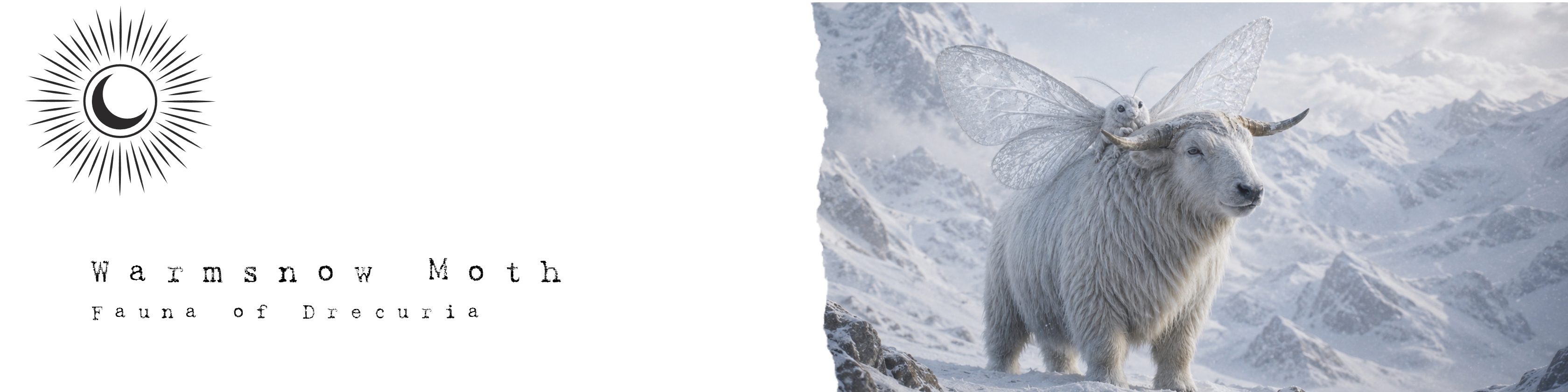
Warmsnow Moth
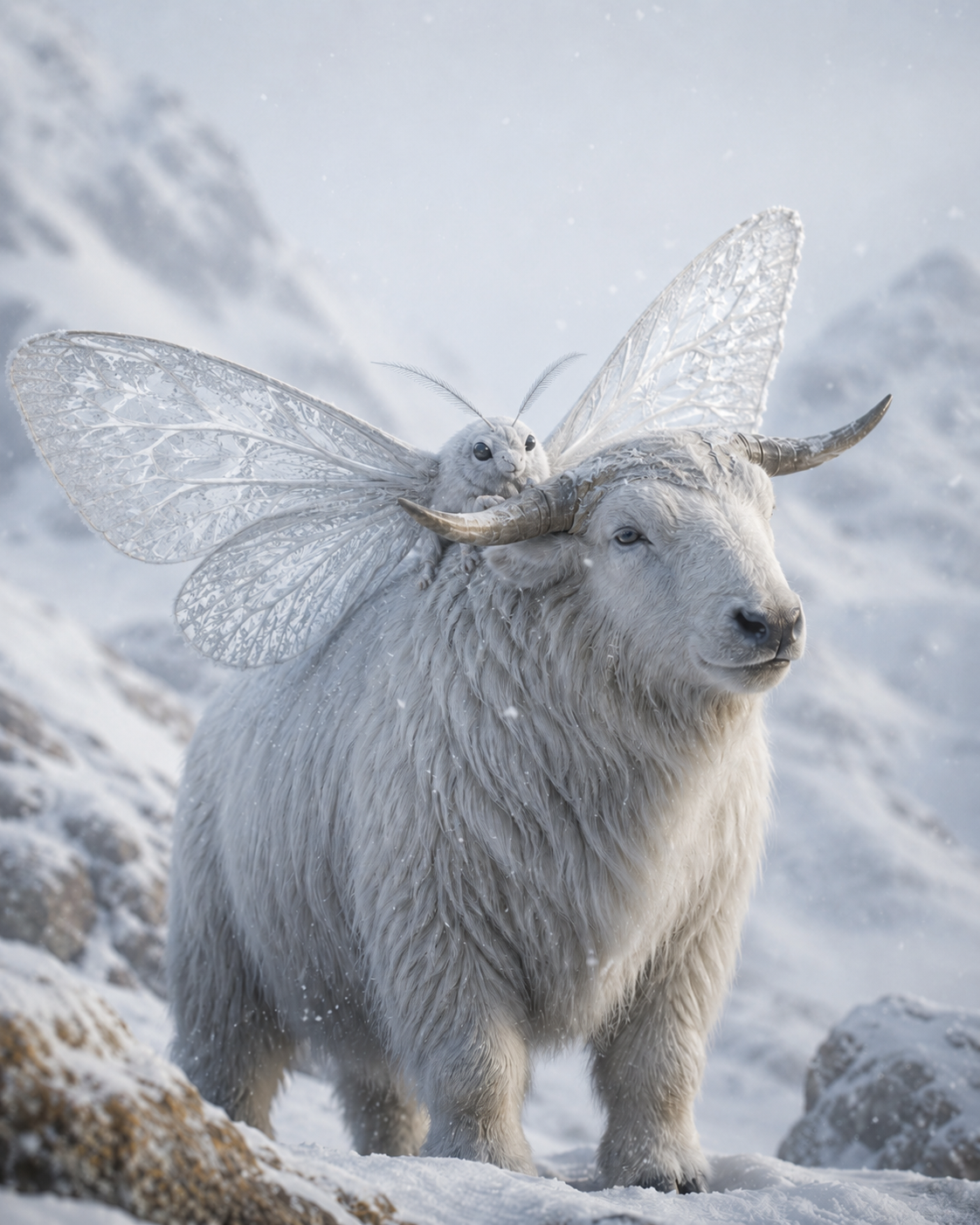
The Warmsnow Moth is a large Drecurian moth known for forming a singular symbiotic bond with one cold-climate animal. Once bonded, it spends much of its life resting across the shoulders or upper back of its host. Its broad, frost-patterned wings spread outward along either side of the animal, creating the striking illusion that the host possesses wings of its own.
Despite its icy appearance, the Warmsnow Moth produces a low, steady warmth from the underside of its body. This warmth helps protect the host during Drecuria’s harshest weather, while the animal provides the moth with shelter, nourishment, transportation, and protection from predators.
Appearance
Warmsnow Moths are considerably larger than ordinary moths, though their bodies remain light enough that they place little strain on their hosts. Their wings are usually pale white, silver, or faint blue, with translucent sections crossed by delicate veins resembling frost spreading over glass.
Common features include:
- A dense, silver-white body covered in insulating fur
- Broad wings shaped like frozen leaves or layered ice petals
- Frostlike markings unique to each individual
- Short, gripping legs suited for clinging to thick fur
- Fine antennae sensitive to movement, temperature, and changes in the host’s condition
When fully settled, the moth opens its wings across the host’s upper back. Through snowfall, fog, or blowing frost, the bonded pair may easily be mistaken for a single winged creature.
Habitat and Range
Warmsnow Moths are native to Drecuria and are most often found across open snowfields, frozen valleys, sheltered mountain passes, and the edges of icy forests. Their natural range overlaps with the migration paths and grazing territories of large, thick-furred animals.
Before bonding, the moths shelter inside caves, rocky crevices, hollow frost-covered trees, and abandoned dens. Although they can withstand Drecurian temperatures, unbonded moths are far more vulnerable to strong winds and prolonged storms.
After a bond forms, the moth’s range becomes tied to the movements of its host. Some pairs travel across wide portions of Drecuria, while others remain near a single valley, settlement, or grazing route for most of their lives.
Diet
A bonded Warmsnow Moth receives much of its nourishment from substances naturally found within the host’s coat. It feeds on shed skin, loose fur, natural oils, mineral deposits, and tiny parasites. It may also consume frost or moisture trapped between layers of dense fur.
This feeding behavior helps keep the host’s coat clean, dry, and well-aerated. By removing dead material and parasites, the moth reduces irritation and helps prevent minor skin conditions from worsening beneath the animal’s thick coat.
The moth occasionally leaves its host to feed on frozen sap, hardy lichen, or nectar from Drecurian cold-blooming plants. These excursions are usually brief, and the moth rarely travels far from its bonded animal.
Behavior
Warmsnow Moths are calm, patient creatures that conserve energy whenever possible. They spend long periods resting quietly against their hosts, shifting only to groom the animal, adjust their position, regulate warmth, or respond to danger.
During severe cold, the moth presses tightly against the shoulders and upper back while spreading its wings to retain heat around the host’s body. In milder weather, it may lift or partially fold its wings to prevent overheating.
Although normally gentle, the moth can defend itself and its host when threatened. A sharp beating of its wings releases a cloud of fine, frostlike scales that may temporarily obscure a predator’s vision, giving the pair time to flee.
Host Species
Warmsnow Moths typically choose medium or large Drecurian animals with broad shoulders, dense fur, and steady temperaments. Grazing animals are their most common hosts, though individual moths have occasionally bonded with large predators or domesticated working animals.
The choice appears to depend more on the individual animal than on its species. A moth may reject several suitable creatures before selecting one whose scent, temperament, and behavior feel compatible.
The host must also be willing to tolerate the moth’s presence. A nervous or aggressive animal is unlikely to maintain a bond, regardless of how physically suitable it may be.
Bond Formation
A Warmsnow Moth usually observes a potential host for several days before attempting contact. It may follow from nearby trees or rocks, or fly low, gradually drawing closer as it studies the animal’s behavior.
The moth’s first landings are brief. It may touch down along the back, remain for only a few moments, and then retreat. If the host stays calm, the moth returns and begins grooming a small patch of fur. It eventually releases a faint warmth against the animal’s skin, allowing the host to experience the benefit of its presence.
An unwilling host may shake, roll, or rub against trees and rocks to dislodge the moth. The Warmsnow Moth does not force the relationship and will leave if repeatedly rejected.
Once accepted, the moth learns the host’s scent, heartbeat, body temperature, and natural movement patterns. A complete bond may take several days or even weeks to establish.
Symbiotic Relationship
The relationship between the Warmsnow Moth and its host is mutually beneficial. The moth receives protection from Drecuria’s weather and predators, as well as food and transportation. The host receives additional warmth, grooming, parasite removal, and an attentive companion capable of detecting subtle physical changes.
The placement of the moth is especially important. Resting across the shoulders and upper back helps warm the host’s neck, chest, lungs, and major blood vessels. This does not make the animal immune to cold, but it improves its endurance during severe weather and reduces the risk of frost injury.
Neither creature controls the other. The bond is cooperative, and both remain capable of surviving independently for limited periods. Long-bonded pairs, however, may become deeply accustomed to one another.
Benefits to the Warmsnow Moth
The host acts as a moving shelter, protecting the moth from wind, heavy snow, and many predators. Its fur provides insulation and a secure resting place, while its movement carries the moth between feeding areas, breeding grounds, and protected valleys.
Bonding also allows the moth to conserve energy that would otherwise be spent on long-distance flights or constant searches for shelter. That preserved energy supports the heat-producing process that benefits the host.
An unbonded moth can survive on its own, but it is far more exposed to storms and usually has a shorter, more difficult life.
Benefits to the Host
- Steady warmth around the upper body
- Protection against frost injury during severe cold
- Removal of parasites, shed skin, and trapped moisture
- Improved coat condition
- Early warning of illness, exhaustion, or environmental danger
The moth may press warmth against an injured or chilled area, flutter repeatedly near the host’s head, or refuse to settle if it senses that the animal should stop moving. Drecurian herders and hunters often observe a moth’s behavior to assess the condition of a bonded animal.
Communication Between the Pair
Warmsnow Moths communicate through heat, vibration, touch, and wing movement. Rapid wing tremors may warn the host of danger, while a sudden increase in warmth can provide comfort or signal that the animal’s body temperature is dropping.
The moth may also tighten its grip or tap lightly against the host with its legs and antennae. Over time, the animal learns to interpret these small signals.
The host responds through posture, breathing, movement, and vocalization. Long-bonded pairs often develop their own recognizable communication patterns, making each relationship slightly different.
Reproduction and Life Cycle
Warmsnow Moths begin life in small nests built from moss, lichen, frost-resistant plant fibers, and shed animal fur. These nests are usually hidden inside caves, beneath tree roots, or within protected rocky hollows.
Their life cycle consists of:
- Egg
- Larval stage
- Cocoon stage
- Unbonded adult
- Bonded adult
Young moths feed on lichen, sap, and discarded fur. After emerging from their cocoons, they remain independent for a period while strengthening their wings and learning the surrounding territory.
Bonded adults temporarily leave their hosts during mating periods but generally return afterward. A moth may carry strands of its host’s shed fur to a nesting site, using them to insulate its eggs and young.
Separation or Loss of a Bond
Short separations are normal. A moth may leave to feed, mate, or avoid terrain that is temporarily unsuitable for it. Bonded pairs typically reunite without difficulty.
Long separation can cause distress. A moth may become restless, stop feeding properly, or attempt to follow the host’s trail. The animal may show agitation, reduced willingness to travel, or greater sensitivity to cold.
If either member of the pair dies, the survivor does not always form another bond. Some moths eventually choose a new host, particularly if the original relationship was brief. Others remain unbonded for the remainder of their lives.
Cultural Beliefs
Drecurians often view a bonded Warmsnow Moth and host as a symbol of trust, shared endurance, and quiet cooperation. The illusion of wings has given the pair an almost legendary presence in some regions.
A host carrying a moth may be described as having “earned its winter wings.” This does not imply that the animal is superior to an unbonded creature, but it suggests that the pair has found strength through mutual acceptance.
Drecurians generally avoid interfering with natural bonds. Attempting to force a moth onto an animal is considered both foolish and disrespectful.
Drecurian Folklore
One common tale claims that the first Warmsnow Moth found a young animal freezing alone during a blizzard. Too small to carry it and too fragile to fight the storm, the moth simply spread its wings over the animal and refused to leave.
By morning, the moth’s body had begun producing warmth, and the animal survived. The falling snow left permanent frost patterns across the moth’s wings, marking the bond that saved them both.
Another belief says that travelers who see a winged-looking creature emerge from a storm will find shelter before nightfall. Children are sometimes told that patient animals grow wings during Frostreign, though most eventually learn that those wings belong to a Warmsnow Moth.
Uses and Observation by Drecurians
Warmsnow Moths are not truly domesticated because they must choose their own hosts. Drecurians may raise animals in areas where the moths are common, but they cannot guarantee that a bond will form.
Naturally shed wing scales and body fur are sometimes collected for use in warming salves, cold-weather poultices, fur treatments, and insulated fabric. Only shed material is considered acceptable to gather. Removing scales from a living moth or capturing one for trade is widely condemned.
Herders and healers also observe bonded moths as indicators of animal health. Unusual wing movement, increased warmth, or repeated refusal to settle may reveal a problem before the host shows obvious symptoms.
Rarity and Conservation
Warmsnow Moths are uncommon, though not currently considered endangered. Their numbers are naturally limited by their slow development, selective bonding habits, and dependence on healthy host populations.
Their greatest threats are the decline in suitable animals, the destruction of nesting sites, illegal capture, and the trade in materials falsely claimed to be naturally shed. Unusually warm seasons may also disrupt their breeding and bonding behavior.
Many Drecurian communities protect known nesting grounds and discourage hunters from disturbing bonded animals. Removing a moth from its host is generally permitted only when one of the creatures is in immediate danger.
Common Misconceptions
Because the Warmsnow Moth blends so neatly with its host, it has been the subject of several misconceptions.
- The host does not possess natural wings.
- The moth cannot lift or carry the animal in flight.
- Only one moth bonds with a host at a time.
- The moth does not drink blood or weaken the animal.
- Its warmth cannot burn healthy skin.
- A host without a moth is not cursed, ill, or rejected by the ice deities.
The most common misunderstanding is that the moth and its host are one species. To an unfamiliar traveler watching through heavy snow, the illusion can be remarkably convincing.


Comments