

Rogue Homebrew Class
Rogues are resourceful specialists that master a versatile variety of skills, giving them a broad expertise that few others can match. They train themselves for combat by prioritising cunning over brute strength. A rogue in combat uses singular precise attacks to hurt their targets most, rather than wearing an opponent down with a barrage of attacks, and uses their almost supernatural reflexes to avoid dangers. A rogue’s strategic prowess is demonstrated by the cunning tactics they utilise to disrupt their opponents and expose their weaknesses. This repertoire of tricks and schemes allows rogues to rely on skill, stealth, and their foes’ vulnerabilities to get the upper hand in any situation.
Quick Build
You can make a rogue quickly by following these suggestions. First, Dexterity should be your highest ability score. Make Intelligence your next-highest score if you plan to take up the Arcane Trickster roguish archetype, otherwise choose either Intelligence, Wisdom, or Charisma as your next-highest scores to excel at various skills based on your character. Second, choose an origin that increases your Dexterity.
Sneak Attack
You know how to exploit a foe’s distractions and strike subtly. Once per round, you can deal an extra 2d6 damage to one creature you hit with an attack using a finesse weapon that lacks the heavy property, or a ranged weapon that lacks the heavy property.
This extra damage can only be added if you have not had disadvantage on the attack roll and have either advantage on the attack roll, or another enemy of the target is within 5 feet of it and isn’t incapacitated, stunned, or paralysed.
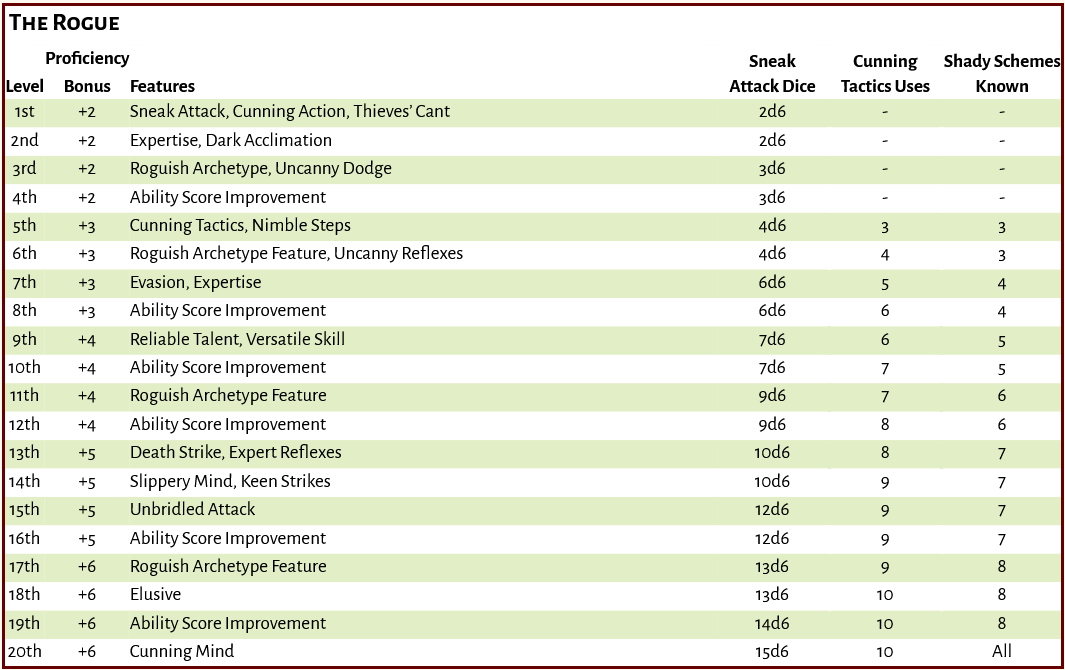
The amount of the extra damage increases as you gain levels in this class, as shown in the “Sneak Attack” column of the Rogue table.
Cunning Action
Your quick thinking and agility allows you to move and act quickly. You can take the Dash, Disengage, or Hide action as a bonus action. Additionally, you can use this bonus action to apply a poison or drink a potion.
Thieves’ Cant
You’ve learnt Thieves’ Cant, a secret language created with a mix of dialect, jargon, and code that allows you to hide messages in seemingly normal conversation. Only another creature that knows Thieves' Cant understands such messages but it takes three times longer to convey such a message than it does to speak the same idea plainly. This language also has a set of secret signs and symbols that thieves use to convey short simple messages, such as a dangerous area, the territory of a thieves’ guild, or a safe house for thieves on the run.
Learning this language has taught your mind to find other coded languages or secret messages hidden in plain sight. You have advantage on ability checks used to decipher or uncover signs of coded language in text or conversation, or even the hidden meanings of secret codes.
Expertise
Starting at 2nd level, choose two from your skills and tools that you are proficient in. Your proficiency bonus is doubled for any ability check you make that uses either of the chosen proficiencies.
At 7th level, you can choose two more of your proficiencies (in skills or tools) to gain this benefit.
Dark Acclimation
Beginning at 2nd level, your extended time traversing dark and shadowed environments have conditioned you. You gain Darkvision of 30 feet.
At 9th level, this Darkvision increases to 60 feet.
Roguish Archetype
At 3rd level, you choose an archetype that you emulate in the exercise of your rogue abilities from the list of available archetypes. Your archetype choice grants you features at 3rd level and then again at 6th, 11th, and 17th level.
Uncanny Dodge
Starting at 3rd level, you can use weird and uncanny movements to narrowly dodge the full brunt of attacks. When an attacker that you can see hits you with an attack roll, you can use your reaction to halve the attack’s damage against you.
Cunning Tactics
Starting at 5th level, your craftiness and wit improves, allowing you to utilise conniving strategies in combat. This wit is represented by your Cunning Tactics, which you expend to perform various tricks and features. When you complete a short or long rest, you regain all your expended Cunning Tactics. You gain additional Cunning Tactics when you reach higher levels in this class, as shown in the “Cunning Tactics Uses” column in the Rogue table.
You also gain three Shady Scheme options from a list of options. You gain Shady Scheme options when you reach higher levels in this class, as shown in the “Shady Schemes Known” column in the Rogue table. When you gain a level in this class, you can replace one Shady Scheme option you know with another option.
On your turn, you can perform a Cunning Tactic, which can either be one of the following options:
Additional Cunning Action
You can use a Cunning Tactic to take an additional bonus action on your turn, however you can only use this extra bonus action to use one of the options in your Cunning Action feature.
Shady Schemes
When you hit a creature with an attack and deal damage with your Sneak Attack feature, you can use a Cunning Tactic to perform one of your known Shady Scheme Options with the extra damage.
If a Shady Scheme forces a target to make a saving throw, the saving throw DC is calculated as follows:
Scheme DC = 8 + your Proficiency Bonus + Your Dexterity Modifier.
Swift Strike
Once on your turn, if you take the Attack action on your turn, you can use a Cunning Tactic to make an additional attack.
Nimble Steps
Starting at 5th level, your speed increases by 10 feet while you aren't wearing heavy armour.
When you reach 14th level, your speed increases by another 10 feet, to a total of 20 feet.
Uncanny Reflexes
Starting at 6th level, your heightened reflexes grant you the chance to dodge additional incoming attacks.
After you use your reaction to Uncanny Dodge, you gain a pool of d6s equal to half your Sneak Attack Dice (rounded down). Each time you are hit by an attack until the start of your next turn, roll the pool of remaining d6s. If any of the dice rolls a 5 or higher, you can use your Uncanny Dodge feature on that attack, allowing you to dodge that attack without expending a reaction. For each additional Uncanny Dodge you use with this pool, you reduce the remaining number of dice in the pool by one.
Evasion
Beginning at 7th level, you can nimbly dodge out of the way of certain area effects, such as a red dragon's fiery breath or an ice storm spell. When you are subjected to an effect that allows you to make a Dexterity saving throw to take only half damage, you instead take no damage if you succeed on the saving throw, and only half damage if you fail.
Expertise
At 7th level, you can choose two more of your proficiencies (in skills or with tools) to gain the benefit of Expertise.
Reliable Talent
Starting at 9th level, you have refined your chosen skills until they approach perfection. Whenever you make an ability check that lets you add your proficiency bonus, you can treat a d20 roll of 9 or lower as a 10.
Versatile Skill
Starting at 9th level, you’ve dabbled in other skills enough to become proficient in them. You gain proficiency in one skill and one tool of your choice.
Death Strike
Beginning at 13th level, you learn to strike with instant death. When you hit a target and deal damage with your sneak attack feature, if your damage reduces a creature to 25 or less hit points, the creature is instead reduced to 0 hit points.
When you reach higher levels in this class, your Death Strike hit point threshold increases. When you reach 15th level, you reduce a creature to 0 hit points if your damage reduces it to 30 hit points or less, 40 hit points or less at 17th level, and 50 hit points or less at 20th level.
Expert Reflexes
Starting at 13th level, the number you need to roll to use your Uncanny Reflexes is now 4 or above instead of 5.
Slippery Mind
Starting at 14th level, your tactical wit strengthens your mind. Whenever you end your turn with the Charmed or Frightened condition, you can expend one use of your Cunning Tactics to end the effect on yourself (no action required).
Keen Strikes
Starting at 14th level, your honed weapons improve your Sneak Attacks. When you roll the damage from your Sneak Attack, you can reroll any damage die that rolled a 1. You must take the new result on the rerolled die.
Unbridled Attack
Starting at 15th level, your ability to strike subtly and exploit distractions improves, allowing you to perform even in disadvantageous circumstances. Having disadvantage on an attack roll no longer prevents you from performing a Sneak Attack. You must still either have had advantage on the attack roll, or have another enemy of the target within 5 feet of it that isn’t incapacitated, stunned, or paralysed.
Elusive
Starting at 18th level, you are so evasive that you can gain the upper hand to avoid any effects that target you. If you fail a saving throw, you can choose to succeed it instead. You can choose to use this feature after you roll the d20 and the DM determines you fail the saving throw. Once you use this feature you can’t use this feature again until you finish a long rest.
Cunning Mind
Beginning at 20th level, you become a master of tactics and agility, granting you unerring accuracy and reflexes. You gain the following benefits:
- Perfect Reflexes: After you use your Uncanny Dodge feature, your uncanny reflexes allow you to Uncanny Dodge every attack that hits you until the start of your next turn.
- Reliable Avoidance: Whenever you make a saving throw that lets you add your proficiency bonus, you can treat a d20 roll of 9 or lower as a 10.
- Stroke of Luck: You have an uncanny knack for succeeding when you need to. When you make an ability check, or an attack with the Attack action, before you roll the die, you can choose to forgo the roll and treat the attack as if you rolled a 20 on the die. Once you use this feature, you can't use it again until you finish a short or long rest.
Rogue Features
As a Rogue, you gain the following class features:
Hit Points
Hit Dice: 1d8
Hit Points at 1st Level: 8 + your Constitution modifier
Hit Points at Higher Levels: 1d8 (or 5) + your Constitution modifier per Rogue level after 1st
Proficiencies
Armour: Light Armour
Weapons: Simple Weapons, Blowguns, Hand Crossbows, Net, Parlor Gun, Rapier, Scimitar, Shortswords, Whip
Tools: Thieves’ tools, one Gaming Set, Choose 1 from Tinker’s Tools, Disguise Kit, or Poisoner's Kit.
Saving Throws: Dexterity, Intelligence
Skills: Choose 5 from Acrobatics, Athletics, Deception, Insight, Intimidation, Investigation, Martial, Perception, Performance, Persuasion, Sleight of Hand, and Stealth.
Starting Equipment
Each character begins their journey with equipment to aid in their adventuring. Some classes will give you a choice between certain equipment, your options are shown with the letters (a), (b) etc. When given this choice, you can only take one option from the choices. Your character starts with the following items on them:
- (a) A shortsword or (b) A sling
- Two daggers
- Padded armour
- Thieves’ tools
- Burglar’s Pack
Link to Shady Scheme Options here.
Remove these ads. Join the Worldbuilders Guild

Comments