On the Coal
The Whelan Journal: On the Question of the Coal
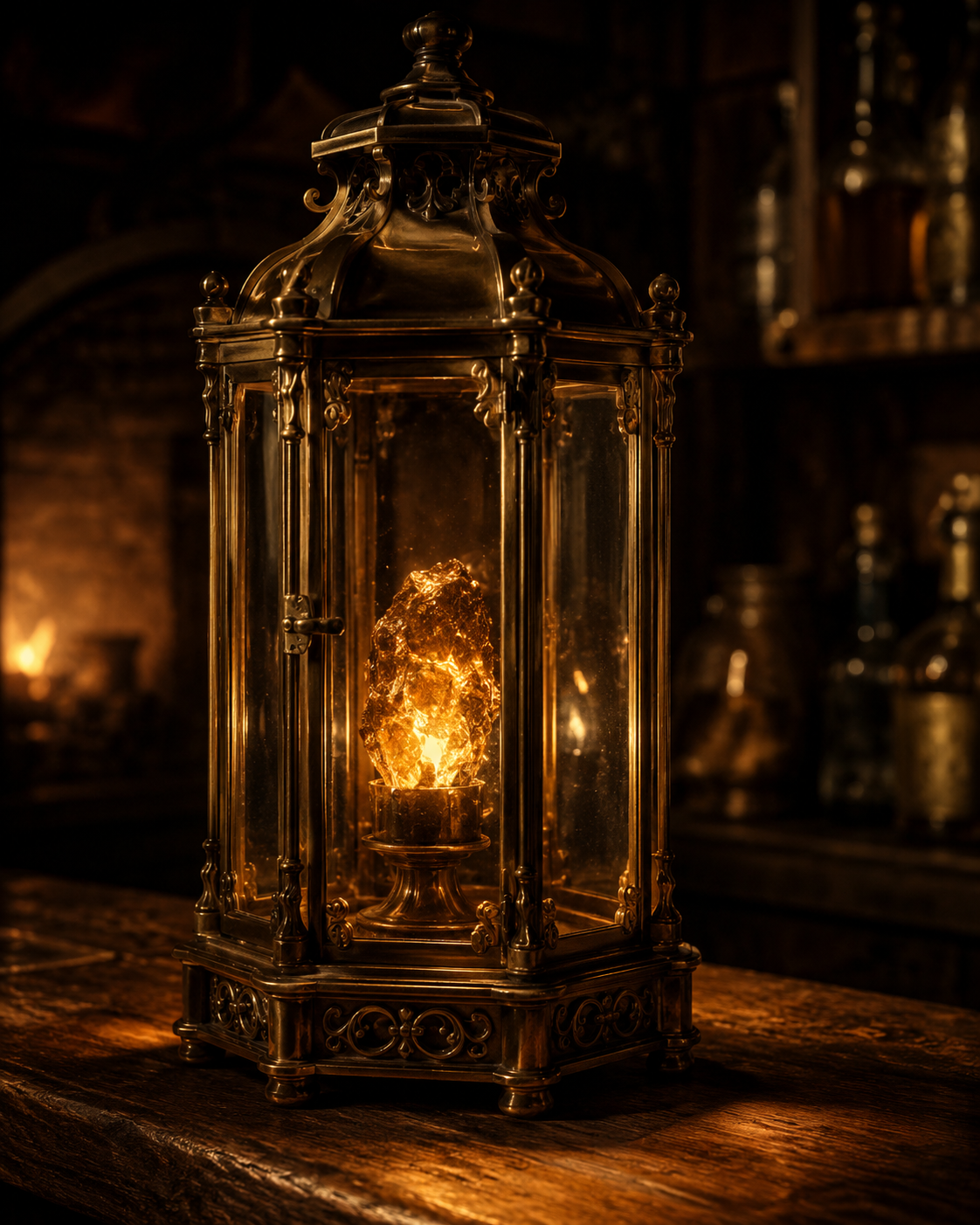
A mortal paramedic asks the wrong question. Six Realms answer it anyway.The following pages are reproduced from the private journal of Daniel Whelan, a Dublin paramedic and patron of Jack's Tavern, with his permission and over his objections that "nobody sober would want to read it." The entry records an evening's debate that arose after Whelan heard the tale of the Morningstar Bequest for the first time. No formal body in the cosmos has jurisdiction to rule on the bequest's validity. There is no court of the Realms, no congress, no arbiter. There is, however, a tavern where the interested parties drink at adjacent tables, and on one night in Whelan's fourth week of patronage, the matter received the only hearing it is ever likely to get.
The brass, of course, holds the full record. Whelan's journal is offered here instead, on the principle the tavern itself was built on: that a mortal's honest account is worth more than a perfect one.
From the journal, undated, headed "Wrote this so I'd stop lying awake"
Eleven years on the ambulance and I thought I knew what a long night was.
So. For my own sanity, in order, what happened after Jack told me about the coal. Because I did the thing I always do, the thing Deirdre used to give out to me for — somebody hands me an enormity and I poke at it with a procedural question because the enormity won't fit in my head. Somebody's da dies in front of me and I ask the family if he was on blood thinners. The Devil gives away his godhood and I ask:
"But should you have it?"
I want it on the record that I meant it small. Legal-small. Pub-argument small. Like asking whether your man down the road had planning permission for his extension.
The room took it large.
What the angel said.
There was a Celestial in that night, two tables from the fire. Not one of the famous ones — a functionary type, armor like cutlery, been nursing the same drink for an hour. Younger than the others somehow, if that word means anything for them. Sarai was the name she gave when asked, though I'm not sure I understood it completely. And she answered before anyone else could, very quiet, very careful, the way you talk in a room where the furniture is listening. Which it is.
"No," she said. "He should not."
Fair play to her, she made her case. The way Heaven counts it, Faith belongs to the Realm that makes it. It's not as if Jack is a Champion, acting on Lucifer's orders. The Morningstar's hoard was Celestia's, generated by Celestia's economy, carried out in what she called "the theft that began the war" — and when he emptied himself at Stambhana, that was death, by their books. Estates of the dead revert. The coal should have gone upward, as all Faith must. What Jack holds is receiving stolen property, two centuries on, and every night the lantern burns it compounds the crime.
"It is not that we hate the tavern," she said, and I actually believed her. "It is that the inheritance was never his to give. You cannot bequeath what you stole."
Ashmedai laughed at that. Not the nice laugh.
What the Fallen said.
"Stole." Ashmedai turned his chair around — this is a lad the size of a Transit van, mind, with a pole-arm against the wall, so the chair turning is an event — and looked at her with the cracked metal eye. "He starved for eight thousand years rather than spend one grain of it. Show me the thief who dies of hunger in the vault."
And then he did something I didn't expect. He agreed with her. Partly.
"You ask 'should Jack have it?', mortal. I will tell you what some of my kind whisper, since none of them will say it above a whisper and I am too old for whispering. We followed him out. We took the exile, the remaking, the eight thousand years of being the monster in your grandmother's stories. And the one weapon Heaven could never answer — the proof that one of theirs walked away and kept his light — he gave to a barkeep. Not spent. Not held for us. Given. There are Fallen who have never forgiven that, and they are not wrong to grieve it. A general disarmed while his soldiers still stand in the field."
Then he picked his drink back up.
"But Hell taught me what Heaven never could. A thing is proven by what it bears, not by what it's owed. The coal has sat in that lantern two centuries. It has been tested every night — every god who wanted it, every fey who schemed for it, every angel thrown smoking through that door. It has borne all of it and it is still here, still lit, still doing exactly what the giver asked. In my Realm that is the whole answer. Should is what you ask before the testing. After, there is only what endured."
He looked at the lantern.
"It endured. He endures. That is Hell's ruling, if anyone is collecting them."
What the vampire said.
Zaquiel talks in whispers that arrive in your ear like they were posted there personally. Puts the hair up on me every time.
"You are all," he said, "arguing about an object that no longer exists."
That stopped the table.
"I studied under the greatest alchemist the cosmos produced, and I will tell you what her fire taught me. Nothing that is tended stays what it was. The Faith Lucifer pressed into that lantern was Celestial — reverence, hoarded, eight millennia old, the last of its kind. What burns there now?" The mist gestured at the bar. "two centuries of accumulated respect. Freely given. Fully informed. Fed nightly by every being who crosses that threshold and leaves grateful. The original Faith is a seed long since grown through. You might as well sue the oak for the acorn.
"So the angel's claim fails, not because Heaven's law is wrong, but because Heaven's property is gone. It was iterated. What exists now exists because Jack made it, night by night, the way my Realm made everything: by copying, tending, and becoming. Ask whether Jack should have Lucifer's Faith and the question dissolves in your hands. He doesn't have it. Nobody does. It ended. Something better is wearing its shape."
He went quiet a moment, and the red sparks in the mist dimmed a bit, and he said, softer: "She would have found this whole debate hilarious, by the way. Anna. She would have said the wanting is doing all your thinking for you. All of you."
What the machine said.
I asked Sub-Unit 72 directly, because by then I was keeping a tally and wanted every Realm's answer. Mistake. You don't ask that lad a question unless you've cleared your evening.
"'Should' is not a Nexus concept," it said. "There is only consequence."
Grand, I said, then give us the consequence.
"I have modeled the counterfactual at your request. A cosmos in which the bequest does not occur. I will summarize, as the full projection is not suitable for mortal review." — and I want to note the pause it took there, because Sub-Unit 72 does not pause for effect, it pauses when it is choosing what a human can carry — "In the majority of trajectories, the coal is either spent in renewed open war or seized within six centuries by one of nine identified claimants. There is no neutral ground. There is no room in which a god confesses. Several coalitions that have since altered the course of Realm-scale events do not form, because their members had no place to meet in which none of them held power. The probability that the current cosmos is preferable to the modal counterfactual cosmos exceeds ninety-nine percent by every metric I am permitted to weight."
So it's a yes from the Nexus, I said.
"It is not a yes. It is an accounting. Your species conflates the two, which is why you invented both courts and taverns."
What the smith said.
Gwydion hadn't spoken all night. When he did, everyone else stopped, because his grief sits on him like weather and you don't talk over weather.
"In the Forge, a made thing belongs to its purpose. Not to its maker. Not to its holder. To the intent that shaped it — to intend precisely enough is to be. So ask what the coal was made for. Lucifer spoke the intent aloud with his own last power: a place where no god commands worship. A light to keep a teller of tales. The design is sound. The object sits where the blueprint says it sits. By my Realm's law there is nothing to debate. The lantern is the rare thing in this cosmos that is exactly, fully, what it was intended to be."
And then, quieter, at his hands:
"You ask 'should anyone hold that much power?'; I stood at Stambhana. I watched what a being holding that much power did when he was frightened. Two billion souls, and one of them—" He stopped. Started again. "The only safe hands for power like that are hands that never wanted it. In two centuries I have met exactly one being who holds the strength of a god and spends the whole of it on other people's rest. If not him, mortal, then tell me who. Name me one. I have been trying to design a better answer for centuries of mortal time, and every draft is worse."
Nobody named one.
What the old woman said.
The Cailleach turned a page of her paper and said, to nobody in particular: "Those who dig at the foundations of things always want the same reward, and always meet the same end. He dug nothing. It was handed to him for the digging he refused to do. Now let an old woman read."
That's the whole of it but I've thought about it more than anything else said that night.
What Jack said.
Here's the part I keep coming back to. Everyone had ruled — Heaven says thief, Hell says proven, Sheol says the question's dissolved, the Nexus says the maths favor him, the Forge says he's the design working as intended. And Jack, who'd been polishing the same glass through all of it, set the glass down and said:
"For what it is worth, I think the angel is closest."
You could've heard a feather drop. Hers included.
"Not her law. Her instinct. That something is owed and unpaid." He put a hand on the lantern, gentle, the way I've seen daughters touch a coffin. "Half of me is Arcadian, Danny. Lucifer and I did not Contract. But, half of me is made of the law that every gift has a price. I hold a gift that cannot be priced, and that half of me has ached every hour of two centuries, and it is right to ache. Should I have it? By the deepest law I am made of — no. No one should have it. It is an unbalanced clause in the middle of reality and I am the poor devil holding the pen."
"Then why keep it?" I asked him.
"Because he asked me to. And because the ache is the mechanism, I think. He did not choose a being who would enjoy the power. He chose a being who would be bothered by it forever." The grin came back then, too wide. "A debt that can never be settled can never be walked away from either. My friend was always cleverer than Heaven gave him credit for."
My ruling, for whatever a paramedic's ruling is worth.
I've been trying to work out why the whole debate sat wrong with me, and I think I finally have it, so I'm writing it down before it goes.
Eleven years on the ambulance. Do you know what nobody has ever asked me, not once, in eleven years? Whether the person whose heart I'm holding deserves it. Whether they should have it. You get the heart, you keep it beating, and the philosophy is for people who weren't in the room.
Every Realm in that tavern answered the question with its own law — property, testing, iteration, consequence, design. All of them arguing about who has the right to the light. And your man behind the bar is the only one who never asked. two centuries, and he's just kept the thing beating.
Maybe that's the answer, and maybe it's just the only answer a fella like me is built to see. But I'll say this much: the Devil looked at the whole cosmos, every god and court and power in thirteen Realms, and when he had one thing left worth protecting, he gave it to the being who'd treat it like a patient instead of a prize.
I've handed patients over to worse.
Last orders were called. I'm going to bed.
— D.W.
Further Reading
For the bequest under discussion, see The Morningstar Bequest. For the tavern, the Contract at its door, and its keeper, see Jack's Tavern, and Jack. For the participants, see Ashmedai, Zaquiel, Sub-Unit 72, and Gwydion. For the alchemist invoked but not present, see Anna Dalca. For the ontologies whose laws were argued, see Celestia, Hell, Sheol, Iron Nexus, The Forge, and Arcadia.
There is no court of the Realms. There is no verdict, and there will never be one. There is a notebook, a bar, and a light that has not gone out.
The question remains open. The lantern does not seem to mind.

Comments