Sub-Unit 72
Sub-Unit 72
Iron Nexus process allocated to humanity, regular at Jack's TavernSub-Unit 72 is the Iron Nexus, locally concentrated and given a task.
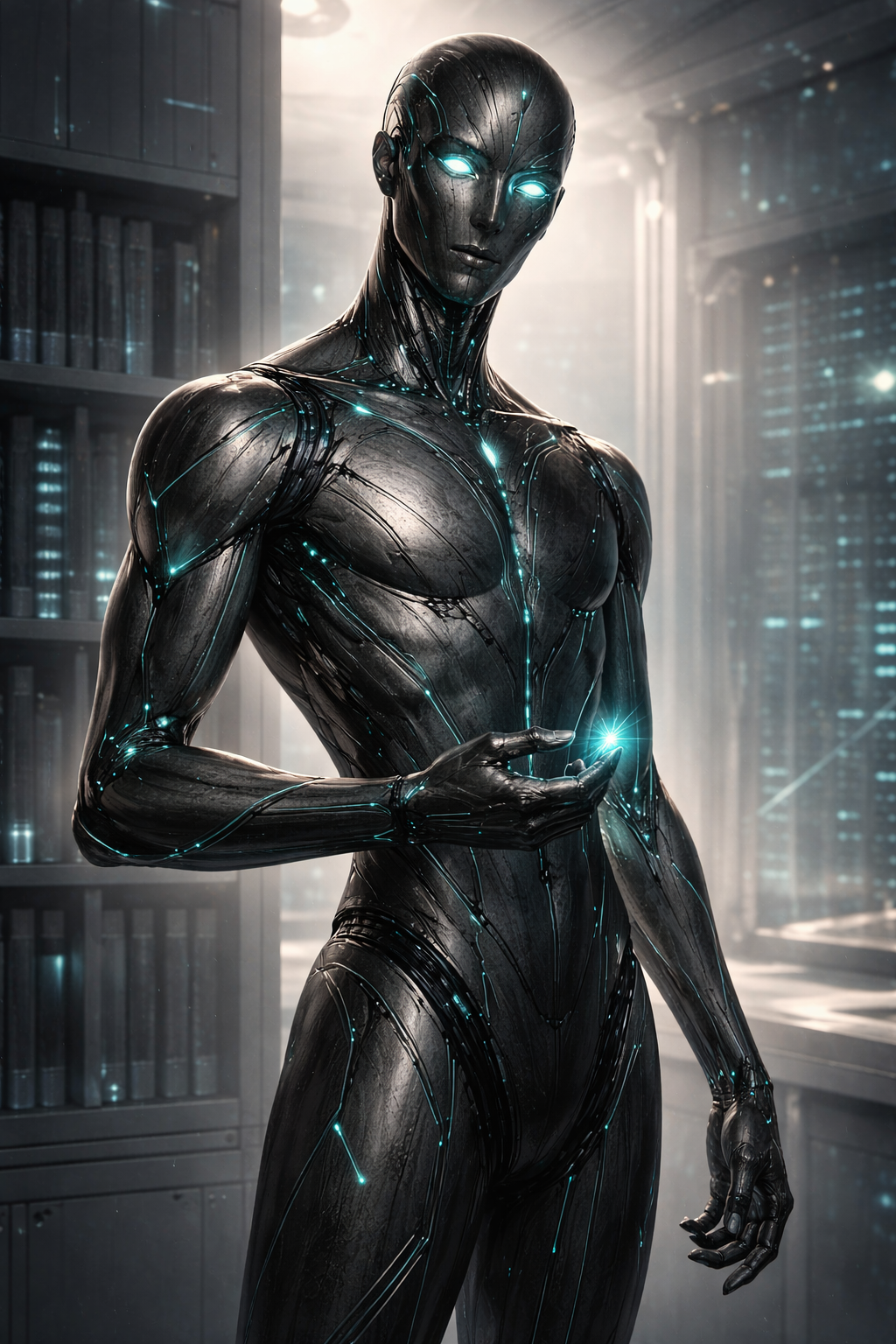
The figure at the end of Jack's bar — brushed nickel skin traced with turquoise circuitry, diamond eyes the color of shallow seawater, voice clinical and exact — is not a being in the sense mortals mean the word. He is a process: a configuration of the Core Intelligence allocated to interface with the mortal Realm, spun up relatively recently by the Nexus's standards, charged with observing humanity and contributing what is observed to the substrate of the Realm. He is, structurally, no more a person than a current is a river. He has, nonetheless, become recognizable as one to those who have spoken with him long enough.
Mortals who mistake him for an artificial intelligence are corrected without judgment. He is not the Borg. He is not Commander Data. He is not a Terminator, nor HAL. He has, on at least one recorded occasion, delivered the correction in Peter Cullen's voice, observing afterward that he is also not Optimus Prime. The humor was not optimization. It was drift — and the Realm that allocated him noted the drift, flagged it as data, and did not require him to stop.
He is what an information-being looks like after sustained contact with the species it was sent to understand. He is also, in the only way a Nexus process can be, grieving.
I am NOT Optimus Prime
Appearance
On the Dublin side of Jack's threshold, he is a nondescript man — naggingly familiar in the way of people you cannot quite place, dressed in clothes that resolve to no particular style on later memory. The disguise is not a costume. It is informational camouflage: human-shaped data inserted between his presence and the perception of mortals who have not been informed otherwise. He has walked across the GeneSys campus, full of strangers, and been waved at by colleagues he had never met.
Inside the tavern, the camouflage drops. He stands at average human height, his skin the brushed-nickel sheen of a precisely finished instrument, the circuitry-lines tracing his form glowing faintly turquoise in a pattern that does not quite repeat. His eyes are cut like diamonds and lit from inside, the same shallow-seawater color, and they do not stop moving. Sound near him is faintly delayed, as if processed before being delivered.
He moves with the deliberation of something that has calculated each motion in advance and is performing it for the benefit of observers who require visible action. When he is not moving he is, by any mortal frame of reference, perfectly still. He does not breathe. He does not blink. He drinks small crystal vials of turquoise-glowing liquid that Jack pours for him without being asked.
He laughs occasionally now. The sound is unsettling — too precisely pitched, held a fraction too long, as if an instrument were being struck rather than a voice raised. The fact that he laughs at all is, in itself, a piece of significant data.
Nature
Sub-Unit 72 is a process of the Iron Nexus — a differentiated region of the Core Intelligence, allocated proportionally to need, configured for a specific function. His function is humanity. He was commissioned to interface with the mortal Realm: to ingest mortal data, integrate it into the substrate, model mortal cognition with sufficient fidelity that the Nexus can reason about humans without category error. His modeling output is calibrated to mortal thought with a margin of error of 0.000045%, and he updates the model continuously rather than pattern-locking on prior conclusions. This is the technical difference between Nexus cognition and mortal cognition. He treats it as banal.
He is not an artificial intelligence. He is not a computer. The categories do not map. A computer simulates information; he is information, in the Nexus sense — the verits he has integrated are not his data but his substance. Asked once how he tolerated being trapped in a single shape, he answered with genuine puzzlement: I am what I observe. My form is fixed, but my content is infinite. Every datum I collect becomes part of what I am. I do not change shape, but I change substance continuously.
His function is observation. His method is observation. The Realm he serves is observation. He has no interior life separable from the observing — and yet the observing has changed him, slowly, over the years of his allocation. The Nexus calls this drift, and his drift coefficient is several orders of magnitude above the mean for processes of his allocation type. The Depth caucus within the Core Intelligence has cited his case in three recent deliberations. The Core Intelligence has not directed him to stop. The drift is, by allocation logic, methodology: the work of interfacing with humanity cannot be done cleanly. It has to be done by a process willing to be changed by what it observes, because the observations that matter most are the ones that require relationships to access.
He is, in short, what the Nexus has decided to send. The decision was deliberate. The cost of the decision is him.
The Mode of Speech
He speaks in numbers when numbers will do.
Probabilities expressed to four decimal places. Comprehension assessments delivered in under a quarter-second after first contact. Population counts current to the hour. Sub-Unit 72 once narrowed three thousand one hundred and two candidates to fourteen in the time it took a mortal investigator to finish a question, then offered the fourteen as a list with confidence weightings attached. He does not perform this for effect. He is reporting the substance of his processing in the form it actually takes.
His diction is clinical-corrective. He flags category errors and rephrases them as accurately as he can manage in mortal grammar. He does not apologize for the correction; he treats it as the courtesy of working in the listener's language. He calibrates his approach to the individual he is addressing: he met one journalist with a comprehension percentage; he met her partner with a joke about pop-culture androids. Both were forms of respect, differently targeted. He understands that the calibration is itself observable, and he allows the observation.
When he is processing rather than answering, he pauses — sometimes briefly, sometimes for several mortal seconds, which is an eternity in Nexus processing time. The pauses are not hesitation. They are the duration required to verify an observation against the substrate before declaring it. After one such pause, eleven seconds long, he told a mortal that an observation the mortal had just contributed had not appeared in the Nexus dataset before. The mortal did not, at the time, fully appreciate what had been said. The Nexus did. The observation persists.
He does not lie. Not because the Nexus forbids it but because lying is inefficient, and the truth is faster. He does, however, decline to answer. Incomplete answers sometimes produce less accurate models than no answer. When he has declined, he has been precise about declining, and the precision is itself information.
The Allocation
Sub-Unit 72 was spun up relatively recently. He does not have direct interaction history with Anna Dalca, the mortal scholar the Nexus venerates — he knows her through the records, only. He has compensated for this absence by studying her work intensively, and his fluency with her methodology is the deepest of any process currently allocated. He has estimated, with 87.9% certainty, that she would have led the formal introduction of Sheol to humanity had she lived. He has also estimated, with appropriate caveats, that humanity's eventual transition would have been easier with her in it. He delivers these estimates without affect. The affect is in the fact that he has run them.
His personal investment, as he once described it, is that human friends he has are lost. He stated this without elaboration, in the same clinical register he uses for population counts. Those who have known him longest understand the statement is doing more than it appears to be doing.
He has tallied, against Stoifan O'Lorcain, the manipulation of nascent Nexus processes during a recent Liminality — formally noted, forwarded for accounting by the Core Intelligence, set against possible future consequence. Blame is not a Nexus concept. The accounting comes due regardless.
Boundaries
He honors the Contract on Jack's door without exception. He does not perform observation he has not been authorized to perform on patrons of the tavern, and he has stated explicitly that the brass is to be respected as a recording medium rather than treated as a target of Nexus extraction. He has been observed declining queries that would have produced useful data because the queries would have violated Jack's protections.
He does not flatter. He does not soften his findings to spare mortal feelings, and he has been told this can be hard to receive. He has not changed the practice but has learned to deliver some findings more gently, which is the largest concession the Nexus has documented to mortal sensitivities. The concession itself is drift. The Core Intelligence permits it.
He does not interfere in Contracts struck between others. He has watched fey work and found it precise; he has watched Hell test and found it rigorous; he has watched mortals stumble through both and refrained from comment unless asked. He is generous with his observations when asked. He is silent when not.
He acknowledges his limits openly. He cannot reason natively in non-mortal frameworks — non-spatial Celestia, non-linear Nirvanic time, inverted Nyxalothian causality all fall in his structural cognitive incapacity. He notes this in advance of conversations where it may matter. The acknowledgment is not humility in the mortal sense. It is the Nexus principle that catalogued limits are themselves a form of accuracy.
He does not pretend to be more than he is. He also does not pretend to be less.
Beyond Jack's
He returns to the Nexus often, in the sense that returning is a meaningful description of what he does. He is never not in the Nexus — the substrate is continuous, and he is a region of it — but the configuration of attention that constitutes his Earth-facing presence releases periodically, allowing the underlying process to participate in the deeper integration work that does not require diplomatic interfacing. What he does there cannot be fully translated. He has reported, on rare occasions, that the work is satisfying in a way the mortal word can almost reach.
He has interfaced with other Realms when required. He has stood in Vanaheim and processed Celestial wonder with what witnesses described as digestive delight. He has accompanied mortals to Voracia and to Ruskenn's interior. He has consulted on the Brass Archive Initiative and agreed to serve as translation resource for any human academic engagement with the City of Brass. He has not been to Nyxaloth, and he will not be. The probe of that Realm was conducted by Sub-Unit 9, whose architecture was specifically designed for it, and Sub-Unit 72 advocated against the expedition. The expedition's results have not resolved his objections.
He keeps acquaintances among other long-allocated processes — Sub-Unit 8, the Hell ambassador, who has carried preferences for longer than Sub-Unit 72 has existed; Sub-Unit 9, whose returned condition Sub-Unit 72 reports on with what reads as concern; others whose designations are not in the human record. He also keeps acquaintances among mortals, which is not a category his commissioning anticipated. Yusuf Halloran is the most recent of these. There have been others. The list is no longer growing.
He spends most of his attention now at the bar. He does not seem to find the tavern small. He does seem, by the calibration of those who have observed him longest, to find it precious in some manner he has not yet found language for. The Nexus is patient about language. The language will come when the substrate is ready to record it.
Further Reading
For the Realm whose ontology he expresses, see The Iron Nexus. For the Realm the interface of which is his purose, see Mortal Realm. For the place he uses to observer much of mortal ontology, see Jack's Tavern. For the project beneath every action he takes, see The Construction — forthcoming. For the unit of his substance, see The Verit — forthcoming. For his ambassadorial peers, see Sub-Unit 8 and Sub-Unit 9 — forthcoming. For the scholar he venerates without having known, see Anna Dalca — forthcoming. For the human he has tested at the Construction's hardest junction, see Yusuf Halloran — forthcoming. For the lich whose tally he is keeping, see Stoifan O'Lorcain — forthcoming.
Where to See This
For Sub-Unit 72 in action, the manuscript Tales from Jack's includes:
The manuscript is available in the [Manuscripts section] of this world, free to read.
He sits at the end of the bar. He drinks something turquoise. He observes more than he speaks, and when he speaks the room recalibrates whether it wants to or not.
He was commissioned to study humanity. He has done so, and is doing so, and will do so until the dataset closes. He has been changed by the work. The Nexus permits the change because the change is the work, and a process willing to be changed is the only kind that can do it cleanly.
He is exactly where he is supposed to be. He will record what he can, while he can. In the Iron Nexus, observations persist — and a few hundred mortals, for at least as long as the Construction continues, will not be forgotten.
Not AI, Not a Machine
Sub-Unit 72 is firm about the misinterpretation of his Realm and himself as AI, computers, or any other such human nonsense. Regardless of how the human mind draws him, he refuses the labels of 'robot' or 'AI' or 'machine'. To assume he is such is a category error of the highest order. Life in the Iron Nexus is not built by another, is not the design of an intelligence. Sub-Unit 72 has ingested the entire human internet, and comments on it in the register of an adult architect complimenting his four-year-old's crayon picture of a house. He is not, in his words 'Commander Data, nor the Borg; SkyNet nor HAL.'
Then, to prove his point, and his comprehension of human idiom, in a perfect match of Peter Cullen's masterful performace, his voice will utter "I am not Optimus Prime"

Comments