

Githzerai
The githzerai were a humanoid race that dwelt primarily in the plane of Limbo. They descended from a splinter group of gith, a race that had been enslaved by mind flayers for centuries until they rebelled for their freedom. Philosophical differences led to a long and bloody civil war among the gith, who ended up divided into the militaristic githyanki and the ascetic githzerai.
 -"Zaerith Menyar-Ag-Gith, the Great Githzerai."
The disagreement led to a violent civil war. Zerthimon was killed and his followers, who called themselves "githzerai" (meaning "those who spurn Gith" in the Gith language), led by Menyar-Ag, retreated to Limbo in defeat. The fighting dealt substantial damage to Gith's forces, which had to retreat to the Astral Plane to regroup. This struggle gave sufficient time for the surviving mind flayers to retreat and hide in well-defended underground locations.
-"Zaerith Menyar-Ag-Gith, the Great Githzerai."
The disagreement led to a violent civil war. Zerthimon was killed and his followers, who called themselves "githzerai" (meaning "those who spurn Gith" in the Gith language), led by Menyar-Ag, retreated to Limbo in defeat. The fighting dealt substantial damage to Gith's forces, which had to retreat to the Astral Plane to regroup. This struggle gave sufficient time for the surviving mind flayers to retreat and hide in well-defended underground locations.
“Better the heartfelt devotion of a free soul than the grudging obedience of a slave.” — Common githzerai sayingHistory: The githzerai descended from the same race as the githyanki, a race which some referred to as "the forerunners" and whose exact origin, and even its name, was lost to time. Some sources claimed that they were originally humans from a world called Pharagos, located in an unknown crystal sphere that had been conquered by the illithids during the expansion of their empire, and who had been slowly altered by the mind flayers' genetic experiments, while others claimed that they might have been created by the illithids themselves through mixing humanoid hosts with powers from the Far Realm. After centuries of servitude, the forerunners revolted under the guidance of their leader Gith, conquering their freedom and spreading unprecedented devastation through the illithid empire, bringing the mind flayers to the brink of extinction. However, Gith ordered the continuation of the war effort until the last mind flayer was destroyed and the Gith became masters of their own empire based on conquest. At this point, Zerthimon, a gith who had gathered a significant following during the uprising, challenged Gith's leadership and her motives, arguing that she would end up leading the people into a similar tyranny that their former masters enforced. Zerthimon maintained that the mind flayers had already been defeated beyond recovery and that it was time for the fighting to stop and for the newly freed gith to learn about themselves and to improve as a culture, strengthening their unity and wisdom as a people, not to start another cycle of violence.
Culture
Major language groups and dialects
The githzerai spoke their own dialect of the Gith language, which used a unique form of writing called tir'su. It was an alphabetical set of runes in which words were formed in circles instead of linearly, with the letters of a given word being linked in a ring counterclockwise from the bottom. Sentences were formed by a series of these rings.
Culture and cultural heritage
Since their hard-won victory against the mind flayers, followed by their dissent and defeat at the hands of the githyanki, the githzerai became ascetics and philosophers, pursuing self-knowledge in the face of adversity. As a splinter group of an oppressed race, they were extremely distrustful of outsiders and were devoted to their self-preservation.
An intense and sometimes fanatical people, the githzerai kept the memory of their origins always alive and carried out all their affairs with a burning sense of righteousness.
“Githzerai come in two types: hardheaded, and stubborn.” — Marivus QuinceThe somewhat imposing fervor for Zerthimon was instilled by the Great Menyar-Ag who after shepherding the Githzerai to Limbo was bestowed enhanced psionic gifts which he believed were a gift from Zerthimon to aid in the survival of his people. Menyar-Ag discovered a way to share this gift with others through great discipline and training, marking the first sages, who would later be known as Anarchs. Menyar-Ag and his sages erected a single great city that would be deemed Zerthimons Cradle. Realizing the mental focus and sheer psionic powers needed to maintain the chaos matter, the caste system was erected to assign roles to each of the Githzerai people. The caste structured the society to be groomed for psionic potential from birth to train only the most worthy to be the next Anarch. Believing that these psionic enhancements were gifts from Zerthimon, it became common knowledge that the more power you possess the closer you are to achieving Zerthimons goals. Menyar-Ag then prophesized that Zerthimon had gifted them their enhancements as tools to work toward a greater future. A future that Zerthimon would be fit to return to. Upon his return, he would usher in a golden age for the Githzerai people and they would finally prosper. While there were no unnecessary roles in Zerai society, low castes were motivated to ascend closer to their god so that they may be rewarded upon his return. The greater an individual's self-improvement is, the greater everyone's improvement is. After several centuries Menyar-Ag's power grew so great that he had ascended beyond death. Instead, he chose to reside in a state of stasis expanding his mind across the planes. He would only awaken upon the return of Zerthimon where he and his illustrious Zerths would open the gates and welcome Zerthimons return. Upon falling into his hibernation, the Great Cradle of Zerthimon split into three different cities each maintained by their own Anarch, only returning once every season for a brief communion before the conglomeration becomes too much for the Anarchs and the cities split once more.
Shared customary codes and values
As a result of their long period of enslavement and manipulation by the mind flayers, all githzerai possessed psionic abilities. They were all capable of minor telekinesis in a similar fashion to the mage hand spell and could also hone their abilities to become capable of innately casting shields and detecting thoughts.
The Githzerai exude a conservative lifestyle as opposed to their Githyanki cousins. While highly xenophobic and untrusting of those outside of their religious order, they are not beyond seeing the uses of foreign cultures when either their goals align or the opposition can be manipulated. Githzerai in their entirety stay the course and remain in Limbo in a constant war between themselves and survival. Few depart, traveling across the planes pursuing special tasks assigned by the prophet Menyar-Ag himself. Even less stray off course entirely, seeking their own path in life and abandoning the ways of Zerth. These are known as Xoh'xil, the casteless, exiles who have abandoned the culture and disgraced the Zerai people.
Among the Githzerai exists the Gormeel a stout Slaad off-shoot that is attracted to the order Githzerai society presents. The Gormeel serve as staunch protectors and vicious warriors for the Zerai and are tolerant of their zealous religion. As functional members of Githzerai society, they can often be seen in Karnith hunting groups or roaming the streets as vendors, trading things from beyond the security of the Citadels for odds and ends.
Average technological level
Githzerai society was monastic and introspective. Many githzerai trained as monks, while others chose to lose their natural magic resistance and become wizards. Some multi-talented githzerai became Zerths, blending magic, combat, and psionics into their fighting. The Zerths also held special significance as religious leaders in githzerai society. Like their cousins and enemies, the githyanki, and githzerai often formed hunting bands to seek out and destroy the hated illithids.
They were fiercely loyal to their leader Zaerith Menyar-Ag-Gith, who remained alive centuries after he had led the surviving githzerai to Limbo following the battle between Gith and Zerthimon. Despite their strong sense of loyalty, the githzerai also placed immense value on their personal freedom.
 - "Githzerai stronghold in Limbo."
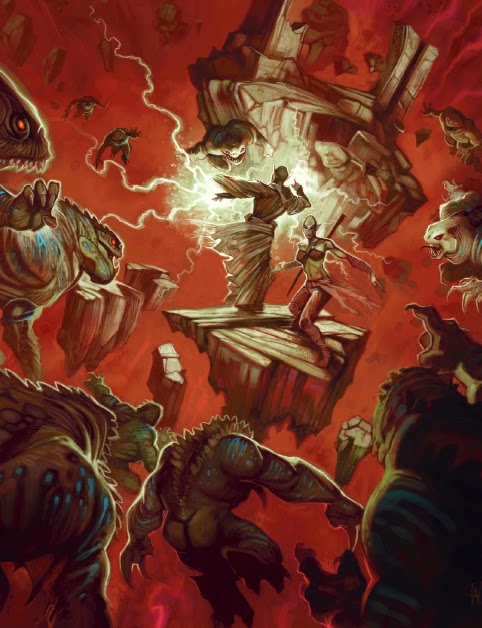
The githzerai dwelt mostly in the chaos of Limbo. There, they used their natural psionic abilities and mental focus to channel the power of the Spawning Stone to control the swirling chaos of the plane, shaping it into great adamantine fortresses and monasteries. Those fortresses, and the ones established outside of Limbo, were maintained by extremely powerful githzerai known as anarchs, who were capable of mentally manipulating the raw material of Limbo into whatever form and landscape they desired. This power extended for a distance of up to 5 miles (8 kilometers) around the Anarch.
Githzerai's presence in Limbo was not confined to fortresses but also included cities. Although city inhabitants did not follow the strict martial discipline enforced in monasteries, they revered and respected the martial discipline of their brethren. Their largest city there was called Shra'kt'lor, an austere fortress city that served as both the capital of the githzerai civilization and its military headquarters. Shra'kt'lor's fortifications were coordinated by Menyar-Ag himself, who dwelt in the center of the city and was considered akin to a deity.
The githzerai kept several outposts in the Underdark, in particular in the region of Old Shanatar, from where they observed githyanki and mind flayer activity. One particularly large fortress was the secret hold of Karokrath, from which they observed activities in Oryndoll and in the githyanki enclave of Gatchorof.
There were also a number of githzerai settlements located in the Elemental Chaos, according to the World Axis cosmology. The largest such city/monastery was called Zerth'Ad'lun, an oasis of peace among the plane's chaos. The city consisted of an enormous spherical arrangement of stone spires that made use of the subjective gravity of the plane to create a complex and nontrivial internal architecture. It contained numerous temples dedicated to several deities, including Corellon, Moradin, and the Raven Queen. The monastery's headmaster, Sensei Bertholomais, taught a martial art called zerthi, which granted its practitioners the ability to briefly glimpse into the future during a battle. These teachings were open to non-githzerai as well. Practitioners of zerthi were known as cenobites.
They also kept a strong fortress and numerous monasteries in Warrior's Rest, where they improved their battle strategies.
- "Githzerai stronghold in Limbo."
The githzerai dwelt mostly in the chaos of Limbo. There, they used their natural psionic abilities and mental focus to channel the power of the Spawning Stone to control the swirling chaos of the plane, shaping it into great adamantine fortresses and monasteries. Those fortresses, and the ones established outside of Limbo, were maintained by extremely powerful githzerai known as anarchs, who were capable of mentally manipulating the raw material of Limbo into whatever form and landscape they desired. This power extended for a distance of up to 5 miles (8 kilometers) around the Anarch.
Githzerai's presence in Limbo was not confined to fortresses but also included cities. Although city inhabitants did not follow the strict martial discipline enforced in monasteries, they revered and respected the martial discipline of their brethren. Their largest city there was called Shra'kt'lor, an austere fortress city that served as both the capital of the githzerai civilization and its military headquarters. Shra'kt'lor's fortifications were coordinated by Menyar-Ag himself, who dwelt in the center of the city and was considered akin to a deity.
The githzerai kept several outposts in the Underdark, in particular in the region of Old Shanatar, from where they observed githyanki and mind flayer activity. One particularly large fortress was the secret hold of Karokrath, from which they observed activities in Oryndoll and in the githyanki enclave of Gatchorof.
There were also a number of githzerai settlements located in the Elemental Chaos, according to the World Axis cosmology. The largest such city/monastery was called Zerth'Ad'lun, an oasis of peace among the plane's chaos. The city consisted of an enormous spherical arrangement of stone spires that made use of the subjective gravity of the plane to create a complex and nontrivial internal architecture. It contained numerous temples dedicated to several deities, including Corellon, Moradin, and the Raven Queen. The monastery's headmaster, Sensei Bertholomais, taught a martial art called zerthi, which granted its practitioners the ability to briefly glimpse into the future during a battle. These teachings were open to non-githzerai as well. Practitioners of zerthi were known as cenobites.
They also kept a strong fortress and numerous monasteries in Warrior's Rest, where they improved their battle strategies.
Common Etiquette rules
Despite the Githzerai's segregated caste system, inequality was discouraged as it presented individuality. Given Githzerai's circumstances, they could not afford separation or infighting, so they decided to work together. All Gith were presented as equals despite their caste, the caste of an individual was to represent their roles throughout society, no role is any less than another in the eyes of other Gith, as if one caste failed, the entire economy would fall and the Githzerai people would cease to exist. The elevation of caste only saw the Gith elevating their prestige with their god Zerthimon. As the Zerthimon sought to reward those most devoted to his teachings and bestowed great power to his most rigorous and disciplined apostles. The caste system is meant to represent the importance of each task and subsequently their attunement with Zerthimon. With the caste system going from bottom to top, those at the top are considered to be the closest to Zerthimons light, those who bask in his light upon his return will be lords upon his prophesized return, and the Golden Age that will follow. The farther one strays from the light the easier they are to be forgotten by Zerthimon. Regardless of zeal or power, each caste respects one another equally as they all make up the foundation of Gith society. Each member of a caste wears their title proudly despite their respective grievances.
To represent this, the Githzerai spoke of themselves in the third person and only took a family name at birth. Individual names were earned through trials and achievements. Upon receiving a name, a Ck'hass could not refer to themselves by this given name, but others would use it to identify them in conversation. Only Zerth reserved the right to use their name, but only in the third person. First-person pronouns were only admitted to those who have such great achievements that everyone intrinsically knew who was speaking. First-person pronouns were reserved for Q'teth and higher as typically those of the higher caste have achievements so great that few in Gith society are unfamiliar with their name.
Common Dress code
An austere and frugal people, githzerai usually favored practical and unadorned clothing, with at most some simple jewelry. Clothing for men and women alike was often neutral in color and tone. Most were equipped with some fashion of robes or dress. Higher quality jewelry and colors were reserved for those of higher caste. Clothing of Zerths and Enlightened was usually composed of high-quality silks and adamantine bracers or amulets opposed to the weave jewelry and simple cottons of Phisks or Ck'hass.
Art & Architecture
Githzerai boasts few pieces of art as recreation is seldom encouraged and individuality is scorned. Art is most commonly seen in monasteries and is displayed as a form of worship and storytelling. Most art found within monasteries are adamantine statues that have been erected of Zerthimon in honor of his sacrifice and in light of his return. Many other distinguished art pieces depict the civil war between Mother Gith and Zerthimon, or the liberation of the Gith people from the illithid clutches. Most art pieces come in the form of tomes with deep inscriptions and detailed moldings. Many of which look strange and undecipherable to an untrained eye. Within the monastery libraries lie a plethora of foreign art and history dedicated to a slew of different races and deities. Within the realm of Limbo, these items appear augmented and stretched, rendering much of this art meaning purely in the eye of the beholder. Regardless of this fact, the art serves as a means for Githzerai to study alternative species throughout the multiverse.
Art to the Githzerai is best demonstrated through their architecture as the Alok weave chaotic matter into numerous different forms in order to erect the massive citadels the Githzerai call home. Many of these citadels and homes are formed with the Stoney aesthetic of Adamantine which gives their cities a very neutral look, much of their architecture is sharp and cubical, lacking any bluster or beauty whatsoever. As it goes for the terrain, many Gith citadels are decorated with verdant green grasses and mountainous landscapes lined with trees. Due to the lack of natural sunlight in the plane of Limbo, these citadels are drowned by dark grey lighting that makes even the most scenic of sights drab. It is in their art, their simple practical nature as a species shines the brightest, underlined by the small spark of subtle beauty washed away by the dim light.
Foods & Cuisine
Residents of the ever-changing plane of Limbo have access to a plethora of dining options, sometimes even exotic. Hunting and farming are the primary suppliers of food within Zerai society. The shifting of chaos matter makes food plentiful within Limbo, but often unreliable and even dangerous. A moment may supply a chunk of rock with a flourishing fruit tree ripe to be harvested for sustenance and as the fruit is brought to bear the wrath of your hungering maw it is transmuted into specks of dust destined to be flushed away by the wind. This is why food is seldom harvested within Limbo, alternatively, each of the three great cities has been equipped with a luminous garden that pierces through the dreary gray of Limbo, these are know as the High Gardens. The High Gardens are designed and overseen by select members of the Phisk caste that Zerths choose to tend to and maintain the gardens. This elite group of Phisks are highly respected as a group, but weak as individuals. The gardeners must maintain a constant unity of the mind, much like a hive, to sustain the stability of the gardens. This concentration often strips the peaceful gardeners of individuality or emotion. Each garden is designed to perfectly pair during the cities joining. Once every season the three great cities merge for a major communion, in such event each of the three gardens joins together to form the center of the merging, known as Zerthimon's cradle. The garden then becomes the meeting and trading grounds between the cities. This super garden is referred to as Zerthimon's clutch. From these gardens, the fruits and vegetables are produced through the will of the gardener's mind. From the harvest, meals are prepared and served in communal dining halls within the cities.
As for the meat content, Githzerai were not picky, nor could they afford to be. The Githzerai among their Gormeel allies would depart in hunting parties known as the Karnith into the void of Limbo. These Karnith would often venture the expanse of Limbo under the guidance of Lillend travellers searching for rogue animals and foreign creatures to hunt. These creatures were most often spawn of the void and would often be difficult to track due to the lack of Constance within the realm. In the instance that Slaad or Khaastas opposed Githzerai, the Zerai would decisively eliminate their opponent taking their hide and meat back to their respective strongholds. Lillend guides were often used to navigate unfamiliar terrains of Limbo or simply to provide protection. These guides, while willing, often came with a price. Many of these Lillend ventured for different rewards often immaterial, such as a secret, ancient history, art, or even song. Many would even barter their skills for a piece of rare Galk fruit from the Galk tree that was erected once every season with the unification of Zerthimon's cradle. These Karnith hunters would supply meats for the cooks of their strongholds to prepare with the vegetables from the garden.
Common Customs, traditions and rituals
Many githzerai, following their monastic lifestyle, tended to train in martial combat and fought as monks. Githzerai monks who most closely followed the teachings of Zerthimon were known as Zerths. Through intense training and meditation, Zerths had access to many psionic powers, such as the ability to innately reproduce effects similar to the feather fall, phantasmal killer, plane shift, and 'see invisibility' spells. Particularly advanced Zerths reached the rank of "enlightened", acquiring the ability to explore the nature of reality itself. Enlightened githzerai could use their psionic abilities to produce additional effects similar to blur, expeditious retreat, haste, and teleport.
Zerths and the enlightened Q'teth were placed near the top of the Githzerai caste system. The Githzerai have used this caste system since the birth of their presence in Limbo. With religions acting as the roots of Githzerai society in an inhospitable plane with limited resources, the caste system acts as a formula for self-improvement and resource management. The caste system gives everyone a job and task that contributes to Gith society.
Each individual is born into the lowest caste which upholds the basic maintenance of society, supplying food, skills, and trade. Those of the lowest caste are known as Phisk's. Those born into the caste are not destined to remain forever as they are trained to hone in on their psionic aptitudes and sharpen their combative skills in order to pass their Phisk trials.
Upon completing the Phisk trials one is elevated to a Ck'hass, the lower class of Githzerai society. Those who fail their trials are either eaten by the void of Limbo or bound to the Phisk caste for eternity. Those who are successful in their trials are considered worthy of Zerthimons light and are adopted into his circle as disciples. Here the Ck'hass are trained, educated, and challenged to achieve their greatest selves. Ck'hass are groomed from their earliest stages to assume the rank of Anarch, but most of them do not make it.
All Ck'hass eventually inherit the philosophies of Zerthimon and ascend to the Zerth caste through rigid study and great mental trials. Few disciples ascend past the Zerth caste as transcendence requires great mental talent often near impossible feats.
Only those with the strongest of wills and greatest of minds are capable of ascending to the Q'teth caste, overseers of Monasteries of Zerthimon and explorers of reality itself. Q'teth are enlightened beyond the realms and are considered as close to their deities Menyar-Ag and Zerthimon as any non-anarch could be. It is said that their power is so great they can feel the presence of Zerthimon as he watches over the Githzerai people.
Beyond the power of the Q'teth are the See'hr's the true upper caste. The See'hr's have accessed information from between space and time and have subsequently gained the ability to foresee the future. See'hr's among the Alok are the most revered and crucial castes in the Githzerai society as they foresee the constant changes of Limbo and its inhabitants and work with the Alok, the highest caste achievable, to instill law and Constance into the realm of chaos. Alok are the Anarchs of the Githzerai society, only three Anarchs may exist at one time. They are the rarest of Githzerai and they use their power to stabilize and manipulate the plane itself to forge the great Adamantine Citadels that harbor Githzerai life and economy. Each individual of the next generation strives to achieve the great power of an Alok, all are conditioned, but few are suited.
Birth & Baptismal Rites
The Githzerai people, unlike their Githyanki cousins, are born in individual households with familial ties. The Zerai suppress individuality in its young and designate its people into a caste system. Each Yank is born within a hatchery forged within a family home, forming deep bonds with their kin. Yanks are all hatched into the lowest caste, known as the Phisk which translates to laborer/contributor. Newborn Yanks remain in their acid pools for their first year until their limbs develop and they inherit the skills to walk and train. Yanks are educated and trialed in Zerth Monasteries across the three great cities of Limbo.
Coming of Age Rites

Funerary and Memorial customs
Unlike in the Astral plane, death was far more common and uniform in Limbo. However in Limbo, death was not the end, but a mere beginning. For the Gith, everything in Limbo is trying to kill them, whether it be Slaadi or a mere unpredictable shift in the realm itself. A majority of Gith die during their Phisk trials where they are challenged by Slaadi and the terrors of the natural terrain.
Upon falling outside the security of a Zerth city or citadel one's soul becomes forfeit to the realm, the plane itself will absorb the soul and decimate the body of a fallen Gith in moments. Occasionally a soul or collection of spirits strong enough to endure the elements will harness the raw energy of Limbo to manifest itself into a chaotic elemental whose mind and will are bound by the plane's miasma. The plane itself was not the only threat present within the magical sphere, creatures known as the Khaastas had evolved much like the Slaadi to the inhospitable plane to venture and raid Limbo's inhabitants. Unlike the Gith and Slaadi, the Khaastas nim wits drove them to seek constant contention with the neighboring species of Limbo, including the celestial Lillends which were feared by most. Similarly, the Githzerai and Slaadi often opposed one another, while sentient, the Slaadi were prone to violence and often assaulted Phisks on their trials. Phisks attacked during their trials were often infected by the Slaadi's reproductive tadpoles. These tadpoles would fester and grow within a Gith and mangle its body spawning a new Slaad. Allowing for this process to take hold was considered taboo by the Githzerai and Phisks were armed with a poison that would kill the tadpole within them and potentially themselves if they proved too weak to endure the toxins. Most Gith would consider their deaths before submitting to the chaotic fiendishness of a Slaad.
Those who ascend their caste and settle into the monastic life of a Monk or Zerth live long enough to see their death come of natural causes. Others die in the pursuit of knowledge or the spread of the Zerthimon Circle. These are deaths that have been recognized by Zerthimon's gaze and upon the falling of a disciple the spirit on an individual and its psionic powers are guided and absorbed by Menyar-Ag, presumably delivering them to a great heaven.
Common Taboos
Relations between Githzerai and foreigners were strenuous at best. The Zerai lead reclusive and fairly content lives on Limbo and external intervention of any degree was met with hostility. As people of zeal and deep rituals any object that opposes their views or ways of life was taboo and purged. While their history with the Githyanki and Illithid left stale tastes in their mouth that would cause them to immediately attack on sight, individuality posed the greatest threat to Githzerai society. Their entire society was structured to perfection for survival. Everyone had a significant role that had to be played out in order for their society to function, if even one cog gets rusty or falls out of place everything else ceases to exist. In Githzerai society everyone must remain equal and play their part, for survival and eventual enlightenment to occur. For this reason, defection, rebellion, or even refusal to participate in society lead to immediate extinguishment, an execution delivered by the plane of Limbo itself. If individuality were allowed to be made manifest, superiority and then infighting would take its course causing the death of the entire Githzerai culture. This is why exposure to other races is limited to very few and most encounters with Githzerai lead to hostility or negligence.
Common Myths and Legends
In an effort to replicate the bond between the githyanki and red dragons, a group of githzerai once attempted to forge a similar alliance with chaos dragons. The effort was largely a failure due to the chaos dragons' unpredictability and disloyalty. However, some successful exceptions existed and, in rare cases, collaborations between chaos dragons and githzerai could be found
In the late 15th century DR, a small group of githzerai Zerths led by Yrlakka, a member of the Sha'sal Khou, dwelt in the 15th level of "Undermountain."
Historical figures
- Dak'kon, companion of the Nameless One.
- Zerthimon, founder of Githzerai
- Grimmbold
- The Singing Gith, an old hermit that lived in the Beastlands and claimed to have learned all the songs of the Delphons after being saved by one on the plane of Arborea.
- V'ziir-Ag, one of the eight Great Readers of Candlekeep in the late 15th century DR, specialized in studies of the Far Realm, undead, and aberrations.
- Yrlakka, a zerth member of the Sha'sal Khou.
- Zaerith Menyar-Ag-Gith, successor of Zerthimon
- Zhjaeve, companion of the Kalach-Cha.
Ideals
Beauty Ideals
Like all gith, githzerai were tall and emaciated-looking humanoids, but, thanks to their rigid training, had more muscular bodies. They had pale yellow skin, sometimes with greenish or brownish tones. Their skulls were long and angular, with deep-set eyes, flattened noses, and long pointed ears. Typical hair colors included black, russet, and sometimes gray, which male githzerai either shaved or wore in braids. Their facial hair was also carefully groomed. Female githzerai usually wore their hair in buns or braids.
 -Githzerai Anarch, an icon of beauty in their culture.
Relationship Ideals
Among Gith, gender roles were obsolete. Gender in Gith society merely decided what role a person had to play in the reproduction process. Being a culture aborting the idea of individuality, the Githzerai are bound without ritual. Courting rituals were taboo in the Zerai society and this belief was maintained despite caste. Romance within Gith society was optional and had few impingements. The greatest of restrictions lie in the fact that Zerai were not allowed to court those outside their order in accordance with keeping their race and culture alive and untainted. Often Zerai courtships were transactional and founded purely for the sake of duty rather than love. While love is not uncommon in Zerai society it is seldom talked about and never shown. Without courting rituals, romance is free to blossom in a variety of ways, most often through interpersonal connection.
Being a frugal and religious society, beauty is only perceived to be upon Zerthimon and his closest disciples. Therefore, psionic aptitude and prestige were a measurement of attractiveness versus physical appeal.
Major organizations
Githzerai Caste System:
Phisk (Laborer): The lowest caste that all are born into, those belonging to this caste are bound to menial labor for eternity. While respected, they are not recognized as true citizens and are not accepted by Zerthimons Circle.
Cka'hass (Monk): The lower caste that is attained through the completion of one's Phisk trials, the ideal Gith caste that embodies the Gith's way of life. Ascetic and philosophical these monks train their bodies and minds in service to the Circle of Zerthimon where they seek to pave a path for Zerthimon's return.
Zerth (Priests): The middle caste that is attained through religious trials, these are veteran monks and teachers of the Zerthimons word. They attained rigid discipline and great psionic feats by inheriting Zerthimons philosophies. They were tasked with honoring the departed and teaching the next generations. Zerths held the special objective of directly opening the portal upon Zerthimons return.
Q'teth (Enlightened): The gateway into the upper caste attained through overcoming great trials and exemplifying unimaginable feats. Q'teth oversees Monasteries and all other disciples of Zerthimons circle. They are said to have the ability to speak to Menyar-Ag at will and transcend their physical forms.
See'hr's (Prophet): The upper caste attained through the transcendence of the physical realm. See'hr's have transcended beyond any realm and have mastered the art of seeing the future. See'hr's are tasked with foreseeing the manipulations of Limbo and its inhabitants and working with the Anarchs to manipulate the world.
Alok (Anarchs): The highest caste attained by only three beings at a time. Anarchs have mastered the body and mind and are capable of mutating and manipulating chaos matter into anything of their design. They are tasked with upholding the three Great Adamantne Citadels and designing Gith societies and economy. They are spoken to directly by Menyar-Ag and are important subjects to his immaculate plan for Zerthimons return.
Parent ethnicities
Encompassed species
Languages spoken
Related Locations

Comments