

Bretons - Manmer
Bretons hail from High Rock - where they make up the peasantry, soldiery, magical elite, and ruling families of the various petty-states vying for power within the province.
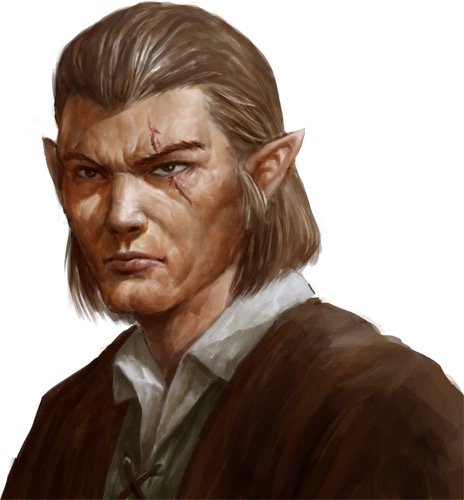
They are generally considered one of the races of ‘Men’, however, the Breton bloodline is unique given the significant elven admixture that occurred early on in their development as a people. Due to their mixed heritage, Bretons have been described disparagingly as "degraded hybrids" or a "mongrel race” by others.
*It may be true that elven blood is stronger amongst the Bretons than in other races of man, but this influence is largely overstated. For example, the pointed ears of our people are unlikely to be of Elvish origin as is so often claimed by Imperial sources, instead they should more probably be ascribed to direct divine manipulation by Cynaree or Julien, that we might better hear the words of the Divine Court.
This has, throughout the history of their people, caused somewhat of an identity crisis. What it means to be a Breton is considered an age-old quandary by their people. To make sense if it all, some may focus on a specific aspect of their culture, or seek to blend it all together.
Some Bretons for example, hold their half-elven heritage in high esteem. Bretons do after all, have elf-like physical features that render them distinct from the other races of man. These include pointed ears, angled faces, slender bodies, and distinctive eyes. But the similarities do not end there.
Outside of their homeland, they are most often found as merchants or mercenaries.
Bretons are distantly related to the Reachfolk , and even more distantly to the Cyrodic Nedes.
| Powers |
|---|
| Increased Spellpoints (x0.5) |
| Dragonskin (Resistance to Magick 50%) |
| Halfblood (Absorb Magick) |
| Attributes | Attribute Bonuses |
|---|---|
| Intelligence | +20 |
| Wisdom | +20 |
| Strength | +10 |
| Personality | +10 |
Society and Culture
"You think politics here are something? Well, we Bretons invented politics." — Anton Virane
In modern High Rock, social class is everything. Four centuries ago, Tiber Septim abolished serfdom in High Rock, in the process ingratiating himself with the peasantry, and helping to ease the province into his new Empire without revolt. Of course in reality, the old feudal order did not disappear overnight, but as the slow march of history has moved ever forward, the constraining bundle of feudal obligations and responsibilities that so tightly controlled rural village life has been replaced with the laws of exchange.
Peasantry
Today, the lower classes are divided between tenant farmers who form the bedrock of Breton society and a mass of day labourers hired on to support the agricultural work below them. The subsistence farmer or small landholder of old, barely able to scrape by, are no more, and actual ownership of land has naturally been brought under the patronage of their betters - for the stability of all. A transition which has ensured the steady supply of grains to the growing urban centres of the Bay. But the newfound freedom and mobility of the tenant and labourer has led to some unrest in the more provincial areas of the country, where the uneducated masses are more easily swayed to unjust anger by the uncouth rhetoric of petty opportunists.
Burghers, Artisans and Merchants
Above this class of rural workers, the true mercantile spirit of us Bretons is made manifest in the countless merchants, artisans and shopkeeps who have prospered these past centuries, buoyed on by the peace and stability of the Empire. The economic boom now being experienced in the Iliac Bay is a direct consequence of the Emperor's good rule, as well as the slow dismantling of the trade guilds which had for so long strangled competition and stifled innovation in High Rock.
Sorcerocrats
Far above the merchant class, sit the Sorcerocrats, a proud relic of our arcane history - a magical elite isolated from the squalid masses below them and tightly connected to the aristocracy.
Aristocracy
Finally, at the top of the social strata, almost untouchable, sit the incoherent jumble of nobility and ruling families. It has been remarked by foreigners that the confusing mass of titles and sovereign polities, of rank and peerage, is challenging to keep track of, and in truth, even Bretons struggle to remember whether the Marquess of Glenpoint is deferential to the Grand Prince of Anticlere, or where precisely to situate the Direnni Castellan in ranking versus one of the mountain Landgraves? But such things rarely matter to those outside of elite circles.
Knightly Orders
Far more common a sight within High Rock, are the countless myriad mass of Knightly Orders that dot the province. Breton society is famous for its knightly orders, with notable examples including Daggerfall's Knights of the Dragon, the Order of the Rose in Wayrest, the Knights of the Flame in Anticlere, and Dwynnen's Order of the Raven.
Breton Music
Breton's are by nature a musical and creative people, naturally inclined to poetry, literature, and song.
Breton Cuisine
Breton Cuisine is at the confluence of the cultural, class, and geographical diversity that is High Rock. Your average commoner will tend to rely on local foodstuffs, taking advantage of flora and fauna native to their environment. However, in the modern-era, with the explosion in free-trade across the Empire, ingredients from father afield are no longer a rarity, even for the lowest echelons of Breton society. As one small example, pepper, once a spice relegated to the wealthy, is now affordable on nearly every tabletop.
Breton Cosmetics
Bayard cosmetics have varied widely over the years, and what is commonly used to adorn the face or sweeten the bodily humours in one locale does not always translate across the Rock.
Cultural Sub-Groupings
The Culture of High Rock is of course dominated by Bretons, as described above. But Bretons themselves are no monolith. Indeed cultural studies generally divides Breton 'culture' into at least 5 distinct sub-groups.
- Bayards
- Montagnards - The Mountain-dwelling folk of the Kuralian and Wrothgarian ranges. Rugged, isolated, destitute, and still governed by clan systems like those that dominated High Rock prior to the Third Empire.
- Normens - Descendants of colonists that migrated to High Rock from Skyrim during the old Nordic Empire of the First Era, Normens still tend towards the Nordic look - tall, pale, fair hair and blue eyes - and yet culturally Normens have long been 'Breton'. Normens today are principally a whaling culture - who make their home in the far, inhospitable North of High Rock where they've been able to maintain a distinct and separate identity. Pockets of Normen culture are still found further South in High Rock, such as in Northmoor.
- Boullards - The Bretons of the Great River, the Bjoulsae and its many tributaries. These Bretons are known for their farming and their humbleness, as well as their distinct aversion to tyrants. Indeed, whether found at the level of the village confederation or the Wayresti Parliament, the idea that any ruler - anywhere - should rule without checks on their power is unheard of.
- Ostern - The Bretons of the East, the Reach, a people of devout religious fervour and extreme poverty juxtaposed with the wealth and lavishness of the Sorcerocrats that rule over them, made ever more strange to other Bretons by their religious unorthodoxy.

Comments