

Strapoda
Topography:
A mix of mountainous terrain, lush forests, and dry grasslands cover Strapoda.
Flora and Fauna:
The flora and fauna of Strapoda is not all that different from Ferodrill and other places in the north and North West. A large number of dragons live there, as well as Thidrols and Leechfolk.
In terms of mammals, there are ferrets, marmots, stoats, wolves, bats, and bears.
In the skies, ravens, drill birds, and pigeons fly.
Tuna, cod, and catfish swim in the rivers and lakes.
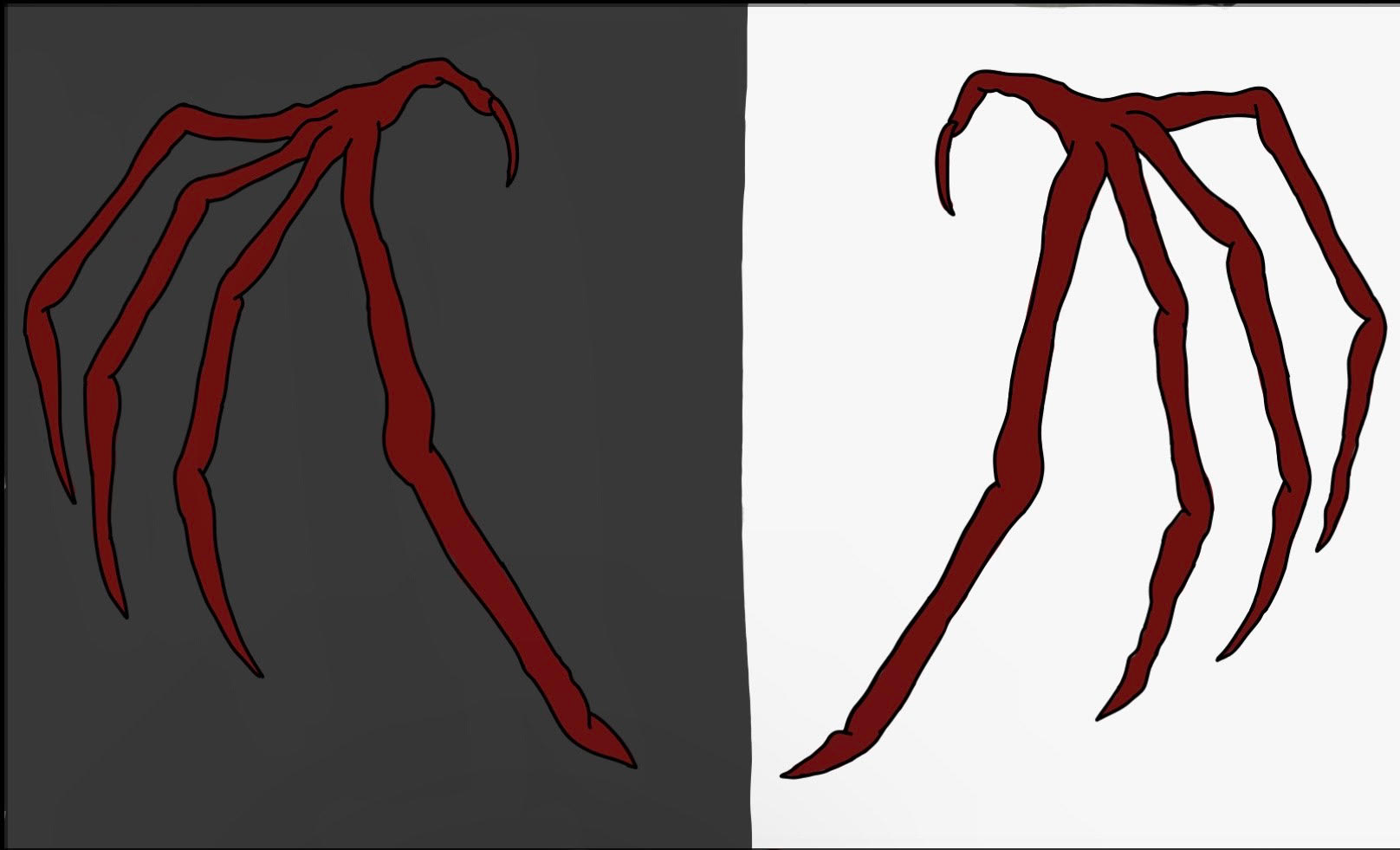
One creature unique to Strapoda is the Spider Horse, an eight legged creature which can only be ridden by vampires. All other species who have tried to ride them have found the Spider Horse simply not listening to their commands.
The flora include trees such as oaks and maples as well as various kinds of ferns and bushes.
People:
About 40% of the sentient creatures in Strapoda are humans. The others are mostly Vampires humanoids with the noses and tall ears of bats as well as white skin and black eyes. Wings for gliding connect their arms to their body.
They also possess long claws and razor-sharp fangs.
Vampires are traditionally nocturnal, only coming out at night. However, there are many vampires who have moved out of Strapoda and assimilated to the day-night structure of humans.
There are also a small collection of Elves, Eotunn Orcs, and Goblins.
A majority of the humans of Strapoda are part of an ethnic group known as Eastern Draoin. They are similar in appearance to Draoins, with pale skin and hair that is often brown, red, or blonde. A small minority are The Fallen. They are descended from people fleeing The Kingdom of The Fallen Moon during its conquest. A third human group are the Northern Yeks.
Culture:
Vampires in Strapoda are more likely to be in positions of power and to have money. The royal families of Strapoda are mostly vampires, and so is much of the aristocracy. However, this does not mean that all vampires in Strapoda are rich.
Most vampires can be split into two separate groups.
Firstly, there are the lower class vampires, most of which live in Strapoda. There are small populations living in Talamh, Balan, and Ferodrill, most of them not numbering more than a thousand.
These vampires are less stringent about the many vampiric traditions and aspects of vampire culture. They may be less strict about being nocturnal, or they may not even be nocturnal at all, as mentioned previously.
Meanwhile, the upper class vampires live exclusively in Strapoda. They are fiercely nocturnal, considering going out during the day to be sinful.
There are many myths about the vampires, including them sucking the blood of humans. However, they consider the act of killing being blasphemous, except for self-defence or in war, and are strictly vegetarian. Something as small as the smushing of a spider goes against the beliefs of the vampires.
This myth probably started due to a practice within vampires of them exchanging blood. This is done by couples after marrying by having the two of them bite each other, typically on the neck. This is done because vampires do not have different blood types and this process is rather painless, as vampire bodies have the ability to separate nerves from veins by the simple act of pinching the skin in a certain way.
Blood has importance to the culture of upper class vampires. They have engineered ways of depleting the blood of animals while still allowing them to live. This blood will then be placed in pools for bathing in during important ceremonies. Baby Strapodans will be dipped in these after being born.
In general, Vampires seem to not have the squeamishness which humans do regarding blood and gore, often reflected in vampiric art. Upper class vampires also do not have the same taboos revolving death, being perfectly fine with describing it. However, they do find procreation to be an extremely taboo subject.
The treatment of corpses by upper class vampires is very unique. When upperclass vampires die, all their blood is removed from their body and placed in a large jug. The bones of the vampire will then be removed and disposed of, and the boneless body will then be placed in the jug.
Upper class vampires have complex systems of politeness and ideas of honour. For instance, you are not to turn your back to someone of higher social status than you, and you are not supposed to initiate a physical fight with someone shorter than you. However, when someone offers a physical altercation, you must answer.
Upper class Vampires are also against rushing, believing that one should always move at a slow, yet steady, pace, unless in a dangerous situation (obviously).
One last important aspect of vampiric culture is always asking permission for every task.
In general, upper class Vampires are constantly in pursuit of a sort of perfection, chasing the ideal of a calm and peaceful person.
There is often a bit of animosity between upper and lower class vampires, with lower class vampires thinking that upper class vampires set a bad precedent. Meanwhile, higher class vampires think lower class vampires are “out of touch” with “vampiric culture”.
The humans of Strapoda, and many of the lower class vampires, have cultural practices distinct from the upper class vampires. Many of these have similarities to Ferrine and Talamh culture, with some exceptions.
Human Strapodan villages often have statues known as Strigoi that are used to ward off evil and protect the village. Offerings of food are often given to the Strigoi.
According to ancient legend, spirits live inside Strigoi. However, most Strapodans no longer believe this, and the official church claims that Strigoi do not contain spirits. As such, the giving of offerings is not a religious activity, but a cultural one.
The humans and lower-class vampires of Strapoda do not have the same ideas of politeness as the upper class humans. In fact, human Strapodans have a reputation of being rather blunt.
One similarity is that human Strapodans do not walk away from fights. However, while vampires will often state their intention to fight someone else as to warn them, human Strapodans do not do this.
To simplify a rather complex issue, human Strapodans do not care for rules as much as upper-class vampires do.
Lower class vampires generally adopt the culture of whoever they are near. In the case of Strapoda, their culture is similar to the Strapodan humans. However, lower class vampires will also do acts of sharing blood after marrying, and some may also observe similar burial rights.
With both vampires and humans, Strapodan culture is rather patriarchal, but currently in a state of change.
The Northern Yeks and The Fallen have their own unique cultures distinct from the others. The Fallen are the last bastions of cultural practices which once existed throughout Ferrodrill. They perform a multitude of rituals which involve small flag-like objects known as Wiphyrs.
Wiphyrs consist of a stick and a piece of half-boiled fabric, hard but still pliable. They have a variety of symbols painted on them, and will often be waived in specific patterns, and then used to snuff out candles.
An important part of Fallen culture is the snuffing out of candles. Even with modern day electric lightning, The Fallen will still light candles during the day, and before falling asleep, the members of a household will gather as the candles are snuffed.
Nowadays, this tradition is not followed extraordinarily strictly, as people will often go to bed at different times.
Nevertheless, candles play an important part within Fallen culture.
The waiving of the Wiphyrs also connects to a common Fallen practice of using hand gestures to communicate. This is done both casually and formally. In many ceremonies, the Fallen are expected to do specific movements with their arms and hands, often in synchronisation.
Government:
Strapoda is a feudal monarchy, but it’s ruled by not one, but three royal families of vampires, Sourrix, Redfang and Ashcrown. These families do not split the land of Strapoda, but all collectively own it. What is split into three is the capital, where the three palaces of these families lie.
This capital city is draped in eternal night thanks to the layer of black clouds constantly surrounding it.
Outside of the capital city, Strapoda is divided into various fiefdoms ruled by barons. It should also be noted that the term baron is gender-neutral, but succession usually places men above women. At the centre of every fiefdom is the baron's castle, almost always a massive palace made out of obsidian. About 9 out of 10 barons are vampires, with the rest being humans. The number of fiefdoms changes regularly.
The barons all swear fealty to the three royal families, and the royal family in turn grants each of their own barons their own official charters which grants them legal ownership of their fiefs.
Living on the land of barons will be the peasants. They can not own land, but merely “permanently rent it” from their barons, which is basically the same as buying it. If someone wishes to sell land to someone who is not their baron, they must use the barons as middlemen.
Working for the barons will be career soldiers in the form of knights, but civilians are also used.
Religion:
The official religion of Strapoda is a branch of The Lavone Belief System known as Anoxism.
It believes in a supreme deity of infinite goodness known as The Entity, who is in opposition to a being known as The Other.
According to scriptures, all of the world was once a vast abyss, known as The Great Mother. The Great Mother would bleed onto a giant egg, and from this egg would hatch The Entity and The Other.
Next to this egg were eight other eggs, the earth, sun, and six moons. However, they were not ready to hatch, so when the Great Mother’s blood fell on them, the blood simply hardened. The broken pieces of the hatched egg would fall onto the largest of these eggs, where it became the life of the world.
All of this is contained within The Tales of Virtue, a series of writings detailing the various legends of Anoxism.
The religion of Anoxism is an organised one, led by The High Priest, who is (almost) always a human.
Relationships between humans and vampires in Strapoda are often strenuous, so the High Priest will often serve as a bridge. Generally, they will serve as a speaker for the humans, telling the vampire monarch what they want. They can also do the opposite.
If the monarch makes a law that is unpopular with humans, then they can tell the high priest to calm the humans down.
While the High Priest does not have any legal powers, they still hold sway over most of the humans. There’s a secret agreement that both the high priest and the monarch depend on each other. If the high priest would go away, the humans might revolt, so the high priest holds that immaterial power over the monarch. However, the monarch has actual power over the high priest in that the high priest officially is in service to the monarch, swearing an oath of fealty to the monarch. If the monarch were to so desire, they could have the high preist sent to jail.
Succession with the High Priest occurs through the priests beneath the High Priest, who all vote for a new High Priest when the old one dies. They are not allowed to vote for themselves.
There are a couple hundred priests in Strapoda. Very few churches have priests, with a majority having sages, the rank below priesthood.
Sages are expected to lead their coronation during ceremonies every new moon. Northern Ainist churches have no windows and no lights within. People will file in single file and walk in a line, guided by a rope leading them in a circle. For the length of the service, they will walk in this circle as the sage in the middle leads them in chants and shakes a Sebinoth-a gourd filled with beans which acts as a musical instrument. Those who can not walk are not expected to attend these meetings, but can instead attend Epilogue Services. These occur the night after the new moon service, but they are not mandatory, and one is allowed to sit down. Attending Epilogue Services is also often done by the elderly and by children.
Priests are covered entirely with black veils so dense and elaborate that one can not even make out the shape of their body, and they are known to meditate for days, sometimes even weeks. These veils may only be removed in private. Priests also do not have names, having “given their identities to eternity”.
Sages wear less elaborate versions of the outfits priests wear, instead dressing in black masks and cloaks.
While vampires also follow Anoxism, their method of practice is much different, in the sense that they do not practise. To vampires, belief is enough, one does not need to pray.
Despite Anoxism being the central religion, there are no laws forbidding worship of other deities.
The Fallen have their own unique religion, which is dedicated to “A Thousand Dead Sky Gods”.
Art:
Wood carvings and paintings are common in Strapoda. Poetic epics are very important to human Strapodans.
Much of Strapodan music is also epic, and traditionally consists of acapella.





Comments