
The Path
On the Passage of Soul and Mind After Death
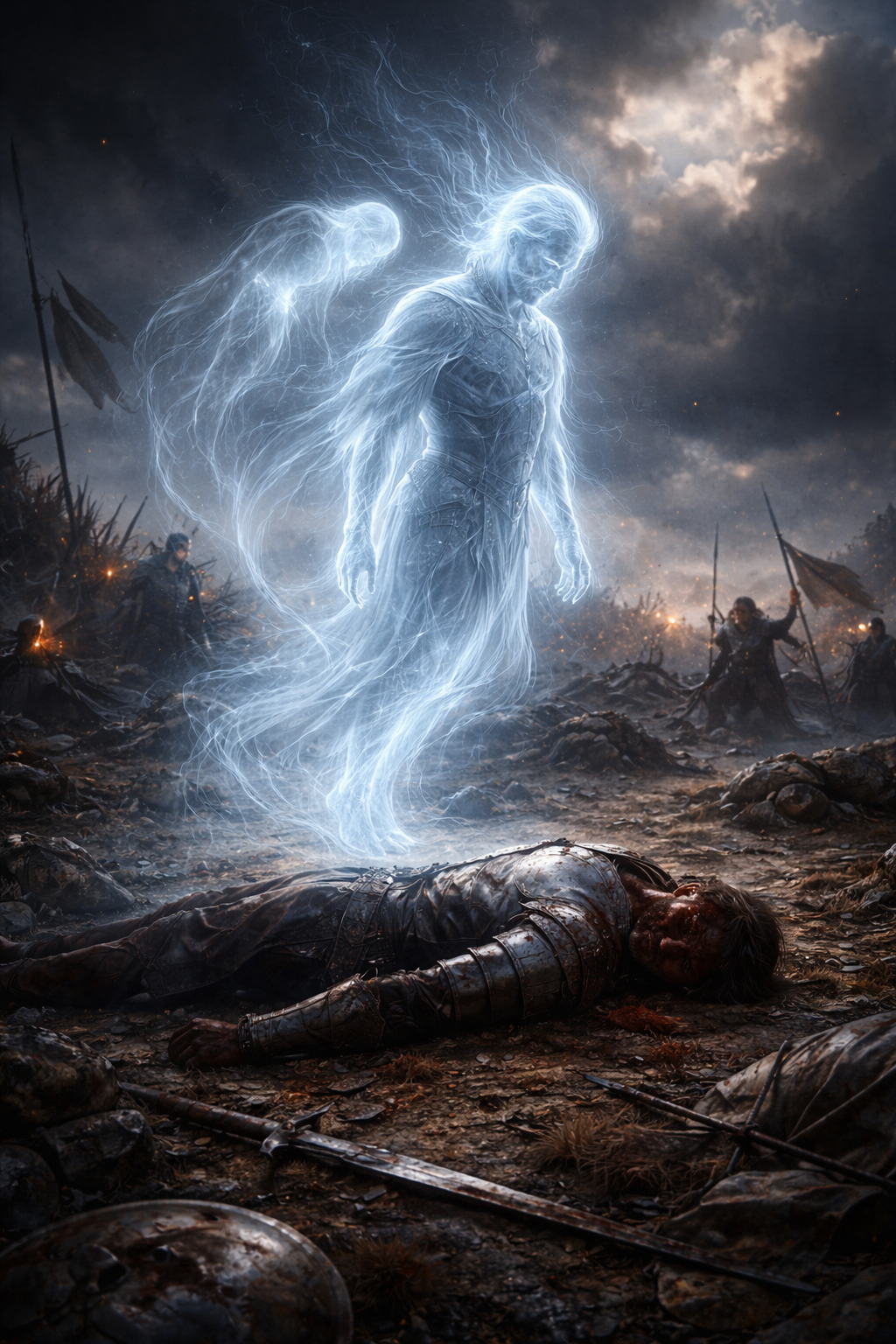
The Path is the name given to the unseen route by which mortal essence departs the living world. It is not a road in any physical sense, but a sequence of separations, transitions, and compulsions governed by will, power, and the structure of reality itself.
Severance
At the moment of death, the soul and the mind disengage from the body. This separation is not instantaneous in all cases. Its speed and finality depend upon several factors: the fortitude of the being, the strength of their will to remain or depart, the local rigidity of the Intersticium, and the inherent power of the individual.
This variability explains a well-known phenomenon. Adventurers and other exceptional beings may linger for a brief span after mortal injury, capable of return if aid is swiftly given. Most common folk and lesser creatures, lacking such resilience or will, pass fully and immediately beyond recall.
The Twin Transition
Once separation is complete, the soul and the mind do not travel together. The soul passes into the Astral Plane, while the mind transitions into the Ethereal Plane. Though divided, the two remain bound by an unseen tether, functioning as a single metaphysical whole.
Perception during this state is weighted toward the Astral. The being experiences motion, distance, and direction primarily through the soul. Awareness may be drawn into the Ethereal through stimulus, interaction, or intrusion, but this awareness is secondary and often disorienting.
Compulsion and Claim
Within the Astral, the soul feels an inexorable pull toward a place of power. This destination is determined by claim. Gods, demigods, and other transcendent beings mark souls through worship, covenant, oath, lineage, or interference.
If a single claim exists, the compulsion is singular and clear. If multiple transcendent beings lay claim, the outcome varies. In some cases, the matter is brought before the Simulacrum for judgement. In others, the soul experiences conflicting compulsions and is permitted to choose its course.
The destination is almost always a location of symbolic or practical importance to the claimant: a temple, sanctum, battlefield, shrine, or other site steeped in meaning.
Beyond the Proximal Realms
Upon arrival, the transcendent being assumes responsibility for the soul’s further passage. The soul is conveyed out of the Proximal Realms, across the Divinexus, and into a Transcendent Realm aligned with the claimant’s nature and dominion.
What becomes of the mind thereafter is not universal. Some deities preserve the connection, allowing memory, identity, and continuity. Others grant rest, dissolving awareness into peace. A few extinguish the mind entirely, preserving only the soul as a functional or symbolic entity. These practices are matters of doctrine and temperament, not cosmic law.
On Return
Restoration of life is simplest before the soul and mind have fully departed the body. Once they have entered the Astral and Ethereal respectively, recovery becomes more difficult, requiring significant power to recall and reunite what has begun to move along the Path.
After a soul has been claimed and carried beyond the Divinexus, return is no longer a matter of spell or art. Only the direct intervention of a god may reverse such a passage.

Comments