

Citadel of Nytheris
The Citadel of Nytheris is the central seat of power in Valoria and the physical manifestation of its arcane theocracy. Rising above the capital city of Erthoris atop a major ley line, the Citadel serves simultaneously as royal palace, religious sanctum, judicial authority, and arcane nexus. From within its walls, the Archmagus and the Arcane Conclave govern every aspect of Valorian life, from military campaigns to caste enforcement and religious doctrine.
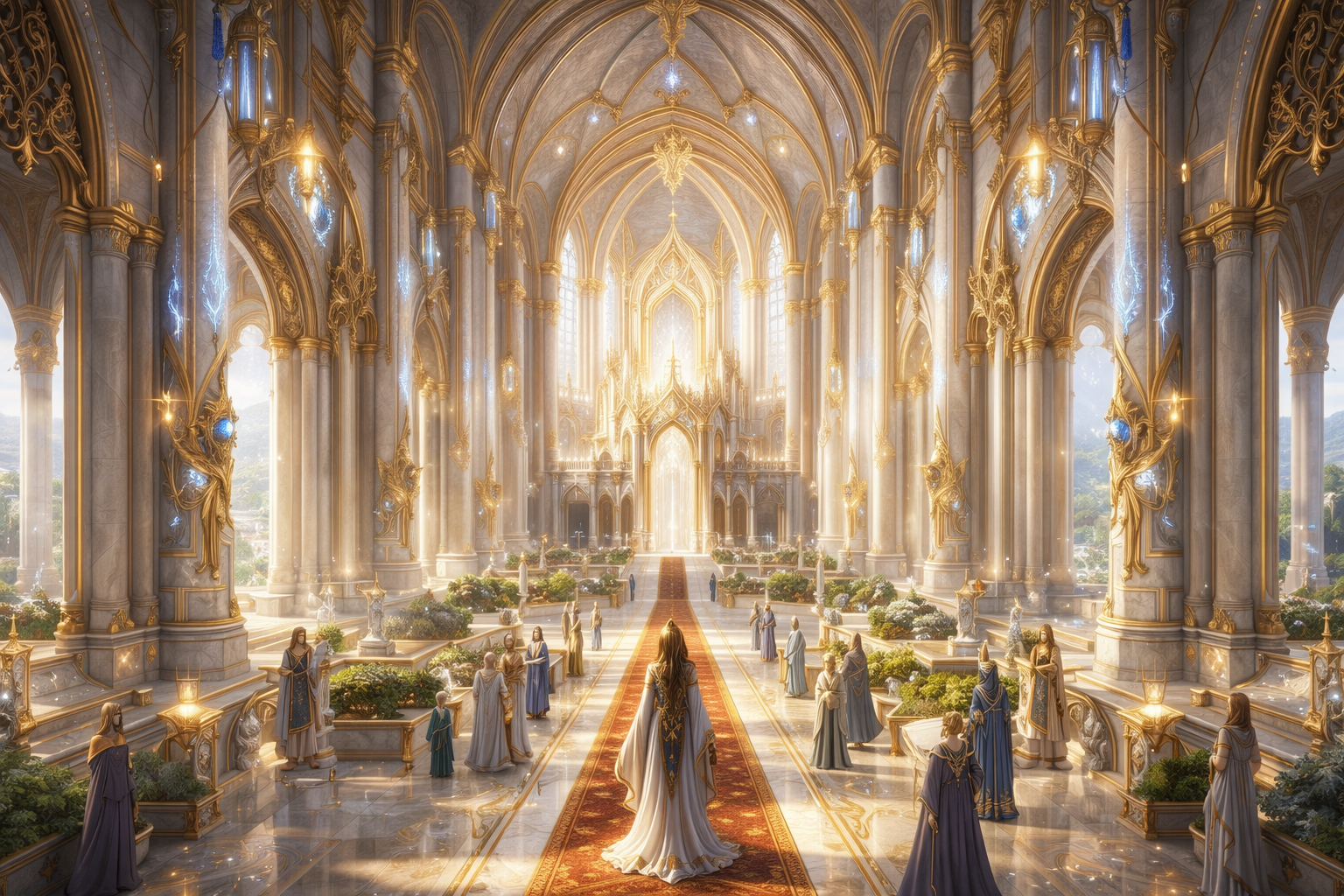
Architecturally, the Citadel is defined by radiant white stone, gold-inlaid sigils, and crystal lattices designed to amplify light and suppress shadow. Its appearance is deliberately immaculate and inviting, projecting an image of order, purity, and divine legitimacy. This brightness is not merely aesthetic; the structure channels sunlight and ambient magic through enchanted materials, feeding the Citadel’s wards, rituals, and internal spellwork. Corruption and cruelty are not hidden in darkness here, but obscured by perfection.
Functionally, the Citadel is both administrative center and sacred space. It houses the Sanctum of the Archmagus, the chambers of the Arcane Conclave, high courts of magical law, and vaults containing some of Valoria’s most dangerous artifacts. Public halls are ceremonial and accessible only by invitation, while the true mechanisms of power are buried deeper within, shielded by illusion, authorization wards, and spatial manipulation.
To the people of Valoria, the Citadel represents stability, divine favor, and the promise of order. To outsiders, it is unsettling in its serenity, a place where control is exercised with calm certainty rather than overt force. The Citadel does not intimidate through menace; it dominates through inevitability.
Purpose / Function
The Citadel of Nytheris was constructed to serve as the centralized instrument of arcane governance for Valoria. Its intended purpose is not merely to house rulers, but to concentrate authority, magic, and doctrine into a single, unquestionable locus of power.
 At its core, the Citadel exists to legitimize Valorian rule. By uniting political leadership, religious authority, judicial oversight, and arcane control within one structure, the Citadel reinforces the doctrine that order is both divinely sanctioned and magically enforced. Governance within Valoria is designed to appear seamless and inevitable, and the Citadel functions as the physical proof of that claim.
Secondarily, the Citadel was intended to act as an arcane stabilizer and amplifier. Built atop converging ley lines, it regulates the flow of magical energy throughout the capital and surrounding regions. This allows Valoria to maintain widespread enchantments, defensive wards, and ritual networks while ensuring that access to large-scale magic remains tightly controlled by the ruling elite.
Finally, the Citadel serves a symbolic and psychological role. Its radiance, openness, and immaculate design were deliberately chosen to project virtue, enlightenment, and security. The building is meant to inspire trust among citizens, awe among allies, and quiet submission among rivals. Fear is not its primary tool. Certainty is.
In practice, while the Citadel presents itself as a beacon of order and progress, its true function is to centralize power so completely that dissent becomes structurally irrelevant.
At its core, the Citadel exists to legitimize Valorian rule. By uniting political leadership, religious authority, judicial oversight, and arcane control within one structure, the Citadel reinforces the doctrine that order is both divinely sanctioned and magically enforced. Governance within Valoria is designed to appear seamless and inevitable, and the Citadel functions as the physical proof of that claim.
Secondarily, the Citadel was intended to act as an arcane stabilizer and amplifier. Built atop converging ley lines, it regulates the flow of magical energy throughout the capital and surrounding regions. This allows Valoria to maintain widespread enchantments, defensive wards, and ritual networks while ensuring that access to large-scale magic remains tightly controlled by the ruling elite.
Finally, the Citadel serves a symbolic and psychological role. Its radiance, openness, and immaculate design were deliberately chosen to project virtue, enlightenment, and security. The building is meant to inspire trust among citizens, awe among allies, and quiet submission among rivals. Fear is not its primary tool. Certainty is.
In practice, while the Citadel presents itself as a beacon of order and progress, its true function is to centralize power so completely that dissent becomes structurally irrelevant.
Architecture
The Citadel of Nytheris is built in what scholars and Valorian architects formally describe as Radiant Arcane Classicism.
This style blends high classical symmetry with ritualized arcane engineering, deliberately evoking permanence, purity, and divine order rather than militarism or austerity. It draws visual inspiration from ancient monumental architecture while refining it through magical precision and impossible material perfection.
Key characteristics of this architectural style include:
- Strict symmetry and axial design, reinforcing the Valorian belief that order is natural and deviation is failure. Every major hall, tower, and terrace aligns along intentional sightlines and ley-flow paths.
- Light-centric construction, favoring white stone, pale marble, crystal lattices, and gold inlay. Illumination is both aesthetic and functional, with surfaces designed to refract, channel, and amplify natural and arcane light.
- Minimal surface ornamentation with layered meaning, where decorative elements double as sigil anchors, ward nodes, or spell matrices. Nothing is purely decorative, even when it appears so.
- Vertical emphasis without menace, using slender spires, open arches, and elevated sanctums to suggest ascension and enlightenment rather than domination.
- Illusion-integrated spaces, where depth, scale, and distance are subtly manipulated to maintain the impression of openness while concealing restricted or dangerous areas.
Defenses
The Citadel of Nytheris employs defenses designed not to repel armies, but to prevent opposition from ever becoming organized or effective. Its protective measures favor invisibility, inevitability, and preemption over overt fortification. The Citadel does not appear defended. It simply is.
At the structural level, the Citadel lacks traditional battlements, walls, or siege-facing architecture. Instead, its pale stone and crystal framework is spell-bound at the material level, rendering the structure resistant to physical damage, vibration, and siege magic. Impacts are absorbed, redirected, or dissipated through embedded arcane lattices that prevent catastrophic failure rather than dramatically resisting it. Cracks, breaches, and fires are almost unknown, as the building continuously corrects itself through restorative enchantments.
Magically, the Citadel is surrounded by a layered ward network woven directly into its decorative elements. Columns, arches, gardens, fountains, and even floor patterns function as sigil anchors. These wards regulate access, suppress hostile spellcasting, distort hostile teleportation, and trigger countermeasures based on intent rather than action. Many intrusions are neutralized before an attack is consciously made. The Citadel does not wait for violence; it identifies potential for disorder.
Spatial manipulation is one of its most effective defenses. Unauthorized individuals may find corridors subtly lengthening, staircases redirecting, or destinations becoming unreachable despite clear line of sight. Entire wings can be folded out of accessible space without visible barriers. This ensures that even those allowed entry are never truly free to navigate.
Defensively, the Citadel relies on absence rather than presence. There are few visible guards. Instead, the Glyphguard and bound constructs remain dormant, embedded within walls, statuary, and ornamentation, capable of activation at a moment’s notice. When deployed, they do so with surgical precision, isolating threats without spectacle. Public confrontations are avoided whenever possible. Order is restored quietly.
As a final measure, the Citadel is believed to possess multiple catastrophic containment protocols. In the event of irreparable breach, internal sections can be sealed, collapsed into controlled arcane null-zones, or isolated entirely from the material plane. Preservation of knowledge and authority takes precedence over preservation of lives, including those within its walls.
History
The Citadel of Nytheris was commissioned in the late 3rd century HE following Valoria’s consolidation under the Arcane Conclave. Its construction marked the moment when Valoria formally abandoned fragmented magelord rule in favor of centralized arcane governance. Built at the convergence of powerful ley lines beneath what would become the capital city of Erthoris, the Citadel was intended to embody permanence, order, and divine legitimacy.
 Construction unfolded over several decades, guided as much by ritual and spellcraft as by engineering. While the Citadel reached functional completion within a generation, it has never been considered truly finished. Continuous enchantment, expansion, and refinement have reshaped its interior repeatedly, allowing it to evolve alongside Valoria’s growing power. Many original chambers no longer exist in their initial form, having been absorbed, repurposed, or sealed as doctrine and political needs shifted.
Throughout Valoria’s history, the Citadel has remained untouched by invasion or revolt. Major declarations, legal reforms, and acts of conquest have all been issued from within its halls, reinforcing its role as both seat of governance and sacred authority. While dynasties and policies have changed, the Citadel endures as the unbroken symbol of Valoria’s belief that order, once established, must never be allowed to fracture.
Construction unfolded over several decades, guided as much by ritual and spellcraft as by engineering. While the Citadel reached functional completion within a generation, it has never been considered truly finished. Continuous enchantment, expansion, and refinement have reshaped its interior repeatedly, allowing it to evolve alongside Valoria’s growing power. Many original chambers no longer exist in their initial form, having been absorbed, repurposed, or sealed as doctrine and political needs shifted.
Throughout Valoria’s history, the Citadel has remained untouched by invasion or revolt. Major declarations, legal reforms, and acts of conquest have all been issued from within its halls, reinforcing its role as both seat of governance and sacred authority. While dynasties and policies have changed, the Citadel endures as the unbroken symbol of Valoria’s belief that order, once established, must never be allowed to fracture.
Tourism
Tourism to the Citadel of Nytheris is strictly controlled and highly curated. While the Citadel is one of Valoria’s most recognizable landmarks, public access is limited to carefully designated outer spaces intended to reinforce the kingdom’s image of enlightened order and benevolent rule.
Visitors, dignitaries, and pilgrims are permitted into select ceremonial halls, terraces, and observation courts, all of which are maintained in immaculate condition and heavily monitored through unobtrusive magical means. These areas showcase the Citadel’s radiant architecture, controlled use of light, and ritual symbolism, offering a carefully managed experience meant to inspire awe rather than inquiry. Guides, often members of the clergy or state-appointed attendants, provide officially sanctioned interpretations of the Citadel’s history and purpose.
Access beyond these public spaces is forbidden. Inner sanctums, administrative chambers, judicial halls, and arcane infrastructure remain sealed to all but authorized personnel. Visitors who stray, ask prohibited questions, or attempt unsanctioned spellwork are quietly removed, detained, or barred from future entry without public incident.
Foreign tourism is encouraged selectively, particularly for allies and trade partners, as a means of projecting stability and superiority. The Citadel is meant to be seen, admired, and remembered—but never understood. In Valorian policy, exposure is not a risk so long as control of access and narrative remains absolute.

Founding Date
circa late 3rd century HE (approx. 280–295 HE)
Alternative Names
The Radiant Citadel, The Spellbound Throne, Nytheris’ Beacon
Type
Acropolis / Citadel
Parent Location
Ruling/Owning Rank
Owning Organization


Comments