
USC
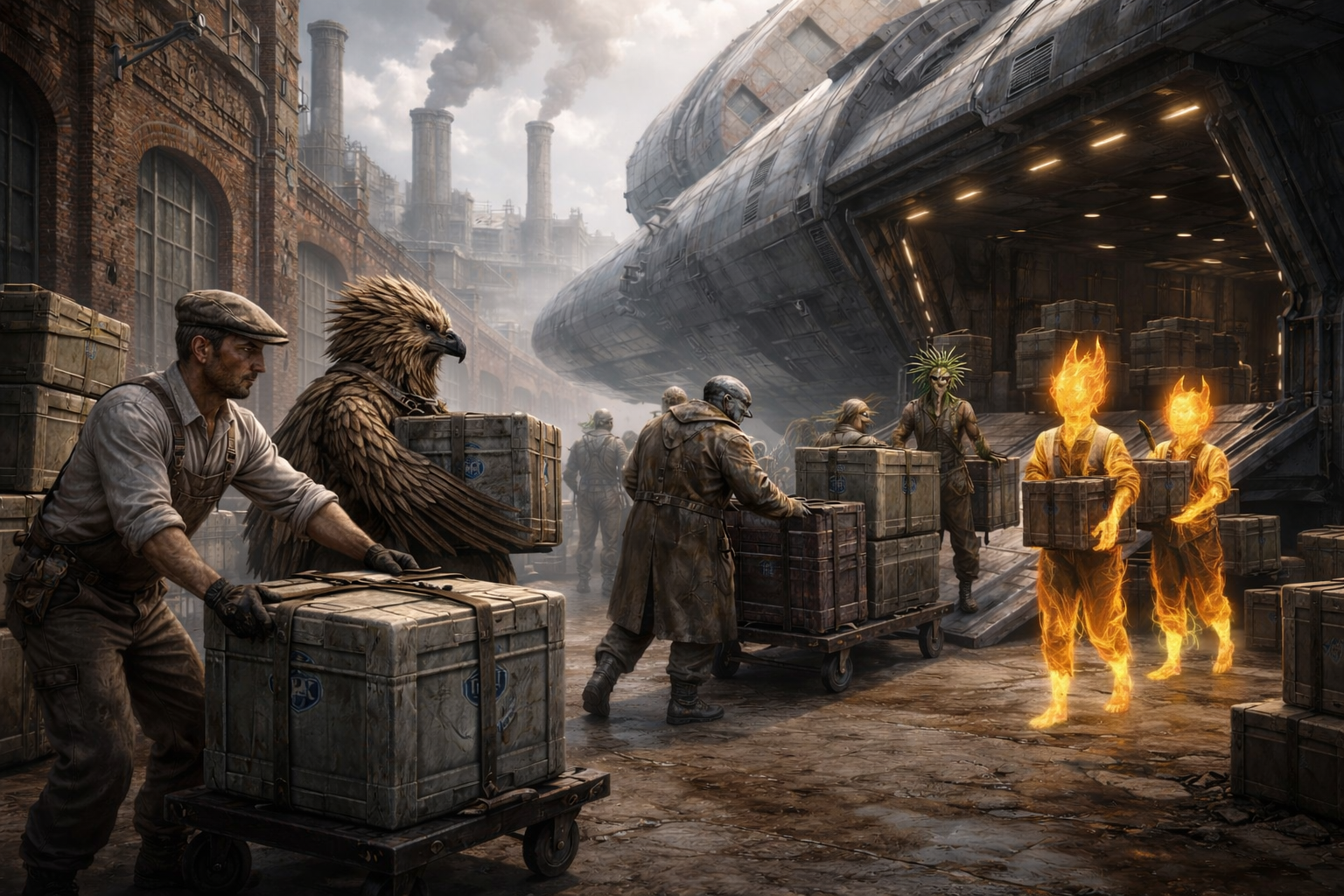
The United Systems Charter is a sprawling technocratic empire sustained by a careful balance between present capability and inherited miracle. At the local level, society operates firmly at an industrial scale: factories, rail and shipping networks, mass labor, and institutional governance form the visible backbone of daily life. Progress here is real and earnest—new processes, better logistics, safer machines—but it advances only where risk is manageable and failure is survivable. Above this layer lies an older foundation of ancient technology: pixel printers, cloning systems, and starship cores inherited from a previous age, still functional but no longer fully understood or easily replaced.
These systems are not forbidden, feared, or worshipped. They are treated as critical infrastructure—operated competently, studied cautiously, and modified only when the cost and risk can be justified across multiple jurisdictions. Innovation is encouraged, but the empire has learned that backbone failures cascade faster than solutions can be deployed. As a result, maintenance and continuity are prioritized over transformation, not out of ideology but necessity. Secrecy exists to manage public expectation rather than suppress truth; the reality of degradation, backlog, and uneven upkeep is known within institutions, but rarely broadcast beyond them.
The empire’s egalitarian ideals remain sincere: access to ancient technology is governed by uniform procedures rather than privilege, yet inequality emerges through geography, queue length, and institutional overload. Fragmentation is not driven by rebellion or dogma, but by distance, delay, and scale. Competent systems strain under their own weight as peripheral regions quietly improvise to keep inherited machinery running. This is not a civilization afraid of progress—it is one discovering, too late, how expensive continuity can be when the future must be built on tools the present can no longer recreate.

Tech Level 3 - Industrial
- Strategy: Secrecy
- Mood: Pragmatic
- Method: Technocratic
- Organization: Institutional
- Boon: Ancient
- Weakness: Overextended
- View: Egalitarian
- Crisis: Fragmenting
- Might - 2
- Influence - 5
- Territory - 5
- Treasure - 2
- Sovereignty - 2