
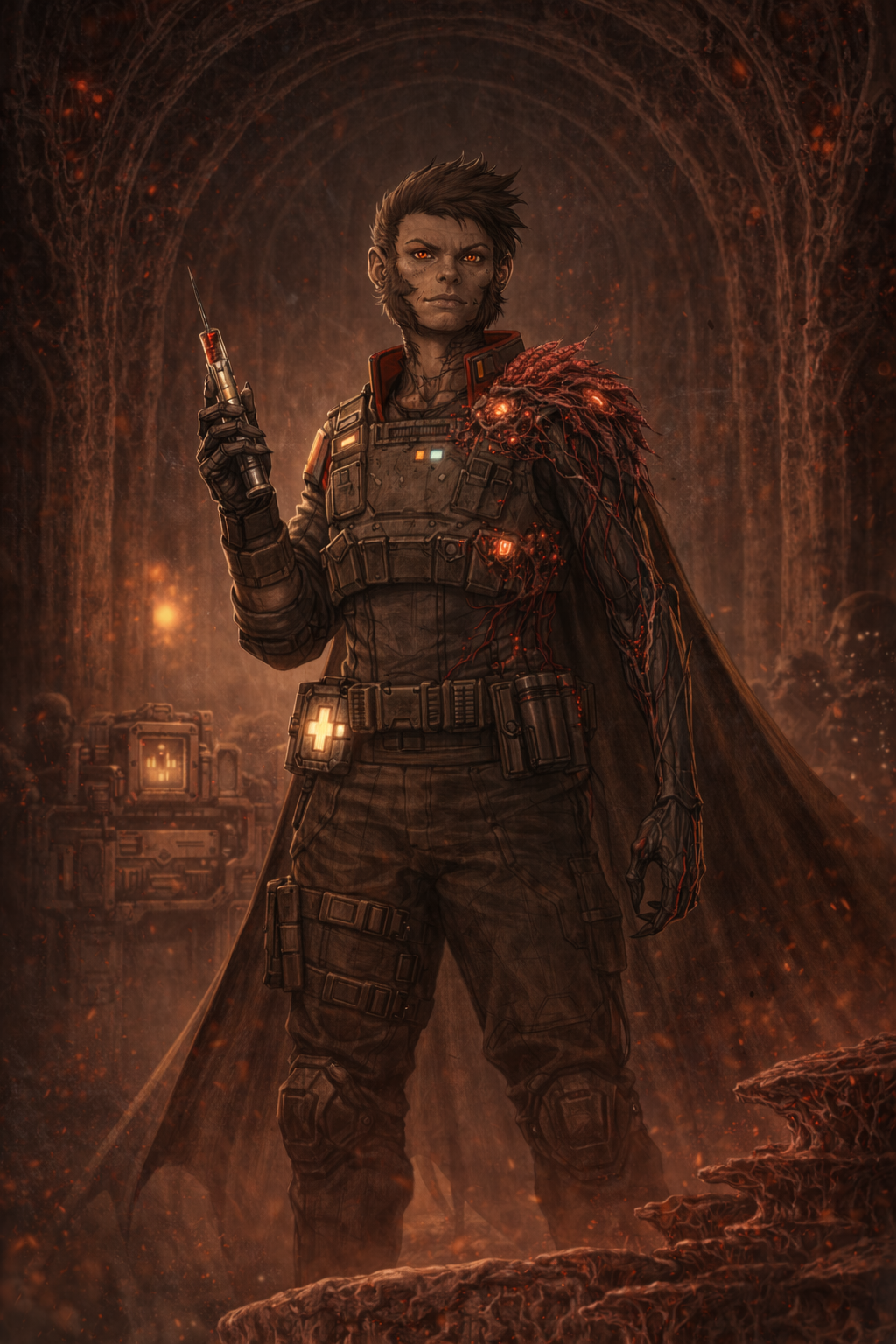
Overseer
The USCMC withdrawal left Halcyon Verge to its own succession crisis. In the vacuum, Ekaterina emerged not as captive but as architect—assuming control of the Dark Hive and embracing the neural augmentation that sharpened her already formidable intellect. Her first act was pragmatic: the corrupted pixel printer, once a bridge between Fungal growth and technological replication, was beyond saving. With advanced fabrication off the table, she prioritized consolidation—fortifying hive structure, accelerating bio-harvesting of stone and metal, and reshaping the warrior caste through deliberate biological refinement. Spreading would come later. Survival came first.
The Verdant Ageis did not wait. Viewing the Fungal occupation of the quarry as an existential threat, they moved to reclaim it, igniting a protracted warfront of skirmish and maneuver. Early clashes favored the Hive’s defensive resilience, but disciplined Floran infantry and sustained pressure gradually reclaimed the quarry. Ekaterina responded not with reckless expansion but with strategic withdrawal—ceding a buffer region between hive and quarry while strengthening her forces from within. What followed was months of brutal oscillation: Fungal corruption aided counteroffensives, the buffer changed hands repeatedly, and both sides bled into attrition without decisive advantage.
In the fifth month, the Verdant Ageis attempted subterfuge—deploying a decoy crystal convoy to draw Hive attention. Ekaterina saw through the ruse, committing only token forces before striking elsewhere with calculated force. Yet even tactical clarity could not overcome strategic strain. Attrition mounted. Anti-fungal remedies improved. Supply chains stabilized. By the seventh month, Verdant Ageis forces overwhelmed the exhausted Hive perimeter, sacking and burning the Dark Hive in a decisive assault.
Ekaterina did not die in the flames. She escaped into the wilderness—stripped of territory but not of vision. The lesson was clear: she had been too visible, too centralized, too exposed. The next phase would not begin in open war. It would begin in secrecy. If she can reach the distant megahive along the planet’s spine, the work of spreading will resume—this time from the shadows.
Overseer Ekaterina began her march along the spine alone, slipping through jungle still thick with the aftermath of war. The Verdant Aegis’ search for her survival was broad and symbolic rather than surgical, yet chance nearly ended the journey before it began. A hunting squad of Floran scouts crossed her path at extraordinary range. Ekaterina struck first—three hunters falling before they could properly engage. The fourth forced a brief exchange, arrows biting deep into flesh before enhanced physiology and combat stims stabilized the damage. The search narrowed no further.
Pressing north, she encountered what at first appeared to be an abandoned Floran hunting ground—a surface camp ringed with lethal traps and adorned with the massive trophies of insectoid megafauna. Beneath a fallen tree lay burrows and concealed infrastructure far more advanced than expected: a functional Cloning Pod, a pixel printer, and a trapped weapons cache. The discovery reframed the planet’s balance of power. Even remote hunting camps rivaled corporate outposts in preparedness. Ekaterina registered with the pod despite the risk of lingering, securing a single contingency against annihilation before pushing deeper.
The camp proved far from empty. A riverbank swarm of venomous beetles forced a tactical retreat, only to be contained with a well-placed force cage that turned their aggression into an incidental perimeter defense. Abandoned equipment yielded an unexpected prize—a Floran solar-powered personal force harness of exceptional design. Two Florans soon revealed themselves: a scavenger hoping for profit and a Star Hunter operating under the authority of an elite hunting order. The encounter turned brittle when the armor became a point of claim and suspicion thickened around Ekaterina’s Fungal condition. She fired first. The Star Hunter fell quickly without their advanced gear. The scavenger, more pragmatic than loyal, recalculated and remained.
What followed was not conquest but assessment. Hidden chambers, sealed doors that refused to yield, and a path guarded by a colony of giant flea-hoppers marked the terrain as dangerous but defensible. The northern half of the hunting grounds was secured without provoking unnecessary conflict. At the far edge of the camp, a large game pit lay empty—functional, isolated, and structurally sound.
With the scavenger eventually departing and resistance eliminated, Ekaterina claimed the site. The former hunting camp—stocked, trapped, and strategically positioned—would become the seed of a new Fungal foothold. Not a public cathedral-hive as before, but something quieter. Smaller. Hidden. The first node in a more disciplined spread.
In the quiet year following the establishment of her hidden colony, Overseer Ekaterina turned her attention inward—both to the burrows beneath the hunting camp and to the slow consolidation of her new domain. The jungle above gradually yielded to the Fungal network, its spores binding soil, root, and carcass into a growing biological infrastructure. Local Flea Hopper nests proved less a threat than an opportunity. While the adults remained merely infected, their newly hatched generation matured breathing the spores themselves, emerging as something new: a semi-autonomous worker caste capable of simple reasoning and tool use. By the time the surface network stabilized, Ekaterina commanded not only the fungus but the first native creatures fully integrated into it.
The year was not idle. Beneath the fallen tree that concealed the camp’s infrastructure, Ekaterina devoted countless hours to breaching a sealed passage in the abandoned Floran dwelling. When the lock finally yielded to a custom-built disruptor, she discovered the source of the faint mechanical sounds she had heard through the walls: an abandoned Ship Diagnostic AI. Though discarded by its former owner, the unit remained functional. With the pixel printer once again available, Ekaterina began fabricating the skeletal hull of a future capital vessel above the camp and installed the SDA within it. The structure now possessed the mind of a ship—yet lacked the materials and planetary launch systems needed to ever leave the ground.
Her attempt to expand belowground proved far less controlled. A rope-lined entrance opened into old hunting tunnels littered with shell casings and buried equipment, evidence of years of Floran activity. Whatever had once been fought here had not fully died. Ekaterina’s first descent ended abruptly when the cavern walls themselves came alive—massive boulder bugs unfurling from the stone and attacking in force. Even with her holographic guardian deployed and constant self-treatment, she was driven back to the surface with little progress made.
By the end of the year, Ekaterina’s foothold had deepened but not yet expanded. The jungle above belonged to the fungus, a new worker species had emerged under her control, and the blueprint for a future starship now waited silently above the camp. But beneath the soil, the burrows remained contested territory—old predators still guarding the darkness below.
For several years after the razing of the original hive, the conflict between the Dark Hive and the Verdant Aegis existed only as a looming inevitability. Ekaterina rebuilt quietly, cultivating Fungal territory beneath the jungle canopy while developing new insectoid castes bred through the cloning infrastructure hidden in the hunting grounds. Flea Hopper broods multiplied rapidly, and experimental variants—most notably the flame-adapted “Flame Hopper” strain designed specifically to counter the Florans’ natural flammability—were introduced to the growing hive forces. During this period the Verdant Aegis expanded aggressively through the surrounding mountains, consolidating farmland and quarry resources but spreading their military thin. Internal corruption within the Senate and officer caste persisted, with regional commanders accumulating personal power while the state attempted to maintain the image of unity.
Inevitably, expansion brought the two powers back into contact sooner than either side had intended. The Verdant Aegis stumbled into fortified Fungal territory while attempting to secure their new holdings. By that time Ekaterina had spent years preparing defensive traps, pits, and layered fortifications throughout the infected jungle. Initial Floran probing attacks failed to penetrate these defenses, and early attempts to disrupt the hive through reconnaissance or supply raids proved largely ineffective. In response, the Dark Hive began limited sabotage and harassment operations of its own—sapper incursions and supply raids designed less to win battles than to force the Aegis to divert resources and attention.
When the Verdant Aegis finally committed to open war, the conflict immediately exposed the cost of their rapid territorial expansion. Their decentralized system of regional forces allowed them to cover wide fronts but lacked cohesion during sustained siege warfare. Repeated assaults on the Fungal defenses ended in heavy casualties as Floran units were caught in layered trap networks and harried by waves of Flame Hoppers bred specifically to counter them. The Aegis were forced to settle into a defensive posture along the front while consolidating their overextended territory.
That moment of consolidation gave Ekaterina the opportunity she had been waiting for. Once the Floran advance stalled, the Dark Hive launched its first counteroffensive, reclaiming the site of the original hive—now transformed into fertile Fungal farmland. The Verdant Aegis withdrew from the contested territory to establish a new defensive line, hoping to blunt the hive’s momentum. Instead the war entered a grinding escalation. The Florans burned through stockpiled resources attempting to reinforce their fractured defenses while oligarch factions competed for control of the remaining wealth. Meanwhile the Dark Hive continued expanding its cloned armies, relying on unified production and the adaptability of the hive mind.
A turning point came when Ekaterina transitioned the hive’s military from simple swarm warfare to organized siege capability. Heavy armor, artillery organisms, and siege equipment were gradually introduced across the entire insectoid host. The Verdant Aegis attempted to keep pace technologically, but their economy and political structure could not support mass deployment. At one point the Florans succeeded in constructing a defensive line of trebuchets—only for the position to be destroyed within a day by Flame Hopper infiltrators. From that moment forward the technological race was effectively over.
With superior equipment and centralized command, the Dark Hive began pushing aggressively across the contested buffer lands. Defensive positions collapsed in rapid succession as hive forces exploited the fragmented command structure of the Aegis. Floran leaders attempted increasingly desperate tactics, including hunter-led infiltration teams meant to disrupt hive infrastructure, but by then their political cohesion had already begun to unravel. Rival oligarchs hoarded resources while frontier forces fought independently to preserve their own territories.
The fall of the quarry marked the decisive strategic blow. Ekaterina’s intimate knowledge of the region—gained during her previous life there—allowed the hive armies to overrun the defenses with alarming speed. From there the Dark Hive advanced directly toward the Verdant Aegis capital, splitting their territory in two and triggering a final collapse of central authority. Senators and oligarchs scrambled to secure what wealth remained while Floran populations fled into the jungle.
In a final act of Floran honor, the two surviving halves of the Verdant Aegis attempted a coordinated counterattack to reclaim their capital. Each faction advanced from opposite directions in a pincer maneuver, trusting that the other would uphold the plan despite the chaos surrounding them. For a brief moment the strategy succeeded—both armies struck simultaneously.
It was not enough.
The Dark Hive repelled both offensives with ease. Within two months the remaining Floran forces were shattered, their coordinated resistance broken for good. The Verdant Aegis—once the dominant power of the mountains—ceased to exist as a functioning state. Their territories fragmented into scattered survivors hiding within the jungle canopy.
In the aftermath, the Dark Hive emerged as the uncontested power across the region, its Fungal domain spreading steadily across lands that had once been defended by stone terraces and disciplined Floran phalanxes. What had begun as a quiet resurgence beneath the jungle had ended with the complete collapse of the Verdant Aegis civilization.
Half a century passed in relative quiet. The Dark Hive expanded not outward in conquest but upward in construction. Towers of Fungal architecture rose from the old territories, and the primitive warrens of the original Hive were gradually replaced by engineered superstructures. At the center of this transformation stood the Sky Hive, a vast hovering organism-machine capable of interstellar travel. Its technologies rivaled—and in some cases surpassed—the relic systems left behind by older galactic powers. Yet the Hive’s ambitions were no longer tied to the contested world that had birthed it.
Ekaterina’s final priority was not dominion, but preservation. Before departing the colony world, she turned her attention to the deep Burrows, determined to catalogue and harvest as much unique genetic material as possible. The planet had proven itself a crucible of strange evolution. Whatever remained beneath its crust would not be left undocumented.
During this period a small flotilla of Floran Star Hunters arrived, as they occasionally had over the decades. Most had previously observed the Fungal dominion from orbit and departed without interference, respecting the territory as a formidable hunting ground rather than a prize to contest. This group, however, requested entry. The burrows ran deep, and rich hunting grounds were rare. Their leader—Dolie, an unusually technology-focused hunter—expressed open interest in testing their skill against the Hive’s creatures.
Ekaterina granted passage. The Hive required only genetic samples, not living hosts, and the presence of skilled hunters might thin some of the more dangerous fauna. Inoculations against the Fungal environment were provided, and the Star Hunters descended into the tunnels.
They never returned.
A day later, one of the remaining ships transmitted a brief message of formal thanks for the granted passage before the flotilla departed the system entirely. The implication was understood. The hunting party had fallen, but not without impact.
When Ekaterina later descended into the burrows, the upper soil layers were almost pristine—cleared with methodical precision. The Florans had fought hard and effectively. Deeper down, however, the story changed. In the bedrock layer the tunnels erupted into chaos: shattered armor, broken weapons, and scattered remains told of a final confrontation with something far worse than the Hive’s typical organisms.
Still deeper, the stone softened into a hostile subterranean furnace. Semi-molten rock pulsed with geothermal heat while toxic gases filled the passages. Whatever ecosystem thrived there was far beyond the hunters’ ability to survive.
Ekaterina attempted to investigate further.
The attempt lasted only seconds.
The molten strata erupted with motion as a swarm of flying, scorpion-like organisms burst from the boiling rock. Their stingers penetrated shielding only briefly, but the venom they carried proved lethal to even Ekaterina’s enhanced physiology. Moments later she awakened in a cloning chamber on the surface.
The lesson was clear.
The planet would never be fully controlled.
Shortly afterward, the Sky Hive lifted from the world that had given birth to it. With a full crew and a vast biological archive, the structure departed into the void, beginning a slow and deliberate spread across uninhabited systems. Adapting Fungal life to barren worlds proved far easier—and far safer—than attempting to conquer inhabited ones.
In time the Dark Hive became something different than an empire.
It became a background phenomenon.
Across the galaxy, scattered worlds would slowly turn green-black with Fungal growth, seeded by distant descendants of the Sky Hive. Ships learned a simple rule: avoid those worlds, and the Hive would avoid you.
The pattern repeated once again.
A faction had risen to extraordinary heights—approaching singularity in power and capability—only to vanish from the center of history as quickly as it arrived.
What remained were only echoes.