
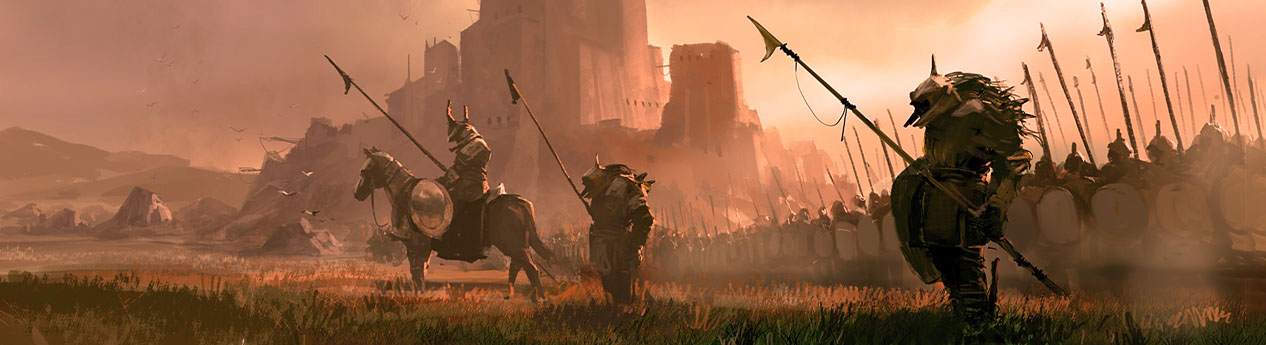
Uruk
The leading civilization among the southern cultual branch are the Uruk (ER-uk or OO-ruk) peoples. They occupy a wide range of lands, from the hot deserts of Rakkia to the jungles ofTuerga. Their strong religious tradition has influenced many other cultural groups, especially the Escharan Ismani.
As a people, the various tribes of this race get their name from a revered ancestral law-giver named Urukaan, who passed on to them a strict monotheistic religion and code of law. Uruk morality is based on personal honor and integrity; it is very exacting and unyielding. Obedience to authority is paramount. Their strong utilitarian morality seeks the good of the tribe above the individual, and tends to limit personal freedom. Uruks are ruled by powerful warlords, and are quite aggressive in their attempt to gain religious and political power through conquest. Most Uruks have only a very limited Infravision, which allows them to detect the impression of heat at a range of 30 feet. Their canine teeth are capable of inflicting (1-4) points of damage, though this sort of attack is only used in close, weaponless, mortal combat.
RAKKIAN URUK: Referred to as Red Uruks, the desert-dwelling Rakkians (RAK-ee-ens) are nomads who dwell in the southern Rakkian deserts along the Darvissan Sea. They are known as "the Reds" (u-ruk), due to the (slight) reddish tint of their skin. Rakkians are the largest tribal group, and descendants cover the most extensive geographical area -- from the Rakkian deserts to the grassy velts of western Shudura. Rakkians respect the wisdom of elder mystics, and look to them for religious and political guidance. It is from this cultural group that Urukaan the Prophet rose to power, uniting his people under one religious law. Rakkians value order in their communities. Though the secular and religious authorities have a firm control of the populace, serving to maintain the foundation of public society. Rakkians have a dark ruddy-brown skin, rough features, and slightly pointed ears. Their thick hair ranges from black to gray, and their eyes are grayish black. Men wear their hair in course mats; women weave and plait their hair. Men often wear beards that are cut short and thin.
SHUDURAN URUKS: Also known as Black Uruks, the Shuduran (shu-DU-ran) subgroup is the most barbaric of the Uruk tribes, living in the manner of their ancient tribal ancestors. They dwell in the lowest latitudes of the Shuduran region, where the plains give way to heavy jungle. In addition to a bite attack, their claws are capable of inflicting (1-4) points of lethal damage per round. Shudurans tend to have a lanky build, and are at least 1-3 inched taller than the average Uruk (when generating a Shuduran character, add +1 to initial STR). Shudurans have dark black skin and pointed ears.
MARIDAN URUKS: (MAR-i-DAN) pl. Maridani. Centuries later, in the Age of Epiphany, Estari sorcerers created the Maridani to serve as an army of sentient soldiers. The Estari used ethereal manipulation to create a hybrid race of Mena and Traull. These strong and physically powerful beings, did not have the power to use active etherea, but they did possess heat-vision and the benefit of rapid physical regeneration. They became the military might of the Estari at the time of the Conflagration. They are often called "half-trolls" -- which is literally the case. Relatively few in numbers, they are usually found as individuals connected to Uruk society. The only large groups that remain still dwell deep within the equatorial Gephtan jungles.
The word "rakkian" and "uruk" comes from the root syllable ruk, meaning "red." In Rakkian and Shuduran dialects, the prefix "u-" is the definite article (the). Thus, the word u-ruk means "the red (ones)." Ironically, the word "raaka" in the Kainen languages means vicious, brutal, or harsh -- which is precisely the way they were described by the northern peoples the Uruks conquered.
.
Urukite Religion
The Lord God (Adünna)
The Lord (or "the Ruler") is the divine Creator of all things seen and unseen. The Lord is a real, personal being, who lives and acts according to his own self-determining will. It is the Lord from whom comes the Law of the Uruk nation, and as the creator and ruler of all things, the Lord maintains the sole power of life and death. The Lord is the final arbiter of the law, insuring that all people receive due recompense for their deeds, both good and evil.This being is referred to in the Urukite language by several terms:
• Adünna (a-DUNE-a): ruler, lord, master
• Adünne Tzäba (a-DUNE-eh SA-ba): ruler of armies
• Gänukku (GAHN-oo-koo): almighty God
• Küdeshadder (KOO-de-SHAD-er): righteous judge
The Two Plates (The Ten Ordinances)
Urukite law is summarized in what is known as the Two Plates of the Law, which in turn contain the Ten Ordinances. The First Plate is comprised of the first three ordinances, concerning a person's direct duty to the Lord. The Second Plate is comprised of the last seven ordinances, concerning a person's duty to the Lord in respect to others. The Ten Ordinances and a summary of their meanings and implications are listed below:
I: You Shall Not Steal Faith: The Lord is to be recognized and honored as the one Creator and Ruler of all things, to be feared, loved, and trusted above all else. Since all things are subordinate to the Lord, and have their being only through him, a person's life is to reflect this in respect and reverence. The worship of other gods or powers is strictly forbidden.
II: You Shall Not Steal Reverence: The Lord is an active presence in the world and his power is manifest in creation. Any use of divine power and authority must give respect to the Lord from whom it comes. Magic, by definition, is divine power objectively separated from its source. Therefore, the use and practice of magic is strictly forbidden.
III: You Shall Not Steal Labor: One day in seven is to be set aside as a day of rest in respect and honor to the Lord (through prayer, reflection and personal devotion). To protect the rights of slaves and laborers, no work, travel, or exercise can be required of an individual. On the day of rest, a person may engage only in responsive action, as required by limited and immediate circumstances.
IV: You Shall Not Steal Honor (of Family and Tribe): An individual is to live in submission and obedience to earthly authority. It is expected that loyalty and faithful obedience will be given to: parents and elder siblings, the tribe and its elders, as well as to the Urukite nation and its leaders.
V: You Shall Not Steal Life: Life is given by the Lord and is to be taken by the Lord alone. Murder and assassination are strictly forbidden.
VI: You Shall Not Steal Betrothel: Tribal lineage and bloodlines are protected by the law of marriage. Man and woman are mated for life, and may not take another mate until they are separated by death. To break this marital bond from within or without is strictly forbidden.
VII: You Shall Not Steal Property: All possessions come by the blessing of the Lord. The taking of another's land or personal property by force or by stealth is strictly forbidden.
VIII: You Shall Not Steal Honor: One's personal honor is their greatest attribute and highest virtue. It is not to be maligned or destroyed by another. Slander, insults, and false testimony against another are strictly forbidden.
IX: You Shall Not Steal Lineage: One's heritage and lineage are the gift of the Lord. An inordinate desire to change one's place and position in society leads to other transgression. Expressions of this desire are highly suspect.
X: You Shall Not Steal Contentment: All things are the gift of the Lord, and therefore a person is to be content with what they have. An inordinate desire to obtain wealth and property leads to other transgression. Expressions of this desire are highly suspect.
The Pan'ra
The Pän'ra is an elite order of warriors among the Uruk people. They are known for their unflagging devotion to the Lord and their obedience to the law. The Pän'ra is a tight-knit group whose prime objective is to put an end to idolatrous worship. In addition to strict obedience to the letter and spirit of the Ten Ordinances, the Pän'ra adhere to a strict Code which includes the following:
• Daily "Prayer of the Hours" (five times per day: dawn, noon, midday, dusk, and evening)
• Ownership only of possessions able to be carried or ridden (members of the Pan'ra may own no land, structures, or herds; any excess wealth is to be given in acts of mercy)
• Obedience to the Wise (elders of the Pän'ra and recognized prophets)
• Battle is engaged for defense only (the Pän'ra sanctions no assassinations or surprise attacks)
• Idols and symbols of false worship are to be utterly destroyed (no matter what they may be)
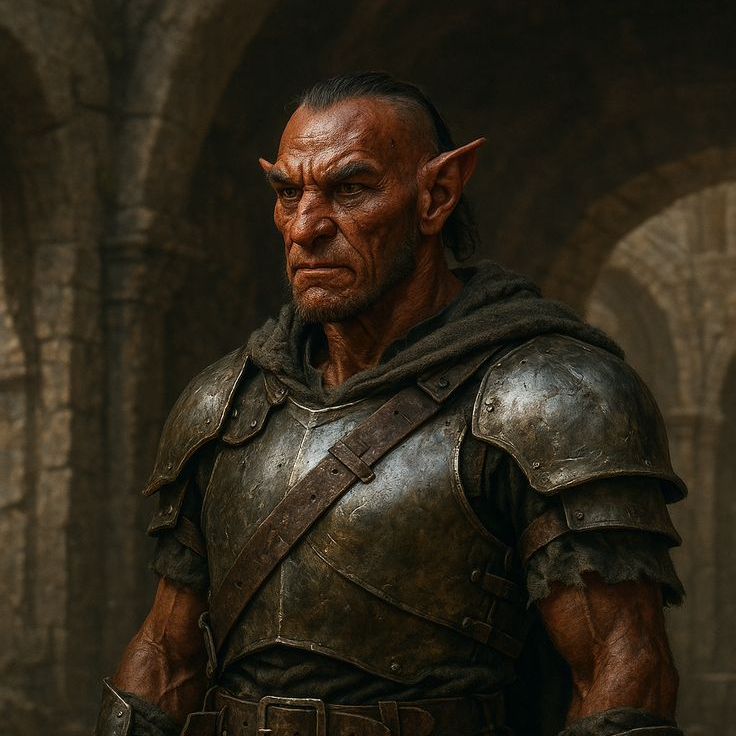
Rakkian Uruk Male
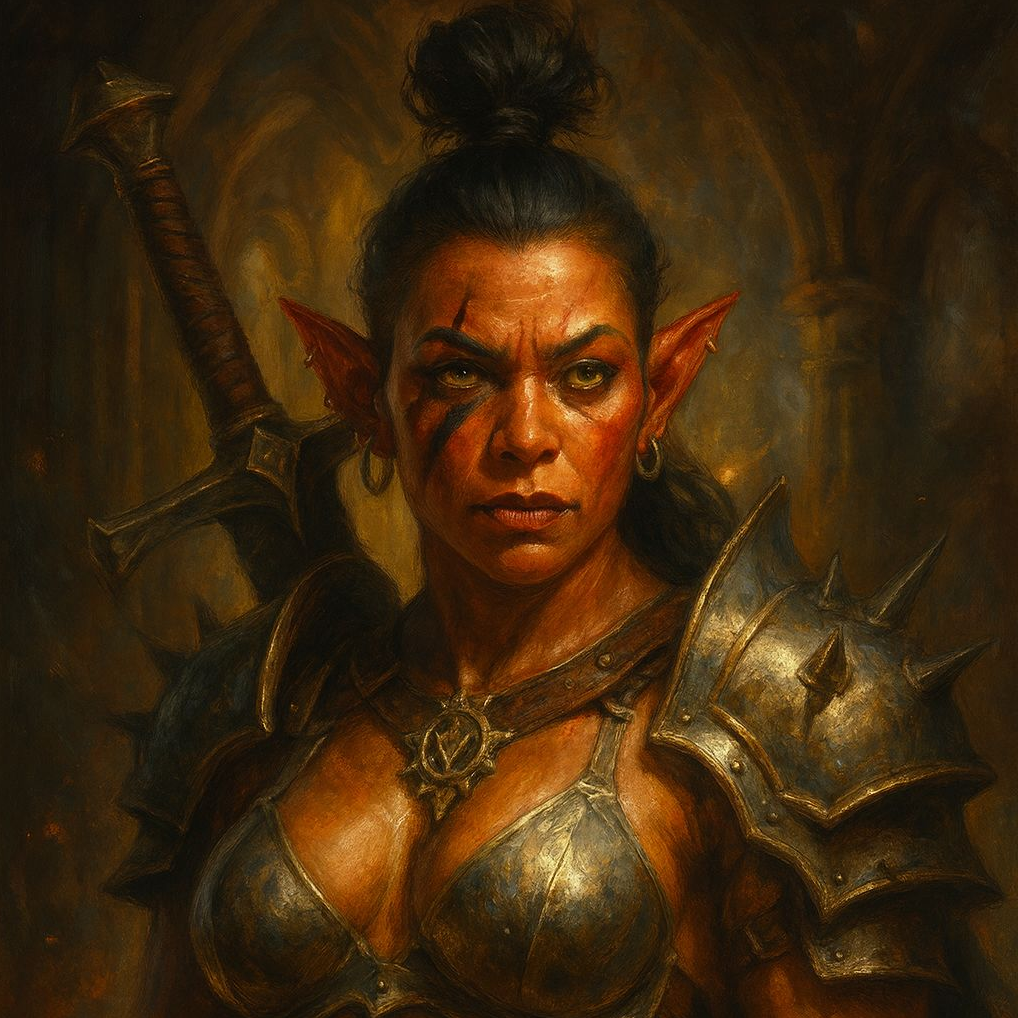
Rakkian Uruk Female
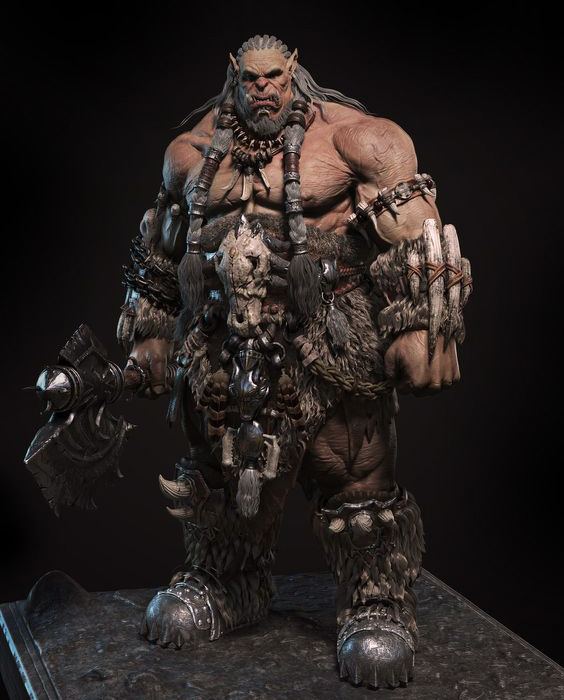
Teurgun Uruk "half-troll"
Comments