
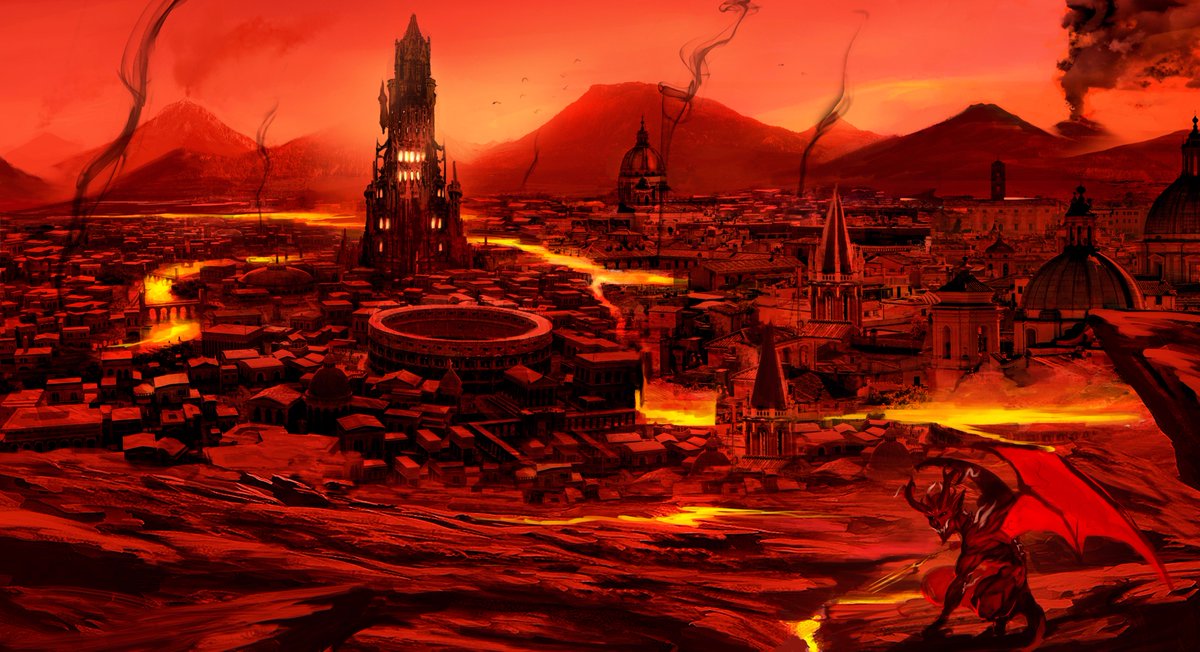
Hell
Hell, also referred to as the Demonic Plane, the Lower Plane, or Inferno, is the plane of demons and devils below Rubicon. It is inhabited by fiends and home to intense elemental activity and dangerous terrain.
Hades is one of the largest cities in Hell, perhaps the absolute largest. The city has around a 3 mile diameter, but its vertical architecture spans several layers of Hell. Hades begins in Avernus at ground level and extends all the way down to the water level of Stygia, taking up the entire ceiling-to-floor length of Dis, Minauros, and Phlegethos. The city is surrounded by a dense stone and metal wall and has several gates at each layer of hell, guarded and maintained fiercely by Amaymon’s soldiers. The city is also surrounded by several forts on both the ground level and ceiling of multiple layers. For these reasons, Hades is considered one of the safest cities in Hell. Still, safest doesn’t necessarily mean “safe” by most people’s standards; Amaymon and his soldiers have an extreme chokehold over the city, acting as police as well as guardians of the city’s inhabitants, and have a nasty reputation for brutality.
Hades is inhabited primarily by tieflings, making up the vast majority of the city’s population. Each layer that Hades connects to is considered a separate district of Hades; most notably, the Phlegethos district is where Molikroth spends most of his time, and where the Physt industrial complex is located. The complex is a massive weapon manufacturing plant where the natural lava flow of the layer is utilized for mass smithing and alloy creation. The Minauros district is where Bael spends the majority of her time; because of this, the district is known for its high entertainment and relative luxury compared to the rest of the city.
Tartarus is a large city located deep in Hell. The city has a diameter of around 4 miles and connects Malbolge to Cania. The city begins at ground level of Malbolge, extends ceiling-to-floor through Maladomni, and extends most of the way through Cania. The very bottom of the city has a gate leading into Nessus, but the city does not officially extend to that layer. The city has very few official gates, but is not walled off like other Hell cities are. This leaves the city very breathable, but open to attacks. The city still sees very little direct warfare, as the layers connected by the city are extremely dangerous environments and act as almost a natural defense for the city and its inhabitants, who are used to such rough environments. On the occasion that the city is attacked, Glasya’s hounds make quick work of tracking down any hostile encampments and disposing of the threat.
Tartarus is inhabited by a large population of both tieflings and goblinoids due to the friendship between Glasya and Anzu. The city is also home to a large number of yuan ti and gelugonids. The majority of the city sits in Maladomni, which is split into three districts: the Canopy, the Understory, and the Field districts. Otherwise, the city has a district for the top in Malbolge and the tunnels in Cania, named after their respective layers. Neither Glasya or Dagon is seen frequently within their city, but their presence is felt in other ways; as mentioned above, Glasya’s hounds patrol the city and its surroundings with extreme diligence, and Dagon’s illusory clones practically govern the city all on their own. The two most notable locations in Tartarus are the Deep Gate and the Magebloom Plantation. The Deep Gate is self explanatory; it’s a massive gate leading into Nessus at the very bottom of Tartarus. It’s one of very few ways to safely get to the floor of Nessus without having to drop from the barren ceiling of the layer and fall to the floor. The Magebloom Plantation is a massive plantation in the Field district that cultivates a variety of native plants, most notably the titular magebloom; this flower’s fruit absorbs large amounts of magical energy and are extremely useful as reagents, potent ingredients, or even organic arcane grenades.
Carceri is a large city located in the higher layers of Hell. The city has a diameter of around 5 miles and connects the floor of Dis to the ceiling of Minauros. The city is surrounded by a massive stone and ice dome with six gates leading into the city; one at each cardinal direction on the floor of Dis, one at the very top of the dome in Dis, and one at the very bottom in Minauros. This dome allows for the city to be fully protected from outside forces and weather, but makes the city feel oddly claustrophobic.
Carceri is inhabited by mostly Tieflings, with very few other races living within the dome. The majority of the city sits in Dis, which is split into four districts: the Northern, Eastern, Southern, and Western districts. The very bottom of the city is locally referred to as “The Bowl”, but it is not an official district. Mammon is very rarely seen anywhere but the Grand Mint; a massive Soul Coin production facility and emporium for all of Mammon’s trade activities, located near the western wall of the dome. Similarly, if Levinea is seen within the city, it is in the Elementalists Colosseum within The Bowl. This colosseum hosts tournaments of all kinds, but Levinea particularly favors mage battles or contests of the magical variety.
Acheron is a city positioned in various locations within Hell. The city has a very strange size as it is split into several sub-cities, each being more of a secluded town than a city, all connected with permanent portals. The largest of these cities, named the Heart of Acheron, is located within Cania’s winding caves. The heart has a main circular chamber that contains the portals to the other sub-cities, one for each additional layer of Hell, and a massive teleportation circle at its center for planar travel. Each sub-city is protected by its own means; some have walls, some are shrouded by illusions, some simply exist as they are without any obvious protections.
Acheron is inhabited by majority Tieflings, but is home to a relatively wide variety of inhabitants due to its spread out population. Each sub-city is also named as a part of Acheron, as if the city were alive: The Mind of Acheron is located in Avernus, The Fist of Acheron is located in Dis, The Eye of Acheron is located in Minauros, The Howl of Acheron is located in Phlegethos, The Bowels of Acheron is located in Stygia, The Bite of Acheron is located in Malbolge, The Will of Acheron is located in Maladomni, and The Whisper of Acheron is located in Nessus. Each sub-city is usually only referred to by its primary title (such as “The Fist”). Forrasis is almost always seen within his Timeless Archive located within The Heart; the Timeless Archive is a massive library and museum and hosts a massive collection of information, rivaled only by the Mouseion in Heaven.
Gehenna is a city located in the lower layers of Hell. The city has a diameter of around 2 miles and connects ceiling-to-floor in Malbolge to the ceiling of Maladomni. The city also has a significant water filtration pump connecting up into Stygia. The city is walled in by fire resistant black thorns growing upwards from a massive, warped tree in Maladomni, cultivated by Zahriel. The city has no gates, but its inhabitants are taught magic as a coming-of-age ceremony that can convince the thorns to part and let them through. Only women are taught this ritual; men are forbidden within the city’s walls, and boys raised in the city are prepared to leave the city for their own coming of age ceremony. Those of more androgynous or nonbinary identities are permitted to stay in the city only if they are given explicit permission to stay by Zahriel herself.
Gehenna is inhabited by mostly tieflings, with a noteworthy Kobold population nestled within the city’s walls. The city is split into three main districts: The Plume, which consists of the entirety of Malbolge, The Nest, which consists of the floor of Malbolge to the ceiling of Maladomni, and The Rot. The Rot is not technically a part of the city, but it is infamous even to those who have never set foot inside the city; at the very base of the twisting tree that makes up the city’s walls, within its hollowed out trunk, exists a permanent portal to Rubicon. It seeps mortality into the surroundings, making the area extremely dangerous to most inhabitants of the city. The reason Zahriel set up her city over this pit of mortality is to keep close contact with her coven and any other Rubiconian occultists or warlocks who are keen on making deals with her or her citizens. Zahriel is able to send her familiar Eryon through this portal without consequence, and so he handles any affairs of hers within Rubicon.
Ghukliak is a large city in Hell ruled over by Moloch. The city has a diameter of around 5 miles and sits on the floor of Malbolge. Ghukliak is multi-layered despite not connecting multiple layers of Hell; its highest point is roughly the vertical middle of the layer. The city has several layered walls that make it appear as a massive man-made volcano. It has three main gates, two on opposite sides on the floor of Malbolge and one at the very top of the city.
Ghukliak is inhabited by primarily goblinoids, with the occasional Gelugonid populating the city. The city is split into three districts: the outer layer, the middle layer, and the inner layer, each corresponding to how many walls separate that part of the city from the outside. Moloch is hardly ever seen inside his city; he is more often leading his massive warband to capture and destroy Heaven’s settlements across Hell. Instead, he has appointed several high generals to govern the city in his stead.
Nilbog is a city in Hell ruled over by Xezbeth. The city has a diameter of around 7 miles and sits on the floor of Avernus. Unlike many other cities in Hell, Nilbog is not layered vertically. Nilbog is protected mostly by the harsh environment in which it sits, as well as the wide open spaces leading up to the city allowing for any invaders to be seen from miles and miles away, but the city is also guarded by controlled, magical winds acting as a barrier for the city. It is still possible to pass these winds unscathed if you know where to walk, but this knowledge comes from experience with the city.
Nilbog is inhabited by primarily goblinoids, with the occasional Gelugonid or Sutauroid residing within the city. The city is split into several “neighborhoods” rather than districts. Xezbeth is most often seen in or around the Den of Sin, a specific neighborhood in Nilbog. This area isn’t a specific location; it changes whenever Xezbeth changes the meeting location. This place is where criminals from all over the plane are invited by Xezbeth herself to discuss work, trade, or information. Any who find the Den on their own are also welcome, provided they make their way in unobstructed through whatever trickery or techniques at their disposal.
Clangor is a city located in Minauros, ruled by Kabiel. The city has a diameter of around 4 miles and only has two layers. The city is also surrounded by a host of watchtowers, a wall made from frozen mud, and another several miles of a half frozen muddy-slush bog that keeps anyone without aerial movement stuck outside the city; or held as prisoners inside it. The city has only one main gate with several doorways intended to prevent entry or escape.
Clangor is inhabited by primarily goblinoids, but is “home” to a wide variety of races from across the three planes. The city is split into two main districts: the main district is simply referred to as “uptown” or “the city” by locals, whereas the other district is more infamously known as The Cage. Clangor is a massive hub for slave trade, and The Cage is where any not-so-willing inhabitants of the city reside, along with any individual who’s job revolves around the captives of the city. Several inhabitants of the city are raised and trained to take jobs that involve teaching or re-training slaves for manual labor elsewhere in Hell, usually for war. The most prestigious job for any local is to become a member of the Steelbiters; goblin warriors who train and ride Rankeion, ice-attuned wolf-deer creatures native to Minauros. These creatures are just large enough for the smaller goblin populations to comfortably ride and have evolved to traverse the frigid muck of Minauros with ease, making skilled Steelbiters the perfect soldiers to patrol the wastes beyond the city for any escapees or intruders heading their way on foot. Kabiel herself is usually found patrolling the streets of The Cage, personally ensuring that everything is kept to standard.
Bahgtru is an arboreal city in Maladomni. The city has a diameter of around 2 miles and has several layers between the massive trees that make up the city. Bahgtru is mainly protected by secrecy; very few know the exact location of the city, and it is mostly camouflaged by the leaves and vines of the trees making up the city. The city also has a strictly enforced volume standard; you can be punished for speaking too loudly or performing loud actions, which helps keep the city hidden despite its size.
Text city is inhabited by primarily blue goblinoids, but also has a sizable population of gelugonids and small groups of renegade celestials. The city is split into two main districts: the inner and outer city. Inner city is composed of rope bridges connecting structures built off of or inside the trees making up the city, and the outer city is composed of more temporary homes built from large leaves and vines that hang from the branches on the edges of the city. Barbatos is not often seen in the city itself; he is usually out with his soldiers organizing rescue attempts on Clangor or diplomatic missions between any celestial settlements that seek to avoid outright warfare.
Avalas is a floating city found in Stygia. The city has a diameter of around 3 miles and is partially underwater. Avalas is protected mainly by its location; only seafaring races have an easy time accessing the city. Boats are spotted easily from a distance, and the city’s own reputation helps keep even dedicated assailants from approaching without a plan.
Avalas is inhabited by primarily gray goblinoids, with a sizable population of kobolds and abishai that are built for aquatic or semi-aquatic lifestyles. The city is split into two main districts: the Deck and the Keel. The Deck is the larger of the two districts and makes up the above water layer of the city, whereas the Keel makes up the underwater portion of the city. Due to Nahemoth’s laws and teachings, the city has a nasty reputation for taking prisoners of war to sustain their cannibalistic lifestyle. Nahemoth is most often seen in her own quarters in the Deck, practicing rituals to protect her city or promote her own goals from the safety of her floating nation.
Palpitatia is a nomadic nation that roams Maladomni. They frequent the city of Tartarus for supplies or rest, but are more often than not hunting elsewhere in the depths of Maladomni.
The nation is inhabited by primarily goblinoids and gilded tieflings, but also has a sizable sutaurid population. They are accompanied by a large number of Glasya’s hellhounds, along with Glasya herself most times. Glasya and Anzu are often found together leading or planning for the next hunt; the nation prides itself on its hunting capabilities and often tries its luck against formidable targets, even sentient creatures such as ancient dragons if they have a reasonable bounty. After a hunt is complete, the most notable trophy part of the creature is taken, cleaned, and used as a grave marker to bury any hunters killed during the hunt. If no hunters are killed, the trophy is taken back to Tartarus instead. Anything else is used for food, weapons, armor, reagents, or any other material that can be crafted / refined and sold whenever they return to Tartarus.
Hrat’lor is a city in Phlegethos. The city has a diameter of around 1 mile and is located within a massive ravine, with layers of bridges connecting the tunnels that make up the majority of the city. The city itself has no walls, but the tunnels in the sides of the ravine have massive steel doors designed to be sealed in case of emergency. More often than not, the doors are sealed when lava floods the ravine, which also acts as a natural deterrent to invaders.
Hrat’lor is inhabited by primarily feathered goblinoids, but also contains a small mix of other demons. The city has no official districts, but each tunnel has its own local name, similar to neighborhoods or streets. Raum is most often seen in the valley of the city’s ravine organizing festivals, but is also just as often found in his own quarters doing research and studying mortality.
Kolohk is a city located in Phlegethos. The city resides on the side of a massive cliff face and is almost entirely vertical in size, with roads and buildings secured to the stone laterally. The city is also built into tunnels in the rock, providing defense in case of an emergency.
Kolohk is inhabited by primarily hobgoblins, with a sizable population of goat sutaurids also occupying the city. The city has no named distinct districts, but the wealthier, stronger inhabitants tend to live higher up on the cliff than the weaker or poorer inhabitants. The city’s hierarchy is based on battle prowess, thus your social ranking within the city is tied to your strength primarily. Hauras is most often seen in his Field of War, positioned at the very top of the city on the top of the cliff. The Field of War is a battle arena that Hauras uses to determine his city’s hierarchy.
Kikanuti is a nomadic nation that roams Dis. They do not have a specific location where they might rest or reside in-between travels, as they gain most of their resources through raids and thievery.
The nation is inhabited by primarily shadow bugbears, but has been known to take in any who are willing to participate in their way of life. Erlik themself is often seen planning their nation’s next raid target and travel route with their soldiers.
Drakurai is a massive palace located atop the highest known peak in Cania. The palace is also surrounded by a city of the same name, though most people only ever reference the palace itself. The palace is not guarded by any physical barriers, but only those who do not grasp the power of even the weakest of its inhabitants would ever launch an attack on the palace.
Drakurai’s city is almost entirely composed of chromatic dragons of Tiamat’s lineage. The palace itself is guarded by the strongest Ancient dragons, hand picked by Tiamat herself. There is also a substantial kobold and abishai population in the city surrounding Drakurai. Tiamat almost never leaves her palace, but will engage in regular sparring with her dragons to keep her own skills sharp.
Marduk is a city located in Stygia, situated atop a large glacier. The city is not guarded by any physical barriers, but only those who do not grasp the power of even the weakest of its inhabitants would ever launch an attack on the palace.
Marduk is almost entirely composed of metallic dragons, but has substantial kobold and abishai populations as well. The city itself was constructed by ice manipulation and turning that ice into stone, allowing for even hot-bodied metallic dragons to enjoy the comfort of the city. Bahamut is most often seen in his own home, which he calls his Hall.
Beirudh is a city located in Dis. The city has a diameter of a bit less than a mile and is surrounded by steep sandstone walls. Beirudh has several gates leading into the city decorated with elegant tapestries.
Beirudh is inhabited by primarily infernal jinnasi, with a substantial tiefling population residing inside the city as well. The city is split into several small neighborhoods, but has a large marketplace located in the center of the city known for its flashy advertisements and loud performers. Asmodeus is most often seen doing his own business within the marketplace or touring his personal guests around his city.
Hanaoi'lec is a city found in the deepest layer of Hell. It is built entirely within the coil of Leviathan, who herself acts as a wall around the city. Her dense hide resists the biting cold of the region and deflects the shifting glaciers that would otherwise threaten to flatten the city; Leviathan acts as a massive wall around Hanaoi'lec, and her body heat acts as a heater for the city within, allowing for a moderate, albeit still freezing, climate within the city.
Hanaoi'lec is inhabited by primarily yuan ti, with a smaller population of wooly sutaurids also making a home within the city. The city is relatively small, though there are distinct neighborhoods split by the social class of those that live within them. If Leviathan is not dormantly resting around the city, she takes small outings to exercise her massive form, but never strays far from the city itself.
Shaar is a city located in Avernus. The city has a diameter of around 1 mile and is built primarily underground, in tunnels through the sheer rock floor of the layer. This alone provides the city defense, but each entrance to the city is also diligently guarded.
Shaar is inhabited by exclusively gelugonids. Other races may travel there to trade, but the city’s design doesn’t support other races well, so none choose to stay. The city’s ruler, Belzebuth, is almost never seen within his own city and is much more interested in causing mischief elsewhere.
Vespili is a city located in Malbolge. The city has a diameter of around half a mile and is surrounded by a low wall with several guarded gates.
Vespili is inhabited by primarily cambion, with a notable tiefling population. The city is split into two distinct districts: the Valley of Lust and the Main district. The Main district is where the majority of the city resides; it is where any locals live and is the more “normal” side of the city. The Valley of Lust is a separated portion of the city, separated from the Main district by several roads. This part of the city is where most tourists go to visit; it is full of brothels, “maid cafe”s, and other forms of sexual entertainment made to sustain the high Incubus / Succubus / Proxibus population (No, there is not going to be any unsavory forms of entertainment here… this will be very VERY legal and consensual by real world standards. No nasty “gritty” interpretations). This is where Saleos is almost always found, flaunting his public image and taking his pick of thirsty tourists. Vureal, on the other hand, is almost always found in her matchmaker’s office in the middle of the Matchmaker’s Quarter; a neighborhood within the Main district that is almost entirely dedicated to the less notable tourist population, tourists seeking Vureal’s matchmaking advice.
Mahat is a city located in Phlegethos. The city has a diameter of around half a mile and is surrounded by a tall, polygonal wall. This wall also separates the districts inside the city. There are gates for each district, as well as gates inside the city between districts.
Mahat is inhabited entirely by sutaurids, with each district being home to a specific kind of sutaurid. These districts allow for social mingling between the different kinds of sutaurids, but Pashupati enforces a strict no-interracial relations law within their city, even pertaining to inter-sutaurid relations if they are not of the same animal traits. Pashupati themself is almost always seen at the center of his city, where he conducts judicial acts and hearings for his city.
In some versions of the legend, the Pit is a literal crevice reaching down to the lowest possible point in Hell. In others, it is a pillar of ice, or a gargantuan moving glacier. In some, where it's referred to as the Sigil, it is a massive arcane scar from whatever magic Lucifer performed to claim his seat of power over Hell. There are hundreds of stories that try to explain how Lucifer exactly got control over the plane, but none have any substantial backing.
Perception
Most fiends know of the other planes in bits and pieces. Devils are taught about the planes during childhood education, and for the most part demons include the planes in their own personal education. Most fiends believe Rubicon to be a no-man's land where the desperate go to die. Some see it as a freedom from the eternal war, some see its inhabitants as the key to their freedom from Heaven's assault, but most see it as a wasteland. Fiends consider Heaven a paradise ruled by a tyrannical theocratic oligarchy. They want nothing to do with the way Heaven is run and what they want to accomplish by Elohim’s will. Many think of its inhabitants as victims of their government, ignorant bystanders, or outright deliberate abusers. Very few compare the similarities of Heaven and Hell openly. Rubicon mostly views Hell as a place where people go to suffer. Plenty believe that reincarnation in Hell is a punishment for bad behavior and morality, others believe that their soul will be repurposed for evil if they die with allegiance to Hell. Few believe it's a better alternative to Heaven or even consider what Hell really is. Rubiconians see devils and demons as tormentors and manipulators, and though they are largely unaware of the extent of the war the standard rubiconian would side with an angel over a devil or demon. Heaven views Hell as a destructive pit of gangs, crime lords, and thugs. They believe most of Hell's inhabitants are groomed into monsters from a young age or are just naturally born horrible and violent. They think of the High Devils as a remnant of their own way of life and the last shred of hope that Hell might be worth saving, and the Demon Lords as the worst Hell has to offer.Terrain and Ecology
Hell’s ecosystem is the most foreign to our own; it contains terrain heavily charged with elemental energy; it is full of volcanic wastes, icy tundras, barren deserts, and electrified brines. Every ecosystem in Hell is amped up to an extreme or augmented with elemental energies. These elemental biomes are split up by nine vertical layers; each layer is connected by caverns and pits that drop downwards, with all but the first layer having a ceiling built from the earth of the layer above it. Most major cities in Hell are built in spaces where multiple layers are connected. The layers are as follows:- Avernus: The first layer, Avernus, is an arid plane of slate and fierce winds. Most of its biomes are made up of jagged cliff faces, miles of flat stone, and dust dunes. There is little to no plant life on the first layer, and most of the creatures that live on this layer have high mobility and flight to travel across the plains with ease. This is the only layer without a ceiling; the sky is pitch black, only interrupted by flying creatures, the occasional raincloud, or light on the horizon from sapient construction (fires or other non-natural light).
- Dis: The second layer, Dis, is a sandy desert filled with constant electric storms built from the eroded sand, dust, and galewinds that bleed in from the plane above it. Sand falls into the plane like waterfalls from the ceiling. Typical desert life exists here.
- Minauros: The third layer, Minauros, is a drastic flip from the first two; it is composed of frigid marshlands and swamps. There is much more plant and animal life in this layer; I won’t make an entire ecosystem list here, but imagine a swamp-like animal ecosystem with arctic traits like thick fur or blubber.
- Phlegethos: The fourth layer, Phlegethos, is a system of ravines and canyons filled with flowing lava. It is prone to constant rockfalls and volcanic floods. This layer is home to typical canyon ecosystems and fiery monsters.
- Stygia: The fifth layer, Stygia, is almost entirely filled with salty water; some parts of the layer have permanent ice sheets overtop of the sea, but others are warm or even hot. This plane is filled with sea life or coastal life where it can latch onto something.
- Malbolge: The sixth layer, Malbolge, is filled with black sand, lakes of lava, geysers of sulfuric smoke, and volcanic mountains. It contains fire-attuned coastal and mountainous life.
- Maladomni: The seventh layer, Maladomni, is a dark and twisting jungle. This layer is filled with poisonous and venomous plants and animals, and a low hanging layer of poisonous fog. Some places in this layer are simple deciduous forests, similar to what you might see in an old disney movie with a “dark woods”, and some of the plane has massive jungle trees that stretch to the layer’s ceiling.
- Cania: The eighth layer, Cania, is full of extreme terrain that jumps from tall peaks to low ditches; it is very easy to fall in Cania, and you fall miles when you do. The peaks are constantly attacked by fierce galewinds, and the pits are lined with lightning-charged crystals that electrocute the unprepared as they fall past them. This layer is occupied by a typical cave-like ecosystem.
- Nessus: The ninth and final layer, Nessus, is a near uninhabitable frozen wasteland. The land is a flat sheet of frozen ice and snow, interrupted only by massive glaciers sliding across the plane’s floor or avalanches from said glaciers crashing into one another. There is very little life that can survive in Nessus as there is no water that exists naturally in the plane, but what does live there mimics arctic ecosystems.
Central Deity
Hell's central deity is known by many names: he is mainly referred to as Lucifer, but also carries the names Satan, Belial, the Day Star, and the Serpent of Eden. Lucifer is a much more open and active deity than Heaven's central deity. He became Hell's central deity through mysterious means; very few beings even still live from the time Lucifer claimed divine status, and it's unknown how many of these beings had any part in that ascension. Lucifer is said to have several physical avatars that he uses to roam and manage the lower plane. His most common form is a red tiefling with black hair and yellow eyes, but he is also known to appear as a black kobold with red markings and yellow eyes, a king cobra yuan ti (any of the three ethnicities) with red markings and yellow eyes, or a hornless black dragon, netting him the snake-like reputation. While not all of Lucifer's motivations are clear, one thing is known - he hates Heaven and Elohim and wants to liberate his plane from their influence.Sapient Inhabitants
The playable races native to or regularly inhabiting Hell are tieflings, goblinoids, abishai, kobolds, infernal jinnasi, yuan ti, gelugonids, sutaurids, and cambions. Please check out the race page for more details on these races and their cultures. The non-playable* groups in Hell consist of High Devils, Demon Lords, and dragons.High Devils
High Devils are a group of strong devils who are in positions of power over Hell's devil populations. They are not one race in particular; any race can be a High Devil despite the devil/demon race distinctions, it is mostly a title that denotes strength, power, and social respect among the devils. A High Devil is usually powerful enough and well known enough to grant power to warlocks who pact with them or sorcerers born from their lineage, but this isn't always the case. It is common for both High Devils and Demon Lords to have an epithet that reflects their power or public perception; many have more than one. High Devils are a sort of pseudo-oligarchy of powerful individuals that control the devil populations as a group; lead and chosen by Lucifer, these devils are in control of around 60% of all Hell's population and handle law and jurisdiction, war efforts, public projects, and territorial disputes for the devils populations. There is at least one High Devil in control of each city in Hell, if not more. *If I allow a player to be a High Devil, it will be at greatly decreased power and detached from any community they were once a part of. Thus, there are no specific stats for a player High Devil and I will deal with that on an individual basis.Demon Lords
Like High Devils, Demon Lords are a group of strong demons who are in positions of power over Hell's demon populations. They are not one race in particular; any race can be a Demon Lord despite the devil/demon race distinctions, it is mostly a title that denotes strength, power, and social respect among the demons. A Demon Lord is usually powerful enough and well known enough to grant power to warlocks who pact with them or sorcerers born from their lineage, but this isn't always the case. It is common for both High Devils and Demon Lords to have an epithet that reflects their power or public perception; many have more than one. Unlike High Devils, Demon Lords do not formally associate with Lucifer and tend to run their own societies separate from Hell's overarching systems. They have their own cities and communities they manage, and typically do not share rule with other Demon Lords. Their system of rule is much more dictatorial than that of High Devils, with no-one else to decide how things are done but themselves. *If I allow a player to be a Demon Lord, it will be at greatly decreased power and detached from any community they were once a part of. Thus, there are no specific stats for a player Demon Lord and I will deal with that on an individual basis.Dragons
Dragons are large draconids that populate Hell. I have an entire page on draconids, so read about Dragons there.Politics
Hell is split into two main government groups: Lucifer and the High Devils, and the Demon Lords. The High Devils form a sort of pseudo-oligarchy of powerful individuals that control the devil populations as a group, known as the Devils' Union. These devils are in control of around 60% of all Hell's population and handle law and jurisdiction, war efforts, public projects, and territorial disputes for the devils populations. There is at least one High Devil in control of each city in Hell, sometimes two or three in the largest cities. Most of the time, each individual High Devil also has some personal control over their cities. This system is similar to Heaven's Celestial Circles, but with only one group of powerful individuals who are selected by the plane's deity instead of elected. Lucifer tends to let his High Devils do as they please, but has been known to appear personally to adjust things the way he wants them to be or issue personal orders. Because they are chosen by Lucifer, most High Devils gain power from their dedication to him and owe a lot of their strength to their piety. Demon Lords do not formally associate with Lucifer and run their own societies separate from the Devils' Union. They have their own cities and communities they manage, and typically do not share rule with other Demon Lords. Their system of rule is much more dictatorial than that of High Devils, with no-one else to decide how things are done but themselves. Still, most Demon Lords respect Lucifer and will listen to him when he appears before them with requests; it ends up being more of a bargain than an order, but he still usually gets what he wants from the arrangement even if he isn't in total control. Most of the plane is educated on the infinite war. Fiends believe that the efforts of the war are to fend off Heaven's assault and retain freedom from Heaven; they believe Heaven is tyranical and discourages free will and personal happiness for an ambiguous end goal that most of the plane has not agreed to. They believe that the eventual end goal is to truly cut off Heaven's influence from their plane and eventually from Rubicon as well, so that each plane can live free of the others interference. Most fiends believe all three planes are better off left to themselves. Demon Lords do not have a universal set of laws, but most have their own laws that each city abides by. High Devils have a universal code of laws, but these are very bare bones (things like "murder is illegal and don't steal"). Generally, Hell is much looser on law than the other planes, allowing for more rampant crime circles; the High Devils and Demon Lords tend to run their cities like crime lords themselves. I won't make an entire constitution here, you are welcome to assume general laws or make your own for your characters as you need.History
The earliest records for the entirety of Hell explain that the plane was once a home for the low class and prisoners of Heaven. The Celestial Circles were once in control of the plane, and they treated the residents of Hell with minimal to no respect. Lucifer was the first of it's residents to act out against Heaven; it is unknown still how, but Lucifer claimed divine status over the plane out of the blue and used that power to force Heaven's control out of Hell and take control of the plane himself. The Infinite War began when Heaven retaliated. It began with spies and plants sent to gather information on Lucifer's new state, and eventually evolved into assasinations and attempts to cripple what semblence of order Lucifer had begun to build in Hell. After these were driven out or defended against, Heaven began to unleash genuine warfare on Hell. Much of the literal battles of the war took place in Hell. Ever since, Hell has been trying to fend off Heaven's attempts at conquering Hell, believing themselves to be better off free of Heaven's influence. Once Hell had gotten used to a relatively consistent pattern of Heaven's attacks, they began seeking alternative methods to defend themselves or retain power in the wake of warfare. They quickly turned to Rubicon for this, knowing that the souls the plane churns out could be useful for empowering themselves and potentially gaining an edge on Heaven. A few brave individuals had to make landfall in the wasteland and give up their mortality to make it work, but they provided enough documentation on how to communicate with Hell through rituals that they could begin trading with Rubicon. Much of their work was convincing the inhabitants to give up their souls upon death in exchange for works of powerful and anonymous magical deeds. When Heaven caught wind of the trades, it quickly backfired; enough of Hell's residents had treated Rubicon with disrespect that when Heaven began campaigning against Hell, most of Rubicon sided with them. Still, Heaven's obsession with virtues and sins made dealing with devils and demons a more straightforward ask, and so not all trade stopped between Hell and Rubicon. Over time, as the talk of the war died down in Rubicon, dealings with Hell increased and both planes have had a stable and equal presence in Rubicon. Hell created the Left Eye of Rubicon after Heaven created the Right Eye. It is unclear how exactly the Left Eye came to be, but many claim that Lucifer employed the same strategy as Elohim and repurposed Elohim's own tactics. The Witches began as a group of rubiconians that enjoyed consistent bartering with Hell and had grown loyal to the High Devils they had been trading power with, allowing them to be easilly convinced to protect the Left Eye and keep it safe from Heaven's meddling. They have always been a more secretive organization, and remain in the shadows today. Roughly a thousand years prior to the events of the campaign, there were several wars between the draconic populations known as the Draconic Wars. These wars were over both territory and racist beliefs; Tiamat and her army of chromatic dragons began slaughtering gem dragons due to the belief that they were too closely related to Heaven's own coalts. Her sister, Kimaahet, attempted to oppose her, but Tiamat killed her without question. This incited the largest of the Draconic Wars, the Chromatic War, which ended in the surrender of most of Kimaahet's kin and Tiamat's victory. When Tiamat resumed her genocide, the metallic dragons fought against her in the Metallic Rebellion, but were largely unsuccessful. Most gem dragons were wiped out in these wars.Notable Locations
I won’t be making a map of Hell, but you are more than welcome to visit the plane during your adventures. The following list is a collection of well known locations, cities, geography, and rumored locations in Hell to fuel any interest you may have in exploring the plane. The majority of these locations are cities; cities are large cultural hubs in Hell, as not many groups choose to brave the harsh wilderness outside of the cities. Most of the size of these cities is vertical (primarily devil cities), and they can connect several layers of Hell together. They are also extremely well defended against Heaven’s attacks, unlike most open areas of Hell’s layers.Hades
Points of Interest: Physt Industrial Complex.Hades is one of the largest cities in Hell, perhaps the absolute largest. The city has around a 3 mile diameter, but its vertical architecture spans several layers of Hell. Hades begins in Avernus at ground level and extends all the way down to the water level of Stygia, taking up the entire ceiling-to-floor length of Dis, Minauros, and Phlegethos. The city is surrounded by a dense stone and metal wall and has several gates at each layer of hell, guarded and maintained fiercely by Amaymon’s soldiers. The city is also surrounded by several forts on both the ground level and ceiling of multiple layers. For these reasons, Hades is considered one of the safest cities in Hell. Still, safest doesn’t necessarily mean “safe” by most people’s standards; Amaymon and his soldiers have an extreme chokehold over the city, acting as police as well as guardians of the city’s inhabitants, and have a nasty reputation for brutality.
Hades is inhabited primarily by tieflings, making up the vast majority of the city’s population. Each layer that Hades connects to is considered a separate district of Hades; most notably, the Phlegethos district is where Molikroth spends most of his time, and where the Physt industrial complex is located. The complex is a massive weapon manufacturing plant where the natural lava flow of the layer is utilized for mass smithing and alloy creation. The Minauros district is where Bael spends the majority of her time; because of this, the district is known for its high entertainment and relative luxury compared to the rest of the city.
Tartarus
Points of Interest: Magebloom Plantation, Deep Gate.Tartarus is a large city located deep in Hell. The city has a diameter of around 4 miles and connects Malbolge to Cania. The city begins at ground level of Malbolge, extends ceiling-to-floor through Maladomni, and extends most of the way through Cania. The very bottom of the city has a gate leading into Nessus, but the city does not officially extend to that layer. The city has very few official gates, but is not walled off like other Hell cities are. This leaves the city very breathable, but open to attacks. The city still sees very little direct warfare, as the layers connected by the city are extremely dangerous environments and act as almost a natural defense for the city and its inhabitants, who are used to such rough environments. On the occasion that the city is attacked, Glasya’s hounds make quick work of tracking down any hostile encampments and disposing of the threat.
Tartarus is inhabited by a large population of both tieflings and goblinoids due to the friendship between Glasya and Anzu. The city is also home to a large number of yuan ti and gelugonids. The majority of the city sits in Maladomni, which is split into three districts: the Canopy, the Understory, and the Field districts. Otherwise, the city has a district for the top in Malbolge and the tunnels in Cania, named after their respective layers. Neither Glasya or Dagon is seen frequently within their city, but their presence is felt in other ways; as mentioned above, Glasya’s hounds patrol the city and its surroundings with extreme diligence, and Dagon’s illusory clones practically govern the city all on their own. The two most notable locations in Tartarus are the Deep Gate and the Magebloom Plantation. The Deep Gate is self explanatory; it’s a massive gate leading into Nessus at the very bottom of Tartarus. It’s one of very few ways to safely get to the floor of Nessus without having to drop from the barren ceiling of the layer and fall to the floor. The Magebloom Plantation is a massive plantation in the Field district that cultivates a variety of native plants, most notably the titular magebloom; this flower’s fruit absorbs large amounts of magical energy and are extremely useful as reagents, potent ingredients, or even organic arcane grenades.
Carceri
Points of Interest: Elementalists Colosseum, The Grand Mint.Carceri is a large city located in the higher layers of Hell. The city has a diameter of around 5 miles and connects the floor of Dis to the ceiling of Minauros. The city is surrounded by a massive stone and ice dome with six gates leading into the city; one at each cardinal direction on the floor of Dis, one at the very top of the dome in Dis, and one at the very bottom in Minauros. This dome allows for the city to be fully protected from outside forces and weather, but makes the city feel oddly claustrophobic.
Carceri is inhabited by mostly Tieflings, with very few other races living within the dome. The majority of the city sits in Dis, which is split into four districts: the Northern, Eastern, Southern, and Western districts. The very bottom of the city is locally referred to as “The Bowl”, but it is not an official district. Mammon is very rarely seen anywhere but the Grand Mint; a massive Soul Coin production facility and emporium for all of Mammon’s trade activities, located near the western wall of the dome. Similarly, if Levinea is seen within the city, it is in the Elementalists Colosseum within The Bowl. This colosseum hosts tournaments of all kinds, but Levinea particularly favors mage battles or contests of the magical variety.
Acheron
Points of Interest: The Timeless Archive.Acheron is a city positioned in various locations within Hell. The city has a very strange size as it is split into several sub-cities, each being more of a secluded town than a city, all connected with permanent portals. The largest of these cities, named the Heart of Acheron, is located within Cania’s winding caves. The heart has a main circular chamber that contains the portals to the other sub-cities, one for each additional layer of Hell, and a massive teleportation circle at its center for planar travel. Each sub-city is protected by its own means; some have walls, some are shrouded by illusions, some simply exist as they are without any obvious protections.
Acheron is inhabited by majority Tieflings, but is home to a relatively wide variety of inhabitants due to its spread out population. Each sub-city is also named as a part of Acheron, as if the city were alive: The Mind of Acheron is located in Avernus, The Fist of Acheron is located in Dis, The Eye of Acheron is located in Minauros, The Howl of Acheron is located in Phlegethos, The Bowels of Acheron is located in Stygia, The Bite of Acheron is located in Malbolge, The Will of Acheron is located in Maladomni, and The Whisper of Acheron is located in Nessus. Each sub-city is usually only referred to by its primary title (such as “The Fist”). Forrasis is almost always seen within his Timeless Archive located within The Heart; the Timeless Archive is a massive library and museum and hosts a massive collection of information, rivaled only by the Mouseion in Heaven.
Gehenna
Points of Interest: The Rot.Gehenna is a city located in the lower layers of Hell. The city has a diameter of around 2 miles and connects ceiling-to-floor in Malbolge to the ceiling of Maladomni. The city also has a significant water filtration pump connecting up into Stygia. The city is walled in by fire resistant black thorns growing upwards from a massive, warped tree in Maladomni, cultivated by Zahriel. The city has no gates, but its inhabitants are taught magic as a coming-of-age ceremony that can convince the thorns to part and let them through. Only women are taught this ritual; men are forbidden within the city’s walls, and boys raised in the city are prepared to leave the city for their own coming of age ceremony. Those of more androgynous or nonbinary identities are permitted to stay in the city only if they are given explicit permission to stay by Zahriel herself.
Gehenna is inhabited by mostly tieflings, with a noteworthy Kobold population nestled within the city’s walls. The city is split into three main districts: The Plume, which consists of the entirety of Malbolge, The Nest, which consists of the floor of Malbolge to the ceiling of Maladomni, and The Rot. The Rot is not technically a part of the city, but it is infamous even to those who have never set foot inside the city; at the very base of the twisting tree that makes up the city’s walls, within its hollowed out trunk, exists a permanent portal to Rubicon. It seeps mortality into the surroundings, making the area extremely dangerous to most inhabitants of the city. The reason Zahriel set up her city over this pit of mortality is to keep close contact with her coven and any other Rubiconian occultists or warlocks who are keen on making deals with her or her citizens. Zahriel is able to send her familiar Eryon through this portal without consequence, and so he handles any affairs of hers within Rubicon.
Ghukliak
Points of Interest: None.Ghukliak is a large city in Hell ruled over by Moloch. The city has a diameter of around 5 miles and sits on the floor of Malbolge. Ghukliak is multi-layered despite not connecting multiple layers of Hell; its highest point is roughly the vertical middle of the layer. The city has several layered walls that make it appear as a massive man-made volcano. It has three main gates, two on opposite sides on the floor of Malbolge and one at the very top of the city.
Ghukliak is inhabited by primarily goblinoids, with the occasional Gelugonid populating the city. The city is split into three districts: the outer layer, the middle layer, and the inner layer, each corresponding to how many walls separate that part of the city from the outside. Moloch is hardly ever seen inside his city; he is more often leading his massive warband to capture and destroy Heaven’s settlements across Hell. Instead, he has appointed several high generals to govern the city in his stead.
Nilbog
Points of Interest: Den of Sin.Nilbog is a city in Hell ruled over by Xezbeth. The city has a diameter of around 7 miles and sits on the floor of Avernus. Unlike many other cities in Hell, Nilbog is not layered vertically. Nilbog is protected mostly by the harsh environment in which it sits, as well as the wide open spaces leading up to the city allowing for any invaders to be seen from miles and miles away, but the city is also guarded by controlled, magical winds acting as a barrier for the city. It is still possible to pass these winds unscathed if you know where to walk, but this knowledge comes from experience with the city.
Nilbog is inhabited by primarily goblinoids, with the occasional Gelugonid or Sutauroid residing within the city. The city is split into several “neighborhoods” rather than districts. Xezbeth is most often seen in or around the Den of Sin, a specific neighborhood in Nilbog. This area isn’t a specific location; it changes whenever Xezbeth changes the meeting location. This place is where criminals from all over the plane are invited by Xezbeth herself to discuss work, trade, or information. Any who find the Den on their own are also welcome, provided they make their way in unobstructed through whatever trickery or techniques at their disposal.
Clangor
Points of Interest: The Cage.Clangor is a city located in Minauros, ruled by Kabiel. The city has a diameter of around 4 miles and only has two layers. The city is also surrounded by a host of watchtowers, a wall made from frozen mud, and another several miles of a half frozen muddy-slush bog that keeps anyone without aerial movement stuck outside the city; or held as prisoners inside it. The city has only one main gate with several doorways intended to prevent entry or escape.
Clangor is inhabited by primarily goblinoids, but is “home” to a wide variety of races from across the three planes. The city is split into two main districts: the main district is simply referred to as “uptown” or “the city” by locals, whereas the other district is more infamously known as The Cage. Clangor is a massive hub for slave trade, and The Cage is where any not-so-willing inhabitants of the city reside, along with any individual who’s job revolves around the captives of the city. Several inhabitants of the city are raised and trained to take jobs that involve teaching or re-training slaves for manual labor elsewhere in Hell, usually for war. The most prestigious job for any local is to become a member of the Steelbiters; goblin warriors who train and ride Rankeion, ice-attuned wolf-deer creatures native to Minauros. These creatures are just large enough for the smaller goblin populations to comfortably ride and have evolved to traverse the frigid muck of Minauros with ease, making skilled Steelbiters the perfect soldiers to patrol the wastes beyond the city for any escapees or intruders heading their way on foot. Kabiel herself is usually found patrolling the streets of The Cage, personally ensuring that everything is kept to standard.
Bahgtru
Points of Interest: None.Bahgtru is an arboreal city in Maladomni. The city has a diameter of around 2 miles and has several layers between the massive trees that make up the city. Bahgtru is mainly protected by secrecy; very few know the exact location of the city, and it is mostly camouflaged by the leaves and vines of the trees making up the city. The city also has a strictly enforced volume standard; you can be punished for speaking too loudly or performing loud actions, which helps keep the city hidden despite its size.
Text city is inhabited by primarily blue goblinoids, but also has a sizable population of gelugonids and small groups of renegade celestials. The city is split into two main districts: the inner and outer city. Inner city is composed of rope bridges connecting structures built off of or inside the trees making up the city, and the outer city is composed of more temporary homes built from large leaves and vines that hang from the branches on the edges of the city. Barbatos is not often seen in the city itself; he is usually out with his soldiers organizing rescue attempts on Clangor or diplomatic missions between any celestial settlements that seek to avoid outright warfare.
Avalas
Points of Interest: None.Avalas is a floating city found in Stygia. The city has a diameter of around 3 miles and is partially underwater. Avalas is protected mainly by its location; only seafaring races have an easy time accessing the city. Boats are spotted easily from a distance, and the city’s own reputation helps keep even dedicated assailants from approaching without a plan.
Avalas is inhabited by primarily gray goblinoids, with a sizable population of kobolds and abishai that are built for aquatic or semi-aquatic lifestyles. The city is split into two main districts: the Deck and the Keel. The Deck is the larger of the two districts and makes up the above water layer of the city, whereas the Keel makes up the underwater portion of the city. Due to Nahemoth’s laws and teachings, the city has a nasty reputation for taking prisoners of war to sustain their cannibalistic lifestyle. Nahemoth is most often seen in her own quarters in the Deck, practicing rituals to protect her city or promote her own goals from the safety of her floating nation.
Palpitatia
Points of Interest: None.Palpitatia is a nomadic nation that roams Maladomni. They frequent the city of Tartarus for supplies or rest, but are more often than not hunting elsewhere in the depths of Maladomni.
The nation is inhabited by primarily goblinoids and gilded tieflings, but also has a sizable sutaurid population. They are accompanied by a large number of Glasya’s hellhounds, along with Glasya herself most times. Glasya and Anzu are often found together leading or planning for the next hunt; the nation prides itself on its hunting capabilities and often tries its luck against formidable targets, even sentient creatures such as ancient dragons if they have a reasonable bounty. After a hunt is complete, the most notable trophy part of the creature is taken, cleaned, and used as a grave marker to bury any hunters killed during the hunt. If no hunters are killed, the trophy is taken back to Tartarus instead. Anything else is used for food, weapons, armor, reagents, or any other material that can be crafted / refined and sold whenever they return to Tartarus.
Hrat'lor
Points of Interest: None.Hrat’lor is a city in Phlegethos. The city has a diameter of around 1 mile and is located within a massive ravine, with layers of bridges connecting the tunnels that make up the majority of the city. The city itself has no walls, but the tunnels in the sides of the ravine have massive steel doors designed to be sealed in case of emergency. More often than not, the doors are sealed when lava floods the ravine, which also acts as a natural deterrent to invaders.
Hrat’lor is inhabited by primarily feathered goblinoids, but also contains a small mix of other demons. The city has no official districts, but each tunnel has its own local name, similar to neighborhoods or streets. Raum is most often seen in the valley of the city’s ravine organizing festivals, but is also just as often found in his own quarters doing research and studying mortality.
Kolohk
Points of Interest: Field of War.Kolohk is a city located in Phlegethos. The city resides on the side of a massive cliff face and is almost entirely vertical in size, with roads and buildings secured to the stone laterally. The city is also built into tunnels in the rock, providing defense in case of an emergency.
Kolohk is inhabited by primarily hobgoblins, with a sizable population of goat sutaurids also occupying the city. The city has no named distinct districts, but the wealthier, stronger inhabitants tend to live higher up on the cliff than the weaker or poorer inhabitants. The city’s hierarchy is based on battle prowess, thus your social ranking within the city is tied to your strength primarily. Hauras is most often seen in his Field of War, positioned at the very top of the city on the top of the cliff. The Field of War is a battle arena that Hauras uses to determine his city’s hierarchy.
Kikanuti
Points of Interest: None.Kikanuti is a nomadic nation that roams Dis. They do not have a specific location where they might rest or reside in-between travels, as they gain most of their resources through raids and thievery.
The nation is inhabited by primarily shadow bugbears, but has been known to take in any who are willing to participate in their way of life. Erlik themself is often seen planning their nation’s next raid target and travel route with their soldiers.
Drakurai
Points of Interest: None.Drakurai is a massive palace located atop the highest known peak in Cania. The palace is also surrounded by a city of the same name, though most people only ever reference the palace itself. The palace is not guarded by any physical barriers, but only those who do not grasp the power of even the weakest of its inhabitants would ever launch an attack on the palace.
Drakurai’s city is almost entirely composed of chromatic dragons of Tiamat’s lineage. The palace itself is guarded by the strongest Ancient dragons, hand picked by Tiamat herself. There is also a substantial kobold and abishai population in the city surrounding Drakurai. Tiamat almost never leaves her palace, but will engage in regular sparring with her dragons to keep her own skills sharp.
Marduk
Points of Interest: Bahamut’s Hall.Marduk is a city located in Stygia, situated atop a large glacier. The city is not guarded by any physical barriers, but only those who do not grasp the power of even the weakest of its inhabitants would ever launch an attack on the palace.
Marduk is almost entirely composed of metallic dragons, but has substantial kobold and abishai populations as well. The city itself was constructed by ice manipulation and turning that ice into stone, allowing for even hot-bodied metallic dragons to enjoy the comfort of the city. Bahamut is most often seen in his own home, which he calls his Hall.
Beirudh
Points of Interest: Marketplace.Beirudh is a city located in Dis. The city has a diameter of a bit less than a mile and is surrounded by steep sandstone walls. Beirudh has several gates leading into the city decorated with elegant tapestries.
Beirudh is inhabited by primarily infernal jinnasi, with a substantial tiefling population residing inside the city as well. The city is split into several small neighborhoods, but has a large marketplace located in the center of the city known for its flashy advertisements and loud performers. Asmodeus is most often seen doing his own business within the marketplace or touring his personal guests around his city.
Hanaoi'lec
Points of Interest: Leviathan.Hanaoi'lec is a city found in the deepest layer of Hell. It is built entirely within the coil of Leviathan, who herself acts as a wall around the city. Her dense hide resists the biting cold of the region and deflects the shifting glaciers that would otherwise threaten to flatten the city; Leviathan acts as a massive wall around Hanaoi'lec, and her body heat acts as a heater for the city within, allowing for a moderate, albeit still freezing, climate within the city.
Hanaoi'lec is inhabited by primarily yuan ti, with a smaller population of wooly sutaurids also making a home within the city. The city is relatively small, though there are distinct neighborhoods split by the social class of those that live within them. If Leviathan is not dormantly resting around the city, she takes small outings to exercise her massive form, but never strays far from the city itself.
Shaar
Points of Interest: None.Shaar is a city located in Avernus. The city has a diameter of around 1 mile and is built primarily underground, in tunnels through the sheer rock floor of the layer. This alone provides the city defense, but each entrance to the city is also diligently guarded.
Shaar is inhabited by exclusively gelugonids. Other races may travel there to trade, but the city’s design doesn’t support other races well, so none choose to stay. The city’s ruler, Belzebuth, is almost never seen within his own city and is much more interested in causing mischief elsewhere.
Vespili
Points of Interest: Valley of Lust, Matchmaker’s Quarter.Vespili is a city located in Malbolge. The city has a diameter of around half a mile and is surrounded by a low wall with several guarded gates.
Vespili is inhabited by primarily cambion, with a notable tiefling population. The city is split into two distinct districts: the Valley of Lust and the Main district. The Main district is where the majority of the city resides; it is where any locals live and is the more “normal” side of the city. The Valley of Lust is a separated portion of the city, separated from the Main district by several roads. This part of the city is where most tourists go to visit; it is full of brothels, “maid cafe”s, and other forms of sexual entertainment made to sustain the high Incubus / Succubus / Proxibus population (No, there is not going to be any unsavory forms of entertainment here… this will be very VERY legal and consensual by real world standards. No nasty “gritty” interpretations). This is where Saleos is almost always found, flaunting his public image and taking his pick of thirsty tourists. Vureal, on the other hand, is almost always found in her matchmaker’s office in the middle of the Matchmaker’s Quarter; a neighborhood within the Main district that is almost entirely dedicated to the less notable tourist population, tourists seeking Vureal’s matchmaking advice.
Mahat
Points of Interest: None.Mahat is a city located in Phlegethos. The city has a diameter of around half a mile and is surrounded by a tall, polygonal wall. This wall also separates the districts inside the city. There are gates for each district, as well as gates inside the city between districts.
Mahat is inhabited entirely by sutaurids, with each district being home to a specific kind of sutaurid. These districts allow for social mingling between the different kinds of sutaurids, but Pashupati enforces a strict no-interracial relations law within their city, even pertaining to inter-sutaurid relations if they are not of the same animal traits. Pashupati themself is almost always seen at the center of his city, where he conducts judicial acts and hearings for his city.
Ruamoko
Ruamoko is a massive volcano located in Malbolge where a large number of fire elementals reside. The volcano is often mistaken for Ghukliak from afar. Not much is known about the inside of the volcano, as no being can enter without immunity to the volcano’s heat.Enlilon
Enlilon is a massive storm in Avernus that wreaks havoc across the layer. Air and storm elementals travel within the massive storm, and any permanent settlements in Avernus know to watch for the elemental whirlwind’s path of destruction.Kamussano
Kamussano is a massive whirlpool located in the depths of Stygia. It is seen as the cousin of Enlilon, and has similar properties; water and storm elementals travel with it, and any permanent settlements in Stygia know to watch for the elemental whirlpool’s path of destruction.Corycia
Corycia is a legendary cavern hypothesized to exist somewhere in Cania. It is described as a lush paradise, with plants that emit light like a sun, aquifers of pure and clean water, and fruits that produce food year round. The location is only rumored to exist.Pit of Creation
The Pit of Creation is the hypothesized location where Lucifer became the central deity of Hell. It is only rumored to exist and is not a confirmed location in Hell. It is also sometimes referred to as the Sigil of Creation depending on the belief of the person describing the location. Most who argue its existence agree that the Pit is somewhere in Nessus, but the exact location is unknown and the details of the location change depending on the telling.In some versions of the legend, the Pit is a literal crevice reaching down to the lowest possible point in Hell. In others, it is a pillar of ice, or a gargantuan moving glacier. In some, where it's referred to as the Sigil, it is a massive arcane scar from whatever magic Lucifer performed to claim his seat of power over Hell. There are hundreds of stories that try to explain how Lucifer exactly got control over the plane, but none have any substantial backing.

On everyone mom's soul we're spending a month at the Vespili incubus lounges
"Lie above"....more like YES PLEASE!!!
i need to be dominated by a 6'1 cambion with a moustache, circle-framed glasses, a mod cut, and patchwork tattoos please please please