
Floatstone Keep
Bastion of the River Besk - Bane of the Beaverfolk
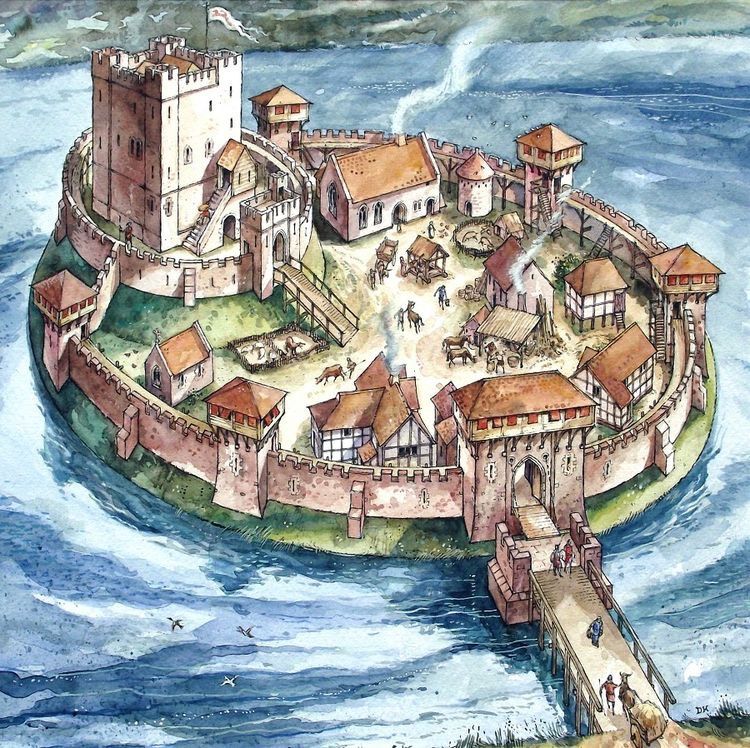
Floatstone Keep is a small holdfast in Throne's lower Electrum Ring on the city's western side. The keep is located on a small rocky island in the middle of the River Besk, which cuts through the district. The keep was constructed in 8557 by Electrum Ring Councilor Heinrich Goggenspenk to defend the city during the then-raging Beaverfolk Rebellion of 8556. After successfully repelling a large invading force on Dying Light 8557, the keep became a symbol of the resilience of the peoples of the Electrum Ring, and the district itself. Despite becoming a ruin when the city fully reallocated funding for its garrison in 8980, the keep remains a symbol of the district, even as the Electrum Ring has fallen into varying states of urban decay during the various crises of the 91st century. The keep was bequeathed to the group known as The Partycrashers in 9048 by the King of the Harvest for their valor in defending the King and royal court from would-be assassins. In mid-Planting 9048, The Partycrashers began the reconstruction of the ruined sections for their future habitation, employing several squatters from the nearby Bokki Dish Amphitheater as operational staff.
Design
Floatstone Keep encompasses the near-entirety of Floatstone Isle, a round rocky island roughly 55,000 square feet in area. The island has a high content of floatstone, from which the island derives its name. Curtain walls form a perimeter around the island, which contains a small courtyard, the main three-story keep, modest barracks, and small lots for operational facilities. The main gate extends from the southern side of the island to the south shore of the mainland. A small postern gate is located at the rear of the keep on its northern shore, leading down to the rocky edges of the island. The original structures are built from local Beskwood and blocks of white Vizenian fog granite, while repaired sections are constructed of more common base granite.
Special Properties
The wooden components are made from salvaged Beskwood, driftwood that has flowed downstream from the lowest levels of the Great Raft of the River Besk. Beskwood is old growth driftwood partially infused with debris from Velnor that line the lowest sediment of the Besk laid down by the Starfall. As such, the wood is uniquely resilient and is extremely toxic if consumed; this was intentially chosen during construction to counter the Beaverfolk revels' tendency to gnaw into enemy fortifications.
Beskwood also has the capacity to augment the flow of magic. Structures built from Beskwood are sometimes known as Trubanni Cages, which are capable of augmenting spells and magical effects. As such, spells cast within the walls of Floatstone Keep are known to behave erratically and unpredictably. It is unknown if this was an intential design decision when constructing keep.
Beskwood also has the capacity to augment the flow of magic. Structures built from Beskwood are sometimes known as Trubanni Cages, which are capable of augmenting spells and magical effects. As such, spells cast within the walls of Floatstone Keep are known to behave erratically and unpredictably. It is unknown if this was an intential design decision when constructing keep.
Alterations
The new construction in 9048 by order of the King of the Harvest on behalf of the Partycrashers is to include a garden, a storehouse, and a restored barracks with expanded accommodations.
Architecture
Floatstone Keep is constructed in a style consistent with fortresses built in the mid 9th millennium, a Hrimmian Glacier style, which cuts white stone with its outer walls being polished smooth and its rooves in steep conical designs to prevent scaling by enemy forces. However, after it was abandoned, many of its defining features fell into disrepair and became less functional. All repairs conducted in 9048 were done in the approved Kingdom Corps of Engineers' Frontier Fort style, far flatter and rougher than its original style with simple thatched rooves, with wattle and daub support facilities within the courtyard.
History
Construction
Amidst the onset of the Beaverfolk Rebellion of 8556, it became evident that the turmoil would boil over into eastern Vizenia, and the Kingdom began to deploy the full might of the militaries in the region to quell them. However, rivers were difficult to fortify as the Great Raft of the River Besk provided active cover for the majority of the Besk's span up to Throne. As the Kingdom armed forces attempted to predict egress points from the Raft along its span, several cities were left to fend for themselves. The lower rings of Throne were no exception, especially ones through which the River Besk flowed. The Electrum Ring on the city's west side was wracked with panic as it was evenly split by the river; in response, the district's conselor, Heinrich Goggenspenk, took it upon himself to finance a fortification in the river on the rocky Floatstone Isle in 8557.Goggenspenk's construction spared no expense, incorporating Vizenian fog granite, known for its resiliency to impacts, as the main material for the curtain walls, tower, and holdfast. Additionally, he purchased rare timbers of Beskwood for inner buildings and inner wall frames due to its known toxic properties when ingested, and possibly due to its mysterious effects upon spells cast upon and near it. A major aspect of the construction was using the porous floatstone to create a chamber of filtered water and a water wheel within the heart of the island’s rocky interior using the waterflow of the river as a natural driver. While constructing the keep, Goggenspenk began recruiting militia members to operate and defend it. He secured several smiths, farmers, and traders from the district and armed them with the finest bows, spears, and swords he could afford. The laborers worked day and night for several months, completing the construction on 3 Dying Light 8557.
The Sack of Throne
Five days after fully manning the keep, a rebel force led by Frink Castor led a sacking of Throne from the west. The outermost districts of Throne which touched the Besk, mostly of wattle and daub construction, were caught offguard and burnt or eaten by the invading Beaverfolk. As the rebels pushed up the Besk deeper into the city, they passed into the Electrum Ring. Goggenspenk deployed riverspanning nets bronze mail links to the northern and southern shore, forcing the Beaverfolk to bottleneck on Floatstone Isle. As the rebels emerged to destroy the nets, the 30 militia members of the keep rained down arrows and spellfire.
The bottleneck and subsequent Crush of Beaverfolk in the Besk against the keep’s walls led to hundreds of casualties in the first hour. Frink Castor, informed of the massacre happening upriver, attempted to lead a land incursion to break into the Keep itself. The costly land incursion led to hundreds of further Beaverfolk fatalities before they arrived at the castle gate. Upon attempting to gnaw their way through the fortress door, the rebels became violently ill. The drawbridge held, and the ill Beaverfolk began to vomit into the river where their comrades were also assaulting the keep. This resulted in a spreading chain reaction of illness in the vanguard, an event now known as the Spew on the Besk.
Frink Castor attempted a final scaling of the walls using his fallen comrades as a makeshift ladder. He is said to have reached the battlments when he was met by Councilor Goggenspenk, who engaged in one-on-one combat. Goggenspenk, according to reports, avoided the lethal tail smacks from Castor and wore him down before stabbing him with his Beskwood spear through the neck. Castor was said to have then fallen into the river on the east side of the castle, flowing out to sea. He was never seen again, and his men began an immediate retreat as word reached them that their leader had fallen.
Symbol of the Electrum Ring
Throne, now safe from the rebels, celebrated the victory at Floatstone Keep and the efforts of its defenders. The Electrum Ring became a symbol of the city’s resilience, and an important turning point in the Rebellion. Shortly after, the rebel leaders agreed on terms of the end of hostilities. Even at the advent of peace, Floatstone Keep remained as a bastion in the case of further rebellions. Goggenspenk was made a member of the Monarch’s Bulwark by the King of the Broken Embankment, and he continued to man Floatstone Keep until his death in 8590.
Floatstone Keep became a popular tourist destination for those who lived through, remembered, or had ancestors who fought in the Rebellion. The Filter Chamber became a central water source for the Electrum Ring, and led to a great deal of prosperity for the district. Several major landmarks for the 8600s and 8700s were found in the district and the Electrum Ring incorporated Floatstone Keep into its heraldry. For nearly three centuries, the keep remained a symbol of a vibrant district in Throne.
Loss of Relevance and Abandonment
As tensions cooled between the Beaverfolk of the Besk, the necessity of Floatstone Keep became questionable. The lack of any hostile force on the mainland of southern Sinderlan led to many suggesting the Keep be dismantled to reduce costs born by the Electrum Ring, which was attempting to maintain thousands of public buildings. At the suggestion, the crown rotated the Bulwark posting to another location in the city in 8866 and suggested the keep be operated on a volunteer basis.
By the end of the 90th century, the structure was manned by a single symbolic volunteer militia member, an elderly tortle named Berkus. On his death in 8980, the Keep was abandoned. The now-delapidated Electrum Ring transferred administration of the island to the crown proper in an a further attempt to reduce on costs, after which it remained untouched for half a century aside from the occasional squatter or trespasser.
Restoration for The Partycrashers
In 9048, the now-ruined Keep was bequeathed to The Partycrashers for their rescue of the King of the Harvest. Construction began to restore the Floatstone Keep to its former glory. Several citizens of the dilapidated Electrum Ring were brought on as hirelings to run the day-to-day operations for the adventuring group in their absence.
RUINED STRUCTURE
8980
8980
Founding Date
8557
Alternative Names
Beaverfolks' Bane, Bastion of the River Besk, Holdfast of the Bloody Castor
Type
Keep
Parent Location
Owner
Additional Rulers/Owners
Owning Organization

Comments