
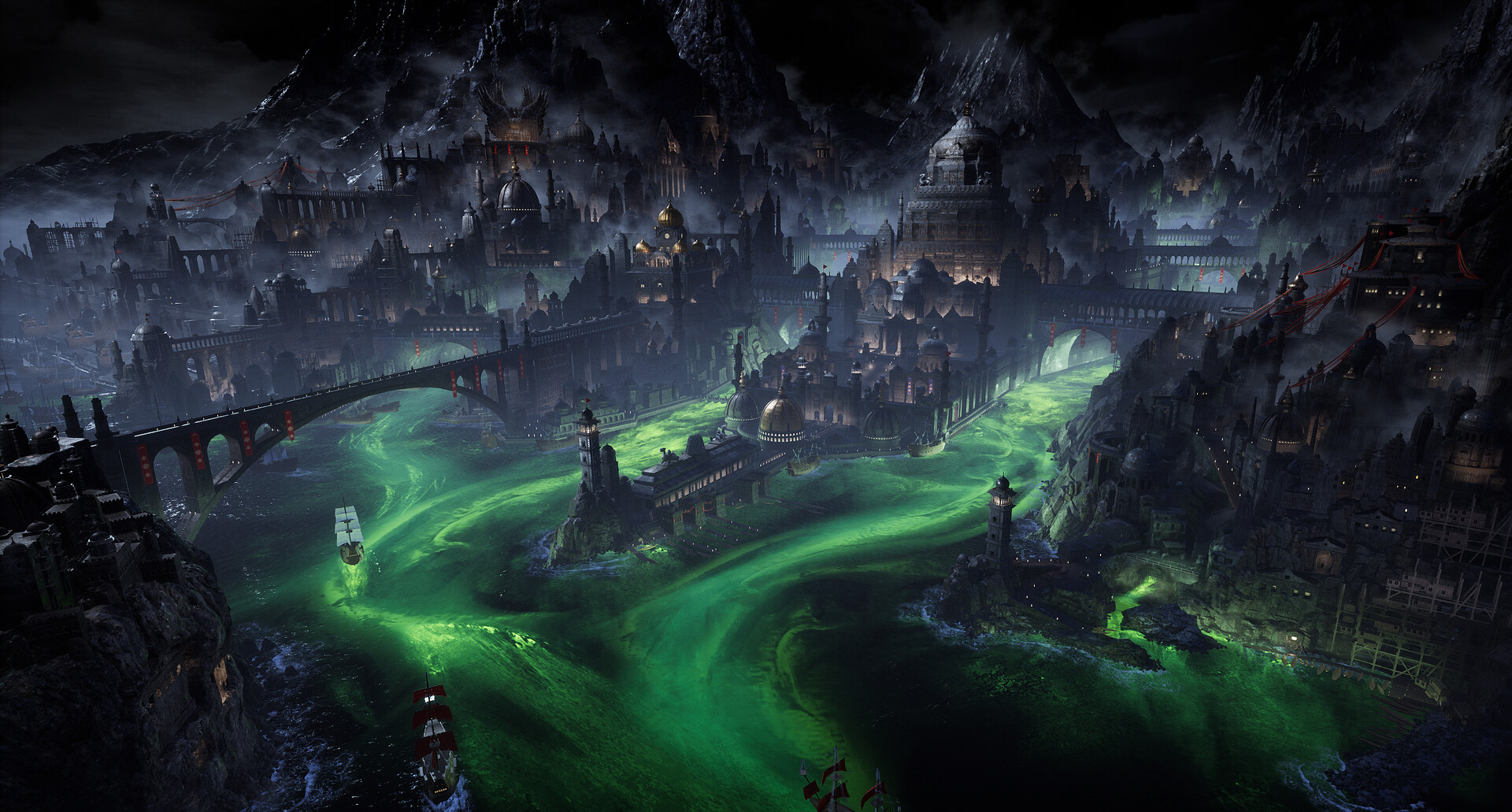
Bravil
Cyrodiil's largest shipping hub controls the Niben Bay, a unique brackish environment with access to the Nibens many tributaries. The basin acts as a filter, protecting the upstream Imperial City from the corrosive salt water of the Niben Sound.
Though it feeds much of Cyrodiil, its wealth is concentrated in only a few powerful families, as the neglected parts of the city slowly sink into the mud. New homes are built hastily atop the old every century.
Geography
Situated on three islands at the mouth of the Larsius River as it empties into Topal Bay. Most of the land is saturated mud, poorly suited for the once-prosperous city built atop it. Precarious cliffs, carved out from glaciers, overlook the swampy lower sections where centuries-old infrastructure just manages to keep the city from collapsing into the Bay.
History
Merethic Era
Early Merethic
The earliest archeological records indicate the region was once controlled by a Khajiit kingdom whose name is unknown. Some artifacts can still be found near the river around the city, suggesting the Khajiit had settled on or around the location of the modern city. Khajiiti oral history still refers to a great kingdom on Lake Makapi, the Ta'agra name for Niben Bay. Evidence suggests a harmonious trading relationship with the nomadic Nedic river-tribes of the region.Late Merethic
The Khajiit were swiftly driven out by the Ayleid elves as they settled the region. Those who were bound to servitude may have been forced to build a new Ayleid city at the site of modern Bravil. For over a millennium, the nameless city on the three islands served as the capital of a slave empire, trading captured men, beastfolk, and goblins to the other Ayleid states. This city-state grew powerful enough to annex its neighbors, growing to control the entire Bay region as well as the Blackwoods region to the south.First Era
The Ayleid Empire
This period of subjugation came to a close in the Naarfinsel Schism, a civil war which tore the Ayleid civilization in two, with Aedra-worshipping Ayleids fleeing to the south and east, while the Heartlanders became more fiercely dedicated to the worship of the Daedra. The Bay-Region Ayleids suffered the most at the heart of this war. Though its king was a staunch worshipper of Molag Bal, many of his holdings were traditional bastions of worship of the Divines. It was this culture who formed the basis of the Barsaebic Ayleid civilization after the war drove them out. The war also had the effect of uniting the Heartland states, consolidating under a single ruler for the first time. This ruler, an alleged demigod known then as Umaril Lightbringer, cemented his rule at the Scouring of Wendelbek, a purge of the last Ayleid-worshipping holdouts at a city under the Bay-Region Ayleids' territory. In a final act of punishment, Umaril had the Three Islands city razed, for the crime of harboring Barsabeics. The extent of this destruction is hard to determine. It is certain that the city survived in some form, as it was captured by Alessian rebel-slaves, led by centurian Teo Bravillius Tasus over half a century later. Bravillius held the city for the rest of the Alessian rebellion, enduring a years-long seige orchestrateed by Umaril's loyalists in the city of Vanua from up-river.The Alessian Order
Though renamed in honor of the Colovian centurion, the city of Bravillium flourished as the cultural heart of a revitalized Nibenese culture. Freed slaves, informed by oral history told over their millennium in bondage, were able to navigate the twisting river network of the Niben and reconnect to a number of hidden refuges, where some of their ancestors managed to avoid capture, and carry on in secret. Now a part of burgeoning human empire, a new Nibenese culture emerged from the mingling of freed men and traditionalist tribes. Nibenese men began building permanant settlements all over Eastern Cyrodiil. Using their traditional river networks, they were able to bring wealth through maritine trade to the region. If the Imperial City was the heart of the Empire as a whole, Bravillium became the heart of the Nibenese people, where traditional spiritual practices of the Nibenese merged with the nascent orthodoxy of the Imperial Cult. Over the following centuries, however, this status put a target on the city once again. The Alessian Order took control of the Empire. This faction of the Imperial Cult pushed to drive out foreign influences on the culture of Cyrodiil. In time, they drove out elves and beastfolk from the homeland, and even eventually targeted "pagan" tribal traditions as inherently Daedric in nature. By the end of the seventh century, the tribal Nibenese had been driven out of Bravilliium, the city rededicated to veneration of "The One", the Order's monotheistic idea of the Divine Akatosh, and named the demoted Mara as its patron saint.The Magocracy of Du'roth
The Alessian Order's upper echelons were predominantly mage-priests. Famous among their ranks was one Magister Dorallius Rothelius. His expertise in the intricate madness of Aetherial Metaphysics is regarded as definitive to experts today. Like many of the Empire's petty kingdoms, Bravillium was eventually reorganized into a theocratic state under the Order. When Rothellius was placed in charge in the early 11th Century, he wasted no time in capitalizing on the city's underutilized economic position. He dissolved the Fisher's Guild, passing laws to ban civlians from fishing any waters in the territory, and placing authority to employ fisherman entire on his own inner circle. Dorallius and his associates faced open riots and open rebellion lasting nearly two years. With aid from the Imperial Legion, they were eventually able to quell the uprising and institute their monopoly. Though he became a very wealthy man, Rothelius funneled all of his wealth into his research. Eventually, he retreated from public life altogether, taking refuge in a nearby Legion tower which he had appropriated for his own use. His inner circle became the founders of the Five Families of Bravil, whose hold on power remains unshakable today.Second Era
Though named in honor of the colovian centurion who took it, the city of Bravil became the nascent hub of a revitalized Nibenese culture through the latter half of the
Location under
Included Organizations
Ruling/Owning Rank

Comments