

Lifevine
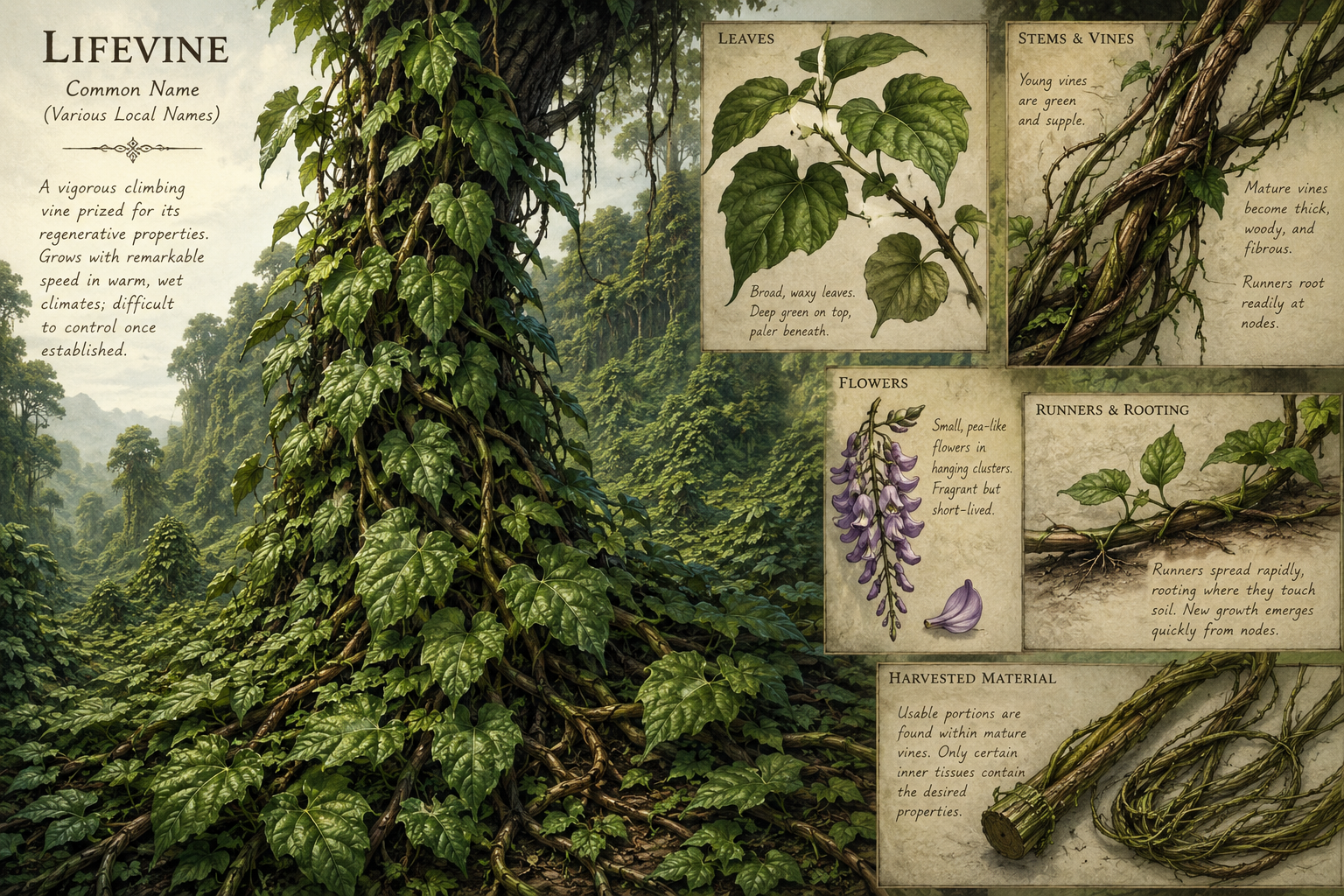
Lifevine is the common name given to a vigorous tropical and subtropical climbing vine renowned for both its extraordinary rate of growth and its potent restorative properties. Found primarily in the warmer regions of Kermoria—including the Isle of Aesry Surlaenis'a, Hara'Jaal, and the wetter reaches of the Pridelands surrounding the Okoniawai River—the vine can spread with astonishing speed when conditions favor it. Long runners creep across the ground, climb trees and stonework, and root wherever they find suitable soil, sometimes smothering entire sections of forest beneath dense curtains of broad green leaves. Cutting it back provides only temporary relief; surviving roots and runners can reclaim cleared ground with remarkable persistence.
Despite this apparent abundance, usable Lifevine is considered rare and extremely valuable. The regenerative properties sought by alchemists are concentrated in only particular portions of mature growth, and most of the sprawling plant possesses little more medicinal value than an ordinary vine. Properly harvested material is among the premier natural reagents for regenerative alchemy, capable of serving much the same role as Troll's Tongue or the freshly harvested tongue of an actual troll. Using Lifevine in ordinary healing potions is certainly possible, but generally regarded as a spectacular waste of an ingredient capable of far greater things.
In less concentrated preparations, Lifevine possesses mild anti-inflammatory properties. Leaves and young shoots lacking sufficient potency for serious alchemical work are sometimes dried and steeped into a bitter herbal tea used to ease swelling, aching joints, and minor injuries. Thus, somewhat ironically, the least valuable portions of one of Kermoria's rarest restorative reagents are commonplace folk medicine in the regions where the vine grows—while alchemists may search through enormous tangles of the plant hoping to find a few precious lengths worth carrying home.
Despite this apparent abundance, usable Lifevine is considered rare and extremely valuable. The regenerative properties sought by alchemists are concentrated in only particular portions of mature growth, and most of the sprawling plant possesses little more medicinal value than an ordinary vine. Properly harvested material is among the premier natural reagents for regenerative alchemy, capable of serving much the same role as Troll's Tongue or the freshly harvested tongue of an actual troll. Using Lifevine in ordinary healing potions is certainly possible, but generally regarded as a spectacular waste of an ingredient capable of far greater things.
In less concentrated preparations, Lifevine possesses mild anti-inflammatory properties. Leaves and young shoots lacking sufficient potency for serious alchemical work are sometimes dried and steeped into a bitter herbal tea used to ease swelling, aching joints, and minor injuries. Thus, somewhat ironically, the least valuable portions of one of Kermoria's rarest restorative reagents are commonplace folk medicine in the regions where the vine grows—while alchemists may search through enormous tangles of the plant hoping to find a few precious lengths worth carrying home.
Properties
Material Characteristics
Lifevine is a fast-growing, woody climbing vine characterized by long, flexible runners and broad, deep-green leaves, superficially resembling several far more mundane creeping vines. Individual stems may stretch for remarkable distances, climbing trees, crawling across exposed ground, and draping themselves over rocks, ruins, and other vegetation. Where established, the plant frequently forms dense tangles and heavy curtains of foliage, with older vines becoming thick, fibrous, and rope-like as younger growth continually spreads outward.
The plant's extraordinary vigor is often its most recognizable characteristic. Runners readily take root where they contact suitable soil, while damaged stems quickly produce new shoots around the injury. Mature patches can become so dense that the original vegetation beneath them is almost completely hidden, giving the impression that the landscape itself has been swallowed beneath a single enormous plant. Despite Lifevine's tremendous growth, there is little outward indication which portions contain the concentrated regenerative properties valued by alchemists; recognizing suitable growth requires knowledge and careful examination rather than simply harvesting the largest vine available.
The plant's extraordinary vigor is often its most recognizable characteristic. Runners readily take root where they contact suitable soil, while damaged stems quickly produce new shoots around the injury. Mature patches can become so dense that the original vegetation beneath them is almost completely hidden, giving the impression that the landscape itself has been swallowed beneath a single enormous plant. Despite Lifevine's tremendous growth, there is little outward indication which portions contain the concentrated regenerative properties valued by alchemists; recognizing suitable growth requires knowledge and careful examination rather than simply harvesting the largest vine available.
History & Usage
Environmental Impact
Where Lifevine becomes firmly established, it can be extraordinarily destructive to surrounding vegetation. Its rapid growth allows it to climb over shrubs and trees, spreading broad layers of foliage across their canopies and depriving the plants beneath of sunlight. Runners root readily wherever they touch suitable ground, allowing a single patch to spread outward with alarming speed. Smaller plants may be smothered entirely, while even mature trees can eventually weaken or die beneath the accumulated weight and shade of an unchecked infestation.
For this reason, Lifevine is treated as both a valuable medicinal resource and a dangerous invasive plant outside the ecosystems where it occurs naturally. Cutting the visible vines is rarely sufficient; established root systems readily produce fresh growth, and discarded fragments may themselves take root if improperly disposed of. Settlements in warmer climates sometimes maintain strict controls on its cultivation, requiring Lifevine gardens to be isolated and regularly cleared around their boundaries. Burning is effective against harvested material, though destroying an established patch completely may require repeated clearing over several seasons.
Curiously, the same aggressive vitality that makes Lifevine so troublesome is often cited as an outward expression of the regenerative properties for which it is prized. The plant is remarkably difficult to kill, rapidly recovering from cutting, grazing, storms, and other physical damage. As one old alchemical observation rather succinctly puts it: Lifevine is exceptionally good at keeping things alive, beginning with itself.
For this reason, Lifevine is treated as both a valuable medicinal resource and a dangerous invasive plant outside the ecosystems where it occurs naturally. Cutting the visible vines is rarely sufficient; established root systems readily produce fresh growth, and discarded fragments may themselves take root if improperly disposed of. Settlements in warmer climates sometimes maintain strict controls on its cultivation, requiring Lifevine gardens to be isolated and regularly cleared around their boundaries. Burning is effective against harvested material, though destroying an established patch completely may require repeated clearing over several seasons.
Curiously, the same aggressive vitality that makes Lifevine so troublesome is often cited as an outward expression of the regenerative properties for which it is prized. The plant is remarkably difficult to kill, rapidly recovering from cutting, grazing, storms, and other physical damage. As one old alchemical observation rather succinctly puts it: Lifevine is exceptionally good at keeping things alive, beginning with itself.
“Lifevine tea is excellent for aching joints. Unfortunately, the first thing it makes you wish would stop hurting is your tongue.” - Victoria Pendrake
Type
Organic
Taste
Lifevine has a sharp, vegetal bitterness, reminiscent of over-steeped green tea with an almost medicinal, resinous finish. Fresh stems carry a faint underlying sweetness, but drying or steeping the plant brings its bitterness strongly to the fore.
Related Locations
Related Professions

Comments