
Iomlán (Yome-lahn)
For more information on all planes, see: Planes & The Multiverse
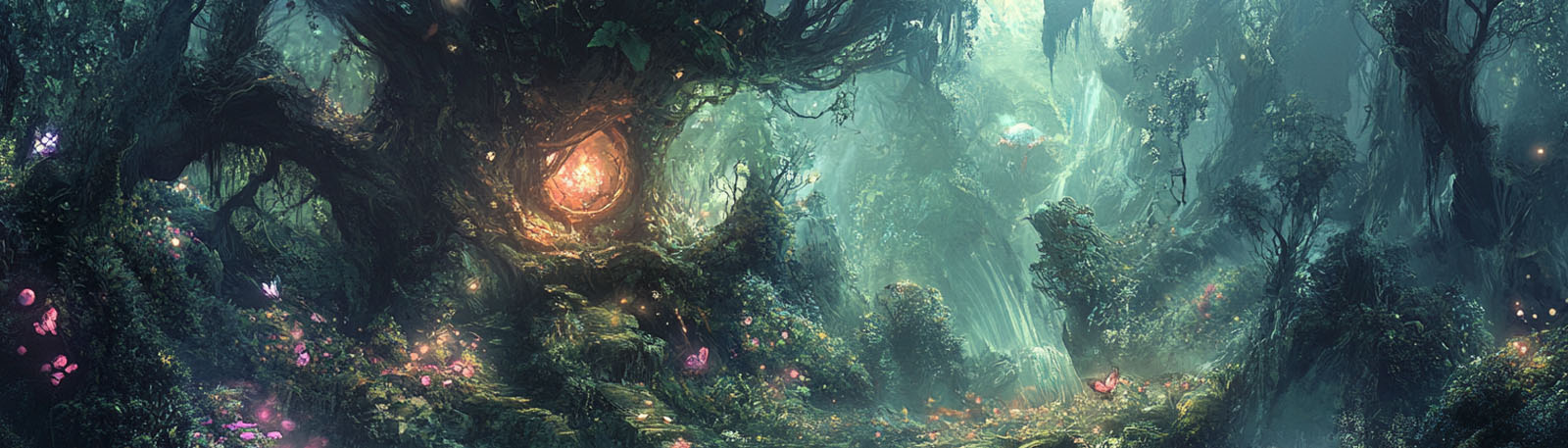
Iomlán is a plane of raw, unbridled nature—a realm defined by its paradoxical resistance to change. It is an extreme and untamed wilderness, spanning vast forests, sprawling jungles, towering mountains, cavernous depths, scorching deserts, and icy tundras. Despite the relentless passage of time, these landscapes largely remain untouched by civilization. It is not for lack of effort, but rather due to the plane's unique property: it rejects all permanent alterations.
Physical Description
Iomlán is a land of untamed splendor, its vast fields, towering mountains, and sprawling forests ever-shifting and unpredictable. What appears familiar can prove treacherous—a simple field may hide adamantine hay that shatters steel, while an ordinary tree might twist into caustic metal that melts flesh. A desert may appear next to a glacier or a volcano might bathe what looks like trees in magma with zero effect. Beneath its superficial resemblance to Materia lies a realm of wondrous and perilous materials, shaping landscapes beyond mortal imagination.
Yet, no change in Iomlán is permanent. Grass regrows in minutes, trees in hours, and mountains in weeks, while anything destroyed decays into uselessness. This relentless cycle of renewal makes lasting settlements impossible—even a simple campfire is swallowed by the earth within an hour, leaving no trace behind. Because the plane refuses to change, it ensures that order can never be brought to it.
The most defining aspect of Iomlán’s wilds, however, is the presence of the Evergleams and Everglooms. Unlike Materia, Iomlán lacks a conventional sun or moon; instead, its skies are ruled by colossal, luminous titans whose true forms remain obscured by overwhelming radiance or shadow. Some believe them to be divine envoys, nascent Monarchs, or fragments of Iomlán’s own soul. Regardless, their influence on the land is undeniable. Each Evergleam and Evergloom is unique, casting golden brilliance, silver twilight, or absolute darkness. Their rule dictates weather and time—some regions bask in endless daylight, while others are swallowed by perpetual night. Certain lands know no storms, while others suffer relentless tempests. Their shifting dominance marks Iomlán’s many regions, and their clashes bring world-shaking calamities.
Beyond these titanic beings, Iomlán's sky is a window to the Multiverse. Vast auroras ripple across the heavens, revealing fleeting visions of Cocytus’ sorrowful rivers, Galzahad’s choking red glow, or Materia’s endless stars—a celestial veil hinting at realms beyond reach.
Réimse
Réimse, the most prominent settlement in Iomlán, was founded in the wake of Anelle and Kaskin's wedding as their gift to the mortal realms. Legends tell of how the Leath family ventured forth together, tracking the mighty Glimberwhale and subduing it just long enough to craft a refuge for those who wished to experience Iomlán's beauty. Vast even by Materia's standards, Réimse is one of the few places in all of Iomlán where the plane does not attempt to undo changes, making it a hub for travelers. Despite its size, the city is perpetually overcrowded. Beneath its surface lies a shadowy underbelly that will find a way to make room—for the right price.Breogán Cruach
Breogán Cruach was once a land of unparalleled beauty, with golden grasses, platinum trees with mithril leaves, and diamond mountains. Its magic and wealth attracted treasure hunters, but it remained largely untouched—until the rise of Galzahad. To create its core, the Hellcrux, devils ravaged the land, destroying mountains, carving caverns into voids, and draining its riches. Fey of all kinds took offense—those who revered nature, Monarchs whose dominion had been slighted, and even the Tane themselves. The ensuing battles were vicious, with the fiends’ ability to claim souls posing an unprecedented threat to the fey, who had never before feared death so long as they remained upon Iomlán. They battled the fiends, but despite their efforts, the land was corrupted and scarred by infernal magic. The devastation ended only when the mighty Glimberwhale appeared, annihilating the fiends. Now, Breogán Cruach is a corrupted, festering wasteland. Though Iomlán struggles to heal, the scars run too deep, and the land’s regeneration has all but stalled.Gairdín gan Teorainn
The Gairdín gan Teorainn, like Breogán Cruach, is a manifestation of Iomlán’s wild nature, a vast, ever-shifting forest with no known boundaries. Unlike Cruach’s gleaming metals, the Gairdín is a chaotic expanse of intertwined trees, fungi, and flowers, where life flourishes without logic. Descending deeper reveals no bottom—none have ever reached it. Likewise, the treetops extend endlessly into the sky, and even fey who have spent centuries searching for the forest’s peak have yet to find it. The forest is a unique, magical labyrinth, home to every plant and species both imaginable and unimaginable. From the deepest corners of Galzahad to realms of myth, the Gairdín supports an impossibly diverse ecosystem of plants thriving in perfect, chaotic harmony.In the center of the Gairdín gan Teorainn lies Kodakai's Husk—a towering, rotted corpse of the god Kodakai's treant-like body, with patches of glowing bark and twisted roots rising like ribs. His once-verdant leaves have wilted in decay, and spores drift from hollow knots in his form. A thousand hollow eyes peer from within his trunk—shattered lenses into foggy memories. And yet, the goddess of decay, Moganshu, dwells within his corpse—gnawing at Kodakai from the inside as thousands of insects weave through hollowed-out deadwood.
The Methenon
Theoneia’s court is a living myth tucked into the folds of Iomlán: the Methenon, a twilight-shrouded glade hidden between thickets of flowering trees. A great, vine-wrapped amphitheater forms the heart of the realm, where stories are sung, plays are performed, and revels last for what seems like years—though time there is a fickle thing. Wine flows in marble basins from unseen springs, and strange constellations flicker above the canopy, shifting to match the tales being told. Paths wind in circles, leading wanderers into poetry, duels of drunken wit, or dances with forgotten lovers. Echoes of legendary names drift on the breeze, tempting listeners to add their own. Tucked along the grotto’s fringes are secluded alcoves, perfectly suited for those inclined to indulge in a little romance.Bayou Gullet
Maldebrum’s realm within Iomlán, Bayou Gullet, is not so much a kingdom as a digestive process made manifest. Once fertile wilderness, his lands have been reduced to fetid mire and shifting terrain, all spiraling toward his bloated court. The bog’s surface is an interwoven net of semi-organic, rootlike material, deceptively stable in one place and treacherously fragile in another. Beneath it lies a network of murky waters patrolled by gahlepods, glistening sentries of sludge and tooth. The Bilepits, lakes of toxic slime and roiling caustic slop, pockmark the territory. These are not places for mortals to tread, though a few floating isles of skymetal drift listlessly across their surface, barely habitable and constantly shifting. Twisted groves ring the Bilepits, their spindly branches laced with adamantine roots that suck nutrients from the bile. They are treacherous to cross, but rich with forbidden material. Sunken forests dot the landscape, filled with slanted, rotting trees and half-swallowed ruins—some of the only places where solid ground exists in Maldebrum's domain. At the realm's darkened center, where all semblance of light begins to fade, lies Maldebrum’s throne—if it can be called that. There is no palace or adornment, only his immensity rising from the muck, dimly lit by floating will-o’-wisps permitted to hover near. No Evergleams or Everglooms dare fly here, lest they be devoured from the air.Government & Law
While most fey accept the immutable nature of Iomlán, there exists only one species of fey capable of permanently reshaping Iomlán’s landscape—a feat no others can achieve: the Tane. With a gesture, a Tane can turn a river into a lake, a plain into a mountain, or a forest into a city. Once a change is made, Iomlán accepts it as though it had always been that way. They can adapt to any environment, from Galzahad’s wastes to Cocytus’ depths, remaining unaffected. Most elusive among them is the Glimberwhale, a colossal floating whale seen only twice in history—at Breogán Cruach’s fall and the Leathin wedding. Its true power remains unknown, but its presence heralds world-altering events.
Some fey aspire to greater ambitions. As a fey grows in power, they may undergo gradual transformations, evolving into new forms that better suit them. This process is poorly understood, but those who reach its pinnacle become Fey Monarchs. Unlike ordinary fey, the Monarchs possess the ability to command the Tane. With this authority, they establish courts, shaping settlements and kingdoms—among Iomlán’s few permanent structures. Their courts reflect their nature, ranging from grand revelries to treacherous domains of intrigue.
Fey Monarchs wield the Tane’s power but not absolutely, often appointing Dukes and Duchesses with limited authority over these beings. There are, however, rare False Monarchs who, through cunning or force, claim a Tane’s allegiance without true right—an act that often makes them hunted by Iomlán’s rightful rulers.
Inhabitants
Iomlán teems with beasts both mundane and magical, sustained by nature’s endless renewal. Herbivores and predators thrive, leaving few places untouched by their passage. Among these beasts, none are as feared or revered as the linnorms—titanic, serpentine dragons lacking mortal dragons’ cunning but unmatched in ferocity and resilience. Found across the plane, they are notable for the potent curse they unleash upon death, said to persist as its soul lingers and awaits the moment to claim its final revenge.
Fey, second only to beasts in number, are born from Iomlán itself and do not experience true death—when slain, they simply reform unchanged. This immortality shapes their alien worldview, free of fear or consequence. Most live in harmony with the plane, tending to nature in ways both whimsical and inscrutable. Though they can briefly alter their surroundings, such changes always revert, leading many to trade in more abstract goods. Rather than trading in wealth, the fey trade in intangibles—favors, memories, even emotions. Their bargains, as lighthearted as "a touch of whimsy" or as dire as "your firstborn child", are never without consequence.
Legends say that when the first fey perished upon Materia, they raged against death so fiercely that Halmyra herself took notice. Whether out of mercy or amusement, she granted them escape, giving rise to the first Queen Slúagh—the only known form of undead fey. For eons, the Slúagh have served Halmyra, their numbers growing as fey seek escape from oblivion. Masters of soul theft, they stalk Cocytus and Materia’s battlefields, claiming souls for the Lady of Salt. Queen Slúaghs, ruthless commanders, are said to house a gateway to the Still Waters in their stomachs, delivering their grim harvest directly to Halmyra for rich rewards.
Mysterious and elusive, the hunting bands known collectively as the Wild Hunt roam Iomlán’s wilds, pursuing the plane’s most formidable prey—Tane, Monarchs, or unlucky interlopers. Some say they arose to counter the devils' invasion; others believe they heed the call of an enigmatic figure known as the Horned One. Whatever the truth, their arrival is an omen of both a mighty quarry and the devastation to come.

Comments