

Cormyr
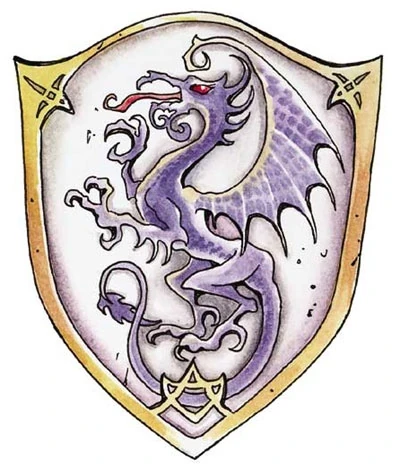
Cormyr (pronounced: /kɔːrˈmɪər/ core-MEER), also known as the Forest Country and the Land of the Purple Dragon1 was an independent nation in interior Faerûn. It was historically one of the most prosperous countries of Faerûn.
Structure
Cormyr was a hereditary monarchy, having followed that government type since its foundation at around 26 DR9251
The royalty and monarchy was synonymous with House Obarskyr, who held the throne in an unbroken line of succession since its establishment.2613Although, around 1370 DR there was some sentiment that the nation should be run by a council.
The royal court was the nation’s center of power, and was located in the nation’s capital, Suzail. The king governed the nation at large through the fealty the landed nobility owned to him, and by the appointment of local lords. Nobles held government and courtly positions, as well as lands and noble titles. They served a variety of function’s, and their main responsibility was to enact the monarch’s visions and goals for the country’s rulership. 28 2930
Local government was often overseen by local lords, which were appointed representatives of the crown for the administration of towns, groups of towns and villages. The main functions of these local lords was collecting taxes and tithes, peacekeeping and dispensing the king’s justice, as well as defending farmland and serving as the eyes and ears of the monarchy. Lords were allowed up to 40 men-at-arms and 6 guides, who were mostly rangers, and could be used as a town guard. Lords also had assistants, who held public office through the title of herald. Also referred to as king’s heralds, they were trained clerks and record keepers.2830
Inside the royal court, noble courtiers received various internal duties from the monarch. Key advisory positions were the most coveted, as they provided the chance of having the crown’s ear and influencing policy. 31 Among these titles, one of the most prestigious was the Sage Most Learned of the Royal Court, or simply the Sage Royal. In the 14th century DR, this office was held by Alaphondar Emmarask, and by 1479 DR, would be held by Ossani Eveningspire.32 33.
The ruling monarch had another advisor, who had the title of High Wizard, also known as the Royal Magician (among other titles), and who was in charge of the War Wizards34.28. Though they were separate organizations, the War Wizards were seen as synonymous with another group known as the Council of Mages, who advised Cormyr’s rulers on matters related to magic, and wrote the kingdom’s laws regarding magical incidents in the Forest Kingdom.
Culture
Cormyte society was divided between commoners, the military, and the ruling class. The last one was in turn was divided between the monarchy and the nobility4142.
Nobility
Titles of Nobility for the Kingdom of Cormyr by Rank
King/Queen
Prince/Princess
Duke/Duchess
Marchion/Marchioness
Earl/Countess
Viscount/Viscountess
Baron/Baroness
Baronet/Baronetess
Knight
The nobility of Cormyr were composed of the most wealthy and influential households. There was an annual ceremony at the beginning of the summer where each noble house came to Suzail to meet and see the monarch and discuss their achievements over the previous year, before retiring to their summer residences.43. By the 15th Century DR, there were two dozen major noble houses, and an oscillating number of more obscure ones. Nobles were born, not made, but there were exceptions in the form of local lords. 30
Local lords, appointed to govern localities in the name of the crown, were a subclass in relation to the Cormyrean noble houses, referred to as the "landed nobility" in order to distinguish the two. While it was true that people appointed as local lords were commonly members of the noble houses, that wasn't necessarily the case. The crown could appoint a notable commoner, who has either distinguished himself or been recommended by the townspeople, or someone who is the default ruler of a particular place by their personal influence alone. However, because local lords must be nobles, the appointment of a commoner serves to ennoble the individual, who is granted a noble title (if they didn't already have one). Myrmeen Lhal was an example of this, after being named king's lord of Arabel.2830
The landed nobility generally had positive relations with local lords, but many noble houses treat the crown's appointed servants as mere lackeys, involved with the petty affairs of commoners.2830
Cormyr's laws were explicitly written to reflect that the noble houses enjoyed their lands and titles at the "favor of the crown", meaning a family could lose their lands and titles if they were disloyal to the nation, as was case with House Bleth, and for a time, House Cormaeril.30
Among the major noble families, three were particularly distinguished, sharing the label of "royal houses" with the Obarskyrs themselves. These were House Crownsilver, Huntsilver, and Truesilver, and are considered to be royal due to their historic blood ties to Cormyr's royal line, as they are descended from the silver brothers, whose offspring married into the Obarskyr dynasty.44 However, by 1368 DR there was a law that only someone with Obarskyr blood could take the throne45.
Nobles swore allegiance to the crown on the sword Symylazarr.46 Nobles owed the king of Cormyr a certain number of troops, in lieu of their military service, under Cormyrian law.47
The nobility of Cormyr were fond of playing board games and were known to keep gaming tables in the parlors of their homes.48.
Common folk
In Cormyte society, everyone who wasn't from a noble family or a local lord was considered a commoner. Commoners were divided between farmers, crafters and merchants. Commoners also filled most of the ranks of the Purple Dragons and the militias4149.
Farmers were the foundation of the kingdom's conservative society, and farming was Cormyr's largest occupation. They mostly lived simple lives in land quite a distance from towns. Cormyrian farmers tended to have a strong sense of unity amongst themselves, more so then compared to most places. They also tended to be loyal to the Crown and the monarch, having promptly volunteered to join the military in times of crisis, such and when Gondengal threatened to break the realm apart and during the conflicts against Netheril and Sembia in the 15th century DR496.
There has never been serfdom in Cormyr. Its farmers were all citizens, who either independently owned the land they cultivated, or were landless crofters (the norm in upland Cormyr) who farmed land owned by someone else while paying rent, through either coin or a yield share. These landless farmers were in no way bound to the land, and could move if they wished6.
Cormyr's crafters also had a long reputation and tradition, and were respected for being blessed by the gods with the ability to transform materials into goods, either useful or decorative, ideally both. This group encompassed all kinds of artisans and builders, with different towns and cities being a centre for a particular type of craft. Unlike in other regions, crafter guilds were not particularly powerful, and resembled fraternal organizations. The concept of labor unions was mostly unknown in Cormyr. The exceptions to these rules were certain guilds of constructors that had discovered they could exert quite a bit of political influence by the 14th century DR496.
Finally, merchants were the most powerful social class outside the nobility. This group had became quite powerful, and their riches surpass even that of some noble families. Merchant influence was usually seen when a merchant house saved a noble family from financial trouble in exchange for behind-the-scenes control of a government post held by such nobles. Despite their power, the merchant class almost always maintained the interests of the nation and of the royalty above their own. This loyalty was due in part to the favorable mercantile conditions maintained by Cormyr's rulers49. Their political influence grew steadily by the 15th century DR
History
Cormyr was founded in the Year of Opening Doors, 26 DR. Its first king was Faerlthann Obarskyr, son of Ondeth Obarskyr and Suzara Obarskyr.9 The kingdom was initially formed because the elves and humans in the region needed to get along with each other. Since that time, Cormyr grew by absorbing the realms of Esparin and Orva and claiming the Stonelands as its own.10
Some time between 376 DR and 432 DR, Cormyr was invaded by many dragons, including Thauglor, the Purple Dragon, so-called because his scales went purple with age, who laid waste to virtually all of the settlements in the country. It was then raided by orcs from the Stonelands, who occupied the King's Forest until they were finally driven out in the Year of the Cat's Eye, 429 DR, by King Duar Obarskyr. By the Year of the Sea Princes, 432 DR, many noble families had left Cormyr for either the Dalelands or Waterdeep, or split into small factional bands. The city of Suzail was sold to Magrath the Minotaur and his pirates by a traitor to the crown around this time,11 and it was after Magrath's death that the Purple Dragon was adopted as the nation's official symbol.12
In the Year of the Dragon, 1352 DR, Gondegal, also known as "The Usurper King" and "The Lost King", attempted to establish a separate kingdom centred on the city of Arabel. He was overthrown, after only eight days in power, by an allied army composed of forces from Tilverton, Sembia, and Daggerdale, along with the Purple Dragons, led by King Azoun IV.13
The Goblin War begun by the elf-dragon Nalavara did significant damage to the kingdom, resulting in the deaths of King Azoun IV and his heir, Tanalasta Obarskyr in 1371 DR.141516 This began the Steel Regency of Alusair Obarskyr, until Tanalasta's newborn son Azoun V could take the throne.141718
The Spellplague did not spare Cormyr, but it survived relatively unharmed, save for the loss of a third of its War Wizards.17 The Wailing Years were not so kind to all its neighbours, and many would join the budding empire as Cormyr reluctantly grew to counter the Netherese vassal-state of Sembia.19 Tensions between Cormyr and its neighbors Netheril and Sembia were constant, further fueled by the assassinations of Cormyrean royalty.20
Between 1484 DR and 1486 DR Cormyr fought a war on two fronts as it mustered troops to defend the Dalelands against Sembia's invasion and its own borders were invaded by Netheril.2122 King Irvel Obarskyr was killed during the Siege of Suzail and was succeeded by his daughter Queen Raedra Obarskyr.23 By the end of the war Cormyr had successfully reclaimed its land from the Sembian and Netherese forces and turned its focus to recovery.
Demography and Population
Demonym
Cormyrian, Cormyrean, or Cormyte
Population
1,360,800
Races
| Race | Percentage |
|---|---|
| Humans | 85% |
| Half-elves | 10% |
| Elves | 4% |
| Other | 1% |
Territories
Often referred to as the "Forest Kingdom", Cormyr was once covered in thick forests. Due to commercial logging and clearing for farming, however, the once-great forests became restricted to the King's Forest in the west, the Hullack Forest in the east, and the relatively small Hermit's Wood to the south between Wheloon and the Dragonmere. The Dragonmere, an expanse of water connected to the Sea of Fallen Stars, bordered Cormyr to the south. The Storm Horns mountains formed a boundary to the north and west of Cormyr, with the Thunder Peaks to the east.51 The Vast Swamp separated Cormyr from Sembia in the southeast.51 The Wyvernwater was a large lake in the middle of Cormyr. Cormyr itself was dotted with beacon towers, used to quickly relay messages across the land.
Military
As a key power in Faerun, whose domain was originally built from a much wilder land, Cormyr has had to defend its security and borders from threats throughout its history.19 To that end, as well as to maintain royal authority in the realm, Cormyr has maintained a powerful military which it has been known for. The military is comprised of a professional standing army, as well as other military forces such as the local militias. 53 54 55
In regards to their standing military, the crown has historically divided its military between an army, a navy and the War Wizards. Due to their centralized hold on power, the Obarskyrs have generally preferred to disallow religious armies and large forces of mercenaries in the kingdom.
Purple Dragons
The Purple Dragons were the main standing force of Cormyr, whose name and banner coincided with Cormyr's crest. They were a large professional army, composed of highly trained, skilled, and loyal warriors, garrisoned in major cities and fortifications. The Purple Dragons were royal soldiers, sworn to the crown and the monarch. In the 14th century DR, the Dragons numbered at more then 12.000 soldiers. 555465457
They were trained warriors, having been known to be armored men-at-arms, guards, archers, as well as acting as horsemen and even hippogriff riders.5859606162 No matter their role, they were trained to work as a cohesive unit. In the 15th century DR, they were divided into companies.663
Special among the army were the similarly named Purple Dragon Knights, a group so heroic that the reputation of the entire institution was deserved partly due to their exploits. These were leaders and high ranking officers among the Purple Dragon, regarded for their leadership, and skill. A Purple Dragon Knight could command from ten to over a hundred regular Purple Dragons. Being included in their ranks was a great honor, and promotion into knighthood was only granted to an exceptional few. 636465
Navy & Seafaring
The navy of Cormyr was called the Blue Dragons.
Cormyr's official naval vessels were all named after Cormyrian monarchs, such as Valashar's Bane (after Azoun I) and Queen Besmra, whereas the corsairs and privateers used vessel named for the weapons possessed by these rulers, such as Drake's Tooth and Undying Gaze.
Laws
Cormyrean law was highly regarded by the people, who believed it was the monarchs' laws, enforced by Purple Dragons and militias, that tamed the wilderness and brought order and peace, and was the foundation for the kingdom's greatness. These laws were to be applied with compassion and diligence in balance, so that criminals neither went free nor feared for their lives without reason.1
They were similarly proud of their court system, thinking it the best in all Faerûn. However, whether it was actually best for the people, and not just the rulers, was debatable. Regardless, it continued to function just as it was originally conceived.
Basic Guide to the Laws of Cormyr
- All persons entering Cormyr must register with the officials of a border garrison.
- Foreign currency can only be used in certain locations. Please exchange your coins for Cormyrean golden lions at your first opportunity.
- Adventurers must acquire a charter before undertaking any operation as a group.
- All weapons must be peace-bonded. The only persons exempt from this law are members of chartered adventuring groups and members of mercenary groups that can offer proof of employment.
- Harming cats is forbidden.
- Bow your head to royalty and the local nobility.
- Purple Dragons have the right to search you upon request.
- Hunting on private land is forbidden.
Adventuring
An armed adventurer in peacetime must be peace-bonded. Peace-bonding involved cords called "peacestrings" tied about the hilts and scabbards of weapons to prevent them being drawn in a hurry. In practice, this was symbolic, and little stopped a veteran fighter from pulling them when forced.192
There were a variety of exceptions: nobles, Purple Dragons, War Wizards, on-duty militia members, weapons dealers, people training with weapons under their lord's supervision, people on a hunt with their lord's permission, attendees of a hunting lodge, mercenaries, chartered adventurers, and bearers of a crown writ for a temporary right to bear arms, which were usually granted to foreign dignitaries, their bodyguards, agents, and special messengers. They were permitted un-peacebonded weapons, but had to display their Purple Dragon ring, Court token (a numbered brass plaque engraved with the Purple Dragon symbol), proof of employment, license, charter, or writ on request. Good records were kept of all these.1011122
A weapon was classed as any blade larger than a dining knife or any blunt instrument that wasn't a walking staff or worker's tool. Ideally, anyone with a weapon should go directly to a Purple Dragon guardpost to have it inspected and properly tied with their secret knots.12
An adventuring charter was granted under the selected adventuring group's name. No two groups were allowed to have the same name. The name was considered unavailable as long as any members of the group remained alive. Each charter required a sponsor. In cases when a charter was sponsored by the Crown, the monarch assigned a ceremonial sponsor. 1311122
Charters were penned using special magical ink created by Cormyr's War Wizards. The ink was enchanted to allow the agents of the Crown, Vangerdahast Aeiulvana, or other members of the Wizards of War to know the exact location of the individuals the charter was issued to. The magic was activated via a command word. The same enchantments allowed War Wizard Stonegrip detect forgery with ease.
Nobility
As a land renowned for its nobility, Cormyr held several laws delineating their conduct and rights:
- A commoner must bow their head to royalty, regardless of their sex.12
- A visitor must bow their head to the local lord and to royals, regardless of who any of the parties were. Cormyreans impressed on outsiders this need to show respect to their rulers.12 By custom, even ordinary folk were supposed to be treated with some respect.15
- The King's Decree of Rights Noble obligated commoners, to the cost of their lives, to aid nobles in times of need and danger.16
- Under the Crown's law, a Lord had a right to pronounce summons on any citizen or guest of their lands. This made it an obligation of those pronounced to immediately seek audience with the summoning Lord.17
- It was illegal to hunt on land privately owned by another without their permission.12 Offenders were, at a minimum, ostracized by the community until they made amends like holding a feast and opening their own lands.
Rules of Succession
Only someone with Obarskyr blood could assume the crown.
Additionally, the rules of succession were bound by ancient treaties between the Forest Kingdom, the elves who held the land that became Cormyr, and the dragons that ruled the land before the elves. The treaties were signed at the dawn of Cormyr by the first Obarskyrs. The law demanded that, no matter what, nobles of the realm could not be restored, resurrected, or otherwise returned to life, including the members of the royal family. No sitting regent or monarch could be returned to life. An exception could only be granted to nobles of the Obarskyr line who'd abdicated from the throne before their death and cut all claims to nobility (unless their faith forbade it). No person who died and was brought back could sit on the Dragon Throne nor take it by conquest. Cormyrean teachings claimed that if this law was ever broken, then the Dragon Throne would shattered and the dragons return to hunt humans.
Regarding Magic
It was explicitly illegal for an individual to receive payment, in the form of money or valuables, to remove the effects of a spell they themself had cast.4
It was forbidden to cast or unleash any magic within the signposted around the village of Mouth o' Gargoyles, owing to the wild magic curse upon the place. Only War Wizards and officers of the Crown were exempt, but faced other penalties for doing so.20
According to a certain ancient law, the extra-dimensional refuges of the Sword Heralds were off-limits to the monarch of Cormyr and their agents such as the War Wizards. They could not demand to enter or even see such a refuge, nor compel someone to reveal one's existence. In practice, however, past kings hired chartered adventurers and private citizens to do so for them.
Forestry Law
All native life within the forests of Cormyr were considered to be "of the heart of Cormyr", meaning property of the Crown and thus under its royal protection. This included such things as flowers, the royal woods and stags, rare birds, dryads, treants, and unicorns. These creatures possessed the rights of a citizen and could demand royal protection, but lacked the responsibilities of a full Cormyrean citizen. This did not cover non-native creatures living with the forests, such as dragons or elves.26
Such inhabitants of the forest were also considered to be "under the royal hand". This term meant that only members of the ruling family, regents, or individuals directed by them were permitted to harvest the forest and its inhabitants and make use of those resources, including the gifting of them.26
For example, anyone caught selling the blood of a dryad or treant sap would receive a life long ban from doing so anywhere within Cormyr, in addition to further punishments depending upon how they obtained the sap. If it was given willingly, they would receive only a small fine. If it was taken through force or coercion, then they would not only receive a hefty fine but be banned from entering any of Cormyr's royal forests for ten summers, with their charges being "theft from the heart of Cormyr, and unlawful sale of the property of the Crown." Those who violated this ban risked being imprisoned for four summers, followed by exile from Cormyr for forty.
Trade & Transport
Cormyr's contact with other regions of Faerun happened primarily through the activities of powerful and wealthy merchant organizations. The most powerful of which were, as of 1479 DR, the Seven Suns Trading Coster, the Trueshield Trading Priakos, as well as the Glanend and Skatterrhawk trading families
Coins of Cormyr
After around 1300 DR, coins in Cormyr were minted in either the Royal Mint in Suzail or the mint in High Horn. Older coins existed that were minted in the Elder Forest Kingdom but these were not minted in the 14th century DR.
By around 1479 DR, Cormyrian coins bore the visage of King Foril I. They aged well and were made of pure metals with good weight. Coins were designated in regards to the Royal Mint that produced them by their mint mark. The marks were a three-decker, four-masted carrack for the mint in Suzail and two parallel crescent moons for the one in High Horn.
Coins were referred to by the following names:
Tricrown (pp Lion (gp Falcon (sp Thumb (cp)
Exchange Rate
1pp = 10gp = 20ep = 100sp = 1000cp
Armor, carved ivory, cloth, coal, food, swords, timber
Glass, ivory, perfume and spices

Comments