

Baldur's Gate
Baldur's Gate, called the City of Blood and simply the Gate, was one of the largest metropolises and city-states on the Sword Coast, within the greater Western Heartlands. It was a crowded city of commerce and opportunity, and one of the most prosperous and influential merchant cities on the western coast of Faerûn. It was described as being the "halfway to everywhere".
Demographics
The population of Baldur's Gate was always dominated by humans, though other races such as elves, dwarves, and to a lesser extent some drow, settled within the city and were not looked upon differently. The older districts of the Upper City and Lower City were quite diverse, while newer neighborhoods and those of the Outer City saw some homogenization along ethnic and racial lines. While no race was outright banned, more-monstrous humanoids such as trolls, ogres and orcs were a rare sight indeed.
As anyone was welcome to visit or conduct business in The Gate, its population continually swelled as the city's geographical size grew well beyond its walls. How the city did not collapse upon itself, was unfathomable to many.
Defences
Historically speaking, Baldur's Gate was naturally well-defended by its location in a natural inlet, and the great wall that was financed by Balduran, who was widely believed to the the city's founder. However, its security was often attributed to its political neutrality and the worldview of its leadership. While the city remained dedicated to the termination of threats that jeopardized trade and commerce in the Sword Coast, it refused to involve itself with the region's political conflicts.
Industry & Trade
The Gray Harbor of Baldur's Gate was one of the largest, busiest and most popular ports-of-call found on the western coast of Faerûn, handling a wide variety of cargoes that rivaled even the sprawling ports of Calimshan. Due to the fact trade was not tied to any individual's moral alignment, anyone conducting business in a non-harmful manner was welcome to trade in the city. By virtue of this tolerant outlook, Baldur's Gate had become the greatest center of trade along the entire Sword Coast in the 15th century, out-competing both Waterdeep and Amn.
For years, Baldur's Gate minted its own silver trade bars, the most common variety of which was a 1 lb bar worth 5 gp. More importantly, the city also set the value for this form of currency and regulated its use in trade.
The cloth market was a trades event that was held annually in late summer, or early fall. The market attracted the best textile weavers, seamsters, and gown makers.
As of the mid-1300s DR, stone was usually imported from Mirabar via Luskan for use in construction, having been magically transported from up north. This feat of arcane conveyance was quite expensive.
Districts
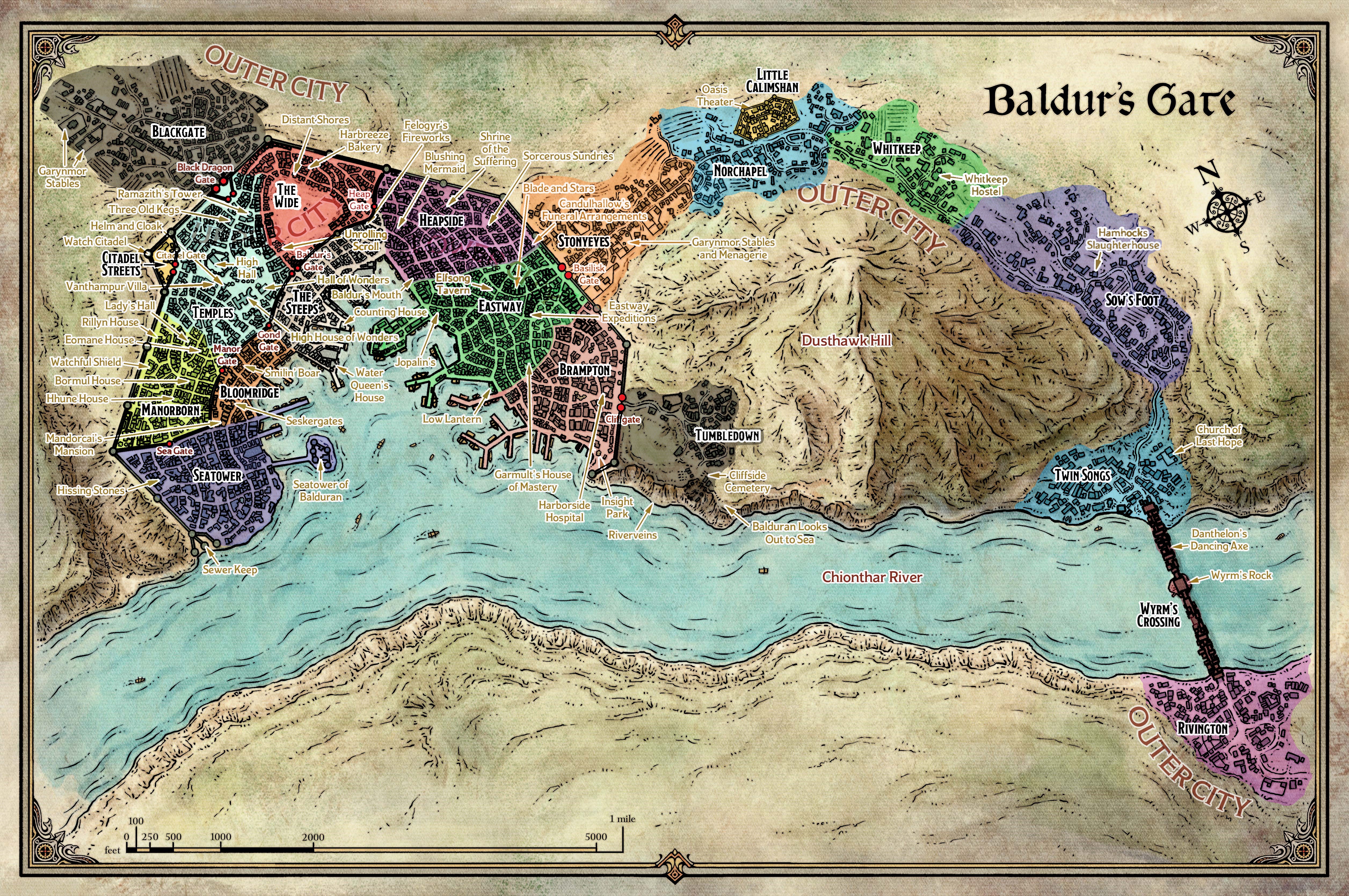
Baldur's Gate is divided into three main sections, described in detail below. Briefly, the Upper City is the walled region to the north, the Lower City is the portion between the Old Wall and the River Chionthar, and the Outer City is the shantytown that rose up along the roads to the city and around Dusthawk Hill.
Upper City
The Upper City, home to the patriar aristocracy of Baldur’s Gate, is a place of beauty and splendor, where magnificent public sculptures stand alongside historic manors, upscale theaters and boutiques, and tiny stone-walled gardens tucked among the streets like hidden jewels. Flowers bloom along the tree-lined streets, ushering away any stray miasma that escapes from the less fortunate quarters below. Silks and velvets, gold braid and mink, water-clear diamonds and luminous pearls: these are common sights in the Upper City, and hardly glimpsed elsewhere except as cheap imitations.
Everything in the Upper City speaks of privilege and wealth. Magical lights illuminate the clean-swept streets, some bearing enchantments that hold back the river fog. Most of the city’s major temples are located in this district, flagrant evidence of how the faiths value the city’s wealthy elite over congregants with shallower pockets. The finest wine shops, ateliers, and jewelers are all in the Upper City, where the Watch’s nightly ritual of expelling all non-residents reinforces their air of luxurious exclusivity. Those without either Watch-issued tokens or a patriars’ vouchsafe must leave at nightfall, without exception.
Residents of the Upper City feel great pressure to maintain outward appearances, and will keep their estate’s facade finely maintained even at the cost of pawning everything within. Admitting to poverty in this district is admitting to shameful failure. The Watch is merciless about turning beggars and malcontents away from the gates, where an erratically enforced entry toll for non-residents and those without Watch tokens or escorts effectively bars the poor from setting foot within this district.
The region consisted of four districts or neighborhoods:
Citadel Streets
The northern part of the Upper City is dominated by the Watch Citadel, where the Watch conducts training, maintains its barracks and stable, and keeps a few jail cells. Beyond the Citadel, this small and somewhat segregated neighborhood includes many shops and the comparatively modest, though still grand, houses that belong to the few non-patriar residents of the Upper City.
Manorborn
About 24 city blocks in size, the western-most district of the Gate's "Old Town" housed the oldest and wealthiest of its patriar families, those who considered themselves the "rightful rulers" of Balduran's namesake.
Temples District
The Temples District was the largest (about 45 city blocks) and perhaps the oldest and most important regions in the entirety of the Upper City. It featured some of the city's greatest buildings and landmarks that were famous across the Sword Coast. It housed the grand Ducal Palace, which served as the seat of power for the ruling Grand Dukes, the vast Gondar temple-workshop known as High House of Wonders, along with the museum that proudly displayed the creations of Baldurian Gondsmen, the Hall of Wonders.
The Wide
This district served as a vast open-air marketplace and plaza. It was a place where Baldurians and outsiders alike could gather together to gossip, trade, debate politics and discuss issues of the day, or otherwise conduct their business within the city. Its reputation as a market and public forum was well-known across Faerûn, as far away as the nation of Thay. Street music and noisy performances are forbidden, and every night the sellers who are not Upper City residents must pack up and leave. Bustling by day, the Wide is desolate at night, except on holidays and when hosting grand celebrations.
Lower City
A crescent of steeply sloping neighborhoods plays home to the common folk of Baldur’s Gate. The Lower City is a chaotic tangle of conjoined, slate-roofed buildings, its narrow cobblestone thoroughfares spanned by bridges and buttresses designed to keep overflowing tenements from tumbling into the streets. As cramped and noisy as the Lower City can be during the day, bustling with business from a thousand shops, the district turns eerily quiet at night. Though lit by street lamps and traversed by hired lantern bearers, the darkened streets are far from safe, and those citizens not running taverns or other late-night establishments tend to lock their doors and bar their colorful window shutters as the river’s dense fog rolls in.
Nearly everyone in the Lower City is engaged in some sort of trade. Crime of all sorts is rampant, from petty smuggling to outright robbery and murder. Though the city government tries to curtail this by paying the Flaming Fist to patrol the streets, the mercenaries sometimes seem more like an occupying army than a true police force, better suited to indiscriminate head-cracking than delicate investigation. As such, while most residents are happy to shout for the Fist when beset by obvious criminals, they also band together into local crews to better watch each other’s backs and settle more subtle scores. In such an environment, laws are often treated as suggestions, and while most residents are just ordinary folks trying to get by, there’s truth to the old adage that everyone in Baldur’s Gate has a secret to keep.
It has six neighborhoods:
Seatower
One of the largest districts with about 27 city blocks, it is located in the western portion of the Lower City. It rested upon the northern shore of the River Chionthar and housed the western docks of Gray Harbor. Everything in this neighborhood revolves around the Seatower of Balduran. The best armorers and weaponsmiths in the city can be found here, along with residences for Fist mercenaries and their families. Dance halls, fighting dens, taverns, and other delights jockey for position near the fortress’s causeway, hoping to be the first place a carousing mercenary stumbles into, and each Flaming Fist payday sees the neighborhood swell into the most boisterous corner of the city as soldiers celebrate with riotous good cheer and flagrant street brawls.
Bloomridge
A wealthy district located on the western half of Gray Harbor south of the Old Wall. It is home to the wealthier citizens of the Lower City, the merchants, landowners and sea captains who sought a lifestyle that more closely resembled that of the wealthy patriar of the Upper City. It encompasses roughly 13 city blocks.
By great feats of engineering, both structural and arcane, Bloomridge was partially built into the Old Wall that separated the Upper and Lower Cities.
The Steeps
Located between the Old Wall and eastern side of Gray Harbor and about 27 city blocks in size. As the most direct route from the harbor to the Upper City via Baldur’s Gate, the Steeps has a natural advantage in securing business from wealthy travelers, and many of the city’s most successful merchants maintain lucrative storefronts along its dramatically steep thoroughfares. This also makes it the Lower City neighborhood most likely to be visited by patriars, and thus the Steeps sees more than its fair share of patrols by the Flaming Fist.
Heapside
A solidly middle-class neighborhood, Heapside has its share of shops but tends to be more residential, catering to the city’s workforce with ancient but reasonably priced homes and only a moderate likelihood of being stabbed in the street. Within the district's 38 city blocks was the infamous tavern The Blushing Mermaid.
Eastway
Home to the Basilisk Gate, Eastway is the city’s primary gateway to the Outer City and the world beyond, catering to travelers with its profusion of inns, porters, and caravan supplies, as well as to Outer City residents looking for reasonably priced Lower City luxuries. The flow of travelers and strangers through this neighborhood makes it one of the most dangerous parts of the city, as criminals prey on those unfamiliar with the city and without local ties to avenge them. Eastway housed a number of famous Baldurian establishments, such as the Blade and Stars inn, the Elfsong Tavern and the Low Lantern festhall.
Brampton
The easternmost Lower City neighborhood, Brampton is notoriously poor, its location making it the worst for residents seeking to serve Upper City denizens—but the best for smuggling in untaxed goods from Rivington.
Outer City
Dirty and uncouth, the Outer City holds everything the elite of Baldur’s Gate resist allowing within their walls: the poor, refugees, tanneries and stockyards, and other industries that offend highborn sensibilities. Stretching forth from each of the city’s external gates, the Outer City sprawls in a chaotic tangle of shanties and shops, carts and tents lining the roads in hopes of bleeding off enough city trade for their owners to survive. And indeed, much of the commerce in Baldur’s Gate happens in these unregulated markets, with even patriars shopping from inside perfumed litters.
While smaller neighborhoods such as Tumbledown and Blackgate squat outside their respective gates, the majority of the Outer City runs along the Coast Way as it curves around the foot of Duskhawk Hill, between Wyrm’s Crossing and the city proper. Residents of these neighborhoods are not technically citizens and receive no representation in the government, nor do they receive the benefit of the city’s police forces. The Flaming Fist rarely patrols the Outer City, usually emerging only to pursue Outer City residents for crimes committed within the walls.
The Outer City’s challenges lead to small, tightly knit communities, where a person’s honor and social connections are the only things standing between them and a quick death. While the various "outsiders" of this district are taxed and technically "ruled" over by the Grand Dukes, city officials do little to truly govern the unregulated Outer City.
It had nine districts:
Blackgate
The Outer City settlement beyond the Black Dragon Gate, Blackgate serves those traveling to and from Waterdeep on the Trade Way. Huge stables cater to travelers’ mounts, while a community of shield dwarf ironsmiths draws even residents of the Upper City with their skill.
Stonyeyes
Just outside the Basilisk Gate that gives it its name, this neighborhood is full of stables and stockyards. Many Outer City residents who work within the city live here to be as close as possible to their places of business. Among them is a significant community of half-orc porters.
Norchapel
The quietest of the Outer City neighborhoods, Norchapel caters to those residents willing to pay more than the usual protection money to the Guild, in exchange for having their safety and security.
Little Calimshan
This walled community’s Calishite inhabitants fiercely guard their home from the Guild and the rest of Baldur’s Gate.
Whitkeep
This neighborhood takes its name from the white manor house at its center, which houses the city’s largest enclave of gnomes. Free-spirited and home to hordes of artists, the neighborhood would likely attract trendy city folk and price out the resident radicals, if not for its odoriferous tanneries.
Sow's Foot
Here, expatriates from dozens of far-flung nations mingle with races ranging from lizardfolk to svirfneblin among the scents of exotic food and the calls of strange animals, banding together against a city that views them as outsiders.
Twin Songs
Standing ready to welcome visitors as they cross the river, Twin Songs is renowned for its enormous diversity of shrines and places of worship, from tiny roadside altars and idols to home-based temples. While those in search of significant magic must still generally visit the larger temples in the city proper, no god is too foreign or obscure to be worshiped in Twin Songs’ divine sprawl, where even non-criminal worship of fiends and the Dead Three goes unchallenged.
Tumbledown
Off by itself overlooking the river, this perpetually foggy neighborhood hosts the Cliffside Cemetery.
Rivington
This self-contained village of anglers and river-powered mills is the first neighborhood encountered by travelers approaching from the south. Dominated by a local gang called the Rivington Rats, it’s also a haven for smuggling thanks to its river access.
Guilds and Factions
Baldur's Gate sponsors nearly 90 professional guilds, from seafarers and financiers from the Upper City, to loremasters, brewmasters, metalworkers and nearly every skilled tradesperson in between. While the honest and once-powerful mercantile guild known as the Merchant's League, previously dominated trade in the city, it was banned by the Council of Four and is forced to operate in secret.
Throughout its history, various thieves guilds have risen and fallen in Baldur's Gate, including the one led by Alatos Thuibuld, Xantam's Guild and the Hands of Glory. Since the fall of these groups in the late 14th century, the Guild, led by Nine-Fingers has emerged as the predominant thieves' organization in Baldur's Gate. Nearly all of the smaller gangs of the Outer and Lower Cities owe at least some obedience to this influential organization.
Other significant factions include The Watch, The Flaming Fist, The Zhentarim, and The Harpers.
Points of interest
Undercellar
Beneath the streets of the city was a sprawling, underground festhall known as the Undercellar. Dank cellars, twisting corridors and cramped tunnels composed its extensive network that stretched beneath nearly every corner of the Upper City region. Entrances into this secretive domain were numerous, but well-controlled, either by private, mercantile or criminal enterprises.
Wyrm's Crossing
Wyrm's Crossing was the great double-bridge that spanned the River Chionthar, which extended north and south from the island-fortress of Wyrm's Rock. A myriad of different buildings were constructed on top of the crossing: from elaborate, several-story mercantile shops to small vendor stalls and even precariously-built businesses that hung off the side of the stone bridge, overlooking the waters of the Chionthar.
The bridge stood atop massive arches that allowed ample room for sea traffic to pass unhindered. It was wide enough to allow overland travelers to pass through its many buildings, along the road that led into Baldur's Gate proper.
The Gates
The three gates of the Lower City are ripe with logistical, historical, and metaphorical significance. Though tokens are not required to pass through the gates connecting with the Outer City, using any gate comes with a 5 cp entry toll and erratic investigation of cargo and suspicious individuals.
- Baldur’s Gate. The oldest and least impressive of the city’s gates, Baldur’s Gate nevertheless remains the city’s heart. As the only gate allowing ordinary people through the Old Wall, Baldur’s Gate embodies the power imbalance between rich Upper City patriars and Lower City commoners. Once the sole gate leading to the harbor, it’s still the primary route by which the city’s wealth flows from port to patriar.
- Basilisk Gate. Piercing the city’s eastern wall, this statue-lined gate connects the Lower City to the great Coast Way, stretching through the majority of the Outer City and then southeast toward Amn, Tethyr, and Calimshan.
- Cliffgate. This foggy minor gate grants access to the Tumbledown neighborhood and its graveyards. Many stories claim that Cliffgate is haunted by the spirits of former citizens seeking reentry to the city and passage back to their homes, but locals know that any mysterious disappearances are more likely the result of a quick mugging and a long fall to the river below.
The Old Wall, built at Balduran’s behest centuries ago, surrounds the Upper City. Six gates pierce it, channeling the district’s visitors and commerce. Entering the Upper City requires either being a patriar, having a patriar’s letter or livery, showing a Watch token issued to the Upper City’s residents or licensed to its few inns for guest use, or paying an entry toll. Tokens and tolls are only accepted at Citadel Gate, Baldur’s Gate, and the Black Dragon Gate, since the other gates are reserved for the exclusive use of patriars, their servants, and their guests.
- Black Dragon Gate. Named for the dragon’s head that a victorious knight once hung upon its arch, the Black Dragon Gate faces the road heading north toward distant Waterdeep. The original dragon’s head is long gone, but a stone replacement snarls above the gate’s arch. Local legend claims that the stone head will magically spew acid at attackers if the city should ever fall under siege.
- Citadel Gate. The only entrance to the Watch’s fortress, Citadel Gate nestles into the Upper City’s landward wall. The Watch maintains a small cavalry, nominally for defense and crowd control, but primarily for parades, honor escorts, and other ceremonial functions. Because of this, the Citadel maintains the only stable within the city walls.
- Patriar Gates. The four gates known collectively as the patriar gates—Gond Gate, Heap Gate, Manor Gate, and Sea Gate—are smaller and are generally not accessible by the general public. They were built after the construction of the Lower City walls and were intended to offer patriars convenient access from their homes to their business concerns and back. Privately funded by the patriars, and thus serving as a display of their personal success, these gates are more ornate and tightly guarded than the public gates. Officially, none may use them without bearing a patriar’s livery or letter of permission, although rumors persist that Guild kingpins and veteran servants among several patriar staffs know exactly which guards to bend. Regardless, the visible double standard imposed at these gates is a constant gall to Lower City residents forced to take longer routes through the public gates because they cannot use the ones in their own neighborhoods.
Taverns & Inns
Upper city:
- Helm and Cloak: An expensive but well-rated feasting hall popular with both locals and travelers alike. Its upper floor is also rented out to the vast majority of the Knights of the Unicorn.
- Purple Wyrm Inn and Tavern: A tavern much compared to the Elfsong, but more commonly used by merchants than those seeking adventure.
Lower City:
- Blade and Stars: A quiet inn known for its high-quality foodstuffs.
- Blushing Mermaid: Located in the north-eastern section of Baldur's Gate, the Blushing Mermaid is known for its status as a hub of illicit business.
- Elfsong Tavern: A tavern in the southeast near the eastern gate known best for its strange haunting, a ghostly elven voice of unidentified origin that could be heard singing quietly at night.
- Hanged Man: A rundown inn infamous for being lawless and the most dangerous establishment on the Sword Coast. The inn has been officially condemned and its license revoked by the Gate numerous time but never enforced.
- Low Lantern: A converted three-mast ship used as a festhall, tavern, and gambling house.
Other Landmarks
Landmarks
- High Hall: Palace of the Grand Dukes in which city business is conducted.
- Watch Citadel: The barracks and training facility for the protectors of the Upper City.
- Baldur's Mouth: This Lower City establishment disseminates official business, public declarations and other daily news through published broadsheets and town criers.
- Gray Harbor: Baldur's Gate has a large and busy harbor that opens into the River Chionthar. The harbor is closed after sunset, after which no ships can tie up. Latecomers have to wait out in the river until sunrise.
- Seatower of Balduran: Defensive structure on an island in the harbor, which also homes the Hissing Stones Bathhouse.
Shops
- Calim Jewel Emporium: This Outer City gem is largely regarded as the home of the best jeweler in the city.
- Sorcerous Sundries: A Lower City shop near the eastern gate that stocks all sorts of arcane supplies, from spell components to magical items.
Places of Worship
- High House of Wonders: A temple of Gond in the upper City that doubles as a workshop for its priests.
- Hall of Wonders: This Upper City museum displays the relics of the Gondar faith, for all Baldurians to behold.
- Shrine of the Suffering: This plain and unadorned shrine of Ilmater in the Lower City caters to the city's poorest citizens.
- Water Queen's House: The temple of Umberlee, found in the Lower City near the city docks, is the oldest house of worship in Baldur's Gate.
Geography
Baldur's Gate was located to the south of the great city-state of Waterdeep, north of Amn along the well-traveled Coast Way road,8 that passed over the Wyrm's Crossing, through the Outer City and into the Gate proper.24 It was nestled on a stretch of poor soil, within a natural bay that formed on the north bank of the River Chionthar about 40 miles (64.4 km) east from its mouth on the Sea of Swords.17
As the minstrels of the 14th century described it, the city was a crescent moon that wrapped around the great harbor,21 though in the century that followed it grew well beyond that form.13 While the terrain of the Upper City was flat and level,25 the Lower City was built over steep bluffs that overlooked the Gray Harbor.
Climate
The region surrounding Baldur's Gate received an abundance of drizzling rain and sleet with frequent-occurring fog that rolled through the city's streets. This excessive precipitation was well-mitigated with an advanced water system where underground basins collected the run off rainwater, maneuvering it through subterranean aqueducts that emptied it into massive cistern beneath the Temples District.
Despite the city's engineering and cleanliness, this continual rain led to regular growth of mildew accompanied by a musky smell that permeated the city's cellars. To abate the slippery stone streets, it was sometimes necessary to spread straw or gravel along the wet cobblestones.

Comments