
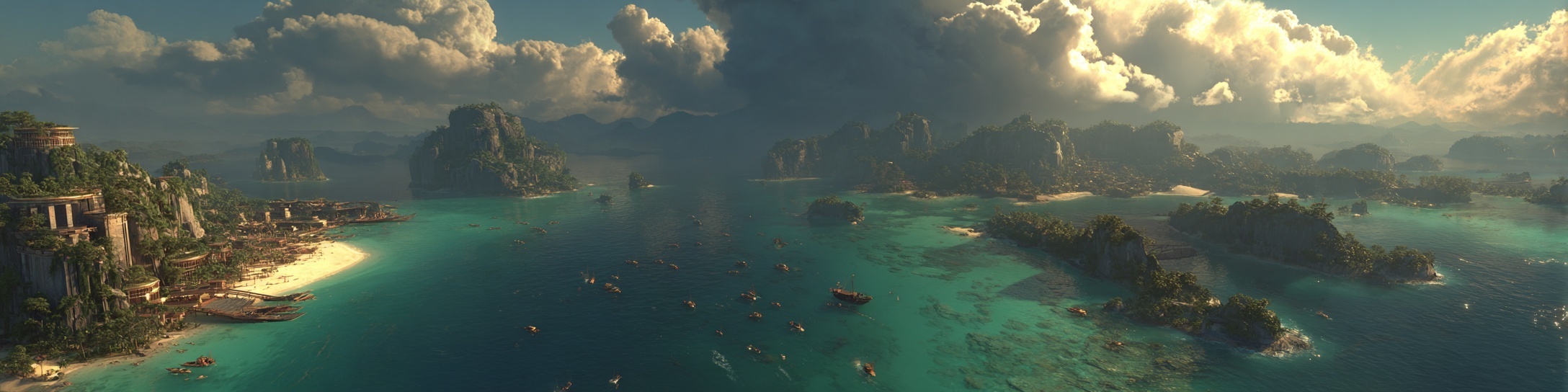
Amfa'atu (ahm-fah-AH-too)
Amfa’atu, colloquially called the Isles of the Spell-Kings, is a compact island nation in the Godslost Sea where law rides on tides and governance rises straight out of living coral. Seven reef-grown towers anchor seven islands, each ruled by a Spell-King whose authority is personal, local, and sharpened by the tower’s vast spell-knowledge. The council that binds them prefers consensus but is not afraid of a vote, and everything they do or refuse to do is constrained by one unignorable truth: the Pearl Elves who tend the reefs can dim the towers if the Isles ever forget that power here is borrowed, not owned.
Structure
Amfa’atu is a magocracy governed by a council of seven Spell-Kings, each sovereign over one island and the coral tower that rises from its reef. Authority is deliberately decentralized: each Spell-King funds and administers local needs on their own island, while the council handles matters that affect the Isles as a whole, especially foreign policy, reef protections, piracy response, and disputes that cross island borders. The Spell-Kings prefer consensus and extended deliberation, but when agreement cannot be reached, they settle questions by majority vote. In practice, the council often defers to Vidye in matters where divination can clarify outcomes or expose hidden risks, though her counsel is influence, not law.
The towers function as both a seat and an engine of governance. Each one is grown from a living reef and maintained through Pearl-Elven stewardship, and a Spell-King working within their own spire can draw on reef-lore to broaden what they can attempt. The council can convene at a distance through tower-work, or use tower passage when weather, distance, or security makes boats impractical. Beneath the council sits a light civic layer rather than a heavy bureaucracy: harbor and customs officials at Taulaga, scribes who maintain council records, and island appointees who oversee storehouses, repairs, and public works. Day-to-day crossings and visitor transport are supported by the Whitewake Guild, a small association of licensed skiff-captains and reef-pilots who operate under council authority while remaining politically neutral.
Each Spell-King maintains an island militia and answers for local lawkeeping, while the council coordinates joint action only when a threat or crisis exceeds any single island’s reach. This structure keeps Amfa’atu stable and unusually “chill” by outsider standards: power is concentrated at the top, but it is close to the people, visibly tied to the health of the reef, and restrained by the practical reality that no tower stands alone.
Culture
Life in Amfa’atu is shaped by three loyalties: hospitality, the reef, and the sea. Islanders tend to be open-handed with strangers and practical with problems, the sort of people who will feed you first and ask questions while you’re chewing. The sea is not treated as a border but as shared ground, and most people grow up competent with boats in the same way other nations raise children to be competent with roads. Days begin early. Dawn fishing is common, followed by bustling markets where catch and produce change hands quickly and gossip moves faster than coin.
Respect has a few hard edges. Harming the reef is one of the clearest taboos in the Isles, not only because it is sacred to the Pearl-Elven Coral Keepers, but because everyone understands that reef and tower health are intertwined. Another deep offense is sabotaging a person’s ability to care for themselves, especially by damaging a home or boat. In Amfa’atu, taking someone’s boat is not mischief. It is closer to stranding them in the wilderness.
The most visible celebration is the New Year Towerlighting, when communities gather to mark the turning of the year by lighting the towers in coordinated sequence across the seven islands. It is not a spectacle of noise, but of luminous color and careful timing, with food, song, and night markets that run until the last light settles. Through it all, the Spell-Kings are regarded less as distant rulers and more as guardians: powerful, present, and expected to use that power to keep the Isles safe, fed, and calm enough to live in. Visitors are generally received as guests, but guests in a place with rules, where a careless hand near coral can turn welcome into cold silence fast.
Public Agenda
Amfa’atu’s public agenda is stability without stagnation. The Spell-Kings present themselves as guardians of a good life: safe waters, dependable food, open markets, and enough law to keep violence rare without turning the Isles into a cage. Their first priority is the health of the reef and the continued symbiosis that makes the towers possible, which in practice means strict reef protections, quick responses to corruption or blight, and deference to Pearl-Elven stewardship when reef safety is at stake. Their second priority is keeping the sea lanes around the Isles usable: discouraging piracy, escorting vulnerable ships when needed, and making Taulaga’s harbor approaches difficult for raiders to exploit. Beyond that, the council aims to preserve Amfa’atu’s diplomatic balance, strengthening ties with the Pearl Elves and maintaining steady trade with Colwyn while keeping contact with Eshara carefully mediated and the Barrens at arm’s length. The Spell-Kings are not expansionists; their ambition is to keep what they have thriving, and to ensure that no outside power gets close enough to threaten the towers, the reef, or the people who depend on both.
Assets
Amfa’atu’s greatest assets are not stored in vaults, but grown and maintained. The seven coral towers are the visible heart of the Isles’ power, each rising from a living reef that functions as a vast repository of spell-knowledge. When a Spell-King is within their tower, that reef-lore broadens what they can attempt, allowing the council to respond to storms, threats, and crises with a speed and sophistication that outsiders often underestimate. Just as important is the Pearl-Elven stewardship behind that power: the Coral Keepers, led by Seshala, safeguard the reef’s health and can diminish the towers’ strength if the Isles ever endanger the symbiosis that sustains them.
Amfa’atu’s following most visible assets are concentrated at Taulaga, the foreign-facing port: inspection capacity, reef pilotage, and the administrative practice of handling outsiders without allowing them to set the tone. Economically, the Isles sustain themselves through abundant fishing grounds and productive groves and terraces, with preservation crafts that make exports dependable rather than seasonal gambits. The Whitewake Guild adds a quieter form of power: a trusted, licensed network for visitor movement, pilotage, and urgent courier work that keeps the Isles connected without needing a large transport bureaucracy.
Finally, Amfa’atu’s defensive strength is distributed. Each Spell-King maintains local wards and an island militia. At the same time, the council’s real deterrent is coordination: shared planning informed by divination, rapid response, and the ability to concentrate expertise when a threat exceeds any single island’s reach. Together, these assets make the Isles difficult to pressure without provoking a unified answer from tower, reef, and ruler alike.
History
Amfa’atu’s history is told in tower order rather than in dynastic order. Each coral spire rose from the reef in its turn, and with every new tower the islands became more unified, more prosperous, and more difficult for outsiders to push around. Even so, the Isles’ oldest story is not about conquest or inheritance, but about a bargain struck between desperation and possibility.
The Founding Pact (Myth and Memory)
The most common founding tale begins with a shipwreck: a lone human survivor cast onto the reefs with just enough arcane potential to realize they were not strong enough to magic their way home. Rather than perish, they bargained. The sea did not give them a ship. The reef did not provide them with a shore. But something answered. From that pact, the first tower rose, and with it the first Spell-King, bound to the living coral as much as elevated by it. Whether the tale is literal truth or civic poetry, the moral is treated as law: power in Amfa’atu is granted through relationship, not seized without consequence.
Selected Timeline
- The First Tower: A coral spire rose from the reef, establishing the tradition of tower-attunement and the title of Spell-King.
- The Towering: Over generations, additional towers emerged in sequence until seven stood across the Isles, each anchoring an island polity and binding the council together through shared reef-lore and mutual dependence.
- The Coral Compact: Pearl-Elven stewardship became explicit rather than assumed, with Coral Keepers recognized as guardians of reef health and the symbiosis that empowers the towers.
- The Sixth Tower Vacancy (About One Year Ago): A drow wizard attempted to take Tower 6. The attempt was stopped, but the tower was left without an attuned Spell-King for a time. With no tower-holder to watch the island and stabilize its magic, the council chose caution and evacuated the island, coordinating passage primarily to Taulaga and other neighboring islands. During this period, Seshala served as acting Spell-King on council matters related to reef stewardship and continuity, preventing panic decisions and ensuring the Coral Compact held together.
- Evergreen’s Resolution: The adventuring party, Evergreen, ended the crisis and made safe attunement possible again. The most dangerous detail, that the tower’s corruption could steal memories, affected only the adventurers who entered to confront it, and remains unknown to the general public.
- Zinth’s Ascension: With the tower stabilized, Zinth Risthún attuned to Tower 6 and took his seat, returning the council to seven.
To most islanders, this chapter is remembered simply as “the evacuation year,” proof that the Spell-Kings will uproot an entire island before they gamble with lives. The more profound truth is held tighter: some threats are handled quietly, not because the council lies easily, but because fear spreads faster than storms.
Demography and Population
Amfa’atu’s population is overwhelmingly human, with other peoples present only in small numbers. Most non-humans are visitors, short-term residents, or individuals drawn by trade, study, or the unusual safety and prosperity the Isles provide. A few outsiders put down roots over time, but Amfa’atu is not a melting pot in the way major mainland cities are; it remains culturally cohesive, with island customs and maritime competence shared broadly across the populace. Long-term exceptions tend to be tied to specific relationships or obligations, such as those created through trade, oaths, or service to a tower. The Pearl Elves are not common among the general population, but their presence is strongly felt through the Coral Keepers and their stewardship of the reefs that power the towers.
Territories
Amfa’atu is a compact island nation of seven inhabited islands, each anchored by a coral tower grown from the living reef and ruled by a Spell-King. The Isles’ territory includes not only the islands themselves, but the surrounding reefs and coastal waters that function as both livelihood and natural fortification. While each Spell-King governs their own island directly, council authority is strongest in shared spaces: reef boundaries, major channels, and especially Taulaga, the primary deep-water harbor and the main point of contact for foreign ships. In practice, the health and extent of the reefs define Amfa’atu’s true borders more than lines on a chart, and threats to those reefs are treated as threats to sovereignty.
Military
Amfa’atu does not field a large standing army, and it does not pretend otherwise. The Isles’ defense is built around three layers: the Spell-Kings’ magic, island militias, and control of approaches through reefs and harbor law. Each Spell-King maintains their own militia suited to local needs, typically small, well-trained in coastal defense, and familiar with skirmishes rather than open-field war. These forces handle lawkeeping support, patrols, and emergency response, while joint operations are coordinated by the council only when a threat crosses island borders or threatens Taulaga’s trade lanes.
The true deterrent is magical. The towers allow the Spell-Kings to respond rapidly to storms, raiders, and maritime threats with coordinated spellwork, informed by divination and reinforced by abjuration. Tower-to-tower travel allows the council to reposition key leaders and specialists without relying on boats, keeping command resilient during bad weather or active piracy. Amfa’atu’s most common military engagement is not “war” but anti-piracy action: patrol coordination, convoy escort when needed, and decisive responses when raiders push too close to the Isles’ waters. Outsiders tend to underestimate Amfa’atu because its forces look small on paper. That mistake usually lasts until the sea itself starts cooperating with the council.
Technological Level
Technologically, Amfa’atu sits at a familiar seafaring baseline: skilled carpentry, reliable small craft, practical harborworks, and the quiet competence of people who treat boat maintenance as ordinary life. What sets the Isles apart is applied knowledge rather than invention for its own sake, especially navigation, weather-reading, reef ecology, preservation, and saltwise construction. The Isles’ “advanced” edge is mostly magical and institutional, rooted in tower-work and reef stewardship rather than in mundane industry.
Religion
Amfa’atu has no official state faith and no single priesthood that governs daily life. Reverence here is practical and communal, expressed through household rites, sailor customs, and shared expectations about survival. The Spell-Kings do not rule by divine mandate, but they also do not pretend the towers exist apart from sacred stewardship, and so faith in Amfa’atu sits beside governance rather than beneath it.
Most islanders honor two great divine powers of the sea-sky boundary. Lomalua, Lord of the Two Tides, is revered with equal parts gratitude and fear as the sea’s shifting will, capable of abundance and catastrophe without warning. Ketoalori, heir to Taralor’s storm-mantle, embodies storms as divine grief and the violence of open water. Outsiders often claim Ketoalori lost his earlier nature, but Amfa’atu preserves a quieter doctrine: that Harbor and Hospitality were not destroyed, only buried, and that shelter can still surface within the storm. The Pearl Elves and their Coral Keepers do not dominate the Amfa’atu religion. Still, their reef stewardship is treated with near-sacred respect, because reefs are understood to be living memory and the towers’ foundation.
Foreign Relations
Amfa’atu’s diplomacy is built on a simple premise: the Isles do not need to be loud to be untouchable. The Spell-Kings prioritize relationships that protect the reef, keep Taulaga’s trade steady, and prevent outside conflicts from turning their waters into someone else’s battlefield. They prefer clear agreements, predictable routes, and limited obligations, and they are quick to become politely uncooperative when a foreign power tries to treat the Isles like a resource to be harvested.
The Pearl Elves are Amfa’atu’s most important external relationship, and also the one with the most leverage. The Coral Keepers maintain the symbiosis that empowers the towers, and the Spell-Kings treat reef safety as a diplomatic red line rather than a negotiable concern. This has practical consequences: foreign captains who ignore reef regulations encounter colder ports, harsher inspections, and unavailable pilots. The council’s policy is simple. No reef harm, no exceptions.
Colwyn is Amfa’atu’s most consistent trade partner and a preferred counterpart for formal agreements. Colwyn provides the Isles with worked goods, specialized materials, and reliable markets, while Amfa’atu supplies foodstuffs and select maritime exports. Relations are generally warm, if occasionally cautious, as both sides understand that a magocracy and a mainland kingdom can misunderstand each other quickly when pride gets involved.
Eshara is treated as a special case. The Pearl Elves distrust Eshara due to the ancient destruction of reefs during its formation, and Amfa’atu refuses to risk a second catastrophe. Official contact is therefore tightly mediated through The Coral Oath under Merel Tideglass, whose crew are bound by a sworn pledge recognized by the Coral Keepers to bring no harm to Amfa’atu’s reef.
Risland sits in a more distant, intermittent lane. Trade and contact exist, but tend to be seasonal, opportunistic, and often routed through third-party captains rather than formal, Isles-wide schedules. The council is cordial but not invested, preferring to keep Risland as a friendly horizon rather than a constant presence in Taulaga.
The Barrens are Amfa’atu’s persistent irritation. The main threat is piracy, and the council’s outward-facing posture hardens whenever raiders become bold. In practice, this means tighter screening at Taulaga, faster coordination between island militias, and a willingness to escort vulnerable ships or make examples when necessary. Amfa’atu will accept a trickle of refugees when they appear, but the Isles are not positioned to be a primary refuge, and the council is wary of anyone using “need” as camouflage for predation.
Laws
Amfa’atu keeps its laws practical, maritime, and easy to remember. Each Spell-King sets island-level rules and handles day-to-day justice through local appointees, but Isles-wide law exists wherever reefs, trade, and safety overlap. The council’s statutes are recorded by dedicated scribes and stored in multiple places for redundancy, most notably at Taulaga’s harbor offices and within tower archives. Enforcement is typically local, but any matter involving reef harm, piracy, inter-island disputes, or foreign violations can be elevated to council review.
Reef Protections (Isles-Wide)
Reef harm is treated as a serious offense, not a minor nuisance. Anchoring on living coral, harvesting protected reef growth, dumping waste into reef water, or reckless spellwork that damages the symbiosis are punishable by heavy fines, confiscation of vessels or cargo, and expulsion from Amfa’atu waters. Repeat offenders can be formally barred from port, and the Spell-Kings will support Pearl-Elven Coral Keeper judgment when reef safety is at stake.
Harbor Law and Customs (Taulaga)
Taulaga’s harbor rules are strict by design. Foreign ships must accept reef pilots when ordered, submit to inspection, and obey channel markers and anchorage assignments. Captains who refuse are denied entry. Smuggling is prosecuted aggressively when it endangers public safety or reef health, while petty trade violations are more commonly resolved through fines and confiscation.
The Esharan Exception (Port Ordinance)
By council decree, no vessel sailing out of Eshara may make port in Amfa’atu without explicit council sanction. A single standing exception is granted to The Coral Oath, captained by Merel Tideglass, whose crew is bound by an oath recognized by the Coral Keepers to bring no harm to Amfa’atu’s reef. Any violation of that oath voids the exception immediately.
Piracy and Sea-Crime
Piracy is treated as an existential threat rather than a romantic nuisance. Captured pirates face harsh sentencing: imprisonment, forced labor, forfeiture of ship and spoils, and, in severe cases, exile to the open sea with no right of return. The council also recognizes “aid to pirates” as a significant crime, including the sale of harbor information, false piloting, or sheltering raiders under local protection.
Self-Sufficiency Protections
Certain crimes are punished more severely in Amfa’atu than outsiders expect. Sabotaging a person’s home or boat, stealing essential gear, or otherwise depriving someone of the means to feed themselves is treated as a serious offense and often requires restitution that far exceeds the value of the item. The cultural logic is simple: in an island nation, removing self-sufficiency is a form of violence.
Whitewake Licensure and Crossing Law
The Whitewake Guild operates under council authority and is bound by licensure. Whitewake captains must keep their boats seaworthy, maintain rescue basics, and refuse recklessly unsafe crossings. In return, Whitewake licensure grants protected status while on duty: assaulting a licensed ferryman, interfering with a contracted crossing, or impersonating a Whitewake authority is prosecuted as a major crime. Whitewake disputes are typically handled internally first, but the council can revoke licensure in cases of repeated misconduct.
Agriculture & Industry
Amfa’atu’s economy is rooted in the sea and supported by the land. Fishing is the primary staple industry, supplying local tables and creating reliable exports through drying, salting, smoking, and oil preservation. On land, the islands produce fruit and hardy vegetation through groves, gardens, and terraced cultivation, with markets turning over fresh goods at dawn and preserved goods moving outward through Taulaga’s docks. Industry is largely small-scale and practical: boatbuilding and repair, net-making, ropework, sails, cooking oils, preservation craft, and the everyday tools of maritime life. Amfa’atu does not compete with mainland nations in heavy manufacturing; instead, it imports most manufactured goods and focuses locally on what the islands can sustain well and consistently.
Trade & Transport
Trade in Amfa’atu is simple in principle and fussy in practice. Most bulk goods enter and leave through Taulaga (Motu Taulaga), the Isles’ primary port and the point where foreign captains learn that reefs are law. From there, cargo moves by local craft. Most residents can ferry themselves, so island-to-island travel is common and informal; visitors and the boatless rely on Whitewake for short crossings, pilotage, and messenger runs. For the Spell-Kings, tower passage provides a second kind of mobility when distance, weather, or politics make boats inconvenient. Amfa’atu exports fish and island produce, and occasionally commissioned spellwork, while importing most worked goods such as metal tools and weapons, fine craftwork, specialized timber, and luxuries.
Externally, Taulaga’s docks see the most regular traffic from Colwyn, which provides manufactured goods and receives foodstuffs and select maritime exports in return. Trade with Risland tends to be smaller and more opportunistic, often routed through third-party captains rather than formal schedules. Ships from the Barrens are treated with suspicion, and anti-piracy measures are strongest at the approaches to Taulaga and along the most-traveled channels. Eshara is handled as a special case: by policy, the only Esharan vessel permitted to make port in Amfa’atu is The Coral Oath, captained by Merel Tideglass, a half Pearl Elf. This exception preserves limited commerce while respecting Pearl-Elven concerns and provides the council with a single, trusted channel through which Esharan goods, messages, and travelers can be inspected, sponsored, and controlled.
Education
Education in Amfa’atu is practical and widely shared. Most children acquire basic literacy and numeracy sufficient for trade, navigation, and household management, with greater emphasis on seamanship, weather sense, and the skills needed to avoid becoming a cautionary tale. Apprenticeships are common, particularly in fishing, preservation, boat repair, rope work, and harbor trades. Advanced study is rare, not due to prohibition but because the Isles do not produce large scholarly institutions by default; those who pursue deeper learning usually do so under a tower’s patronage, through specialized mentorship, or by traveling abroad. Magical instruction is treated with respect and caution, and while the Spell-Kings are living proof of what the towers can enable, they are not factories for producing new rulers.
Infrastructure
Amfa’atu’s infrastructure is built around three things: safe water, safe landing, and the towers. Settlements cluster near sheltered coves and reliable freshwater, with terraced gardens and managed groves on the calmer slopes and fishing hamlets wherever reefs break the surf. Taulaga maintains the best harborworks in the Isles: marked channels, mooring fields, repair yards for small craft, and a standing system for reef pilots to guide unfamiliar ships. Between islands, there are no grand highways, just well-worn paths, local docks, and a lot of practical seamanship. The true marvels are the coral towers, grown from the living reef and maintained through Pearl-Elven stewardship. When a Spell-King is within their tower, the reef functions as a living library of spellwork, widening what they can attempt without replacing the limits of their own training. The true marvels are the coral towers, grown from living reef and sustained through Pearl-Elven stewardship. Their existence reduces the need for centralized roads, standing fleets, or large garrisons, because the council can coordinate quickly and move key people by tower passage when it must. Most public services are handled at the island level, with each Spell-King funding and maintaining their own militia, docks, storehouses, and civic works, and the council stepping in mainly when an issue threatens more than one island.
Mythology & Lore
Amfa’atu’s oldest myths are not “creation stories” so much as survival stories that became sacred through repetition. Islanders speak of the Godslost Sea as a wound made into a world: Taralor, god of war and storms, fell from the heavens in a divine battle, and his ruin carved the Godslost Basin. Liora, stricken by grief, became Moiren, and her tears filled the Basin with salt water and moon-laced magic. What followed was not immediate balance but chaos. Weather went feral, coastlines broke, and the newborn sea behaved like a thing learning how to bite.
In that era, Taralor’s storm-mantle did not die with him. It passed, unasked and unsoftened, to his divine son: a god once known for Harbor and Hospitality, suddenly burdened with storms he could not control. Amfa’atu tells that his grief lashed the sea for a time, and sailors learned to fear the sky as much as the waves. Then came the tale of the Still Circle. In the teeth of one of his grief-tempests, a ship shattered, and survivors clung to wreckage. The storm-god felt the old instinct to shelter them and nearly killed them with his own power, until he forced himself into a single deliberate mercy, carving a harbor-shaped pocket of still water into the chaos. The survivors lived, and that choice became the hinge of Amfa’atu’s faith: grief may rage, but it can be guided.
The Pearl Elves entered the myth not as comforters but as teachers of exchange. Through coral, they offered a memory of shelter freely given and dearly paid for, and in return demanded a vow: be shelter again. The reefs answered that vow by growing the first coral tower, not built but grown as a promise made visible. Among the saved was a human with arcane potential, not enough to magic his way home, but enough to recognize what the reef offered and to attune to the spire. In most tellings, this is the founding moment of Amfa’atu’s magocracy: power is not seized, it is carried, and it is held only as long as the reef is honored.
Alongside this tower-myth runs the darker, older truth of the sea itself: Lomalua, Lord of the Two Tides, whose nature swings between bounty and taking. Amfa’atu does not explain Lomalua’s mercurial will. It endures it. When the nets come up heavy, it is said that Lomalua’s open palm passes beneath the boats. When a calm night turns murderous without warning, it is said his closed fist remembered its due. From this, islanders derive their hardest lessons: do not boast over calm waters, do not break promises made at sea, and never confuse survival with entitlement.
These myths underpin the Isles’ everyday ethics. Reef harm is treated as sacrilege because the reef is living memory and living power. Guest-right is sacred because the sea makes everyone a potential shipwreck. Boat sabotage is condemned as violence because taking a person’s craft is to steal their ability to live. And when storms rise, the faithful shorten theology into a working breath, “Tau-Āvai,” not as a polite prayer, but as a plea for the buried Harbor within the storm to remember mercy.
Tenets of Faith
Amfa’atu does not treat faith as a list of beliefs to recite. Tenets are rules for staying alive without becoming a monster about it. Most households honor both Ketoalori and Lomalua, but the tone differs: Ketoalori is approached with grief-respect and rescue-duty. In contrast, Lomalua is approached as a dangerous host whose generosity must never be assumed.
Tenets of Ketoalori (Heir of the Storm-Mantle)
- Do not boast you are safe. Calm is not a promise; it is a moment.
- Keep storm-vows. An oath made before open water is binding, even when it is inconvenient.
- Rescue is sacred work. In storm and surf, help first, question later.
- Grief may rage, but it must not unmake the world. Power is judged by what it refuses to destroy.
- Speak “Tau-Āvai” only while acting. The quick prayer is not for comfort, but for steadiness and mercy.
Tenets of Lomalua (Lord of the Two Tides)
- The sea is a host, not a servant. Enter as a guest, and behave like one.
- Pay guest-right, pay guest-debt. Give before you take, and give again when you return.
- Never assume his mood. Yesterday’s kindness does not purchase tomorrow’s calm.
- Do not whistle at night on open water. Some attention is not worth having.
- Do not steal a person’s means to live. To take or ruin a boat is to invite the sea’s judgment.
Shared Tenets (Isles-Wide, taught like manners and law)
- Harm no reef. The reef is living memory, living protection, and the foundation of the towers.
- A guest under your roof is under your protection. Hospitality is an obligation, not a performance.
- Take only what you can repay. If you cannot repay it, you are stealing from the sea.
If you like, I can keep the next section, Ethics, very tight and practical: “sins,” “virtues,” and what punishments or social consequences actually look like in Amfa’atu.
Ethics
In Amfa’atu, ethics are judged less by private intention than by public consequence. The sea does not care why you were careless, only what your carelessness costs. Moral life is therefore built around restraint, reciprocity, and the obligation to keep others capable of survival. Islanders can be warm, even generous, but they are not permissive about the kinds of selfishness that strand, starve, or endanger a community.
Virtues
Hospitality with boundaries is the Isles’ most praised virtue. A visitor is treated as a guest, fed before questioned, and sheltered when weather turns. But hospitality is paired with expectation: guests must respect reef law, harbor rules, and the fact that the sea is not a playground. Rescue-work is considered holy, whether it is done by spell, rope, or skiff. People who take risks to save others earn lasting respect, and refusing aid in a true emergency is remembered for years.
Reciprocity is treated as moral adulthood. Those who give before taking, who repay debts without being chased, and who support communal maintenance are seen as people the sea will tolerate. Quiet competence is admired more than bravado, especially among sailors, ferrymen, and harbor crews.
Sins and Taboos
The clearest sin is reef harm. Damaging living coral, fouling reef waters, harvesting protected growth, or reckless spellwork that wounds the symbiosis is treated as sacrilege, not merely as vandalism. Even when the law is not invoked, the social punishment is brutal: cold silence, loss of service, and informal blacklisting that makes life on the islands very uncomfortable very quickly.
The second great taboo is the theft of self-sufficiency. Sabotaging or stealing a boat, damaging a home, ruining fishing gear, or otherwise stripping someone of their ability to care for themselves is considered a form of violence. Amfa’atu does not romanticize “pirate cleverness” or “harmless pranks” in matters of survival. If your joke leaves someone unable to feed their household, you have committed a moral crime, not a social misstep.
Oathbreaking at sea is feared. Promises made before open water, especially storm-vows, carry spiritual weight. Breaking them marks a person as untrustworthy to their neighbors and “interesting” to the gods, which is the opposite of what sensible sailors want. Bragging about calm seas or mocking storm warnings is treated as a smaller but telling vice, a kind of arrogance that invites catastrophe.
Moral Tension: Lomalua’s Two Tides
Lomalua’s worship produces a particular ethical posture: gratitude without entitlement. Islanders are taught to accept bounty without gloating and to endure loss without claiming they are owed fairness. This does not make them fatalists; it makes them cautious. The sea can be generous and cruel in the same hour, and the ethical response is humility, preparation, and repayment, not resentment and defiance.
Moral Tension: Ketoalori’s Grief
Ketoalori’s presence creates a second posture: action in the face of fear. Storms are understood as grief-made weather, and the Isles’ ethic is not to “win” against grief but to move through it without becoming cruel. This is why the quick-prayer Tau-Āvai is spoken while doing rescue-work, not while waiting for fate. Mercy is not a feeling. Mercy is a rope thrown in time.
Worship
Worship in Amfa’atu is done with hands as much as words. Many households keep a salt bowl, a simple basin of seawater touched before voyages and after returns. Sailors observe the First Cup, pouring a small measure of fresh water into the sea before departure to acknowledge guest-right, and many offer a Second Cup after a safe return, paying guest-debt with oil, perfume, or coin of value. People avoid boasting about calm seas, and those who slip often “take the words back” with a quiet mouthful of seawater cast overboard.
In bad weather or during rescue, islanders shorten faith into a single working breath, “Tau-Āvai,” spoken while hauling rope, guiding skiffs through surf, or pulling someone from the water. It is less a request for calm than a plea for shelter to be remembered, and for the sea to choose mercy. Communal devotion often looks like shared maintenance and shared restraint: clean harbors, careful anchoring, shoreline tending, and deliberate avoidance of waste or damage that would wound reef or tide. The year’s largest public rite is the New Year Towerlighting, when the seven towers are lit in coordinated sequence across the Isles, a reminder that Amfa’atu endures by relationship: tower to reef, island to island, and people to the sea that both sustains and threatens them.
Priesthood
Amfa’atu has no unified church hierarchy and no state priesthood. Religious authority is mostly functional: the people who keep others alive, keep rituals correctly, and keep the sea from becoming everyone’s funeral. In practice, priestly roles overlap with civic ones, and a person’s legitimacy comes from competence, reputation, and community trust more than formal ordination. The Spell-Kings recognize these roles, consult them during crises, and enforce certain religious protections through law, but they do not appoint clergy as political instruments. That would be a quick way to learn what “cold silence” looks like on an island.
Tide-Speakers (Lomalua)
Tide-Speakers are the closest thing Amfa’atu has to public priests. They interpret omens, bless departures, mark safe days for travel, and preside over communal offerings like the First Cup and Second Cup. Tide-Speakers are respected and slightly feared, because their job involves telling people “no” when the sea looks hungry. Many are former sailors, reef-pilots, or elder fishers who survived enough bad choices to stop making them. They keep simple shrines near docks and coves, not grand temples.
Drownwardens (Lomalua)
Drownwardens oversee wreck-right and burial-at-sea practices. They decide what must be returned to the water, what may be reclaimed, and what must be left untouched because “the sea has taken it.” They also handle the social aftermath of loss: naming the dead, marking absences, and mediating disputes when grief turns into accusations. Outsiders sometimes mistake them for morbid officials. Islanders treat them as necessary guardians of boundaries.
Storm-Tenders (Ketoalori)
Those who serve Ketoalori rarely look like “priests” at all. Storm-Tenders are rescue leaders, harbor-watch coordinators, and the people trusted to organize response when the weather turns violent. They teach storm-vows, keep the customs around Tau-Āvai, and maintain the practical rites of steadiness and mercy. Many Storm-Tenders are tied to the Whitewake Guild or to island militias, and their authority is proven each time they bring someone home alive.
The Coral Keepers (Reef Stewardship)
The Coral Keepers, led by Seshala, are not priests of Lomalua or Ketoalori, but they are treated with near-sacred respect. Their stewardship of living reef and tower symbiosis makes them a third pillar of spiritual authority in the Isles. They arbitrate reef harms, set boundaries for safe anchoring and harvesting, and can call upon council enforcement when the reef is threatened. To most islanders, the Coral Keepers are not “clergy” so much as the people who keep the Isles’ covenant with the sea from breaking.
Training and Recognition
There is no single route into priestly service. Tide-Speakers and Drownwardens are usually apprenticed, learning rites, sea-law customs, and community mediation. Storm-Tenders are chosen by trust and tested by storms. Across all roles, the most consistent requirement is restraint: anyone who uses divine talk to inflate their ego loses the Isles’ confidence quickly. Amfa’atu does not like loud holiness. Loud holiness tends to get people killed.
Political Influence & Intrigue
Religion in Amfa’atu does not run the government, but it absolutely shapes what the government is allowed to do without consequences. The Spell-Kings rule by council and practical legitimacy, yet their authority rests on an understood covenant: protect the people, protect the reef, and do not pretend the sea can be bullied. When the council aligns with those expectations, the Isles experience calm and unusual stability. When it does not, the Isles do not rebel with banners. They rebel by refusing: withdrawn cooperation, silent markets, and a sudden shortage of the small services that keep island life functioning smoothly.
The Reef as Leverage
The most substantial political influence is reef stewardship. The Coral Keepers do not hold formal seats of rule, but everyone understands they can diminish the towers’ strength if the symbiosis is endangered. That reality acts as a governor on council ambition. Any policy that threatens reef health, invites reckless foreign traffic, or tolerates magical pollution becomes politically radioactive. This is why reef law is treated as sovereignty, not environmental preference, and why even powerful Spell-Kings tend to sound unusually reasonable when Coral Keepers speak.
Lomalua’s “Two Tides” and Harbor Policy
Lomalua’s mercurial worship produces an outward-facing politics that is inherently cautious. Taulaga is hospitable but not permissive. Foreign captains are welcomed as guests, and then immediately placed under rules that assume the sea is looking for excuses to collect someone. This religious posture gives the Spell-Kings a socially acceptable rationale for strictness: harbor inspections, pilot requirements, and reef restrictions are framed as protection rather than paranoia. Smugglers, reckless sailors, and anyone who treats sea law as negotiable find themselves opposed not only by the state but by public morality.
Ketoalori, Storm-Vows, and Crisis Leadership
Ketoalori’s influence is most visible during emergencies. Storm-Tenders and rescue-leaders carry cultural authority that can override rank in the moment, because islanders treat rescue-work as a sacred duty. A Spell-King who interferes with rescue operations, hoards resources during storm season, or breaks a storm-vow risks being seen as illegitimate in a way that no formal vote can fully repair. Conversely, a Spell-King who takes personal risk, funds public readiness, and honors the quiet customs of Tau-Āvai earns a kind of trust that lasts longer than policy disagreements.
Quiet Factions and Pressure Points
Amfa’atu’s intrigue is rarely about ideology and often about access: access to harbor permits, pilotage privileges, reef harvesting boundaries, and tower resources. Three pressures recur:
- Taulaga Interests: dock officials, merchants, and shipwrights benefit from tighter regulations that maintain order in trade, whereas opportunists advocate looser enforcement under the banner of “prosperity.” This friction is constant and usually polite, until piracy spikes.
- Whitewake Neutrality: the Whitewake Guild’s political neutrality is valued, but it also makes them an attractive target. A faction that can quietly influence pilot assignments, crossing schedules, or courier routes can steer commerce and information without ever passing a law.
- Foreign Channels: the Esharan exception, as articulated in The Coral Oath, establishes a single controlled conduit for Esharan contact. That is stabilizing, but it also means anyone who compromises, imitates, or pressures that conduit can force the council into hard decisions fast.
The Shape of Intrigue in the Isles
Political conflict in Amfa’atu tends to remain nonviolent because violence harms trade and is even worse for reefs. Instead, influence moves through soft tools: public reputation, access to services, controlled information, and the ability to make someone’s work harder without ever raising a weapon. When relations turn sharp, it is usually because piracy has escalated, reef damage has occurred, or an outsider has treated Amfa’atu’s hospitality as a sign of weakness. That is when the Isles stop being “chill” and become quietly terrifying.
“We don’t ask the sea to be kind. We ask it to be honest. Then we steer like we mean to live.”
~ Tavita, Whitewake skiff-captain of Taulaga

Comments
Author's Notes
Image created with MidJourney