
Firebrass
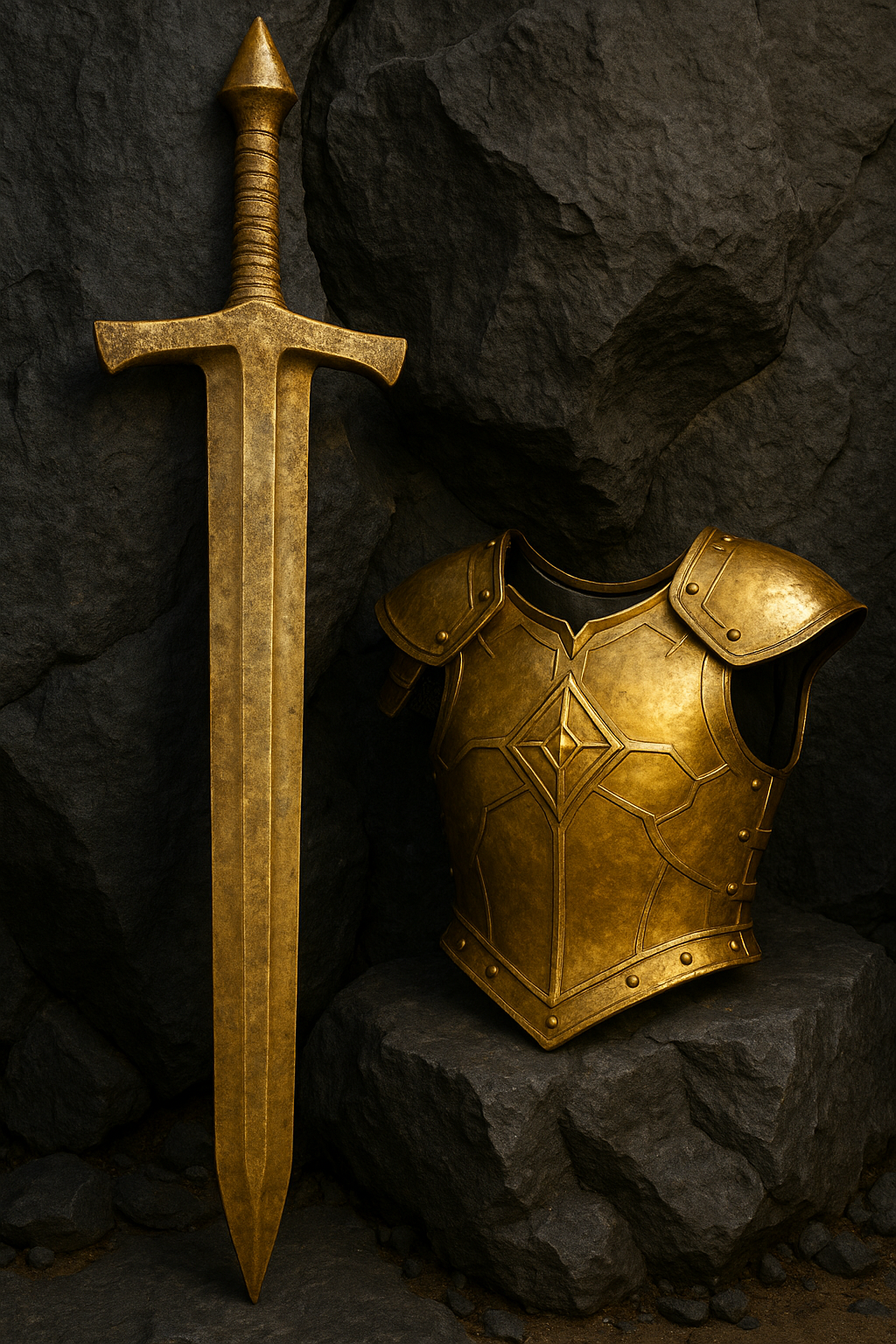
Firebrass is a rare alchemical alloy that functions identically to mithral, though it carries a warm golden-bronze radiance instead of silver. Lightweight, resilient, and capable of being worked into finely shaped armor and weapons, firebrass is visually striking—bright without being gaudy, polished without appearing soft.
It is most closely associated with the Sulatar, a culture of fire-aligned drow dwelling in Xen’drik, who claim descent—and rightful inheritance—from the ancient Sul’at fire giant empire. To the Sulatar, firebrass is not merely a material. It is continuity.
Properties
Material Characteristics
Refined firebrass is smooth and light, taking on a burnished amber-gold sheen in daylight and deep bronze tones in shadow. The alloy is as flexible and resilient as mithral, allowing armor made from it to feel almost weightless while retaining full structural protection. It does not tarnish, dim, or blacken with age or heat; rather, frequent use enhances its luster.
Physical & Chemical Properties
Firebrass mirrors mithral in all mechanical respects. Armor made from it counts as one category lighter for movement and proficiency. Weapons forged from firebrass are notably well-balanced, lending themselves to swift motion, dueling, and ritual display. Its resistance to heat is symbolic rather than mechanical, though Sulatar smiths treat its durability under flame as proof of rightful heritage.
Origin & Source
Firebrass is not naturally occurring. It is created through a guarded alloying process practiced almost exclusively by Sulatar forge-clans. Their tradition holds that the techniques were taught by the Sul’at fire giants before their downfall—preserved through memory, oath, and flame. The formula itself is not written; it is recited, enacted, and reinforced through ritual.
History & Usage
History
Where mithral spread through elven high-craft and Khorvairian trade, firebrass remained umbral, guarded, and internal. Early explorers misidentified firebrass artifacts as gold-tinted mithral, but Sulatar oral tradition maintains that the alloy is older, or at least truer to the fire-born legacy of the Sul’at League. Whether this is history, myth, or both depends on who you ask.
Cultural Significance and Usage
Among the Sulatar, firebrass is a mark of chosen purpose, not a material for common use. Its presence signifies both lineage and duty, and access to it is tightly bound to tradition. Only certain individuals may wear or forge firebrass—those who have demonstrated commitment to ancestral pacts, who stand as ritual duelists, flamecallers, war-priests, or envoys empowered to speak for the forge-clans. Firebrass is therefore not merely equipment, but a statement of identity and burden. To wear it casually would be irreverent; to wear it without right would be dangerous, both spiritually and socially.
Manufacturing & Products
The forging of firebrass is a disciplined craft passed through memory and repetition, not written instruction. The alloying process requires precise heat control under living flame, with repeated reheating in magically tended forges and measured cooling cycles accompanied by rhythmic chant. The metal must be shaped while it glows at the edge of visibility, requiring the smith to work by posture, instinct, and breath rather than sight alone. Apprentices spend years preparing without ever touching the alloy itself, for mistakes waste not only material, but honor and history.
Distribution
Trade & Market
Firebrass is rarely found in open commerce. When it enters broader circulation, it typically does so as a recovered relic taken from Sulatar strongholds, a deliberate diplomatic gift intended to convey alliance or warning, or as a black-market sale made by those who do not understand the cultural claim embedded in the metal. To knowingly possess firebrass without Sulatar sanction is to invite attention—political in some cases, religious in others, and in certain circumstances, deeply personal.
Firebrass
Cost- Light armor +1,000 gp
- Medium armor +4,000 gp
- Heavy armor +9,000 gp
- Shield +1,000 gp
- Other items +500 gp/lb.
Hardness 15
Hit Points 30/inch