
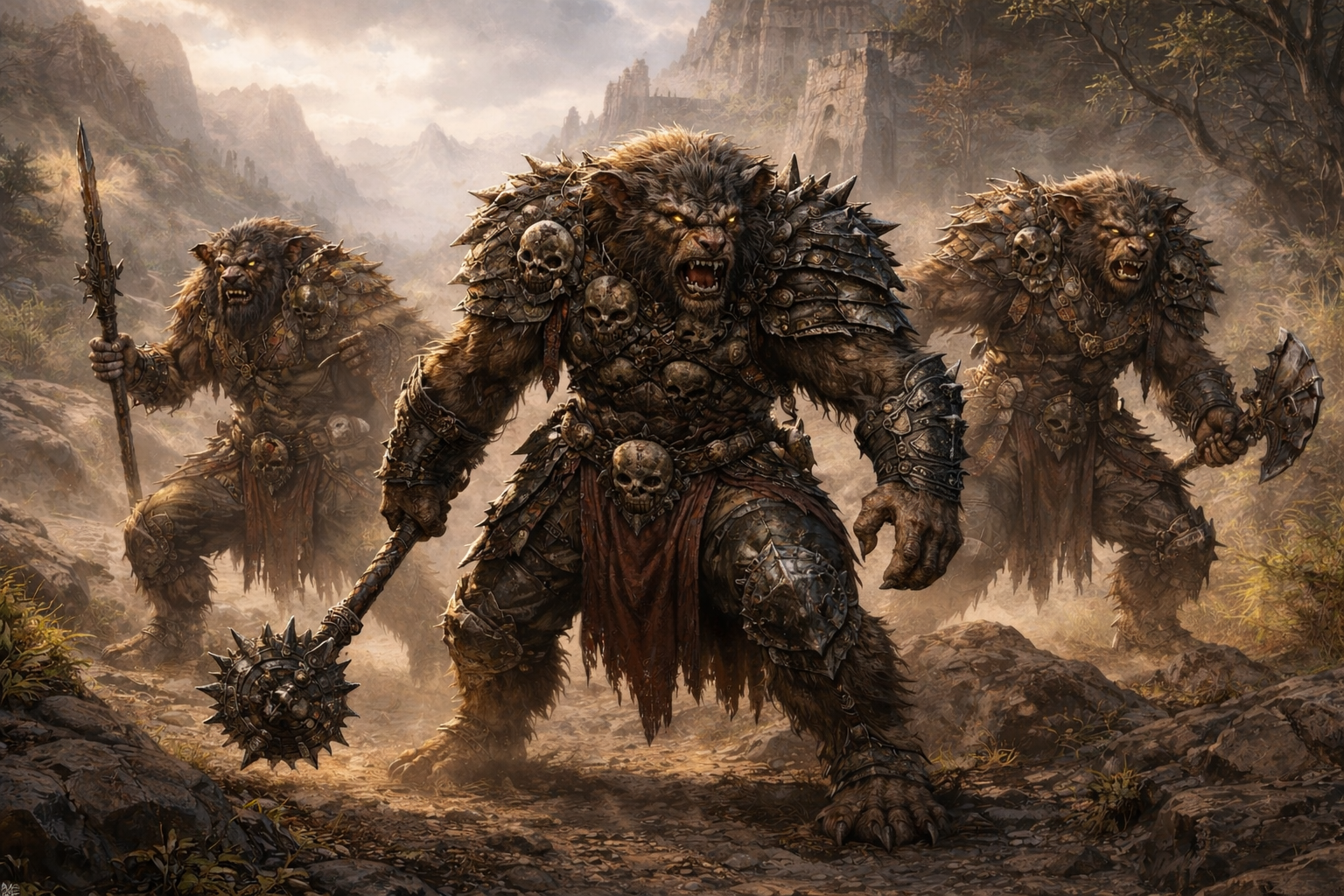
Bugbear
Among the many threats that lurk in the shadowed corners of Khorvaire, few inspire as much primal fear as the bugbear. Larger, more heavily muscled than their goblin and hobgoblin kin, bugbears are not merely brute force; they possess a chilling, predatory cunning that belies their fearsome appearance. They are the assassins and shock troops of the goblinoid races, masters of the ambush, capable of moving with a surprising quietude for creatures of their bulk. While often found in mercenary companies or serving as enforcers for more organized warlords, a bugbear's loyalty is often bought, never freely given, and always to be eyed with suspicion.
Their history, though less meticulously chronicled than the hobgoblin legions of the fallen Dhakaani Empire, suggests a consistent role as brutal vanguard or insidious infiltrator. They are not builders or administrators, but destroyers and enforcers on the fringe, thriving in chaos and preying on the vulnerable. To encounter a bugbear in the wild is to face a creature honed by generations for the hunt, driven by a savage pragmatism and an almost gleeful embrace of violence. They are a danger not to be underestimated, for their raw strength is matched only by their wicked intellect and a chilling capacity for cruelty. Their presence signals imminent threat, a shadow that promises a swift, brutal end.
Basic Information
Anatomy
Bugbears are the largest and most powerfully built of the goblinoid peoples. They stand taller than humans on average, with broad shoulders, elongated arms, and a dense, heavy-boned frame built for explosive strength rather than endurance. Their musculature is thick and corded, particularly through the back, shoulders, and thighs, giving them a characteristic forward-leaning posture even at rest. A bugbear’s arms hang long, with broad hands and thick, blunt claws adapted more for grappling and tearing than fine manipulation.
Their skulls are heavy and pronounced, with projecting brows, wide nasal cavities, and strong jaw structures suited for crushing and tearing food. Dense body hair grows across much of the torso, shoulders, and limbs, varying from sparse bristling coats to full shaggy mantles depending on lineage and climate. Their skin beneath ranges from slate gray to deep umber. The overall impression is not of bulk alone, but of coiled violence—a body designed to unleash power suddenly and decisively.
Internally, guul’dar possess reinforced skeletal structures and unusually thick connective tissue. Their hearts are proportionally large, and their adrenal systems are highly developed, supporting the intense battle-fury for which they are culturally and biologically known.
Biological Traits
Bugbears display the greatest physical variation of the goblinoid peoples, but across nearly all lineages they share a common suite of biological traits: exceptional muscle density, high fast-twitch fiber concentration, reinforced skeletal structures, and endocrine systems that strongly favor adrenaline and growth hormones. These traits result in individuals who are heavier, stronger, and more impact-resistant than other humanoids of similar height. Sexual dimorphism exists but is modest; differences between individuals are influenced more by diet, role, and upbringing than by sex. Bugbears raised in militarized Dhakaani-descended cultures tend to be leaner and more compact, while those of frontier and feral lineages often grow broader, heavier, and more thickly furred.
Genetics and Reproduction
Bugbears reproduce sexually and are fully interfertile with other goblinoids, though stable cross-heritage lineages are culturally rare among Dhakaani descendants. Gestation averages slightly longer than that of humans. Births are physically taxing, and traditional guul’dar societies historically relied on midwives and healers to reduce mortality.
Infants are born relatively small but densely muscled, with thick skin and fine body hair already present. Litter births are uncommon; twins occur rarely but are often regarded with spiritual significance. Bugbear children develop coordination and strength at an accelerated pace, with early grip power and musculoskeletal growth exceeding that of goblins and hobgoblins.
Growth Rate & Stages
Bugbears mature quickly. By the age of six or seven, a guul’dar child is physically comparable to a human adolescent, and by sixteen they are considered adults among most goblinoid cultures. Their growth emphasizes rapid muscular and skeletal expansion, often accompanied by volatile emotional and hormonal changes.
Life stages are culturally defined more than biologically. Among Dhakaani-descended clans, youth is marked not by age but by controlled aggression—learning to harness rage rather than be consumed by it. Old age manifests more in declining recovery and flexibility than in loss of raw strength. Bugbears can live into their seventies or eighties, though few wild or war-bound individuals reach such years.
Ecology and Habitats
Bugbears are ecological generalists but thrive in rugged, resource-scarce regions. Historically they favored uplands, deep forests, caverns, and broken terrain where ambush hunting and close-quarters dominance are most effective. In the modern age they are most commonly found in the Seawall Mountains, frontier forests, deep ruins, and the upper reaches of Khyber.
They shape their environments aggressively. Bugbear settlements tend toward defensible, concealed locations rather than engineered cities, emphasizing territory control over cultivation. Their presence dramatically alters local food chains: apex predators are displaced or exterminated, prey herds become wary and nocturnal, and travel routes shift.
Dietary Needs and Habits
Bugbears are omnivorous with a strong carnivorous bias. Their digestive systems are optimized for dense proteins and fats, allowing them to process sinew, marrow, and organ meat efficiently. They hunt by ambush, favoring sudden overwhelming violence rather than pursuit. When necessary, they scavenge readily and without cultural taboo.
Plant matter supplements their diet, particularly tubers, fungi, bitter greens, and bark-based carbohydrates. Bugbears can digest materials that are toxic or indigestible to humans, giving them resilience in wastelands and deep caverns.
Food is often consumed quickly and communally. Preservation methods are crude but effective: smoking, pit-drying, fat-packing, and fungal curing. Hoarding behavior is biologically discouraged; bugbears are physiologically adapted for feast-and-scarcity cycles rather than long-term storage.
Biological Cycle
Bugbears exhibit heightened seasonal hormonal cycles. Late autumn and winter correlate with increased aggression, territoriality, and restlessness—a biological echo of ancestral pressures when food scarcity and predation risk were highest. Many guul’dar cultures historically timed raids, dominance challenges, and war campaigns to these seasons.
They do not hibernate, but caloric demand rises during colder months, and individuals who lack adequate nutrition may experience dangerous metabolic crashes followed by frenzied feeding behavior. Spring and early summer mark heightened fertility and social stabilization.
Behaviour
Bugbear psychology is shaped by a nervous system that privileges immediacy, dominance response, and emotional intensity. They feel quickly and act decisively. Fear responses are muted; anger responses are amplified. This does not make them mindless—it makes them direct.
They are highly sensitive to hierarchy, challenge, and respect. Dominance is read through posture, tone, and spatial control. However, once bonds are formed—tribal, martial, or ideological—they are fiercely loyal. Betrayal produces profound psychological reactions, often resulting in obsessive vengeance or total social withdrawal.
Among their own kind, bugbears are tactile, physical, and blunt. Affection is shown through presence and protection more than language. Among outsiders, they are often reserved and watchful, evaluating threat potential continuously.
In Dhakaani tradition, bugbears cultivated controlled battle-fury: rage not as madness, but as a sharpened weapon. In post-imperial cultures, this discipline is unevenly preserved, giving rise to both noble war-champions and feral reavers.
At their core, guul’dar are not driven by cruelty but by intensity. When guided, they become peerless shock troops and guardians. When untethered, they become storms.
Additional Information
Facial characteristics
Geographic Origin and Distribution
Average Intelligence
Perception and Sensory Capabilities
Bugbear senses are tuned to motion and threat. Their eyesight favors low light and peripheral awareness over fine detail; guul’dar can detect movement in shadow and darkness with unsettling ease. Their hearing is acute, particularly in the lower registers—subtle vibrations, distant footfalls, and the shifting of stone or underbrush carry meaning to them long before they become audible to other humanoids.
Their sense of smell is underappreciated by outsiders. Bugbears can track individuals, beasts, and even emotional states through scent: fear, sweat, blood, and smoke are all distinct to them. Many guul’dar hunters claim to smell magic as a copper-sharpness in the air, though whether this is a true arcane sensitivity or long cultural association remains debated among Dhakaani scholars.
While not inherently psionic, bugbears exhibit a notable resistance to fear and mental intrusion, a trait developed during the Daelkyr War and reinforced by millennia of survival against aberrant horrors. Their nervous systems favor fight over flight, suppressing panic responses and heightening focus during moments of imminent violence.
Civilization and Culture
Naming Traditions
Traditional Dhakaani names are harsh, rhythmic, and declarative, often referencing strength, fear, or battle-deeds. A guul’dar may possess several names over a lifetime: a birth-name, a deed-name earned through accomplishment, and sometimes a war-name bestowed by a commander or spirit-keeper.
Male and female names are not strongly differentiated. Examples from preserved Dhakaani forms include names such as Gurrok, Tharash, Vokkar, Dhurga, Kash’tek, Marruk, Zhaur, and Ulka. Clan or kech identifiers may follow as honorifics rather than surnames. Among post-imperial cultures, surnames often derive from locations, warbands, or symbolic animals.
In many communities, to speak a bugbear’s full formal name is to acknowledge their status. Enemies and outsiders are rarely granted this courtesy.
Major Organizations
The most culturally significant bugbear institutions remain the Dhakaani kechs—isolated fortress-clans such as Ke’ch Volaar or Ke’ch Dhakaan, where guul’dar still train as disciplined imperial soldiers. Within Darguun, bugbear clans often serve as elite enforcers for Lhesh Haruuc’s regime, operating as heavy warbands, terror detachments, or independent mercenary houses.
Outside Darguun, bugbears most commonly organize into war companies, monster-hunting lodges, criminal enforcement crews, or frontier strongholds. Some cultic and Khyber-influenced bugbear sects exist as well, venerating ancient battle-spirits, daelkyr remnants, or primal violence.
Beauty Ideals
Among bugbears, beauty is synonymous with presence. A beautiful guul’dar is one who fills space, whose posture commands instinctive attention. Thick muscle, heavy scars, powerful jaws, and asymmetry earned through survival are admired. Smoothness and delicacy are not.
Scars are particularly prized, each representing a story written into flesh. Elaborate scar-rituals, controlled maimings, and ritual burnings are practiced among some clans to mark transformation, survival, or allegiance. Grooming of fur and braiding of body hair into cords, knots, or battle-mantles is also common.
Gender Ideals
Bugbear societies generally recognize little rigid gender stratification. Physical capability, intimidation, and effectiveness determine role far more than sex. Pregnancy and child-rearing are treated as critical tribal functions but do not permanently define social standing.
Guul’dar cultures often revere individuals who move fluidly between roles or expressions, seeing adaptability as strength. In Dhakaani doctrine, the ideal was not “male” or “female” but weapon—each citizen shaped into the function they performed best.
Courtship Ideals
Courtship among bugbears is rarely subtle. Attraction is demonstrated through protection, challenge, and shared danger. A guul’dar may court another by choosing them as a sparring partner, guarding their sleep, offering trophies from hunts, or standing beside them in battle.
Displays of endurance, fearlessness, and loyalty are more important than tenderness, though deep emotional bonds are common once trust is secured. Among more stable clans, ritualized combat-dances, scar-gift exchanges, and shared blood rites serve as formal courtship markers.
Relationship Ideals
Bugbear relationships are built on mutual defense and emotional anchoring. Partners are expected to make one another harder to kill and harder to break. Possessiveness is common but culturally moderated; betrayal is not merely emotional but existential.
Family structures range from pair-bonds to bonded triads to war-family clusters. Children are often raised communally, trained early in physical control, emotional regulation, and threat awareness.
Average Technological Level
Historically, bugbears were heirs to Dhakaani metallurgy, siegecraft, and military engineering. In the modern age, technological attainment varies widely. Dhakaani guul’dar maintain high-quality forged arms, disciplined logistics, and advanced battlefield doctrine. Post-imperial clans often rely on scavenged, brutal, but effective technology: heavy cleavers, hooked weapons, reinforced armor, and trap-engineering.
They favor technologies that amplify physical dominance: fortifications, restraints, shock weapons, and terror tools. Subtle artifice is less culturally valued than devices that endure punishment.
Major Language Groups and Dialects
The ancestral tongue of bugbears is Goblin (Dhakaani), spoken in multiple dialects. Dhakaani kechs preserve formal High Goblin, while Darguul and frontier populations speak degraded or blended forms. Many bugbears also learn Common, though often as a trade language rather than a cultural one.
Ritual war-cant, composed of clipped Dhakaani phrases, gestures, and percussion beats, remains widely used.
Common Etiquette Rules
Bugbear etiquette is grounded in threat awareness and respect signaling. Eye contact is direct. Space is significant. Touch is not casual. To turn one’s back, to interrupt a speaker, or to display uncontrolled fear is insulting.
Formal greetings often involve the showing of empty hands, the striking of the chest or ground, or the offering of one’s scent. Among their own kind, physicality—shoves, grips, leaning presence—is a normal communicative mode.
Common Dress Code
Bugbear clothing favors durability, layered protection, and intimidation. Common garments include heavy wraps, reinforced leathers, fur mantles, bone fastenings, and scavenged plate components. Ornamentation often incorporates teeth, chains, carved stone, and war trophies.
Ceremonial attire may include scar-paint, blood-marks, and war masks designed to exaggerate the face and silhouette.
Culture and Cultural Heritage
Bugbear culture is haunted. Even those who reject Dhakaan feel its echo in their instincts: the pull toward organized violence, the craving for command, the reflex to define self through conflict. Some seek to reclaim that heritage. Others seek to drown it. Few truly escape it.
Songs, war chants, and oral histories are the primary means of cultural transmission. Written tradition is rare outside Dhakaani enclaves.
Common Customs, Traditions and Rituals
Shared meals after battle, scar-marking rites, dominance trials, and ancestor-invocation before campaigns are widespread customs. Many clans maintain “rage days” or controlled fury rituals to purge accumulated aggression.
Weapons are often named, inherited, or ritually broken when their bearer dies.
Common Taboos
Cowardice, betrayal, and uncontrolled frenzy are among the gravest taboos. To abandon a bonded group member in danger is one of the few acts likely to result in immediate execution.
Desecrating the dead without cause, poisoning communal food, or claiming unearned victory are also deeply forbidden.
History
The bugbears of modern Khorvaire are heirs to the Dhakaani Empire, though many no longer remember it clearly. In the age when goblins ruled the continent, guul’dar were engineered by culture and doctrine into living weapons: shock soldiers, terror troops, night hunters, and siege breakers. Dhakaan did not treat them as brutes, but as a vital component of an integrated imperial war-machine, pairing bugbear ferocity with hobgoblin discipline and goblin ingenuity.
When the empire fell during the Daelkyr War, bugbear populations were among the hardest hit. Deprived of command structures and cultural containment, many guul’dar groups fractured into feral survival-bands, mountain clans, and predatory warpacks. Over millennia, this produced the modern stereotype of the bugbear as marauder—an echo of a military caste without the empire that once shaped it.
Today, bugbears exist across a wide cultural spectrum: from Dhakaani kechs preserving ancient doctrine, to Darguul clans forging new identities, to urban mercenaries who have never heard the old war chants but still feel their weight in their blood.
Historical Figures
- Harann the Breaker Dhakaani terror-general
- Uul Dhakaan legendary shock-lord
- Kharash One-Eye early post-imperial war-founder
- Numerous unnamed “Black Champions” whose stories persist without clear lineage
Common Myths and Legends
Bugbear myths center on the First Terror, the Black War, and the Forging of the Living Weapon. Legends speak of guul’dar created to stand where others broke, of war-saints who became storms of flesh, and of daelkyr horrors shattered by hands that would not stop closing.
Modern myths often reframe these stories into monstrous cautionary tales or tragic epics of lost purpose.
Interspecies Relations and Assumptions
Bugbears view other species through functional lenses. Hobgoblins are often regarded as rightful commanders, goblins as essential specialists. Humans are seen as numerous, fragile, and dangerously adaptable. Elves and dwarves are respected for endurance and discipline. Aberrations inspire instinctive hatred.
Outsiders frequently mistake bugbear reserve for stupidity or malice. In truth, guul’dar are constantly assessing threat, dominance, and potential loyalty. Trust is slow. Once earned, it is profound.
Skin tones range from ash-gray through umber, sienna, and deep charcoal. Fur coloration varies widely: black, rust, tawny, silver-gray, mottled brown, and pale sand hues are all recorded. Many bugbears exhibit natural striping or marbling along the shoulders, spine, and thighs, often faint until adulthood. Eye colors tend toward gold, red-brown, amber, and dark green.
In Dhakaani-descended cultures, body paint, ash markings, and ritual scarring are common methods of artificial patterning, often layered atop natural coloration to signify lineage, battle history, or spiritual affiliation.