Bloodglass
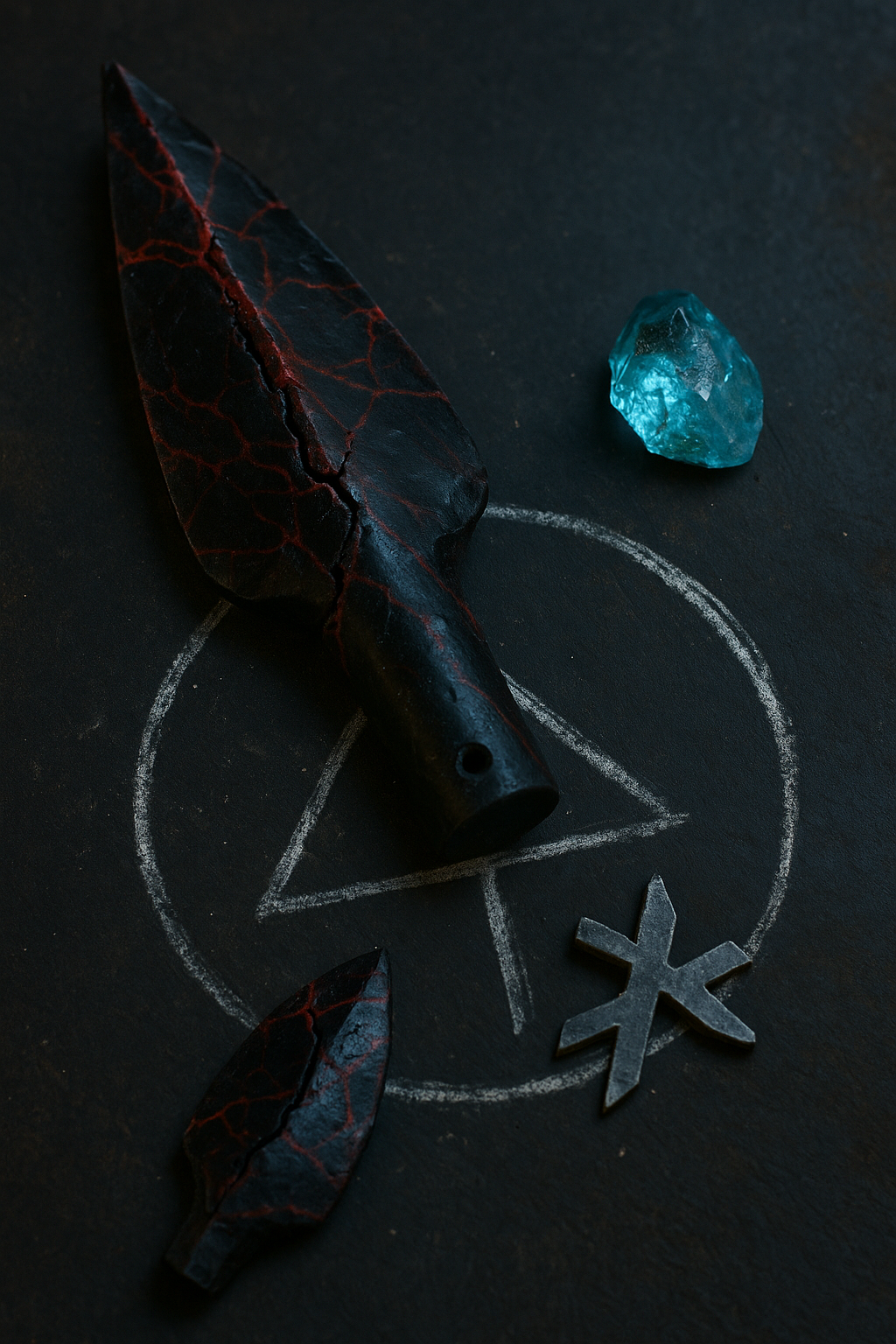
Bloodglass is a rare volcanic glass suffused with the eerie resonance of Khyber. Formed where molten stone rises through veins of dragonshard sediment, the material cools into obsidian-dark surfaces streaked with deep crimson. These internal lines seem to shift subtly when held to the light, like slow pulses of something alive beneath the surface. Smiths and scholars agree that bloodglass retains a fragment of elemental presence from its creation—quiet, dormant, but undeniably present.
Though brittle compared to worked steel, bloodglass takes a keener edge than almost any metal. Blades crafted from it cut cleanly and with startling ease, their sharpness carrying a faint and unsettling intent. Such weapons strike with unusual force, but shatter easily if mistreated, leaving their wielders to rely more on precision than brute strength. The material’s association with Khyber and its forbidding origins has given it a reputation equal parts reverence and dread, and its use is often as symbolic as it is practical.
Even in small pieces, bloodglass commands attention. It is a substance born of fire and deep earth, touched by powers that lie far below the world’s surface. To hold it is to feel the echo of that depth—a reminder that not everything buried stays quiet.
Properties
Material Characteristics
Blood glass is a glossy volcanic glass, smooth enough to reflect light like polished stone. When fractured, it forms razor-thin cutting edges. The crimson streaking is not merely visual but structural, running in irregular and branching filaments throughout the glass matrix. In the hand, blood glass feels slightly cooler than its surroundings, and some swear they feel a faint internal vibration when holding a piece and focusing.
Physical & Chemical Properties
The crimson veining is the result of Khyber shard resonance, which allows minor elemental spirits to be bound into the material itself without requiring a full dragonshard lattice. This makes blood glass naturally suited for weapons, granting a +1 bonus on damage rolls when used to make piercing or slashing implements. However, the same volcanic formation process leaves the glass brittle; it has hardness 5 and is easily broken by direct impacts, intentional parrying, or powerful channelling spells like shatter. Despite this brittleness, blood glass always receives a saving throw against destructive resonance.
Compounds
Blood glass is primarily a fusion of volcanic silica and the mineralized dust of Khyber dragonshards. When heated improperly, the red inclusions become unstable and the material turns dull black, losing its binding affinity. Proper batching must preserve the resonance lines intact.
Geology & Geography
Blood glass forms only where molten basalt rises through deep Khyber-scarred strata. Known deposit zones include lava tubes beneath the Demon Wastes, collapsed vent systems in the Blackcaps, and several uncharted regions of Xen’drik. These environments are hazardous, not only physically but metaphysically—Khyber proximity brings aberrations, planar seams, and elemental disturbances.
History & Usage
History
The earliest confirmed use traces to long cold forges of the Sul'at League of Xen'drik, where blood glass blades were believed to “cut the boundary between flesh and spirit.”
Discovery
The Sulatar drow of Xen'drik are the only modern culture to actively mine the substance. The first experiments in Zilargo confirmed its innate elemental binding capacity, sparking quiet academic interest and cautious restriction.
Everyday use
Its most frequent use is in the crafting of knives, spear heads, arrowheads, and dueling blades. It is favored by assassins, skirmish fighters, and hunters comfortable with weapons that kill quickly and break cleanly.
Cultural Significance and Usage
To some Khyber cults, the red veining is a blessing, a visible sign of the Dragon Below’s presence. Among certain Sulatar forges, the material is used only in ritual duels. Marcher shamans occasionally use blood glass shards in spirit-binding totems, always with caution.
Manufacturing & Products
Products include blades, needles, hooked knives, ritual incision tools, arrowheads, and spirit totems. Some Cannith researchers have attempted to produce blood glass lenses for arcane focusing, but with inconsistent results.
Distribution
Trade & Market
Blood glass moves primarily through black markets, specialized weapon-smiths, and underground collectors. Legal sale varies drastically by region.
Law & Regulation
In Breland and Aundair, sale is technically legal but heavily monitored. Thrane and Aerenal ban its possession outright, citing spiritual corruption and danger to the deathless. Darguun and Droaam view it as just another commodity.