Wavecallers
People of the Sundered Isles
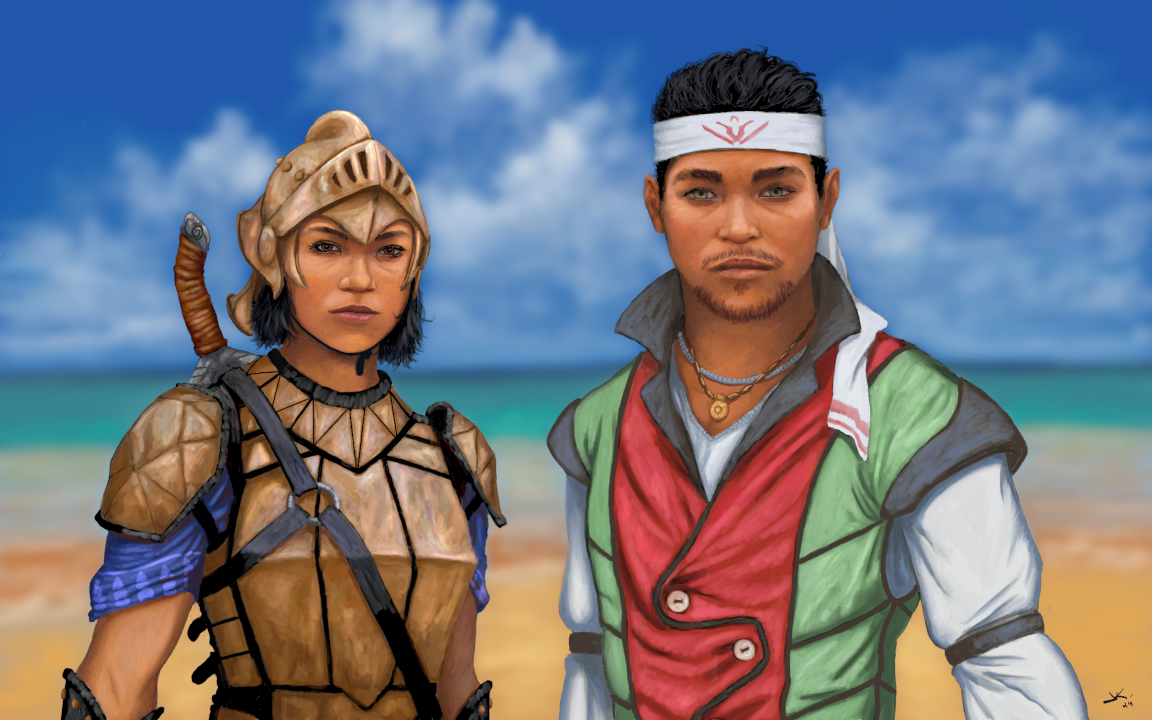
On Seahome and sprawling across the world, one will find families that call themselves Wavecallers. They are united across Drintera by common ancestry—a group of humans created by the sea goddess Sivora . Whether they still reside on their original island of Seahome, live on land elsewhere, or are part of a nomadic family, they share a reverence for the sea and strong ties to their history. Expertly-crafted ships adorned with colorful geometric decorations that fill every inch of open space, ocean waves moving in perfect harmony, pleasing patterns of seashells strung into jewelry— you can find all that and more when among a Wavecalling tribe.
Kinship
Wavecalling People can be found all over Drintera, but across the world they are united by their ancestry. They believe that Sivora created a group of humans in her image on the island of Seahome in the Sundered Isles, and Wavecallers are descendants of those humans. No matter how far back in your family tree—if one of your ancestors is a Wavecaller, you’re welcome to call yourself such as well.
Way of Life
Ages ago, Wavecallers were nomads, sailing from island to island on houseboats called lepa. They fished, foraged, and traded to support themselves.
Some individuals chose to settle down permanently in the cities they encountered in their travels. A number of tribes remain nomadic to this day, but as the families of settlers grew, so too did the number of Wavecallers that live on land. Many now live in cities and towns throughout the world, participating in their adopted land’s culture in addition to their own. Others live in villages on Seahome to be both physically and spiritually closer to their origins.
The villages on Seahome range from quaint to almost city-sized. Though they are no longer nomads, sailing is still an extremely important part of life, so villages are always located near a body of water. Homes are traditionally built from bamboo and raised on stilts to protect from flooding. Settlers without access to bamboo replace it with whatever material is local. If they’ve settled in an area where flooding isn’t a common issue, the empty space underneath is converted to storage or additional rooms.
Merchants from Seahome studied the architecture of the permanent port towns they frequented, and thus newer buildings include techniques and styles from the neighboring continents of Dramigar , Mor Thia , and Niere . For example, permanent buildings like schools and meeting houses may be constructed with sturdier wood, roofs might have unique shapes, or the sides of homes might be painted similarly to a nearby port town’s.
Geography
Seahome has the largest population of Wavecallers on Drintera, but smaller communities can also be found anywhere in towns along the shore. Nomadic tribes can be seen traveling the world, commonly encountered at sea or on small islands. Most tribes return to Seahome at varying intervals to reconnect with other Wavecallers.
Demographics
Most Wavecalling People are human, as that was the lineage of their ancestors. But a significant amount of Wavecallers are not human, the result of centuries traveling all around the world and making homes in every region. In a few nomadic tribes, humans are the minority—one long-ago family member fell in love with someone of another lineage and now that lineage makes up most of the family.
In all, there are around three million Wavecallers on Drintera.
Religion
Sivora is the main devotion of the Wavecalling People, as they believe she personally created their ancestors on Seahome. Each tribe and family has their own ways of worship, but mirrors are a common thread due to the goddess’ power over reflections. The villages of Seahome host an annual gathering to celebrate their ancestry and connection with Sivora. Members of tribes from far and away are called to visit for the weeks-long festival.
Shamans lead their people in ceremonies to other gods as well. It’s common for nomadic tribes to send offerings to Azboran, hoping they will turn the tides in a favorable direction. Some Wavecalling merchants pray to Zuvinar for good trades. Pottery, a common art form in Seahome villages, often contain images of the life god Tephera. Wavecallers might worship Sivora as their own creator, but they acknowledge the fact that she created all other life on Drintera.
Distinctive Features
Shamans
Shamans are the religious leaders of the Wavecalling People. They are always women (or someone of a feminine-leaning gender) and a child of another Wavecaller—no one from outside the tribe has ever been inducted to the rank of shaman. When girls become adults, their coming-of-age ceremony ends with a recitation of prayers to their reflection in ocean water. If Sivora appears beside them, they are considered chosen by the goddess and begin an apprenticeship with the current shaman. People who come out as women later in life can participate in this ceremony as well and can still become shamans.
Born from the Ocean
Unlike other humans on Drintera, the Wavecalling People were created by Sivora. The sea goddess, curious to see if she was capable of spontaneously creating life without the contributions of other gods, gathered large clams from the water and filled them with a mixture of materials from her ocean. The exact components vary from story to story, but sea salt is the most prominent. She sealed the contents within the clams, placed them on Seahome, and waited for the humans inside to grow. When the time came, she sent a seagull messenger to crack open the clams, giving birth to the first tribe of Wavecallers.
Law and Governance
Wavecalling society is matriarchal. In nomadic families and smaller villages, the shaman may be the only leader, taking care of both the spiritual and material needs of their community. In larger villages duties may be split between the shaman and another leader, usually called some variation of “Mother” by everyone in the village, no matter their age. The Mother is chosen by the shaman and tends to be one of the eldest people in the tribe.
Enforcement of rules and laws is not delegated to one specific group; the leader is in charge of arbitrating disputes and selecting punishments for wrongdoers. Such punishments might include doing extra work for the village or meditation with the shaman, giving time to reflect on their actions. For extremely abhorrent acts such as murder, the offender may be exiled and stripped of any right to use their family surname.
Marriage and Family
Marriage among Wavecallers is typically monogamous, but polygamous relationships are accepted as well. The shaman presides over the wedding. Ceremonies include prayers to the ancestors and offerings to Sivora or other deities. The most important element of a wedding is a reflective surface of some kind. The ocean is preferred, but Wavecallers living far from the sea might use another body of water or even a mirror.
Spouses-to-be look into their reflections and recite promises of devotion. Typically they see visions of a happy life together in the water; more rarely, these visions are negative, which often results in an immediate cancellation of the wedding. Divorce is handled in a similar ceremony, where the couple stands in front of their reflection and gives reasons why they want to separate. In the reflections, they are reminded of the events that caused the divorce with visions of their unhappy past.
When a Wavecaller dies, any currency they have is given to the leader, who will use it for the benefit the entire village. Important items like personal heirlooms or sentimental objects are bequeathed to the person’s spouse and children. If they have no immediate family, the leader conducts the distributions of their possessions.
Naming Traditions
Surnames or family names are shared by an entire tribe and tend to describe where they originate from on Seahome, either by taking the place’s name directly or describing the area. Nomadic tribes might have sailing or nature-related surnames. Large villages usually have multiple separate groups with different family names. If a Wavecaller marries a non-Wavecaller, the outsider will take on the family surname no matter their gender.
Personal or first names are unique to each individual. There are no unique middle names; instead children take the first name of their mother. For example, a person named Amebra from the village of Vosigapan whose mother’s name is Maddonge would write their name as Amebra Maddonge Vosigapan. If they were instead from a tribe near a mountain with many caves they would be Amebra Maddonge Gorotem, the surname meaning “mountain of refuge” in the Sacred Language.
Wavecaller Player Characters
Backgrounds
Class Concepts
This article originally appeared in Issue #9 of Drintera Magazine (November 2024), which is included in the Volume 1 bundle.
This free article is made possible by our crowdfunding supporters. Support our Patreon to help fund continued development of Drintera!