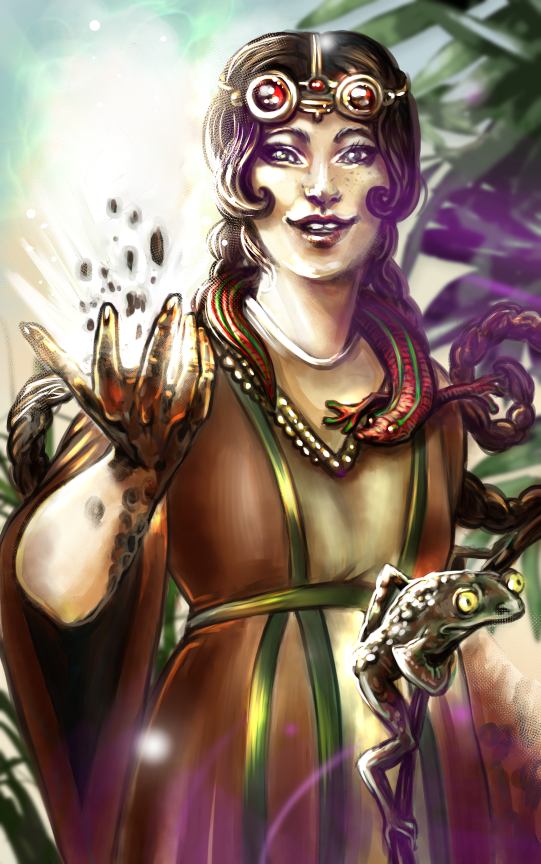
Tephera
The Potter, The Older Sister, The Salamander
Creator of Life (a.k.a. The Potter, the Older Sister, the Salamander)
Tephera (she/her) is the maker of animal and intelligent life, which dropped as mud from her sleeves when she was playing in a marsh. Though a creator, she is not a mother figure. Rather, Tephera is playful and childlike. Children in Drintera are encouraged to regard her as an older sister who is looking out for them and a playmate, especially if it involves getting dirty. She is worshipped in her gleeful, chthonic nature by the lower classes of society, while aristocrats and kings sometimes emphasize her skills as a sculptor and creator.
Given that she created life from mud, marshy areas are sacred to her, as is the life around them. Fishers and hunters are careful to make offerings to her to gain her protection when they work near the mud.
She enjoys the company of mortals. She taught them to make pottery both for decoration and utility, though their creations do not come to life. She enjoys raucous parties, loud music, and anything creative.
Her brother is Manani, the god of death.
Shapes and Messengers
Tephera manifests in human form as a young woman or a child, wearing a robe whose hems and sleeves are perpetually stained with and dripping mud. She may be surrounded by marsh plants to indicate where she is likeliest found. A traveler can find images of her aspect as Older Sister, surrounded by happy children.
Other depictions tidy her and her clothing, showing a grown lady with a potter’s wheel or lump of clay, in which case the mud stains her hands and fingers. These images show freshly shaped pots on the wheel and sculpted people at her feet.
Amphibians like frogs and salamanders are sacred to Tephera because they are often found in the mud. Some say that these creatures do not breed but continually emerge, sculpted by the deity. The life cycle of an amphibian lends itself to the idea of a form being malleable and refined. Others say that Tephera takes the form of a salamander herself, the better to create small creatures. Amphibians are her messengers, and people study their patterns to divine the goddess’s intentions.
Dominion
Logically, Tephera would reside where there is ample clay for her creations, and so there are several marshlands and riverbeds in Drintera competing for the honor of being her original workplace. Despite the ardent belief of each sect of followers, none of them is correct. The mud with which Tephera created was infused with primordial magic left over from the Age of the Titans, and has since disappeared.
Tephera currently maintains a residence in the Heron King's Land in Throntru. She lives in a house made of dried clay with which she is constantly tinkering, adding rooms and workshops and once, so a story goes, a palace. Her animal creations and companions assist in the building and decorating and even the destruction, for while life is constant its shape is not, and neither is the house of Tephera. Whatever shape it takes, it is a welcoming place. Mortals who find it are greeted warmly with food and drink and invited to play in the mud with their hostess.
Myths
When Tephera first came to Drintera, she found herself hip-deep in a muddy marsh. When she emerged, the mud dripped from her hems and her sleeves, falling into clumps of various sizes on the ground. These clumps became animals. She was so entranced with what she made, she returned again and again to the pit and dripped more mud, thus populating the entire earth. Tephera is very hands-on, and with practice her creations became more elaborate and detailed, so what started as worms soon became elves, humans, and orcs. She shows no favoritism, and the tiny and slimy are as beloved to her as those who walk on two legs.
One day, a human woman discovered Tephera sitting in the swamp, creating new creatures from the mud. The human shyly tried to imitate the work and when the goddess spotted her, Tephera sat down and helped her develop techniques not just for creating sculpture but designing vessels useful for carrying water and wine. Tephera was pleased that she was able to teach such a useful skill, though Zuvinar claims that the clay works would not exist without her power to harden them with extreme heat. This is a long-running dispute between the deities, and when the waters recede and the marshes dry up, people believe that Zuvinar currently has the upper hand, and hope this will not last.
Humans are not the only creatures whom Tephera has inspired to build and create. Dung beetles learned to roll balls of dung for their children by watching Tephera sculpt. When beavers and birds were having difficulty constructing safe places to live and raise their young, Tehphera showed them how to use mud to strengthen their nests. Wasps, too, learned the secret of mud construction and tried to teach it to the bees, though the bees felt they were too good to work with dirt and instead used their own bodies to construct wax. They remain arrogant about this to this day.
Symbols
Tephera’s colors are brown, green, and red, for the life she creates and the material she creates from. Three orbs in these colors, arranged in a triangle, serve as her symbol. Children commonly wear humbler amulets made of clay, with three round indents pressed into the surface.
A common symbol for Tephera is a salamander, striped green, red, and brown. The salamander may be shown on its own, making a convenient badge or apotropaic emblem. It can also be shown curled in the mud or surrounded by marsh plants.
Potters and sculptors have adopted the wasp as their symbol, for the elaborate nests these insects create with mud under Tephera’s guidance. Shops that create and sell glassware often use a bee instead, likening their medium to beeswax, which allows light to pass through and needs to be melted before it can be formed.
Among the upper classes you can find the potter’s wheel used to symbolize Tephera. The round, spinning shape indicates eternity and echoes the amulets with the three circles found on children.
Patronage
Though throughout Drintera Tephera is worshipped for her creation of life. In Niere the humans lean into her aspect as the benevolent Older Sister. First-born daughters are dedicated to Tephera in special temple ceremonies, where they receive three dabs of mud: one on their forehead, one on each hand. Primarily these girls are expected to be responsible for the care and guidance of their younger siblings. Not every girl is pleased with this arrangement, especially since dedication to the Older Sister frequently translates into desirability for marriage and childbearing. Their mothers will tell them that the goddess likes having fun and getting dirty, and protects those who raise a little hell when they’re young.
Dwarves of the Rainsong Mountains spend most of their time below ground, and it is rocks, not mud, that is their element. However, they recognize their creation by Tephera, and each is expected to venture from the mine once in a life to make a pilgrimage to the Heronrealm Marsh to put their hands in the wet earth and bring some back with them. There is an annual festival where the local marsh mud is celebrated. Egrets and terns are eaten, salamanders captured for pets, and clay sculpture contests judged.
Fertility rituals invoking Tephera are common throughout Drintera. The Rootkin elves of Niere mix clay with a few drops of the parents’ blood and form it into figurines of a baby or child about the size of a hand, which are painted, decorated, and inscribed with specific wishes. Once finished and dry, they are taken to the nearest body of water and tossed in, where they dissolve. The idea is that by giving Tephera the material she needs, the propitiant will receive the child they desire. The upper classes often decorate their figures with gems or gold, hoping to curry more favor. It doesn’t work.
Priesthood and Mysteries
- Order of Salamancers: Diviners who interpret the will of Tephera
- Sisterhood of Tephera: A large sect of laypersons dedicated to assisting childbirth and caring for young children; includes some clerics
- Twisters of Clay: Secretive spellcasters who reputedly shape the future like clay
Divine Domains
Divine Symbols & Sigils
- Salamander, especially striped brown, green, and red
- Frog or other amphibian
- Three orbs of brown, green, and red arranged in a triangle
- Child's clay amulet with three hemispherical indents
- Wasp or wasp nest
- Bee or beehive
- Potter's wheel