Dragon
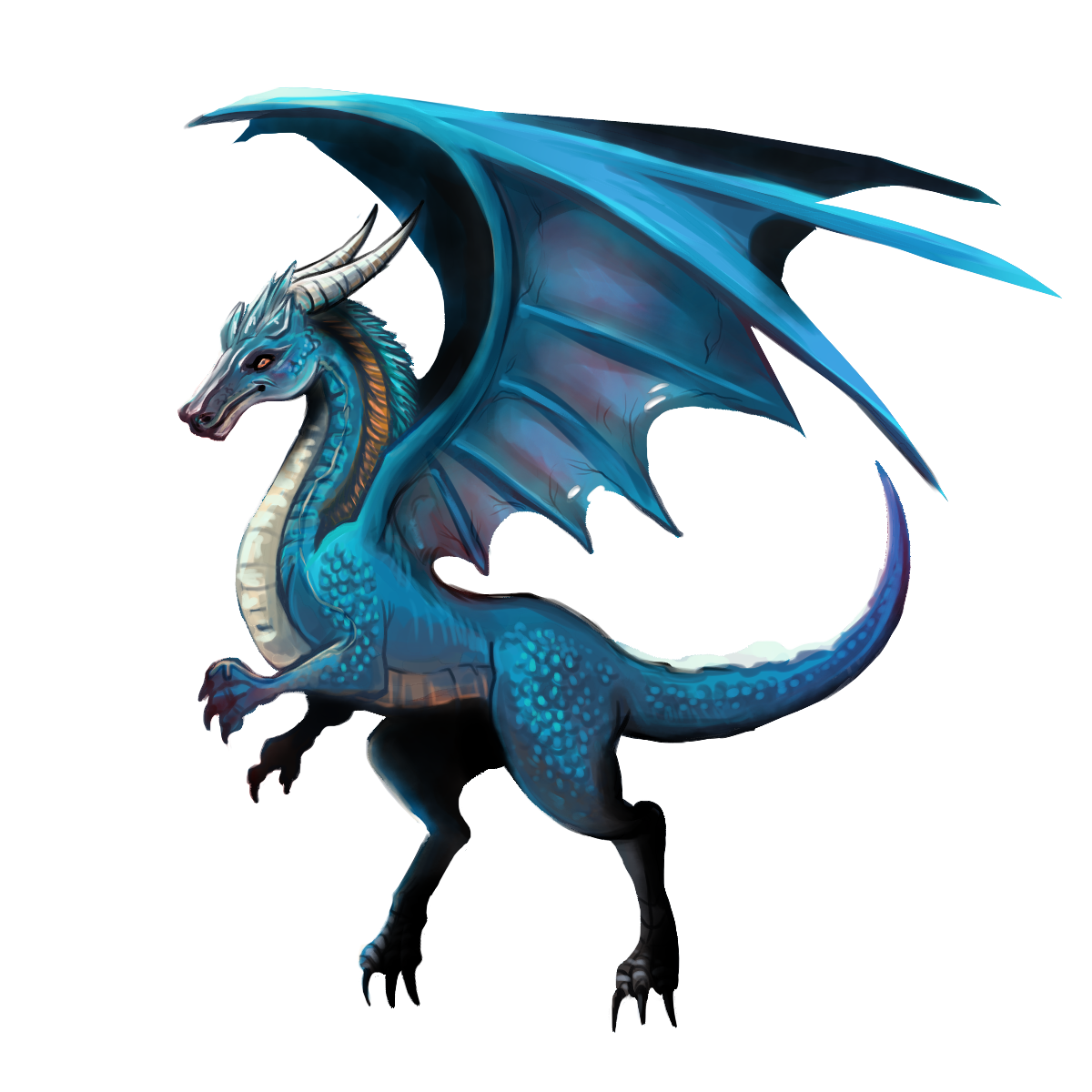
Drintera features fantastical creatures from myth and folklore, one of which is the dragon. Dragons are long-lived creatures. Some outlive civilizations, though many appear to live for around a thousand years. Dragons are not immortal, however, and can be slain, although they are more likely to die of old age.
How Dragons Came to Be
Dragons have existed since the dawn of time, born from the very elements that shaped the world.
Spontaneous Genesis via Spirit Fragments
Dragons can be created spontaneously by the magic of Drintera. The "Origins" section for each dragon species described in a separate article explains the lore of its kind.
It is said that each dragon comes into the world as spirit fragments. Spirit fragments are extracted from the thoughts or feelings manifested of elemental spirits or anomalous sparks of life triggered by major magical or environmental change. For example, a spirit fragment can be created from the interaction between the bone dust of two ancient feuding creatures and elemental forces. The spirit fragment then develops an outer layer made of the primordial essence of existence, like a chrysalis. The chrysalis is invisible even to those with the ability to see beyond the veils of dream, darkness, and reality. When the time is right, the chrysalis unravels like thread being pulled away, and the dragon is revealed.
Reproduction
Like any living creature, dragons possess carnal passions and reproductive drives. In their pursuit of legacy, a pair of dragons may mate and breed young. Alternatively, a number of dragons may each give up a little of their life energy, which commingles and forms a clutch of eggs.
A hint into the type and personality of the being inside can be gleaned from the eggshell. An egg with scales that glint like fire contains a fire-breathing reptile with bat wings and eagle claws, whereas a leathery egg houses a giant serpentlike worm with round beady eyes and jaws as big as a whale’s. Offspring tend to resemble their parents.
Transformation
It is said that from small things, big things grow. Likewise, a small carp or a lizard, through mighty deeds or the accumulation of great knowledge and wisdom, may one day become a great dragon . However, the path to become a dragon is one fraught with great peril and challenges, a long journey that spans centuries. Dreams of dragonhood only occur when one believes they have the blood of a dragon, either through bloodline or by a chance encounter from the elemental forces of the universe.
Note that there are many stages of evolution to attain dragonhood. For example, an ambitious and worthy fruit fly metamorphoses into a dragonfly, and thereafter the dragonfly is reborn as a gecko after a lifetime of trials. Only after many lives lived as many different creatures can one finally achieve the final step of becoming a dragon. However, it is very rare for a mortal to attain this higher level of existence, subject to the whims and fancies of the gods or a chance collision of magical forces that herald evolutionary change. But when it is time, the creature knows. It travels to a sacred or magical place where the veil between nature and the supernatural is thin, where a transformation gate awaits. This may be a tall and mysterious lone archway that rises out of the sea, as if reaching for the sky, or the crater of a volcano, where a boiling and bubbling pool of lava churns. Or it could be the space between the highest peak of a misty mountaintop and the plains below, shrouded in clouds so that none may see where the portal begins or ends. When the creature passes through the gate, it transforms into a young dragon.
Abilities
Dragons possess the following magical abilities.
Breath Weapon
Dragons, particularly Dracos, are notorious for their lethal breath. The properties of a draco’s breath weapon are aligned with the dragon’s elemental nature. For example, there are fire dracos, storm dracos (who breathe lightning), and ice dracos.
Shape-Shifting
As magical creatures, many adult dragons can assume the shape of other creatures and can remain in these forms indefinitely. They wander the world as humanoids or beasts to avoid drawing attention to themselves. Dragons can remain in their assumed shape for as long as they like, but many avoid staying in that shape for too long It is rumored that dragons fear the loss of their draconic abilities from lack of use. Others say it is nothing more than the fear of forgetting what it’s like to be a dragon.
Spell Casting
Some dragons are well versed in the magical arts. They are competent, if not adept, spell casters and are masters of the arcane.
Lairs
A dragon’s lair is its home and more. More than just a place to pile its hoard, a dragon's lair can be like a lord’s castle, occupied by servants loyal to their draconic overlord.
Dragons may establish their lair anywhere they please, but they prefer secure places that are impregnable and out of reach. This may be a cave deep in the forest, an aerie high up in the mountains, or a grotto in the depths of the ocean. Dragons are territorial creatures, and they rarely lair next to each other.
A dragon is so connected to its lair that the lair reflects the dragon’s emotional state and becomes an extension of the dragon’s magical abilities. The dragon’s influence may warp the physical properties of its lair. The lair may become more visually appealing to the dragon’s taste, or develop fortifications as befits the dragon’s stature and sophistry with the arcane, becoming a more dangerous place to the dragon’s foes. Not only that, the region surrounding a dragon’s lair may also absorb the dragon’s influence and become altered.
Behavior
Like any sentient being, dragons are complex. They may be driven by their own internal moral compass, or they may abide by a social compact, or both. Some crave power and seek to rule over humanoids or beasts. Some strive to be like a god, worshipped by followers.
Given their shape-changing ability and history of living among humanoids, dragons are more than capable of blending in with humanoid society. Because their draconic abilities surpass that of mortals, some even ascend to positions of power and influence within society while in humanoid form. Little wonder, then, that the kings and queens of old tend to favor dragons in heraldry.
Dragon Species
The dragons of Drintera come in many types and forms. They may look like lizards or serpents or a strange chimera with reptilian features, like spiked neck frills or a tortoise’s shell upon their back. Many have scales covering their leathery skin, and some are furred. Some have wings that may be feathery or batlike, and some have multiple heads. Here are the two best-known dragon species that one may encounter in the world of Drintera.