
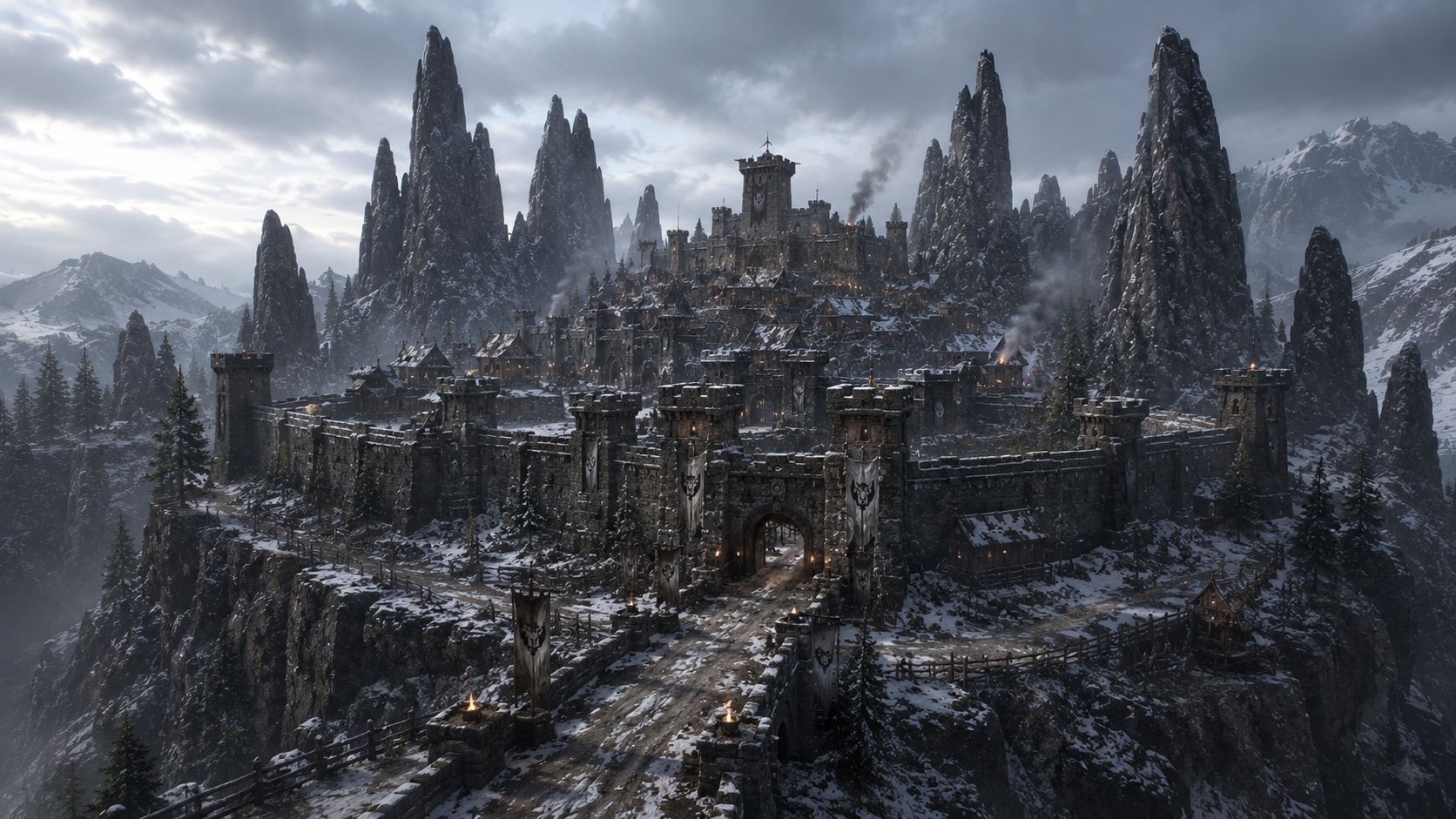
Ashclaw
"Others see a fortress built from ruins. We see a promise our ancestors entrusted to us, that no flame, no monster, and no enemy will ever claim this ground again."Rising from the charred ruins of a fortress consumed by Wyrmfire, Ashclaw stands as one of the greatest military bastions of the northern Canins and a lasting symbol of vigilance, sacrifice, and unbroken resolve. Built upon the very ground where the ancient Fire Wyrm known as The Ash Tyrant annihilated an earlier stronghold, the fortress was deliberately raised among the blackened scars of that catastrophe, transforming a place of unimaginable loss into an enduring shield for the Canin heartlands. Today, Ashclaw guards the northern frontier against human raiders, hostile elven warbands, monstrous terrors, and any threat that dares emerge from the untamed wilderness beyond. Its towering walls, disciplined warriors, and sacred Black Claws serve as constant reminders that the settlement exists not merely to wage war, but to ensure that the tragedy of The First Ashclaw is never repeated. To its people, every patrol, every watch kept through the bitter northern night, and every stone laid upon its ancient foundations is another promise fulfilled to the generations who fell defending the same ground centuries before.
Demographics
Approximately 4,000 Canins depending on the season and siege.
Age Breakdown:
- 54% are adults serving as warriors, craftsmen, hunters, laborers, or support personnel.
- 18% are respected elders, many of whom are retired veterans who now train recruits, advise commanders, or preserve the fortress's history through oral tradition. The elderly of Ashclaw are held in particularly high esteem, for many bear scars that have become symbols of wisdom rather than weakness.
- 28% of the population consists of pups and adolescents undergoing education and military preparation.
- 60% male and 40% female. Fairly balanced, Emberfang culture makes little distinction between male and female roles in survival, warfare, or leadership. Both are expected to fight, hunt, build, and lead.
- 90% Core Bloodlines: Families and packs who have stayed across generations, they trace their ancestry to survivors of the original fortress destroyed by the Fire Wyrm.
- 5% Outcasts & Wanderers: Rogues, exiles, or survivors from other settlements, often seeking redemption or a dedication to defending the northern borders.
- 5% Temporary Warbands & Pilgrims: Travelers, warriors between campaigns, or Canins coming to honor the fallen.
Government
Ashclaw is governed by a War Council led by the High Warden, the fortress's highest military commander. Unlike hereditary rulers found in many kingdoms, the High Warden is selected from among the settlement's most accomplished commanders through a consensus of senior officers, respected elders, and the Howling Seers. Leadership is earned through decades of proven service, strategic judgment, and the unwavering trust of the pack rather than noble blood or personal ambition.
The War Council itself is composed of veteran captains, border wardens, quartermasters, master armorers, and a representative of the Howling Seers. While military defense remains the council's foremost responsibility, it also oversees matters of justice, trade, resource distribution, construction, and the welfare of the fortress's civilian population. Decisions are typically reached through deliberate discussion, with each member expected to argue for what best serves the pack rather than individual interests. During times of invasion or other immediate threats, however, the High Warden is granted temporary authority to issue binding orders without debate, allowing the fortress to respond with speed and unity.
Despite its martial structure, Ashclaw's government is not a dictatorship. The people expect their leaders to embody the Canin virtues of loyalty, discipline, cooperation, and self-sacrifice. A commander who repeatedly endangers the settlement through arrogance, cowardice, or poor judgment can be removed by the War Council, an outcome considered rare but necessary to preserve the strength of the pack. Among the people of Ashclaw, authority is respected because it is expected to be earned every day, not merely inherited once.
Defences
Ashclaw is regarded as one of the most heavily fortified Canin settlements in the north, designed with the expectation that one day it will again face an overwhelming enemy. Massive granite curtain walls, reinforced with black volcanic stone recovered from the ancient ruins, encircle the fortress, while towering watchtowers overlook every approach through the surrounding mountains and forests. Deep ditches, narrow choke points, collapsible bridges, and concealed killing grounds force attackers into carefully prepared fields of fire, where archers, spear walls, and war beasts can overwhelm even larger invading forces.
Beyond its walls, a vast network of watchposts, beacon towers, hidden trails, and fortified outposts extends deep into the frontier, allowing Ashclaw to detect threats days before they reach the settlement. Constant patrols of rangers and border wardens monitor the wilderness for human raiders, elven warbands, monstrous creatures, and signs of wyrm activity, while messenger wolves and signal horns ensure warnings can spread rapidly throughout the region.
The settlement's greatest defense, however, is its people. Nearly every adult has received military training, reserve companies can be mobilized within minutes, and every citizen understands their role during a siege. Ashclaw's commanders believe that walls alone never saved a fortress, it is disciplined warriors, united by duty and prepared through generations of relentless training, that make the settlement truly unconquerable.
"Break their walls and they build stronger ones. Slay their warriors and their pups grow into better soldiers. That fortress learns faster than any army."
Industry & Trade
Although Ashclaw was founded as a military fortress rather than a commercial center, its strategic position and constant demand for supplies have given rise to a robust industrial economy. The settlement is renowned throughout the northern Canin territories for its master blacksmiths, armorers, bowyers, leatherworkers, and siege engineers, who produce some of the finest weapons, armor, shields, and fortification equipment in the region. Vast storehouses preserve dried meats, smoked fish, medicinal herbs, and winter provisions, ensuring both the fortress and neighboring settlements remain supplied during long campaigns or harsh winters.
Ashclaw imports food, timber, furs, medicinal plants, and specialized materials from allied settlements such as Fangholt, Blackpine Crossing, and Redspire, while exporting military equipment, forged steel, trained war beasts, and defensive expertise. Veteran engineers and officers are often requested by other Canin communities to oversee the construction of walls, watchtowers, and fortified gates, making Ashclaw's greatest export not merely steel, but generations of hard earned military knowledge. Though merchants are welcome within its walls, trade is carefully regulated, and every caravan is inspected before entering or leaving the fortress. To the people of Ashclaw, commerce exists to strengthen the pack and safeguard the frontier, not to accumulate wealth for its own sake.
Guilds and Factions
Ashclaw's culture is defined more by orders of service than by merchant guilds. Every major faction exists to strengthen the fortress, preserve its history, or defend the northern frontier.
The Wardens Of The Black Claws: are Ashclaw's elite military order and the fortress's foremost defenders. Drawn from the most accomplished veterans, they command the walls during sieges, oversee border patrols, and train future officers. Membership is earned only after years of distinguished service and an oath sworn before the sacred Black Claws.
The Ashen Forge Consortium: is a respected guild of blacksmiths, armorers, engineers, and siege builders responsible for maintaining Ashclaw's renowned weapons, armor, fortifications, and war machines. Their master craftsmen frequently advise neighboring Canin settlements on the construction of defensive works, and their forge mark is recognized throughout the northern territories as a symbol of exceptional quality.
The Ember Keepers: are a solemn brotherhood of lorekeepers, historians, and caretakers who preserve the memory of the First Ashclaw. They maintain the memorials surrounding the Black Claws, record the names of every fallen defender, and safeguard relics recovered from the ancient ruins. Their duty is to ensure that no sacrifice is ever forgotten.
The Grey Wind Rangers: serve as Ashclaw's scouts and border wardens, patrolling hundreds of miles beyond the fortress walls. Masters of survival, tracking, and wilderness warfare, they are often the first to discover human raiding parties, monstrous migrations, or signs of greater dangers approaching the frontier. Their reports frequently determine the fortress's military response long before an enemy reaches its gates.
Although smaller than the military factions, The Circle Of The Silent Flame holds quiet influence within the fortress. Composed of Howling Seers, battlefield healers, and spiritual advisors, the Circle ministers to both the living and the fallen. They oversee remembrance rites, counsel commanders before major campaigns, and tend the emotional scars left by generations of warfare, reminding the people that even the strongest shield requires wisdom to guide it.
History
The history of Ashclaw began with the First Ashclaw, an ancient Canin fortress that guarded one of the principal northern passes into the Canin heartlands. For generations it stood as a bulwark against raiders and monsters until it was destroyed by the legendary Fire Wyrm known as the Ash Tyrant. The beast reduced the fortress to smoldering ruins, leaving behind thousands of dead and a landscape forever scarred by Wyrmfire. The towering obsidian like formations later known as the Black Claws became enduring reminders of that catastrophe.
For centuries, the ruined fortress remained abandoned. Many believed the land was cursed, while others claimed the spirits of the fallen still watched over the blackened stones. Eventually, a coalition of northern Canin packs, inspired by the teachings of the Howling Seers and led by the renowned High Warden Rask Embermane, reclaimed the site. Rather than erase its tragic past, they rebuilt the fortress upon the original foundations, incorporating the scorched ruins and Black Claws into the new settlement as symbols of remembrance and resilience.
Since its rebirth, Ashclaw has become one of the Canins' foremost military strongholds, standing as the first line of defense against countless threats from beyond the northern frontier. Over the centuries, its warriors have repelled human invasions, shattered monstrous incursions, and defended neighboring settlements during times of crisis. Though the Ash Tyrant has never returned, the memory of its devastation continues to shape every aspect of the fortress. To the people of Ashclaw, history is not simply remembered, it is carried forward in every watch kept, every wall rebuilt, and every oath sworn beneath the shadow of the Black Claws.
Points of interest
Although every corner of Ashclaw serves the fortress's defense, several locations have become famous throughout the northern Canin territories. The most revered are the Black Claws, towering obsidian-like stone formations left behind by the Fire Wyrm's devastation. Each bears the names of fallen defenders carved into its base, and warriors traditionally touch the ancient stone before departing for battle and again upon their return.
At the heart of the fortress stands the Hall Of Embers, the seat of the High Warden and War Council. More than a command center, it is a living military archive whose walls are lined with battle standards, scorched relics recovered from the original settlement, and maps documenting centuries of border wars. Nearby lies the Ashen Muster Grounds, one of the largest military training fields in the Canin lands, where recruits drill from dawn until dusk and elite companies perfect the shield formations that have made Ashclaw renowned.
Dominating the highest ridge is the Wyrmwatch Keep, an immense watchtower whose beacon can be seen for many miles on clear nights. Originally built to monitor the frontier, it now serves a second purpose, its wardens are trained to recognize the distant signs of dragons and other colossal threats long before they approach the settlement. Beneath the fortress stretches the Embervault, a network of ancient tunnels, secure granaries, armories, emergency wells, and hidden escape passages, some of which still contain sealed chambers from the First Ashclaw that have never been fully explored since the Fire Wyrm's attack.
Finally, just inside the main gate stands the Field Of Silent Honor, a solemn memorial where broken weapons, cracked shields, and weathered banners from generations of defenders are displayed instead of statues. Every warrior leaving the fortress passes through this quiet courtyard, pausing for a moment of reflection before taking up the duty of adding their own chapter to Ashclaw's long and unbroken legacy.
Tourism
Ashclaw attracts very few visitors, and that is entirely by design. As one of the Canins' foremost military fortresses, access is tightly controlled, with all travelers questioned and escorted while within the settlement. Most who enter its gates are soldiers, messengers, diplomats, merchants bearing essential supplies, or pilgrims paying their respects to the fallen at the Black Claws. Leisure travelers are exceedingly rare, for the harsh climate, dangerous frontier, and disciplined military atmosphere offer little comfort to those seeking recreation.
Those few outsiders who are granted entry come not for entertainment, but to witness the fortress's storied history and unwavering spirit. The Black Claws, the Hall Of Embers, and the memorials to the defenders of the First Ashclaw are regarded with quiet reverence, serving as solemn reminders of the Canins' enduring resolve. Visitors often leave with the impression that Ashclaw is less a destination than a living bastion, a place where every stone, every scar, and every sentinel exists for a single purpose, to stand watch against the darkness beyond the frontier.
Architecture
Ashclaw's architecture reflects its dual identity as both a fortress and a memorial. Built atop the blackened ruins of the ancient settlement destroyed by the Fire Wyrm, the town is dominated by thick granite walls, towering battlements, and imposing gatehouses designed to withstand prolonged sieges. Builders intentionally incorporated scorched stone and the jagged obsidian-like formations known as the Black Claws into the city's defenses, allowing the scars of the past to remain visible rather than hidden.
Within the walls, function takes precedence over ornamentation. Barracks, armories, forges, training grounds, and supply halls occupy much of the settlement, while homes are constructed from heavy timber and locally quarried stone with steep roofs to shed heavy northern snows. Decorative carvings are sparse but meaningful, often depicting wolves, shields, crossed spears, or scenes from the defense of the First Ashclaw. Rather than celebrating wealth or prestige, the architecture honors endurance, sacrifice, and the unbroken spirit of the Canin people.
Despite its austere appearance, Ashclaw possesses a quiet grandeur. Memorial courtyards, ceremonial plazas, and shrines built around the Black Claws provide places for reflection, reminding every resident that the fortress was not simply built upon history, it was built to carry that history forward.
Geography
Ashclaw occupies a commanding position atop a rugged basalt ridge overlooking one of the principal northern frontier passes into the Canin heartlands. To the north, broken mountains and windswept highlands give way to untamed wilderness inhabited by monstrous beasts and ancient predators, while dense evergreen forests cloak the lower slopes to the east and west. The terrain is fractured by deep ravines, narrow valleys, and rocky outcroppings, creating natural defensive barriers that have shaped the fortress's military strategy for centuries.
The most striking feature of the landscape is the ring of towering black stone formations known as the Black Claws, jagged pillars left behind by the unimaginable heat of the Fire Wyrm that destroyed the original settlement. Rising from the earth like the talons of some colossal beast, these ancient formations dominate both the skyline and the culture of Ashclaw. The fortress was deliberately built around them, transforming the scars of the past into enduring symbols of vigilance, resilience, and the unbroken will of the Canin people.
Climate
Ashclaw endures a harsh subarctic climate, marked by long, bitter winters and short, cool summers. Snow blankets the surrounding mountains and forests for much of the year, while fierce northern winds sweep through the valleys, testing both the settlement's fortifications and the resolve of its people. Even during summer, nights remain cold, and the growing season is brief, forcing the fortress to rely on carefully managed food stores and regular trade with neighboring Canin settlements.
The rugged terrain surrounding Ashclaw is as much a defense as its walls. Rocky ridges, dense conifer forests, narrow mountain passes, and steep ravines funnel both travelers and invaders into predictable routes, allowing the fortress to monitor and control movement across the frontier. Although the climate is unforgiving, the Canins consider it an ally as much as a hardship, believing that only those tempered by cold, wind, and snow possess the strength to defend the northern wilds.
Natural Resources
Although the land surrounding Ashclaw is rugged and ill suited for large scale agriculture, it is rich in resources essential to a frontier fortress. Nearby quarries provide durable granite and dark volcanic stone for fortifications, while the surrounding evergreen forests supply timber, resin, game, and medicinal plants gathered by skilled hunters and foragers. Clear mountain streams furnish fresh water and support modest populations of cold water fish, supplementing the settlement's food stores.
The region is also known for deposits of iron ore, copper, and small veins of silver hidden within the surrounding hills, sustaining Ashclaw's renowned forges and armories. Equally valuable are the wilderness itself and the creatures that inhabit it. The hides, bones, horns, and rare alchemical components harvested from dangerous beasts are prized throughout the northern settlements, providing both valuable trade goods and the raw materials needed to equip the fortress's warriors.
"Ashclaw was not rebuilt to remember the day we were broken. It was rebuilt so the world would remember we were not."
Motto
"From Ashes, We Stand."
It is carved above every gate, engraved upon military standards, and spoken before every company marches beyond the walls. Among the Canins, it has become more than a motto, it is a promise that Ashclaw will never again allow fire to consume the northern frontier unopposed.
Founding Date
457 B.S. Aproximately 1,200 years ago.
Type
Large town
Population
Approximately 4,000 Canins. 3600 permanent residents and 400 pilgrims, traveling warbands, wanderers, outcasts, and temporary residents.
Related Traditions
Related Professions
Culture
Life in Ashclaw is shaped by the belief that vigilance is the highest form of respect for those who came before. Every citizen, whether soldier, blacksmith, healer, or laborer, is taught that the fortress endures because each generation faithfully fulfills the duty inherited from the last. Personal glory is viewed as fleeting, while discipline, cooperation, and self-sacrifice are celebrated as the virtues that have preserved Ashclaw since its rebirth. This mindset produces a people who are stoic, dependable, and fiercely loyal to both their pack and the northern frontier. Remembrance is woven into daily life. The Black Claws serve not only as memorials but as gathering places where oaths are sworn, victories are commemorated, and the names of the fallen are recited during seasonal ceremonies led by the Howling Seers. Veterans are deeply respected, children grow up listening to accounts of the First Ashclaw's destruction, and families often preserve heirlooms recovered from the ancient ruins as treasured reminders of their ancestors' sacrifices. To outsiders, Ashclaw may appear austere and unyielding, but among its people there exists a quiet sense of kinship forged through shared hardship and the unwavering belief that no defender is ever truly forgotten.The First Ashclaw
Long before the current fortress existed, another military settlement occupied the same rocky ridge overlooking the northern frontier. It served as the primary shield protecting the hunting lands from invaders arriving through the mountain passes. Its destruction became one of the darkest chapters in Canin history. The Fire Wyrm, known in surviving accounts only as The Ash Tyrant, descended without warning during the height of summer. Unlike dragons that coveted treasure or dominion, the wyrm sought only destruction. It collapsed stone walls with its immense body, boiled streams dry with its breath, and ignited entire forests with sweeping arcs of living flame. Thousands perished. The fortress burned for nearly two weeks. When neighboring packs finally arrived, they found only fields of charcoal, rivers of cooled glass, and jagged black stones whose shapes resembled enormous claws reaching from the earth. Those stones gave the settlement its modern name.The Black Claws
The Black Claws are a series of immense, obsidian black stone formations that rise from the earth around and within Ashclaw like the talons of a colossal beast. Their surfaces are dark, glassy in places, rough and fractured in others, bearing the unmistakable signs of having been exposed to unimaginable heat. Some stand only a few feet tall, while others tower above the fortress walls, their jagged silhouettes dominating Ashclaw's skyline. Whether they are ordinary rock transformed by the Fire Wyrm's inferno or something far older remains a mystery, but their unnatural appearance has inspired countless legends. To the Canins, however, the Black Claws are far more than geological curiosities, they are sacred monuments to sacrifice and perseverance. The names of fallen defenders are carefully carved into their bases, warriors place a paw upon the stone before departing for battle, and memorial ceremonies are held in their shadow throughout the year. Rather than erase the scars left by the Ash Tyrant, the founders of the new Ashclaw built their fortress around them, ensuring that every generation lives beneath a constant reminder that even the fiercest flames could not extinguish the spirit of the pack.The Burned Legacy
Ashclaw's greatest cultural value is known as The Burned Legacy. Its people believe every generation inherits unfinished battles from the one before it. A warrior does not fight solely for the living. They fight to prove the sacrifices of their ancestors were not meaningless. Children learn the names of the fortresses fallen long before they memorize the names of kings or neighboring realms. Every soldier carries a small pouch of black ash collected from the ancient ruins beneath the city. To lose this ash is considered deeply shameful.Relations With Other Settlements
Ashclaw maintains its strongest alliance with Ironpaw Bastion, with whom it shares patrol routes, military intelligence, and defensive strategies along the northern frontier. Joint training exercises between the two fortresses are common, and many officers spend portions of their careers serving in both strongholds. Its relationship with Firstblood Hollow is one of mutual respect. Ashclaw relies on the Hollow's expert hunters and scouts, while Firstblood values Ashclaw's mastery of defensive warfare. Together they represent two complementary philosophies, one teaches warriors to pursue the enemy, the other teaches them to deny the enemy passage. The people of Howlrest are respected for their spiritual guidance, though Ashclaw's commanders sometimes grow impatient with prolonged religious deliberations when immediate military action seems necessary. Their Howling Seers, in turn, caution that vigilance without wisdom can become blind aggression. Perhaps the most interesting relationship exists with Emberfang Refuge, another settlement shaped by tragedy. While both communities celebrate resilience, they differ in philosophy. Ashclaw believes true strength lies in preventing another disaster through vigilance and preparedness, whereas Emberfang teaches that strength is measured by the ability to rise again after devastation. Neither philosophy is considered wrong, yet each quietly believes the other misunderstands the truest lesson of survival."When the horns sound from Ashclaw, every pack knows that someone still stands between the darkness and home."

Comments