
Railguns
Types
Simple
Simple railguns are a rudimentary and early version of the weapon system. They lack any conductive medium between the conductor rails and projectile resulting in substantial friction and thus low muzzle velocity and frequent maintenance.Expanding Gas
Expanding gas railguns are higher power maglevs that utilize expanding filler gases to provide additional acceleration. Typically, only the largest and most powerful railguns like the TKV-34 can take advantage of this action.Plasma
Plasma railguns are a very advanced class used by the Kapisan in defense of important worlds like Preccyoba. These railguns have incredibly high muzzle velocities but do damage through thermal shock instead of high-energy impacts.Maglev
Maglev railguns are a high performance class of railguns that levitate the projectile within the gun while using a conductive filler gas to complete the circuit required to accelerate the projectile. This negates almost all friction on the conductor rods increasing service life and muzzle velocity greatly. These are the considered the default class of railgun in use by modern militaries.Hybrid
Hybrid railguns are a family of unconventional design that merge Kapisan technology and materials to gain various advantages. More efficient energy usage and higher velocities can be achieved, but the most successful were Trrässo railguns which had vastly higher operating temperatures.Pros
- Designs are functionally simple
- Easy to manufacture and maintain
- Very reliable operation
- Shots are very precise
- Cheapest system to operate
Cons
- Systems are very heavy
- Need robust electrical systems to be useful
- Systems take up a lot of space
- Lacks versatility
- Solid shots can bounce off targets
Components
Capacitors
Railgun capacitors tend to be incredibly massive and easily make up more than half the weight and cost of a railgun system. The capacitors store constant power being produced and then discharge them quickly. The power output of the capacitors can easily be an order of magnitude greater than the input.Conductor Rods
Conductor rods on a railgun are a pair of parallel "rails" through which current flows to accelerate a round. As electricity passes through the conductors, a magnetic field is created. When the current passes through the round it also gains a magnetic field, but one that is at a 90 degree angle to that of the conductors. Repulsion from the angle forces the round down the conductor rods until the circuit is broken.Flash Arrestor
Flash arrestors are devices installed on the muzzle of railguns to obscure visual indicators of a railgun firing. They capture and cool ablated material and filler gases which betray a firing railgun. High quality flash arrestors when used in conjunction with responsive vessel reaction control can make the firing sequence nearly invisible.Known Railgun Models
| Image | Name | Type | Found |
|---|---|---|---|
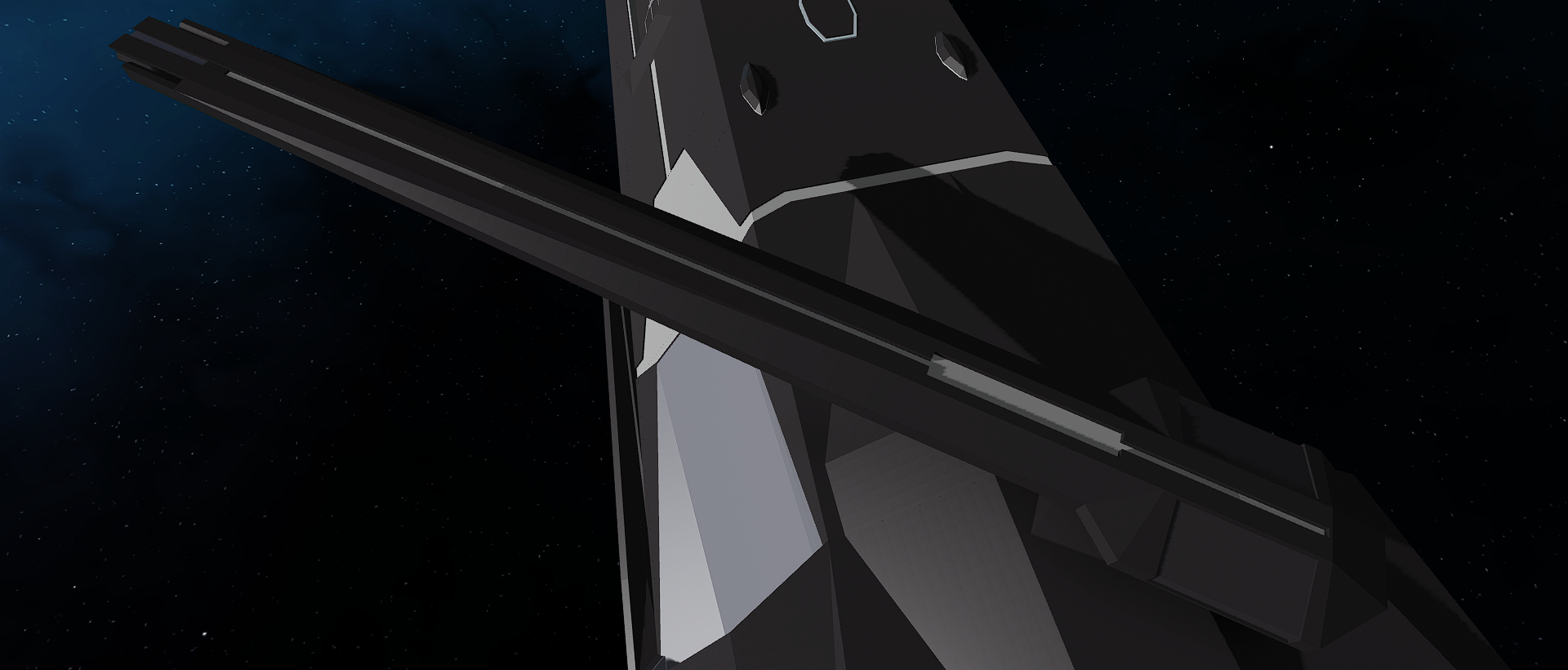 |
TKV-34 "Thunderchild" | Expanding gas | On Vendoya-class Cruisers |
| Preccyoba Defenses | Plasma | On Preccyoba's only continent | |
| Trrässo Railgun | Hybrid | On Ayin-class Frigates |

Comments