

Stargates
Stargates
Humanity's Greatest Engineering Achievement
Official Name: Einstein–Rosen Interstellar Transit Gate
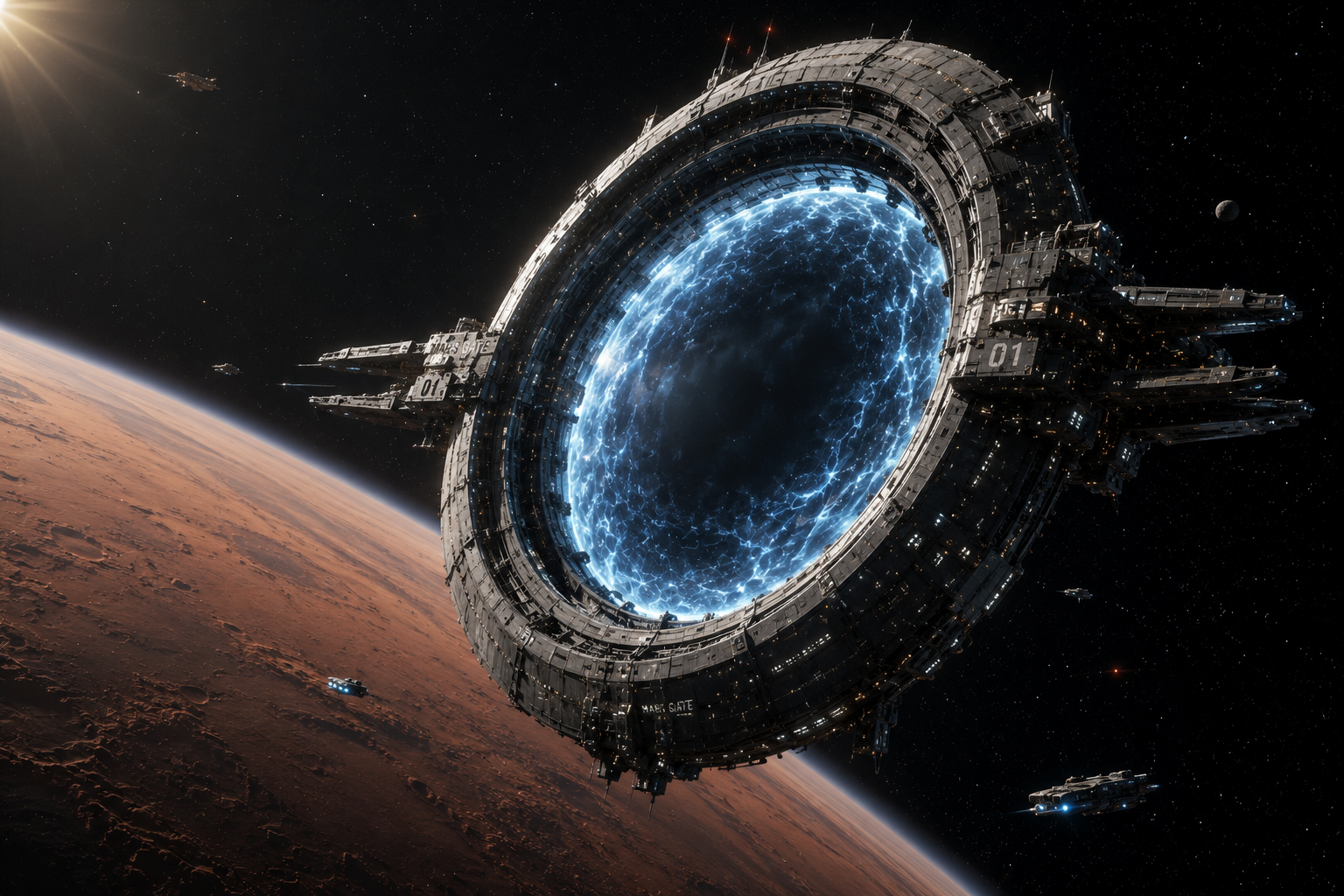
Common Names:
- Stargate
- Gate
- ER Gate
- Transit Gate
- The Ring
- The Bridge
Current Operational Gates (as of 2829 CE): Mars, Alpha Centauri Prime, and Chendiuria (operational; infrastructure still under construction)
Overview
There are inventions that change civilizations. Some inventions redefine civilization itself. The Stargate belongs to the latter.
No technology in Human history, not fusion power, Artificial Gravity, faster quantum communications, or artificial intelligence, has altered humanity's trajectory more profoundly than the Stargate.
It has not made the galaxy small. It has merely made it connected.
Entire colonial economies, military doctrines, migration patterns, and political systems are being rewritten around a technology that even its creators admit they do not fully understand.
One joke has become common among gate physicists: "We know how to build them. We are still arguing about why and how they work."
The Discovery
The first functioning Stargate was never supposed to activate. Construction beneath Mars in the Valles Marineris Defense Research Arcology had originally begun as a large-scale experiment in multidimensional field geometry and quantum topology.
The project sought to validate emerging theories involving:
- Calabi-Yau compactifications
- higher-dimensional manifolds
- superstring resonance
- Einstein-Rosen bridge stabilization
For nearly eighteen years, the enormous ring produced nothing but increasingly expensive failures while sucking up hundreds of gigawatts of power per second of operation.
Then, during what should have been another calibration test, the gate activated. Every power grid on Mars immediately experienced catastrophic load demand. Entire cities dimmed. Factories shut down. Artificial weather systems briefly lost power. Several tethered orbital stations and their space elevators automatically entered emergency mode. Later calculations suggested that had Mars possessed a less robust fusion infrastructure, the activation would have collapsed the planetary electrical grid.
No one expected success. Even fewer understood what they had achieved.
What a Stargate Is
A Stargate represents something other than a standard portal. Nor does it move a spacecraft through normal space.
Instead, the gate temporarily establishes a stable topological connection between two distant locations by manipulating higher-dimensional geometry beyond ordinary three-dimensional spacetime.
The result resembles an Einstein-Rosen bridge. Physicists are quick to point out that resemblance is not identity.
Every successful gate transit has generated data inconsistent with classical wormhole models. This has only deepened the mystery.
"Cheating" Physics
The public often says Stargates cheat physics. Physicists disagree. The gates obey physics. Humanity simply does not yet understand all the relevant physics.
The best current models incorporate concepts from:
- General Relativity
- Quantum Field Theory
- Condensed Matter Physics
- Superstring Theory
- M-Theory
- Kaluza-Klein Theory
- Calabi-Yau geometry
- Kähler manifolds
- Kähler-Einstein manifolds
- Multidimensional topology
No existing theory completely explains the observed gate behavior. Every successful transit produces new data. Every new dataset creates new questions.
Multidimensional Physics
The development of Stargates gave birth to an entirely new scientific discipline: Multidimensional Physics
It combines:
- geometry
- particle physics
- cosmology
- topology
- higher-dimensional mathematics
- information theory
- quantum mechanics
The field has become one of the most prestigious and notoriously difficult areas of study. Even many accomplished physicists openly admit they understand only small portions of it.
Power Requirements
Stargates consume astonishing amounts of energy. Each operational gate draws directly from the output of its host star through immense orbital energy collection systems. The stronger the star, the greater the transit capacity.
This requirement has significantly influenced human expansion. Systems containing hotter, more luminous stars have become prime candidates for future gate construction. Some frontier governments have already begun vying for ownership of suitable stellar systems.
Why Blue Stars Matter
One long-term strategic objective involves constructing gates around massive blue stars. Such stars produce extraordinary energy output. Although shorter lived than stars like Sol, they might support gate networks far beyond the capacity of current systems.
Several military planners have quietly noted an uncomfortable implication. A sufficiently powerful gate network could make intergalactic military campaigns economically practical. That possibility concerns many governments.
Construction
Building a Stargate is among the largest engineering projects humanity has ever attempted.
Average construction time: twenty standard years.
This includes:
- gate fabrication
- orbital infrastructure
- power collection arrays
- traffic control stations
- navigation systems
- repair facilities
- crew habitats
- security and defensive installations
Each gate requires millions of tons of exotic materials. Entire industrial sectors exist solely to support Stargate construction.
Under Construction or Planned Gates
They have planned several stargates, or deep space construction drones are on their way.
Construction drones, each just over five-kilometers long, are en route to:
- Small Magellanic Cloud (SMC)
- Large Magellanic Cloud (LMC)
- main asteroid belt - a vast, doughnut-shaped region of the Solar System between the orbits of Mars and Jupiter
- Tau Ceti
- Valusian Cluster
- The Enanan System (formerly Azhar 4487) at Estu, a Hycean (water world) super Earth 2.77 times the size of Earth with a thick, hydrogen-rich atmosphere. Estu has a large ring made of hydrogen-rich ice asteroids. The Estu seahorse particularly interests xenobiologists.
As we explore more star systems, we will build more Stargates.
The Support Stations
The gate itself is only part of the system. Every operational Stargate requires an extensive network of supporting stations.
These include:
- traffic control
- navigation
- power regulation
- customs
- quarantine
- repair docks
- rescue services
- security and defense
- communications
Without these facilities, routine operations would be impossible. Chendiuria currently illustrates this reality. Its gate functions perfectly. The surrounding infrastructure is still catching up.
Transit
What happens during transit remains the greatest unanswered question in modern physics.
Everyone universally accepts one observation. Scientists cannot detect a vessel undergoing gate transit anywhere in observable spacetime.
For a brief period, it simply does not exist.
No radiation.
No gravity.
No quantum signature.
Nothing.
Then it appears at the destination gate. Perfectly intact. To outside observers, the process is nearly instantaneous.
Where Does the Ship Go?
Nobody knows.
Leading theories include:
- temporary higher-dimensional translation
- non-manifold spacetime
- quantum topological isolation
- Brane transfer
- information reconstruction
- causal suspension
No theory explains every observation. The subject remains fiercely debated.
One saying has become famous among gate physicists: "The safest answer is that we don't know."
Safety
Remarkably, Stargates have proven extraordinarily reliable. Once properly stabilized, transit failures are essentially unknown.
Most accidents occur during:
- docking
- navigation
- traffic management
- power synchronization
- rather than transit itself.
The gates themselves have earned a remarkable safety record.
Traffic Control
Authorities tightly regulate gate transit.
Every jump requires:
- flight authorization
- mass verification
- trajectory confirmation
- power scheduling
- traffic deconfliction
The process resembles modern air traffic control, albeit operating across interstellar distances. Unauthorized activations are effectively impossible.
Economic Effects
The gates have transformed trade. Products that once required decades to transport can now move between major systems in days.
Entire industries have emerged around:
- rapid logistics
- interstellar tourism
- specialized manufacturing
- medical transportation
- scientific collaboration
High-value, low-mass cargo benefits the most. Bulk freight still relies heavily on conventional transport because of gate transit costs. As more gates enter service, those costs may fall.
Military Importance
Every operational Stargate is among the most heavily defended structures in human space.
Control of a gate means control of:
- commerce
- reinforcements
- migration
- strategic mobility
Military planners now regard Stargates as the modern equivalent of both naval chokepoints and planetary capitals. Losing one could reshape an entire interstellar war.
Cultural Impact
The gates have eroded centuries of cultural isolation. Artists tour multiple star systems. Universities exchange faculty. Families separated by light-years can visit each other within weeks instead of generations.
Some frontier cultures celebrate the gates. Others fear the loss of their unique identities.
Adi's Understanding
Like most Marines, Aditi "Adi" Nizhóní Peshlakai understands only the operational basics.
She knows the gate works and knows it requires enormous power. She knows ships disappear during transit.
She has heard technicians casually mention:
- quantum entanglement
- Calabi-Yau spaces
- Kähler manifolds
- M-Theory
- higher-dimensional geometry
To her, those words occupy the same category as advanced brain surgery. She respects the people who understand them. She has no desire to become one of them.
As she once told Kane after listening to two multidimensional physicists argue for nearly an hour: "I don't need to know how the gate works. I just need to know which end I'm supposed to fly into."
Current Gate Network
As of 2829 CE, humanity possesses only three operational Stargates:
- Mars
- Alpha Centauri Prime
- Chendiuria
They expect to finish building the Chendiurian stargate infrastructure in another three to five standard years.
Most historians believe later generations will divide history into two eras:
- Before the Stargates
- And after them
Whether that future becomes one of unprecedented cooperation or unprecedented conflict remains uncertain. The gates do not determine humanity's destiny.
They merely ensure that, for the first time in history, every civilization can reach every other one. Future centuries depend on how humanity utilizes this occasion.
Three active gates. Connected civilizations. An entire future beginning to unfold.
All artwork by me using ChatGPT.


This was cool. I like that you went to the trouble to design plausible mechanics behind the operation of the gates instead of just hand waving it