
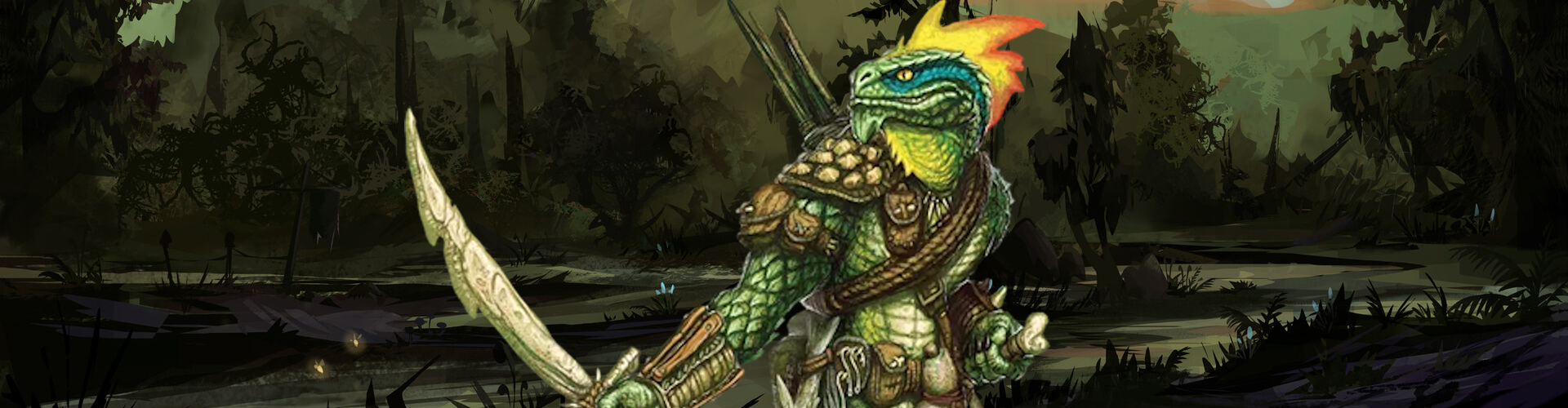
Lizardfolk
"A primitive folk by many measures, I still found beauty in the lives of the Lizardfolk. Simple lives, with simple worries and simple conflicts, unbothered by the cavalcade of nonsense that the rest of us must toil with."Lizardfolk, otherwise known as Kecualas in their native language, are a race of reptilian humanoids that inhabit some of Asylums most dangerous environments. Most of them live in wild tribes far rom the influence of civilisation and zealously cling to their ancestral ways. In recent times, a handful of Lizardfolk have begun to leave their tribes behind, bringing their unusual ways to the cities of Asylum.
Appearance
Lizardfolk are split across three clans: The Greenclaws in the swamps and bogs, the Blightooth in the Underdark caverns, and the Hornskins in the deserts and badlands. Each of the three kinds of Lizardfolk has a different appearance, reflecting the adaptations to their inhospitable homes.Greenclaw
Tall and muscular, the Greenclaws sport green-blue scales, webbed hands and feet, and short frills running the length of their necks and tails. They are the most physically imposing of the Lizardfolk clans, with large and powerful jaws, bulky limbs and thick tails.Blightooth
The Blightooth dwell in the bowels of the Underdark. Their scales are dark, typically black, brown or grey, and possess a stony texture to them. Their claws are longer than other lizardfolk and hooked, allowing them to scale the cavern walls and their eyes are naturally capable of piercing the darkness. Their most defining feature is their neck frills, decorated with elaborate patterns and colours, which are used in mating displays or as intimidation tools.Hornskin
Hornskin lizardfolk get their name from the jagged, thorny scales that adorn their bodies. They are shorter than the other lizardfolk clans, with broad heads and large eyes protected by a thin membrane that keeps out sun and sand. Hornskin tails are particularly long, aiding their balance in rough rocky terrain or in long treks across sand dunes.Unique Adaptations
Each of the three types of lizardfolk have unique adaptations to fit their respective environments. The Greenclaw lizardfolk use their blue-green scales to blend into the water and ambush prey, and a hefty lung capacity to hunt aquatic prey. Their jaws are especially strong, with a bite force comparable to that of crocodiles and alligators, capable of easily rending flesh even underwater. Blightooth meanwhile, have thick hooked claws to climb walls and eyes capable of piercing the deep shadows of the Underdark. Moreover, they secret a potent acid from glands at the back of the throat, which they mix with their saliva and spit at prey to damage and blind them. Finally, a Hornskin Lizardfolk's titular trait is their thorny, barbed scales that cover their entire body. Moreover, these scales are sandy in colour, allowing them to easily blend into their environment and ambush prey. A thin membrane covers their bulbous eyes to keep out sand and sunlight. If caught in a tight spot, a Hornskin lizardfolk can use their jagged body to rush past foes, barrelling them out of the way and injuring them in the process.Long-Forgotten Gods
The lizardfolk are among the few socities in Asylum free from the influence of the Aldrian faith. Rather, they worship a duo of ancient deities, known as Yxdohr and Ke'esis, the God and Goddess of the day and the night respectively. Religious worship is seen in the strict day-night schedule of the lizardfolk; by day, they perform their duties, honouring Yxdohr, and by night, the revel and retell their history, honouring Ke'esis. Lizardfolk are strictly forbidden from performing their duty in the day, as it is seen as an insult to the Goddess of night, and likewise forbidden from relaxing during the day. An exception is made for the sick and the injured, though they are moved out of sight, beneath a tent or cavern so as to hide them from the Gods' fury. In the Underdark, the Blightooth lizardfolk use the appearance and vanishing of the Woven Sky to keep track of the day and the night, even as far from the surface as they are.Ancient Tribes
Lizardfolk oral history dictates that the Lizardfolk were the first mortal race to walk Asylum, long before even the arrival of the Elders. What unites all Lizardfolk, regardless of clan, is their strict adherence to their ancestral ways. Lizardfolk form small tribes of fifteen to thirty members. Each member of a tribe has their own role to fill, working as a collective unit rather than individuals or even families. Everything they do is for the survival of the tribe, and most lizardfolk would place the tribe above even their own wellbeing. Moreover, a Lizardfolk tribe adheres to a strict schedule determined by the time of day; the tribe is to perform their duty by day, but the night is dedicated to rest, recovery, celebrations and the passing of their oral history to the young. All members of a tribe must learn of their history, but are forbidden from writing it down. The collective history and knowledge of a clan is passed down in oral form only.Tribal Roles
The young are raised by a few dedicated caregivers - known as Denmothers or Denfathers - regardless of parentage. Lizardfolk mating seasons vary between the clans, with each clan having its own way of determining who is permitted to mate this year. For example, the Greenclaw Lizardfolk compete in tests of strength, pairing off males and females with regards to their performance. According to the Lizardfolk, they rarely experience romantic feelings, leaving procreation as a simple necessity for the survival of the clan. A young lizardfolk will often be told of who their parents are, and expected to give thanks to their parents for the gift of life; however, beyond that the Lizardfolk have no concept of parenthood. A majority of a lizardfolk tribe is made up of hunters. Lizardfolk are natural ambush predators, and exclusively carnivores. As a whole, they abhor waste, so after killing a creature and bringing it back to the tribe to be eaten, the leftover bones, skin horns and anything else is repurposed by the builders of the clan. Builders take whatever they can find and use it to create buildings, tools, weapons and fortifications. Lizardfolk are simple people, and they build nothing extravagant or gaudy. They prefer simple, functional things, or things that display their merit. For example, a builder might be asked by a hunter to weave together a necklace decorated with the teeth of a powerful enemy they felled. Finally are tribal shamans. While lizardfolk tribes have no concept of leadership, a shaman's role is to guide the others and offer advice of the spiritual or magical kind. These lizardfolk typically learn primal magic, using it to heal the sick or wounded, or defend the clan from interlopers while the hunters are away. How a lizardfolk is given a role is dependant on the skills they display when they are young. Typically, a lizardfolk child is expected to fulfill the same role as either of their biological parents. However, should they display a penchant for another role, they may decide to perform that role instead. It is exceedingly rare for a lizardfolk to change their role as an adult.Life and Death
Lizardfolk are born from eggs, hatching around the same time as their clutchmates. They mature quickly, reaching adolescence after around eight years, and full maturation after sixteen years. Curiously, even once a lizardfolk reaches adulthood, they do not stop growing. Their growth slows considerably compared to when they were young, but given a perfect environment, with plenty of food, water and no disease, a lizardfolk will never stop growing and will not die of old age. Rather, as a lizardfolk grows older and, therefore, larger, it puts more of a strain on their body and the tribe. A larger lizardfolk needs more food, more water and takes longer to heal from injuries. A great fear of many lizardfolk is to become so large that they become unable to move quickly, to hunt, to feed themselves or otherwise perform their duty. Moreoever, their immune system still grows weaker with age like other creatures, resulting in large, elderly lizardfolk being more susceptable to illness. For this reason, lizardfolk developed the concept of a "good death." To a lizardfolk, nothing is more heinous than dying of sickness or becoming a burden to the tribe. So, once they reach a certain age in life, when they have passed down all the oral tradition they know, they begin seeking a good death. Death at the hands of an enemy, dying to protect the next generation, even death from a failed hunt are, in the eyes of the lizardfolk, good ways to die. No lizardfolk wants to die of sickness, or to die because they became too large to sustain themselves. When a lizardfolk does die, they are not mourned by the rest of the tribe - most lizardfolk believe they cannot experience sadness like other races do. And, in keeping with their hatred of waste, a dead lizardfolk's corpse is put to use. Their scales are used for armour or housing, their weapons and tools given to the next generation, and their body used for food provided it is deemed safe to eat. Nothing is ever wasted in a lizardfolk clan, not even the body of the deceased.Names
Lizardfolk do not name their young when they hatch. A female lizardfolk lays large clutches of eggs, with the knowledge that several will not survive. For that reason, a lizardfolk is not given a name until they come of age, and each clan has a different way of naming their children. For example, when a young Blightooth comes of age, they are instructed to venture into the Underdark alone to retrieve a piece of stone from an area sacred to that clan. The stone they find must represent them, and upon successfully returning, they claim that stone as their name. Most then request a builder - or do so themselves - to fit the stone onto a necklace, band, ring, or something else to allow them to wear it with them at all times.Other Races
Lizardfolk hardly see other sentient races as "real people." To them, the lizardfolk way of life is the only way of life; to do otherwise is to abandon the principles of nature and the wild. It is for this reason that they cling so steadfast to their ancient beliefs, even despite multiple attempts to bring them to heel under the flag of empires. That said, some do choose to travel beyond their tribe and join civilisation. To do so is tantamount to abandoning the tribe, however, and they will never be permitted to return.Magic
In a lizardfolk tribe, it is primarily the shamans that learn magic. Usually, they are druids, communing with the land around them and wielding primal magic. Sometimes, a hunter shows a knack for magic and is taught by the shamans as an extension of their martial training.Brands
Brands are a heinous thing in lizardfolk culture. To be marked as chosen by a God of the "civilised" people is seen as a betrayal to their tribe and their Gods. A branded Lizardfolk typically either has the brand forcibly removed - often by removing the body part it manifested on - or is banished from the tribe, never to return.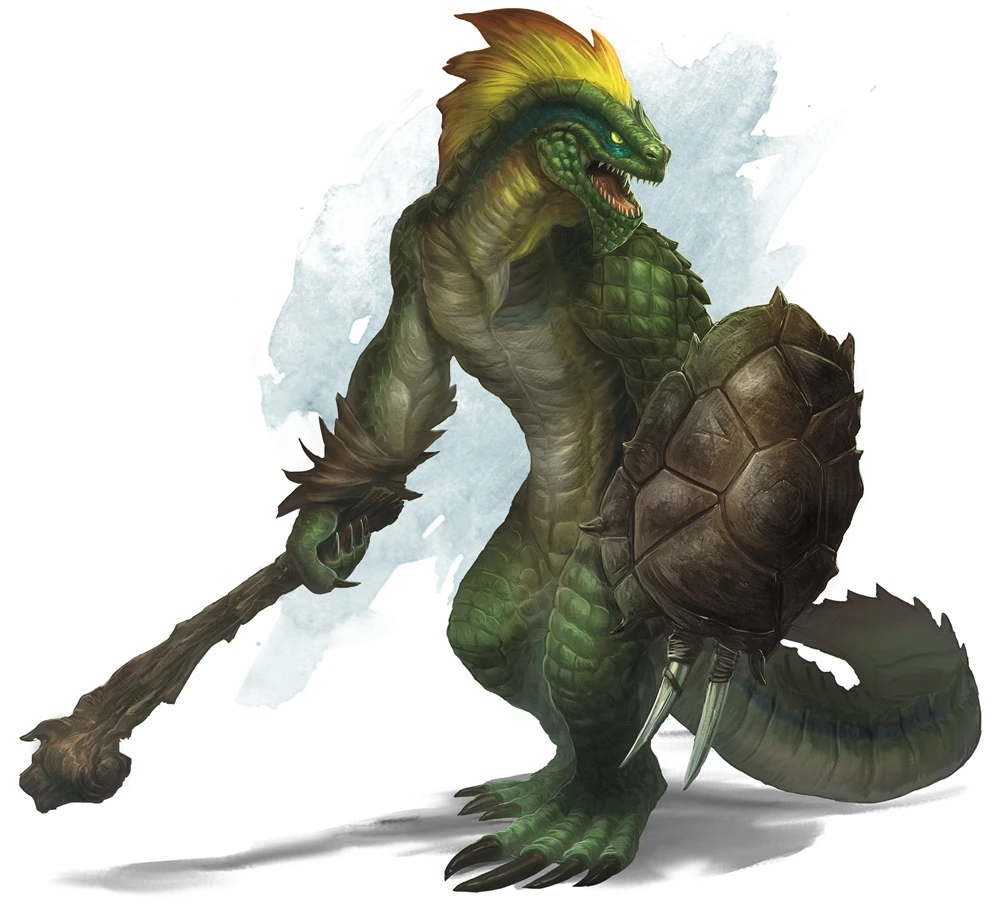
Statistics
| Size | Medium/Large |
| Type | Humanoid |
| Alignment | Typically Neutral |
| Traits |
General Information
| Location(s) | Irral, Akhmaten, Underdark |
| Language(s) | Common, Celestial |
| Alias(es) | Lizard men Kecualas |
| Common Classes | Fighter Barbarian Druid |
Physical Information
| Vision | Darkvision |
| Lifespan | Unknown |
| Height | 6'' - 7'' |
| Weight | 200 - 250 pounds |
| Abilities | Natural Weapons Natural armour Subrace adaptations |
