
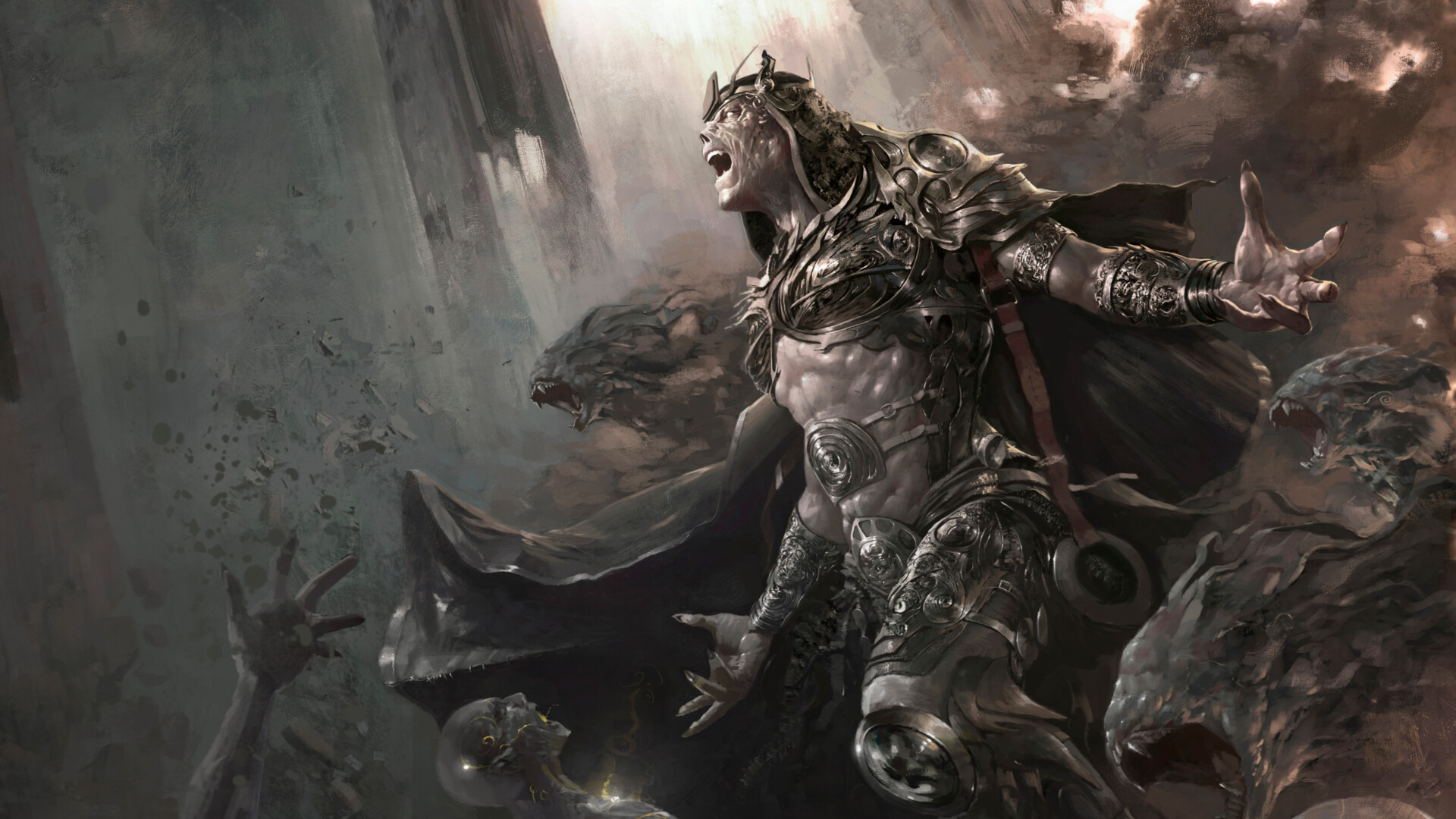
Chapter 1: Heritages & Traits
Chapter 1: Heritages & Traits
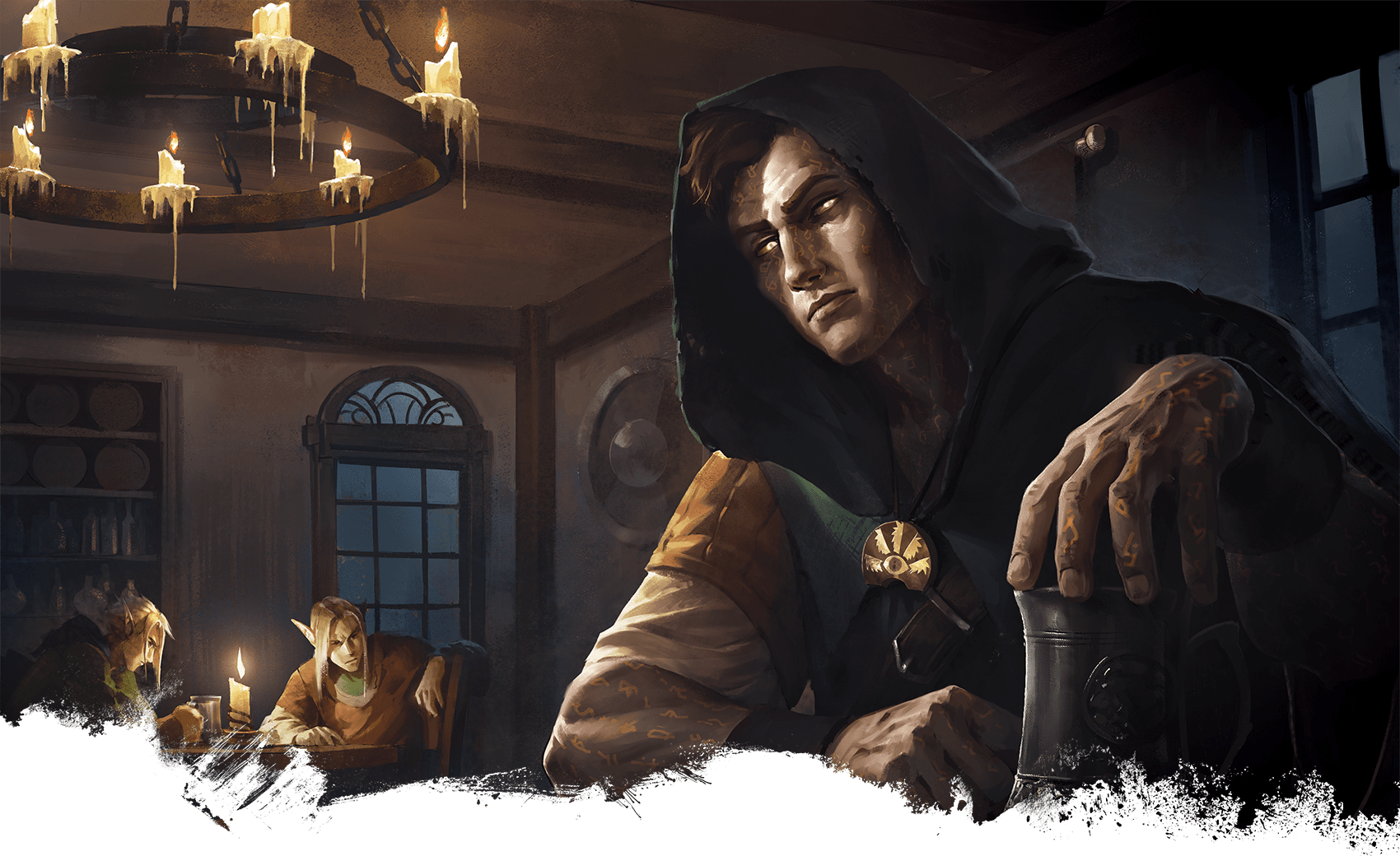
Humans dominate the world of Etharis. The folk known as the elder peoples—the dragonborn, dwarves, elves, gnomes, and halflings—are spread throughout human lands or concentrated in the isolated realms they retained after the conquests of the Era of Expansion. Although those heritages represent the most common folk of the world, the Grim Hollow campaign setting features a much broader range of heritage options with which to build your character—and a system of character creation that can help make the player characters in a Grim Hollow campaign truly unique.
Characters in a Grim Hollow Campaign
The world of Grim Hollow offers players new rules for creating characters to explore the world and enhance roleplaying. Use the guidelines in this section alongside the normal fifth edition character-building rules to create a character for a Grim Hollow campaign.
Choosing a Heritage
For Grim Hollow campaigns, available heritages are grouped into three categories—common heritages, rare heritages, and eldritch heritages.
The common heritages of Etharis are the dragonborn, dwarves, elves, gnomes, halflings, and humans whose cultures and nations have defined the history of the continent.
The rare heritages are the folk who dwell on the fringes of more widespread cultures, often treated as outsiders and struggling to find their place in the world—the dreamers, grudgels, laneshi, and ogresh.
Then there are the eldritch heritages of the accursed, arisen, dhampir, disembodied, downcast, wechselkind, and wulven—creatures whose creation or nature is touched by magic, living as true outsiders with no culture of their own.
Humanoid Type
If you select any of these Grim Hollow heritages, your character is a Humanoid, even if their appearance is radically different from other Humanoids.
Physical Features
In addition to selecting your heritage traits, you can also decide the general look and appearance of your character. Elves might have a general tendency toward tall, graceful figures, while Dwarves are known for their stout and sturdy forms. But as an adventurer in Etharis, you are anything but typical. Feel free to play an Elf defined by an intimidating physical presence. Play a Dwarf who uses their slender physique to maximum advantage while delving through claustrophobic ruins. In many campaigns, Humans are known for having the widest possible range of coloring and features, but that broad palette of appearance can apply to every heritage in Etharis, common or uncommon.
Features and Traits
The only limitation to your body’s physical features is that a feature can’t reproduce the effect of any heritage trait without taking that trait, and a physical feature can’t create benefits if there’s no trait to cover those benefits. For example, you can easily describe your Grudgel character as being exceptionally thickly muscled, or create a Wulven character covered by thick mats of body hair that betray their werebear heritage. But those cosmetic effects have no bearing on your Armor Class unless you also take the Well Protected trait. (The rest of this section talks more about heritage traits, which are detailed at the end of this chapter.)
If you create a character from an eldritch heritage, the unique nature of some of those heritages lets you play even more freely with your character’s physical features and form. You might ask the GM about creating an accursed character who has extra arms, or a tail that you use the same way you use your arms and hands. But extra appendages don’t make it any easier to climb or carry more gear unless you also take the Climber or Powerful Build traits and describe the effects of those traits as coming from your extra arms or tail.
Likewise, no number of extra appendages will give you the innate ability to make additional attacks, because there’s no heritage trait providing that benefit. However, you’re free to describe multiple attacks you gain from a class feature as making use of your extra arms or tail in any way you like.
Thinking About Traits
The traits presented as part of each heritage’s write-up are divided into three categories that can help guide your sense of who your character is:
When considering the traditional traits for your chosen heritage, consult that section to assess whether the benefits a trait provides fit your character concept—and read through other available traits to get a sense of the many aptitudes, instincts, and innate abilities your character might embrace.
Trait Selection
In a typical fifth edition game, characters are given a list of traits or features based on their species, ancestry, heritage, or whatever term is used by the source material. If you choose to use that method for your Grim Hollow game, you can do so. Each heritage presented in this chapter features base traits shared by all characters of that heritage, plus eight traditional traits that create a typical member of that heritage. However, a Grim Hollow campaign also allows players to build unique characters built on a diverse range of traits.
Selecting the traditional traits noted for your heritage is quick and easy, and creates a character who feels like a solid archetype within your chosen heritage. But you can swap any of those suggested traditional heritage traits for any of the traits provided, building your character around any eight traits. This can include taking the traditional traits presented for any other heritage, taking one of your traditional traits again to gain its secondary effect, or taking any of the many traits that aren’t part of any heritage’s default presentation.
Two Modes of Free Trait Selection
Within the Grim Hollow Heritage System, players can experiment with the free choice of heritage traits for characters of any heritage, not just Accursed characters. But a character of a particular heritage built using freeform trait selection is meant to have a vastly different feel to an Accursed character.
For example, a Dwarf character can easily eschew all the traditional Dwarf traits. Choosing nothing but traits relating to magic, performance, and movement can create a magnificent Dwarf bard who sets themself apart from any standard Dwarf archetype. Such a Dwarf will absolutely stand out in a campaign—but with the context of feeling different than the Dwarves known to most characters in the world.
However, when a player builds an Accursed character, there is no norm for that character to relate to. Accursed characters are wholly unique and alone, disconnected from any of the culture or history that gives even the rare heritages and the other eldritch heritages a common baseline defining their place in the world. Furthermore, other characters in Etharis may treat an Accursed with any mixture of amazement, admiration, or fear, depending on how an Accursed presents and conducts themself.
You want to talk to him about fixing your wagon? I suggest you rethink that, friend, and just walk away. He might be a gnome, but the only tools he knows are the ones that can break your skull.
—Helpful Tavern Patron
Customizing Heritage
The world of the Grim Hollow campaign setting is a world of endless conflict, fell magic, and dark secrets. The peoples of the world are divided along clear lines of heritage that are often subdivided by culture or region. But no matter your chosen heritage, your character is also defined by upbringing and circumstance. Have you spent your life in relative peace in the heartland, or in a frontier territory where raids and warfare are a constant threat? Have you or your family line been touched by contemporary magic or an ancient curse? Do you consider yourself an exemplar of your people, or do you quietly push against the social and cultural norms that others expect to define you?
As an adventurer in Etharis, you have even more reason than most to break the expectations that your heritage might hold for you. You might play an Elf who lived among dwarves for years, swapping the default Elf’s Shroud of the Wild trait for the Toughness trait. You might play a Grudgel with a magical background, deciding to take the spellcasting granted by Magical Savvy and Magical Savant traits in place of the Grudgel’s suggested Artisanal Focus and Crafter’s Eye traits. You might decide to select four of your suggested traditional traits and take those four traits again, creating a character whose specific focus grants them an edge in the things they’re best at. The traditional traits listed for each heritage are only thematic suggestions. How much or how little your heritage’s most popular traditions shape your character is up to you.
Balancing Traits
Traditional traits for each of the standard heritages in a Grim Hollow campaign are divided fairly evenly between combat, exploration, and roleplaying, with three traits in two of those categories and two traits in the third category. However, this isn’t a specific pattern to which you must adhere.
In a Grim Hollow campaign, you can take heritage traits from any of the three trait categories as you see fit, unless the GM determines otherwise. In certain campaigns with a strong focus on combat or exploration, it might make sense for characters to balance their trait selection, choosing at least two traits in each category. But most of the time, allowing free selection of heritage traits allows you to customize your character in a way that best fits the story you want to tell.
Sometimes, you might want your heritage traits to provide options that your chosen class doesn’t give you. For example, in building a Sorcerer character, you might focus on Combat traits, creating a character who grew up amid conflict, and who trained with weapons, armor, and combat tactics even before their magical power began to assert itself. At other times, you want your heritage traits to reinforce your chosen character concept, as with building a Ranger who focuses on Exploration traits. By creating a foundation of natural capability on which your class can further build, you can shape a character to make them the absolute best at what they do.
Choosing a Class
Any typical fifth edition class can be found in the world of Grim Hollow, as can any specialized classes that the GM and players decide on.
Generating Ability Scores
You can generate your character’s ability scores in any way available in the game’s rules and approved by your GM. When you have generated your ability scores, choose two scores to increase by +2 and +1, respectively. If you use a heritage from another book and that heritage offers a standard setup for increasing starting ability scores, you can use that setup instead.
Choosing Languages
The many languages of Etharis are defined along lines of heritage and politics. Work with the GM to determine what languages your character knows. All of the typical standard and rare languages are available in Etharis. However, the most prevalent languages are national languages, spoken by the residents and citizens of a nation or realm.
There is nothing akin to the Common language of other settings. This makes multilingual people—or in some cases professional translators who speak many languages—invaluable to folks traveling from one area to another.
The sidebar has more information on languages in Etharis. Gamemasters are encouraged to use languages and language barriers as a tool to enhance their games. If it makes more sense to have a language that most people or creatures of Etharis speak in your campaign, do what is best for your campaign.
Describing Your Character
The information in each heritage’s write-up provides a broad overview of the typical appearance and outlook for characters of that heritage. But the description of your character can work with or against the typical as much as you want it to. Even for the common and rare heritages tied to a broad culture, you might have few distinguishing features, rarely standing out in a crowd of related folk. Or you might look and act starkly different than your kin, drawing attention by virtue of your individuality. And for characters of some of the eldritch heritages, your description can easily establish you as a unique figure in the campaign—and perhaps even the world.
Grim Hollow Heritages
The following sections present the heritages available to players in a Grim Hollow campaign, divided into the three categories of common heritages, rare heritages, and eldritch heritages.
Speak loud, smile wide, and when all else fails, start pointing.
—Merchant’s Guide to Life on The Road
Common Heritages
The common heritages of Etharis include the Humans who now rule the continent and the folk of the elder peoples who have been forced to reckon with new lives in lands they once ruled or dominated.
Dragonborn
Dragonborn walk with pride through a world that greets them with equal parts fear and admiration. Their powerful resemblance to dragons makes them remarkable among other common folk. Thick scales cover their bodies, sharp claws tip their fingers, fangs line their jaws. They do not possess the legendary size or impressive wings of their presumed ancestors, but to be dragonborn is to be blessed with the breath and beauty of a dragon.
Some claim that the dragonborn must be the most ancient among all heritages. During the Era of Expansion, humanity discovered a kingdom already shattered in Etharis’s most southern regions. Not even the dragonborn themselves could recount the history that had led to the destruction of their once-great capital—the granite city of Ember Cairn. When dragonborn prayed, they were met with silence from their gods. They dwelled in the ruins of their own inheritance.
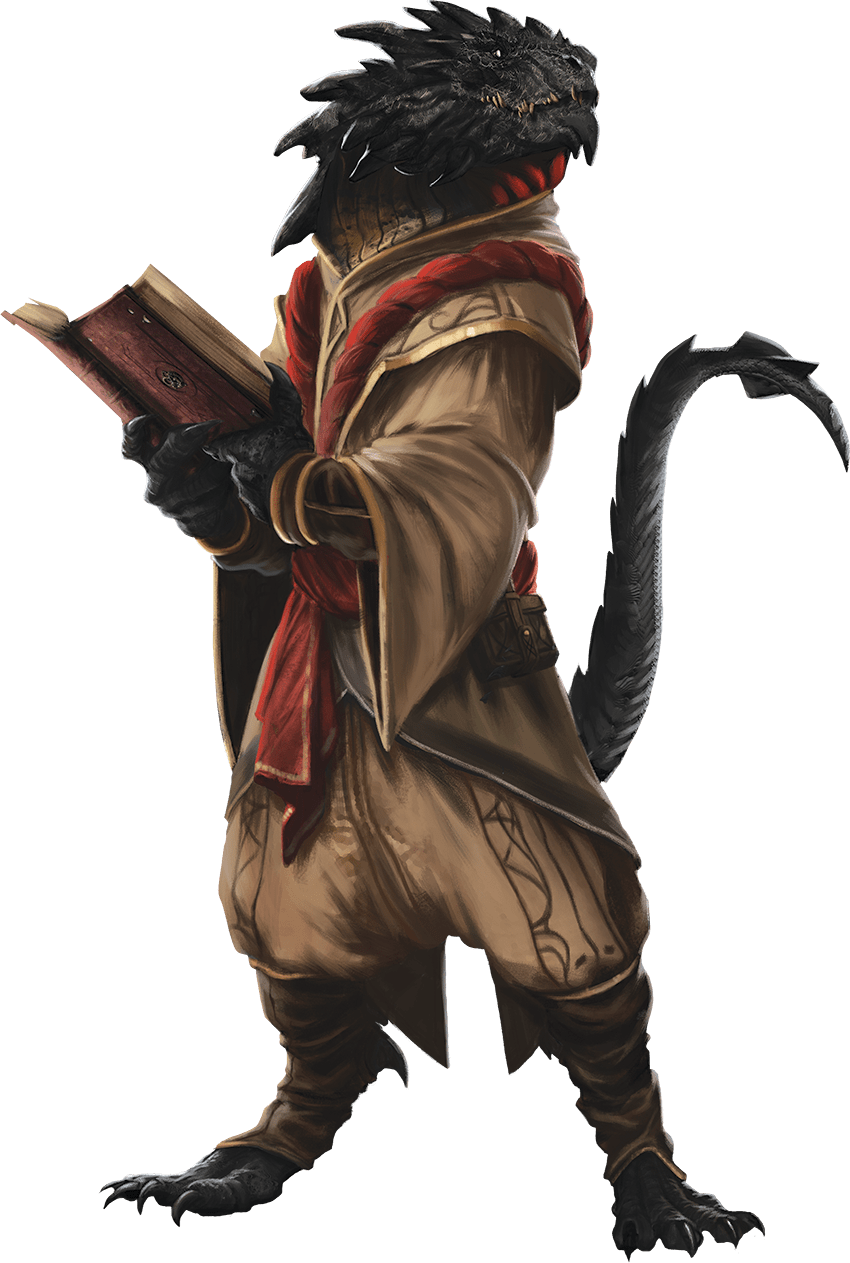
It was not difficult for humans to settle the southern lands that would become Castinella. Disillusion and desperation caused the dragonborn to abandon their ancestral lands and scatter across Etharis, searching for the answers as to why their gods fell silent. It was in this same period human missionaries began teaching their own religions to the dragonborn that remained—of the Aetheric War and the Divine Seraphs. The dragonborn came to believe that their gods had not abandoned them but had been destroyed by the Aether Kindred. With a new faith to fill the void of their lost beliefs, the dragonborn of Castinella became among the most zealous adherents of the Eternal Dogma.
Castinella awarded the dragonborn a small region of their ancestral land to call their own. From this humble start, they rebuilt the ancient city of Ember Cairn. Those who were scattered across the continent began to undertake pilgrimages to the city, where they were encouraged to embrace worship of the Divine Seraphs. With their ancient prayers seemingly answered at last, many dragonborn were drawn to become clerics, missionaries, and inquisitors, spreading their new beliefs with burning passion—and more often than not with burning fire.
Dragonborn Base Traits
Your draconic heritage marks you as a unique folk among the other heritages of Etharis.
Age. Young Dragonborn grow quickly. They walk hours after hatching, attain the size and development of a 10-year-old human child by the age of 3, and reach adulthood by 15. Dragonborn live to be about 80.
Size. Dragonborn are typically tall and solidly built, with most standing well over 6 feet tall and averaging almost 250 pounds. Your size is Medium.
Speed. 30 feet.
Traditional Dragonborn Traits
For most Dragonborn, a unique physiology defines and shapes their innate capabilities.
Combat Traits
- Damage Resistance (same as Breath Weapon)
- Menacing Roar
Exploration Traits
Roleplaying Traits
Dwarves
Ancient and dauntless as the mountains they call home, the dwarves first appeared in Etharis long before recorded history. As talented and diligent crafters, the dwarves forged their kingdoms in the valleys and foothills of the two oldest mountains on the continent: the Rock-Teeth and the Grey Spine. Beneath these vast ranges ran rich veins of mithral and gold. The dwarves who mined and crafted these metals quickly became famous across Etharis.
During the wars of the Era of Expansion, the dwarves barricaded themselves within their greatest capitals: the tiered city of Stehlenwald and the mountain stronghold of Grabenstein. Both fortress cities were once thought impregnable. The dwarves of Grabenstein fought valiantly for their homelands, withstanding multiple sieges until eventually their walls were ruined, their thanedoms uprooted, and their rich mines claimed by human warlords. These conquerors’ descendants would later lay the groundwork for the Bürach Empire.
The dwarven kingdom of Stehlenwald endured. Rather than share the fate of their northern cousins, the Stehlenwald dwarves dug deeper into the heart of the mountain. There, miners laid eyes upon a new metal, impenetrable to the weapons of their enemies: adamantine. With armor and weapons crafted from adamantine, dwarf battalions managed to push the invaders back to their homelands, but at a great cost. The population of Stehlenwald was decimated by war and famine. Isolation within the mountains was the only option for survival for those who remained.
By the time of the rise of human kingdoms, the proud dwarves of Stehlenwald had recovered from war. They emerged from the mountains at last to discover the political landscape had dramatically changed, leaving them surrounded and vastly outnumbered by the armies of the Bürach Empire. Realizing there was only one way for his people to survive and prosper, the dwarf king struck a deal with the Bürach Empire. The dwarves would surrender their lands and become members of the empire, as long as they could govern themselves independently.
Great numbers of dwarves still cannot forgive the great loss of life and sovereignty their ancestors once endured. It’s a common phrase in Etharis that it’s easier to move a mountain than a dwarf. But though deep wounds still exist in the Bürach Empire, dwarves have become among the most prosperous and accepted peoples in all nations of Etharis.
Dwarf Base Traits
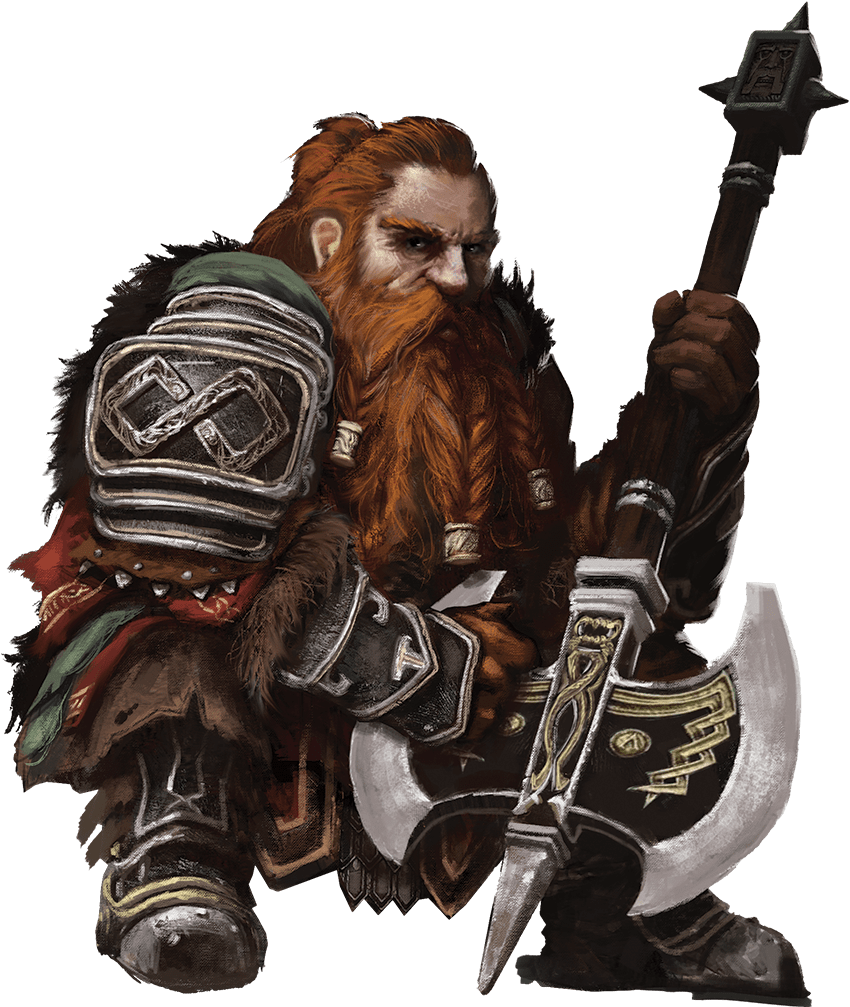
Typically short and stout, Dwarves are among the most recognizable folk of Etharis.
Age. Dwarves physically mature by their late teens, but are considered young until they reach the age of 50. On average, they live about 350 years.
Size. Dwarves stand between 4 and 5 feet tall and average about 150 pounds. Your size is Medium.
Speed. 30 feet. Your Speed is not reduced by wearing heavy armor. You can reduce your Speed by 5 feet to gain an extra traditional trait.
May your drink be strong and your hammer strike true.
—Dwarvish Blessing
Traditional Dwarf Traits
Dwarves are known for their natural resilience and for the degree to which they have adapted to living in the deeps beneath hills and mountains, where few other folks can thrive.
Combat Traits
- Damage Resistance (Poison)
- Toughness
Exploration Traits
- Steady
Roleplaying Traits
Elves
The proud and elegant elves were among the first people to dwell in the forests of Etharis. Their long history is entwined with fables from the distant past. Tall, graceful, and extraordinarily beautiful, these ancient folk believe they are descended from the nature spirits who cultivated the mortal realm. The elves claim the forests and river lands of Caer Neiada as their ancestral home, in what is now the Charneault Kingdom. Within those deep woods they created magnificent domains, ever taking guidance and blessing from the ageless spirits of the forest.
Many elves are blessed with keen eyesight and a talent for archery. Their deep knowledge of the woodlands and their affinity with the fey enable them to conceal themselves effortlessly within their own domains. Their deadly and nimble armies made them a force to be reckoned with in the early days of Etharis. However, their unchallenged dominion over the forests combined with their long lives made the elves arrogant, setting themselves above and away from other folk—especially humans, who they considered primitive and barbaric. And so the elves failed to recognize the humans as a plausible threat.
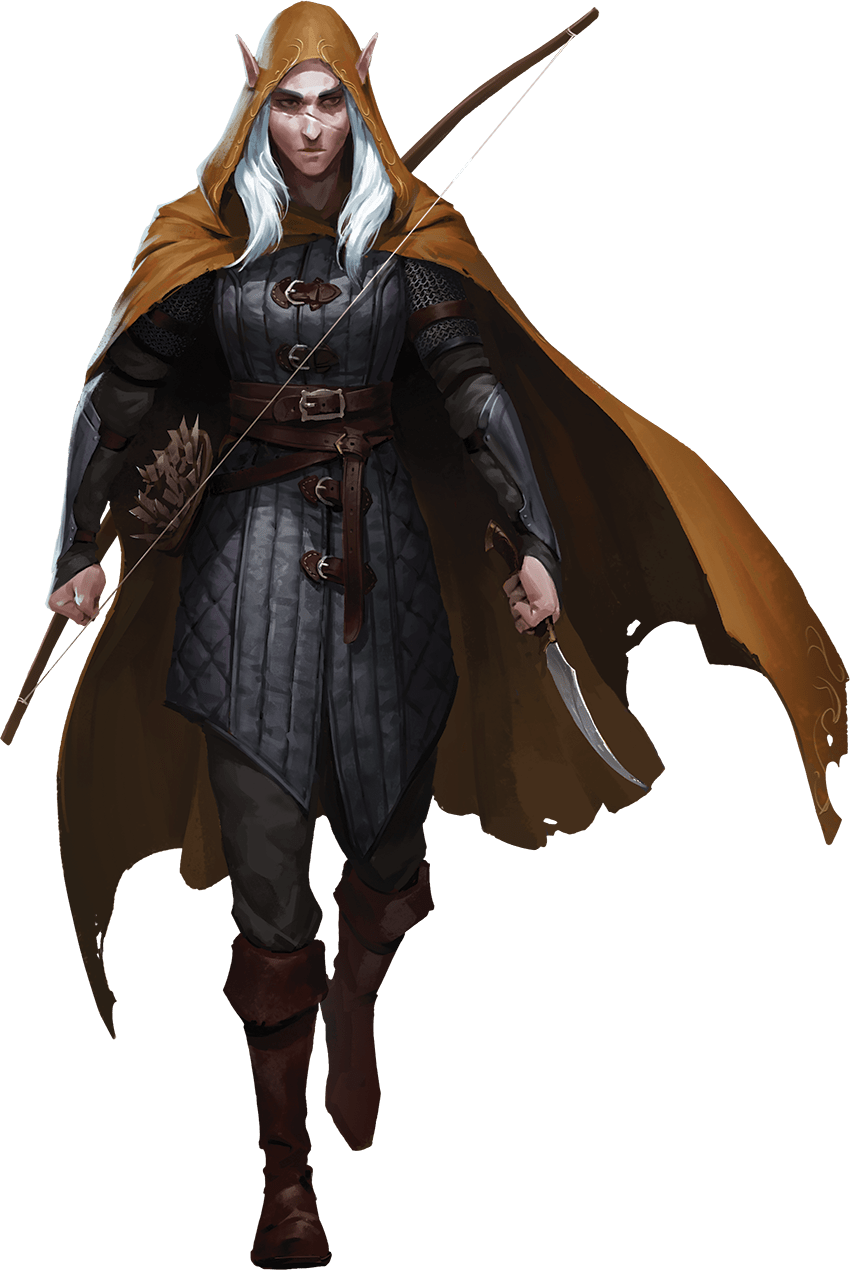
The Era of Expansion cost the elves dearly. Their kingdoms were shattered, with many of their forests reduced to ash and blackened stumps. Though their battle prowess never dimmed, the elves found themselves outnumbered and unable to repel war-hungry armies burning and lumbering their sheltering woodlands. They instead retreated deep into their forests on the outskirts of human civilization, where they believed the Spirits of Nature would still protect them. When the elves eventually reemerged, they formed a pact with humankind that birthed the Charneault Kingdom.
In the end, the sorrow of the elves for their lost paradise empowered them to recreate that beauty in music and arts. They have crafted heartbreaking songs of a lost past that echo among the trees in the night. In these ballads they call themselves the ulufey, meaning mortal fey and the descendants of the fey sidhe. The faerie courts who had once guided the elves were not vanquished in the Era of Expansion and many hope such Spirits of Nature will aid in restoring elven lands to their ancient grace.
Elf Base Traits
Though elves might pass as humans at a distance, their fine features typically make them immediately recognizable to other folk.
Age. Although elves reach physical maturity at about the same age as humans, the elven understanding of adulthood goes beyond physical growth to encompass worldly experience. An Elf typically claims adulthood and an adult name around the age of 100, and can live to be 750 years old.
Size. Elves range from under 5 to over 6 feet tall and often have slender builds. Your size is Medium.
Speed. 30 feet.
Traditional Elf Traits
The ancient traditions followed by many Elves reflect a mastery of mind, body, and magic.
Combat Traits
Exploration Traits
Roleplaying Traits
Gnomes
Ingenious and full of energy, gnomes are thought to be distant cousins of the dwarves. Shorter than their dwarf kin and less bulky, these small-framed folk are often known for their ever-working brains and great aptitude for invention. Gnomes are clever, curious, sometimes mischievous, but culturally very diligent.
Gnomes have created some of the most impressive mechanical wonders of Etharis. Cannons, automatons, flintlocks, and explosives are all reputed to be results of gnomish crafting. The process of tinkering is as important as the result. Gnomes create new inventions simply to prove it can be done. It’s said among other folk that if you’re looking for a gnome in a populated city, you need only wait for the explosion to guide your steps.
During the Era of Expansion, gnomes fled their settlements outside the sheltering mountains to seek the protection of dwarf cities such as Stehlenwald. There, they shared the fate of their dwarf cousins as human armies besieged the soaring stone walls of the city. While the dwarves eventually gazed upon adamantine, the ingenious minds of the gnomes hatched other plans with the gifts from the mountains.
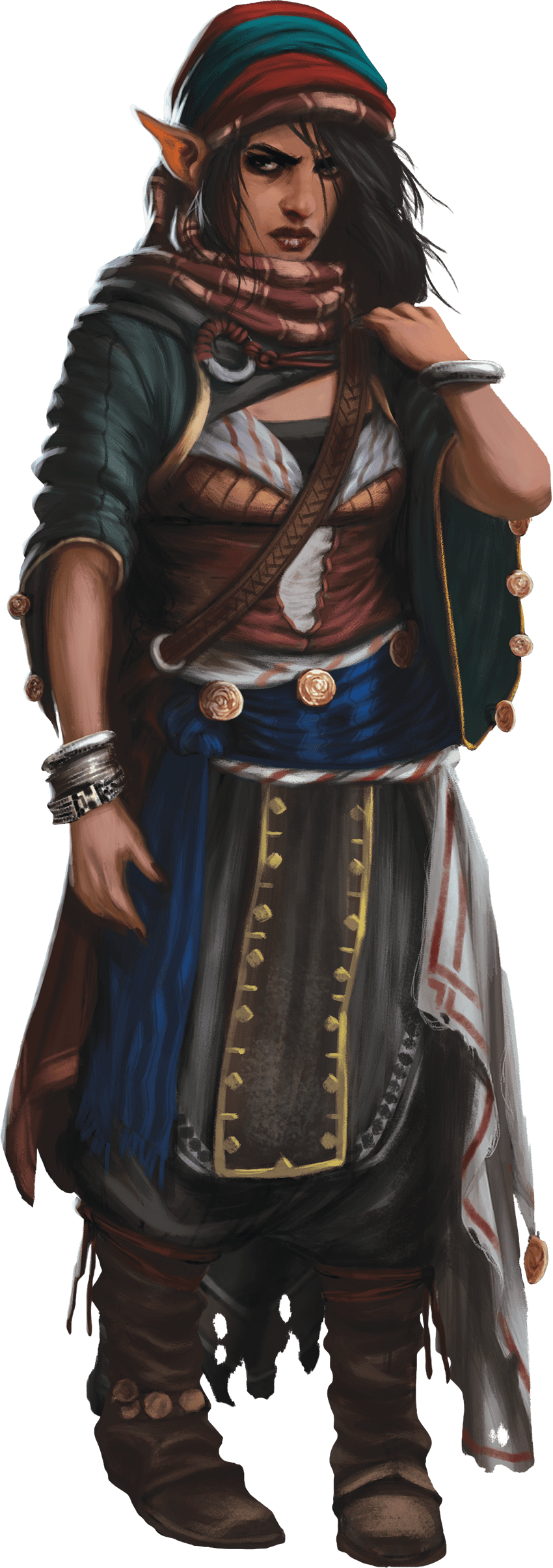
Gnome alchemists worked day and night, mixing chemicals and powders, until they invented a new weapon: explosives. As the adamantine-clad dwarves charged the besieging human armies, they were supported by the sound of explosions as gnome artillery hurled cannonballs and dynamite at the enemy. Beneath the barrage, the human forces were quickly broken. The effects of the never-before-seen explosives struck fear into their minds, as if witnessing a new and terrible sorcery. A first great battle had been won, but the losses for both gnomes and dwarves were great. So did the gnomes follow the dwarves of Stehlenwald into their centuries-long isolation—and when the dwarf king voluntarily brought his people into the Bürach Empire, the gnomes followed.
Curiously, gnomes have an affinity with the natural world. Those who did not flee for the safety of mountains were called back to their ancestral homes deep in Etharis’s forests. Perhaps this suggests a common ancestor with the elves, also.
Gnome Base Traits
Most Gnomes are marked by the slight features and long lives that are common among their kind.
Age. Gnomes are physically mature by 18, and most are expected to settle down into an adult life by around age 40. They can live to almost 500 years.
Size. Gnomes are between 3 and 4 feet tall and average about 40 pounds. Your size is Small.
Speed. 30 feet. You can reduce your Speed by 5 feet to gain an extra traditional trait.
They’re grubby little folk, always smeared with ash and blackpowder. Couldn’t ask for better engineers though.
—Guard Captain, on her efforts to recruit gnomes
Traditional Gnome Traits
For many Gnomes, an instinctive quickness of body and mind shapes their approach to life and learning.
Combat Traits
Exploration Traits
Roleplaying Traits
Halflings
Over the centuries in which humankind proved an unstoppable force in conquering Etharis, humans earned the enmity of most other folk. All who tried to oppose them were met with violence. One group, however, chose not to contest human ascendancy and instead survived by adapting to human hegemony.
The Era of Expansion did not affect the halflings of Etharis as it did the folk of other heritages. Halflings hold less value for mundane riches like gold or jewels and were therefore happy paying tithes to stronger and better-armed humans who offered them protection. Though brave and spirited, halflings lack the ambition for nation building. Their humble shires easily adapted to becoming breadbaskets for human-made empires and kingdoms. Halflings also fit into human culture perfectly by acquiring useful positions such as merchants, advisors, teachers, or scholars. Even though the halflings did not agree with the violent ways of humans, they kept their silence and ensured their survival.
Halflings are a resilient but peaceful people. What most of these tiny folk seek in life is a quiet place to settle, far away from conflict and war. They enjoy good music, fine food, and a good laugh when they can, and have a passion for lore, learning, and wild tales. But this does not mean that halflings are unable to fend for themselves in a dangerous world. They’re courageous folk when standing against foes they cannot elude or escape, and accounts of halfling adventurers seeking ancient and hidden knowledge are some of the most famous stories among their kind.
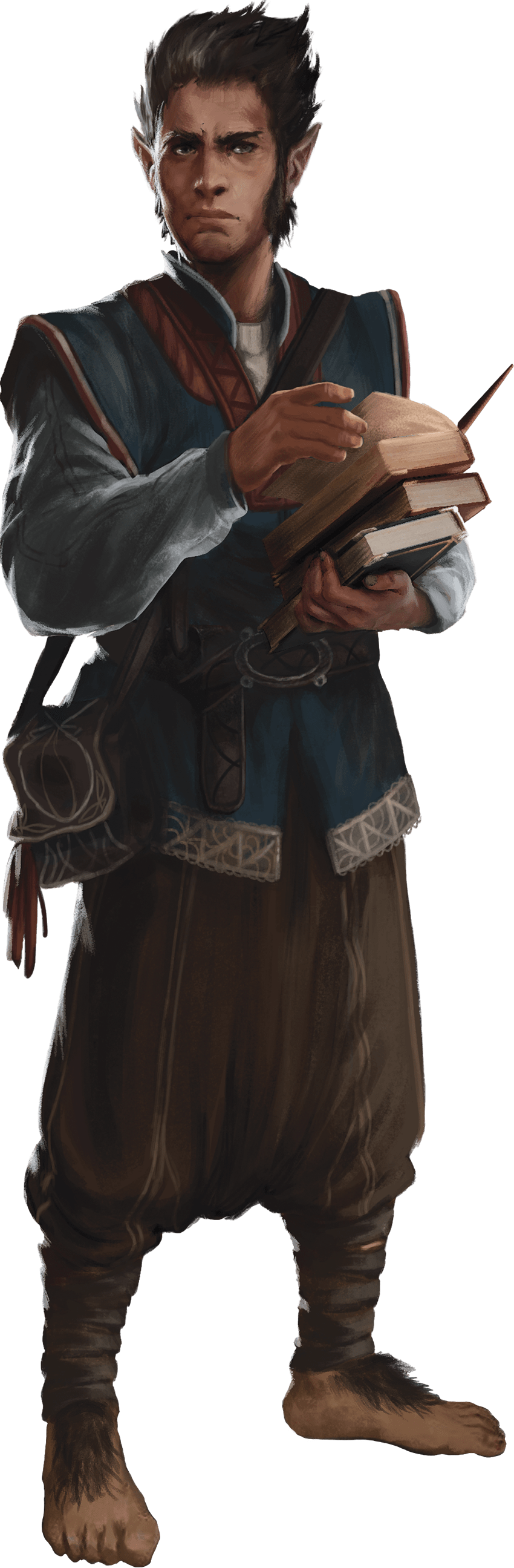
Halflings have long used the lore they gather to build impressive libraries on specific subjects. Within the countless volumes of these libraries lie generations of knowledge pertaining to the interests and passions of these folk, including domestic crafts, nature, and history.
Halfling Base Traits
Whatever their approach to life, most Halfling characters are defined by their diminutive stature.
Age. A Halfling reaches adulthood at the age of 20 and generally lives into the middle of their second century.
Size. Halflings average about 3 feet tall and weigh about 40 pounds. Your size is Small.
Speed. 30 feet. You can reduce your Speed by 5 feet to gain an extra traditional trait.
The halflings prove trickier than I first suspected, though content enough with current arrangements. I wouldn’t push things.
—Tax Collector’s Report
Traditional Halfling Traits
Many Halflings possess innate instincts of courage and curiosity, even if only a few get the chance to use them.
Combat Traits
- Brave
- Lucky
Exploration Traits
Roleplaying Traits
Humans
While ancient heritages such as the elves and the dwarves claim to have raised the first kingdoms in Etharis, humans dominate those lands in the current age. Humans can be found everywhere, from the frozen and inhospitable tundra of the North to the scorched plains of the South. First recorded emerging from temperate forests in the lands that are now the Bürach Empire, humans were not considered a threat by the dominant folk of the continent. Left unchecked, their numbers quickly grew. And in the end, the humans’ adaptable nature and adventurous mindset led them to expand beyond their homelands.
The period written in history as the Era of Expansion is often portrayed as an endless eruption of violence that lasted centuries as humans spread to every corner of Etharis. Rather, the Era of Expansion describes many separate conflicts that occurred in the wake of human migration. Humans didn’t send armies initially, but settlers. They cut trees from the Grove Maze to build homes. They journeyed to the reaches of Valika to escape their own kingdoms in the south. When they claimed the lands already populated by other folk, war became inevitable. By the time the great kingdoms of the elves and dwarves recognized the danger of human migration, it was already too late. The bloodshed that followed changed Etharis forever.
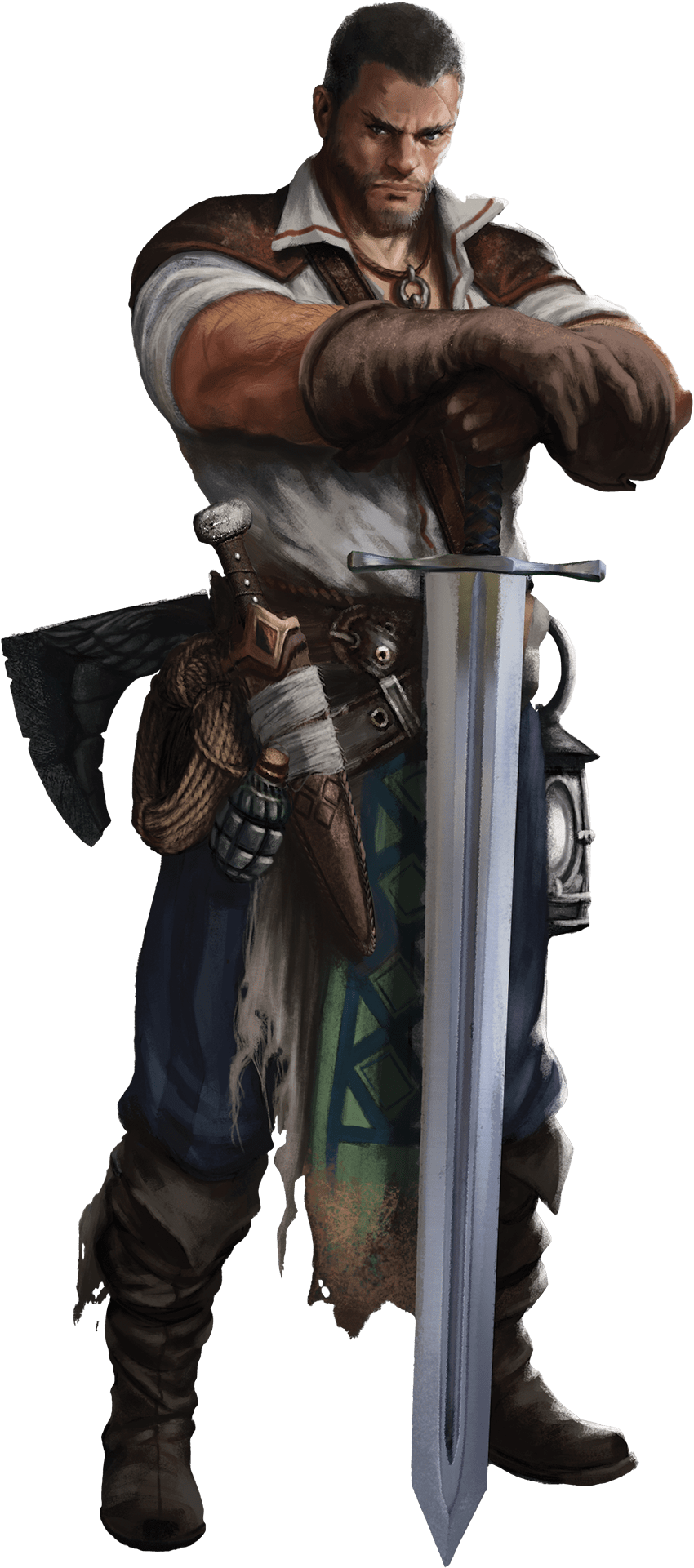
The success of humans is owed to their adaptability. They live shorter lives than many other peoples, causing their cultural customs to fade quicker and preventing them from becoming stifled by their own traditions. Every human culture has been touched by another heritage in the lands they’ve come to settle. In the duchies of the Charneault Kingdom, humans pay homage to the Spirits of Nature as taught to them by the elves. The modern fortresses and cities in the Bürach Empire incorporate dwarven stonework and architecture. To this day, humans are considered the dominant folk across all Etharis, controlling most of the land and sea. But their realms are far from homogeneous, each with their own history and mix of folk from other heritages.
Of all human vices, ambition is thought to be the most insidious. Humans still dominate positions of power within their societies. Many have asserted their claim to the High Throne of Altenheim, wishing to control the most powerful empire in the world. Known as the Era of Descent, the years that followed the Era of Expansion have been witness to the decline of each human domain. While many commoners believe it to be the death of the gods that began this downfall, folk of other heritages whisper that it was human hubris. When there were no more realms to conquer, humanity turned their greed, ambition, and violence upon themselves.
Human Base Traits
Humans present a wide range of physical traits, but their brief lifespans have long defined their collective ambition.
Age. Humans reach adulthood in their late teens and live less than a century.
Size. Humans vary widely in height and build, from barely 5 feet to well over 6 feet tall. Your size is Medium.
Speed. 30 feet.
Traditional Human Traits
Though Humans are no more drawn to violence than any other folk, many possess an innate ambition, a hunger for exploration, and a willingness to stand against danger.
Combat Traits
Exploration Traits
Roleplaying Traits
Rare Heritages
Folk of the rare heritages of Etharis have dwelled long in isolation or on the fringes between the lands and cultures of more populous folk. Characters of these heritages face the same struggles as all people, but often possess unique views of the world that others struggle to understand.
Dreamers
History repeats itself. Long before humans had their Eras of Expansion and Descent, and even before the time of elves and dwarves, another civilization had risen and fallen. Where the dwarves of Stehlenwald live today once stood the seat of a nameless empire thought to have surpassed any to have arisen since. For centuries, it lived only in the mythologies of elves and dwarves. In some stories, the downfall occurred when mortals try to challenge the gods. In other tales, the empire was devoured entirely in the first cataclysm that was the Aetheric War.
Nevertheless, something survived.
As the humans laid claim to Etharis, the Stehlenwald dwarves were forced to dig deeper into their mountain strongholds to withstand the siege. Deep in the dark, even beneath the adamantine that proved to be their salvation, the dwarves found sealed chambers of mysterious origin. With the seals broken, an ancient spell was lifted, and the inhabitants of the chambers began to stir from their millennia-long slumber.
In the days before the calamity that wiped out their civilization, a group of mystics known as dreamers foresaw the danger and devised a plan to survive it. Time passes differently in dreams, and those ancients were able to use the magic of oneiromancy to free themselves from the flow of time. Suspended between reality and dreams while sealed deep underground, they could live in a state of perpetual slumber for as long as necessary, outlasting the aftermath of the disaster that would wipe out the rest of their kind.
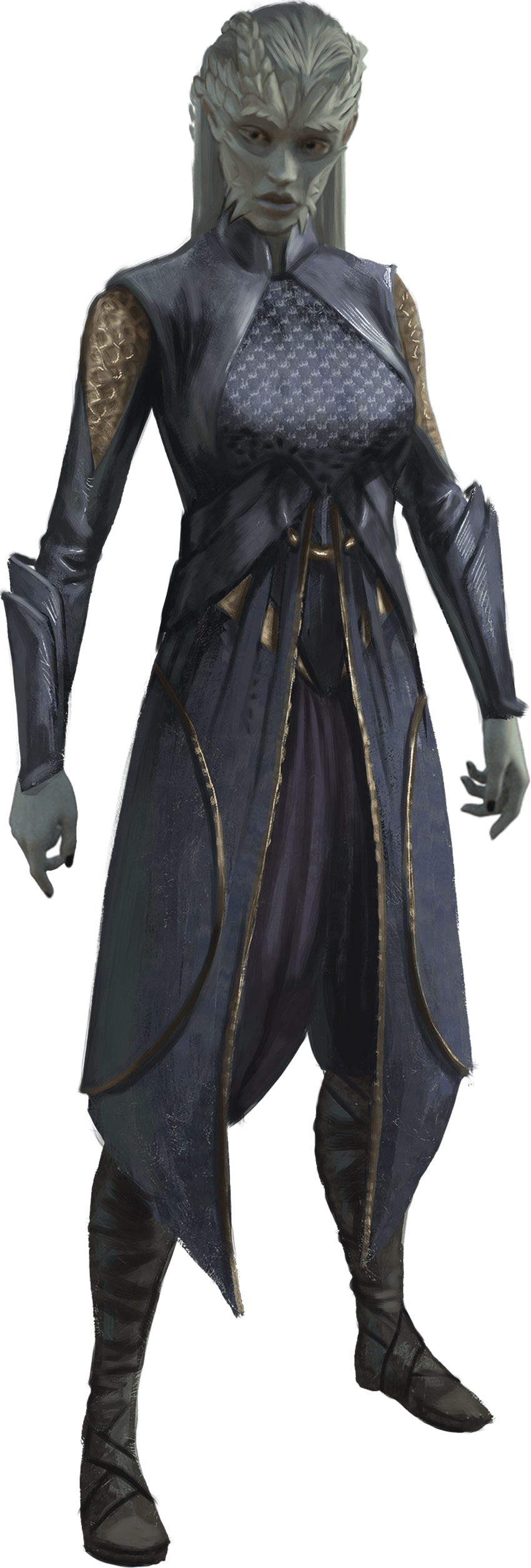
The plan worked. But living for so long within the world of dreams had unforeseen consequences. Upon waking, the dreamers found that they could no longer differentiate between dreams and memories, with both fading quickly from their minds. The result was the emergence of a new people with no knowledge of their own history—only half-formed images and dreamlike impressions of a place and time that may or may not have existed.
Now the dreamers struggle to adapt in a world that was not made for them. Whatever their history, they have proven to be quick-witted and strong, able to easily adapt to a new and unknown world. Their long slumber has seemingly left them energized, and able to work even beyond the legendary endurance of the dwarves. Even so, sleep is where the dreamers still feel most at home, and they have a habit of quickly dozing off whenever no immediate task presents itself.
Dreamer Base Traits
Dreamers bear a general resemblance to other humanoids, but their distinct features make them stand out.
Age. The magic that kept the Dreamers in stasis during their long slumber has also served to preserve their bodies from natural aging. Dreamers mature at the age of 18 and can live to be 250 years old.
Size. Dreamers typically range from 5 to 6 feet in height, and have solid builds. Your size is Medium.
Speed. 30 feet.
Traditional Dreamer Traits
Their long sleep and the lingering dreams that come with it shape the minds and instincts of many Dreamers.
Combat Traits
Exploration Traits
Roleplaying Traits
Grudgels
Legends in Etharis speak of an age of orcs. This ancient heritage has its roots in Etharis’ North, from where history claims they spread to terrorize other cultures. Orcs, as the term has become understood, were formidable warriors with endless thirst for battle. Yet tales of their armies nearly conquering all Etharis are almost certainly the propaganda of fearful outside cultures.
Those same legends speak of how the orcs abandoned their lands en masse—not because of enemy incursions or natural disaster, but because of some mysterious calling from their ancestors to sail west across the sea. While it’s agreed that orcs did flee Etharis in a great fleet, their legacy calling to Thorgard av Holgar a century later, it seems apocryphal that an entire heritage could simply disappear across the sea. Indeed, the truth is more complex than any of those old tales can tell.
The descendants of the orcs call themselves grudgels. Their lack of resemblance to the dreadful legends about their ancestors causes the uneducated to assume orcs and grudgels are different. But what truly separates them is merely time and evolving culture.
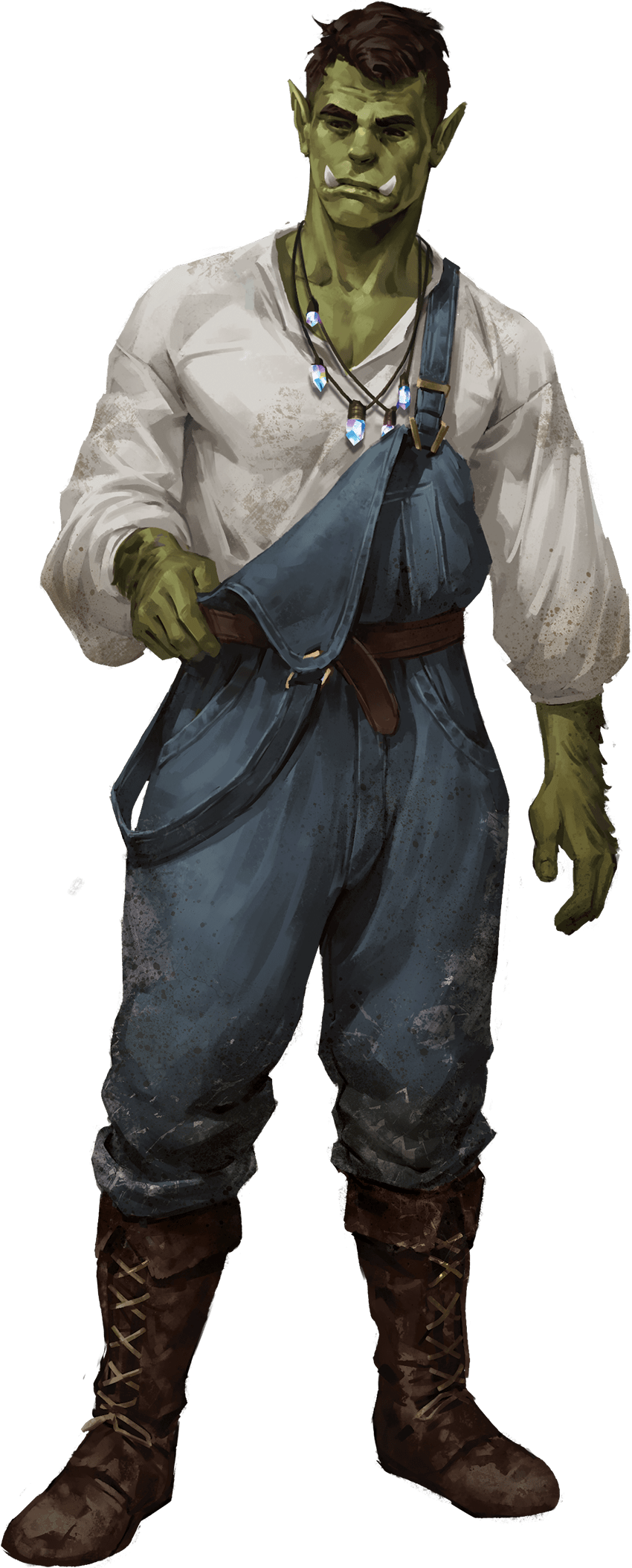
Grudgels are an imposing folk whose physical presence has not diminished since the legends of orc warriors. Yet even where they are most populous among the Valikan Clans, grudgels are no more or less predisposed to battle or taking the path of the warrior than any other folk. Grudgels are also talented artisans, wanderers, magic weavers, and star gazers. They alone hold the secrets of forging stryllum, a strange substance that occurs when starlight is solidified into glass. Grudgels are hard-working, peaceable among friends, and have a knack for keeping calm under pressure. But they’re more than capable of defending themselves against the threats of the wilderness and folk looking for a fight.
Outside of the North, grudgels remain rare enough in Etharis that folk are less likely to meet one than hear fearful rumors regarding their kind. While a grudgel working as a bodyguard or mercenary can make use of such rumors, the one thing that seemingly connects all grudgels is a shared disinterest in discussing or hearing the ancient legends of the orcs. But whether this extends from wanting to distance themselves from the violent past of their kin, or from some secret knowledge of why the orcs vanished from Etharis, only they know.
Grudgel Base Traits
The Grudgels’ ancient heritage marks them as distinct figures among the folk of Etharis.
Age. Grudgels reach adulthood at about the age of 16, and can live to their seventh decade or more.
Size. Grudgels are taller and stockier than many other humanoids, typically ranging from 6 to 7 feet in height, and weighing 200 pounds or more. Your size is Medium.
Speed. 30 feet.
Traditional Grudgel Traits
Many Grudgels are shaped by living as wanderers and by a long-held fascination with crafting and magic.
Combat Traits
- Centered
Exploration Traits
- Tireless
Roleplaying Traits
Laneshi
Deep beneath the waves off the eastern shores of Etharis lies the Llana’Shi Empire, home to the mysterious people called the laneshi by surface dwellers. Appearing incredibly alien to other common folk, these pale humanoids with manes of kelp-like hair are creatures of the sea, able to converse with the flora and fauna of the depths. Laneshi dwell within a culture that views the world in terms of absolutes and a sense of underlying duality. Day or night. Acceptance or rejection. Friend or foe. Their culture is also entwined along the line between life and death. They commune with spirits for guidance and are unafraid to meet their mortal demise. All things must have their place in laneshi society, which is built on a rigid caste system reflecting this view.
The mystic caste comprises all laneshi born as twins, a common occurrence among their people. The first-born twin is always inducted into the mystic caste, while the other is consecrated as their sibling’s spirit guide. Using a powerful necromantic ritual, the second twin is sacrificed, its soul bound within the body of the other. Each member of the mystic caste is therefore possessed of two souls—one living and one dead—which grants them vision into the spirit world and heightens their necromantic abilities. Mystics oversee funeral rites, crafting, construction, recordkeeping, and food preparation. The heavier duties of members from this caste are even performed with the aid of undead labor—a nightmarish vision for surface-dwelling folk.
The warrior caste of the laneshi oversee not just warfare but diplomacy, farming, and the raising and educating of children. The warrior caste is roughly double the size of the mystic caste, structured as a meritocracy, with great deeds leading to greater status.
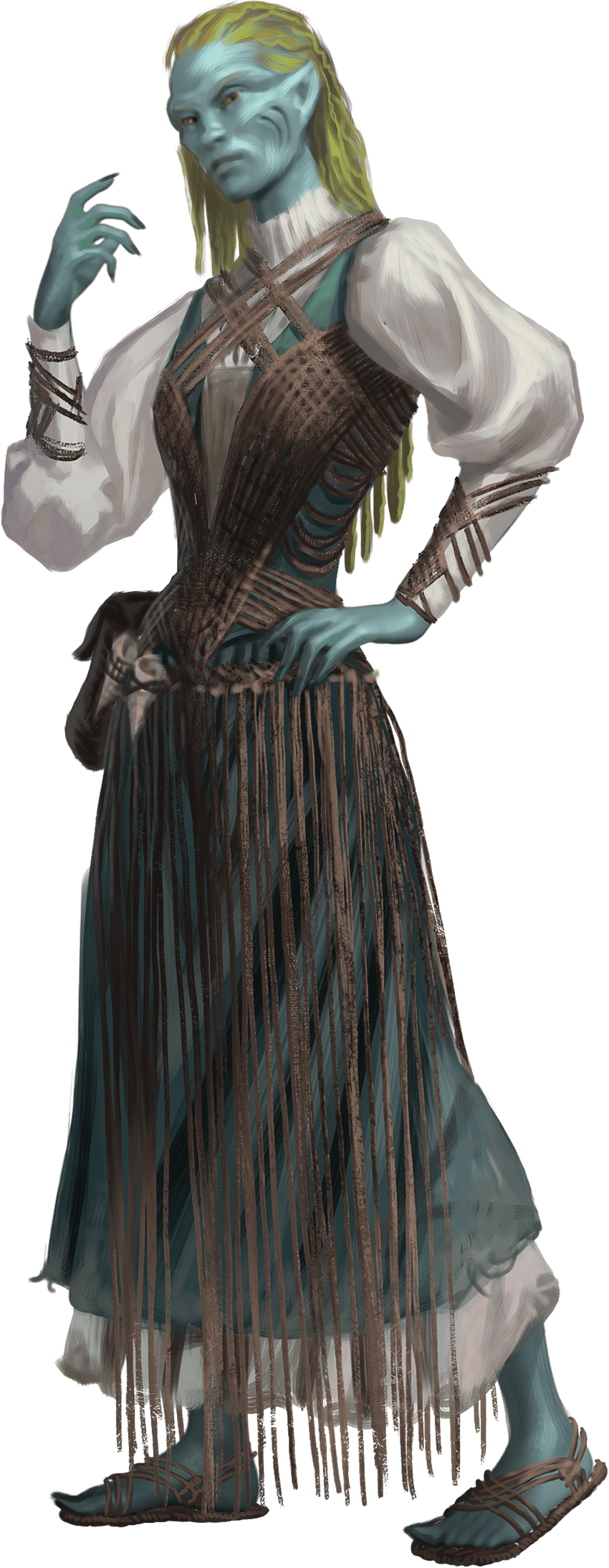
Laneshi warriors skirmish constantly with their deep-dwelling neighbors. But at the same time, the rulers of the Llana’Shi Empire have begun to focus on the surface world for unknown reasons. Perhaps some new and greater threat stirs in the dark depths of the sea, and the laneshi seek aid from their air-breathing cousins. Or perhaps there’s truth in the fearful whispers that these aquatic visitors have wrought blasphemous pacts with ancient evils, and the laneshi search for new lands to conquer to appease the hunger of an unnamable master.
Laneshi Base Traits
Among the other folk of Etharis, Laneshi are unique in their appearance and their aquatic nature.
Age. Laneshi mature quickly, reaching adulthood at around 14, and can live up to 150 years.
Size. Laneshi are typically 5 to 6 feet tall and have slender builds. Your size is Medium.
Speed. 30 feet. You have a Swim Speed of 30 feet.
Traditional Laneshi Traits
Their unique undersea culture shapes the talents and drives of many Laneshi.
Combat Traits
Exploration Traits
- Swimmer
Roleplaying Traits
Ogresh
The more populous cultures of Etharis all have stories about the ogresh, although few have seen these gentle giants in person. Tales describe them as solitary, wise figures who often serve as founts of information and advice for nearby communities. Adventure tales abound in which a protagonist receives counsel from an ogresh before setting off on their quest, even as others describe royal advisors with a distinctive set of broad features. These tales are not without merit, as ogresh can be worldly from their travels in their younger years. Yet even outside the scope of such stories, those who know the ogresh often view them as something of an exotic oddity.
In truth, the scarcity of the ogresh is a result of their particular biology. Young ogresh mature slowly, and during an extended youth that might last decades, they are driven by a deep-seated sense of wanderlust. This feeling compels them to travel in search of a suitable area to settle—one holding ample natural resources, a local population of sentient creatures, and a lack of other ogresh nearby. Once they decide upon an area, an ogresh enters the second stage of their life, which is marked by a drastically increased appetite and a mostly sedentary lifestyle. More than a single ogresh could easily deplete the surplus of a small village, so the reason for their wanderlust is a simple case of biological necessity.
Given their reliance on other folk for survival, it comes as no surprise that many ogresh are masters of social interaction. But some folk maintain that the ogresh ability to glean insight from others has an unnatural quality to it, revealing more to the ogresh than most creatures would willingly share.
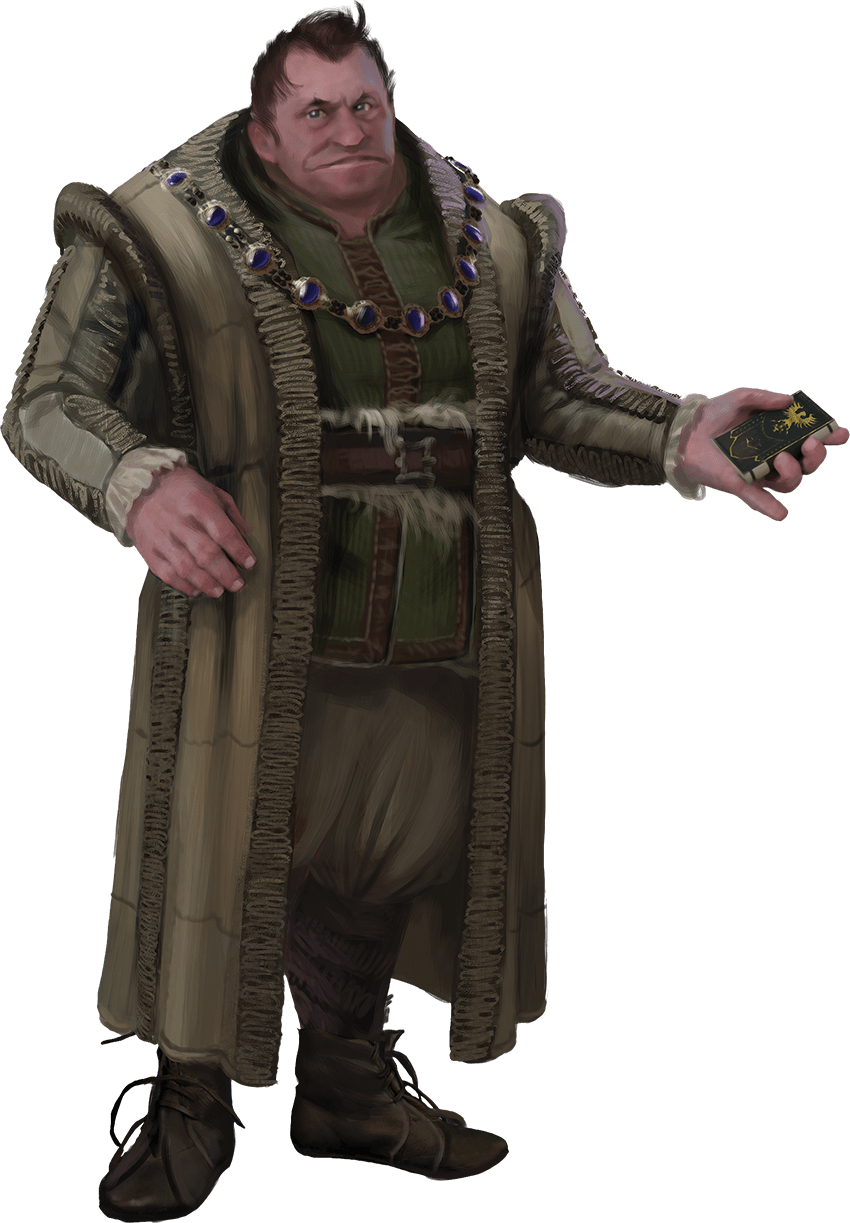
He’s a fantastic investigator. Most suspects confess as soon as they see him, and the rest spill after a few moments of conversation.
—Chief Inquisitor Cormin Dellair
Ogresh Base Traits
An ogresh’s formidable size and slow aging makes them stand out in settled lands.
Age. Ogresh reach maturity around age 25 but are considered youthful by their kin for decades afterward. They can live as long as 300 years.
Size. Young Ogresh typically stand 6 to 7 feet tall, and sport a distinctively wide and heavy build. A young Ogresh usually ranges between 200 and 300 pounds, while an older Ogresh can reach upward of 700 to 800 pounds. Your size is Medium.
Speed. 30 feet.
Traditional Ogresh Traits
A wandering lifestyle, and an innate ability to read other creatures, shapes and defines many Ogresh.
Combat Traits
Exploration Traits
Roleplaying Traits
Eldritch Heritages
The eldritch heritages of Grim Hollow cover a range of folk shaped by magical intent, unnatural power, or the touch of ancient curses. Almost universally, folk of these heritages are fated to make their way alone through a troubled and dangerous world.
Accursed
The accursed are the rarest and least understood of all the heritages of Etharis—because each accursed is effectively a heritage unto themself. Whether created by unique magic, brought to the world through planar gates or extradimensional portals, or representing one of the last members of a heritage thought to have been lost to history, an accursed is a creature whose traits are all freely chosen with a specific character concept in mind.
Accursed are so named not because their birth or creation was the result of magical malfeasance, a hag’s bargain, a corrupted scroll, or any of the other typical senses of “curse” in the game. Rather, accursed reflects the grim sense of how most other folk in the campaign will view such a character, especially those who don’t take the time to learn more about the character’s life and outlook. This heritage is intended to encourage players to decide who their character is with a maximum amount of creativity. It’s a sort of “catch-all” for unique characters who don’t fit into another heritage, but can still fit into Grim Hollow.
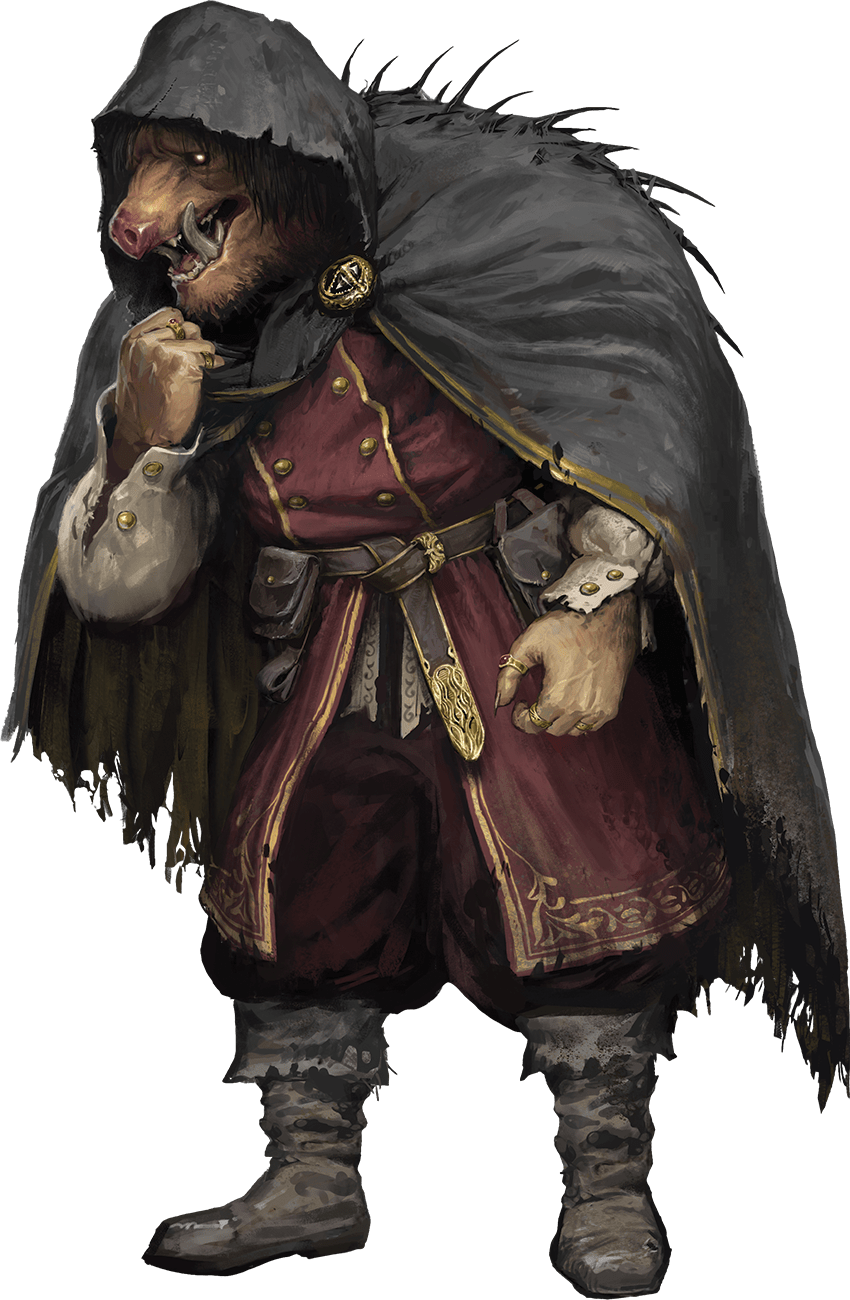
Accursed typically don’t represent a people or a culture and are often entirely unique unto themselves. One player might create an accursed character taking the form of a halfling-sized talking raven who hatched from a petrified basilisk egg during a full moon. In all the world, there is no one else quite like them, and the combination of heritage traits chosen by the player of that accursed character reflects as such. Another player might choose the accursed heritage to reflect the form and capabilities of a lizardfolk—a heritage that doesn’t canonically exist in Grim Hollow. Whether that accursed character represents a wanderer who set out from a lost lizardfolk enclave deep in the Black Mire, or a character born to elf parents cursed by an evil mage, their selection of heritage traits defines their unique place in the world.
Accursed Base Traits
The unique nature of each Accursed is reflected in a breadth of form and longevity.
Age. Accursed that strongly resemble other humanoids might have a longevity only slightly different than those other folk. However, unusual Accursed might age quickly or live effectively ageless lives until cut down by tragedy.
Size. Accursed can range in size from under 3 feet to 6 feet or more, with a wide range of body types to match. Your size is Small or Medium, as you determine.
Speed. 30 feet. If you are Small, you can reduce your Speed by 5 feet to gain an extra trait.
Traditional Accursed Traits
The unique nature behind your creation or the evolution of your exceedingly rare kind dictates the traits that define you. If you resemble or once lived as one of the standard heritages of Etharis, you might choose one or more of the traits of that heritage as a starting point. But you are free to choose any traits as you determine, creating a character whose unique nature shapes their experience in the world.
Arisen
The arisen are spoken of in fearful whispers across Etharis, all too often proclaimed unnatural entities that can be neither trusted nor redeemed. For although they are humanoids, each arisen is a unique construct created by magic, mysterious science, or both.
Arisen are never born in their current form. They are not undead, nor have they been raised from death by divine magic. Rather, each arisen is constructed and given the gift of life, usually by a creator. Arisen are people, to be sure. They have unique personalities, intellects, and experiences, as all humanoids. But do they possess souls? That is an existential question that all arisen must grapple with.
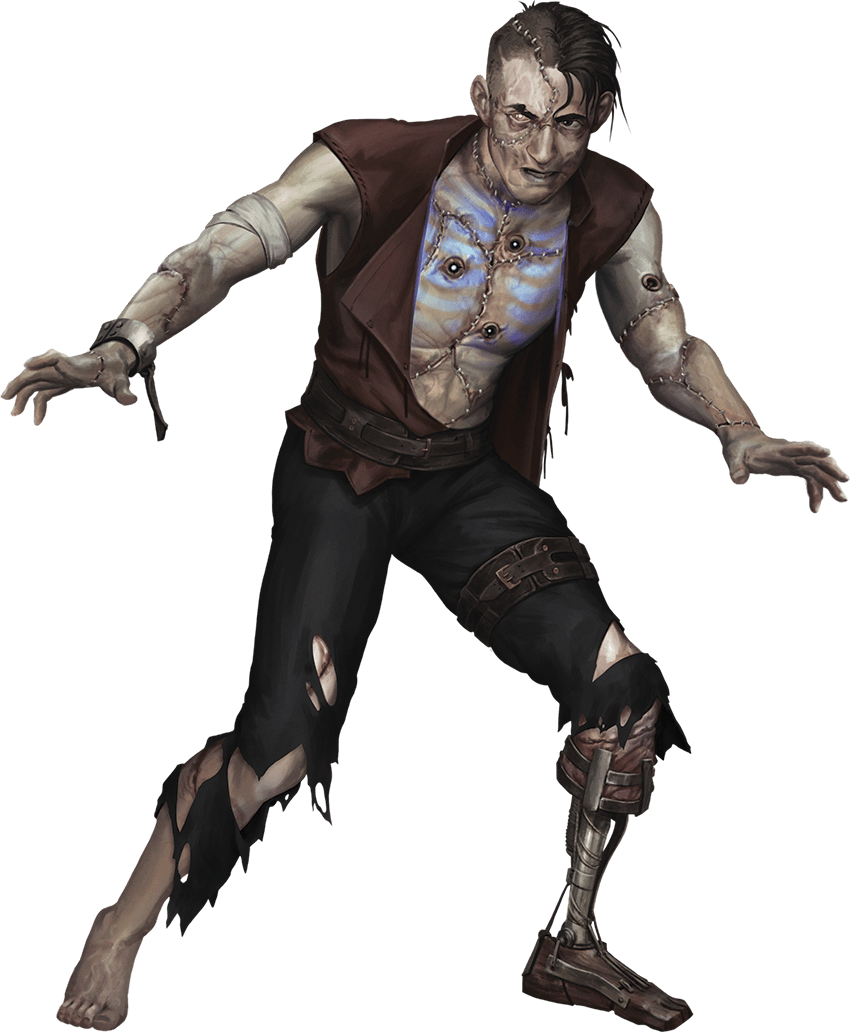
Arisen are made from mostly organic matter. They are not machines, though many possess mechanical parts in small or large measures. One arisen may have a single mechanized limb, while another’s organs are held in a cluster of jars. An arisen may have wires protruding from their body that connect to an arcane power supply grafted into their back, while another appears entirely mundane save for some scars and the arcane gems held within their eye sockets.
Some arisen are entirely constructed, built according to some specification or plan. Others start out innocuously through experimentation to replace living limbs or organs, with repeated experiments inexorably pushing a creature to lose all connection to themself. Still others might be the result of a living creature who died or was grievously injured before being “reassembled.” But no matter the process that spawned them, the creation of an arisen is often traumatic, typically held as fractured memories of arcane laboratories and the first flickering of consciousness, or as the vague nightmares that are all that remains of a former life.
Their rarity among the peoples of Etharis and the grim rumors that swirl around them most often leave arisen socially isolated. But not all arisen are driven to nihilism by the bleakness of their creation and their lives. For from that trauma, many develop a sense of introspection that drives an intense curiosity and a philosophical viewpoint on matters of life, mortality, and their own place in the world.
Arisen Base Traits
Each Arisen character is shaped by the unique nature of the magic or circumstances that created them.
Age. Some Arisen age slowly, the artificial nature of their bodies sloughing off the worst effects of age to leave them hale even into their second or third century. Others age more quickly, worn down by the unnatural magic that imbues them well before their sixtieth year.
Size. Arisen can be any size, from compact constructs 2 feet tall, to towering figures topping 7 feet. Your size is Small or Medium, as you determine.
Speed. 30 feet. If you are Small, you can reduce your Speed by 5 feet to gain an extra traditional trait.
If the whirring engine didn’t give it away, the rotting flesh would have.
—High Consecrator Tevesh Day
Traditional Arisen Traits
The artificial forms that all Arisen share often establish the baseline of their talents and instincts.
Combat Traits
Exploration Traits
Roleplaying Traits
Dhampir
A dhampir is marked by a forbidding birthright—a humanoid half-cursed with vampirism, living as a mortal but touched by a dreaded immortal power. A dhampir possesses many of the grim features of their undead sires, but their mortal nature lets them avoid vampiric vulnerabilities. Like their creators, dhampir crave the blood of the living, but are not controlled by such cravings if their will is strong enough to resist it.
Always spawned from creatures of other heritages, dhampir are incredibly rare and vary widely in form and temperament. The only thing all dhampir truly share is the legacy of their unnatural creation. True vampires are the embodiment of death, mimicking life by twisting cadavers into undead or spreading their curse to spawn more of their own kind. But vampires cannot naturally reproduce or create anything truly living. Dhampir are thus most often the result of some form of necromantic accident—a dying child revived by fell magic, an apothecary mixing herbs with vampire blood, or a failed attempt to find a cure for vampirism.
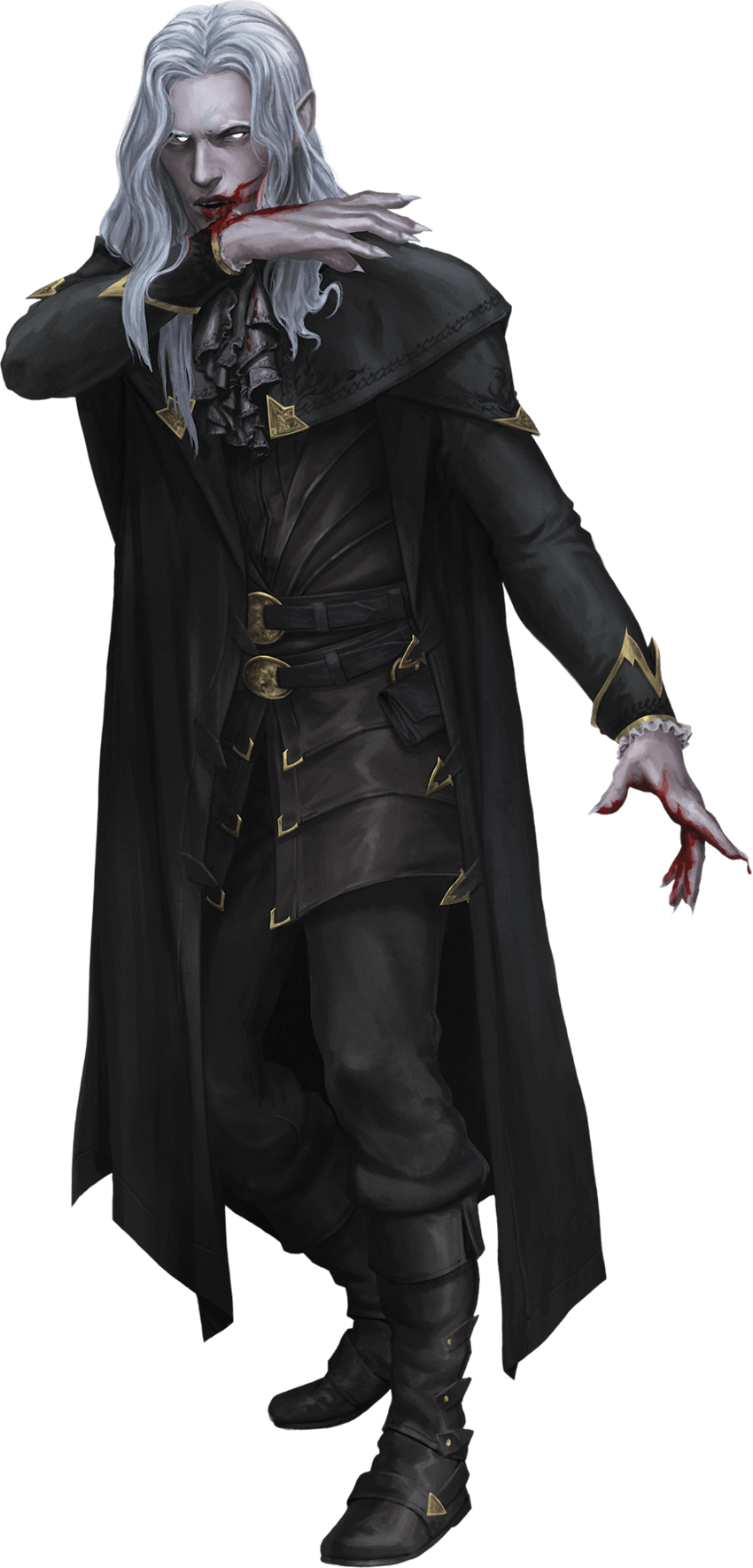
Whatever their origins, most dhampir experience an existence rooted in trauma, and often pervaded by loneliness. Commoners who fear dhampir view them as blood-hungry monsters, despite the fact that most sustain their life with normal food and drink. At the same time, vampires revile them as thin-blooded weaklings. A dhampir’s life is thus usually spent searching for somewhere to belong, whether fitting into mortal society or trying to appease their blood-drinking forebears.
A dhampir who chooses life among mortals is often wracked by guilt. Their craving for blood can come to feel all-consuming as they cling to their humanity and empathy. Dhampir are made to feel like monsters by those who are superstitious of them. Yet commoners who care for a dhampir as family can never truly understand their struggle against the monster within.
Other dhampir decide to indulge their bloodlust. They may even vie for position among the nobility of Ostoya. Despite lacking conventional parentage, a dhampir may form a familial bond with the vampire they regard as their sire. Vampires who exploit this relationship can gain a valuable ward who is able to walk in sunlight and blend more easily with mortal society. A dhampir in this position may become a spy, steward, or herald of their master. But they understand that they will never achieve positions of actual power in vampire society.
Dhampir Base Traits
The physical nature of a Dhampir is shaped by the creature they once were, and by the nature of their curse.
Age. The curse that creates a Dhampir makes them ageless, letting them ignore the passage of time—though they can succumb to death in many other ways.
Size. A Dhampir is the same size as the humanoid they were spawned from. You are Small or Medium, as you determine.
Speed. 30 feet. If you are Small, you can reduce your Speed by 5 feet to gain an extra traditional trait.
Traditional Dhampir Traits
The vampiric features they inherit inevitably mark the Dhampir as who they are.
Combat Traits
- Natural Attack (Fangs)
- Well Protected
Exploration Traits
- Climber
Roleplaying Traits
Disembodied
To allow one’s mind to touch the planes is the ultimate dream of many an arcane spellcaster, and nowhere has that dream come closer to reality than in the lost city of Ulmyr’s Gate. Founded in the Bürach Empire by a group of ambitious wizards who chafed under the limitations imposed upon them by government bureaucracy, Ulmyr’s Gate boasted free study for all mages who sought sanctuary within its walls. The Great College dedicated to magical study in the city quickly became a sanctum for mages of all disciplines from across Etharis, creating a golden age of magic within its walls.
That golden age came crashing down in a single night, when the founding mages of Ulmyr’s Gate attempted an ambitious ritual intended to part the veil and create a permanent portal to the Ethereal Plane. Instead, their magic tore a gaping rift in the fabric of reality, and in an instant the entire city was tipped into the void between worlds. Ulmyr’s Gate and all its citizens were presumed destroyed. The incident triggered another inquisition against hubristic arcanists who tampered in things mortals were not meant to know. Then, life in the empire went on.
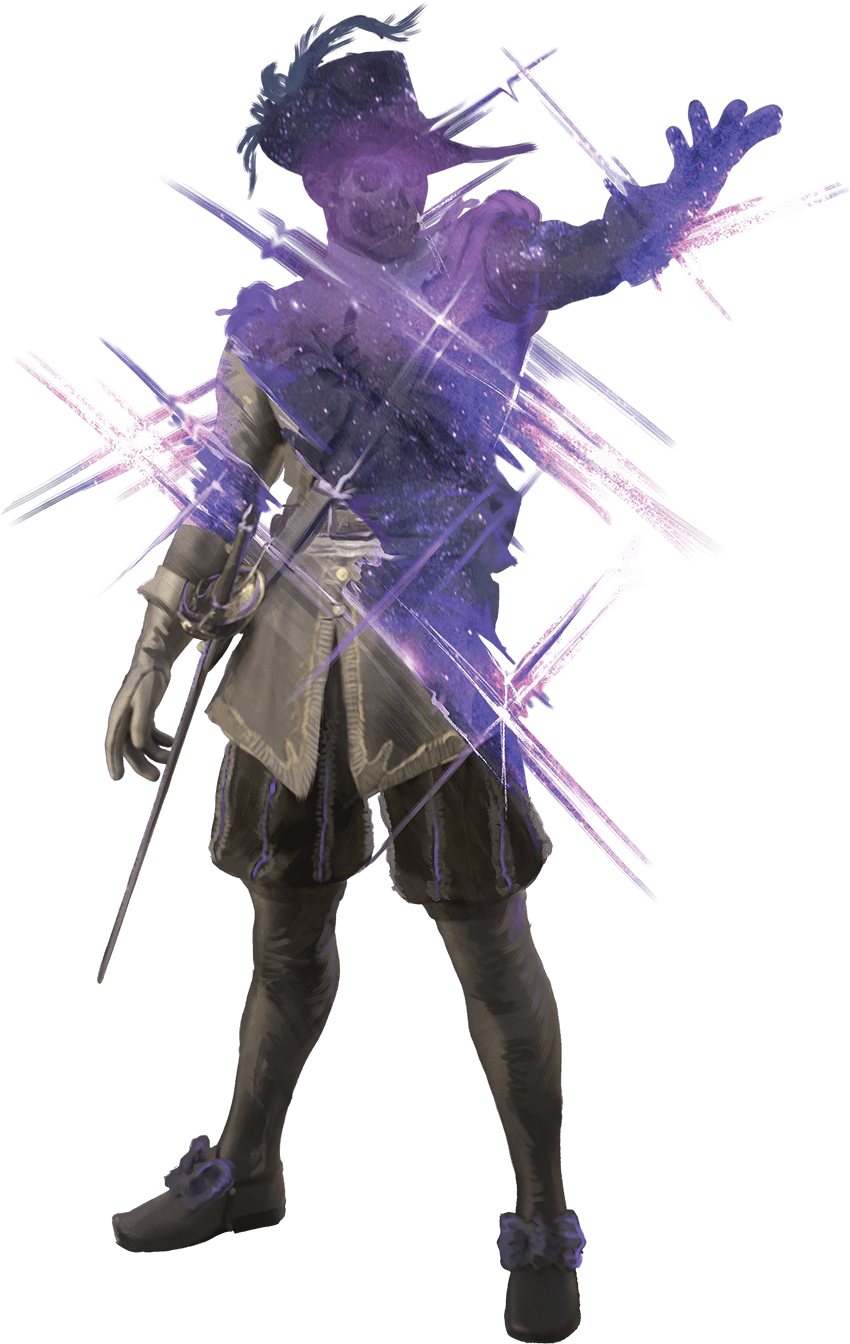
Years later, stories began to surface of frightening apparitions sighted in the region where Ulmyr’s Gate once stood. These haunting folk seemed oddly blurred or indistinct. Witnesses reporting that they would vanish as suddenly as they appeared. Gradually, it became clear that these poor souls were the survivors of the Ethereal Rift, now trapped between worlds and trying to retain their tenuous grasp on the Material Plane.
Those residents of lost Ulmyr’s Gate who have mustered the strength to return to the world have been named the disembodied by the sages who have studied them. These rare individuals have left or fled their former home, crossing through the Ethereal Rift to roam the mortal world. Though they resemble the people they once were, they are both more and less—creatures of two realms, often haunted by memories of the city’s destruction, of which they rarely if ever speak.
Disembodied Base Traits
Though their presence in the world is shaped by magic, the forms of the Disembodied appear much as they did before the disaster that spawned them.
Age. The Disembodied mature at a much slower rate than the Humanoids they once were, with their life expectancy doubled or even tripled.
Size. Disembodied appear as translucent versions of their former selves, their nearly insubstantial nature reducing their weight to a quarter of what it was. Your size is Small or Medium, as you determine.
Speed. 30 feet. If your size is Small, you can reduce your Speed by 5 feet to gain an extra traditional trait.
The day Ulmyr’s Gate fell, the area eerily was quiet…for a time.
—Bürach Historian
Traditional Disembodied Traits
Most Disembodied retain a touch of the ethereal magic that marks them as creatures of two worlds.
Combat Traits
Exploration Traits
Roleplaying Traits
Downcast
At the conclusion of the Gods’ End, a thousand souls fell to Etharis like burning stars from the sky. The downcast had once been part of the celestial legions, but the death of the gods sent shockwaves through the heavens. Cast down to the mortal realm, these former angels found themselves bereft of power and left to live out their now-mortal existence among the people of the world.
In the absence of the gods, the Arch Seraphs of each deity descended upon the mortal realm, taking upon themselves the burden of imposing order on a world cast into disarray. The Arch Seraphs were the most powerful lieutenants among the angelic hosts, strong enough to retain a semblance of their divine power following the tragedy. But an angel is not a god. An Arch Seraph cannot embody every aspect of a divine domain. Some became consumed with enforcing narrow virtues. Others have turned from grace entirely, choosing to embody vice rather than virtue, and becoming feared as Arch Daemons.
The downcast, are far fewer in number than when they first arrived. Many succumbed to despair and sickness after their fall from grace. Of those who remain, some still serve the Arch Seraphs in their twisted crusades, hoping to reclaim what they have lost. Others have turned their backs on their former comrades to seek their own goals, fully embracing mortal life. And more than a few feel embittered enough by their fall that they have been gleefully accepted by the Arch Daemons as agents to spread fear and destruction in the world.
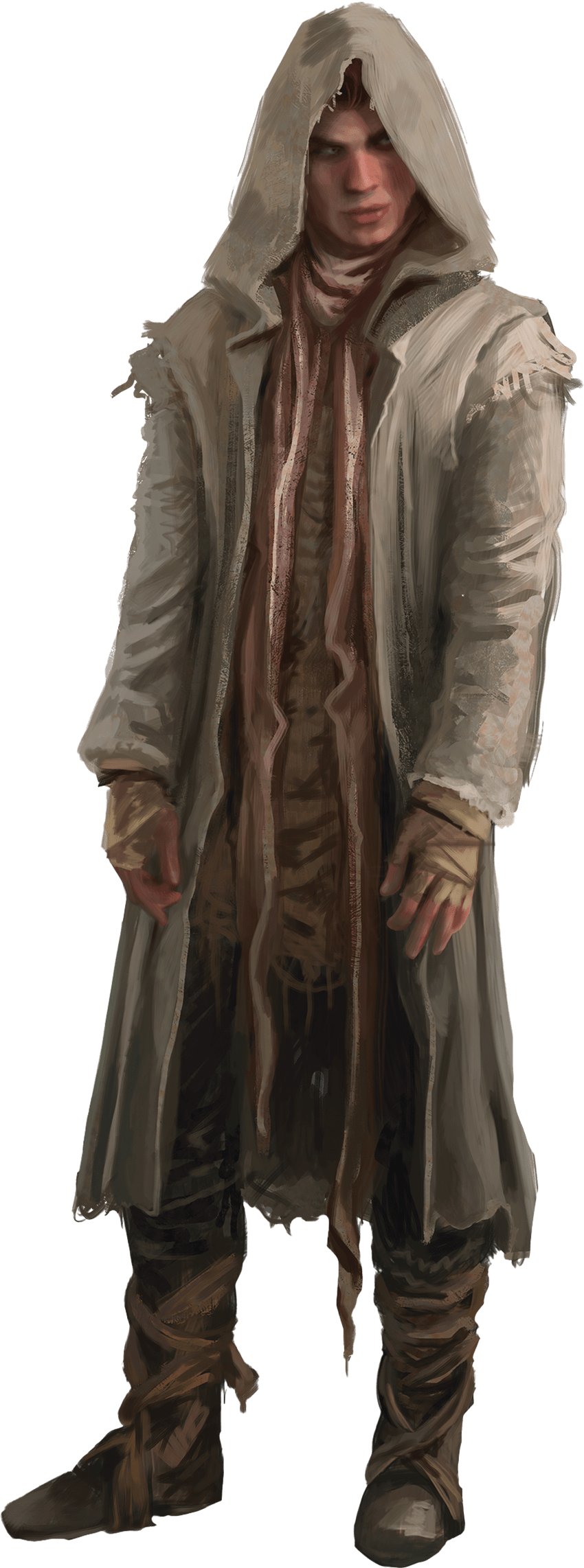
Physically, the downcast still possess the beauty of their angelic forms, although they no longer shine as brightly as before. For most, the mark of the divine still lingers as a visible glow within their eyes, or faintly glowing Celestial runes on their otherwise unblemished skin. Others have been marked by their shift in morality, manifesting cracked skin or devilish horns.
Downcast Base Traits
Though mortal, Downcast are still touched by the celestial nature that has been taken from them.
Age. Stripped of their immortality, the Downcast nevertheless possess long lifespans to rival even the elves. A Downcast reaches maturity in their late teens, but can live up to 800 years.
Size. Downcast generally range from 5 to 6 feet tall and have a wide range of body types. Your size is Medium.
Speed. 30 feet.
Brother Adovald is no longer welcome in the sanctuary. When last we spoke, he had some…unkind words for the Arch Seraphs.
—Preacher’s Notice
Traditional Downcast Traits
Many Downcast channel magic driven by the vestiges of celestial power that still flow through them.
Combat Traits
Exploration Traits
- Tireless
Roleplaying Traits
- Magical Savant (Cleric spells only)
- Magical Savvy (Thaumaturgy)
- Moved by Faith
Wechselkind
A mother hears a sound in the night and worriedly checks on her sleeping toddler. Nothing appears amiss. But weeks later, an unseen glamour fades and a horror is revealed: the child has been stolen by the faerie, and a wechselkind is left in their place. For the faerie are callous and unchanging beings, and nothing inspires their fascination—and their envy—more than the malleable, bright spark of a young humanoid child.
A wechselkind is a construct crafted of wood, clay, and ceramic in the form of a small child, animated by faerie magic and concealed in illusion that makes them appear identical to a stolen mortal babe. Once that glamour fades and the lie is revealed, a wechselkind is most often cast out by the stolen child’s family, if not destroyed. Occasionally, though, a family takes pity on the poor creature and attempts to raise them, only to find that while their mind develops normally, a wechselkind is forever bound in the unchanging form of a childlike doll.
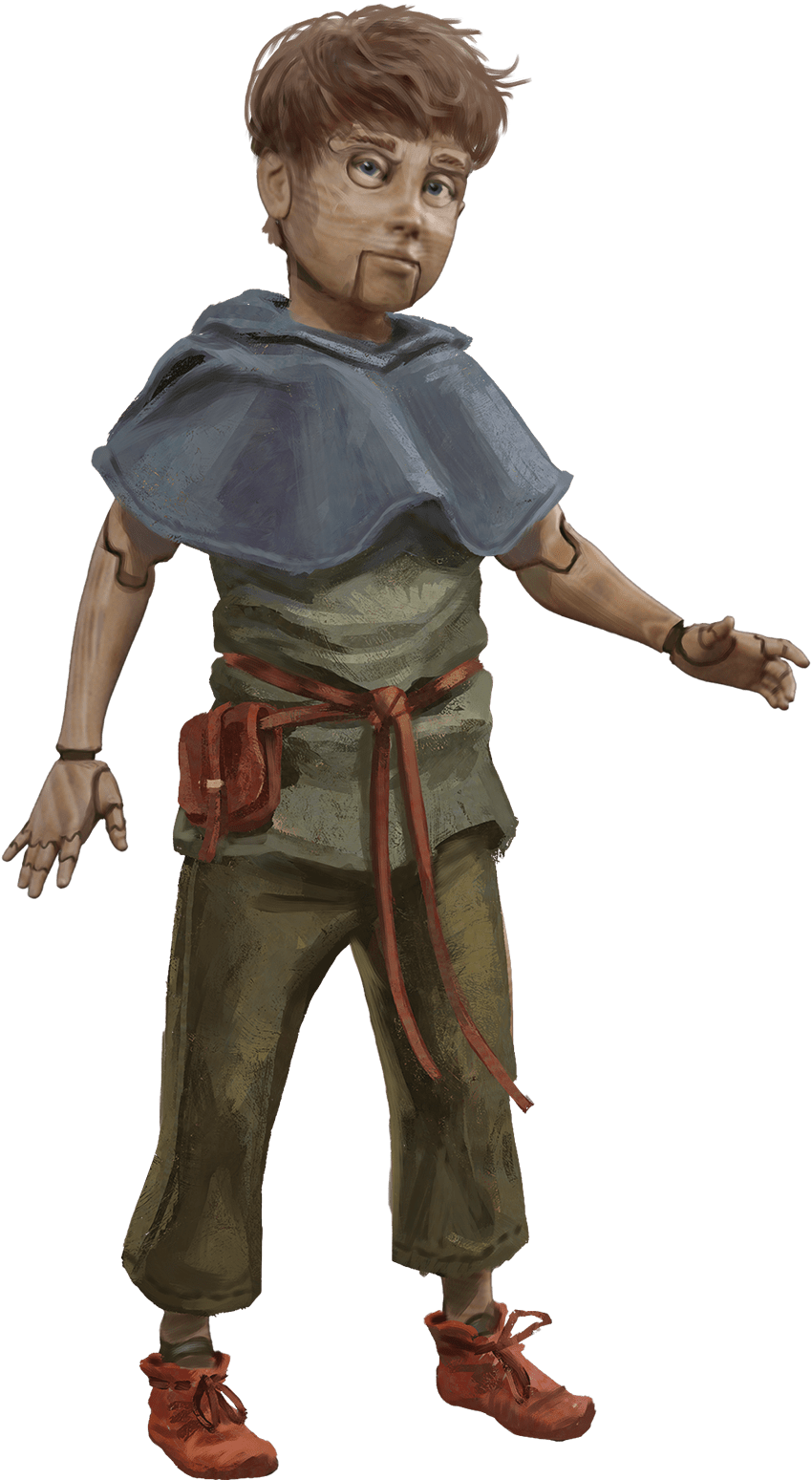
Whether nurtured or shunned, most wechselkind eventually find themselves living as outcasts, and learning to fend for themselves as best they can. The residual magic of their faerie glamour allows a wechselkind to conceal themself for short periods, whether in the guise of the child they replaced or an adult halfling, gnome, or other person of similar stature. With few physical needs, a wechselkind can easily wander from settlement to settlement, watching the people they encounter with envious eyes, and hoping for a place to finally fit in.
With the spread of the Weeping Pox, many wechselkind have emerged from hiding. With their immunity to disease, they’re able to aid healers in plague-stricken regions, gaining a measure of respect—or even admiration—from those able to see beyond their tragic origins. However, even wechselkind who are accepted among other folk often remain wary, fearing that once their usefulness is at an end, they might be cast out once more.
Wechselkind Base Traits
Enchanted with powerful faerie magic, Wechselkind are unique among other Humanoids.
Age. Wechselkind do not age as normal creatures do, forever trapped in the doll-like visage of their creation. Their maximum age is a function of natural wear and damage, and they are immune to magical aging effects.
Size. Built to resemble a child, Wechselkind are between 2 and 3 feet tall and weigh between 35 and 55 pounds. Your size is Small.
Speed. 30 feet. You can reduce your Speed by 5 feet to gain an extra traditional trait.
They’re astoundingly quick studies and eager assistants. Thankfully, our patients don’t seem to mind the splinters.
—Delia Phaxus, Master Physician
Traditional Wechselkind Traits
The magical and artificial nature shapes the aptitudes and innate features of all Wechselkind.
Combat Traits
Exploration Traits
Roleplaying Traits
Wulven
Across wilderness and settled lands, in forest hamlets and farmsteads, the fear of lycanthropy runs deep. But few folk ever come to realize that the hulking stranger they passed on the trade road at dusk, the forest hermit who appeared from nowhere to warn of unseen danger ahead, or the druidic acolyte protecting a sacred spring do not share their fears. For these folk have already been touched by the lycanthropic curse, and have accepted the bestial gifts it bestows.
Wulven are the natural-born children or descendants of an individual cursed with lycanthropy, not inheriting the curse in full but touched by its feral nature. Those afflicted in this way are commonly associated with werewolves in the minds of commoners, inspiring the name given to them. But wulven are equally likely to be descended from werebears, wererats, wereravens, or even rarer lycanthropes.
The weaker trace of lycanthropy handed down to a wulven means they do not take animal or hybrid form. They are as calm and personable as any folk, suffering no loss of control or mindless bloodlust under the full moon. However, the feral nature of the beast they carry within them drives most wulven to lives of solitude and the quiet of the wilderness.
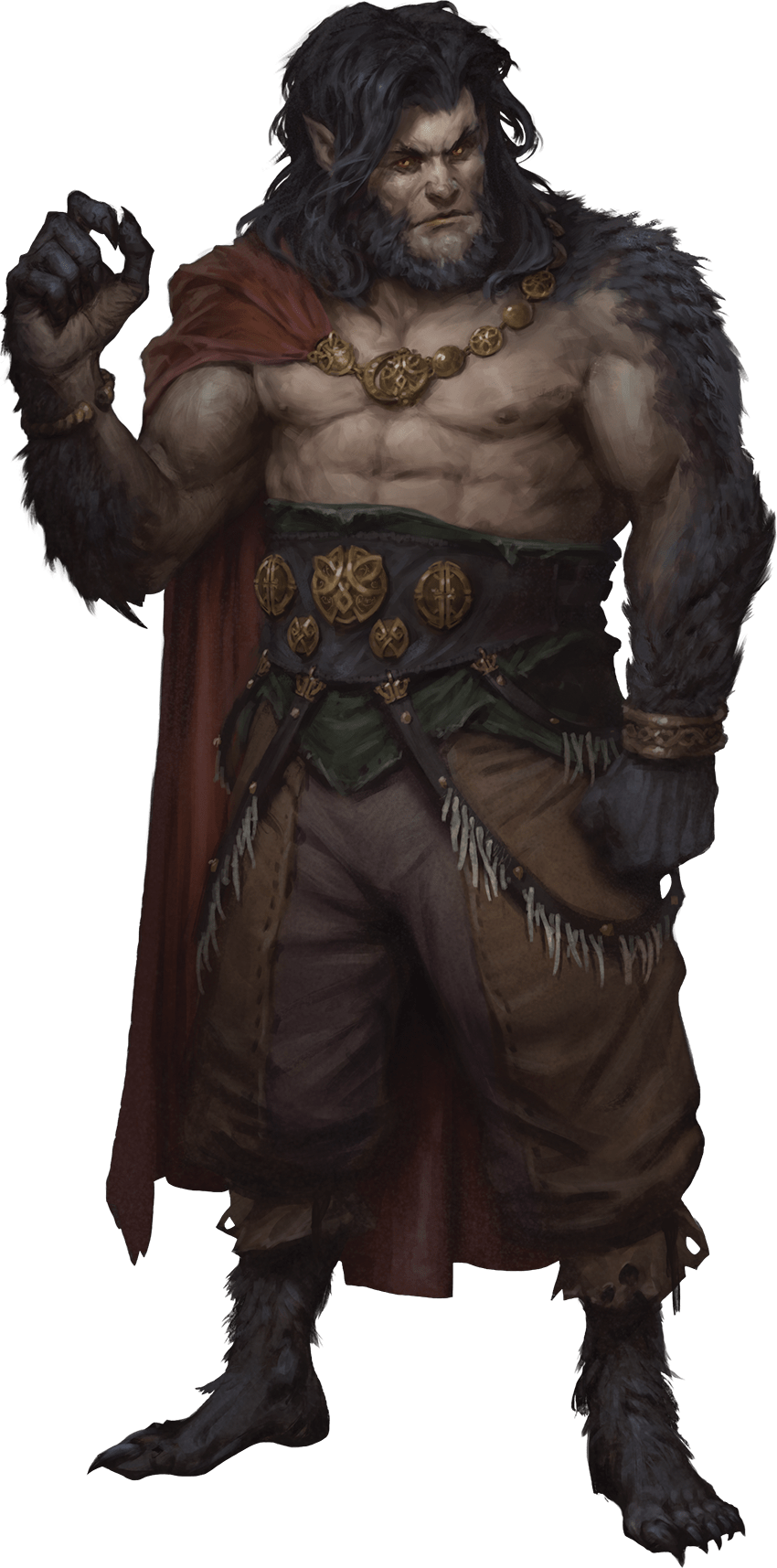
Wulven embody the mysticism of the primal world, rather than its savagery. Where they wander through forest and scrubland, their wild look and solitary nature sees them often mistaken for fey spirits, druids, or actual lycanthropes. Many make lives for themselves as members of druidic enclaves or as protectors of small, isolated communities. Some become emissaries or champions of the fey courts, though the touch of cursed magic in the wulven makes some fey distrust them. But in the end, most wulven live as outlanders, cautious around folk they don’t know for fear of their solitary nature and subtly bestial features being misunderstood.
Wulven Base Traits
Wulven can arise among any other culture or folk, and draw on the physical features of those folk.
Age. Wulven mature at the same rate as others of their original heritage, but the magic that spawns them lessens the debilitating effects of aging, and they remain fit even in their later years.
Size. Wulven are the same general height as others of their original heritage, but are often stockier, more muscular, or lither, depending on the nature of the curse that touches them. Your size is Small or Medium, as you determine.
Speed. 30 feet. If you are Small, you can reduce your Speed by 5 feet to gain an extra traditional trait.
My, what big teeth you have… —Drunken Logger
Traditional Wulven Traits
Many Wulven channel the natural instincts—and often the natural fierceness—of the creature their curse links them to.
Combat Traits
Exploration Traits
- Climber
Roleplaying Traits
Heritage Traits
This section presents the heritage traits featured in each of the heritages defined in the previous section. Each of these traits helps shape and define what your character’s heritage means for them. Some characters proudly use most or all of the traditional traits presented for their heritage, marking themselves as a solid example of the capabilities and worldview for which that heritage is widely known. Other characters are defined by the unexpected differences between them and other folk of their heritage.
Traits and Story
When you choose your traits, whether traditional or freely chosen, consider not just what those traits provide your character in terms of game mechanics, but also how your character came to possess those traits. Is a trait something you were born with? Is it a feature that runs in your family, whether a natural inheritance or a long-held familial curse? Is a trait something you came upon later in your life? Did it just happen to you, or was it gained through years of focus and training? Was the trait enabled by magic, or is it naturally occurring?
Whatever the genesis of each of your heritage traits, you should also imagine how those traits have affected—and continue to affect—your life. Does a particular trait set you apart from your kin, or even make you an outcast in your traditional society? Or has it made you more accepted? How has your trait affected the life you’ve lived, and do folk around you have any reason to react to it, positively or negatively?
The answers to all these questions can help you establish a rich backstory and personality for your character.
Taking Heritage Traits
Taking a heritage trait once establishes a baseline benefit for your character. For example, you can take the Darkvision trait if you want to see in shadow or darkness, the Eager Deceiver trait if you want to have innate proficiency in the Deception skill, and so forth.
You can also take each trait a second time to grant an additional benefit, and many traits can be taken three or more times if they are built around specific choices or options that change each time you take the trait. Taking a trait more than once grants an additional benefit over and above the trait’s baseline benefit, improving the baseline benefit in some way. For example, taking the Darkvision trait a second time gives you the Improved Darkvision trait, allowing you to see even farther in the dark.
All rules and limitations that come with a trait the first time you take it apply to the benefit granted by taking the trait again unless the trait specifies otherwise. For example, the Impromptu Artisan trait allows you to craft simple gear as long as you have an appropriate proficiency, raw materials, and necessary equipment. If you take that trait twice, you can craft more complex gear, but the requirements for materials and equipment don’t go away.
Natural or Magical?
With the exception of traits that grant you the ability to cast cantrips or spells, most heritage traits don’t specify whether any given trait is natural or magical. This gives you the freedom to decide how the trait has shaped your character.
A Dwarf with the Damage Resistance trait might be possessed of a natural fortitude that lets them shrug off poison damage, while a Dragonborn with that trait carries the legacy of a draconic ancestor to protect them from Fire damage. A Dhampir character whose curse makes their body unnaturally strong has a perfect physical explanation for their Well Protected trait. But a Halfling with a seemingly normal physique might select the same trait to represent some kind of preternatural resilience.
Even traits that specifically focus on defending against magical effects, such as Awakened Mind or Magical Fortification, might be mundane in origin, representing a natural resilience or aptitude powerful enough to interact with magic.
Even if you decide that some or all of your character’s traits are magical, those traits remain an intrinsic and natural part of you, fueled by your physical, mental, and spiritual strength. As such, traits to which you give a magical origin can’t be dispelled with Dispel Magic and similar effects, and are unaffected by magical dead zones or wild magic zones, the Antimagic Field spell, and so on.
Trait List
Heritage traits are grouped into three categories: Combat, Exploration, and Roleplaying. Traits of each group are listed below in alphabetical order, along with the name of the improved version of the trait if it is taken more than once. This list includes the traditional traits identified for each of the heritages described in the previous section.
Combat Traits
Awakened Mind → Reawakened
Awesome Critical → Maximum Critical
Battlefield Control → Battlefield Dominance
Brave → Infectious Bravery
Breath Weapon → Potent Breath
Centered → Centered Edge
Charging Attack → Furious Charge
Creature Cover → Subtle Cover
Damage Resistance → Damage Immunity
Divine Sangromancy → Sangromancy Savant
Draining Attack → To the Dregs
Enemy in Motion → Moving Insight
First Strike → Strong Strike
Focused Mind → Immutable Mind
Focused Reserves → Focused Edge
Hunter’s Instinct → Relentless Instinct
Larger Target → Even Larger
Light Armor Training → Light Armor Expertise
Lucky → Master of Fortune
Magical Fortification → Extended Fortification
Master of Distraction → Hindering Distraction
Medium Armor Training → Heavy Armor Training
Menacing Roar → Incomparable Roar
Mighty Shove → Overwhelming Shove
Natural Attack → Swift Strike
Out of Phase → Phase Shift
Pack Hunter → Pack Leader
Pack Tactics → Pack Instinct
Personal Bastion → Mobile Bastion
Psychic Spirit → Spirit’s Strength
Quick Initiative → Focused Initiative
Quick Slip → Astute Slip
Reach Attack → Opportune Reach
Relentless Endurance → Unparalleled Endurance
Ruthless Response → Focused Ruthlessness
Skirmish Tactics → Supreme Skirmisher
Slippery → Supreme Slip
Stalwart Reserves → Stalwart Edge
Tenacious → Hard to Kill
Timely Boon → Born Lucky
Touch of Life → Strength of Life
Toughness → Extra Tough
Unchecked → Slip Free
Weapon Aptitude → Weapon Specialist
Well Protected → Protective Cover
Exploration Traits
Amphibious → Water Born
Artifice Expertise → Expert Gadgeteer†
Artificial Form → Self-Repair
Burst of Speed → Furious Speed
Climber → Wall Walker
Darkvision → Improved Darkvision
Driver → Remarkable Driver
Environmental Awareness → Adaptive Awareness
Ethereal Fade → Ethereal Focus
Even in Sleep → Sleeping Ward
Fade Away → Long Fade
Fleet of Foot → Shared Fleetness
Helping Hand → Helpful Tactics†
Hold Breath → Endless Breath
Intrinsic Orientation → Expert Orientation
Inured to the Elements → Immune to the Elements
Irrepressible Sight → Resolute Sight
Meditative Rest → Restorative Rest
Natural Camouflage → Shared Camouflage
Natural Movement → Shared Movement
Pass Through → Nimble Passage
Poison Resilience → Poison Indemnity
Power Nap → Extreme Resilience
Powerful Build → Powerful Shove†
Resilient Ears → Determined Hearing
Shroud of the Wild → Faultless Shroud
Standing Leap → Incredible Leap
Steady → Stand Fast
Supple Squeeze → Full-Speed Squeeze
Swimmer → Quickened Swim
Tireless → Vigorous
Roleplaying Traits
Animal Friend → Animal Ally
Artisanal Focus → Artisanal Expertise
Athlete’s Spirit → Athlete’s Resolve
Born Healer → Combat Doctor
Calculating Listener → Master Manipulator
Commanding Insight → Exceptional Insight
Connection to Nature → Bond with Nature
Crafter’s Eye → Crafter’s Cunning
Dreamwalking → Secret Dreams
Eager Deceiver → Expert Deceiver
Embrace the Past → Deep Lore
Firm Influence → Terrifying Influence
Gifted Performer → A Sight to Behold
Impromptu Artisan → Master Artisan
Improviser → Expert Improviser
Inborn Perception → Piercing Perception
Instinctive Stealth → Calculated Disappearance
Instrumentalist → Virtuoso
Intuitive Acrobat → Stunt Expert
Keen Survivor → Determined Survivor
Magical Insight → Magical Historian
Magical Savvy → Magical Savant
Masterful Aptitude → Focused Mastery
Mindful Investigator → Thorough Sleuth
Moved by Faith → Force of Faith
Nature’s Voice → Primal Voice
Nimble Moves → Exquisite Legerdemain
Persuasive Knack → Tongue of Gold
Polyglot → Language Expert
Skill Prowess → Skill Mastery
Unnatural Healer → Regenerative Healer
† When this trait is taken twice, the second trait is a Combat trait.
Trait Descriptions
The following traits define your character, establishing who they were at birth and who they’ve become since then. Though your character’s capabilities are largely defined by your choice of class, these traits provide the tools to tailor your character’s other physical, mental, and magical potential.
Amphibious (Exploration)
Surviving underwater is second nature to you. You can breathe air and water.
Water Born. If you take this trait twice, you have Advantage on ability checks or saving throws made while submerged in water. You can use this feature a number of times equal to your Proficiency Bonus, regaining all expended uses when you finish a Long Rest.
Animal Friend (Roleplaying)
Time spent among beasts has gifted you a way with those creatures. You have proficiency in the Animal Handling skill.
Animal Ally. If you take this trait twice, you have Advantage on Animal Handling checks. You can use this feature a number of times equal to twice your Proficiency Bonus, regaining all expended uses when you finish a Long Rest.
Something must be done about that elf. Last time I confronted her, she sicced my own dog on me.
—Disgruntled Neighbor
Artifice Expertise (Exploration/Combat)
Working with detritus and shattered objects has granted you an affinity for repairing and remaking things. You have proficiency with Tinker’s Tools. (This is an Exploration trait.)
Additionally, you can use your Tinker’s Tools and 10 GP worth of appropriate materials to spend 10 minutes creating a small clockwork device. The device must fit in the palm of your hand, and can serve one of the following functions:
Smoker. The device exudes smoke in a 5-foot Cube for 1 minute. Any objects or creatures within this Cube are considered Lightly Obscured.
Lighter. The device emits a small flame the size of a candle’s that can light flammable objects.
Compass. The device always points north, or in a cardinal direction of the GM’s determination on another plane.
Expert Gadgeteer. If you take this trait twice, you can make a device in 1 minute instead of 10 minutes. In addition, you can choose to imbue a device with the following extra function: (This is a Combat trait.)
Distractor. This device is set with blinking lights that can captivate other creatures. As a Bonus Action, you place or toss the device into a space within 30 feet of you. A creature sharing a space with the device must succeed on a DC 10 Intelligence saving throw. On a failure, attacks against that creature have Advantage until the start of your next turn. A creature can use an action to destroy the device. You can give up to three of your devices the Distractor feature. You regain the ability to do so when you finish a Long Rest.
Artificial Form (Exploration)
You were made, not born, and your unnatural origin forever marks you as different. You are a Construct, but your enchanted form still benefits from healing spells. You can also heal yourself by spending Hit Dice during Short Rests and Long Rests, as normal.
You don’t need to eat, drink, sleep, or breathe. You must still be inactive for 8 hours during a Long Rest to gain its benefits.
Self-Repair. If you take this trait twice, when the Mending cantrip is cast on you, you can spend a Hit Die to regain a number of Hit Points equal to the roll of the die plus your Constitution modifier (minimum 1 Hit Point). You can use this feature a number of times equal to your Proficiency Bonus, regaining all expended uses when you finish a Long Rest.
Artisanal Focus (Roleplaying)
You revere the crafting skill of ancestors long dead. Choose an Artisan’s Tool. You have proficiency with that tool.
Artisanal Expertise. If you take this trait multiple times, you gain proficiency with a new tool each time.
Additionally, you have Advantage on ability checks made using any tool you selected with Artisanal Focus. You can use this feature a number of times equal to twice your Proficiency Bonus, regaining all expended uses when you finish a Long Rest.
Athlete’s Spirit (Roleplaying)
Your reserves of physical power have kept you alive on more than one occasion. You have proficiency in the Athletics skill.
Athlete’s Resolve. If you take this trait twice, you have Advantage on Athletics checks. You can use this feature a number of times equal to twice your Proficiency Bonus, regaining all expended uses when you finish a Long Rest.
Awakened Mind (Combat)
The dangers of Etharis have given you a focus that allows you to shrug off debilitating magical effects. You automatically succeed on saving throws against magical effects that would give you the Incapacitated, Stunned, or Unconscious conditions. This does not include effects that leave you Unconscious because you are reduced to 0 Hit Points.
Reawakened. If you take this trait twice, you also have Advantage on Intelligence, Wisdom, and Charisma saving throws.
Awesome Critical (Combat)
When fortune favors your blade, you know how to make it count. When you score a Critical Hit with a melee attack with a weapon or an Unarmed Strike, you can roll one of the weapon’s damage dice one additional time and add it to the extra damage of the Critical Hit.
Maximum Critical. If you take this trait twice, when you use Awesome Critical, you can add the maximum of the weapon’s original damage dice and the extra Awesome Critical die to the extra damage of the Critical Hit, rather than rolling them. You can use this feature a number of times equal to your Proficiency Bonus, regaining all expended uses when you finish a Long Rest.
Battlefield Control (Combat)
When foes attempt to press you in melee, they do so at their peril. Other creatures provoke Opportunity Attacks from you whenever they move into your reach, in addition to when they move out of your reach.
Battlefield Dominance. If you take this trait twice, you have Advantage on Opportunity Attacks. You can use this feature a number of times equal to your Proficiency Bonus, regaining all expended uses when you finish a Long Rest.
Born Healer (Roleplaying)
When others suffer, you are there to help. You have proficiency in the Medicine skill.
Combat Doctor. If you take this trait twice, you have Advantage on Medicine checks. You can use this feature a number of times equal to twice your Proficiency Bonus, regaining all expended uses when you finish a Long Rest.
Brave (Combat)
The horrors you’ve lived through have hardened you. You have Advantage on saving throws to avoid being Frightened.
Infectious Bravery. If you take this trait twice, you can use your Reaction to bolster the spirits of your allies, granting one ally who can see or hear you Advantage on a saving throw against being Frightened. You can use this feature a number of times equal to your Proficiency Bonus, regaining all expended uses when you finish a Long Rest.
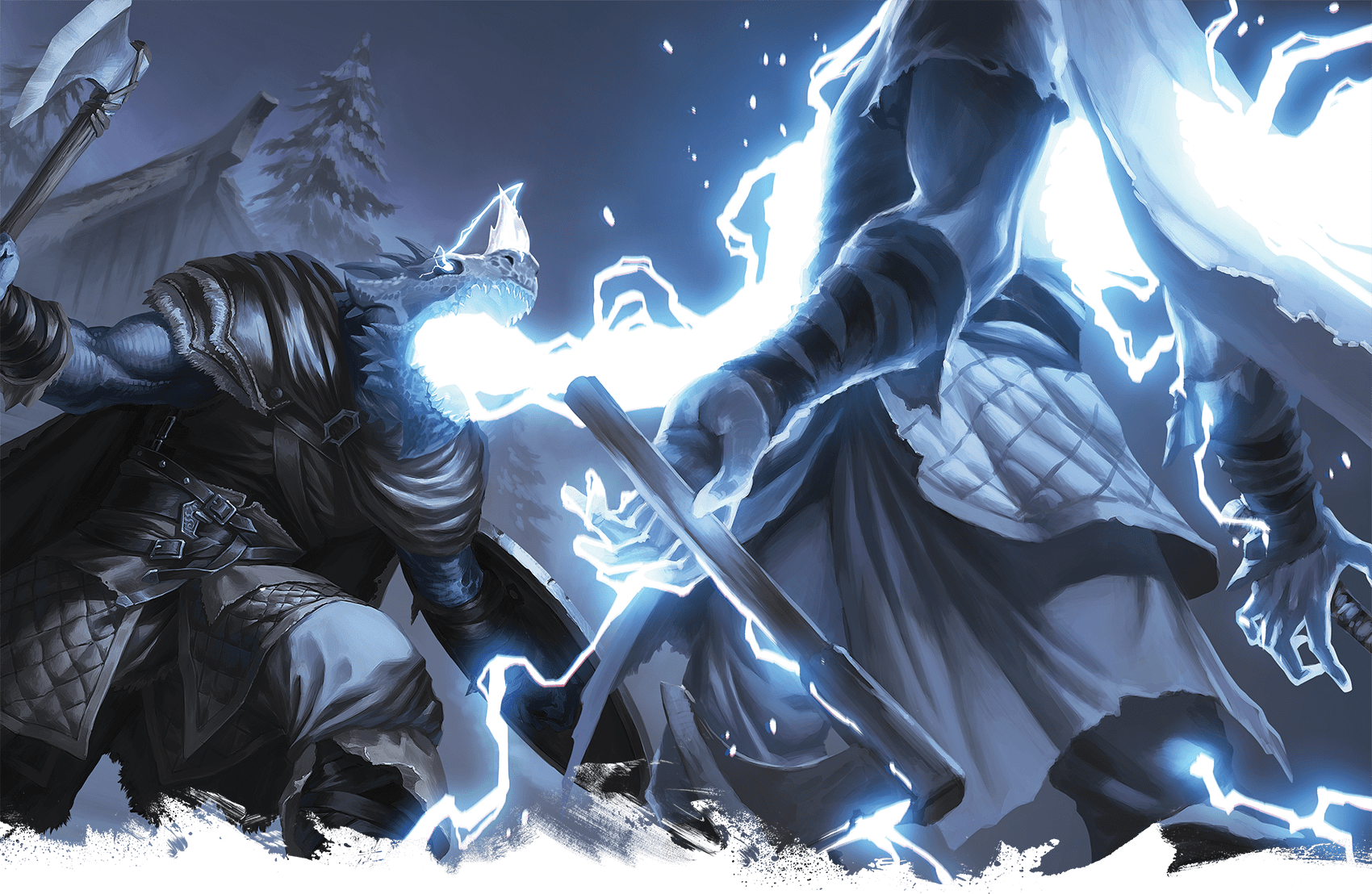
Breath Weapon (Combat)
A connection to draconic or elemental fury lets you unleash a blast of destructive energy. When you select this trait, choose a damage type: Acid, Cold, Fire, Lightning, Poison, or Thunder. Then choose an area of effect: a Line that is 5 feet wide and 30 feet long, or a 15-foot Cone.
When you use a Magic action to expel your Breath Weapon, each creature in the area of effect must make a Dexterity saving throw (DC = 8 + your Constitution modifier + your Proficiency Bonus). A target creature takes 1d8 damage of the chosen type on a failed save, or half as much damage on a successful one. This damage increases by 1d8 when you reach character levels 5 (2d8), 11 (3d8), and 17 (4d8).
You can use this feature a number of times equal to your Proficiency Bonus, regaining all expended uses when you finish a Long Rest.
Potent Breath. If you take this trait multiple times, you gain an additional breath weapon each time, with its own number of uses, damage type, and area of effect.
Additionally, when you use any of your Breath Weapons, one target of your choice has Disadvantage on the saving throw. You regain the use of this feature when you finish a Long Rest.
Burst of Speed (Exploration)
The many things that want to kill you must catch you first. On your turn, you can increase your Speed by 30 feet until the end of your turn. You can use this feature a number of times equal to your Proficiency Bonus, regaining all expended uses when you finish a Long Rest.
Furious Speed. If you take this trait twice, on a turn when you use Burst of Speed, you don’t provoke Opportunity Attacks.
On the battlefield, quick feet are the best suit of armor you could ask for. If an enemy can’t reach you, it can’t hurt you. Now pick up those knees!
—Militia Drillmaster
Calculating Listener (Roleplaying)
The weak-willed around you are easy targets for your manipulation. By conversing with a nonhostile creature for at least 1 minute, you can attempt to charm them. The creature must succeed on a Wisdom saving throw (DC = 8 + your Charisma modifier + your Proficiency Bonus) or have the Charmed condition for 1 hour. At the GM’s discretion, you also learn one piece of information that the target knows that relates to the topic of conversation while you speak to them. Regardless of whether or not the target succeeds on the saving throw, they remain unaware of your attempt. You regain use of this feature when you finish a Short or Long Rest.
Master Manipulator. If you take this trait twice, a creature has Disadvantage on the saving throw, and it has the Charmed condition for 8 hours on a failed save.
Centered (Combat)
By focusing your inner strength, you gain a needed edge. As a Bonus Action, you grant yourself Advantage on an attack roll or ability check you make before the start of your next turn. You can use this feature a number of times equal to your Proficiency Bonus, regaining all expended uses when you finish a Long Rest.
Centered Edge. If you take this trait twice, when you succeed on the attack roll or ability check made while using Centered, you can choose one creature within 30 feet of you. That creature has Advantage on the next attack roll or ability check they make before the start of your next turn.
Charging Attack (Combat)
The fury with which you throw yourself into battle forces your foes to feel your wrath. If you move at least 20 feet straight toward a target and then hit it with a melee attack with a weapon or an Unarmed Strike on the same turn, you can make another attack against the same target as a Bonus Action with the same weapon.
Furious Charge. If you take this trait twice, when you use Charging Attack, you have Advantage on all attacks after the triggering movement until the end of your turn. You can use this feature a number of times equal to your Proficiency Bonus, regaining all expended uses when you finish a Long Rest.
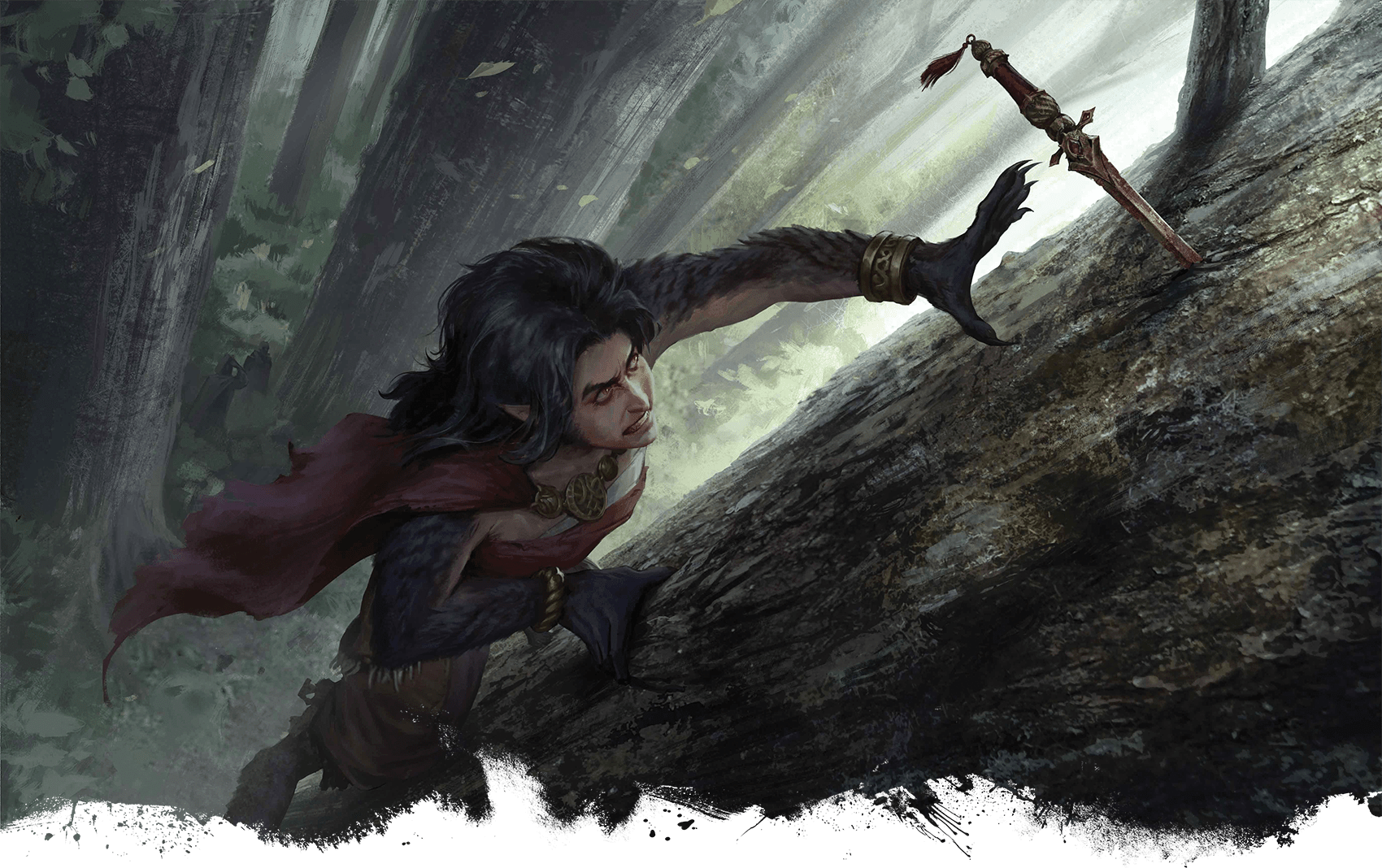
Climber (Exploration)
Sometimes staying away from what threatens you means getting clear of those threats. You have a Climb Speed equal to your Speed.
Wall Walker. If you take this trait twice, you can use your Climb Speed to move up, down, and across vertical surfaces and upside down along ceilings, while leaving your hands free.
Additionally, while using climbing movement, you can use the Dash action as a Bonus Action. You can use this feature a number of times equal to your Proficiency Bonus, regaining all expended uses when you finish a Long Rest.
Commanding Insight (Roleplaying)
Those who attempt to deceive you do so in vain. You have proficiency in the Insight skill.
Exceptional Insight. If you take this trait twice, you have Advantage on Insight checks. You can use this feature a number of times equal to twice your Proficiency Bonus, regaining all expended uses when you finish a Long Rest.
Connection to Nature (Roleplaying)
You’ve learned that paying attention to the environment around you is the best way to predict its threats. You have proficiency in the Nature skill.
Bond with Nature. If you take this trait twice, you have Advantage on Nature checks. You can use this feature a number of times equal to twice your Proficiency Bonus, regaining all expended uses when you finish a Long Rest.
Crafter’s Eye (Roleplaying)
The history of Etharis is written in relics, and you read that history better than most. When you make a History check related to any object (an item, device, building, or material) and you have proficiency in an Artisan’s Tool associated with creating that object, you are considered proficient in History and you add double your Proficiency Bonus to the check instead of your normal bonus.
Crafter’s Cunning. If you take this trait twice, you have Advantage on the History checks you make with Crafter’s Eye. You can use this feature a number of times equal to your Proficiency Bonus, regaining all expended uses when you finish a Long Rest.
Creature Cover (Combat)
By slipping behind enemies or allies alike, you are able to fade from view with ease. You can take the Hide action even when you have Half Cover from a creature, as long as that creature is of a size larger than you.
Subtle Cover. If you take this trait twice, you can take the Hide action when you have Half Cover from a creature the same size as you.
Damage Resistance (Combat)
Exposure to the worst effects of a specific energy has given you a tolerance to its effects. You have Resistance to one of the following damage types of your choice: Acid, Cold, Fire, Lightning, Poison, or Thunder.
Damage Immunity. If you take this trait twice, as a Reaction to taking damage of the type you chose for Damage Resistance, you gain Immunity to that damage type until the end of your next turn. You regain the use this feature when you finish a Short Rest.
Darkvision (Exploration)
A life spent in shadow has made you grow accustomed to the gloom. You can see in Dim Light within 60 feet of you as if it were Bright Light, and in Darkness within 60 feet of you as if it were Dim Light. You can’t discern color in Darkness, only shades of gray.
Improved Darkvision. If you take this trait twice, the range of your Darkvision increases to 120 feet.
Divine Sangromancy (Combat)
A connection to the life force of others lets you shape that force to their benefit. Whenever an allied creature within 30 feet of you regains Hit Points, you can spend a Hit Die and add the roll of the die to the number of Hit Points gained by the ally.
Sangromancy Savant. If you take this trait twice, when you use Divine Sangromancy, you also regain Hit Points equal to your Hit Die roll.
Draining Attack (Combat)
As your enemy’s life force ebbs, you grow ever stronger. If you have the Natural Attack trait, each time you hit with an Unarmed Strike, you gain Temporary Hit Points equal to the damage dealt by the attack.
To the Dregs. If you take this trait twice, when you use Draining Attack, the target also takes a penalty to their Hit Point maximum equal to the damage dealt by the attack. You can use this feature a number of times equal to your Proficiency Bonus, regaining all expended uses when you finish a Long Rest.
Dreamwalking (Roleplaying)
Whenever you rest, you touch the dreams of those around you, seeding their thoughts and memories into your own mind. When you make an ability check to recall lore or knowledge, you have Advantage on the check. You can use this feature a number of times equal to your Proficiency Bonus, regaining all expended uses when you finish a Long Rest.
Secret Dreams. If you take this trait twice, you gain an instinctive knowledge of the secrets of other creatures while you touch their dreams. Using a Search action, you focus on one creature you can see and make a DC 15 Wisdom Insight check. With a successful check, you learn one secret of the GM’s choice known to that creature. The secrets of creatures that don’t have a language come to you as vague images and impressions. You regain the use of this feature when you finish a Short or Long Rest.
Why bother with interrogation? Just let him rest a few hours. I’ll get you your answers.
—Varrigan the Dreamwalker
Driver (Exploration)
The roads and waterways of Etharis are often no less dangerous than the open wilderness, and you dedicate yourself to moving others safely on those routes. You have proficiency with Navigator’s Tools, and you have Advantage on ability checks made to drive a vehicle.
Remarkable Driver. If you take this trait twice, you can make checks involving driving a vehicle that require an action without having to use your action. You can only get this free use once per round.
Eager Deceiver (Roleplaying)
You long ago learned that being open with others only gives them power over you. You have proficiency in the Deception skill.
Expert Deceiver. If you take this trait twice, you have Advantage on Deception checks. You can use this feature a number of times equal to twice your Proficiency Bonus, regaining all expended uses when you finish a Long Rest.
Embrace the Past (Roleplaying)
The lessons of the past are harsh, but learning those lessons might give you the best insight for navigating the future. You have proficiency in the History skill.
Deep Lore. If you take this trait twice, you have Advantage on History checks. You can use this feature a number of times equal to twice your Proficiency Bonus, regaining all expended uses when you finish a Long Rest.
Enemy in Motion (Combat)
A lifetime spent wandering lets you judge when others’ movement works to your benefit. When you make an attack roll against a creature or make a saving throw against a creature’s attack, spell, or ability, you can use a Reaction to have Advantage on the attack roll or saving throw if that creature moved since the end of your last turn. You can use this feature a number of times equal to your Proficiency Bonus, regaining all expended uses when you finish a Long Rest.
Moving Insight. If you take this trait twice, Enemy in Motion also lets you use your Reaction to affect an ally's attack roll or saving throw if your ally is within 30 feet.
Environmental Awareness (Exploration)
The natural world is a dangerous place, and your connection to specific parts of that world grants you an edge in survival. Choose an environment: arctic, coastal, desert, forest, grassland, hill and mountain, swamp, subterranean, or underwater. While in that environment, whenever you make an ability check to assess structures, monuments, or natural features; to find food or drinkable water; or to track creatures, you are considered to have proficiency in the appropriate skill for the check, and you add double your Proficiency Bonus to the check instead of your normal bonus.
Adaptive Awareness. If you take this trait multiple times, you gain its benefit for a new environment each time.
Additionally, when you make an ability check using Environmental Awareness, you have Advantage on the check. You can use this feature a number of times equal to your Proficiency Bonus, regaining all expended uses when you finish a Long Rest.
Ethereal Fade (Exploration)
Shifting away from the mortal world lets you move through and observe that world unseen. As a Magic action, you fade from the Material Plane into the Ethereal Plane for 1 minute. While you remain in this state, you can’t interact with the Material Plane, and effects on the Material Plane can’t affect you, including spells and creatures. You can move and hear as normal, and you see everything in shades of gray. When the effect ends, you reappear in the Material Plane in the closest unoccupied space to where you faded from. You can end the effect early as a Bonus Action. You regain the use of this feature again when you finish a Long Rest.
Ethereal Focus. If you take this trait twice, you have Advantage when making Wisdom checks as part of a Search Action.
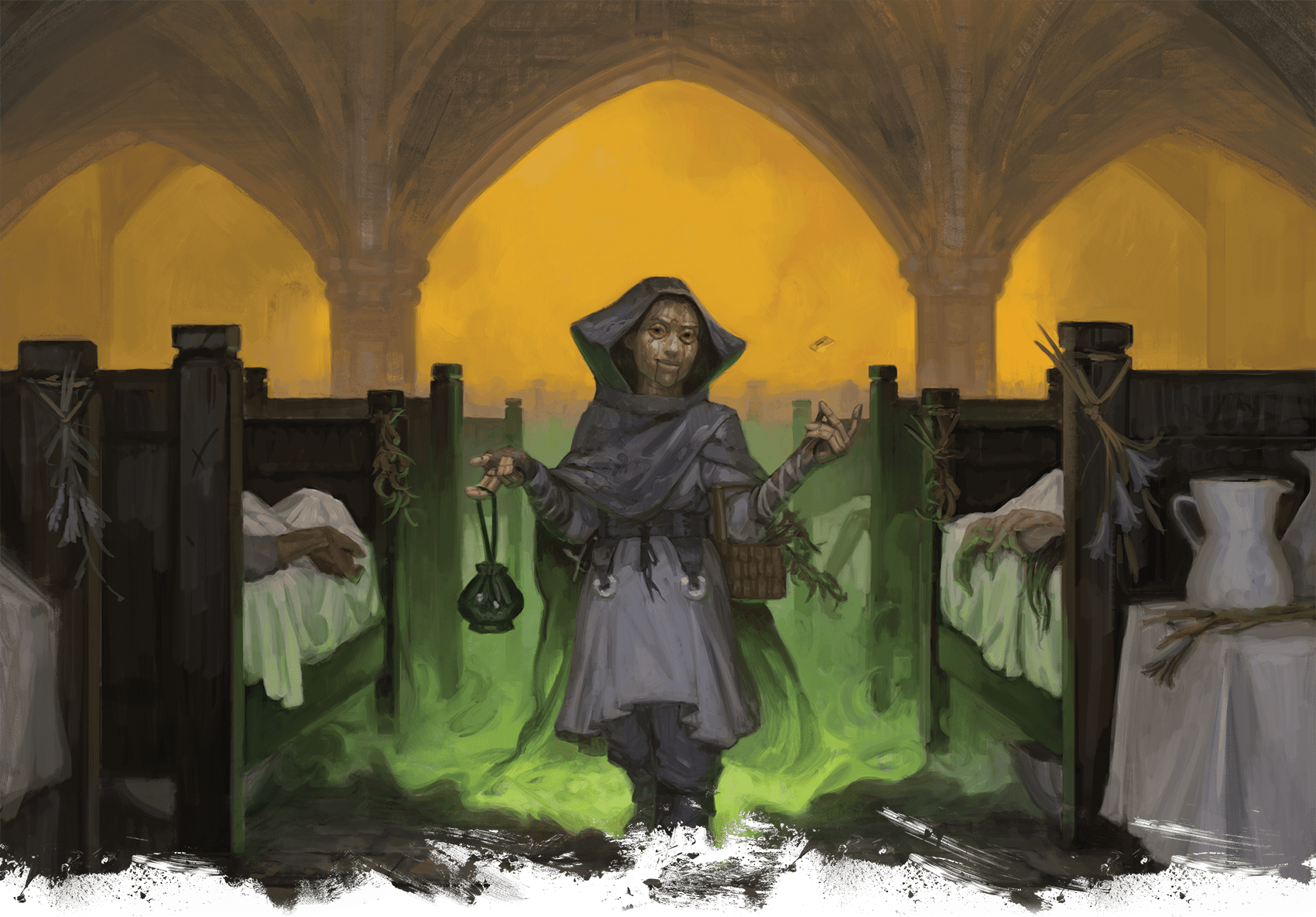
Even in Sleep (Exploration)
An instinctive sense for danger protects you at all times. While you have the Unconscious condition while asleep, you are aware of your surroundings and can make Perception checks normally.
Sleeping Ward. If you take this trait twice, while you are asleep, you automatically detect the presence of any creature intending harm to you that moves within 30 feet of you. A creature that is simply capable of harming you does not trigger this trait until it has intent to do so. For example, a wild animal might approach you cautiously, then decide to attack only when it realizes you are sleeping.
Fade Away (Exploration)
You have learned to avoid notice at all costs, letting you momentarily obscure yourself from observation. As a Bonus Action, you can take the Hide action to conceal yourself without needing to be Heavily Obscured or behind Three-Quarters Cover or Total Cover. You need not be out of a creature’s line of sight to use this ability.
You become visible at the start of your next turn unless you have moved into a position that allows you to use the Hide action normally. You can use this feature a number of times equal to your Proficiency Bonus, regaining all expended uses when you finish a Long Rest.
Long Fade. If you take this trait twice, you have Advantage on your ability check when you take the Hide action from Fade Away, and you become visible at the end of your next turn instead of the start of your next turn.
Firm Influence (Roleplaying)
Others have learned to fear you—and for good reason.
You have proficiency in the Intimidation skill.
Terrifying Influence. If you take this trait twice, you have Advantage on Intimidation checks. You can use this feature a number of times equal to twice your Proficiency Bonus, regaining all expended uses when you finish a Long Rest.
First Strike (Combat)
Hesitation in others is a weakness you’ve learned to take deadly advantage of. When you hit a creature that hasn’t taken a turn in the combat yet, your attack deals an extra 2d6 damage. You can use this feature a number of times equal to your Proficiency Bonus, regaining all expended uses when you finish a Long Rest.
Strong Strike. If you take this trait twice, you can use the maximum value of the extra damage dice from First Strike, rather than rolling. You regain the use of this feature when you finish a Long Rest.
Fleet of Foot (Exploration)
As you’ve learned more than once, moving fast is often the best way to avoid trouble. Your Speed increases by 5 feet.
Shared Fleetness. If you take this trait twice, your Speed increases by another 5 feet, for a total increase of 10 feet.
Additionally, as a Bonus Action, choose any number of creatures within 30 feet. Those creatures gain a 10 foot bonus to their Speed for 1 minute. You regain the use of this feature when you finish a Long Rest.
Focused Mind (Combat)
Your strength of will protects you from magic that would corrupt your mind. You have Advantage on saving throws against being Charmed.
Immutable Mind. If you take this trait twice, when you fail a saving throw against being Charmed, you can use your Reaction to succeed on the save instead. You regain the use of this feature when you finish a Long Rest.
Focused Reserves (Combat)
No matter how badly beaten down you are, you find the will to keep fighting when you most need it. As a Reaction after you take damage, you can roll a number of d6s equal to your Proficiency Bonus and gain Temporary Hit Points equal to the total. You can use this feature a number of times equal to your Proficiency Bonus, regaining all expended uses when you finish a Long Rest.
Focused Edge. If you take this trait twice, you can reroll 1s and 2s when you use Focused Reserves, but you must use the new rolls.
Gifted Performer (Roleplaying)
When you desire to stand out, you have a natural gift for impressing others. You have proficiency in the Performance skill.
A Sight to Behold. If you take this trait twice, you have Advantage on Performance checks. You can use this feature a number of times equal to twice your Proficiency Bonus, regaining all expended uses when you finish a Long Rest.
Helping Hand (Exploration/Combat)
You excel at aiding your allies, knowing that the time will come when you need them to return the favor. You can use the Help action as a Bonus Action to assist any ally making an ability check. (This is an Exploration trait.)
Helpful Tactics. If you take this trait twice, when you use Helping Hand, you can also assist an ally making an attack roll. You can use this feature a number of times equal to your Proficiency Bonus, regaining all expended uses when you finish a Long Rest. (This is a Combat trait.)
Hold Breath (Exploration)
Whether trapped under black water or resisting poisonous fumes, you refuse to give in. You can hold your breath for up to 1 hour.
Endless Breath. If you take this trait twice, you can hold your breath for up to 8 hours.
Hunter’s Instinct (Combat)
You summon a surge of ferocity when your prey least expects it. At the end of each Long Rest, you gain a number of d8s equal to your Proficiency Bonus. When you make an attack with a weapon or an Unarmed Strike, you can roll a d8 and add it to either the attack roll or the damage roll. If you add it to the d20 roll, you can decide to roll the d8 after the d20 roll is made, but you must do so before the outcome of the roll is known.
Relentless Instinct. If you take this trait twice, whenever you use Hunter’s Instinct for an attack roll, if the attack roll misses, you retain the d8 and can use it again.
Impromptu Artisan (Roleplaying)
You’ve never known the luxury of always having the gear you need, but you have more than learned to make do. If you possess Artisan’s Tools with which you have proficiency, and if you have access to appropriate raw materials and any additional necessary equipment (as the GM determines), you can use a Short Rest to craft any one nonmagical item worth 10 GP or less, including:
- Adventuring gear
- A weapon or shield
- A unique item that performs a simple function approved by the GM
The gear you create is workable but not high quality, and can’t be sold except as the GM determines.
Master Artisan. If you take this trait twice, you can use Impromptu Artisan during a Long Rest, during which you craft one nonmagical item worth 50 GP or less.
Improviser (Roleplaying)
When needs demand, you get the job done better than most. As a Bonus Action, choose one skill or tool that you don’t have proficiency with. You have proficiency in that skill or with that tool for 1 hour. You regain the use of this feature when you finish a Long Rest.
Expert Improviser. If you take this trait twice, you have Advantage on ability checks you make using the skill or tool you select with Improviser. You can use this feature a number of times equal to your Proficiency Bonus, regaining all expended uses when you finish a Long Rest.
Inborn Perception (Roleplaying)
The best way to avoid danger is to make sure you’re the first person to notice it. You have proficiency in the Perception skill.
Piercing Perception. If you take this trait twice, you have Advantage on Perception checks. You can use this feature a number of times equal to twice your Proficiency Bonus, regaining all expended uses when you finish a Long Rest.
Instinctive Stealth (Roleplaying)
When trouble comes for you, you excel at making sure it can’t find you. You have proficiency in the Stealth skill.
Calculated Disappearance. If you take this trait twice, you have Advantage on Stealth checks. You can use this feature a number of times equal to twice your Proficiency Bonus, regaining all expended uses when you finish a Long Rest.
Instrumentalist (Roleplaying)
In the quieter moments, music can help you forget the horrors you’ve seen. You have proficiency with two instruments of your choice.
Virtuoso. If you take this trait multiple times, you gain proficiency with two new instruments each time.
Additionally, you have Advantage on ability checks made using any instrument. You can use this feature a number of times equal to twice your Proficiency Bonus, regaining all expended uses when you finish a Long Rest.
Intrinsic Orientation (Exploration)
A single misstep can lead to ruin, but your instincts for direction keep you from going astray. You always know which way is north, and you can reckon a cardinal direction of the GM’s determination while on other planes. Additionally, you have Advantage on ability checks made to avoid becoming lost, to navigate, or to track.
Expert Orientation. If you take this trait twice, when you fail an ability check made to avoid becoming lost, to navigate, or to track, you can choose to succeed instead. You regain the use of this feature when you finish a Long Rest.
Intuitive Acrobat (Roleplaying)
Staying loose and limber means being able to get out of even the tightest spots when your life is on the line. You have proficiency in the Acrobatics skill.
Stunt Expert. If you take this trait twice, you have Advantage on Acrobatics checks. You can use this feature a number of times equal to twice your Proficiency Bonus, regaining all expended uses when you finish a Long Rest.
Inured to the Elements (Exploration)
Even beneath scorching sun and in freezing cold, you hold yourself strong. You have Advantage on Constitution saving throws made to resist the effects of extreme cold or extreme heat.
Immune to the Elements. If you take this trait twice, you automatically succeed on Constitution saving throws to resist the effects of extreme cold or extreme heat.
Irrepressible Sight (Exploration)
Any foe you can see is a foe you can take down—so you make sure nothing prevents you from seeing. You have Advantage on saving throws against having the Blinded condition.
Resolute Sight. If you take this trait twice, when you fail a saving throw against having the Blinded condition, you can use your Reaction to succeed on the save instead. You regain the use of this feature after you finish a Long Rest.
Keen Survivor (Roleplaying)
The wilds of Etharis have claimed many who lack the skill to navigate them. You have proficiency in the Survival skill.
Determined Survivor. If you take this trait twice, you have Advantage on Survival checks. You can use this feature a number of times equal to twice your Proficiency Bonus, regaining all expended uses when you finish a Long Rest.
Larger Target (Combat)
Foes that outsize you quickly learn to fear your wrath. If you hit a creature that is one size larger than you, you can choose to deal extra damage to the creature equal to your Proficiency Bonus. You can use this feature a number of times equal to twice your Proficiency Bonus, regaining all expended uses when you finish a Long Rest.
Even Larger. If you take this trait twice, Larger Target applies to creatures of any size larger than you.
Light Armor Training (Combat)
Dealing with the threats you face requires the right combination of protection and movement. You have training with Light armor.
Light Armor Expertise. If you take this trait twice, your AC increases by 1 while wearing Light armor.
Lucky (Combat)
The luck you carry will see you through the worst Etharis has to offer. When you roll a 1 on a D20 Test, you can reroll that die but must use the new roll. You can use this feature a number of times equal to your Proficiency Bonus, regaining all expended uses when you finish a Long Rest.
Master of Fortune. If you take this trait twice, you have Advantage on the reroll made with Lucky.
Magical Fortification (Combat)
The more that magic threatens you, the more your resilience to it increases. Choose an ability score: Strength, Dexterity, Constitution, Intelligence, Wisdom, or Charisma. You have Advantage on saving throws using that ability score against spells and other magical effects.
Extended Fortification. If you take this trait multiple times, you have Advantage on saving throws using a new ability score each time.
Additionally, if you fail a saving throw against a spell or other magical effect and you do not have proficiency with that saving throw, you can use your Reaction to reroll the save. You regain the use of this feature when you finish a Long Rest.
Magical Insight (Roleplaying)
Magic is power in the right hands, and those hands are yours. You have proficiency in the Arcana skill.
Magical Historian. If you take this trait twice, you have Advantage on Arcana checks. You can use this feature a number of times equal to twice your Proficiency Bonus, regaining all expended uses when you finish a Long Rest.
Magical Savvy (Roleplaying)
Whether through intensive study or the innate touch of magic in your blood, you have the ability to invoke magical spells. You learn one cantrip of your choice from any spell list, which you cast using the associated ability score: Intelligence for Wizard spells, Wisdom for Cleric and Druid spells, and Charisma for Bard, Sorcerer, and Warlock spells. If the spell appears on multiple spell lists, choose one to determine the spellcasting attribute for that spell.
Magical Savant. If you take this trait multiple times, you select a different cantrip each time, or you can select a level 1 spell from the same list as a cantrip you have previously chosen. If you select a level 1 spell, you can cast it once without expending a spell slot, and you regain the ability to cast it in that way when you finish a Long Rest. If you have levels in the associated spellcasting class, you always have this spell prepared, and it doesn’t count against the number of spells you can prepare each day.
Masterful Aptitude (Roleplaying)
Your discipline and focus give you an edge that others lack. Choose one of your skill or tool proficiencies. You have Expertise on ability checks made using the chosen proficiency.
Focused Mastery. If you take this trait multiple times, you gain its benefit for a new skill proficiency or tool proficiency each time.
Additionally, when you make a check using a skill or tool for which you’ve taken Masterful Aptitude, you have Advantage on the check. You can use this feature a number of times equal to your Proficiency Bonus, regaining all expended uses when you finish a Long Rest.
Master of Distraction (Combat)
You draw your foes’ attention to you, intending it to be the last diversion they ever see. As an Influence action, you put on a tactical display (bravado, cowardice, confusion, or some other tactic) that gets your enemies’ attention. Until the end of your next turn, any attack on an enemy within 10 feet of you that could see you when you took the Influence action is made with Advantage. You can use this feature a number of times equal to your Proficiency Bonus, regaining all expended uses when you finish a Long Rest.
Hindering Distraction. If you take this trait twice, when you use Master of Distraction, one affected enemy of your choice also has Disadvantage on attack rolls it makes against any of your allies until the end of your next turn.
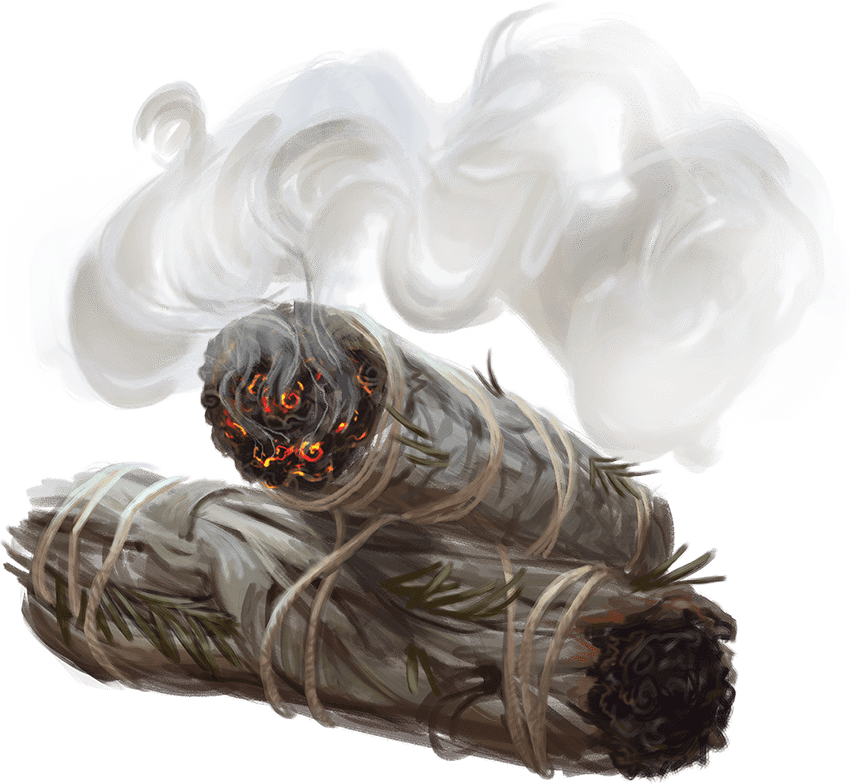
Meditative Rest (Exploration)
Sleep is a luxury you’ve never needed to afford. When you rest, you meditate deeply for 4 hours, dreaming but remaining conscious. After resting in this way, you gain the same benefit that other humanoids do from 8 hours of sleep.
Restorative Rest. If you take this trait twice, you need to spend only 2 hours in your meditation to gain the benefit of 8 hours of sleep, and you gain a d6 at the end of each Long Rest. Before the end of your next Long Rest, you can roll the d6 and add it to any d20 Test you make. You can decide to roll the d6 after the d20 Test is made, but you must do so before the outcome of the roll is known.
Medium Armor Training (Combat)
The pounding you routinely take in combat requires a formidable layer of defense. You have training with Medium armor and with Shields.
Heavy Armor Training. If you take this trait twice, you have training with Heavy armor.
Menacing Roar (Combat)
Your battle cry can cause even the most formidable foes to quail before you. As a Bonus Action, you emit a roar, shout, or other loud vocal outburst. Each creature of your choice within 10 feet of you that can hear you must succeed on a Wisdom saving throw (DC = 8 + your Proficiency Bonus + your Constitution modifier) or have the Frightened condtion until the end of your next turn. You regain the use of this feature when you finish a Long Rest.
Incomparable Roar. If you take this trait twice, when you use Menacing Roar, one target of your choice has Disadvantage on the saving throw.
Mighty Shove (Combat)
Your powerful blows send your targets reeling. When you hit a creature no more than one size larger than you with a melee attack, you can use a Bonus Action to attempt to shove that creature. The target must succeed on a Strength or Dexterity saving throw (DC = 8 + your Strength modifier + your Proficiency Bonus) or be pushed up to 10 feet away from you.
Overwhelming Shove. If you take this trait twice, when you use Mighty Shove, the target creature has Disadvantage on the saving throw.
Mindful Investigator (Roleplaying)
Putting together the pieces of even the darkest mysteries is second nature to you. You have proficiency in the Investigation skill.
Thorough Sleuth. If you take this trait twice, you have Advantage on Investigation checks. You can use this feature a number of times equal to twice your Proficiency Bonus, regaining all expended uses when you finish a Long Rest.
Moved by Faith (Roleplaying)
The grimmest myths and legends of the past hold the keys to shaping the future. You have proficiency in the Religion skill.
Force of Faith. If you take this trait twice, you have Advantage on Religion checks. You can use this feature a number of times equal to twice your Proficiency Bonus, regaining all expended uses when you finish a Long Rest.
Natural Attack (Combat)
The gift of natural weaponry means you are never unarmed, as your foes learn to their peril. Your Unarmed Strikes deal damage equal to 1d6 + your Strength or Dexterity modifier. The type of damage dealt by your Unarmed Strikes can be Bludgeoning, Piercing, or Slashing, based on the type of natural weaponry you possess (claws, horns, a tail, and so forth).
Swift Strike. If you take this trait twice, you can use Unarmed Strike as a Bonus Action. You can use this feature a number of times equal to your Proficiency Bonus, regaining all expended uses when you finish a Long Rest.
Natural Camouflage (Exploration)
Your ability to fade into the background of familiar territory helps keep you safe from threats. Choose an environment: arctic, coastal, desert, forest, grassland, hill and mountain, swamp, subterranean, or underwater. You have Advantage on Stealth checks made with the Hide action while in that environment.
Shared Camouflage. If you take this trait multiple times, you gain its benefits for a new environment each time.
Additionally, when you take the Hide action, you can forgo making a Stealth check while in any environment chosen with Natural Camouflage, instead treating the check as if you had rolled a 15. You regain the use of this feature when you finish a Long Rest.
Natural Movement (Exploration)
The time you’ve spent in the natural world lets you travel at speed, and hinders the abilities of those who would hunt you. Choose an environment: arctic, coastal, desert, forest, grassland, hill and mountain, swamp, subterranean, or underwater. While in that environment, moving through nonmagical Difficult Terrain costs you no extra movement, and ability checks made to track you have Disadvantage.
Shared Movement. If you take this trait multiple times, you gain its benefits for a new environment each time. Additionally, while in any environment chosen for Natural Movement, as a Bonus Action, you can grant creatures of your choice the benefit of Natural Movement for 1 hour, as long as those creatures remain within 120 feet of you and can see you.
Nature’s Voice (Roleplaying)
Mastering the subtle expression of fauna and flora grants you an edge in dealing with the threats of the wilderness. Through sounds and gestures, you can communicate simple ideas with Beasts and Plant creatures, understanding if a creature is hungry, for example. This gives you no specific ability to control such creatures, and you can’t understand or learn detailed information from them.
Primal Voice. If you take this trait twice, you have Advantage on ability checks made as part of an Influence action to interact with a Beast or Plant creature.
Nimble Moves (Roleplaying)
You have learned the value of being able to manipulate the world around you without attracting the notice of others. You have proficiency in the Sleight of Hand skill.
Exquisite Legerdemain. If you take this trait twice, you have Advantage on Sleight of Hand checks. You can use this feature a number of times equal to twice your Proficiency Bonus, regaining all expended uses when you finish a Long Rest.
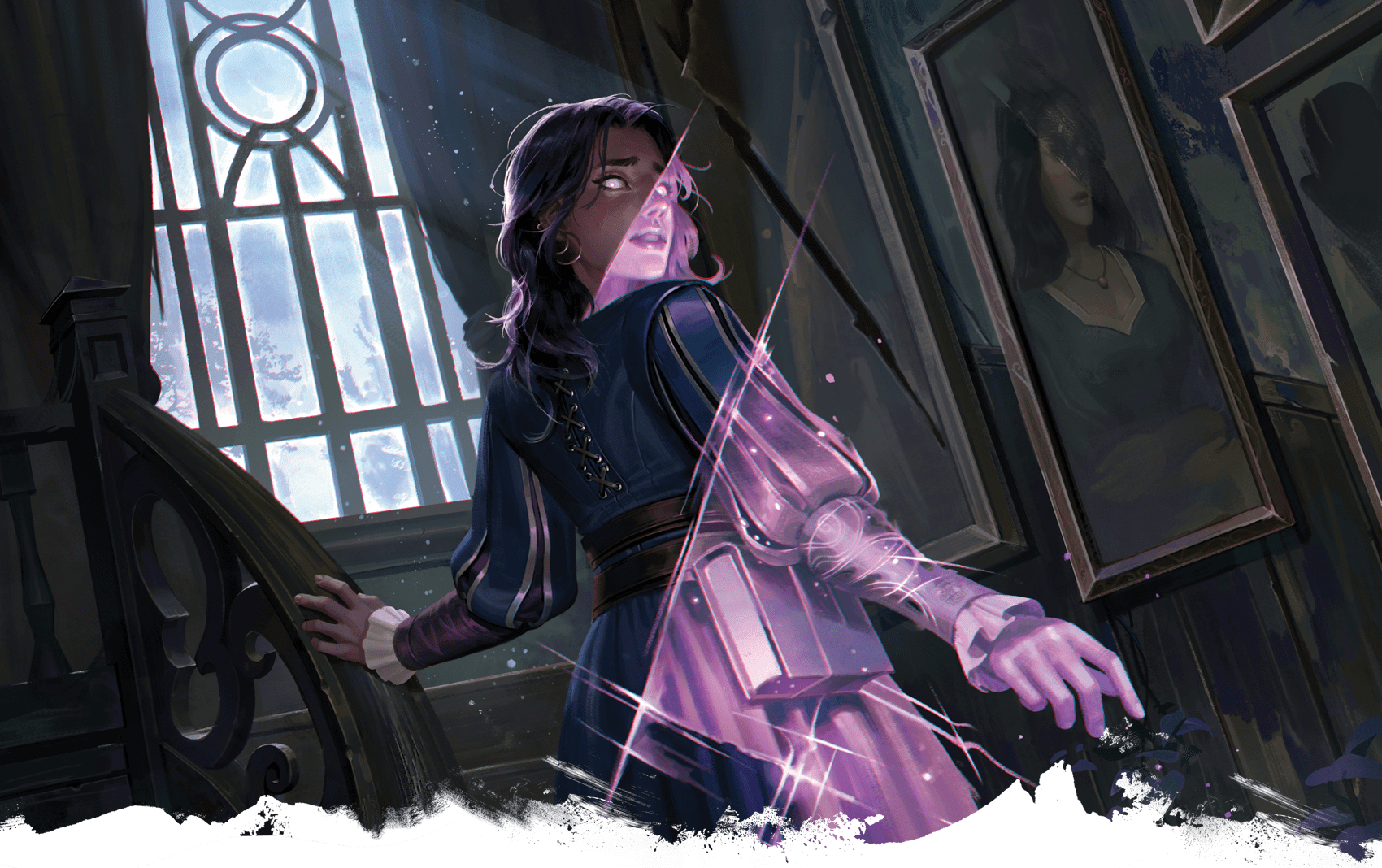
Out of Phase (Combat)
Your corporeal presence shifts and fades, softening your enemies’ ability to harm you. As a Bonus Action, for 1 minute, all creatures have Disadvantage on attack rolls against you, and you can move through other creature’s spaces without treating them as Difficult Terrain. You can use this feature a number of times equal to your Proficiency Bonus, regaining all expended uses when you finish a Long Rest.
Phase Shift. If you take this trait twice, when you use Out of Phase, you can extend its benefit to any ally within 10 feet of you.
Clear a special cell for this one. She’s got tricks.
—Castinellan Jailor
Pack Hunter (Combat)
Fighting in the thick of battle lets you aid your allies when it counts. When an ally within 10 feet of you is about to make an attack roll or a saving throw, you can use a Reaction to grant that ally Advantage on the attack or save. You can use this feature a number of times equal to your Proficiency Bonus, regaining all expended uses when you finish a Long Rest.
Pack Leader. If you take this trait twice, Pack Hunter can be triggered by any ally within 30 feet of you. Additionally, if the attack roll misses or the saving throw fails, you don’t lose that usage of Pack Hunter.
Pack Tactics (Combat)
Staying close to your allies in combat makes you even more dangerous. When you start your turn with at least one ally who isn’t Incapacitated within 5 feet of another creature you can see, you can use your Reaction to have Advantage on attack rolls against that creature until the end of your turn.
Pack Instinct. If you take this trait twice, gaining Advantage from Pack Tactics requires no action.
Pass Through (Exploration)
Making use of constant movement lets you minimize the threat of larger foes. You can move through the space of any creature at least one size larger than you.
Nimble Passage. If you take this trait twice, you do not treat another creature’s space as Difficult Terrain.
Personal Bastion (Combat)
Focusing all your resolve, you stand fast and watch your enemies flail against your defenses. As a Magic action, you become motionless and gain the following effects:
- You have a +4 bonus to AC.
- You have Disadvantage on Dexterity saving throws.
- You have Advantage on Strength and Constitution saving throws.
- Your Speed is 0 and you can’t benefit from any bonus to your Speed.
- You lose Concentration.
You can’t take actions, and you can’t use your Bonus Action except to end the effect of this trait.
Mobile Bastion. If you take this trait twice, when you use Personal Bastion, your Speed is reduced to half your normal Speed (rounded down), you do not have Disadvantage on Dexterity saving throws, and you can use Bonus Actions.
Persuasive Knack (Roleplaying)
You have learned that the best way to deal with certain threats is to keep those threats from escalating. You have proficiency in the Persuasion skill.
Tongue of Gold. If you take this trait twice, you have Advantage on Persuasion checks. You can use this feature a number of times equal to twice your Proficiency Bonus, regaining all expended uses when you finish a Long Rest.
Poison Resilience (Exploration)
Your exceptional fortitude lets you shrug off the effects of even the worst toxins. You have Advantage on saving throws against being Poisoned.
Poison Indemnity. If you take this trait twice, when you fail a saving throw against being Poisoned, you can use your Reaction to succeed on the save instead. You regain the use of this feature when you finish a Long Rest.
Polyglot (Roleplaying)
The advantages of mastering the languages of enemies and allies alike are clear to you. You learn two languages of your choice.
Language Expert. If you take this trait multiple times, you learn two new languages each time.
Additionally, you have Advantage on Influence action ability checks made to interact with another creature using any language you selected with Polyglot. You can use this feature a number of times equal to twice your Proficiency Bonus, regaining all expended uses when you finish a Long Rest.
Power Nap (Exploration)
When you don’t know how long it might be before your next full respite, you learn to take maximum advantage of any rest you can get. When taking a Short Rest, you can choose to sleep for 1 hour. If you do so, you reduce your Exhaustion by one level and regain a Hit Point Die in addition to the other benefits of a Short Rest.
Extreme Resilience. If you take this trait twice, when using Power Nap, you can choose to regain a single resource that would normally refresh on a Long Rest. For example, a Sorcerer could choose to regain a Sorcery Point on a Short Rest.
Powerful Build (Exploration/Combat)
Whether carrying well-earned loot or the body of a fallen companion, you shoulder that load with ease. You count as one size larger when determining your carrying capacity and the weight you can push, drag, or lift. A Small creature with this trait can use any weapon with the Heavy property as long as they have proficiency with that weapon. (This is an Exploration trait.)
Powerful Shove. If you take this trait twice, you can move or knock foes prone with ease. When you use Unarmed Attack to shove a creature 5 feet or give it the Prone condition, the target has Disadvantage on the saving throw. (This is a Combat trait.)
Psychic Spirit (Combat)
Your strength of mind shields you from unnatural forces. You have Resistance to Psychic damage.
Spirit’s Strength. If you take this trait twice, when you fail a saving throw against an effect that deals Psychic damage, you can use your Reaction to succeed on the save instead. You regain the use of this feature when you finish a Long Rest.
Quick Initiative (Combat)
Danger is never far away from you, and you are always ready for it. You add your Proficiency Bonus to your Initiative rolls.
Focused Initiative. If you take this trait twice, when you roll Initiative, you can treat a roll of 9 or lower as if you rolled a 10.
Quick Slip (Combat)
Even in the thick of battle, anything that obscures your enemies’ view of you gives you a chance to strike unseen. You can take the Hide action as a Bonus Action on each of your turns. You must have appropriate cover to attempt to hide, as normal.
Astute Slip. If you take this trait twice, you have Advantage on Stealth checks you make with the Hide action when you use Quick Slip.
Reach Attack (Combat)
As you hurl yourself into battle, your foes discover that trying to keep away from you won’t save them. Your reach increases by 5 feet. This extra reach doesn’t apply to Opportunity Attacks.
Opportune Reach. If you take this trait twice, your extra reach from Reach Attack applies to Opportunity Attacks.
Relentless Endurance (Combat)
The battles you need yet to fight are many, and death is not an option. When you are reduced to 0 Hit Points but not killed outright, you can drop to 1 Hit Point instead. You regain the use of this feature when you finish a Long Rest.
Unparalleled Endurance. If you take this trait twice, when you use Relentless Endurance, you drop to 1d6 Hit Points + your Proficiency Bonus. Additionally, when you use Relentless Endurance, you can use a Reaction to spend up to five Hit Dice, rolling them and gaining that number of Hit Points.
Resilient Ears (Exploration)
Even as destruction rains down around you, your hearing stays sharp. You have Advantage on saving throws against having the Deafened condition.
Determined Hearing. If you take this trait twice, you have Advantage on Perception checks involving hearing. Additionally, when you fail a saving throw against being Deafened, you can use your Reaction to succeed on the save instead. You regain the use of this feature when you finish a Long Rest.
Ruthless Response (Combat)
A creature that gets the drop on you is met with a swift and brutal reply. When you take damage from a creature within your reach, you can use your Reaction to make a melee attack with a weapon or an Unarmed Strike against that creature. You can use this feature a number of times equal to your Proficiency Bonus, regaining all expended uses when you finish a Long Rest.
Focused Ruthlessness. If you take this trait twice, you have Advantage on attack rolls made using Ruthless Response.
Shroud of the Wild (Exploration)
With any degree of obscuration, your instinctive ability to conceal yourself lets you avoid your enemies’ notice. You can take the Hide action even when you are only Lightly Obscured by foliage, heavy rain, falling snow, mist, and other natural phenomena.
Faultless Shroud. If you take this trait twice, you have Advantage on Stealth checks using the Hide action while using Shroud of the Wild.
Skill Prowess (Roleplaying)
Your ingenuity and inventiveness help keep you alive in a dangerous world. Before you make an ability check using a skill you are proficient with, you can add your Proficiency Bonus again. You can use this feature a number of times equal to your Proficiency Bonus, regaining all expended uses when you finish a Long Rest.
Skill Mastery. If you take this trait twice, when you fail an ability check made using the Skill Prowess trait, you can reroll the check and must use the new roll.
Skirmish Tactics (Combat)
Your brutal strike leaves your foe reeling as you slip away. When you hit a hostile creature with an attack with a weapon or an Unarmed Strike, Opportunity Attacks against you by that creature have Disadvantage until the end of your turn.
Supreme Skirmisher. If you take this trait twice, when you hit a hostile creature with an attack with a weapon attack or an Unarmed Strike, you can take the Disengage action as a Bonus Action until the end of your turn.
Slippery (Combat)
Any enemy that tries to grab you is in for a surprise. You have Advantage on Athletics and Acrobatics checks to escape a grapple.
Supreme Slip. If you take this trait twice, when you fail an Athletics or Acrobatics check to escape a grapple, you can use your Reaction to succeed instead. You regain the use of this feature when you finish a Long Rest.
Stalwart Reserves (Combat)
Each time you lay into a foe, their state of peril lends you vigor. When you hit a creature with a melee attack, you can use your Reaction to roll a number of d4s equal to your Proficiency Bonus and gain Temporary Hit Points equal to the total rolled. You can use this feature a number of times equal to your Proficiency Bonus, regaining all expended uses when you finish a Long Rest.
Stalwart Edge. If you take this trait twice, you can take the maximum number of Temporary Hit Points rather than rolling.
Standing Leap (Exploration)
Threats on the ground are of little concern as you leap over them with ease. You can make a Long Jump of up to 20 feet and a High Jump of up to 10 feet, with or without a running start. If your Speed is less than the distance you can Long Jump, you can leap only a distance equal to your Speed.
Incredible Leap. If you take this trait twice, you can make a Long Jump of up to 30 feet and a High Jump of up to 15 feet, as limited by your speed.
Additionally, when you jump out of another creature’s reach, the movement of the jump does not provoke Opportunity Attacks from that creature. You regain the use of this feature when you finish a Long Rest.
Steady (Exploration)
No matter what kind of upheaval surrounds you, you stand your ground. You have Advantage on saving throws against having the Prone condition.
Stand Fast. If you take this trait twice, standing from Prone takes only five feet of movement instead of half your movement.
Additionally, when you fail a saving throw against being knocked Prone, you can use your Reaction to succeed on the save instead. You regain the use of this feature when you finish a Long Rest.
Don’t stay down. Never stay down. If you stay down, you’re dead.
—Monster Hunter’s Guide to Survival
Supple Squeeze (Exploration)
With an effort of will, you contort your body into the tightest spaces. You can squeeze through a space that is large enough for a creature two sizes smaller than you, rather than one size smaller.
Full-Speed Squeeze. If you take this trait twice, squeezing does not cost you additional movement, and you do not have Disadvantage on attack rolls and Dexterity saving throws while squeezing.
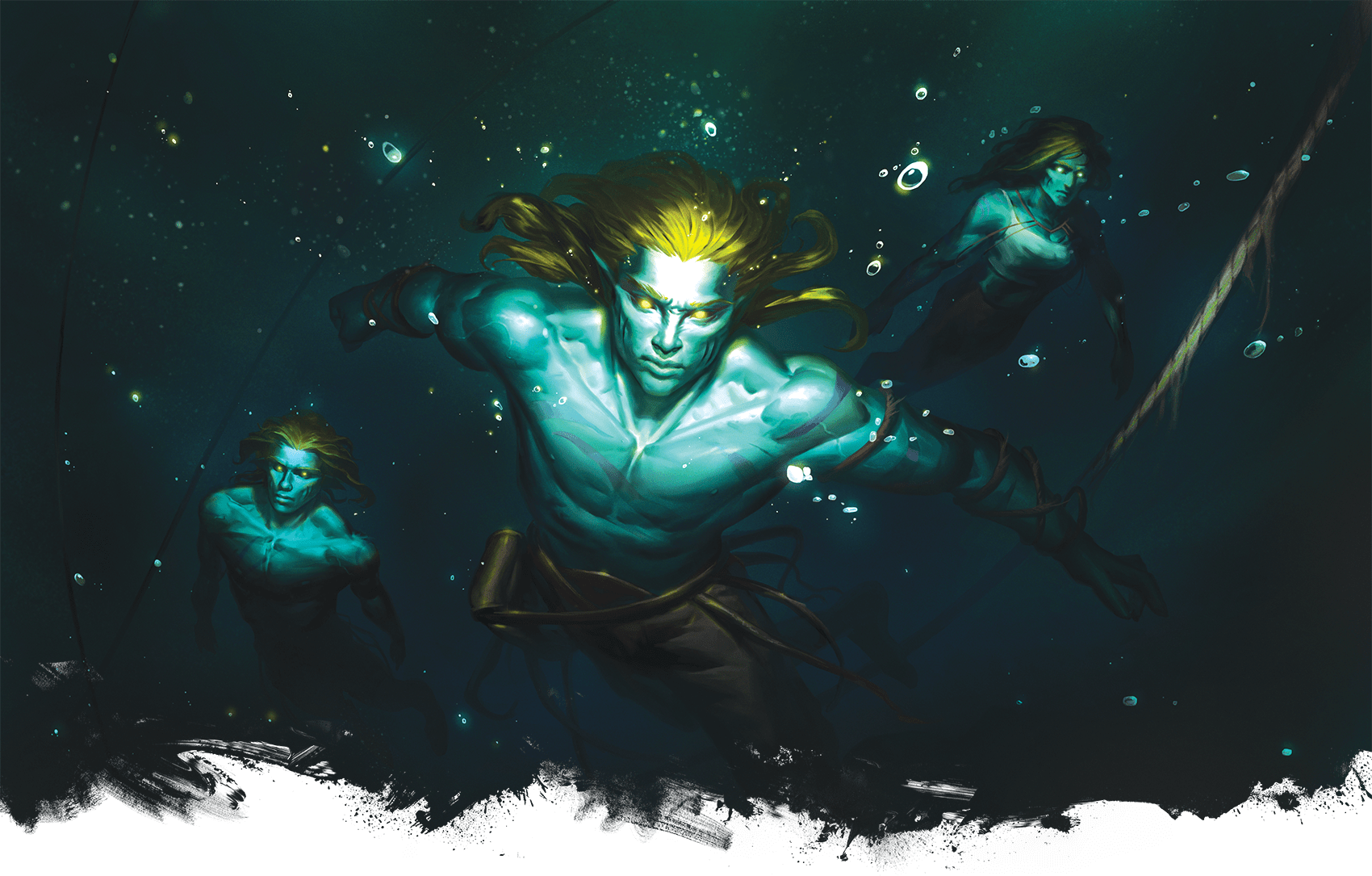
Swimmer (Exploration)
You are in your element while in the water, moving with grace and ease. You have a Swim Speed equal to your Speed.
Quickened Swim. If you take this trait twice, you can use the Dash action as a Bonus Action while swimming.
Tenacious (Combat)
Your enemies might put you down, but you are never down for long. You have Advantage on Death Saving Throws.
Hard to Kill. If you take this trait twice, when you drop to 0 Hit Points but don’t die outright, you remain conscious. You must make Death Saving Throws as normal while at 0 Hit Points, and you suffer a Death Saving Throw failure each time you take any damage, but you can otherwise act freely. You can’t become Stable while you remain at 0 Hit Points in this way.
Timely Boon (Combat)
Fortune favors you at times when a threat might send you down. When you fail a saving throw, you can use your Reaction to roll a d4 and add it to the save, potentially turning it into a success. You can use this feature a number of times equal to your Proficiency Bonus, regaining all expended uses when you finish a Long Rest.
Born Lucky. If you take this trait twice, you roll a d8 instead of a d4 when you use Timely Boon.
Tireless (Exploration)
An innate resilience lets you shake off conditions that would take others down. You have Advantage on saving throws connected to gaining or removing Exhaustion levels.
Vigorous. If you take this trait twice, when you fail a saving throw against Exhaustion, you can use your Reaction to succeed on the save instead. You regain the use of this feature when you finish a Long Rest.
Touch of Life (Combat)
Effects that corrupt the essence of other living creatures are of little concern to you. You have Resistance to Necrotic damage.
Strength of Life. If you take this trait twice, when you fail a saving throw against an effect that deals Necrotic damage, you can use your Reaction to succeed on the save instead. You regain the use of this feature when you finish a Long Rest.
Toughness (Combat)
An intrinsic hardiness marks you as one born for battle. Your Hit Point maximum increases by 1, and it increases by 1 each time you gain a level.
Extra Tough. If you take this trait twice, your Hit Point maximum increases by 2 instead of 1, and it increases by 2 each time you gain a level.
Additionally, when you make a saving throw against an effect that would decrease your Hit Point maximum, you have Advantage on the save. You regain the use of this feature when you finish a Long Rest.
Unchecked (Combat)
Your ability to stay in motion is second to none, and foes try in vain to pin you down. You have Advantage on saving throws against being Restrained.
Slip Free. If you take this trait twice, when you fail a saving throw against being Restrained, you can use your Reaction to succeed on the save instead. You regain the use of this feature when you finish a Long Rest.
Unnatural Healer (Roleplaying)
Your innate healing abilities let you recover from some of the grimmest wounds. During a Long Rest, you can automatically reverse Grievous Wounds. Additionally, you can reattach any severed body parts (fingers, legs, tails, and so on), which are automatically restored at the end of the Long Rest. If your severed body parts aren’t available, you can replace them with the same body parts of another creature of the same general anatomy as you. If you wish to intentionally swap out body parts with replacements, you can sever your own body parts with no pain or discomfort.
The ability to make use of unusual body parts (for example, giving yourself the taloned paw of a lion if you lose a hand) are left to the GM’s discretion. In any event, swapping a severed body part for an unusual body part grants you no mechanical Advantages not covered by other traits (see “Features and Traits”).
Regenerative Healer. If you take this trait twice, you automatically reverse Permanent Wounds during a Long Rest. Additionally, you can restore any severed body part during a Long Rest, as if subject to the Regenerate spell. You can use this trait to create unusual regenerated body parts at the GM’s determination.
Weapon Aptitude (Combat)
The weapons you wield might save your life one day, and you know their secrets. You have proficiency with three weapons of your choice.
Weapon Specialist. If you take this trait multiple times, you gain proficiency with three new weapons each time. Additionally, choose one weapon with which you have proficiency. You have a +1 bonus to damage rolls with that weapon.
Well Protected (Combat)
Your ability to roll with even the worst attacks means that armor would only slow you down. When you are not wearing armor, your AC is equal to 13 + your Dexterity modifier.
Protective Cover. If you take this trait twice, when you make a Dexterity saving throw or are targeted by a ranged attack, you can use a Reaction to have Advantage on the saving throw or impose Disadvantage on the ranged attack roll. You can use this feature a number of times equal to your Proficiency Bonus, regaining all expended uses when you finish a Long Rest.
Alternate Rules: Wounds and Resting
The Grim Hollow Campaign Guide contains alternate rules for resting and receiving both Grievous Wounds and Permanent Wounds. These alternate rules are meant to enhance game play in a dark fantasy world where the heroes have to overcome every sort of obstacle to achieve their goals.
Wounds In Grim Hollow
Grievous Wounds are applied to characters that would be dropped to 0 Hit Points, but instead choose to gain a lingering wound that stays with them. These wounds remain until a character takes a Long Rest (see Resting below) and undergoes treatment by a physician or someone trained in Medicine.
Permanent Wounds occur when a creature takes multiple Grievous Wounds, or when a character dies and is brought back to life. The challenges of Permanent Wounds can be offset with certain magic items or prosthetics.
Rests in Grim Hollow
The dark-fantasy vibe of Grim Hollow necessitates a change to the effects of Short and Long Rests. Grievous Wounds can be healed by taking a Long Rest, but those rests in Grim Hollow take 32 hours of resting in a completely safe environment.
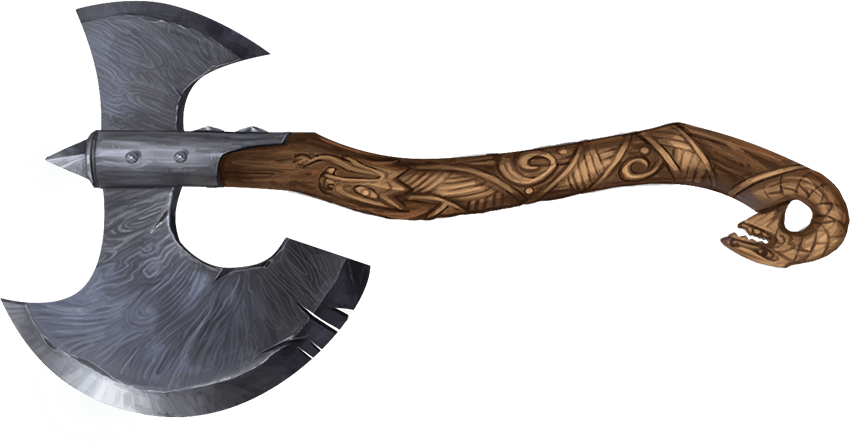
Comments