
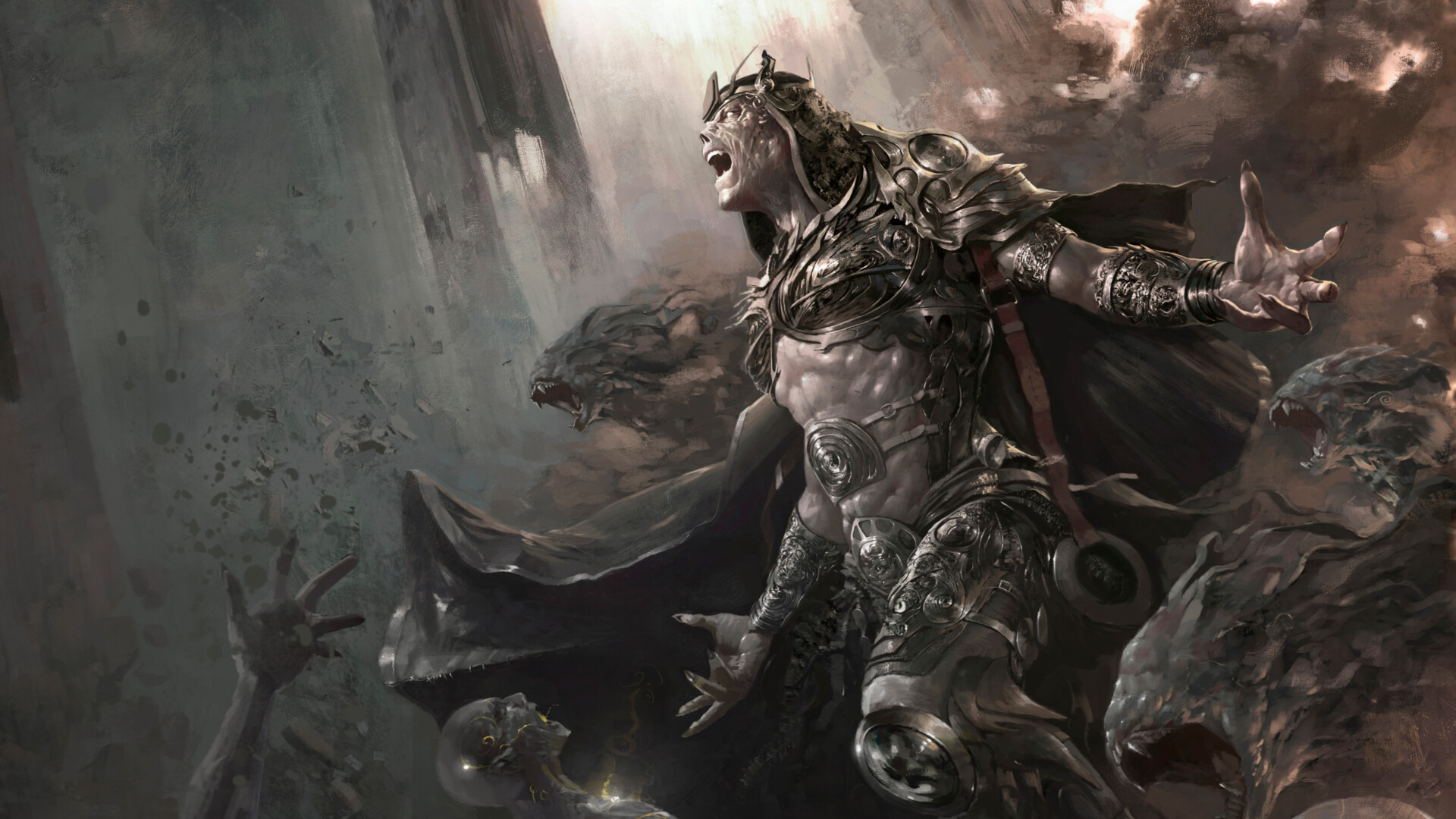
Chapter 6: Transformations
Chapter 6: Transformations
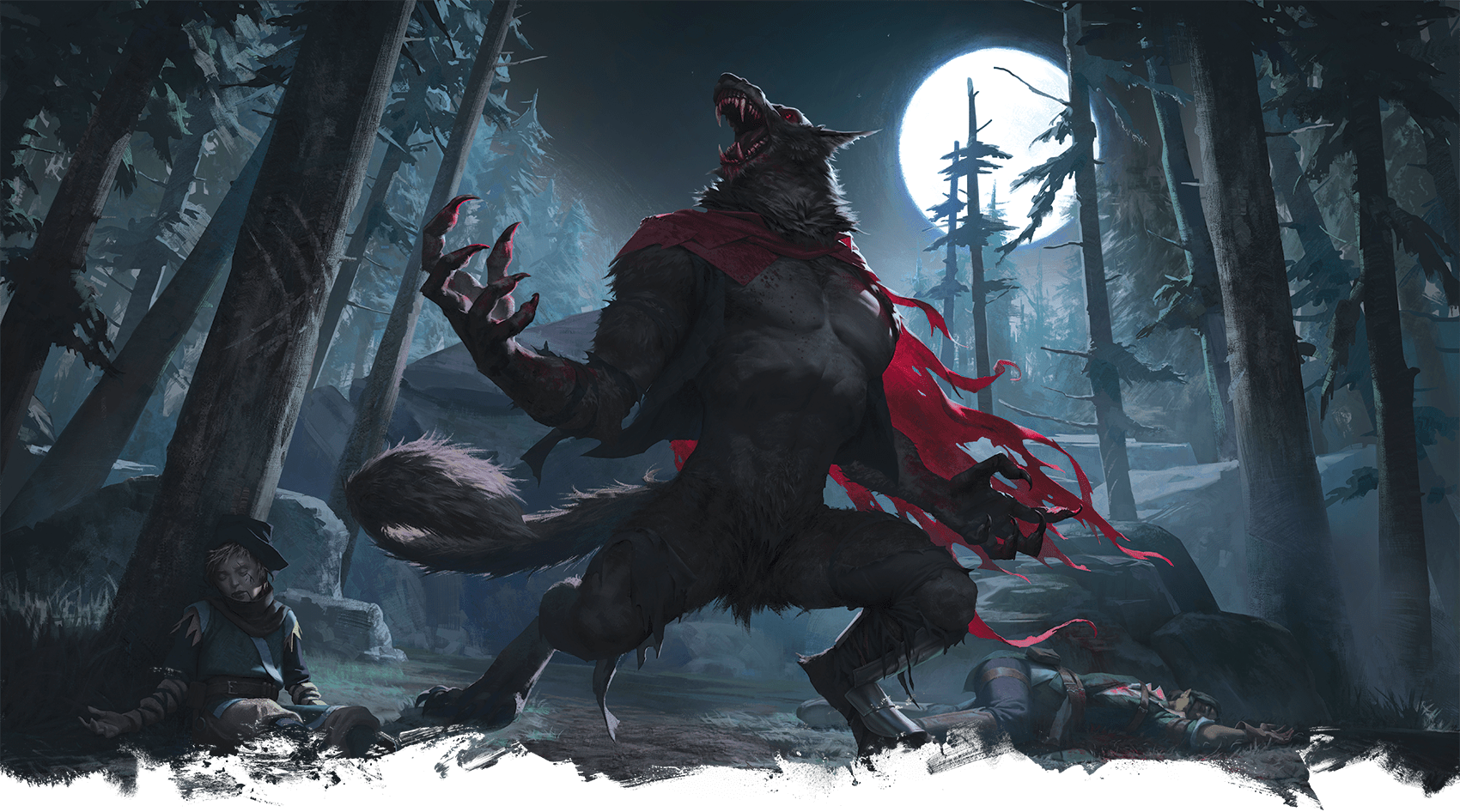
Etharis teems with monsters of countless varieties. Some are born monstrous; others are shaped into creatures of malice and cruelty. Others still became monsters through accidents or by choice. They became transformed.
What these transformed folks do with their newfound abilities—and how they deal with the monstrous urges that come with those abilities—might be the only delineation between whether they are seen as heroes or monsters.
Some transformations may be caused or accelerated by exposure to Drakkenheim, delerium, the Haze, curses, or eldritch entities. However, transformations are major story events. A character does not begin with a transformation unless the player and GM agree before the campaign starts.
Why Transformations?
The following rules provide players and GMs with the tools to see their characters slowly become grim monsters. From dread-inducing werewolves to all-powerful liches, and bloodthirsty vampires to plane-touched seraphs, the following Transformations are available to characters.
The stories that permeate fantasy—and especially those stories of dark fantasy, horror, and the gothic—tend to come tinged with themes of transformation. Tales of innocent victims turning into the same monsters that attack them in the dark forest are as old as time itself. Magic wielders dabbling in forbidden arcana, paying with their very souls for the hubris, permeate most cultures.
Making character Transformations—whether forced onto a creature or self-inflicted—viable within an RPG is a challenge. Sometimes the tropes are worked into a class itself, as we see with the blood-tainted Sorcerer or the pact-making Warlock.
These classes, however, often focus on only the positives. They show what these people have gained from their actions or backgrounds, but rarely do they capture the struggles that come with getting bitten by a lycanthrope, turned into a creature of the night by a vampire, or cursed with ghoul-hood by using the dangerous shadowsteel.
Transformation Buy-In
Transformations can add a layer of storytelling and tension to a campaign. The suspense of slowly turning into a monster is wonderful grist for the roleplaying mill, and being able to do things that a normal character cannot is fun!
But there are risks as well. The power that comes with a Transformation, as well as the drawbacks they represent, can give transformed characters a perceived (or real) advantage over other characters. Likewise, a drawback can be the end of a character, or the entire party, at the most inopportune time.
In addition to the issues of power, the roleplaying and narrative consequences of transformed characters can be far reaching and devastating. A character whose Transformation causes obvious supernaturally infused physical change is unlikely to escape the notice of a villager. Roleplaying those reactions every time can bog down a campaign; to ignore those reactions can make the point of the Transformation moot.
Before using Transformations in your campaign, discuss these issues so they do not harm the enjoyment of all the players and GM. While Transformations offer compelling narrative and mechanical opportunities, at no point do they provide an acceptable excuse to hurt the enjoyment of other players at the table.
Beginning a Transformation
Individuals rarely choose to change into monstrous beings. Most often, they have an affliction forced upon them. Foul curses, horrific experiments, and the diabolical machinations of fiends, vampires, and other dark agents are all examples of how a character might begin a Transformation.
There are times, however, when a character may wish to begin a Transformation of their own volition. Perhaps they have succumbed to the lure of power, or they see it as the only way to achieve a greater goal. Regardless, the first step in any Transformation should involve a discussion between the player, the GM, and the rest of the players involved in the campaign. Intentions should be clearly stated, as campaigns with a lighter tone or strict moral boundaries may not suit certain Transformations.
The next step in a Transformation is to ensure you meet the Transformation’s prerequisites. These requirements, either narrative or game-mechanical, must be met for a character to start a Transformation. It is strongly recommended that these narrative prerequisites be attained through gameplay rather than through a backstory or other “offscreen” actions. However, a discussion for alternative avenues of meeting prerequisites can certainly take place.
Each of the Transformations that follows contains a section specifically focused on how a character might gain that Transformation, as well as how the first stages of the Transformation begin.
We told her we’d support her to become whatever she wanted.
—Parent of a Werewolf
Transformation Stages
Each Transformation has four stages. Characters reach a new stage of a Transformation when a certain milestone or trigger occurs. A list of potential general milestones or triggers is shown below. Additionally, each individual Transformation contains more specific triggers or milestones that can be used to dictate when a Transformation reaches a new stage.
Universal Milestones or Triggers
The following milestones or triggers might cause the beginning of a Transformation, or they may cause a Transformation to move to a new stage.
- Undertaking an exceptionally evil (or good) act
- Completing an ancient ritual
- Obtaining a powerful artifact
- Being cursed by a dark agent
- Being exalted by a patron or god
- Making a pact with a powerful fey creature
- Stumbling upon an area infused with great power
Class Levels and Transformation Stages
While Transformations are milestone- or trigger-based achievements, and come with Flaws (see below), Transformations still represent a significant increase in power. For this reason, it is recommended that players and GMs use the Transformation Progression table as a guide for when characters should be able to increase to the next stage of a Transformation.
| Transformation Progression | |
|---|---|
| Character Level | Transformation Stage |
| 1–4 | 1 |
| 5–10 | 2 |
| 11–16 | 3 |
| 17–20 | 4 |
Transformation Boons and Flaws
When the prerequisites for a Transformation are met and the Transformation begins, the character undergoing the Transformation is considered to be at Stage 1 of the Transformation.
At this point, the player should follow the instructions for selecting the Boons and Flaws for Stage 1. For some Transformations, the character may have to choose among various options. Similarly, some Transformations may require a character to select more than one Boon or Flaw at a given stage of Transformation.
Aberrant Horror
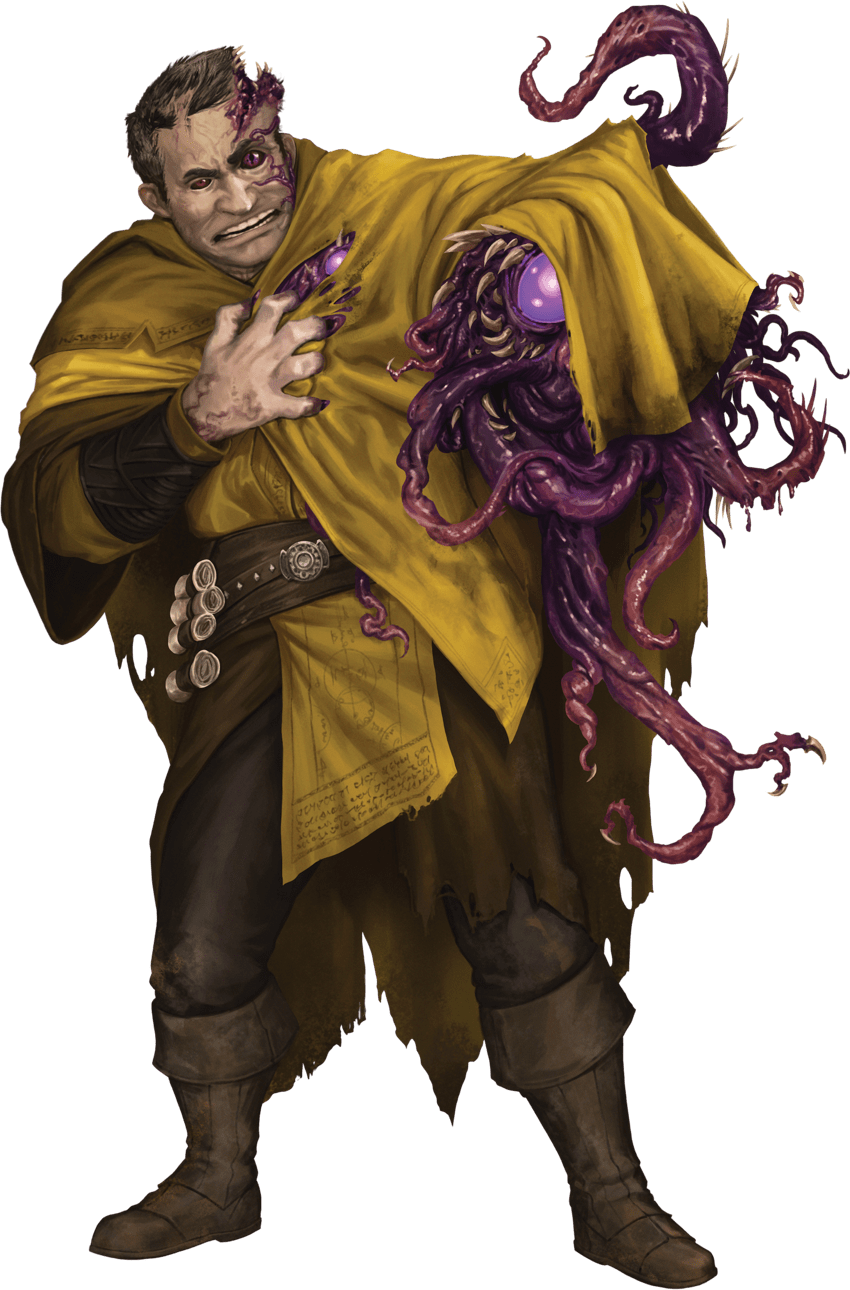
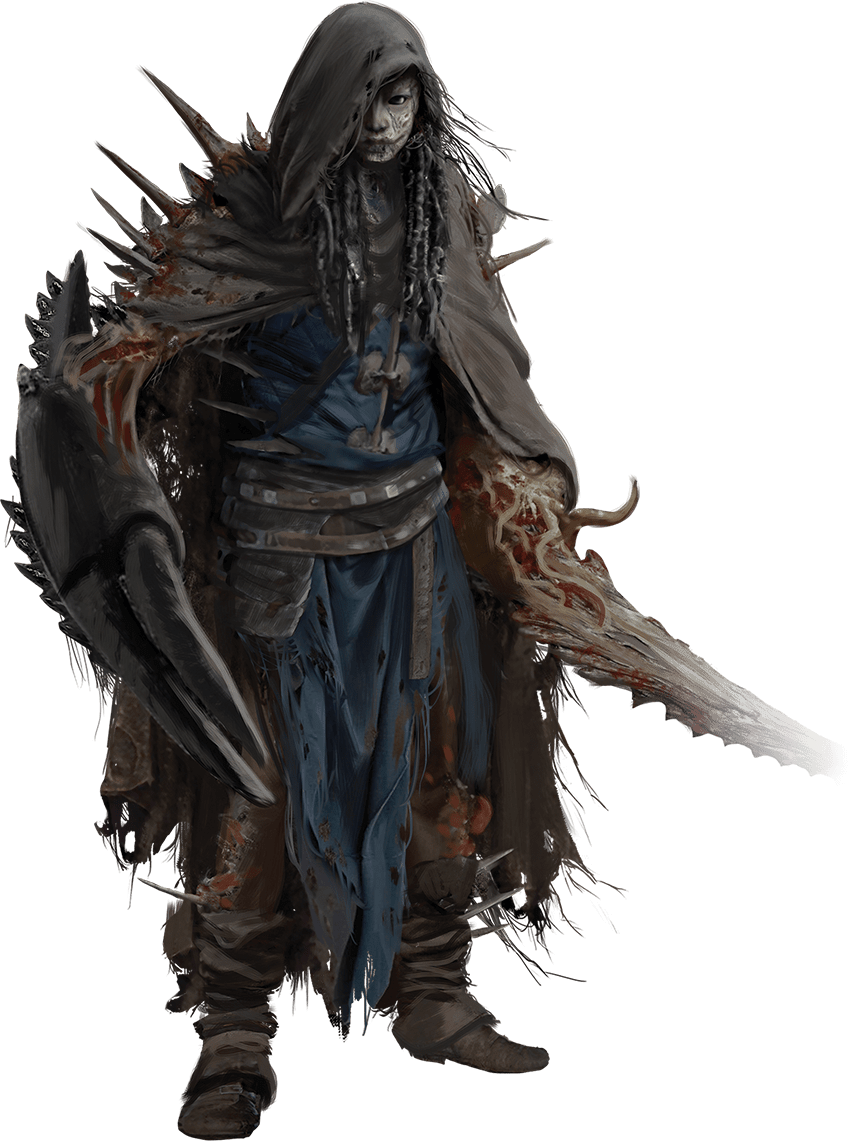
A cloaked figure flees through the dimly lit city streets. The guards appear to have the upper hand, until she turns to greet them—a hulking mass of spines, claws, and gnashing maws.
Lightning cracks. A mad doctor bellows in triumph as a fresh corpse rises. With three fleshy tentacles sprouting from her back, the doctor’s newest creation is complete. Thunder booms as the woman approaches the doctor menacingly, tendrils extended. Not all successful experiments end well.
Aberrant Horrors are the result of a Humanoid becoming an Aberration. Able to break free from the physical restrictions imposed upon them by the natural laws of the world, they shift the components of their form at a whim. This makes Aberrant Horrors terrifying to behold, especially in battle. Many adversaries are caught off-guard when a seemingly defenseless opponent suddenly sprouts rows of gruesome spines.
Becoming an Aberrant Horror
Every Aberrant Horror begins with a defining question: what happened to them? Some individuals make pacts with ancient entities for powers that have unforeseen effects. Others awaken after defeating an unnatural monster, surprised that they survived, only to feel something writhing in their stomach. Many tropes of body horror can be used as inspiration for an Aberrant Horror’s creation.
Once you've established your origin, consider your character’s motivations regarding their Transformation. As their power grows and manifests, they may feel they have lost what makes them fundamentally themselves. Perhaps they decide to take revenge on the entity responsible for their Transformation, or perhaps they perceive their mutation as a gift.
Reversing Aberrant Horror Traits
Once the character reaches Stage 1 of the Aberrant Horror Transformation, the Boons and Flaws they’ve received cannot be removed by normal or even typical magical means. Some magic might slow or halt the mutations that the character endures, but magic on the level of the Wish spell is needed to completely remove the Transformation and its Boons and Flaws.
Aberrant Horror Stages
At each stage of this Transformation, follow the instructions provided for that stage.
Achieving a New Stage
To move from one stage to the next higher one in this Transformation, an event or some other notable occurrence tied to the story of the character should take place. The following events are suggestions for ones that might trigger a move to the next stage of the Transformation:
- Become exposed to magic of an unearthly or transformational nature
- Rest in the vicinity of a cursed item or site
- Offer prayers to an Aether Kindred and fulfil the quest they show you in your dreams
- Drink the blood or other fluids of an Aberration that is still alive
Player Agency
Some abilities or flaws dictate the way creatures respond to a character, such as the Hideous Appearance flaw that makes creatures Hostile. Other player characters always have the choice how they react to these revelations.
Aberrant Horror Stage 1
When you initially undergo the Aberrant Horror Transformation, you gain both Stage 1 Boons and the Stage 1 Flaw.
Stage 1 Boon: Aberrant Form
Aberrant Horror Stage 1 Boon
Your creature type becomes Aberration in addition to any other creature types you have.
Also, the first time you become Bloodied after a Short or Long Rest, you gain a number of Temporary Hit Points equal to your Proficiency Bonus plus your current Transformation Stage.
Stage 1 Boon: Aberrant Mutation
Aberrant Horror Stage 1 Boon
Your body can twist and reshape itself as you will it, changing body parts into dangerous or useful tools and regenerating after taking damage. These abilities are represented by Aberrant Mutations. You can manifest an Aberrant Mutation listed below a number of times equal to your Proficiency Bonus plus your current Transformation Stage.
Each of these Aberrant Mutations last for 1 minute, and you can end them early by spending a Bonus Action to remove them or take on a different mutation. If you choose another Aberrant Mutation, you must spend another use of this feature.
You regain all uses of this ability when you finish a Short or Long Rest.
Chitinous Shell. As a Bonus Action, you grow a hard, crustacean-like shell. While this mutation is active and are not wearing heavy armor, your Armor Class increases by 2. While you maintain this shell, your Speed is reduced by 10 feet.
Eldritch Limbs. As a Bonus Action, you transform one or both of your arms into thick muscle, scything claws, or sharpened bone. When you use the Attack action, you can replace one or more attacks with melee attacks made with your eldritch limb. You are considered proficient with this attack, and it uses either Strength or Dexterity (your choice). On a hit, the attack deals 1d8 damage (either Bludgeoning, Piercing, or Slashing, chosen each time you manifest the mutation).
As a Bonus Action, you can make a melee attack with your eldritch limb.
Your eldritch limbs cannot hold weapons, shields, or other items. They are not considered weapons or Unarmed Strikes.
Slimy Form. As a Bonus Action, you cover yourself in a slippery slime. You have Advantage on ability checks to escape a grapple, and you can use the Dash action as a Bonus Action. You also gain Resistance to Acid, Fire, and Cold damage while in this form.
Stage 1 Flaw: Unstable Form
Aberrant Horror Stage 1 Flaw
Your body becomes malleable and struggles to maintain any one physical shape. Upon completing a Long Rest after an adventuring day in which you took damage, you must roll 1d100 on the Unstable Form table and apply the corresponding mutation based on current your Transformation Stage. This mutation lasts until you finish another Long Rest.
Aberrant Horror Stage 2
When you reach Stage 2 of the Aberrant Horror Transformation, you select one Stage 2 Boon and gain the Stage 2 Flaw.
Stage 2 Boon: Efficient Killer
Aberrant Horror Stage 2 Boon
When you make an attack with your eldritch limbs, you can gain an added ability based on the damage type you have chosen.
Piercing. You may replace any attack made with your eldritch limb with a razor-sharp barb hurled at the target. You are considered proficient with this barb, which has a Range of 20/60, has the Finesse and Thrown properties, and deals 2d6 Piercing damage on a hit.
Bludgeoning. You manifest a long tentacle, tipped with a hardened bone club. Your eldritch limb attack deals an additional 1d8 Bludgeoning damage. Also, the attack uses the Slow Weapon Property, which you have Mastery with.
Slashing. Your arm forms a row of viciously hooked claws and talons. Your eldritch limb attack deals an additional 1d8 Slashing damage. Also, the attack uses the Graze Weapon Property, which you have Mastery with.
Stage 2 Boon: Writhing Tendrils
Aberrant Horror Stage 2 Boon
You gain the ability to grow long, tendril-like appendages out of your body. As a Bonus Action, these tendrils sprout from you. While you maintain these tendrils, you gain the following benefits:
- When a creature moves to within 5 feet of you, you can try to push it back as a Reaction. Unless the creature succeeds on a Strength saving throw, it is pushed 5 feet away from you and its Speed is reduced to 0 until the start of your next turn. The DC of the saving throw is 8 plus your Proficiency Bonus plus your Transformation Stage.
- Your tendrils can protect you if you move. You can use a Bonus Action to Disengage.
- As a Reaction to being targeted with a melee attack, you can cause that creature to have Disadvantage on all melee attacks it makes that turn.
The tendrils last for 1 minute. You can use a Bonus Action to retract your tendrils.
You can use this ability a number of times equal to your Proficiency Bonus, and you regain all uses when you finish a Short Rest or Long Rest.
Stage 2 Flaw: Hideous Appearance
Aberrant Horror Stage 2 Flaw
Your appearance has grotesquely transformed. You may have turned into a hulking mass of flesh adorned with countless eyes, or a bone-and-tusk-covered behemoth. Regardless of your true form, you’re horrific to behold.
You can suspend this form and take on the appearance of the humanoid you once were, but this is taxing and requires effort. This form is not permanent, and moments of stress are likely to reveal your true nature. Your true form may be revealed in the following situations:
- Becoming Bloodied
- Concentrating on a spell
- Gaining the Unconscious condition
- Entering hallowed ground
- Choosing to reveal yourself
In these events, or times of other extreme emotional or physical stress, a GM can call or a Constitution saving throw with a DC based on your current Transformation Stage. If you fail this save, your Horrific Appearance is revealed.
| Hideous Appearance DCs | |
|---|---|
| Stage | Constitution Save DC |
| 2 | 13 |
| 3 | 16 |
| 4 | 20 |
Non-evil creatures that witness your true form become instantly Hostile to you, unless the GM decides otherwise.
Aberrant Horror Stage 3
When you reach Stage 3 of the Aberrant Horror Transformation, you select one Stage 3 Boon and gain the Stage 3 Flaw.
Stage 3 Boon: Terrifying Visage
Aberrant Horror Stage 3 Boon
Your mutations and unearthly appearance can unsettle even the bravest creatures. When you invoke your Aberrant Mutations or Writhing Tendrils, you choose one creature within 30 feet that can see you. That creature must succeed on a Wisdom saving throw or gain the Frightened condition for 1 minute. The DC for the saving throw is 8 plus your Proficiency Bonus plus your Transformation Stage. A creature that makes its saving throw is immune to this effect for 24 hours.
Stage 3 Boon: Constricting Tendrils
Aberrant Horror Stage 3 BoonPrerequisite:Writhing Tendrils
You gain an additional option for your Writing Tendrils mutation.
As a Bonus Action while Writhing Tentacles is active, you can attempt to restrain a creature within 5 feet of you with your tendrils. The creature must succeed on a Strength or Dexterity saving throw or gain the Restrained condition. The DC is 8 plus your Proficiency Bonus plus your Transformation Stage. A Restrained creature can take an action to make a Strength (Athletics) check against this DC, ending the condition on itself on a success. The Restrained condition ends if you are Incapacitated, you move from your current position, if you retract your tendrils, or if you use your tendrils to perform another ability.
Stage 3 Flaw: Unstable Existence
Aberrant Horror Stage 3 Flaw
Magic causes your physical form to unravel. Whenever you roll a natural 1 or 2 on a saving throw against a spell, you reveal your Hideous Appearance and must roll again on the Unstable Form table. If the result is less than your current Unstable Form effect, replace it with the new result.
The madness that comes with connecting with the Kindred is inevitable.
—Büracher Scholar
Aberrant Horror Stage 4
When you reach Stage 4 of the Aberrant Horror Transformation, you select one Stage 4 Boon and gain the Stage 4 Flaw.
Stage 4 Boon: Eldritch Aberration
Aberrant Horror Stage 4 BoonPrerequisite:Has Spell Slots
You gain the ability to deliver jolts of magical energy with your eldritch limbs. Once per turn, when you hit a creature with an attack using your eldritch limbs, you can expend a spell slot to deal additional damage equal to 1d6 per spell level expended. You can choose for this additional damage to be of any of the following types: Acid, Cold, Fire, Force, Lightning, or Thunder. If any of these extra dice show a 6 when rolled, the target has the Prone condition.
Stage 4 Boon: Poisonous Mutations
You have Resistance to Poison damage and are Immune to the Poisoned condition.
While you have an Aberrant Mutation active, any creature you choose that starts its turn within 5 feet of you takes 3d6 Poison damage unless they succeed on a Constitution saving throw. The DC for this saving throw is 8 plus your Proficiency Bonus plus your Transformation Stage.
Stage 4 Flaw: Entropic Abomination
Aberrant Horror Stage 4 Flaw
This Flaw replaces the Stage 3 Flaw: Unstable Existence. The very essence of magic and the effect of stress aggravates the unstable nature of your aberrant body. Each time you fail a saving throw, or the first time you become Bloodied after finishing a Long Rest, you must roll on the Unstable Form table. If the result is less than your current Unstable Form effect, replace it with the new result.
| Unstable Form | ||||
|---|---|---|---|---|
| Stage 1 | Stage 2 | Stage 3 | Stage 4 | Effect |
| 01–02 | The stress of your Transformation becomes too much. You die. You cannot restored to life by any spell below level 5. | |||
| 01 | 03–04 | Your form becomes fragile. Your Hit Point Maximum is half your normal maximum. | ||
| 01 | 02–03 | 05–06 | Your body starts to lose cohesion. You have Disadvantage on all D20 Tests. | |
| 01–05 | 02–03 | 04–06 | 07–24 | Your body’s metabolism quickly drains your energy. You gain 2 Exhaustion levels. |
| 06–10 | 04–06 | 07–24 | 25–32 | You have trouble processing what is happening. After rolling Initiative, you have the Stunned condition until the end of your first turn. |
| 11–15 | 07–24 | 25–32 | 33–40 | Your limbs weaken. Your Speed (in all modes of movement) decreases by 15 feet and cannot be increased. |
| 16–24 | 25–32 | 33–40 | 41–48 | Your body does not react quickly to mental commands. You cannot take Reactions. |
| 25–32 | 33–40 | 41–48 | 49–56 | You are distracted by your changing form. You have Disadvantage on Wisdom (Perception) checks. |
| 33–40 | 41–48 | 49–56 | 57–64 | Your body becomes unable to fight off attacks. You have Disadvantage on Constitution saving throws. |
| 41–48 | 49–56 | 57–64 | 65–79 | You become clumsy. You have Disadvantage on Dexterity saving throws and Dexterity ability checks. |
| 49–56 | 57–64 | 65–79 | 80–87 | You lose blood or other vital fluids during your mutations. You cannot add your Constitution modifier to any Hit Point Dice spent to regain Hit Points. |
| 57–64 | 65–79 | 80–87 | 88–93 | Speaking is difficult. You can only utter one word during each turn. This does not hamper spellcasting. |
| 65–79 | 80–87 | 88–93 | 94–100 | No effect. |
| 80–87 | 88–93 | 94–100 | Your lower limbs become more powerful. Your Speed increases by 5 feet. | |
| 88–93 | 94–100 | Your flesh becomes more hardy. You start the day with 4 Temporary Hit Points per Transformation Stage. | ||
| 94–100 | Your body’s systems are enhanced. You have Advantage on Death Saving Throws. |
Fey
The soft strumming of a harp draws the children ever deeper into the dark wood. As they reach a moonlit clearing, they see a beautiful maid dressed in a gown of starlight. She turns her soft gaze upon them at the sounds of their gasps. “Welcome, little ones. Be not afraid.” She beckons them forward with a long, lithe hand. “Step into the ring so we may dance and play.”
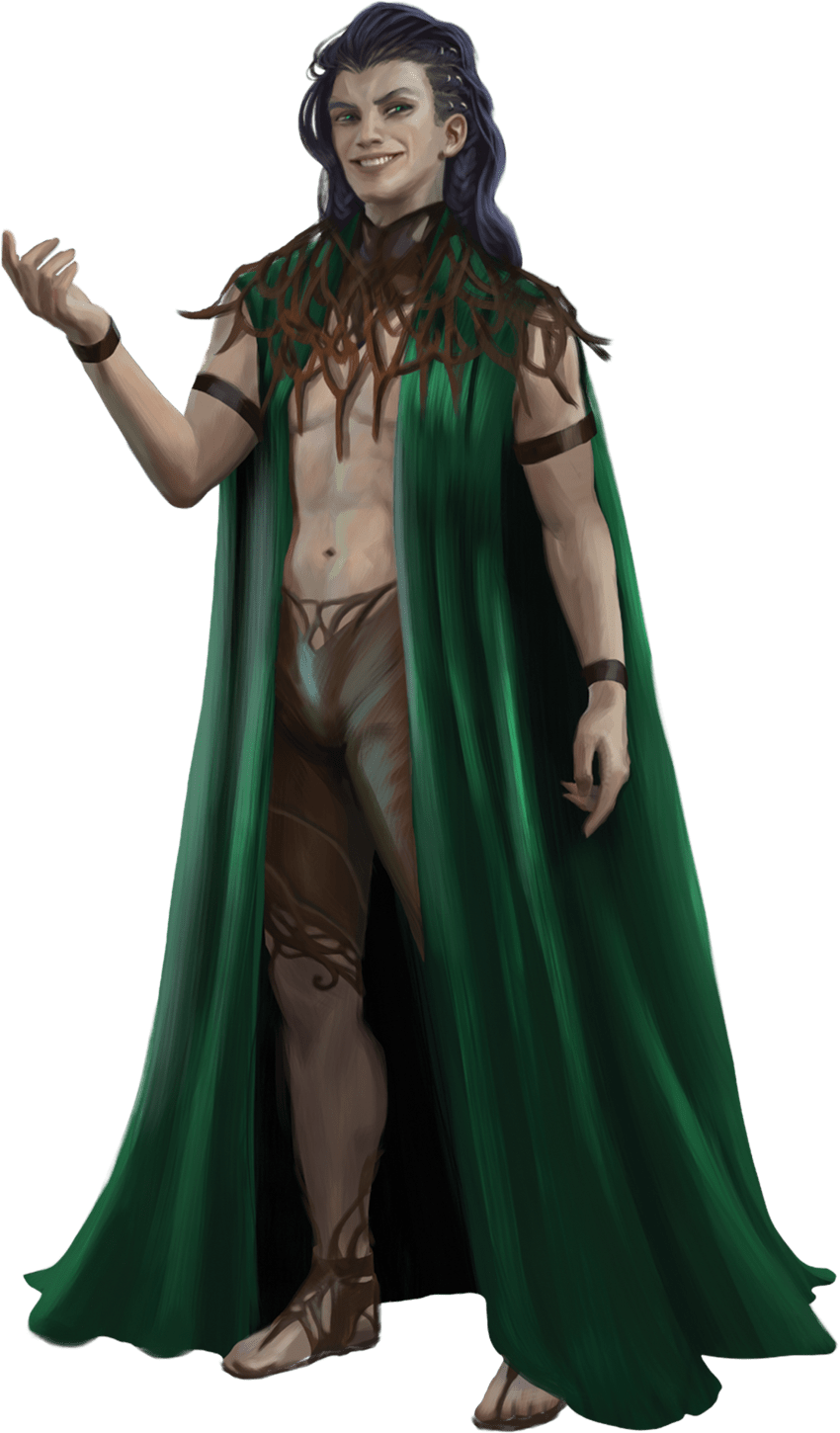
An elfin man with pale blue skin leans his forehead against the dying tree. As he softly hums, the shriveled leaves turn green once again, and the ancient bow begins to straighten. The man lets out a sigh of relief, which momentarily chills the air.
The Fey of Grim Hollow are mercurial and malleable beings of great power and even greater danger. No two Fey are quite alike, but their ties to the natural world and the Realm of Faerie are universal. Mortals cannot comprehend the level of true freedom the faerie people feel. To know such freedom is to change entirely—and to care not for the change such freedom brings to others.
Becoming a Fey
Becoming a Fey requires a direct connection to the Realm of Faerie. Many mortals who become Fey are stolen from the mortal realm as children. These children, known as changelings, transform rapidly after a few days trapped in the Realm of Faerie. A changeling’s transition is often painful or strange, for a child altered in this way does not have a say in what type of Fey creature they ultimately become.
Others might be born mortal but have the taint of Fey blood coursing through their veins. As they mature, their Fey features slowly manifest. More than a few innocent folks quickly learn of their Fey destinies immediately after a joyous birthday celebration.
A creature who voluntarily seeks to become a Fey can strike a deal with a Fey or beseech the court of a Faerie Queen. These pathways to transformation are as dangerous as the Realm of Faerie itself, and it requires a quick wit and sharp awareness to get the best of Feykind.
Reversing Fey Traits
The hold of the Fey over a mortal being is strong, but it’s even stronger when the mortal begins to show signs of Fey heritage. The rituals to reverse the Fey Transformation are dangerous and rarely successful.
Fey Stages
At each stage of this Transformation, follow the instructions provided for that stage.
Achieving a New Stage
To move from one stage to the next higher one in this Transformation, an event or some other notable occurrence tied to the story of the character should take place. The following events are suggestions for ones that might trigger a move to the next stage of the Transformation:
- Striking a bargain with a greater Fey creature
- Performing a great deed in the name of a Fey Queen
- Establishing a new faerie ring or bridge to the Realm of Faerie
- Defeating a powerful agent from your rival Fey Court
- Earning a domain or title in the Realm of Faerie
- Being born with Fey blood that starts manifesting Fey traits on the day of maturation
Fey Stage 1
When you initially undergo the Fey Transformation, you gain the Fey Form Boon and one other Stage 1 Boon of your choice. You also gain the Stage 1 Flaw.
Stage 1 Boon: Fey Form
Fey Stage 1 Boon
Your creature type becomes Fey in addition to any other creature type(s) you have.
Also, after you finish a Long Rest, pick a damage type from the following list: Acid, Cold, Fire, Lightning, Psychic, or Thunder. You gain Resistance to that damage type until you finish a Long Rest.
Stage 1 Boon: Servant of the Spring Court
Fey Stage 1 Boon
The Spring Court embodies carnal desires, rebirth, and the planting and sowing season. The Fey creatures of Spring tend to be capricious, unreliable, and quick to flare their emotions. This is the court most associated with satyrs and nymphs. Creatures of the Spring Court hide savage intentions and uncontrollable urges behind gentle words.
As a Bonus Action, you can magically teleport up to 30 feet to an unoccupied space you can see. One creature of your choice that you can see within 5 feet of your starting or ending space takes 1d6 Thunder damage. You can use this ability a number of times equal to your Proficiency Bonus, and you regain all uses when you finish a Long Rest.
Stage 1 Boon: Servant of the Summer Court
Fey Stage 1 Boon
The Summer Court embodies the lush warmth and manic celebration of the growing season. The Fey creatures of Summer tend toward joviality, excess, and vanity. This is the court most associated with dryads and pixies. Creatures of the Summer Court often hide their narcissism and cruelty behind beautiful façades.
As a Bonus Action, you can magically teleport up to 30 feet to an unoccupied space you can see. One creature of your choice that you can see within 5 feet of your starting or ending space takes 1d6 Fire damage. You can use this ability a number of times equal to your Proficiency Bonus, and you regain all uses when you finish a Long Rest.
Stage 1 Boon: Servant of the Autumn Court
Fey Stage 1 Boon
The Autumn Court embodies the careful scheming and approaching rot of the harvesting season. The Fey creatures of Autumn tend to be devious, scheming, and full of secrets. This is the court most associated with treants and other plant fey. Creatures of the Autumn Court often appear beautiful and helpful, but in truth their forms are hideous and methods vile.
As a Bonus Action, you can magically teleport up to 30 feet to an unoccupied space you can see. One creature of your choice that you can see within 5 feet of your starting or ending space takes 1d6 Poison damage. You can use this ability a number of times equal to your Proficiency Bonus, and you regain all uses when you finish a Long Rest.
Stage 1 Boon: Servant of the Winter Court
Fey Stage 1 Boon
The winter court embodies the stillness, darkness, and death of the coldest season. The Fey creatures of Winter tend to be serious, cruel, and reflective. Creatures of the Winter Court are often terrifying to behold and very direct about their intentions.
As a Bonus Action, you can magically teleport up to 30 feet to an unoccupied space you can see. One creature of your choice that you can see within 5 feet of your starting or ending space takes 1d6 Cold damage. You can use this ability a number of times equal to your Proficiency Bonus, and you regain all uses when you finish a Long Rest.
Stage 1 Flaw: Planar Binding
Fey Stage 1 Flaw
Your body and soul have been saturated with the magical energy of the Realm of Faerie. Rather than inuring you to the essence of magic, it has made you more susceptible. After finishing a Short or Long Rest, you have Disadvantage on the first saving throw you make against a spell originating from an enemy.
Fey Stage 2
When you reach Stage 2 of the Fey Transformation, you select one Stage 2 Boon and gain the Stage 2 Flaw.
Stage 2 Boon: Two-Faced
Fey Stage 2 Boon
You can transform your face into a vision of enchantment or horror that affects creatures around you, based on the Fey Court you serve. As a Magic action, you take on this visage. Creatures within 30 feet who can see you must succeed on a Charisma saving throw with a DC equal to 8 plus your Charisma modifier plus your Transformation Stage or be affected for 1 minute.
You can do this a number of times equal to your Proficiency Bonus, and you regain all uses after finishing a Long Rest.
Spring. Any creature that fails the saving throw has the Stunned condition. The creature can attempt a Constitution saving throw at the end of each of their turns to end the condition. This effect ends early on a creature if you or an ally deal damage to it or take other harmful actions.
Summer. Any creature that fails the saving throw gains the Charmed condition. This effect ends early on a creature if you or an ally deal damage to it or take other harmful actions.
Autumn. Any creature that fails the saving throw gains the Poisoned condition. The creature can attempt a Constitution saving throw at the end of each of their turns to end the condition.
Winter. Any creature that fails the saving throw becomes Frightened of you. This effect ends early if a creature affected by this ability ends its turn out of your line of sight.
Stage 2 Boon: Magic Tricks
Fey Stage 2 Boon
Your Fey masters provide you with the ability to weave magic based on your Fey Court allegiance. You gain the ability to cast one cantrip, one level 1 spell, and one level 2 spell. You can cast each of these once without using a spell slot or needing spell components. You regain the ability to cast these spells when you finish a Long Rest. The DC for these spells is 8 plus your Proficiency Bonus plus your Transformation Stage.
Spring. Your cantrip is Poison Spray, and your spells are Fog Cloud and Misty Step.
Summer. Your cantrip is Fire Bolt, and your spells are Burning Hands and Flame Blade.
Autumn. Your cantrip is Shillelagh, and your spells are Thunderwave and Ray of Enfeeblement.
Winter. Your cantrip is Ray of Frost, and your spells are Ice Knife and Darkness.
Stage 2 Flaw: Queen’s Command
Fey Stage 2 Flaw
The Fey court lends you its power, and in exchange you must pay regular tribute to maintain your freedom. Twice a year, at times relevant to the Fey Court that you serve—such as the solstices or the equinoxes—you must deliver a treasure or other significant tribute to your ruling Fey Queen.
If your queen considers the tribute lacking, you are immediately notified of your failure and are given detailed instructions on how to atone. You have Disadvantage on all D20 Tests until you rectify the situation. If you do not satisfy your queen’s demand in one week’s time, your queen transports you immediately to her Fey Court, where you must answer for your insolence. Once transported in this way, you must remain in the Realm of Faerie for 100 years, or until you strike a bargain with your queen to let you return to the Material Plane.
Your GM will tell you what constitutes an appropriate tribute to the court. Some Fey Queens prefer magic items while others wish for long-kept secrets, the capture of Fey criminals, or Humanoid servants.
Fey Stage 3
When you reach Stage 3 of the Fey Transformation, you select one Stage 3 Boon and gain the Stage 3 Flaw.
Stage 3 Boon: Illusionary Cloak
Fey Stage 3 Boon
You can use a Magic action to wrap yourself in an illusionary cloak for up to 1 hour. During this time, you can make yourself look like another creature of your general size and humanoid shape. This illusion ends when you use a Bonus Action to end it, or if you die or gain the Unconscious condition.
A creature can pierce the illusion by taking the Study action and succeeding on a DC 20 Intelligence (Investigation) check, thus seeing your true form.
Stage 3 Boon: Tooth and Claw
Fey Stage 3 Boon
You can manifest fangs, tusks, claws, or other means of harming your enemies. These manifestations also deliver a powerful magic jolt.
As a Bonus Action, you manifest some natural defense mechanism for 1 minute. This gives you the following benefits:
- You manifest a Claw, Bite, or Gore attack that you may use in place of any weapon attack. This manifested attack deals 1d6 plus your Strength or Dexterity modifier Slashing damage. You are proficient with this attack, and you add either your Strength or Dexterity modifier to attack and damage rolls. This attack is not an Unarmed Strike, nor can it be used in place of an Unarmed Strike.
- After taking an Attack action that did not use your manifested attack, you may take a Bonus Action later in that turn to use your manifested attack once.
- Once per round, when you hit a target with a manifested attack, you can choose to deal an additional 2d6 Psychic damage to the target. The creature must succeed on a Constitution saving throw or have the Stunned condition until the end of its next turn. The DC is 8 plus your Proficiency Bonus plus your Transformation Stage.
You can use this ability a number of times equal to your Proficiency Bonus plus your Transformation Stage. You regain all uses of this ability after completing a Long Rest.
Stage 3 Boon: Dreams and Nightmares
Fey Stage 3 Boon
You gain the ability to manipulate the mind of mortal beings. As a Bonus Action, choose a Humanoid you can see within 30 feet of you. That creature must succeed on a Wisdom saving throw. The DC is 8 plus your Proficiency Bonus plus your Transformation Stage.
On a failed saving throw, the creature has the Paralyzed condition, as it is stuck in a blissful dream or a terrifying nightmare. The condition lasts for 1 minute. The target can attempt the Constitution saving throw at the end of each of its turns and each time it takes damage.
You can choose to concentrate on the effect as you would a spell. If you are concentrating on the effect when the target attempts its saving throw, the target has Disadvantage on the saving throw.
You can use this ability a number of times equal to your Proficiency Bonus, and you regain all uses of this ability when you finish a Long Rest.
Stage 3 Flaw: Weakened Constitution
Fey Stage 3 Flaw
Your connection to the Fey Courts has granted you tremendous power but also an inherent fragility. When you become Bloodied for the first time after you roll Initiative, you must succeed on a DC 20 Constitution saving throw. On a failed save, you gain a level of Exhaustion.
As a Magic action, you can expend a number of Hit Point Dice equal to your Transformation Stage to remove one level of Exhaustion gained in this manner. You gain no other benefit from those expended Hit Point Dice.
Fey Stage 4
When you reach Stage 4 of the Fey Transformation, you select one Stage 4 Boon and gain the Stage 4 Flaw.
Stage 4 Boon: Greater Magic Tricks
Fey Stage 4 BoonPrerequisite:Magic Tricks
Your Fey masters provide even further magical abilities. You gain the ability to cast one level 3 spell, one level 4 spell, and one level 5 spell. You can cast each of these once without using a spell slot or needing spell components. You regain the ability to cast these spells when you finish a Long Rest. The DC for these spells is 8 plus your Proficiency Bonus plus your Transformation Stage.
Spring. Your spells are Stinking Cloud, Vitriolic Sphere, and Cloudkill.
Summer. Your spells are Fireball, Fire Shield, and Dream.
Autumn. Your spells are Lightning Bolt, Blight, and Hold Monster.
Winter. Your spells are Vampiric Touch, Ice Storm, and Cone of Cold.
Stage 4 Boon: Twilight Glamour
Fey Stage 4 Boon
As a Magic action, you gain the Invisible condition for 1 hour or until you end it as a Bonus Action. If you make an attack roll, deal damage, or cast a spell that causes the target to make a saving throw, the remaining duration changes to 1 minute.
You can use this ability twice, and you regain all uses after finishing a Long Rest.
Stage 4 Flaw: Seasonally Affected
Fey Stage 4 Flaw
Your connection to the Realm of Fey has a stronger pull on you. You have Disadvantage on Death Saving Throws as the Fey Court attempts to claim your soul as their own.
Additionally, you gain Vulnerability to a certain damage type based on the Fey Court that you are pledged to. You cannot benefit from Resistance or Immunity to that damage.
Spring. You are Vulnerable to Necrotic damage.
Summer. You are Vulnerable to Cold damage.
Autumn. You are Vulnerable to Radiant damage.
Winter. You are Vulnerable to Fire damage.
When the veil between the land of Faerie and our world is thin and parted, people can easily cross over to the other realm. Sometimes it’s planned, often it’s accidental, but the effects of the journey stay with a mortal creature forever.
—Charneaultian Explorer
Fiend

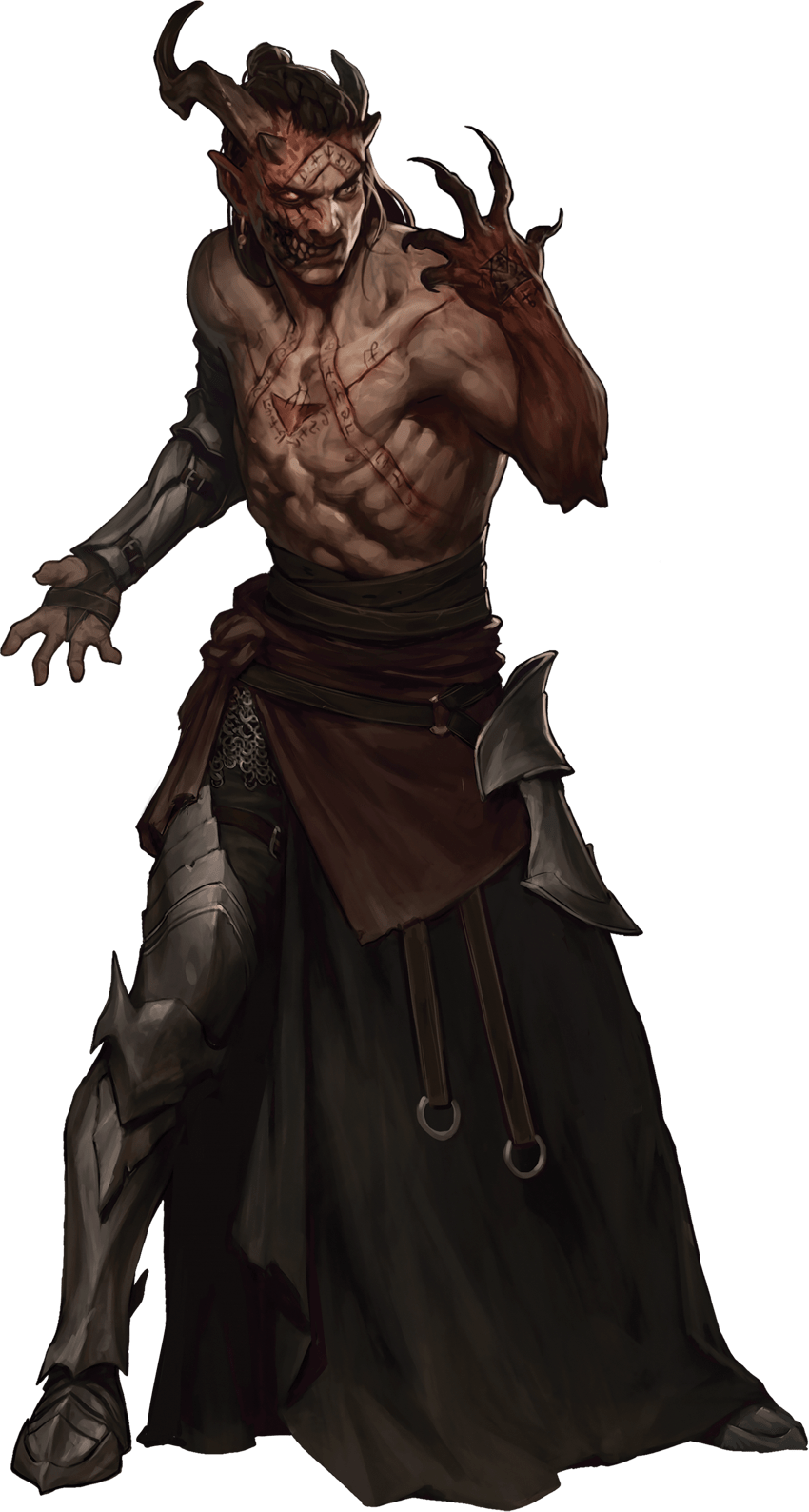
The strange man sat back from the candle on the table. The small flame barely sputtered since he entered the room, yet its glint caught in the man’s dark eyes. The commoner sitting opposite the stranger stared at a parchment on the table, admitting, “I’d like to sign, sir, but I’m afraid I don’t know my letters.” The man’s pale hand entered the candlelight, offering a small needle. “That’s alright,” he spoke softly, “a single drop will do.”
A priest screams as the Fiend presses her thumbnail into his forehead. A blasphemous rune burns itself into his skin. She grins at the smell. The priest collapses, horror etched onto his face, his shaking hand reaching for the brand. “Don’t weep,” the Fiend purrs, “to whom did you think you prayed?”
Many tales are told in Etharis of the evil of fiends. Folks fear meeting a stranger at the crossroads, lest they be tempted towards the wickedness resting in their own heart. A champion rises from a battlefield of broken bodies, a blood tithe paid for their glory. A fortune is gained by draining wealth from the needy. Fiends are the brokers of bargains that reward only the ruthless, selfish, jealous, and cruel. The true horror is that many Fiends began as mortals who surrendered to that seed of evil nested in their heart.
Becoming a Fiend
A mortal can become a Fiend in a variety of ways. Some forfeit their souls and become one upon death. Others undertake excruciating rituals to be granted forbidding power by an Arch Daemon. Some mortals may become Fiends unintentionally, as a reward or punishment for their life of cruelty and misdeeds. Yet it is rare for a creature to be chosen to join the legions of the Netherworld without first having made a bargain for such a gift.
Communicating with your GM about creating deals with mortals in their story is a great way to roleplay your influence within the game world. As a Fiend, you should consider your character’s motivations and which NPCs might serve to achieve their goals.
Are you in service of a particular Arch Daemon or dark deity? Do you follow only your own ambitions, making the necessary bargains to do so? What evils will you exact upon the world, and to what ends? Fiends rarely behave without ambition, even if that is simply corrupting as many mortals as you can convince to sign a contract.
Reversing Fiend Traits
Transforming into a Fiend usually requires deeds of great evil. You may have performed blood sacrifices or made bargains that resulted in others suffering. Even magic on the level of the Wish spell could not atone for your actions or redeem your soul. Only once you perform a deed of incredible sacrifice or atonement could such magic remove your Transformation boons and flaws.
Fiend Stages
At each stage of this Transformation, follow the instructions provided for that stage.
Achieving a New Stage
To move from one stage to the next higher one in this Transformation, an event or some other notable occurrence tied to the story of the character should take place. The following events are suggestions for ones that might trigger a move to the next stage of the Transformation:
- Defeating a greater rival Fiend and taking their place in the hierarchy.
- Ensnaring a particularly powerful or influential soul with a contract.
- Establishing a cult of worshipers who offer their strength to you.
- Establishing a portal between the material plane and the Netherworld.
- Killing or corrupting a Seraph.
Fiend Stage 1
When you initially undergo the Fiend Transformation, you gain the Fiendish Soul Boon and one other Stage 1 Boon of your choice. You also gain the Stage 1 Flaw.
Stage 1 Boon: Fiendish Soul
Fiend Stage 1 Boon
You become a Fiend in addition to any other creature type(s) you have. You have Advantage on Charisma (Deception) checks.
Additionally, choose one of the following damage types and gain Resistance to it: Acid, Cold, or Fire.
Stage 1 Boon: Devilish Contractor
Fiend Stage 1 Boon
You have acquired the ability to bind mortal creatures to your will. You can create a contract to bind a mortal Humanoid’s soul to you, feeding on its power. The mortal gains a gift asked for in the contract, and you gain a Gift of Damnation of your choice. (See Gifts of Damnation at the end of this Transformation.)
To bind a mortal’s soul to you, you must first create a contract for their desired gift. A contract requires magical ink and paper worth 10 GP for each Transformation Stage you have acquired.
You and the mortal must both sign the contract willingly, fully aware of the costs involved. Once signed, daemonic entities give you a Gift of Damnation, and the mortal receives their desired wishes within 7 days. You do not have to provide this boon yourself.
For example, upon signing a contract for a Gift of Unfettered Glory, you receive the benefits listed for that gift. The mortal who signs receives their stated desire, provided by the dubious powers of the Netherworld. You cannot benefit directly from the mortal’s desired gift, nor can an ally. No ally of yours can ever sign a contract with you.
You may take a Gift of Damnation of the Stage that you have attained or lower. For example, if you are at Stage 2 of the Transformation, you may only take a Stage 1 or Stage 2 Gift of Damnation.
There is no limit to the number of contracts you can execute, but you can only have one active Gift of Damnation at a time. When you would gain a second Gift of Damnation, you may replace your active gift with the new one. Also, when you finish a Long Rest you may swap your active Gift of Damnation for any other gift associated with a signed contract.
Stage 1 Boon: Infernal Smite
Fiend Stage 1 Boon
Once on each of your turns, you can choose one creature you have just damaged with a weapon attack, an Unarmed Strike, or a cantrip. Deal an extra 1d6 Acid, Cold, or Fire damage to that creature, using the same damage type you chose for Fiendish Soul. You can add this damage a number of times equal to your Proficiency Bonus plus your Transformation Stage, but no more than once per damage roll. You regain all uses of this ability when you finish a Short Rest or Long Rest.
At higher Transformation Stages, you do an additional 1d6 of damage per Transformation Stage, for a total of 2d6 at Stage 2, 3d6 at Stage 3, and 4d6 at Stage 4.
Stage 1 Flaw: Fiend Bound
Fiend Stage 1 Flaw
Your body and soul are bound to the Netherworld. You have Disadvantage on Death Saving Throws as the plane attempts to pull you into it.
Fiend Stage 2
When you reach Stage 2 of the Fiend Transformation, you select one Stage 2 Boon and gain the Stage 2 Flaw.
Stage 2 Boon: Daemonic Brand
Fiend Stage 2 Boon
As a Bonus Action on your turn, you can brand a creature within 60 feet of you that you can see with a fiery mark that remains on them for 1 minute. If the target succeeds on a Wisdom saving throw, they are not branded. The DC of the saving throw is 8 plus your Proficiency Bonus plus your Transformation Stage.
If the creature fails the saving throw, you choose one of the following effects that lasts for the duration:
- The creature takes a –2 penalty on all saving throws.
- The first attack against the creature on each turn is made with Advantage.
- The creature cannot regain Hit Points.
You can use this ability a number of times equal to your Proficiency Bonus, and you regain all uses when you finish a Long Rest.
Stage 2 Boon: Enhanced Contract
Fiend Stage 2 BoonPrerequisite:Devilish Contractor
You may switch between your active Gift of Damnation at the end of a Short or Long Rest. In addition, when you switch Gifts of Damnation, you gain Temporary Hit Points equal to 5 times your Transformation Stage.
Stage 2 Flaw: Fiend Form
Fiend Stage 2 Flaw
Your appearance has grotesquely transformed. Your skin becomes red and leathery, and vicious horns, teeth and nails erupt through the surface of your skin. You can suppress this form and present the appearance of the humanoid you once were, but this is taxing and requires effort. Moments of stress are likely to reveal your true nature. In the following situations your true form may be revealed:
- Becoming Bloodied
- Concentrating on a spell
- Gaining the Unconscious condition
- Entering hallowed ground
- Entering the presence of Celestials or other Fiends
- Choosing to reveal yourself
In these events, or times of other extreme emotional or physical stress, a GM can call or a Constitution saving throw with a DC based on your current Transformation Stage. If you fail this save, your Horrific Appearance is revealed.
| Fiend Form Save DC | |
|---|---|
| Stage | Constitution Save DC |
| 2 | 13 |
| 3 | 16 |
| 4 | 20 |
Non-evil creatures that witness your true form become instantly Hostile to you, unless the GM decides otherwise.
Fiend Stage 3
When you reach Stage 3 of the Fiend Transformation, you select one Stage 3 Boon and gain the Stage 3 Flaw.
Stage 3 Boon: Devilish Subcontractor
Fiend Stage 3 BoonPrerequisite:Enhanced Contract
You may gain the benefits of two Gifts of Damnation at the same time. You may still only switch one Gift of Damnation after a Short or Long Rest.
Stage 3 Boon: Overwhelming Brand
Fiend Stage 3 BoonPrerequisite:Daemonic Brand
You can apply one of the following additional effects to a creature under the effect of your Daemonic Brand.
- The creature’s Speed is halved, and you can move the creature up to 10 feet horizontally on your turn (no action required).
- The creature has the Blinded condition. On your turn, you can choose to remove this condition (no action required).
Stage 3 Flaw: Pull of the Netherworld
Fiend Stage 3 Flaw
Your new native plane attempts to pull you to it, laying claim to your form. Whenever you roll a natural 1 on a D20 Test, you take 6d6 Psychic damage as the denizens of the fiendish plane attempt to unbind your soul from the Material Plane. This damage can only be taken once per Short Rest, and it ignores all Resistances and Immunities. If this damage reduces your Hit Points to 0, you die and your soul is immediately taken to the Netherworld. You can only be returned to life by spells of 7th level or higher.
Fiend Stage 4
When you reach Stage 4 of the Fiend Transformation, you select one Stage 4 Boon and gain the Stage 4 Flaw.
Stage 4 Boon: Abyssal Resistance
Fiend Stage 4 Boon
You gain Immunity to the damage type chosen for Fiendish Soul, and you gain Resistance to the other two damage types. Additionally, you have Resistance to damage from nonmagical weapon attacks or Unarmed Strikes.
Stage 4 Boon: Infernal Summons
Fiend Stage 4 Boon
As a Magic action, you can tear open a portal to the Netherworld and summon up to four Fiends of CR 4 or less within 30 feet of you. The Fiends remain for 1 minute before disappearing back to the Netherworld. (The GM can decide what Fiends answer the summons.)
The summoned Fiends are Friendly to you and your companions. They act directly after you in the initiative order. They obey any verbal commands that you issue to them (no action required by you). If you don’t issue any commands to them, they use the Dodge action on their turn and take no other movement, Bonus Actions, or Reactions unless it is to protect themselves.
Stage 4 Boon: Ultimate Brand
Fiend Stage 4 BoonPrerequisite:Overwhelming Brand
When a creature affected by your Daemonic Brand starts its turn, you can use a Reaction to dictate its move and the action it takes. If you do, the creature repeats the initial Wisdom saving throw at the end of its turn. On a success, you can't use this Reaction again while your brand lasts.
Stage 4 Flaw: True Name
Fiend Stage 4 Flaw
Your Fiend transformation is complete, and you are reborn. You are assigned a new name by the denizens of the Netherworld, which becomes your True Name. You receive a talisman of brimstone and brass with your true name inscribed in Infernal on it.
A creature with a Challenge Rating of 10 or higher within 10 feet of you that knows your True Name can use a Magic action and speak your True Name. You must succeed on a DC 20 Charisma saving throw or suffer the following effects for 1 minute. You may attempt a Charisma saving throw at the end of each of your turns to end the effects.
- You have the Charmed condition, even if you are Immune to being Charmed.
- As a Bonus Action, the entity that has spoken your True Name can force you to move up to your Speed and use your action to attack with a weapon, use your Unarmed Strike, or cast a cantrip against a target of their choice.
- All attacks against you have Advantage, and you have Disadvantage on saving throws.
- You cannot regain Hit Points or have Temporary Hit Points. You immediately lose any Temporary Hit Points you have.
Gifts of Damnation
Gifts of Damnation are named for the benefits you can gain after offering mortals gifts in exchange for their souls, via the Devilish Contractor Boon.
Stage 1 Gifts
You can gain Stage 1 Gifts whenever you sign a victim to an infernal contract.
Gift of Joyous Life
At the beginning of your turn, if you are Bloodied, you can choose to roll a Hit Point Die (no action required) and regain a number of Hit Points equal to the roll. If you roll a 1 on this die, you regain no Hit points and take 1 point of Force damage instead. You regain this ability when you finish a Short or Long Rest.
Gift of Prodigious Talent
Choose two Skills. Gain Expertise in the chosen skills.
If you roll a 1 or 2 on an Ability Check using one of the chosen skills, you immediately lose half your maximum number of Hit Point Dice, rounded down. You do not regain Hit Point Dice lost this way until you finish two Long Rests.
Gift of Unsurpassed Fortune
When an enemy you can see within 10 feet succeeds on an attack roll or a saving throw, you can use your Reaction to roll d20. On a 6 or higher, the triggering attack or save misses or fails, and you regain the use of your Reaction. Otherwise, you take 1d6 Psychic damage per Transformation Stage, which cannot be reduced. You regain your use of this ability when you finish a Long Rest.
Stage 2 Gifts
You can gain Stage 2 Gifts whenever you sign a victim to an infernal contract while at Stage 2 or higher of the Fiend Transformation.
Gift of Liberating Freedom
As a Bonus Action while aren't wearing Heavy armor, you can manifest a pair of leathery wings. You gain a Fly Speed equal to half your Speed. These wings recede if you dismiss them as a Bonus Action on your turn, if you have the Unconscious condition, or if you become Bloodied while they are manifested.
You can have your wing manifested for 1 hour total, including several shorter stints adding up to 1 hour. You regain your ability to use your wings for an hour after finishing a Long Rest.
Gift of Unfettered Glory
Each time you damage a creature with a melee attack, an Unarmed Strike, or a cantrip, you can do an additional 2 points Force Damage per Transformation Stage.
Each time you roll a Hit Point Die to regain Hit Points during a Short Rest, you regain 2 Hit Points fewer per Hit Die.
Stage 3 Gifts
You can gain these Gifts whenever you sign a victim to an infernal contract while at Stage 3 or higher of the Fiend Transformation.
Gift of Second Chances
When you are reduced to 0 Hit Points, you can use your Reaction to roll a Hit Point Die. If you roll a 2 or better, set your Hit Point total to the result of the roll. If not, you suffer a Death Saving Throw failure. You regain the use of this gift when you finish a Long Rest.
Gift of Unconditional Love
When a creature you can see within 30 feet of you fails a saving throw, you can use your Reaction to gain Temporary Hit Points equal to 1d10 plus your Transformation Stage. You regain the use of this gift when you finish a Short or Long Rest.
If you roll a 1 on the die, you gain no Temporary Hit Points and instead have the Prone condition.
Stage 4 Gifts
You can gain these Gifts whenever you sign a victim to an infernal contract while at Stage 4 of the Fiend Transformation.
Gift of Martial Prowess
Once per turn, when you miss with a weapon attack or Unarmed Strike, you can reroll the attack roll. If the reroll hits, you must spend 3 Hit Point Dice and add the result to the attack’s normal damage as Force damage. If the reroll misses, you must spend 3 Hit Point Dice and take Psychic damage equal to the result. If you have fewer than 3 Hit Point Dice available, you cannot use this gift.
Once you hit a target with an attack using a rerolled attack, you cannot use it again until you finish a Long Rest.
Gift of Unbridled Power
Upon finishing a Short Rest, you can spend 2 Hit Point Dice and regain a number of spell slot levels equal to the highest number rolled. However, you take Psychic damage equal to twice the total that you rolled. You regain the reuse of this gift when you finish a Long Rest.
Hag

In the heart of a forbidden forest, a lost hunter sees a modest cottage nestled among the trees. A bewitching maiden greets the hunter, offering him a bowl of stew to stave off both hunger and the chill night air. Seconds after eating the first spoonful, the hunter begins to feel unnaturally drowsy.
In the dark alleyways of the city, a woman hurries home from a long day at the marketplace selling her bread. A feeble man in filthy clothes asks her if she can spare a crust for a down-on-his-luck traveler. She scoffs at the request, spitting a curse toward the vagrant. Before she can round the next corner, she feels a cold shiver wrack her body. She is unable to take another step.
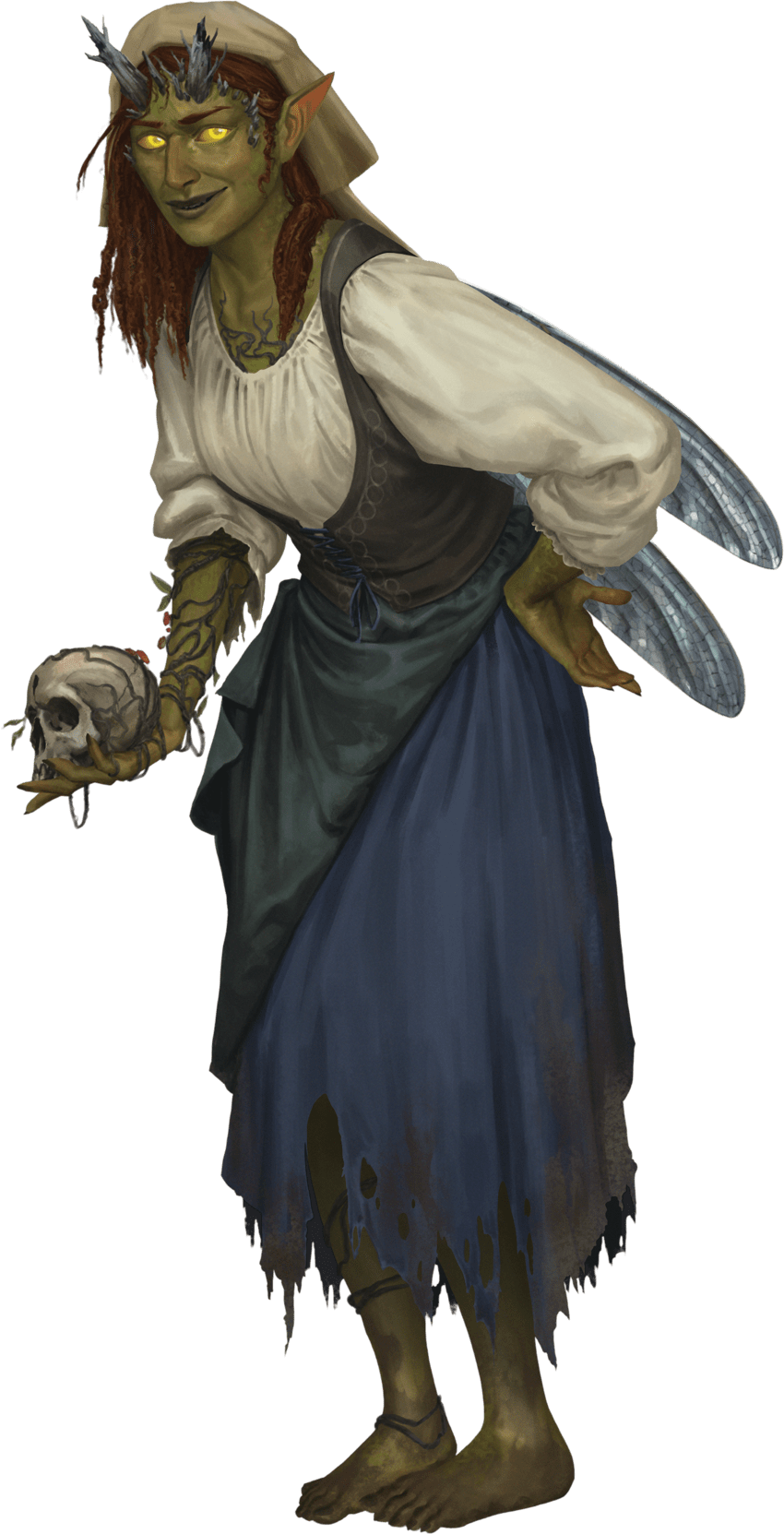
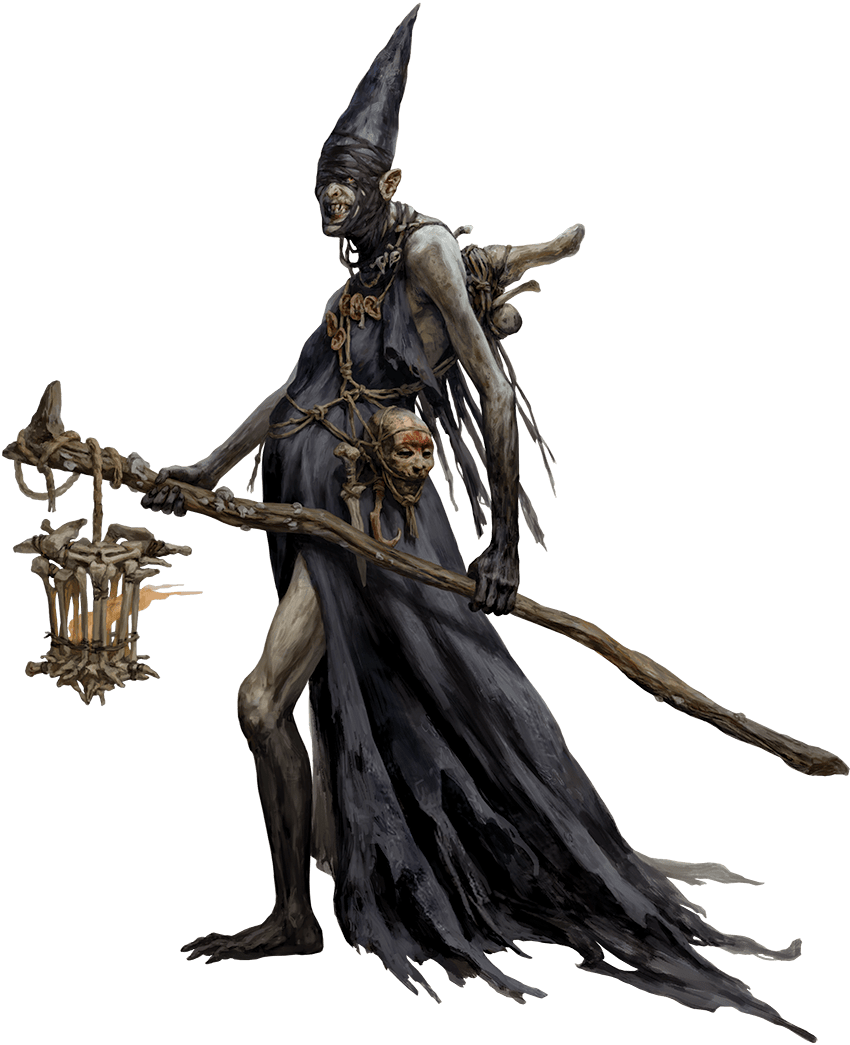
Hags of Grim Hollow take many shapes and forms, and their powers and goals are as diverse as any other creature who has connections to the Realm of Faerie. What is true of them all, however, is that they are as fickle as they are dangerous, and they often serve a special form of justice based on their own strange and sometimes contradictory codes of behavior. Hags revel in despoiling purity, whether it resides in nature or a mortal’s soul. While those that do not respect a Hag can find themselves in a stew or forced into service, Hags can be persuaded to forge dark bargains with those who offer polite deference.
Hags often have knowledge, power, and skills that are much sought after in Grim Hollow. Dealing with them to gain their help, however, often comes at the steepest of prices. Many have lost body, mind, and soul to a Hag’s deal. Others become Hags as payment for a curse or bargain.
Becoming a Hag
Few creatures are born Hags. Humanoids can become a Hag as a result of a ritual or a curse. Sometimes the offspring of a cursed individual becomes a Hag after reaching the age of maturity. Hags have ways of spawning fully mature Hags, but only the most depraved individuals would consider that any sort of birth.
Other Fey creatures see Hags as pitiful, revolting creatures who can never enjoy the blessing of an existence in the Realm of Faerie, so cursing a mortal to become a Hag is a particularly harsh consequence for angering a Fey. Hags themselves are fond of creating other Hags to join them and form a coven.
Very few people are twisted enough to seek to transform themselves into a Hag. The power it provides is not worth the pain and anguish that comes with it. Yet that power is attractive to some, who seek out the rituals to make the change or entreat Hags to twist them as part of a bargain.
Reversing Hag Traits
The Hag Transformation is one of the few that can be reversed, especially when it is bestowed via a curse rather than sought, but only in its first two stages. Once the creature travels too far down the path of maddening power, the grip has become too strong.
Reversing the Transformation, even in its early stages, is an elaborate process that may take months or years, and often only with the assistance of a benevolent fey creature willing to donate some of their magic to the process.
The last step of the reversal process requires a powerful Fey creature to participate in a ritual to remove all remnants of the transformative magic. As with most Fey, this participation almost always comes at a steep cost.
Hag Stages
At each stage of this Transformation, follow the instructions provided for that stage.
Achieving a New Stage
To move from one stage to the next higher one in this Transformation, an event or some other notable occurrence tied to the story of the character should take place. The following events are suggestions for ones that might trigger a move to the next stage of the Transformation:
- Striking a bargain with a powerful Hag
- Cursing or killing an innocent being under the new moon
- Drinking a poisonous draught from a dead Hag’s cauldron
- Becoming the victim of multiple curses at the same time
- Consuming the flesh of the innocent
- Crafting a Hag’s Eye or creating a Gasdra
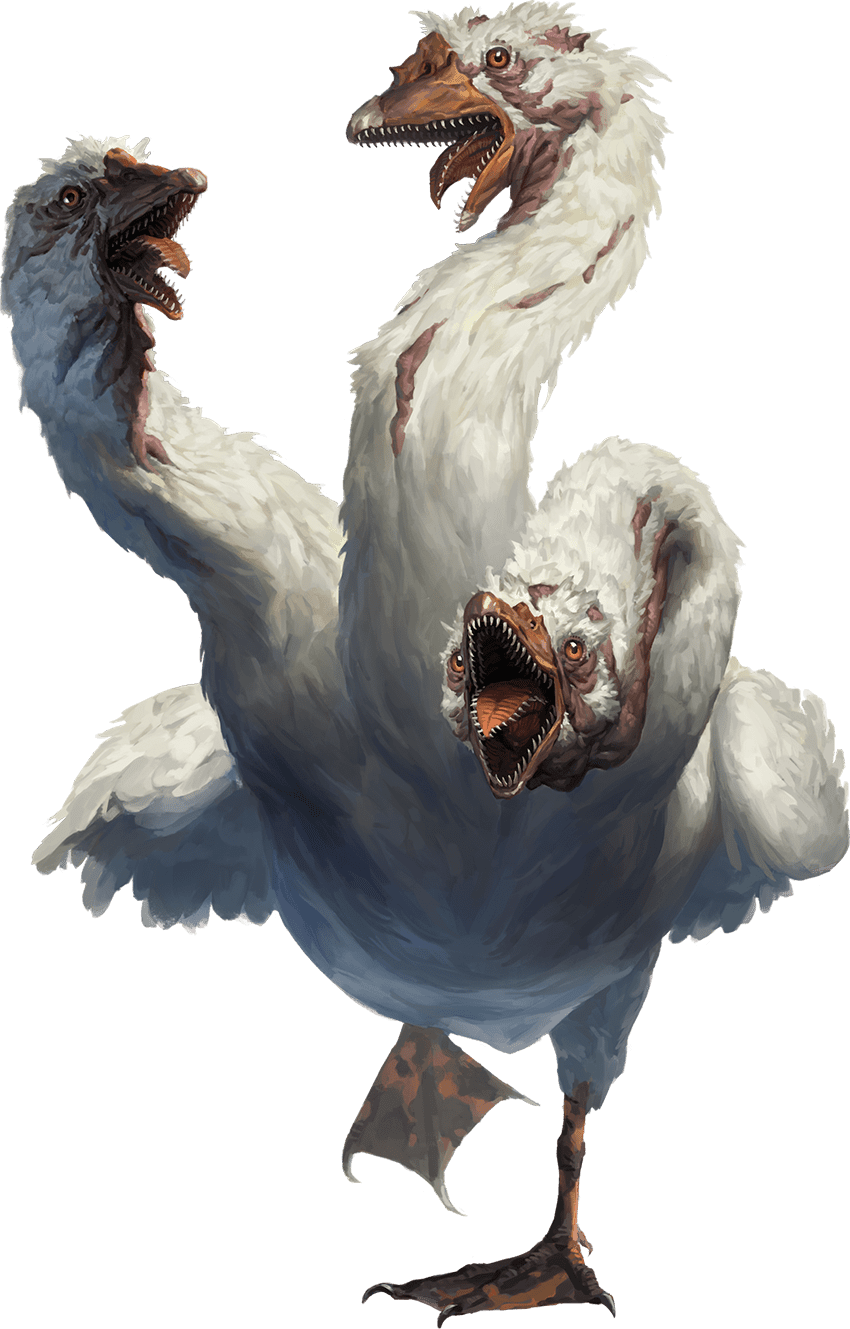
Gasdra
Small Monstrosity, Neutral Evil
AC 13 Initiative +4 (14)
HP 22 (4d6 + 8)
Speed 30 ft., Fly 40 ft.
| Ability | Score | Mod | Save |
|---|---|---|---|
| STR | 8 | -1 | -1 |
| DEX | 15 | +2 | +2 |
| CON | 15 | +2 | +2 |
| Ability | Score | Mod | Save |
|---|---|---|---|
| INT | 6 | -2 | -2 |
| WIS | 10 | +0 | +0 |
| CHA | 7 | -2 | -2 |
Skills Perception +2
Senses Darkvision 60 ft.; Passive Perception 12
Languages Understands Sylvan but can’t speak
Challenge 1 (XP 200; PB +2)
Traits
Three Heads. The gasdra has Advantage on Wisdom (Perception) checks and on saving throws to avoid or end the Blinded, Charmed, Deafened, Frightened, Stunned, or Unconscious conditions. The gasdra can take one Reaction for each of its heads. The extra Reactions can be used only for Opportunity Attacks.
Wakeful. While the gasdra sleeps, at least one of its heads is awake.
Actions
Multiattack. The gasdra makes three Beak attacks.
Beak. Melee Attack Roll: +4, reach 5 ft. Hit: 5 (1d6 + 2) Bludgeoning damage.
Hag Stage 1
When you initially undergo the Hag Transformation, you gain the Hag Form Boon and one other Stage 1 Boon of your choice. You also gain the Stage 1 Flaw.
Stage 1 Boon: Hag Form
Hag Stage 1 Boon
Your Creature Type becomes Fey in addition to any other creature type(s) you have.
Additionally, your connection with the magic of the natural world provides you with increased defenses. When you are not wearing armor, your Armor Class is 13 plus your Dexterity modifier. Additionally, choose Strength, Intelligence, or Charisma: you are proficient with Saving Throws using that ability score.
Stage 1 Boon: The Green Sisterhood
Hag Stage 1 Boon
Green Hags are skilled deceivers who collect corrupting magic and secret curses. They use their magic to twist pure into foul, poking at the weaknesses of their foes. Green Hags embrace magical deceptions and are known for their vile recipes. There are no worse cooks in Etharis.
- You have Darkvision with a range of 60 feet. If you already have Darkvision, its range increases by 60 feet.
- You become Amphibious and can breathe both air and water.
- You can mimic animal sounds and humanoid voices. A creature that hears the sounds can tell they are imitations with a Study action and a successful Wisdom (Insight) check with a DC equal to 8 plus your Charisma modifier plus your Transformation Stage.
Stage 1 Boon: The Red Sisterhood
Hag Stage 1 Boon
Red Hags are sometimes called the “nice” hags due to their ability to pretend to be helpful, but their kindness is a mask. While they are more subtle than other Hags and may choose to do good deeds, their motives are selfish. They delight in using honeyed words and offering deals that are just too good to pass up.
- You have Darkvision with a range of 60 feet.
- You gain proficiency in Deception and Persuasion. If you are already proficient, you gain Expertise instead.
- You are immutable. No effect can change your form, and an illusion can disguise you only if the illusion gives you the Invisible condition.
Stage 1 Boon: The Sea Sisterhood
Hag Stage 1 Boon
Sea Hags enjoy spreading chaos. They hate order and calm, creating elaborate deceptions that lead to despair when uncovered. Their appearances are especially hideous, and their gaze can cause fear, or even kill. You gain the following benefits.
- You have Darkvision with a range of 60 feet.
- You become Amphibious and can breathe both air and water. You gain a Swim Speed equal to your Speed. If you already have a Swim Speed, it increases by 10 feet.
- As a Magic action, you can gaze upon a creature you can see within 30 feet. If the creature fails a Wisdom saving throw with a DC equal to 8 plus your Charisma modifier plus your Transformation Stage, it takes 1d8 Psychic damage for each Transformation Stage you have.
Stage 1 Flaw: Hideous Appearance
Hag Stage 1 Flaw
Your appearance is grotesquely transformed. Your body, hair, and eyes change in ways mortals find abhorrent. Most creatures witnessing your true form become Hostile and no one is likely to trust you, unless the GM decides otherwise. You have Disadvantage on Charisma (Persuasion) checks.
You cannot stand to look upon your own reflection. The first time you see your reflection after a Short Rest or Long Rest, you must succeed on a DC 18 Wisdom saving throw or gain 1 Exhaustion level.
Your appearance changes based on your Stage 1 Sisterhood Boon:
Green Sisterhood. You wither or bloat as your body struggles to deal with the ravages of age. Your hair becomes white and several feet in length. Your skin becomes green and covered in warts and boils.
Red Sisterhood. Your eyes have turned entirely red, and your pupils are narrow like a cat’s. Your skin becomes blood red.
Sea Sisterhood. You have slimy scales and the pallid skin of a dead fish that sags from your emaciated body. Your hair resembles seaweed, and your eyes are glassy.
Hag Stage 2
When you reach Stage 2 of the Hag Transformation, you select one Stage 2 Boon and gain the Stage 2 Flaw.
Stage 2 Boon: Adept of the Green Sisterhood
Hag Stage 2 BoonPrerequisite:The Green Sisterhood
As your connection to your Green Sisterhood grows, your body and your magical skills strengthen.
- You gain a Claw attack that deals 1d6 plus your Strength or Dexterity modifier Slashing Damage. You are proficient with this attack, and you add either your Strength or Dexterity modifier to attack and damage rolls. This attack is not an Unarmed Strike, nor can it be used in place of an Unarmed Strike.
- You can hide yourself from others. As a Magic action, you can cast Invisibility without expending a spell slot. You can use this feature a number of times equal to your Transformation Stage. You regain all uses after finishing a Long Rest.
Stage 2 Boon: Adept of the Red Sisterhood
Hag Stage 2 BoonPrerequisite:The Red Sisterhood
As your connection to your Red Sisterhood grows, your body and your magical skills strengthen.
- You gain a Claw attack that deals 1d6 plus your Strength or Dexterity modifier Slashing Damage. You are proficient with this attack, and you add either your Strength or Dexterity modifier to attack and damage rolls. This attack is not an Unarmed Strike, nor can it be used in place of an Unarmed Strike.
- You can sway others to your will. As a Magic action, you can cast Charm Person without expending a spell slot. The spell save DC when cast in this way is 12 plus your Transformation Stage. You can use this feature a number of times equal to your Transformation Stage. You regain all uses after finishing a Long Rest.
Stage 2 Boon: Adept of the Sea Sisterhood
Hag Stage 2 BoonPrerequisite:The Sea Sisterhood
As your connection to your Sea Sisterhood grows, your body and your magical skills strengthen.
- You gain a Claw attack that deals 1d6 plus your Strength or Dexterity modifier Slashing Damage. You are proficient with this attack, and you add either your Strength or Dexterity modifier to attack and damage rolls. This attack is not an Unarmed Strike, nor can it be used in place of an Unarmed Strike.
- You can appear as someone other than yourself. As a Magic action, you can cast Disguise Self without expending a spell slot. The spell save DC when cast in this way is 12 plus your Transformation Stage. You can use this feature a number of times equal to your Transformation Stage. You regain all uses after finishing a Long Rest.
Stage 2 Flaw: Iron Sensitivity
Hag Stage 2 Flaw
Your body and soul connect back to the Realm of Faerie, and iron and steel weapons forged of the mortal realm cause you pain. After each Short or Long Rest, the first time you are damaged by an iron or steel weapon, you must succeed on a DC 15 Constitution saving throw or have the Stunned condition until the end of your next turn.
Eye of Newt… Powdered Owlbear Beak… Hag’s Blood… hmm… maybe we can skip that last one for now.
—Auntie Petra, Coven Matron
Hag Stage 3
When you reach Stage 3 of the Hag Transformation, you select one Stage 3 Boon and gain the Stage 3 Flaw.
Stage 3 Boon: Master of the Green Sisterhood
Hag Stage 3 BoonPrerequisite:Adept of the Green Sisterhood
You come into your power as a Hag and enhance your abilities.
- When you take the Attack action on your turn, you may make an additional Claw attack. Your Claw attacks deal an additional 1d6 Poison damage.
- You learn a corrupt ritual to create a Hag Eye or a Gasdra companion. The ritual takes four hours and 200 GP to complete. You choose which ritual you know when you select this boon. You can only have one Hag Eye or Gasdra companion at a time, and you cannot have both.
- As a Magic action, you can recover an expended spell slot by spending Hit Point Dice equal to the spell slot’s level. The spell slot can have a level equal to no more than one third your character level (round up). Once you use this boon, you can’t do so again until you finish a Long Rest.
Stage 3 Boon: Master of the Red Sisterhood
Hag Stage 3 BoonPrerequisite:Adept of the Red Sisterhood
You come into your power as a Hag and enhance your abilities.
- When you take the Attack action on your turn, you may make an additional Claw attack. Your Claw attacks deal an additional 1d4 Psychic damage. You regain Hit Points equal to the Psychic damage dealt.
- Your banter becomes supernaturally charming. A creature under your magical influence (such as being Charmed by you) who is able to hear you for 1 minute must must make a Charisma saving throw with a DC equal to 14 plus your Transformation Stage. On a failed save, when your mental influence ends, the target forgets magic was used to influence it. You regain use of this feature after you finish a Short or Long Rest.
- As a Bonus action, you can expend a Hit Point Die to cast the Charm Person spell.
Stage 3 Boon: Master of the Sea Sisterhood
Hag Stage 3 BoonPrerequisite:Adept of the Sea Sisterhood
You come into your power as a Hag and enhance your abilities.
- When you take the Attack action on your turn, you may make an additional Claw attack. Your Claw attacks deal an additional 1d6 Slashing damage.
- Your appearance becomes so vile that it terrifies mortal creatures. As a Bonus Action, you gaze upon a Beast or Humanoid within 30 feet that can see your true form. The creature must succeed on a Wisdom saving throw with a DC equal to 14 plus your Charisma modifier. On a failed save, the target has the Frightened condition until the start of its next turn. A target that succeeds is immune to this feature for 24 hours. You regain use of this feature after you finish a Short or Long Rest.
- As a Magic action, you can expend and roll a Hit Point Die to touch a creature and allow the target to breathe water for a number of minutes equal to the amount rolled.
Stage 3 Flaw: Purity’s Pain
Hag Stage 3 Flaw
Unspoiled, pure things cause you physical pain to witness. A child hugging their parent, a loyal dog laying its head upon a sick man’s lap, a work of religious art devoted to an Arch Seraph, a baby’s laughter: these things make you physically ill.
When you are in the presence of a pure act or object (GM’s discretion) you are wracked with pain. At the start of each of your turns while you can see the cause of your pain, you suffer 3d6 plus your Charisma modifier Psychic damage, and cannot use a Hag Transformation boons until the start of your next turn. The first time you take Psychic damage from this flaw after finishing a Short or Long Rest, you must make a DC 18 Wisdom saving throw. If you fail, you have the Frightened condition as long as you can see the source of your pain.
Hag Stage 4
When you reach Stage 4 of the Hag Transformation, you select one Stage 4 Boon and gain the Stage 4 Flaw.
Stage 4 Boon: Evil Eye
Hag Stage 4 Boon
Your visage is so horrifying that you can cause creatures to drop dead when your gaze falls upon them. As a Magic action, you gaze upon a Bloodied Beast or Humanoid within 30 feet that can see your true form. The creature must succeed on a Wisdom saving throw with a DC equal to 14 plus your Charisma modifier. If the target fails the save, it drops to 0 Hit Points. On a successful save, the creature takes 6d8 Psychic damage. You regain the use of this feature when you finish a Long Rest.
Stage 4 Boon: Grandmother’s Curse
Hag Stage 4 Boon
You learn one Shadowsteel curse of your choice. You always have it prepared, and it doesn’t count against the number of spells you can prepare each day. You can cast it once per day without using a spell slot or needing spell components.
Stage 4 Flaw: Arch-Crone’s Hunger
Hag Stage 4 Flaw
You develop a taste for strange, cursed, or vile foods, and normal food no longer nourishes you. You must consume one of these unusual foods at least once every day or you gain 1 Exhaustion level, which cannot be removed until you feed your vile hunger. If you are forced to eat or drink normal food, you must succeed on a DC 18 Constitution saving throw or vomit it up and gain 1 Exhaustion level.
Examples of vile foods include the following:
- The flesh of sapient creatures (Humanoids, Fey, or Celestials)
- Magical ingredients (rare herbs, dragon’s blood, etc.)
- The pain and suffering of others
- Pages of a cursed tome
Lich
The screams of souls torn from their bodies echo over the crackling of forbidden magic. A skeletal form rapidly stitches flesh and muscle to its frame, creating a seemingly living man—a man from an age and kingdom long gone. A man who has conquered death and risen again to enact his insidious will from millennia ago. The screams stop and are replaced with murmurs, as the corpses of the fallen arise as undead.
A Lich is to their domain what a king is to their kingdom: undisputed, absolute power. Resting upon a throne of raw, world-rending potential, a Lich comes as close to a god as any mortal could imagine. However, this awe-inspiring power comes at a dear price. Some Liches favor arcane or divine magic, becoming peerless Hierophants. Some are warriors, called Memori Liches, who steal the life force of their vanquished foes to make themselves nigh immortal.
Immune to the effects of age but not time, a Lich is destined to exist without living for eternity. While this drives some Liches mad and others to the extremes of pure evil, it also makes them more acute in some areas and weakened in others. Time itself takes their faculties from them until they are a mockery of their past selves.
Becoming a Lich
There are many ways to become a Lich, each determining the type of Lich the mortal becomes. The Ritual of Dread is one of the main methods for arcanists of Etharis. The process of this ritual is a well-guarded secret, entrusted to only a handful of mortals at any one time. The process of the ritual involves several despicable acts including murder, the brewing of a vile concoction, and even one’s own death.
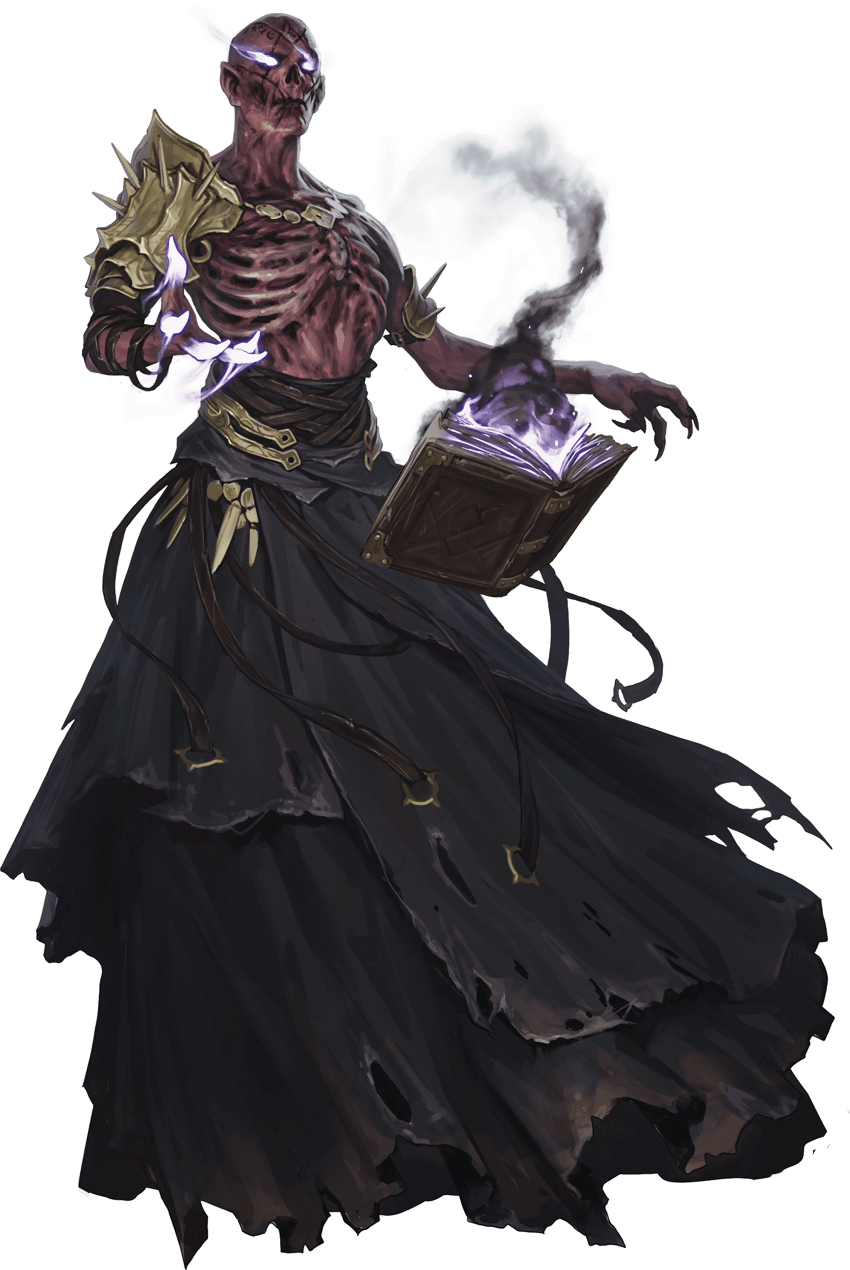
For Memori Liches, warriors of great renown who hope to break the cycle of death, the process is less involved but no less gruesome. The skull of a powerful vanquished foe serves at the focus of power, tipping off new opponents they are in for a hellish battle.
For Hierophants, the call of the divine is equally strong to the call of mortality. Those who want to spend an eternity with power over both life and death in the name of a powerful divine source.
Regardless of the form of lichdom, the process of tearing one’s soul from the body is most despised, for this process involves the sacrifice of something truly dear to a mortal, and no substitute will be accepted. For some, it is the death of a cherished loved one. For others it is a family legacy. Regardless of the sacrifice, unless the dread spirits deem it worthy, lichdom will not be granted.
Reversing Lich Traits
The amount of raw magical energy that goes into becoming a Lich means that undoing it is impossible. The only stage beyond lichdom is annihilation, and even that can only occur if both the physical form of the lich and its soul vessel are both destroyed.
Lich Stages
At each stage of this Transformation, follow the instructions provided for that stage.
Achieving a New Stage
To move from one stage to the next higher one in this Transformation, an event or some other notable occurrence tied to the story of the character should take place. The following events are suggestions for ones that might trigger a move to the next stage of the Transformation:
- Discover ancient and dark arcane knowledge
- Consume the soul of an exceptionally powerful spellcaster
- Build a monument to your power to serve as a giant arcane focus
- Create or lead an army of undead
- Meditate in the glow of a powerful arcane item or location
- Kill an Arch Daemon or Arch Seraph and absorb their power
Lich Stage 1
When you initially undergo the Lich Transformation, you gain the Undead Form Boon and one other Stage 1 Boon of your choice. You also gain the Stage 1 Flaw.
Stage 1 Boon: Undead Form
Lich Stage 1 Boon
You become an Undead in addition to any other creature type(s). You cannot be excluded from Turn Undead.
You also stop aging. You are immune to any effect that would age you, and you cannot die from old age. You do not require air, food, drink, or sleep.
Stage 1 Boon: Lich Magica
Lich Stage 1 Boon
You can trade the soul in your soul vessel for increased magical power.
On your turn, as a Bonus Action, you can spend the charge in your soul vessel (see the Stage 1 Flaw below) for one of the following effects.
- Regain a spell slot equal to or lower than your current Lich Transformation Stage.
- The next saving throw made before the end of your next turn against one of your spells has Disadvantage.
- The next time you cast a spell before the end of your next turn, deal an extra 1d6 Necrotic damage per Lich Transformation Stage to a single creature damaged by that spell.
- The next time you cast a spell before the end of your next turn that restores Hit Points, that spell restores an additional 1d6 Hit Points per Lich Transformation Stage.
Stage 1 Boon: Memori Lichdom
Lich Stage 1 Boon
While your soul vessel is charged, you gain the following benefits to your weapon attacks or Unarmed Strikes:
- They deal your choice of Force damage or their normal damage type.
- They have Advantage if taken as a Reaction.
- After you deal damage with a weapon attack or an Unarmed Strike, you can spend a Bonus Action later on that turn and spend a Hit Point Die. Roll the Hit Point Die and deal Necrotic damage equal to the result to one target damaged by the triggering attack or Unarmed Strike.
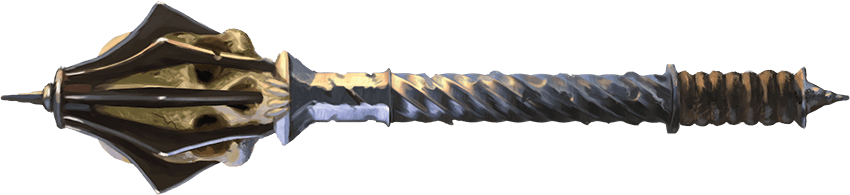
Stage 1 Flaw: Soul Vessel
Lich Stage 1 Flaw
You have successfully torn your soul from your body and trapped it in a suitable object. The object must be a trinket or item no larger than 1 cubic foot in size. This item becomes your soul vessel.
Soul Vessel. A soul vessel is an enchanted vessel containing a Lich’s soul. Additionally, a soul vessel is a conduit for the lich to feed on captured souls. A soul vessel has the following statistics:
Armor Class: 18
Hit Points: 10 × your Character Level
Speed: 0
Damage Immunities: Poison, Psychic; Bludgeoning, Piercing, and Slashing from non-magical sources
Damage Resistances: Cold, Fire, Lightning, Necrotic, Thunder; Bludgeoning, Piercing, and Slashing from magical sources
While a soul is stored in your soul vessel, the soul vessel is considered charged. The soul contained within the soul vessel must be from a creature whose Challenge Rating is equal to or higher than half your Character Level. The soul vessel can only contain one soul at a time.
You can add a soul to the soul vessel 2 times for each of your Transformation Stages. You regain this ability when you complete a Long Rest.
To store a soul within the soul vessel, the lich must use a Magic action within 1 minute of a creature’s death, or a Reaction triggered by the creature’s death, while holding the vessel to capture the soul, and the dead creature’s body must be within 60 feet of the vessel when the capture occurs. The creature cannot be returned to life until its soul is removed from your soul vessel.
If your soul vessel is reduced to 0 hit points, you must create a new one. Doing so takes a Long Rest. Until you do, you do not gain any of the benefits of having the soul vessel. Also, until you have a soul vessel, you have Disadvantage on the first D20 Test you make after finishing a Short or Long Rest.
If you are killed while you control a charged soul vessel on the same plane of existence, your soul vessel’s charge is consumed. You are brought back to life as per the Resurrection spell within 5 feet of your soul vessel 1 day later. If you are killed and your soul vessel is not charged, you are resurrected 7 days later instead.
Lich Stage 2
When you reach Stage 2 of the Lich Transformation, you select one Stage 2 Boon and gain the Stage 2 Flaw.
Stage 2 Boon: Acolyte of Undeath
Lich Stage 2 Boon
When you reduce a Humanoid to 0 Hit Points and it dies, you can use a Reaction to immediately transform it into a Zombie under your control. You can have three such creatures under your control at once. These Zombies act on their own initiative count, following your verbal commands to the best of their ability.
Stage 2 Boon: Binding Curse
Lich Stage 2 Boon
You can compel a creature with a binding curse. As a Bonus Action, choose a creature within 30 feet who can see you. That creature makes a Charisma saving throw against a DC of 12 plus your Transformation Stage. On a failed save it cannot move more than 30 feet away from you for 1 minute. Also, during that time, your weapon attacks and Unarmed Strikes against the creature deal an additional 2d6 Necrotic damage.
You can use this feature three times, regaining all uses after finishing a Short Rest or Long Rest.
Stage 2 Boon: Corrupting Magic
Lich Stage 2 Boon
Whenever you kill any creature with a spell, you may apply an additional effect depending on the damage dealt. This ability cannot be used when you kill a Construct, Undead, or any creature without a soul.
Choose one of the following effects when you use this ability:
Life Force. As the soul of your enemy leaves their body, you siphon off part of their life force. You regain 1d6 Hit Points per Transformation Stage.
Poison. Choose a creature within 10 feet of the killed creature. That creature takes 1d6 Poison damage per Transformation Stage.
Exhaustion. Choose a creature within 10 feet of the killed creature. That creature gains one Exhaustion level. A creature may only have one Exhaustion level from this feature at a time.
The Making of a Lich
In most fantasy stories, lichdom isn’t just something that happens to an innocent person. Becoming a Lich takes years of research, countless sacrifices for yourself and others, and the incredibly low moral and ethical standards necessary to follow through. The years or even decades of meticulous planning and study are infused into the mythology of what lichdom means.
For the Lich Transformation, that mythology may need to be rewritten slightly. The power of Liches comes much more quickly, or perhaps even accidentally, or through a curse. Liches may not be the all-powerful geniuses they are thought to be. They might be tricked or forced to undergo a transition to lichdom. They may even think they are free agents, but the forces that turn them into Liches are using them for other purposes.
Stage 2 Flaw: Hideous Appearance
Lich Stage 2 Flaw
Your appearance has grotesquely transformed. Your flesh withers and contracts around your bones, your eyes become sunken, and you reek of death. Regardless of your true form, you’re horrific to behold.
You can suspend this form and manifest the appearance of the humanoid you once were, but this is taxing and requires effort. This form is not permanent, and moments of stress are likely to reveal your true nature. Your true form may be revealed in the following situations:
- Becoming Bloodied
- Concentrating on a spell
- Having the Unconscious condition
- Entering hallowed ground
- Choosing to reveal yourself
In these events, or times of other extreme emotional or physical stress, a GM can call or a Constitution saving throw with a DC based on your current Transformation Stage. If you fail this save, your Horrific Appearance is revealed.
| Hideous Appearance Save DC | |
|---|---|
| Stage | Constitution Save DC |
| 2 | 13 |
| 3 | 16 |
| 4 | 20 |
Non-evil creatures that witness your true form become instantly Hostile to you, unless the GM decides otherwise.
Lich Stage 3
When you reach Stage 3 of the Lich Transformation, you select one Stage 3 Boon and gain the Stage 3 Flaw.
Stage 3 Boon: Eldritch Concentration
Lich Stage 3 Boon
Your supernatural ability with magic manifests in new ways. When you cast a spell that requires Concentration, if you are already concentrating on one such spell, you can spend the charge of your soul vessel. If you do this, you do not lose Concentration on the original spell. Instead, you gain 1 Exhaustion level.
If you cast a third Concentration spell during this time, or lose Concentration for any other reason, you lose Concentration on both current spells you are concentrating on. Once you use this feature you cannot use it again until you finish a Short Rest or Long Rest.
Stage 3 Boon: Master of Undeath
Lich Stage 3 BoonPrerequisite:Acolyte of Undeath
Undead creatures under your control from a Lich Transformation Boon have Advantage on attack rolls when they are within 5 feet of you.
Additionally, whenever an Undead creature you control due to a Lich Transformation Boon is reduced to 0 Hit Points, you can spend the charge of your soul vessel as a Reaction. If you do, that Undead creature is at 1 hit point instead and may immediately move up to its full speed and make an Attack action with Advantage. This feature has no effect if the creature has been reduced to 0 Hit Points by Radiant damage.
Stage 3 Boon: Unholy Healing
Lich Stage 3 Boon
Your magical connection to your soul vessel restores your vitality quickly. While your soul vessel is charged, you can use a Magic action to draw healing power from it. At the start of each of your turns for 1 minute, you regain 10 Hit Points. The soul vessel does not lose its charge.
You can use this feature three times, and you regain all uses after finishing a Long Rest.
Stage 3 Flaw: Necromantic Dystrophia
Lich Stage 3 Flaw
When your soul vessel is not charged, you suffer the following effects:
- You cannot use the Dash, Dodge, or Disengage actions.
- You cannot use Reactions.
- You have Disadvantage on Constitution saving throws.
- You cannot disguise your Hideous Appearance.
Upon charging your soul vessel with an appropriate soul, you are no longer subject to these effects.
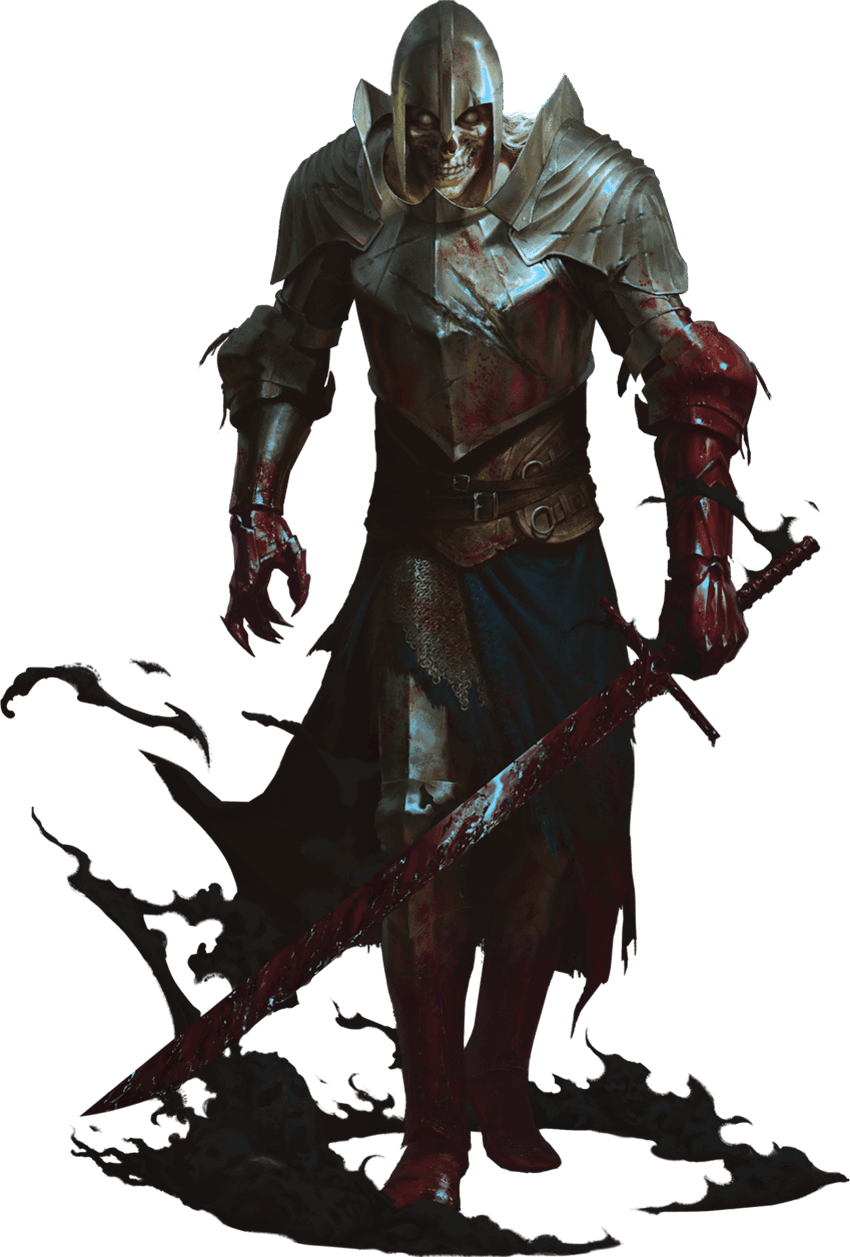
Lich Stage 4
When you reach Stage 4 of the Lich Transformation, you select one Stage 4 Boon and gain the Stage 4 Flaw.
Stage 4 Boon: Eldritch Omniscience
Lich Stage 4 Boon
You have better mastered the magical arts. The number of spells you can learn and can have prepared increases by 4. Additionally, whenever you finish a Short Rest or Long Rest you gain 1 additional spell slot of whichever level you choose.
If a creature dies as a result of one of your spells, you can instantly draw that soul into your soul vessel without using a Magic action or Reaction.
Stage 4 Boon: Lord of Undeath
Lich Stage 4 BoonPrerequisite:Master of Undeath
When you use Acolyte of Undeath you can choose to transform the target into a Ghoul instead of a Zombie.
Stage 4 Boon: Soul-Shattering Attack
Lich Stage 4 Boon
After you make a weapon attack or Unarmed Strike, you can spend the charge in your soul vessel to add the Challenge Rating of the soul within it to the attack roll and damage dealt with that attack. If the creature dies from that attack, you can instantly recharge your soul vessel with the soul that you just expended.
You can use this feature a number of times equal to 4 plus your Proficiency Bonus. You regain all uses after finishing a Long Rest.
Stage 4 Flaw: Weight of the Ages
Lich Stage 4 Flaw
The weight of time is degrading for your form, and only the magic of your soul vessel holds it together. If your soul vessel is reduced to 0 hit points, your soul is lost; you are killed instantly and your body crumbles to dust.
There is always a price for power. And the powerful aren’t always the ones who pay.
—Valikan Poet
Lycanthrope
A howling call is heard across thatched rooftops, summoning the pack to assemble. Below, a man tears at his clothes as moonlight shines down on him. The hunched figure screams in pain, begging his family to run. With muscles bursting and razor-sharp claws forming, his transformation is underway.
Rain pours through the forest canopy as a woman falls to her knees in exhaustion. Unable to run further, she accepts her fate and awaits the monsters of the dark. Instead, she hears a thunderous roar as a hulking figure tears through the undergrowth with impossible strength. The hulking, bear-like figure then turns to the woman and grunts, “Are you lost?” offering a paw in aid.
Lycanthropes may appear to be ordinary humanoids, but behind the veneer of humanity there is a pivotal struggle between beast and man. For most, it is a matter of time before they lose this fight and transform into a monstrous hybrid, half-animal and half-humanoid. Most Lycanthropes recall very little of their time transformed, often waking in a strange location, covered in blood and tattered clothes. However, as some Lycanthropes grow, they learn to balance both natures, using their curse as a gift.
Becoming a Lycanthrope
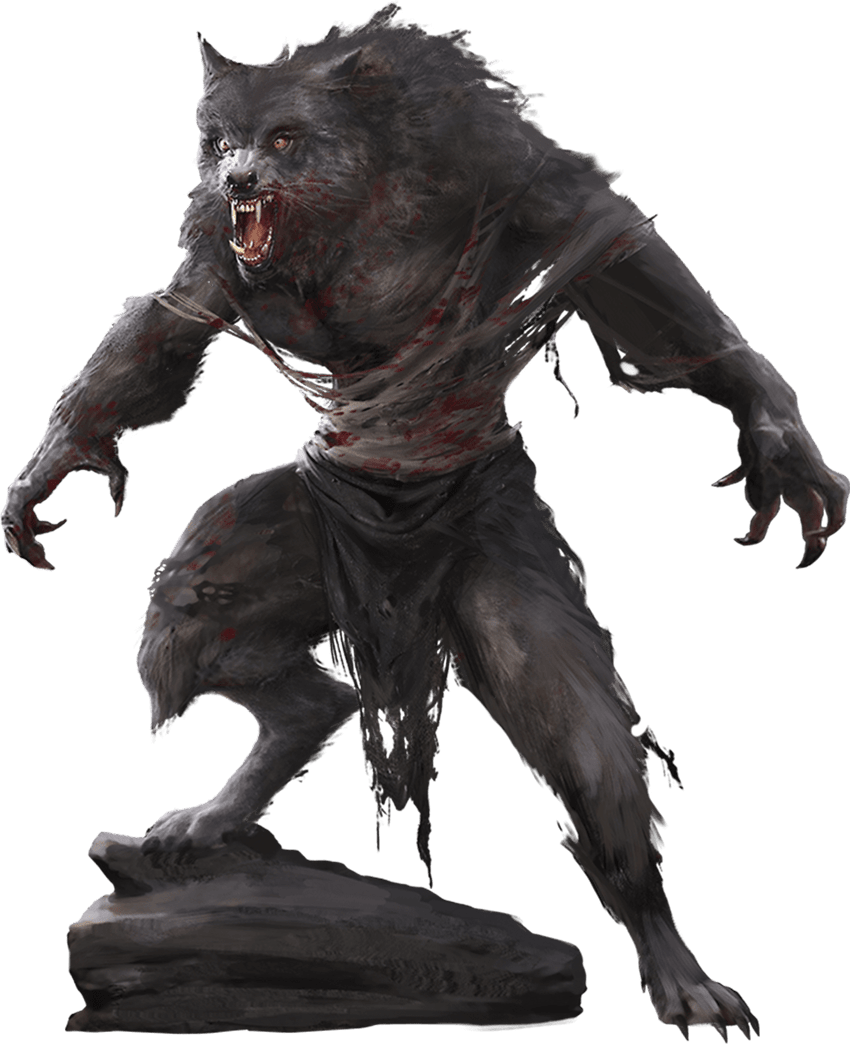
In Etharis, there are two well-known methods of contracting the lycanthropic curse. The first is being bitten by a lycanthrope and not curing the curse before it takes hold.
The second is to complete a Druidic ritual known as the Lunar Sacrament. This violent and bloody rite, involving the sacrifice of an innocent person, underscores the ruthless and uncompromising nature of someone willing to do evil in exchange for power.
Other means of gaining lycanthropy are possible. The curse of a powerful being, a side effect of a powerful artifact, or eating the raw flesh of a lycanthropic creature: all of these are potential triggers for the Lycanthrope Transformation.
Once your character has become a Lycanthrope, consider how they feel about the curse. Do they wish to cure it before it progresses too far? Do they wish to understand it and make peace with the beast that resides within?
Curing Lycanthropy
Once the character reaches Stage 1 of the Lycanthrope Transformation, no typical magic like Remove Curse can cure the character’s lycanthropy. Magic on the level of the Wish spell is needed to completely remove the Transformation and its Boons and Flaws.
Lycanthrope Stages
At each stage of this Transformation, follow the instructions provided for that stage.
Achieving a New Stage
To move from one stage to the next higher one in this Transformation, an event or some other notable occurrence tied to the story of the character should take place. The following events are suggestions for ones that might trigger a move to the next stage of the Transformation:
- Making a further bargain with the Fey creature who gifted you with Lycanthropy originally.
- Killing a powerful creature under the light of a full moon in your hybrid form.
- Failing two Death Saving Throws.
- Killing an innocent creature in your hybrid form after failing your saving throw against Lust for the Hunt.
Lycanthrope Stage 1
When you initially contract lycanthropy, you select one Stage 1 Boon and gain the Stage 1 Flaw.
Stage 1 Boon: Hybrid Wolf Form
Lycanthrope Stage 1 Boon
You become a Monstrosity in addition to any other creature type(s).
As a Magic action, you may voluntarily transform into a hybrid half-wolf creature. While in your hybrid wolf form, the following rules apply:
- Your Strength score becomes 18 unless it is higher.
- Your Speed increases by 10 feet, and you can use the Dash action as a Bonus Action.
- You can’t cast spells or concentrate on spells. Your ability to speak is reduced to short, basic, guttural responses.
- While transformed, you can use weapons and equipment as normal, unless specified elsewhere.
- You gain a Claw or Bite attack that you may use in place of any weapon attack. These attacks deal 1d8 plus your Strength or Dexterity modifier Slashing damage. You are proficient with this attack, and you add either your Strength or Dexterity modifier to attack and damage rolls. This attack is not an Unarmed Strike, nor can it be used in place of an Unarmed Strike.
- After taking an Attack action, you may take a Bonus Action later in that turn to attack once with either your Claw or Bite.
Your hybrid wolf form lasts 1 hour per Transformation Stage. If you entered your hybrid form voluntarily, you can revert to your normal form by using a Magic action on your turn. (Flaws listed below may override this rule.)
Stage 1 Boon: Hybrid Bear Form
Lycanthrope Stage 1 Boon
You become a Monstrosity in addition to any other creature type(s).
As a Magic action, you may voluntarily transform into a hybrid half-bear creature. While in your hybrid bear form, the following rules apply:
- Your Strength score becomes 20 unless it was higher.
- You gain a Climb Speed equal to your Speed.
- You can’t cast spells or concentrate on spells. Your ability to speak is reduced to short, basic, guttural responses.
- While transformed, you can use weapons and equipment as normal, unless specified elsewhere.
- You gain a Claw attack that you may use in place of any weapon attack. This attack deals 1d8 plus your Strength or Dexterity modifier Slashing damage. You are proficient with this attack, and you add either your Strength or Dexterity modifier to attack and damage rolls. This attack is not an Unarmed Strike, nor can it be used in place of an Unarmed Strike.
- Immediately after hitting a target with a Claw attack, you can take a Bonus Action to grab the creature with that hand, as long as it is no more than one size category larger than you. The grabbed target has the Grappled condition. The escape DC is 8 plus your Strength modifier plus your Proficiency Bonus.
Your hybrid bear form lasts 1 hour per Transformation Stage. If you entered your hybrid form voluntarily, you can revert to your normal form by using a Magic action on your turn. (Flaws listed below may override this rule.)
Stage 1 Boon: Hybrid Rat Form
Lycanthrope Stage 1 Boon
You become a Monstrosity in addition to any other creature type(s).
As a Magic action, you may voluntarily transform into a hybrid half-rat creature. While in your hybrid rat form, the following rules apply:
- Your Dexterity score becomes 18 unless it was higher.
- You can Hide or Disengage as a Bonus Action.
- You gain proficiency with Stealth, and you can double your Proficiency Bonus when making a Dexterity (Stealth) check.
- You can’t cast spells or concentrate on spells. Your ability to speak is reduced to short, basic, guttural responses.
- While transformed, you can use weapons and equipment as normal, unless specified elsewhere.
- You gain a Claw or Bite attack that you may use in place of any weapon attack. This attack deals 1d6 plus your Strength or Dexterity modifier Slashing damage. You are proficient with this attack, and you add either your Strength or Dexterity modifier to attack and damage rolls. This attack is not an Unarmed Strike, nor can it be used in place of an Unarmed Strike.
- After taking an Attack action, you may take a Bonus Action later in that turn to attack once with either your Claw or Bite.
- If you target a creature that is within 5 feet of one of its enemies, you have Advantage on Claw or Bite attacks made against the target.
Your hybrid rat form lasts 1 hour per Transformation Stage. If you entered your hybrid form voluntarily, you can revert to your normal form by using a Magic action on your turn. (Flaws listed below may override this rule.)
Stage 1 Flaw: Lust for the Hunt
Lycanthrope Stage 1 Flaw
The savage nature of your curse sometimes causes you to lose control. These ferocious tendencies are a constant struggle between you and the beast within.
The first time you become Bloodied after finishing a Short Rest or Long Rest, you must succeed on a DC 10 Wisdom saving throw. If you are in the light of a full moon, you automatically fail this saving throw.
If you fail this saving throw, you are subjected to the following rules until you can end the hybrid form:
- You immediately enter your hybrid form. You go completely feral, and you cannot use any of your equipment or class features.
- On your turn while in hybrid form, you must move toward the closest creature you can see, smell, or hear, prioritizing Bloodied creatures. If you end your movement and no creature is within 5 feet of you, you must use the Dash action to move toward the closest one.
- If there is a creature within 5 feet of you and you have not used your action, you must make an Attack action using your Claw attack.
- When you damage a creature on your turn and it is not reduced to 0 Hit Points, you must use further attacks that turn against that creature.
If you are at full Hit Points at the start of your turn, you can make a DC 10 Wisdom saving throw. On a success, you return to your normal form. You also return to your normal form if Remove Curse is cast on you, or after 1 hour passes.
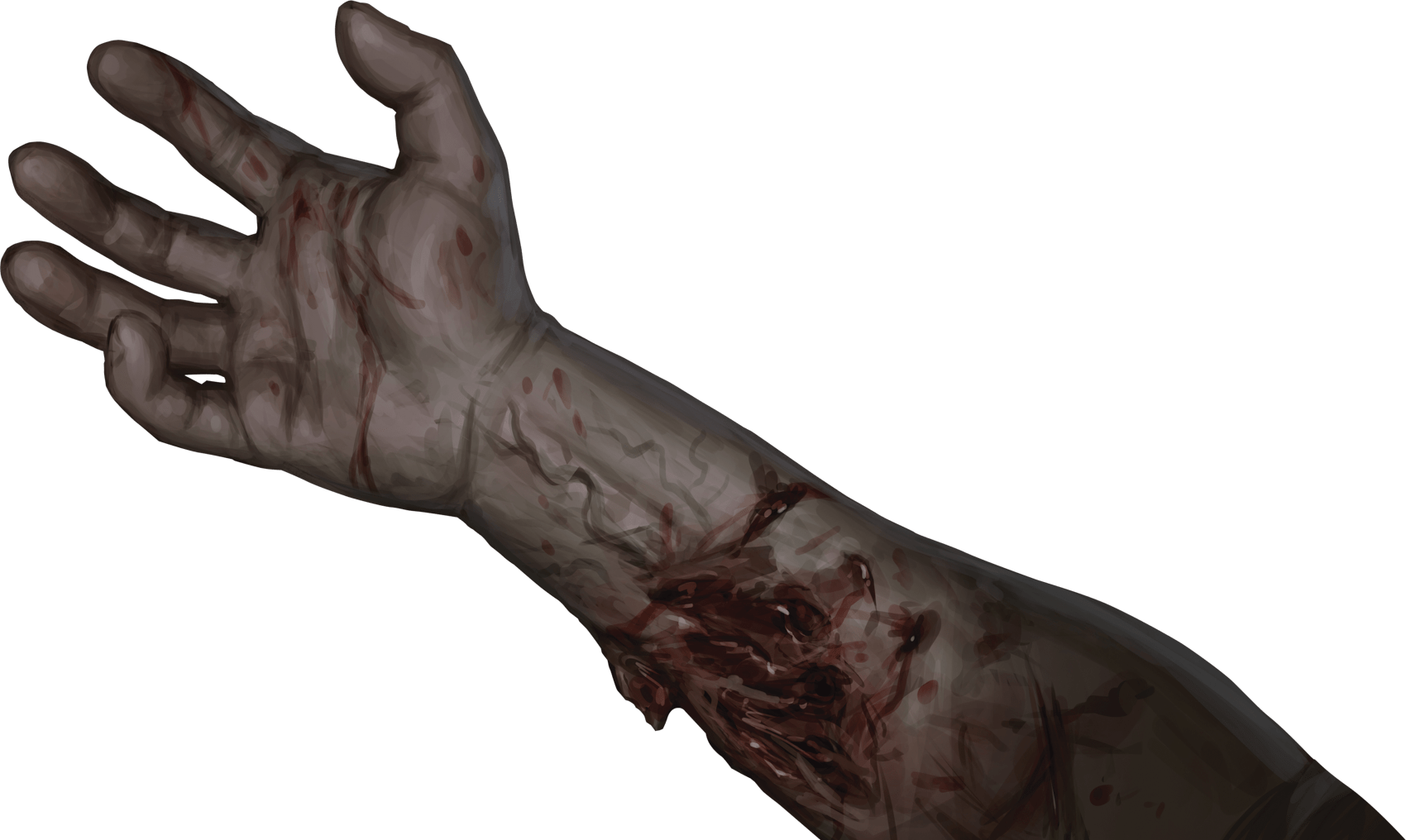
Lycanthrope Stage 2
When you reach Stage 2 of lycanthropy, you select one Stage 2 Boon and gain the Stage 2 Flaw.
Stage 2 Boon: Hunter’s Focus
Lycanthrope Stage 2 Boon
While in hybrid form, you can use a Bonus Action to mark one creature within 60 feet as your prey. A creature remains marked this way for 1 hour, or until it dies. You may only have 1 creature marked at a time.
While a creature is marked as your prey, you gain the following benefits:
- Whenever you hit the marked creature with a melee attack, you deal an additional 1d6 damage of that attack's type.
- You have Advantage on any Wisdom (Perception or Survival) check you make to find it.
Stage 2 Boon: Iron Pelt
Lycanthrope Stage 2 Boon
While in hybrid form, you have Resistance to Bludgeoning, Piercing, and Slashing damage. Magical and silvered weapons ignore this resistance.
Stage 2 Boon: Kindred Form
Lycanthrope Stage 2 Boon
You gain the ability to transform into the animal form representative of your Lycanthropy type, known as your Kindred Form. Use the stat block of the creature your lycanthropy corresponds with and follow the rules of the Polymorph spell:
- Werebear: Black Bear
- Wererat: Giant Rat
- Werewolf: Wolf
You are indistinguishable from other creatures of that type, and you can communicate with those creatures. You cannot speak, but you can understand languages you know. All equipment you wear and carry falls off you when transforming.
Stage 2 Flaw: Silver Sensitivity
Lycanthrope Stage 2 Flaw
You have developed a debilitating sensitivity to silver. In all forms, you have Vulnerability to Bludgeoning, Piercing, or Slashing damage from silvered weapons. In addition, you cannot have Resistance to damage inflicted by silvered weapons.
I can still see her silver blade cutting through the beast’s flesh, where arrows had just bounced off.
—Account of a Monster Hunter’s Exploits
Lycanthrope Stage 3
When you reach Stage 3 of lycanthropy, you select one Stage 3 Boon and gain the Stage 3 Flaw.
Stage 3 Boon: Bestial Vigor
Lycanthrope Stage 3 Boon
Your Hit Point Maximum increases by an amount equal to your character level, and it increases by 1 every time you gain a character level.
Additionally, when in your hybrid form, you gain 5 Temporary Hit Points at the start of each of your turns.
Stage 3 Boon: Shapeshifter’s Savagery
Lycanthrope Stage 3 Boon
You have embraced the animalistic side of your transformation. While in your hybrid form, you gain the following benefits:
- Your Claw and Bite attacks deal an additional 1d8 Slashing damage.
- You have Immunity to the Charmed and Frightened conditions.
Stage 3 Flaw: Frayed Thoughts
Lycanthrope Stage 3 Flaw
You suffer the effects of sharing a mind with two personalities. Memories of less practical significance are lost to new ones of midnight hunts. You have Disadvantage on Intelligence ability checks and saving throws.
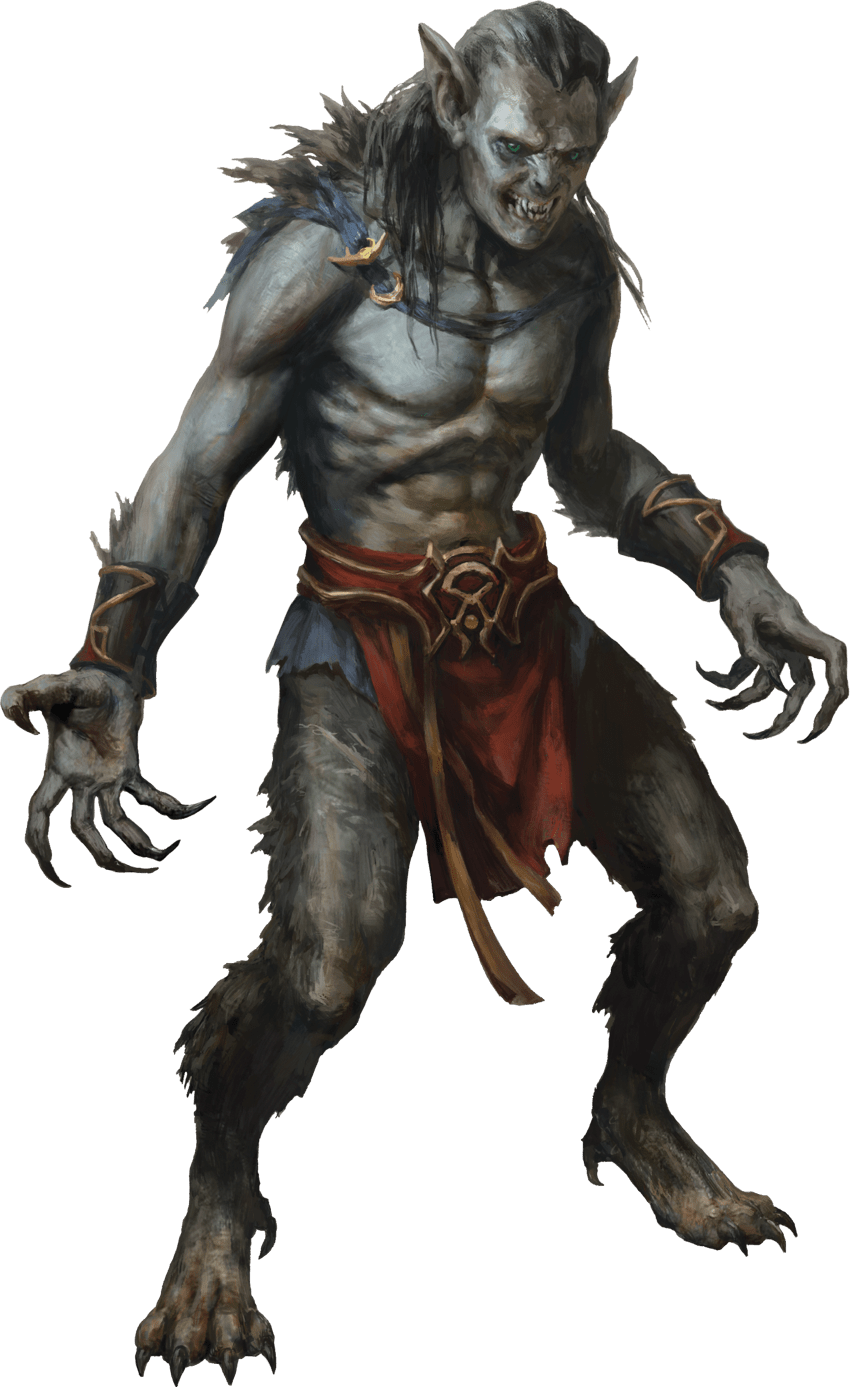
Lycanthrope Stage 4
When you reach Stage 4 of lycanthropy, you select a Stage 4 Boon and gain the Stage 4 Flaw.
Stage 4 Boon: Hybrid Form Affinity
Lycanthrope Stage 4 Boon
You have achieved a state of equilibrium that most Lycanthropes never find. You gain the following benefits while you are voluntarily in your hybrid form:
- You can speak normally.
- You can cast spells without needing to provide their Verbal or Somatic components. Additionally, you can cast spells without needing to provide material components, provided they do not have a GP value listed.
- Allies within 20 feet of you have Advantage on Wisdom ability checks and saving throws.
Stage 4 Boon: Savage Instincts
Lycanthrope Stage 4 Boon
You have developed an unrelenting thirst for bloodshed and carnage. While in your hybrid form, if you hit a Bloodied creature with a Claw or Bite attack, the attack deals an additional 1d8 Slashing damage.
Stage 4 Flaw: Ultimate Predator
Lycanthrope Stage 4 Flaw
You realize the true cost of your transformation. The beast within has gained more control of your body than you have. While you can control it at times, you know it cannot be contained forever—and when it breaks free, it delights in any slaughter it can find.
You gain the following features:
- If you can see, hear or smell a Bloodied creature, you have Disadvantage on Wisdom saving throws.
- At the start of your turn, if you can see, hear or smell a creature with the Unconscious condition, you must make a DC 15 Wisdom saving throw. On a failure, you transform into your hybrid form, or, if already in hybrid form you go feral as described under Lust for Hunt, above. On a success, you are immune to this effect until you finish a Long Rest.
- Whenever you kill a creature while in your hybrid form, you cannot transform back into your normal form until dawn the next day.
Ooze
The Weeping Pox eats away at the flesh of a suffering victim, their life force slowly draining away day after day and hour after excruciating hour. Then, when all hope is gone, the victim’s family notices gradual improvement until they’re back on their feet. A day later, however, the newly cured person finds their body bending in strange ways, much to the horror of their loved ones.
A stooped figure in a plague mask mutters to herself as she hobbles around the figure strapped to a table. The physician applies several different ointments to the figure’s flesh, ignoring the screams of pain that accompany each application. Finally, the doctor sighs in satisfaction as the patient’s flesh turns translucent.
An adventurer falls into a pit, causing his companions to rush forth. The slime at the bottom of the pit coalesces around the poor rogue, seeping past the edges of his armor. The allies pull the rogue out and burn away the corrosive slime, but the rogue faints. When he awakens, he feels better. And he is half the size he was.
The horror of the unknown in Grim Hollow is strong, and people perhaps know the least about the disgusting and mysterious Oozes. Only one thing might be as terrifying as being slowly killed by an Ooze: becoming one. You become the slime-covered monster of nightmares. And they want to kill you.
Becoming an Ooze
It may seem like Oozes are monsters that only appear in the deepest, dankest recesses of dungeons and cave complexes that never see the light. While they certainly do haunt those places, Oozes in Etharis are never far away. Urban areas with poor sanitation are breeding ground for Oozes, as are pastoral locations with proximity to the Fey Realms.
And while some Ooze creatures may only devour and destroy, there are just as many — especially those who have been created or experimented on by the curious and the morbid — who seek to spread their oozy nature to others.
It is rumored by sage and peasant alike that the Filth Grazer, the force allegedly behind the creation and spread of the Weeping Pox, devours organic life by reducing it first into a putrescent sludge. Mortals are but food for aetheric horrors, and the Filth Grazer prefers theirs gurgling, gooey, and foul.
The truly mad might seek to gain the benefits of becoming an Ooze, thinking that being formless would provide power. Regardless of how it happens, people who become an Ooze find themselves in a terrible race: which will they lose first, their body or their mind?
Reversing Ooze Traits
Ooze features are terrible and difficult to undo once they have taken hold. Excruciating experimental trials might be able to alleviate some of the symptoms for a while, but a complete cure would take decades of knowledge and wealth that few in Etharis possess. Even then, it would still require a great deal of luck.
Ooze Stages
At each stage of this Transformation, follow the instructions provided for that stage.
Achieving a New Stage
To move from one stage to the next higher one in this Transformation, an event or some other notable occurrence tied to the story of the character should take place. The following events are suggestions for ones that might trigger a move to the next stage of the Transformation:
- Become Bloodied or Unconscious by the attacks of an Ooze
- Undergo experimentation by an arcanist or diabolist
- Suffer from the Weeping Pox or other disease
- Study an ancient tome from the time when Oozes first came to Etharis
- Consume a recently slain Ooze
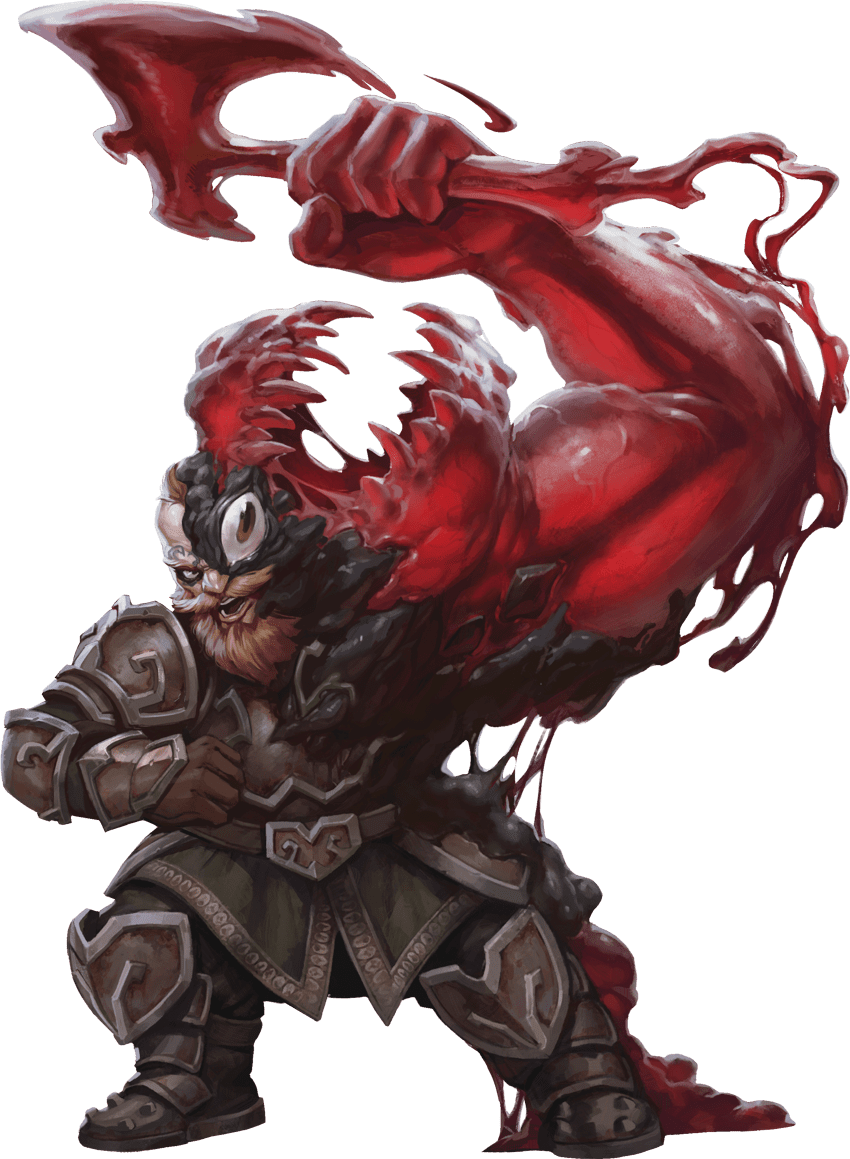
Ooze Stage 1
When you initially undergo the Ooze Transformation, you gain the Ooze Form Boon and one other Stage 1 Boon of your choice. You also gain the Stage 1 Flaw.
Stage 1 Boon: Ooze Form
Ooze Stage 1 Boon
You become an Ooze in addition to any other creature type(s) you are. You gain Blindsight with a range of 30 feet. If you already have Blindsight, your range increases by 30 feet.
You can will your body to melt and flow, becoming more fluid than solid. As a Bonus Action, you manifest your Ooze Form. You become amorphous, able to move through a space as narrow as 1 inch without expending extra movement, and you are immune to the Grappled and Restrained conditions. You remain in Ooze Form for 1 minute or until you use your Bonus Action to return to normal.
You can manifest your Ooze Form a number of times equal to your Proficiency Bonus plus your Transformation stage. You regain all uses of this feature after finishing a Long Rest.
Stage 1 Boon: Mutable Corpus
Ooze Stage 1 Boon
You have abundant control over your Ooze Form. Each time you manifest your Ooze Form, you can choose to augment it with one of the following options:
- Breathless. You do not need to breathe.
- Disguise. You remold your features and body to look different. You can change your apparent species, seem 1 foot shorter or taller, and appear heavier or lighter. You must adopt a form that has the same basic arrangement of limbs as you have. To discern that you are disguised, a creature must take the Study action to inspect your appearance and succeed on an Intelligence (Investigation) check with a DC equal to 10 plus your Constitution modifier plus your Transformation Stage.
- Transparent. You body becomes transparent. You have Advantage on Dexterity (Stealth) checks.
Stage 1 Boon: Slimy Mien
Ooze Stage 1 Boon
While manifesting your Ooze Form, you gain the following additional benefits:
- You are immune to the Charmed condition.
- The range of your Blindsight increases by 30 feet.
- You can communicate with Oozes within 30 feet as if you shared a common language. While Oozes are not automatically Friendly to you, they do not see you as food. You can ask them simple questions, and they may choose to respond if they are not Hostile.
Stage 1 Flaw: Sluggish
Ooze Stage 1 Flaw
Your body frequently shifts and melts without control, making you sluggish. Your speed decreases by 5 feet for every Transformation Stage you achieve.
In addition, your skin glistens with oozy droplets leaving a trail anywhere you go. Ability checks made to follow your tracks are made with Advantage.
Ooze Stage 2
When you reach Stage 2 of the Ooze Transformation, you select one Stage 2 Boon and gain the Stage 2 Flaw.
Stage 2 Boon: Elastic Limbs
Ooze Stage 2 Boon
Your limbs have become elastic and tacky, allowing you to reach distant enemies and climb walls.
Your reach increases by 5 feet and you gain a Climb Speed equal to your Speed. You can move up, down, and across vertical surfaces and along ceilings, while leaving your hands free. Creatures you are grappling have Disadvantage on Strength (Athletics) and Dexterity (Acrobatics) checks to escape.
Stage 2 Boon: Viscous Durability
Ooze Stage 2 Boon
Your mind and body become even more Ooze-like. You have Immunity to the Frightened condition and Acid damage.
When you gain this Boon, choose Cold, Fire, or Lightning. Gain resistance to the chosen damage type.
Stage 2 Flaw: Melted Appearance
Ooze Stage 2 Flaw
Your body is now a hideous lump of dripping flesh excreting foul smelling slime. While your form remains roughly humanoid, the horror of what you are is clear to anyone that looks upon your molten face. You have Disadvantage when you use the Influence action to make Charisma-based ability checks made against creatures that are not Aberrations or Oozes.
In addition, your Transformation to an Ooze has liquefied many of your organs and dimmed your senses. Your eyes melt and run down your face and there is nothing but flesh where your ears once were. You permanently have the Blinded condition beyond the range of your Blindsight.
Ooze Stage 3
When you reach Stage 3 of the Ooze Transformation, you select one Stage 3 Boon and gain the Stage 3 Flaw.
Stage 3 Boon: Corrosive Membrane
Ooze Stage 3 Boon
When you manifest your Ooze Form, it lasts for 10 minutes.
While manifesting your Ooze Form, you are covered with a sheen of acidic slime. When a creature hits you with a melee attack, it takes Acid damage equal to 1d6 plus your Transformation Stage. Nonmagical ammunition is destroyed immediately after hitting you and dealing damage. Any nonmagical weapon takes a cumulative −1 penalty to attack rolls immediately after dealing damage or coming into contact with you. The weapon is destroyed if the penalty reaches −5. The penalty can be removed by casting the Mending spell on the weapon.
Additionally, you can eat through 2 feet of nonmagical wood or metal in 1 minute simply by touching it.
Stage 3 Boon: Engulf
Ooze Stage 3 Boon
When you manifest your Ooze Form, it lasts for 10 minutes.
While manifesting your Ooze Form, you can envelop your foes in your gooey body. As a Magic action, you can try to engulf a creature of your size category or smaller that is within 5 feet of you. The target makes a Strength saving throw, with a DC equal to 10 plus your Strength modifier plus your Transformation Stage. On a failure, the creature is engulfed.
While engulfed, a target has Total Cover against attacks and other effects outside of you, and when you move, the engulfed target moves with you. While engulfed, a creature takes 4d6 Acid damage at the start of each of its turns, is suffocating, has the Restrained condition, and repeats the save at the end of each of its turns, ending the effect on a success. An engulfed creature that is reduced to 0 Hit Points is fully digested, leaving no body or nonmagical equipment behind.
Stage 3 Flaw: Physical Deterioration
Ooze Stage 3 Flaw
Your skin sloughs away in thick, syrupy sheets and your bones become like melted wax. The sun itself burns you, and holy light becomes lethal. Now your reactions slow as much as your pace.
You are Vulnerable to Radiant damage, and you have Disadvantage on Dexterity ability checks and saving throws.
I’ll never use the term “I’m melting from this heat“ again after seeing that.
—Liesecher Doctor, treating an Ooze patient
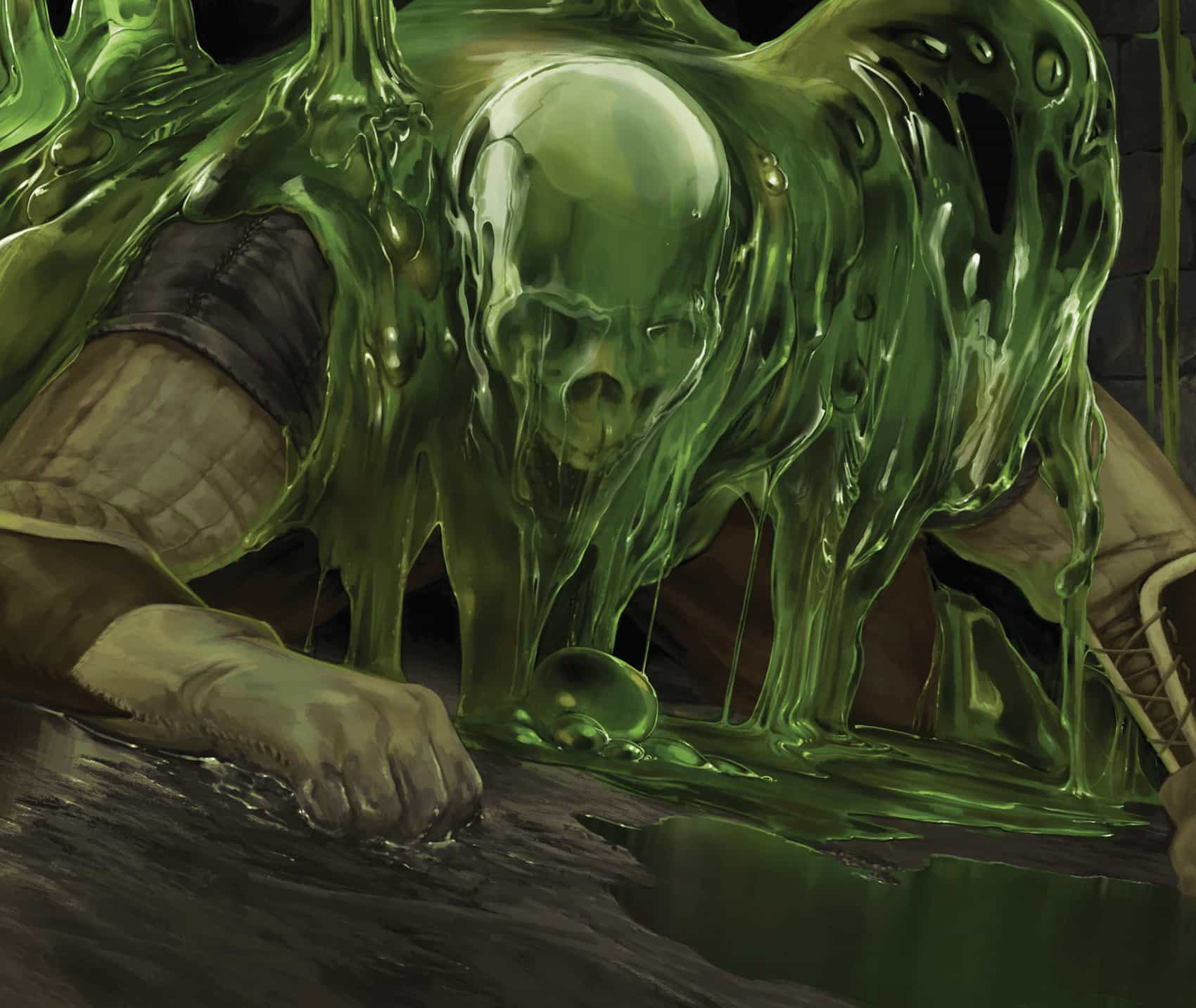
Ooze Stage 4
When you reach Stage 4 of the Ooze Transformation, you select one Stage 4 Boon and gain the Stage 4 Flaw.
Stage 4 Boon: Legion of Slime
Ooze Stage 4 Boon
When you manifest your Ooze Form, it lasts until you finish a Short or Long Rest.
While you are manifesting your Ooze Form and you are hit by an attack that causes you to become Bloodied, you can use a Reaction to split into two identical Oozes. Each Ooze uses your game statistics, except that they are one size category smaller than your normal size, and your remaining Hit Points and Hit Point Maximum are divided evenly between the two Oozes (round down). Your equipment is not duplicated; all of it remains on one of the Oozes.
Each Ooze acts on your Initiative. They can each move independently, but they can only collectively take one action and Bonus Action on your turn and one Reaction per round.
After you use this feature, you cannot use it again until after you finish a Long Rest.
Stage 4 Boon: Mimic Object
Ooze Stage 4 Boon
When you manifest your Ooze Form, it lasts until you finish a Short or Long Rest.
While manifesting your Ooze Form, you can use a Magic action to transform into an object of your size or up to two sizes smaller. Any equipment worn or carried is dropped in your space. While mimicking an object, you retain your statistics.
While mimicking an object, you are indistinguishable from the object and you can take a Reaction when you are touched to adhere to the creature that touches you. The creature has the Grappled condition. The DC to escape is equal to DC equal to 8 plus your Constitution modifier plus your Transformation Stage. Ability checks made to escape this grapple have Disadvantage.
Stage 4 Flaw: Slippery Ego
Ooze Stage 4 Flaw
As your brain becomes just one more part of the gooey mass that is you, and your sense of self becomes ever more tentative, the slightest distraction can cause you to forget who you were.
The first time you become Bloodied after a Long Rest, or whenever you roll a 1 on a saving throw, the pain or surprise causes you lose your grip on your mind. You can’t cast spells, activate magic items, understand language, or communicate in any intelligible way. You are overwhelmed with hunger and take the Attack action on your next turn to make melee attacks against a random creature within reach. If there are no creatures within reach, you move until you are adjacent to the nearest creature, using the Dash action if necessary.
You may attempt a DC 18 Wisdom saving throw at the end of each of your turns to regain your sense of self. This effect ends automatically when you finish a Short Rest or Long Rest.
You don’t know real power until you can become anything!
—Victim of the Ooze Transformation
Primordial
Her skin turns black and peels away. But underneath, her bones are made of rock and her blood is fire. “What’s happening?” the girl cries. Heat radiates from behind her eyes. “I can’t control it!” She walks away from the ashes of her village sometime later.
The city dwellers raise their eyes to the thundering sky. Lightning strikes the cobblestones, then takes the shape of a man. Cries ring out as the figure, sparks scintillating from his body, clenches a fist. The earth trembles violently. Buildings crack and begin to crumble. Commoners flee whilst others throw themselves at the mercy of the elemental manifestation. Its voice booms, “I have heard it. I heard the song of creation!”
Primordials are created when a creature absorbs a spark of primordial chaos. Primordial forces are the purest building blocks of creation, and a fostered spark quickly grows to an all-consuming flame. Mastering the elements requires unlearning the limitations of mortality, a process that spurs rapid transformation.
Becoming a Primordial
There are several ways for a mortal to consume a primordial spark. They might be born with one due to some sorcery or gifted one by accident in the dreams of a slumbering Primordial. A mortal may consume the power of an Elemental through arcane rituals. Or a body could become infused with primal energy after surviving a calamity caused by an Elemental creature or rift to an Elemental Plane.
Once acquired, one must spend a great deal of time contemplating and understanding the spark to unlock its full potential. The process of attaining elemental mastery is dangerous. The slightest slip in control can cause devastation on a massive scale. Such facts are why isolated individuals like Druids, Monks, or Rangers are most likely to see the Transformation through to its end.
Reversing Primordial Traits
Once a primordial spark has taken hold, your mortal body will continue to deteriorate from the roiling elements it now tries to contain. You will inevitably become one with the elements, your soul pulled into the Elemental Plane. Only magic on the level of the Wish spell can then revive you, with or without your Transformation and its Boons and Flaws.
Primordial Stages
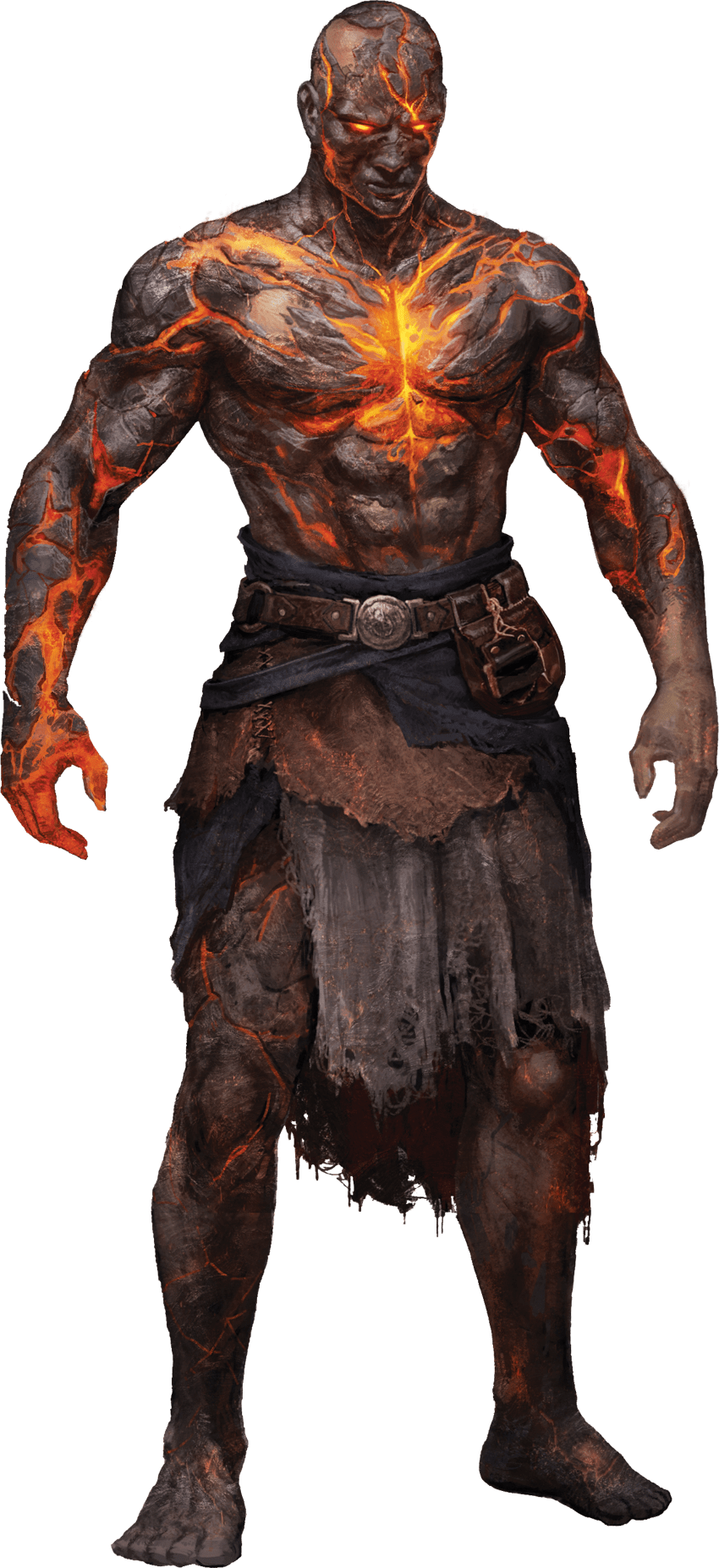
At each stage of this Transformation, follow the instructions provided for that stage.
Achieving a New Stage
To move from one stage to the next higher one in this Transformation, an event or some other notable occurrence tied to the story of the character should take place. The following events are suggestions for ones that might trigger a move to the next stage of the Transformation:
- Defeat and absorb the power of a greater Elemental.
- Come into contact with an elemental node.
- Make an alliance with a being from one of the Elemental Planes.
- Use your powers to defeat an encroaching civilization.
- Free an imprisoned or indentured Elemental creature.
Primordial Stage 1
When you initially undergo the Primordial Transformation, you gain both Stage 1 Boons and the Stage 1 Flaw.
Stage 1 Boon: Primordial Form
Primordial Stage 1 Boon
You become an Elemental in addition to any other creature type(s).
Your Constitution score increases by 1, but cannot increase above 20 in this way.
Stage 1 Boon: Elemental Affinity
Primordial Stage 1 Boon
Though you have sway over all the elements, your Primordial change was sparked by one particular element: your Elemental Affinity. This element infuses your form and dictates your powers. You must choose one element below and gain all the benefits of that element:
Air. You have Resistance to Lightning damage. In addition, you can channel the air currents around you to guide a ranged attack. Once on each of your turns, when you make an attack with a Ranged weapon or ranged spell, you can make that attack with Advantage. If you are in a location without air—such as underwater or in a vacuum—this feature has no effect.
Earth. You have Resistance to Bludgeoning damage. In addition, whenever you gain Temporary Hit Points, you gain additional Temporary Hit Points equal to your Proficiency Bonus.
Fire. You have Resistance to Fire damage. In addition, whenever you deal Fire damage, you can add your Constitution modifier to the damage dealt.
Water. You have Resistance to Cold damage. In addition, whenever a creature within 30 feet regains Hit Points, you can use a Reaction to imbue them with healing elemental energy. The creature regains an additional 1d6 Hit Points.
Stage 1 Flaw: Planar Binding
Primordial Stage 1 Flaw
Your body and soul are connected to the Elemental Plane. You have Disadvantage on Death Saving Throws as the plane attempts to pull you into it.
Primordial Stage 2
When you reach Stage 2 of the Primordial Transformation, you select one Stage 2 Boon and gain the Stage 2 Flaw.
Stage 2 Boon: Dual Nature
Primordial Stage 2 Boon
You add a second element to your Elemental Affinity Boon. When you do so, you gain the associated benefits of your new element.
Stage 2 Boon: Elemental Surge
Primordial Stage 2 Boon
You can channel pure elemental energy into a concentrated bolt of an element of your choice. As a Magic action, you can use any of the following options:
Lightning Strike. You can make a ranged attack targeting a creature within 60 feet. You are proficient with this attack, which uses your Constitution modifier. On a hit, this attack deals 3d8 plus your Constitution modifier Lightning damage. You can then use a Bonus Action to target another creature within 30 feet of the first target with the same attack.
Increase the damage of these attacks by 1d8 for each Transformation Stage above 2.
Earth Shard. You can force a creature within 30 feet to make a Constitution saving throw. On a failed save, the creature takes Bludgeoning damage equal to 3d6 plus your Constitution modifier, or half as much on a successful save. Increase the damage by 1d6 for each Transformation Stage above 2.
You also gain Temporary Hit Points equal to half the damage dealt.
Flame Wave. Each creature in a 15-foot Cone originating from you makes a Dexterity saving throw against a DC equal to 8 plus your Constitution modifier plus your Transformation Stage. On a failed save, creatures in the area take Fire damage equal to 2d8 plus your Constitution modifier. Increase the damage by 1d8 for each Transformation Stage above 2.
Aquatic Rejuvenation. Choose a creature you can see within 60 feet of you. The creature regains a number of Hit Points equal to 2d8 plus your Constitution modifier. Increase the number of Hit Points regained by 1d8 for each Transformation Stage above 2.
You can use Elemental Surge a number of times equal to your Constitution modifier, regaining all expended uses upon finishing a Long Rest.
Stage 2 Flaw: Roiling Elements
Primordial Stage 2 Flaw
Your physical vessel strains to contain the roiling elements trapped inside of you. In a moment of distraction your body may erupt momentarily to reveal your Primordial nature. Tongues of flame may lash out or arcs of lightning might burst from beneath your skin.
You can contain the elements and maintain the appearance of the humanoid you once were, but this is taxing and requires effort. Moments of stress are likely to unleash your true nature, which might occur under the following circumstances:
- Becoming Bloodied
- Having the Unconscious condition
- Encountering Elemental creatures or powers
- Having the Charmed or Frightened conditions
- Using your Primordial Transformation powers
In these events, or times of other extreme emotional or physical stress, the GM can call for a Constitution Saving Throw with a DC based on your current Transformation Stage:
| Roiling Elements Save DC | |
|---|---|
| Stage | Constitution Save DC |
| 2 | 13 |
| 3 | 16 |
| 4 | 20 |
When your Primordial nature is revealed, you have Disadvantage on every D20 Test you make for 1 minute as you fight to control the volatile elements within you.
Primordial Stage 3
When you reach Stage 3 of the Primordial Transformation, you select one Stage 3 Boon and gain the Stage 3 Flaw.
Stage 3 Boon: Aura of Awakening
Primordial Stage 3 Boon
You emit an aura of power that awakens the elemental forces in your companions. When you first gain this feature, choose one of the options below. You may change the aura you emit upon finishing a Long Rest.
Light as Air. Whenever you or an ally you can see within 30 feet of you makes a Dexterity saving throw, the creature gains a bonus equal to your Constitution modifier.
Forged in Fire. When an ally within 10 feet of you deals damage with a melee attack, you can use a Reaction to make the attack deal Fire damage instead of the normal damage type, and add 2d6 Fire damage to the attack’s damage.
Heart of Stone. You can choose to have Disadvantage on any Initiative check. If you do, as a Reaction, you and each creature of your choice within 30 feet of you gain Temporary Hit Points equal to your 1d10 plus your Constitution modifier. While a creature has Temporary Hit Points gained in this manner, they cannot have the Prone condition unless it is part of the Unconscious condition.
Fluid Movement. When an ally within 30 feet moves or attempts to escape a Grapple, you can use a Reaction to give them the following benefits:
- Their Speed increases by 10 feet until the end of their turn.
- Their movement doesn’t provoke Opportunity Attacks.
- They have Advantage on checks to escape the Grapple.
Stage 3 Boon: Primeval Body
Primordial Stage 3 Boon
Your transformation to an Elemental creature has changed your body entirely. You no longer need to sleep, breathe, or eat. Also, you no longer age normally and suffer no effects of aging.
Additionally, choose one damage type from Bludgeoning, Cold, Fire, and Lightning damage. You gain Resistance to that damage type. If you already have Resistance, you gain Immunity to it.
Stage 3 Boon: Master of Many
Primordial Stage 3 BoonPrerequisite:Dual Nature
You add a third elemental to your Elemental Affinity Boon. When you do so, you gain the associated benefits of your new element.
Stage 3 Flaw: Elemental Imbalance
Primordial Stage 3 Flaw
Your body reacts in strange ways to the application of severe elemental damage. When you take Acid, Cold, Fire, Lightning, or Thunder damage, roll 1d6. On a 1, your Primordial form reacts in a volatile manner, and the following effects occur:
- You gain Vulnerability to the instance of damage you just took, even if you had Resistance or Immunity to that damage.
- Creatures within 5 feet of you take the original amount of damage that you took. A DC 15 Constitution saving throw halves this damage.
The Primordial Existence
The mythological, and perhaps even the empirical, representation of primordial power in Etharis is Gormadraug, the Prismatic Wyrm. Valikans grow up hearing tales of the power—and the world-ending danger of the Great Wyrm. The beast embodies all the apocalyptic potential of earth, air, fire, and water.
Within the land controlled by the Valikan Clans, creatures showing an ability to manifest the primordial elements would strike awe into witnesses of that power. And more importantly, they would also likely be feared and mistrusted. Indeed, with the awakening of Gormadraug such a feared event, such people would be seen as a threat unless they could convince the common folk that they are not harbingers of doom.
While other lands would not be as fearful as the Valikans of the elemental magic (save for maybe the Arcanist Inquisition), wielders of primordial elemental power are likely looked at as dangerous and in league with powers beyond their control and understanding.
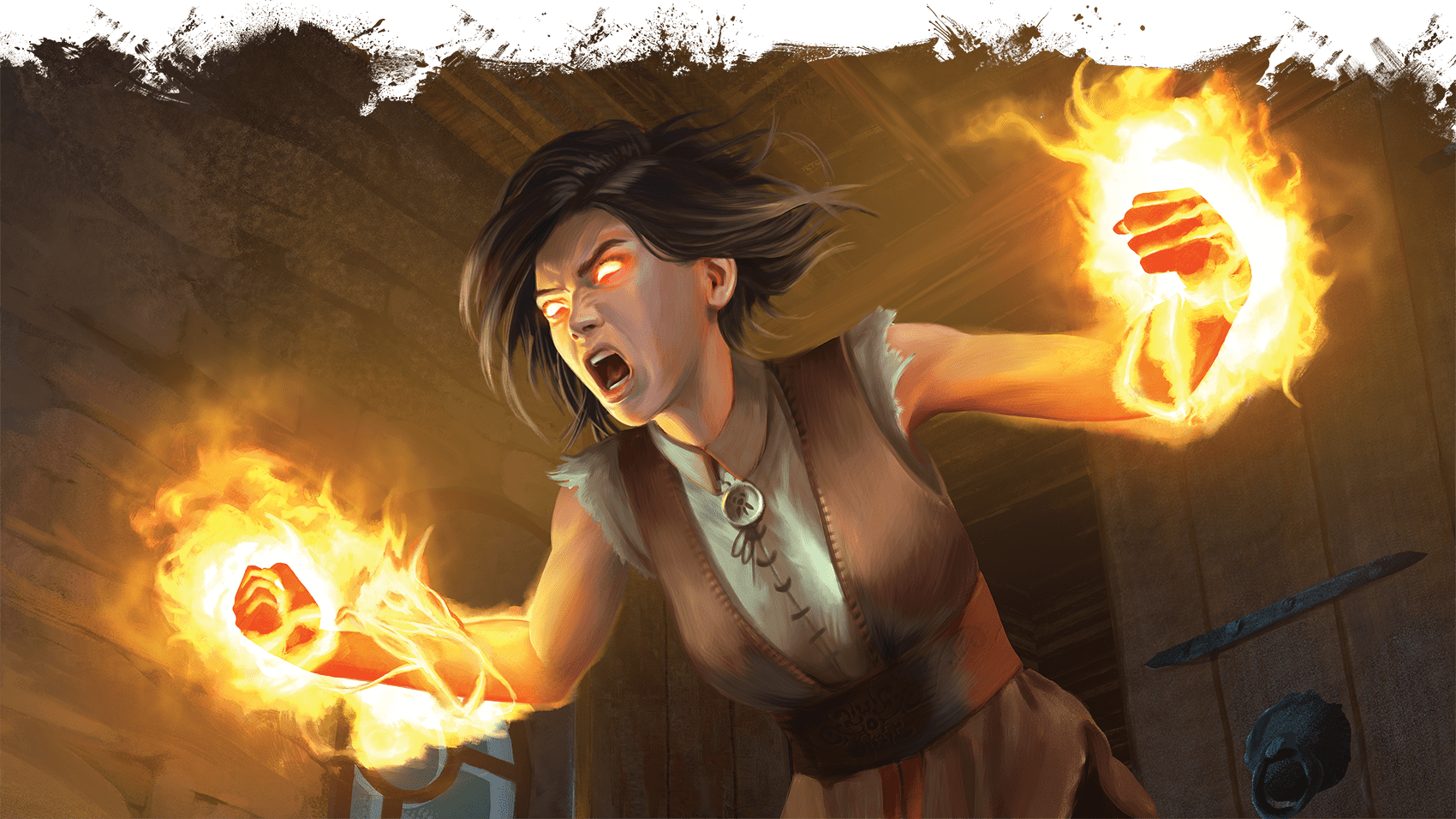
Primordial Stage 4
When you reach Stage 4 of the Primordial Transformation, you select one Stage 4 Boon and gain the Stage 4 Flaw.
Stage 4 Boon: Primordial Aura
Primordial Stage 4 BoonPrerequisite:Aura of Awakening
Creatures of your choice within 15 feet of you gain Resistance to Bludgeoning, Cold, Fire, or Lightning damage. You choose the damage type after finishing a Short Rest or Long Rest, and you can change the damage type as a Bonus Action. If they already have Resistance to any of these damage types, they gain Immunity to that damage type.
Stage 4 Boon: Elemental Mastery
Primordial Stage 4 BoonPrerequisite:Master of Many
You add the final element to you Elemental Affinity Boon. When you do so, you gain the associated benefits of your new element.
Additionally, you can summon the four elements to wreathe you in power. Whenever a creature hits you with a melee attack, you can use your Reaction to force it to make a Dexterity saving throw, dealing 6d6 damage of a type of your choice from Bludgeoning, Cold, Fire, or Lightning, or half as much on a successful save.
After you use this Reaction, your Elemental Affinity features gain the following benefits until the end of your next turn:
Air. You have Advantage on all Ranged weapon and ranged spell attacks.
Earth. At the beginning of your turn, you gain 20 Temporary Hit Points.
Fire. At the beginning of your turn, each creature of your choice within 5 feet of you takes 2d6 Fire damage.
Water. Whenever a creature withing 60 feet that you can see regains Hit Points by spending Hit Point Dice or through a spell or magical ability, that creature regains an additional 20 Hit Points.
You can use this feature a number of times equal to your Constitution modifier, regaining all uses upon completing a Long Rest.
Stage 4 Flaw: Primordial Chaos
Primordial Stage 4 Flaw
The plane of Primordial energy that you’re tied to strengthens its pull on you. Whenever you roll a natural 1 on a saving throw against a spell, you take 8d6 Force damage, which ignores Resistances and Immunities. This damage is in addition to any normal damage from the effect.
The presence of these people gives credence to mortals being comprised of four essential elements.
—Büracher Professor
Seraph
Incense burns dimly as muffled coughs echo through the musty room. Loved ones hold each other as a bedridden woman exhales a final breath, her scarred face bearing the mortifying lesions of the Weeping Pox. Her family sobs, too lost in their sorrow to notice how the smoldering embers radiate and shine. A woman with flowing robes and platinum hair approaches from the shadows, radiant energy emanating from her folded, angelic wings. “Hold on for but a moment, my child,” she whispers. “Mercy has been granted.”
With a thunderous boom, a Seraph’s hammer collides with a clot of writhing corpses. Scraps of bone and offal scatter across the dilapidated chapel floor as voices wail in pain. Gritting her teeth, the angelic figure proclaims, “You foul spirits are dead. Begone! I condemn your cadavers to dust!” Golden fire erupts from her hammer as she prepares for another strike.
Seraphs are mortals transformed into Celestial representations of a virtue or ideal. Exalted by a higher power, Seraphs are selected by divine beings after long and patient observation, confirming that the mortal displays pure character. Seraphs are selected from noble martyrs, tireless crusaders, or other exemplary individuals prepared to become the physical manifestation of righteousness.
Becoming a Seraph
To be chosen by an Arch Seraph is to become a vessel for the principles they uphold. This is a charge not to be taken lightly, and those who display righteousness with the intention of becoming a Seraph are usually overlooked for this reason. When becoming a Seraph, consider why your character was chosen. Do you display hidden merit? Are you devoted to a cause they will value?
Relinquishing Divinity
Characters who reach Stage 1 of the Seraph Transformation do not typically seek power without righteous cause. The Transformation’s Boons and Flaws can be removed at any time by relinquishing divinity, as a warrior retires their sword when the war is over. Regaining such power may not be so easy.
Seraph Stages
At each stage of this Transformation, follow the instructions provided for that stage.
Achieving a New Stage
To move from one stage to the next higher one in this Transformation, an event or some other notable occurrence tied to the story of the character should take place. The following events are suggestions for ones that might trigger a move to the next stage of the Transformation:
- Defeat a powerful force of darkness.
- Create a hallowed landmark for pilgrims.
- Establish a parish of worshipers who uphold your virtue.
- Redeem a soul that was considered beyond redemption.
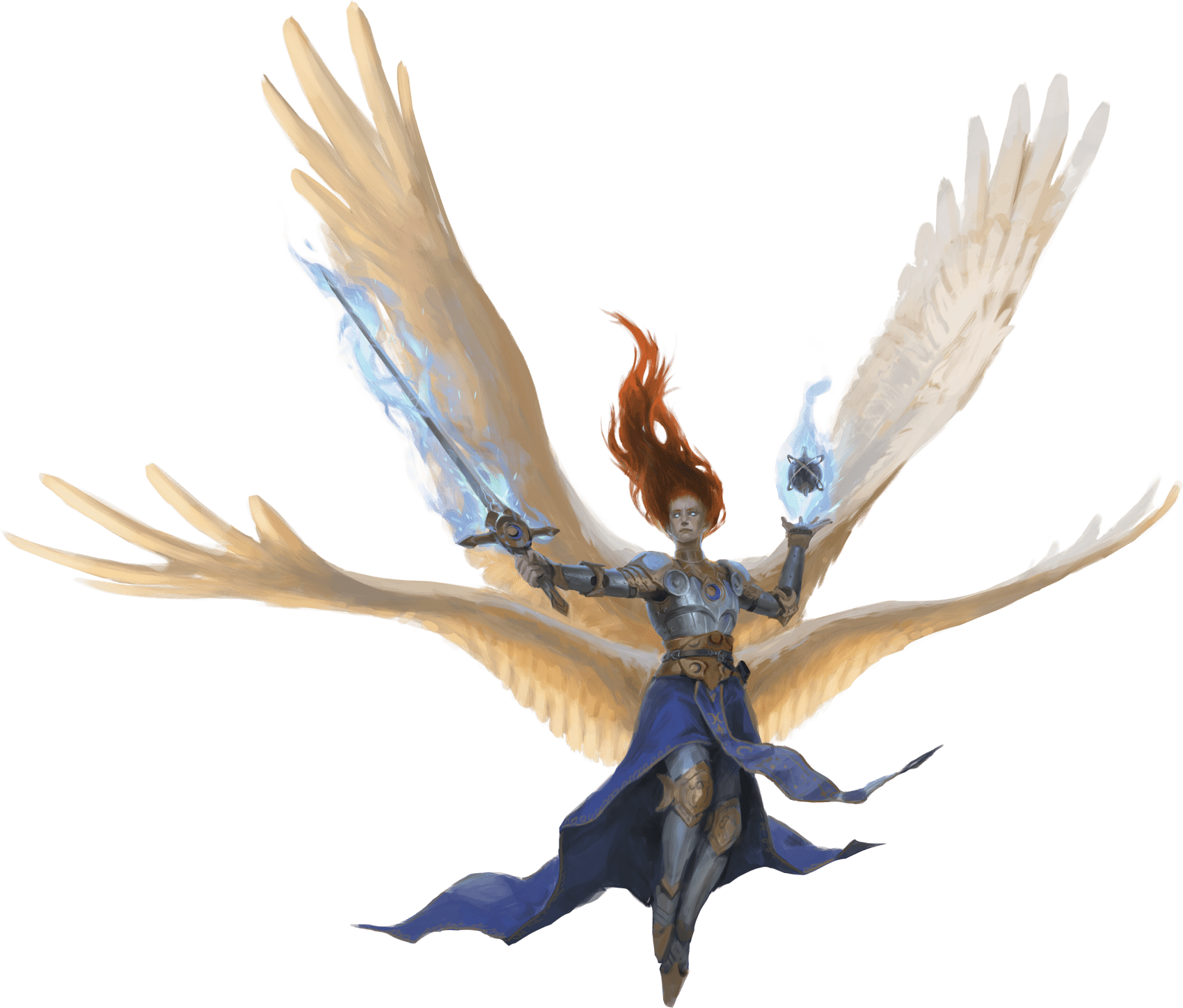
Seraph Stage 1
When you initially undergo the Seraph Transformation, you gain Celestial Form and one other Stage 1 Boon of your choice. You also gain the Stage 1 Flaw.
Stage 1 Boon: Celestial Form
Seraph Stage 1 Boon
You become a Celestial in addition to any other creature type(s) you are. Additionally, you have Resistance to Radiant Damage.
Stage 1 Boon: Angelic Wings
Seraph Stage 1 Boon
As a Bonus Action, you can manifest feathered wings for 1 hour. While they are manifested, you have a Fly Speed equal to your Speed when you are not wearing heavy armor.
You can manifest these wings a number of times equal to your Transformation Stage, and you regain all uses after finishing a Short or Long Rest.
Stage 1 Boon: Holy Strikes
Seraph Stage 1 Boon
When you hit with a weapon or an Unarmed Strike or damage a creature with a cantrip, you can add 1d6 Radiant damage to that attack. You can add this damage a number of times equal to your Proficiency Bonus plus your Transformation Stage. You regain all uses of this feature when you finish a Short or Long Rest.
At higher Transformation Stages, you deal an additional 1d6 Radiant damage per Transformation Stage, for a total of 2d6 at Stage 2, 3d6 at Stage 3, and 4d6 at Stage 4.
Stage 1 Flaw: Planar Binding
Seraph Stage 1 Flaw
Your body and soul are bound to the higher planes of good. You have Disadvantage on Death Saving Throws as the plane attempts to pull your soul into its place of final reward.
Seraph Stage 2
When you reach Stage 2 of the Seraph Transformation, you select one Stage 2 Boon and gain the Stage 2 Flaw.
Stage 2 Boon: Divine Clemency
Seraph Stage 2 Boon
When an ally within 30 feet of you that you can see takes damage, you can use a Reaction to cast Healing Word at first level on that ally without using a spell slot.
You can do this a number of times equal to your Transformation Stage. You regain all uses of this feature after finishing a Long Rest.
Stage 2 Boon: Sacred Retribution
Seraph Stage 2 Boon
When an ally you can see within 30 feet takes the Attack action with a weapon or Unarmed Strike, you can use your Reaction to imbue them with holy zeal, allowing them to make one additional attack. On a hit, the target takes an additional 1d8 Radiant damage. You may use this feature a number of times equal to your Transformation Stage. You regain all uses of this feature when you finish a Long Rest.
Stage 2 Flaw: Blinding Radiance
Seraph Stage 2 Flaw
Your Transformation into a Seraph brings with it changes to your physical features. Your body radiates a divine glow, your eyes may become hollow braziers of celestial light, or your many sets of wings may appear unsettling to mortal creatures.
You can suspend this form and manifest the appearance of the humanoid you once were, but this is taxing and requires effort. This form is not permanent, and moments of stress or wrath are likely to reveal your true nature. This might occur under the following circumstances:
- Becoming Bloodied
- Having the Unconscious condition
- Witnessing an act of evil
- Encountering Fiendish creatures or powers
- Using your Seraph Transformation powers for the first time after a Short Rest or Long Rest
In these events, or times of other extreme emotional or physical stress, a GM can call or a Constitution saving throw with a DC based on your current Transformation Stage. If you fail this save, your Blinding Radiance is revealed.
| Blinding Radiance Save DC | |
|---|---|
| Stage | Constitution Save DC |
| 2 | 13 |
| 3 | 16 |
| 4 | 20 |
When your true nature is revealed this way, all non-enemy creatures within 30 feet of you who can see you must succeed on a DC 15 Charisma saving throw or have the Blinded condition for 1 minute. Additionally, for the next minute, attacks against you have Advantage.
Seraph Stage 3
When you reach Stage 3 of the Seraph Transformation, you select one Stage 3 Boon and gain the Stage 3 Flaw.
Stage 3 Boon: Cleanse Affliction
Seraph Stage 3 BoonPrerequisite:Divine Clemency
When you use Divine Clemency on a creature, they gain the following additional benefits:
- They gain Temporary Hit Points equal to the amount of damage healed by Healing Word.
- They have Advantage on their next D20 Test made within the next minute.
- You end one of the following conditions on it: Blinded, Deafened, Paralyzed, or Poisoned.
Stage 3 Boon: Protective Wings
Seraph Stage 3 BoonPrerequisite:Angelic Wings
While you are manifesting your Angelic Wings, you gain the following benefits:
- As a Reaction, when you or an ally within 5 feet of you is targeted by a weapon attack, you can impose Disadvantage on that attack. If the attack hits the ally, you take half the attack’s damage (rounded up) and the original target takes the other half.
- You have Advantage on saving throws or ability checks to avoid having the Grappled condition or to escape a Grapple.
- Your Fly Speed is increased by 10 feet.
Stage 3 Boon: Bow of Celestial Judgement
Seraph Stage 3 Boon
You can use a Bonus Action to manifest a powerful bow made of divine light. The Bow of Celestial Judgement lasts for 1 minute and grants you the following abilities while manifested:
- You can use a Magic action to target a creature you can see within 120 feet with your bow. The creature must succeed on a Dexterity saving throw against a DC equal to 8 plus your Proficiency Bonus plus your Transformation Stage. On a failed save, the creature takes 6d6 Radiant damage, or 10d6 if it is a Fey, Fiend, or Undead. On a success, the creature takes half damage.
- You have Resistance to Necrotic damage.
- You gain 5 Temporary Hit Points at the start of each of your turns.
You can use this feature a number of times equal to your Transformation Stage, and you regain all uses after finishing a Long Rest.
Stage 3 Flaw: Beacon to Darkness
Seraph Stage 3 Flaw
You are now a Seraph of noted virtue and divinity, becoming a target for the world's evil. Whenever you or an ally within 30 feet commits an evil act, such as murdering innocents, you acquire a trace of darkness and you are Corrupted. GMs determine what constitutes an evil act.
While you are Corrupted, whenever you make an attack roll against an evil creature or a saving throw against a spell or effect from an evil creature, you have Disadvantage on the check. Also, if an ally is the one who caused your Corruption, they cannot be considered your ally or you theirs until the Corruption is removed.
You can remove the Corrupted condition by finishing a Short Rest or Long Rest, during which you must pray for at least 1 hour and burn holy incense or donate wealth to a local good cause worth at least 100 GP times your Transformation Stage.
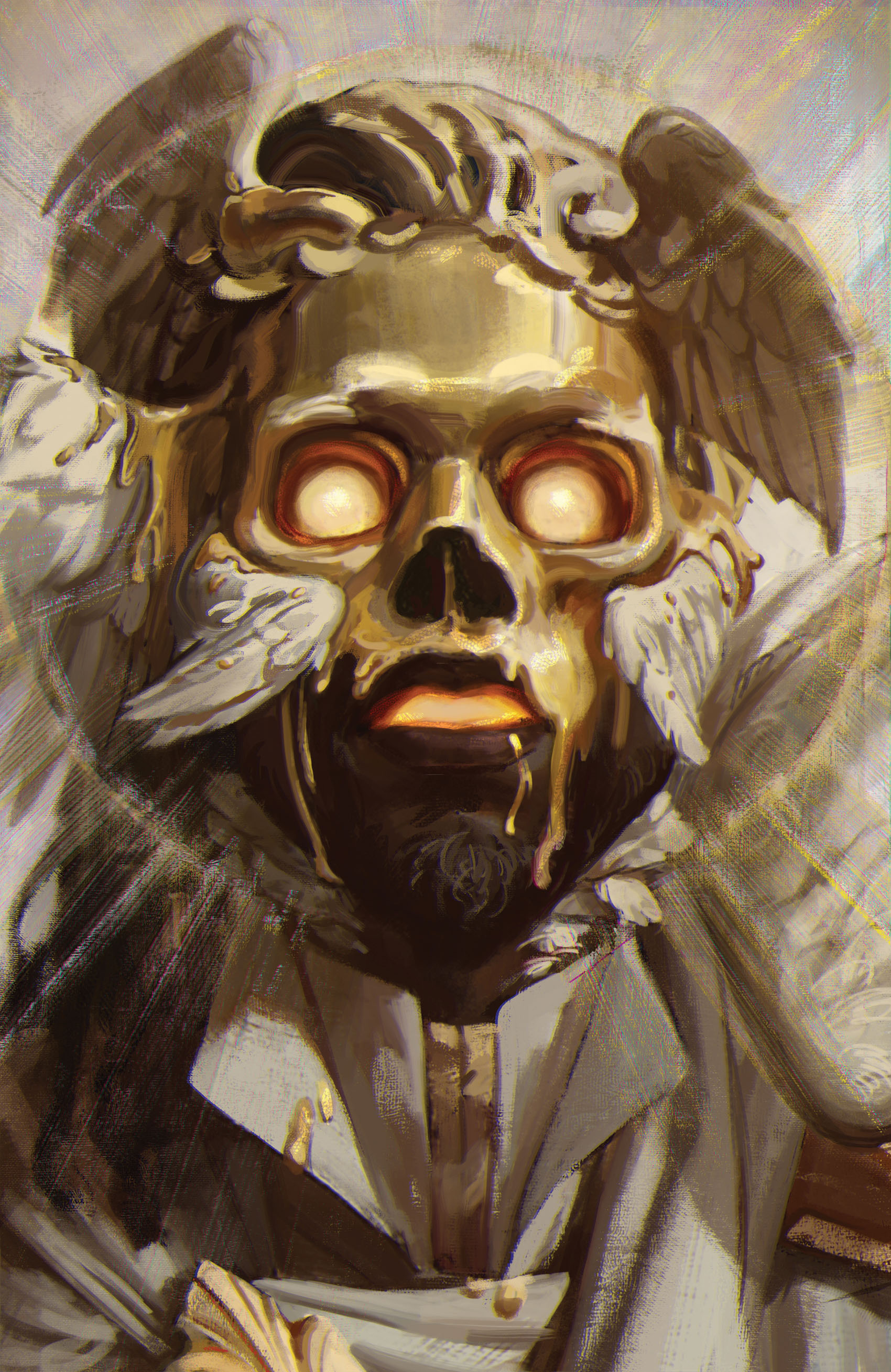
Seraph Stage 4
When you reach Stage 4 of the Seraph Transformation, you select one Stage 4 Boon and gain the Stage 4 Flaw.
Stage 4 Boon: Aura of Holy Purge
Seraph Stage 4 Boon
You emit an aura of righteous fervor in a 20-foot Emanation centered on you, except when you have the Unconscious condition. When an ally within your aura hits with a weapon attack, the ally can use their Reaction to cause the hit to be a Critical Hit. If they do, you and the ally each gain a level of Exhaustion. After an ally uses this Reaction, that ally can't use it again until after they finish a Long Rest.
Stage 4 Boon: Aura of Righteous Mercy
Seraph Stage 4 Boon
You emit an aura of peaceful resolution in a 20-foot Emanation centered on you, except when you have the Unconscious condition. When an ally within your aura would be reduced to 0 Hit Points, they can use their Reaction to drop to 1 Hit Point instead. If they do, you and the ally each gain a level of Exhaustion. After an ally uses this Reaction, that ally can't use it again until after they finish a Long Rest.
Stage 4 Boon: Bow of Celestial Domination
Seraph Stage 4 BoonPrerequisite:Bow of Celestial Judgement
While your Bow of Celestial Judgement is manifested, you gain these additional benefits:
- When you use a Magic action to target a creature you can see within 120 feet, you can also affect one other creature with 10 feet of the original target.
- You have Immunity to Necrotic damage instead of Resistance.
- You gain 15 Temporary Hit Points at the start of each of your turns instead of 5.
Stage 4 Flaw: Seraph Corruption
Seraph Stage 4 Flaw
The weight of evil in the world encumbers you more and more heavily as the days pass. Sometimes it becomes too much, and your celestial form is wracked with pain and doubt.
Whenever you roll a natural 1 on a saving throw, you suffer the following effects for 1 minute:
- At the start of each of your turns, you take 1d10 Psychic damage. This damage cannot be reduced in any way.
- You cannot regain Hit Points or have Temporary Hit Points.
- You have Disadvantage on the first attack you make every round.
- Once per round, the first creature you force to make a saving throw against your spell has Advantage on the saving throw.
Shadowsteel Ghoul
The cloaked figure hunches over a dusty tome, incanting words of power. At intervals, the figure caresses a dark rod with a sharp point, then jabs themself, causing a sharp gasp of pain. The victim of the figure’s curse, sleeping across town, rolls over in his sleep. He will soon suffer the ravages of a Shadowsteel curse. But the curser has a much worse fate awaiting them.
In Etharis, sometimes the metal of the earth itself carries an enormous, vile power. Such is the case with Shadowsteel, a material that has absorbed corrupt power. This makes the substance perfect for warping the magic that passes through it, making it perfect for cursing or enhancing spells.
Cursing an enemy, however, requires an enormous amount of work and personal power. These efforts, though enhanced when passing through Shadowsteel, take a toll upon the magic-wielders handling it. By using it, spellcasters and ritualists bind their soul, a bit at a time, to the energies of the fell metal. Those who use Shadowsteel often feel its effects as they move closer and closer to undeath.
Becoming a Shadowsteel Ghoul
Curses are wrought from and woven with intense feelings of loathing, spite, and bitterness. Humanoids who choose to wield such deeply evil magic leave an indelible mark upon their own soul. When enough of these marks pollute a person, their spirit begins to rot.
A creature who uses a Spellcasting Focus made of Shadowsteel, particularly to cast curses, risks acquiring the Shadowsteel Ghoul curse. Being attuned to a Shadowsteel magic item or wielding a Shadowsteel weapon for a prolonged period also carries a similar danger.
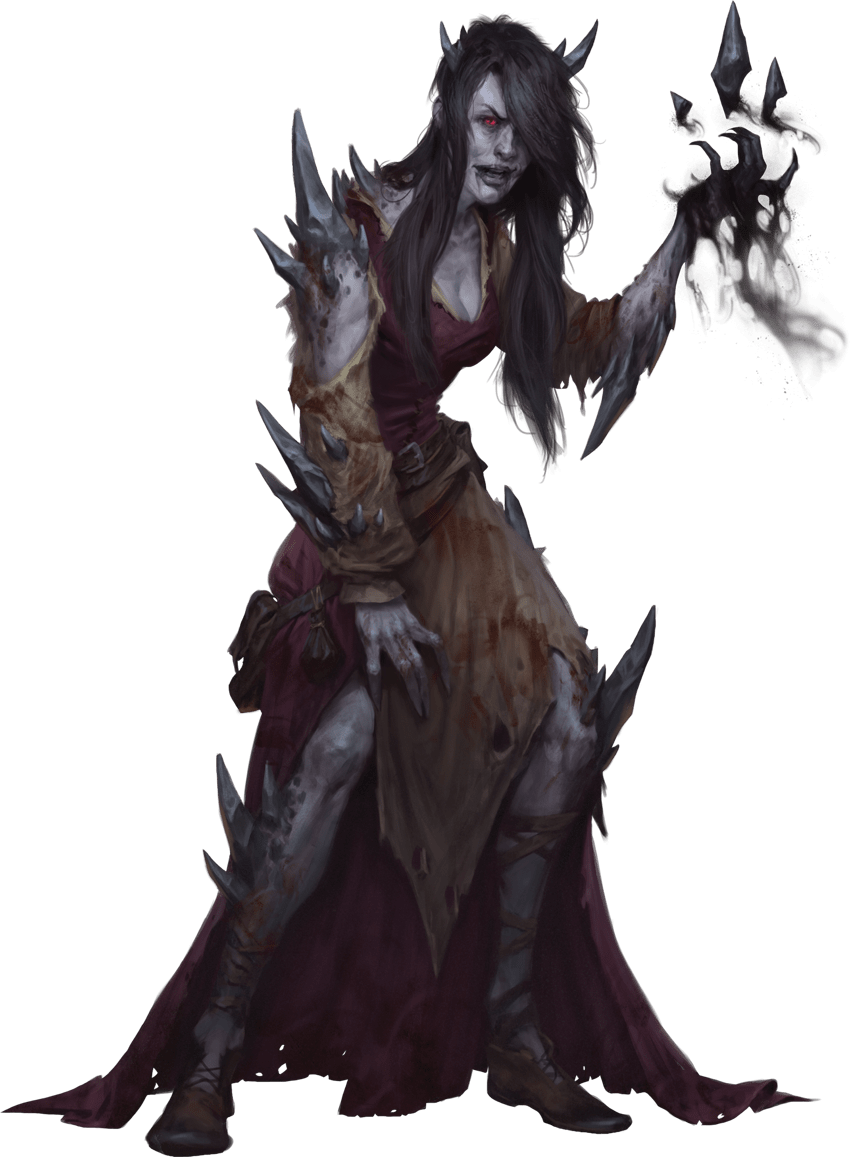
Curing Shadowsteel Ghoul Curses
Once the character reaches Stage 1 of the Shadowsteel Ghoul Transformation, no typical magic like Remove Curse can remove the affliction. Magic on the level of the Wish spell is needed to completely remove the Transformation and its Boons and Flaws.
Shadowsteel Ghoul Stages
At each stage of this Transformation, follow the instructions provided for that stage.
Achieving a New Stage
To move from one stage to the next higher one in this Transformation, an event or some other notable occurrence tied to the story of the character should take place. The following events are suggestions for ones that might trigger a move to the next stage of the Transformation:
- Casting a Shadowsteel curse on a powerful creature that later reaches culmination.
- Casting a ritual that consumes a Shadowsteel magic item, allowing you to absorb its power.
- Making a bargain with a Fiend who gifts you with a new object made of Shadowsteel.
- Casting a 7th-level or higher spell for the first time using a Shadowsteel Focus.
- Slaying a powerful foe with a weapon forged from Shadowsteel.
- Failing two Death Saving Throws.
Shadowsteel Ghoul Stage 1
When you initially contract the Shadowsteel Ghoul curse, you select one Stage 1 Boon and gain the Stage 1 Flaw.
Stage 1 Boon: Shadowsteel Curser
Shadowsteel Ghoul Stage 1 Boon
If you do not already have it, you gain the Shadowsteel Adept feat.
Additionally, when you cast a Shadowsteel curse, the casting time is reduced by half, and the saving throw DC increases by 1.
Stage 1 Boon: Shadowsteel Weapon
Shadowsteel Ghoul Stage 1 Boon
During a Long Rest, you focus upon a Melee weapon within your reach, imbuing it with a fragment of your Shadowsteel corruption. This Shadowsteel weapon deals your choice of Force damage or their normal damage type.
When you reduce a creature to 0 Hit Points with a melee attack made with your Shadowsteel weapon, you gain 1d8 Temporary Hit Points for 1 hour.
You can repeat the process described above to imbue a different weapon with Shadowsteel. This removes the effect from your existing Shadowsteel weapon.
Stage 1 Flaw: Debilitating Magic
Shadowsteel Ghoul Stage 1 Flaw
Choose one ability score. You lose 2 points in that ability as the power of the Shadowsteel slowly eats away at your body, soul, or both.
Shadowsteel Ghoul Stage 2
When you reach Stage 2 of the Shadowsteel Ghoul curse, you select two Stage 2 Boons and gain the Stage 2 Flaw.
Stage 2 Boon: Magic Resistance
Shadowsteel Ghoul Stage 2 Boon
You have Advantage on saving throws against spells.
Stage 2 Boon: Shadowsteel Absorption
Shadowsteel Ghoul Stage 2 Boon
As the Shadowsteel courses through you, it begins to harden your flesh. Your Armor Class increases by 1 when you aren’t wearing armor.
Stage 2 Boon: Shadowsteel Caster
Shadowsteel Ghoul Stage 2 BoonPrerequisite:Shadowsteel Curser
If you do not already have it, you gain the Shadowsteel Master feat.
Additionally, when you use a Shadowsteel component to cast a spell using a spell slot, you can spend a Hit Die to regain that spell slot. The spell slot level cannot be greater than twice your Shadowsteel Ghoul Transformation Stage.
You can use this feature a number of times equal to your spellcasting ability modifier. You regain all uses of this feature after finishing a Long Rest.
Stage 2 Boon: Shadowsteel Weapon Master
Shadowsteel Ghoul Stage 2 BoonPrerequisite:Shadowsteel Weapon
You gain a +4 bonus to damage rolls made with your Shadowsteel weapon.
Stage 2 Flaw: Friendless
Shadowsteel Ghoul Stage 2 Flaw
You are no longer able to connect with other creatures on a social level. You prefer isolation and twisted contemplation to friendship and camaraderie.
You cannot be considered an ally to any Humanoids or Beasts, and no living creature can be Friendly toward you.
You also have Disadvantage on all Charisma ability checks.
Shadowsteel's Temptation
The Shadowsteel Ghoul Transformation might be the most likely change for characters to undertake. Each time a caster uses a Shadowsteel Focus to cast a spell, or a warrior wields a Shadowsteel weapon, they risk losing a bit of their soul to gain a bit of power.
Players should know what is happening to their characters when they wield Shadowsteel's power. It’s a boost to the power of a character, and the risk should be offsetting that power. The toll that is takes on the character should be explained by the GM, and hopefully the player—in the spirit of a dark fantasy campaign—should be able to express and illustrate that toll through roleplaying.
Shadowsteel Ghoul Stage 3
When you reach Stage 3 of the Shadowsteel Ghoul Transformation, you gain the Stage 3 Boon and the Stage 3 Flaw.
Stage 3 Boon: Cursed Claw
Shadowsteel Ghoul Stage 3 Boon
You gain a Claw attack. This attack uses either your Strength or Dexterity for attack and damage rolls.
You can use this attack twice as part of an Attack action, or once as a Bonus Action. The Claw attack deals 2d6 plus your Strength or Dexterity modifier.
Additionally, when the Claw attack hits, the target must succeed on a Constitution saving throw or be afflicted with a random Shadowsteel curse at Stage 1. The saving throw DC is 8 plus your Constitution modifier plus your Proficiency Bonus. A creature already afflicted with a Shadowsteel curse cannot gain another Shadowsteel curse with this attack.
Stage 3 Flaw: Healing Resistance
Shadowsteel Ghoul Stage 3 Flaw
You heal at a slower rate than normal, whether that healing is magical or natural. Whenever you regain Hit Points, you regain half as many Hit Points as you should. You still recover all Hit Points at the end of a Long Rest.
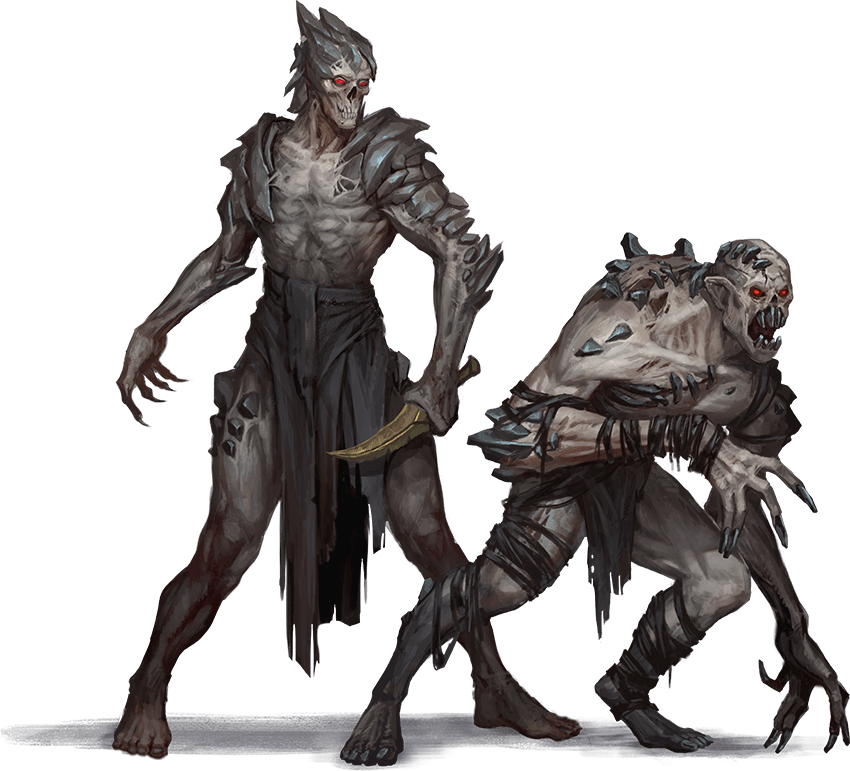
Shadowsteel Ghoul Stage 4
When you reach Stage 4 of the Shadowsteel Ghoul Transformation, you select one Stage 4 Boon and gain the Stage 4 Flaw.
Stage 4 Boon: Shadowsteel Arcane Vessel
Shadowsteel Ghoul Stage 4 BoonPrerequisite:Shadowsteel Caster
When you cast a spell using a spell slot, the power of your Shadowsteel infection emanates from you. One creature targeted by the spell within 60 feet of you has Disadvantage on the saving throw to resist the spell, or you have Advantage on the spell attack roll.
You can use this feature a number of times equal to your Proficiency Bonus, and you regain all uses after you finish a Long Rest.
Stage 4 Boon: Shadowsteel Fury
Shadowsteel Ghoul Stage 4 Boon
When you use the Attack action to attack with your Shadowsteel weapon or Cursed Claw, you can use a Bonus Action to make an additional attack with the same weapon or Claw. This extra attack carries with it the power of the Shadowsteel infection.
When you hit with this attack, the target must succeed on a Constitution saving throw or gain a 1 Exhaustion level. The saving throw DC is 8 plus the ability modifier used in the attack plus your Transformation Stage.
Stage 4 Flaw: Shadowsteel Explosion
Shadowsteel Ghoul Stage 4 Flaw
The Shadowsteel that suffuses your flesh responds to stress, and you can do nothing to control it. The first time you are Bloodied or reduced to 0 Hit Points after you finish a Short or Long Rest, you risk hurting everyone around you.
When these events occur, all living creatures within 60 feet of you must succeed on a DC 20 Constitution saving throw. On a failed save, creatures in the area suffer 4d10 Force damage and have the Stunned condition until the end of their next turn. On a successful save, a target takes half damage and is not Stunned.
The power of the Shadowsteel became a part of me the first time I picked it up. It practically sang to me of magical ability beyond my understanding. If I had any idea of how true that was….
—Recovering Shadowsteel Caster
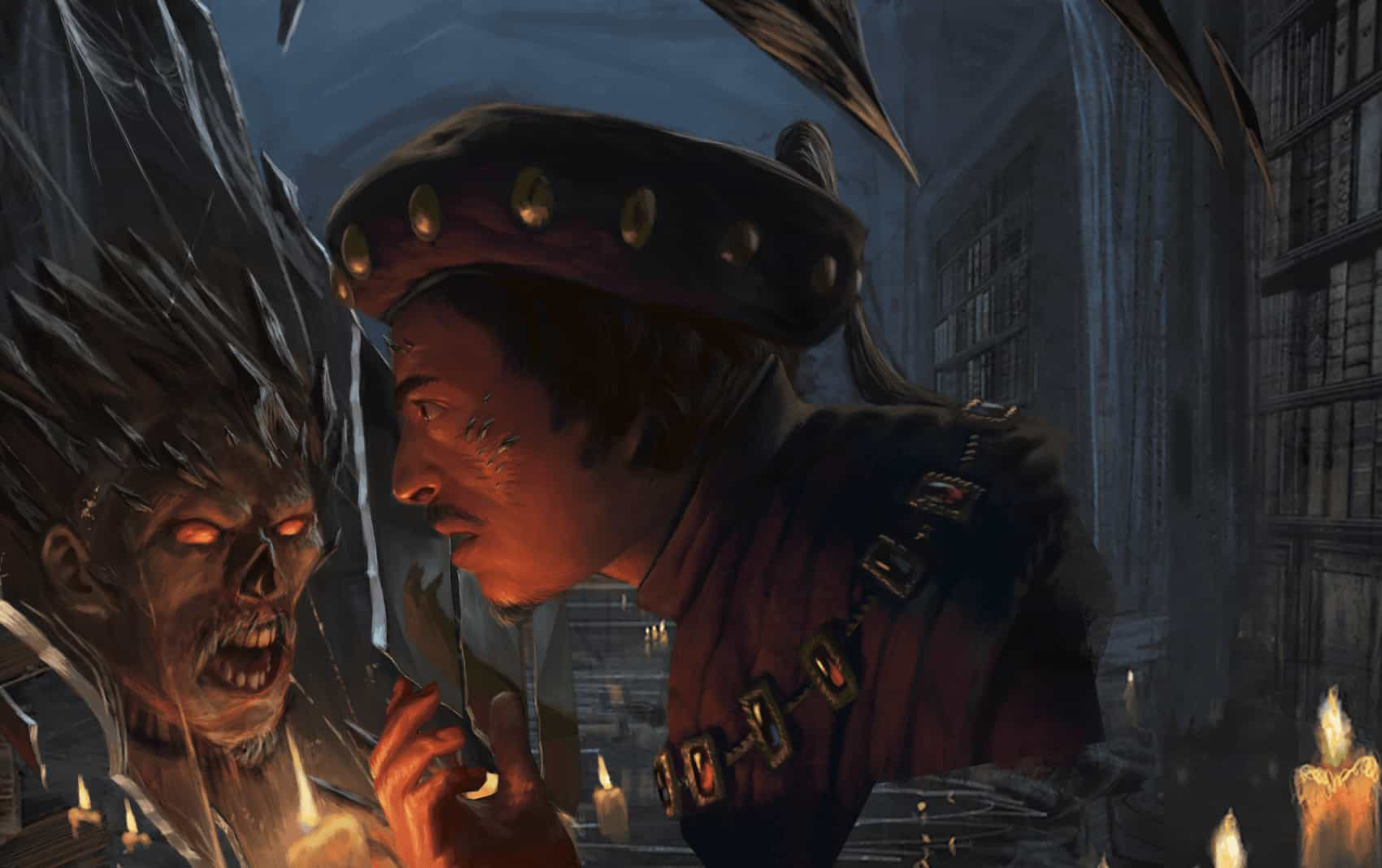
Specter

The young woman walks the cobblestone streets every evening. No one ever speaks with her. Few even dare to pass her by. She searches for her home, unaware that it’s long demolished, and she is long dead. Her haunting image illuminates the dark streets. Her voice echoes in the dusk, “Help me!”
A lithe figure shambles into town from the graveyard; their body is luminous and ghastly. Their soiled clothes are held together in tatters and their head is marked by twenty gashes. They raise a ghostly hand to point. Their eyes are haunted and filled with rage. The wraith unleashes a cry of the dead that would chill their murderer’s blood to ice.
A living person becomes a Specter through death, by contacting the realm of the dead, or through magic that breaks the body’s ties to the material world. This Transformation tears at the substance of body and mind, until what is left is a spiritual shadow.
Specters have a tenuous grasp on reality, and some fade into oblivion while others become monsters that sow the same. Few cursed with this Transformation have the fortitude to remain whole.
Becoming a Specter
Methods of becoming a Specter vary, and few find their way willingly. One that dies of an unjust or violent cause may find their spirit refusing to depart, despite their physical form fading. Contact with the forces of death can drain the soul of vitality—a would-be hero is corrupted by the force they wanted to fight. Sinister rituals can also infuse a body with the powers of unmaking from the realm of the Aether Kindred.
Alongside incorporeal beings and the magic of death stand entities that exist in a reality untethered from the material world as mortals understand it. These others and their minions, manifestations of otherworldly chaos, can infuse a person with that chaos, making the victim’s ultimate home a dream of cosmic horror.
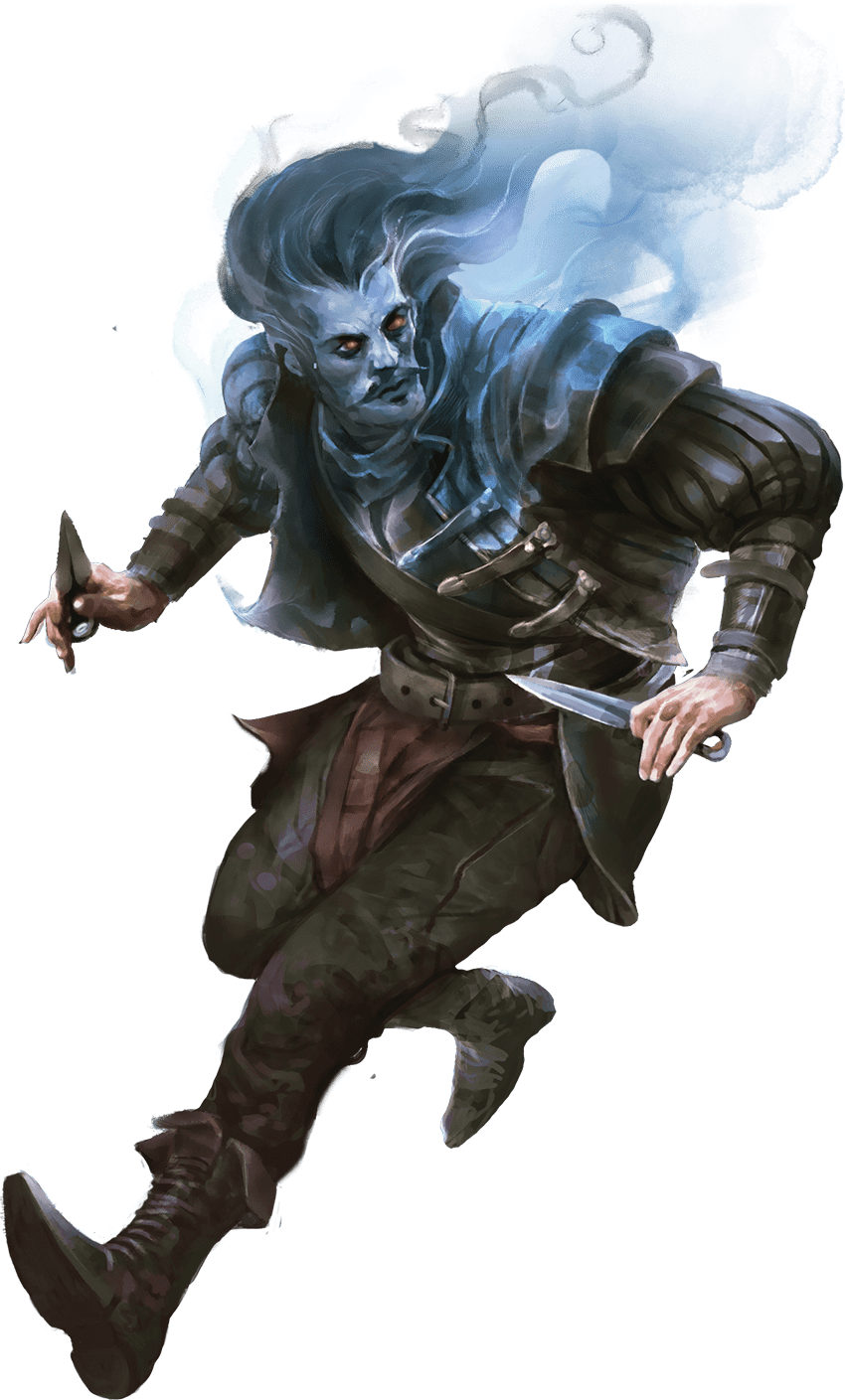
Reversing Specter Traits
Once the character reaches Stage 1 of the Specter Transformation, typical magic like Remove Curse cannot remove the affliction. You cannot be revived or restored by any magic lesser than the Wish spell due to the ties that anchor your spirit to the corporeal world.
Once you die completely and your soul departs, you may be brought back to life by more conventional magic, free of the Transformation and its Boons and Flaws.
Specter Stages
At each stage of this Transformation, follow the instructions provided for that stage.
Achieving a New Stage
To move from one stage to the next higher one in this Transformation, an event or some other notable occurrence tied to the story of the character should take place. The following events are suggestions for ones that might trigger a move to the next stage of the Transformation:
- Defeat a powerful, ghostly Undead and absorb its power.
- Defeat an Aberration that has powers over space, time, or death.
- Use a ritual that infuses your body with the forces of death or primordial chaos.
- Survive a near-death experience caused by a ghostly Undead creature or an Aberration, especially one in which your Hit Point maximum is reduced, such as by a Wraith’s Life Drain, or in which you drop to 0 Hit Points.
- Kill a significant foe with Necrotic or Psychic damage, or by using Necromancy.
- Infuse other willing people with the power that corrupts you.
- Interact with ghosts and similar spirits, or beings of other realities, perhaps as a conduit between them and other mortals.
- Open a gate or path to places of the dead or the dreams of the Aether Kindred.
Specter Stage 1
When you initially undergo the Specter Transformation, you gain the Spectral Form Boon and one other Stage 1 Boon of your choice. You also gain the Stage 1 Flaw.
Stage 1 Boon: Spectral Form
Specter Stage 1 Boon
You are considered to be Undead in addition to your existing creature type(s). You cannot be excluded from Turn Undead.
Additionally, you have Resistance to Necrotic damage. If you have Resistance to Necrotic damage from another source, you have Immunity instead.
Finally, you stop aging. You are immune to any effect that would age you, and you cannot die from old age.
Stage 1 Boon: Ghastly Touch
Specter Stage 1 Boon
You can deliver a soul-chilling jolt through your attacks. Once per turn, when you hit a target with a melee attack when you are within 5 feet of the target, you can deal an additional 1d6 Necrotic damage.
You can use this feature a number of times equal to your Proficiency Bonus plus your Transformation Stage. You regain all uses of this feature when you finish a Short Rest or Long Rest.
Stage 1 Boon: Incorporeal Movement
Specter Stage 1 Boon
You are able to loosen the binds that tie you to the material world to move through solid objects and creatures. As a Magic action, you can make yourself incorporeal until the start of your next turn. While in this form, you gain the following benefits:
- You can move through solid objects at your full Speed. You take 1d10 Force damage if you end your turn inside a solid object and are moved to the nearest open space.
- You have Resistance to all damage types except Force damage.
- You are Lightly Obscured.
You can use this feature a number of times equal to your Proficiency Bonus, and regain all uses after finishing a Long Rest.
Stage 1 Flaw: Drawn to Darkness
Specter Stage 1 Flaw
Your body and soul are bound to the cold darkness of the realms of death. You have Disadvantage on Death Saving Throws as your life force is drawn to oblivion.
Specter Stage 2
When you reach Stage 2 of the Specter Transformation, you select one Stage 2 Boon and gain the Stage 2 Flaw.
Stage 2 Boon: Ethereal Phasing
Specter Stage 2 Boon
You can cast the Blink spell without expending a spell slot. You can cast the spell using this Boon a number of times equal to your Transformation Stage, and you regain all uses after finishing a Long Rest.
While you are under the effects of Blink when cast in this way, you also gain Temporary Hit Points equal to your Proficiency Bonus plus your Transformation Stage at the start of each of your turns.
Stage 2 Boon: Haunting Flight
Specter Stage 2 Boon
You gain a Fly Speed equal to your Speed.
Also, while you are flying, you can use a Bonus Action to focus your terrifying presence on one creature you can see within 30 feet. That creature must succeed on a Wisdom saving throw or have the Frightened condition for 1 minute. The DC for the Wisdom saving throw is 8 plus your Proficiency Bonus plus your Transformation Stage. Once you use this feature, you must finish a Short or Long Rest before you can use it again.
Stage 2 Flaw: Untethered from Life
Specter Stage 2 Flaw
Your life force is weaker than other creatures. When you would regain Hit Points, you regain half as many Hit Points as normal (rounded down).
Specter Stage 3
When you reach Stage 3 of the Specter Transformation, you select one Stage 3 Boon and gain the Stage 3 Flaw.
Stage 3 Boon: Draining Flight
Specter Stage 3 BoonPrerequisite:Incorporeal Movement and Haunting Flight
You can now use your Incorporeal Movement feature as a Bonus Action. Additionally, your Fly Speed while using Haunting Flight becomes double your Speed.
Additionally, while you are using Incorporeal Movement, your movement does not provoke Opportunity Attacks and you can damage creatures that you move through. Once per turn, when you enter a space occupied by a creature, you can choose to force that creature to succeed on a Constitution saving throw or take 6d6 Psychic damage and have the Frightened condition until the end of your next turn. A creature takes half damage on a successful save and is not Frightened. The DC of the Constitution saving throw is 8 plus your Proficiency Bonus plus your Transformation Stage.
Once you use this feature, you must finish a Short Rest or Long Rest before you can use it again.
Stage 3 Boon: Paralyzing Touch
Specter Stage 3 BoonPrerequisite:Ghastly Touch
Your Ghastly Touch feature takes on a spirit-freezing quality. The damage from your Ghastly Touch increases to 2d6 Necrotic damage. Additionally, you can force any creature you damage with Ghastly Touch to make a Constitution saving throw. The DC for this saving throw is 8 plus your Proficiency Bonus plus your Transformation Stage.
On a failed save, the creature has the Paralyzed condition until the start of your next turn. On a successful save, they have the Prone condition instead. You can use this feature a number of times equal to your Transformation Stage. You regain all uses of this feature when you finish a Short or Long Rest.
Stage 3 Flaw: Fraying Reality
Specter Stage 3 Flaw
Your mind begins to slip into the dark places where the world of life and world of death intersect. When you become Bloodied for the first time after finishing a Short or Long Rest, you must make a DC 15 Charisma saving throw. On a failed save, you act as though under the effects of a Confusion spell for 1 minute.
Specter Stage 4
When you reach Stage 4 of the Specter Transformation, you select one Stage 4 Boon and gain the Stage 4 Flaw.
Stage 4 Boon: Call of Unmaking
Specter Stage 4 Boon
As a Bonus Action, you can give a mournful wail or otherwise set up a wracking vibration. This sound has no effect on Constructs and Undead.
All other creatures of your choice within 30 feet of you must make a Constitution saving throw. The DC of the Constitution saving throw is 8 plus your Proficiency Bonus plus your Transformation Stage. Creatures that can’t hear you have Advantage on the saving throw.
On a failed save, the creature bears the Mark of Unmaking for 1 minute. While bearing this mark, a creature takes an additional 1d6 Necrotic damage each time it takes damage.
Once you use this feature, you can’t use it again until you finish a Long Rest.
Stage 4 Boon: Possession
Specter Stage 4 Boon
As a Magic action, you enter the space of a Humanoid or Beast and force that creature to make a DC 15 Charisma saving throw. If the target fails, you disappear, and the target is Incapacitated and loses control of its body. You control the body without depriving the target of awareness.
While possessing a target, you can’t be targeted by any attack, spell, or other effect. You retain your alignment, Intelligence, Wisdom, Charisma, and any immunity to having the Charmed and Frightened conditions. Otherwise, you use the possessed target’s statistics but don’t gain access to the target’s knowledge, spellcasting abilities or Magic actions, class features, or proficiencies.
The possession lasts for 1 hour, until the possessed target drops to 0 Hit Points, you end it as a Bonus Action, or you are forced out by an effect that ends possession. When the possession ends, you reappear in an unoccupied space within 5 feet of the possessed creature. Once you use this feature, you can’t use it again until you finish a Short Rest or Long Rest.
Stage 4 Flaw: Pull of Oblivion
Specter Stage 4 Flaw
Your connection to the material realm becomes gossamer thin. When you roll a natural 1 on a D20 Test, you take 4d6 Force damage, and this damage cannot be mitigated. If this damage reduces you to 0 Hit Points, you die.
When you die in this way or any other, you can only be brought back to life through magic equivalent to level 7 or higher spells.
He faded away as quickly as he appeared. From his expression, it looked like he was being dragged away.
—Witness to a Spectral Transformation
Vampire
A twisted figure lurks in the shadows of a castle wall as the roaring infantry charges through a breach. In a flash of black mist, the figure appears in front of the soldiers, one by one, striking them down with inhuman speed.
Candlelight flickers as a hooded advisor leans over an ornate throne, whispering machinations into her lord’s ensnarled mind. The chamber erupts into commotion as the lord announces further powers be granted to the resident merchants’ guild.
A terrified villager flees through the forest, hoping to outrun his pursuer. His eyes burn with tears, sweat, and blood. He stops, listening for the sounds of footsteps behind. His sigh of relief is stopped before it escapes his throat, as fangs sink deep into his neck.
Vampires are creatures of accursed blood and tragic existence. Exquisite food, a warm summer breeze, and growing old surrounded by loved ones: these are luxuries a Vampire will never experience. Unable to enjoy many of life’s pleasures as they once knew them, Vampires often become bitter creatures, filled with hate for everything they once loved.
Becoming a Vampire
Vampires are spawned into the world when a mortal contracts the Sanguine Curse, dies, and is reborn undead. There are a variety of ways to contract the curse. A Vampire may have offered their blood to a loyal servant, powerful ally, or loved one they wished to elevate. More commonly, a Vampire may bite a victim, who survives the attack long enough to contract the Sanguine Curse before perishing and being reborn.
Other methods of becoming a Vampire include ancient and dark magic, as well as powerful but cursed magical artifacts. Vampirism may be passed along when an ancient Vampire allows a beloved plaything to drink blood from the Undead creature’s cursed veins. Regardless of how you have become a Vampire, you should discuss with your GM what type of Vampire you might become and how it can be implemented in the campaign.
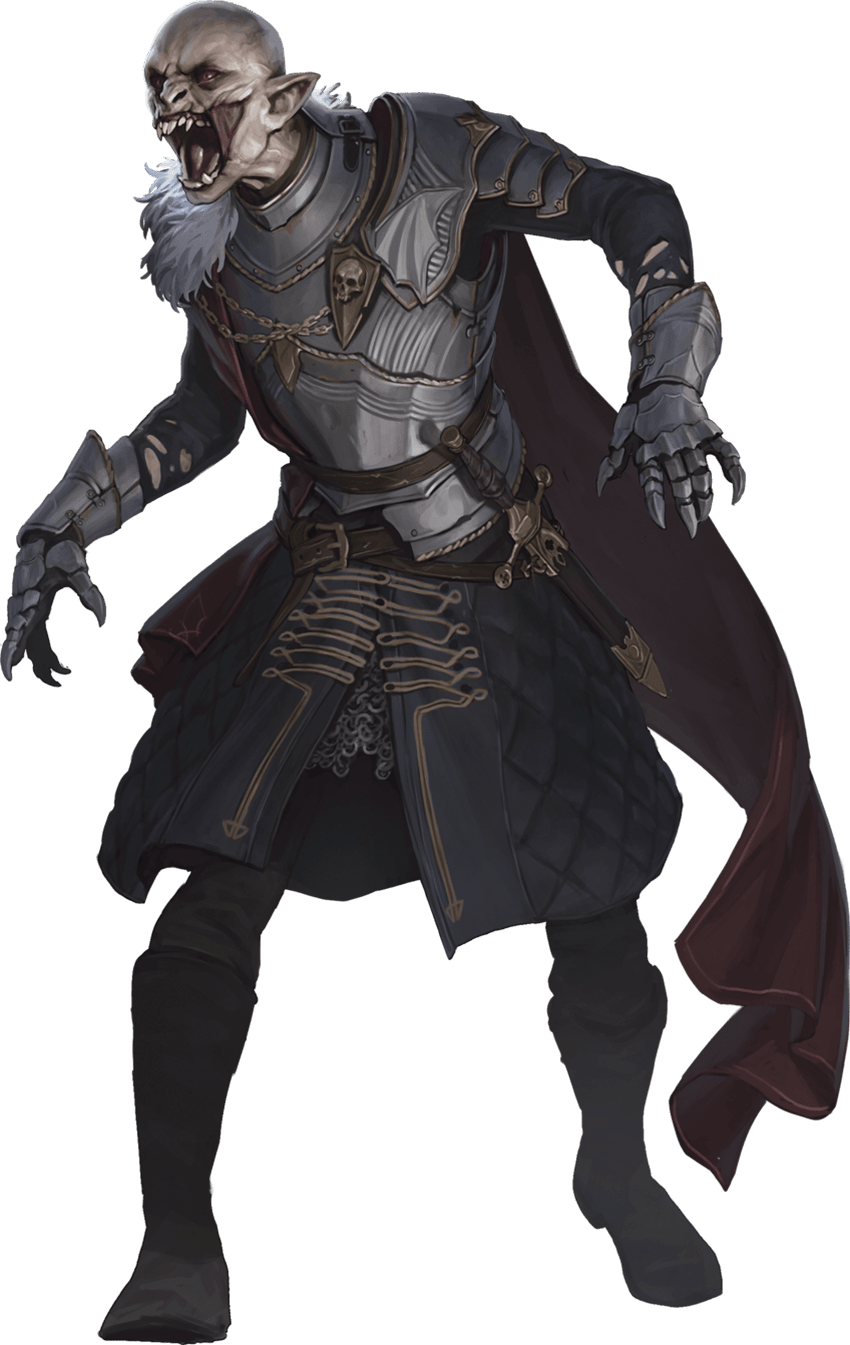
Curing Vampirism
Once the character reaches Stage 1 of the Vampire Transformation, no typical magic like Remove Curse can remove the affliction. Magic on the level of the Wish spell is needed to completely remove the Transformation and its Boons and Flaws.
Vampire Stages
At each stage of this Transformation, follow the instructions provided for that stage.
Achieving a New Stage
To move from one stage to the next higher one in this Transformation, an event or some other notable occurrence tied to the story of the character should take place. The following events are suggestions for ones that might trigger a move to the next stage of the Transformation:
- Severing a tie to your mortal life, such as discarding a sentimental trinket or abandoning a loved one.
- Making a further bargain with the Vampire who gifted you with the Sanguine Curse.
- Drinking the blood of another, more ancient, Vampire.
- Failing two Death Saving Throws.
- Performing a blood ritual using Sangromancy.
Vampire Stage 1
When you initially contract vampirism, you gain the Fanged Bite Boon and one other Stage 1 Boon. You also gain the Stage 1 Flaw.
Stage 1 Boon: Fanged Bite
Vampire Stage 1 Boon
As an Attack action, you can make a Bite attack. You are considered proficient with this attack, and you can use Strength or Dexterity as the ability. This attack deals Piercing damage equal to 1d6 plus your Strength or Dexterity modifier. This Bite attack is not a weapon or an Unarmed Strike.
If the attack hits a creature that has blood, the target must succeed on a Constitution saving throw or take an additional 1d6 Necrotic damage. You regain Hit Points equal to the Necrotic damage dealt this way. The DC is 8 plus your Proficiency Bonus plus your Transformation Stage.
Stage 1 Boon: Soman Bloodline
Vampire Stage 1 Boon
Your vampirism follows the Soman bloodline, the most prevalent in Etharis. You gain the following features:
- Your Strength and Dexterity scores increase by 1. Neither score can exceed 19 with this feature.
- You have Advantage on attack rolls with Fanged Bite.
- The Necrotic damage dealt by Fanged Bite increases to 1d8.
- You gain a Climb Speed equal to your Speed.
Stage 1 Boon: Fzeg Bloodline
Vampire Stage 1 Boon
Your vampirism follows the Fzeg bloodline, a line of vampires that combines the affliction with lycanthropy. You gain the following features:
- Your Strength score increases by 2. Your Strength score cannot exceed 20 with this feature.
- You gain a Claw attack. This attack deals 1d8 plus your Strength modifier Slashing damage, using your Strength modifier and Proficiency Bonus on attack rolls. This Claw attack is not a weapon or an Unarmed Strike.
- When you take the Attack action to make the Claw attack, you may use a Bonus Action to make a Bite attack from Fanged Bite.
- Your Speed increases by 10 feet.
Stage 1 Boon: Strigoi Bloodline
Vampire Stage 1 Boon
Your vampirism follows the Strigoi bloodline. Your speed and guile almost match your ferocity. You gain the following features:
- Your Dexterity score increases by 2. Your Dexterity score cannot exceed 20 with this feature.
- If you make your Fanged Bite attack with Advantage, the Piercing damage increases to 2d4 plus your Strength or Dexterity modifier.
- You can take the Hide action as a Bonus Action, and you can use the Hide action anywhere that is not in sunlight.
- You have proficiency with the Stealth skill. If you are already proficient in Stealth, you gain Expertise in Stealth instead.
Stage 1 Flaw: The Sanguine Curse
Vampire Stage 1 Flaw
The Sanguine Curse has taken hold of you. As a result, you gain the following features:
- You cannot enter a private residence that you do not own without one of the occupants inviting you. Once invited, you can enter without penalty as long as the inviter resides there. If you do enter uninvited, you have Disadvantage on all D20 Tests while in the residence. Additionally, you take 1d4 Psychic damage at the start of each of your turns. You cannot be Resistant or Immune to Psychic damage while inside such a residence uninvited.
- You must feed at least once within seven days of your last feeding. See the Feeding sidebar for more information.
Feeding
As a Vampire transforms further and further from its mortal form, its metabolic requirements change. The first change is a need for mortal blood. This need is approximately 1 pint of blood from a Humanoid, Beast, or other creature with mortal blood.
As an action, you can bite a living creature within 5 feet that is Charmed by you, or that has the Incapacitated, Paralyzed, Restrained, or Unconscious condition. You drain the target of one pint of blood (or similar life-giving substance), leaving a visible bite mark on that creature. The bitten creature gains one Exhaustion level.
A Vampire that does not feed within the required time enters a rabid feeding frenzy under the GM’s control. They attack the nearest creature they could feed from. A Vampire remains in this state until they have drained a creature completely (killing them), at which point the Vampire falls unconscious for 4 hours.
Vampire Stage 2
When you reach Stage 2 of vampirism, you select two Stage 2 Boons and gain the Stage 2 Flaw.
Stage 2 Boon: Eyes of the Night
Vampire Stage 2 Boon
You gain Darkvision out to 60 feet. If you already have Darkvision, the range increases by 60 feet.
Stage 2 Boon: Grave-Touched Soul
Vampire Stage 2 Boon
You gain Resistance to Necrotic damage. If you already have Resistance to Necrotic damage, you gain Immunity instead.
Stage 2 Boon: Inhuman Reflexes
Vampire Stage 2 Boon
You have Advantage on Dexterity saving throws.
Stage 2 Boon: Undead Resilience
Vampire Stage 2 Boon
You become supernaturally tough to kill. When you are reduced to 0 Hit Points by any type of damage except Radiant, you can choose to be reduced to 1 Hit Point instead. Once you use this feature, you cannot use it again until you finish a Long Rest.
Stage 2 Flaw: Greater Sanguine Curse
Vampire Stage 2 Flaw
Your curse has taken a stronger hold onto you. You gain the following features:
- You have Disadvantage on all D20 Tests when you are in sunlight.
- You must feed every 4 days.
Vampire Stage 3
When you reach Stage 3 of vampirism, you select two Stage 3 Boons and gain the Stage 3 Flaw.
Stage 3 Boon: Beguiler’s Charm
Vampire Stage 3 Boon
You gain the ability to manipulate the mind of a creature with your unearthly charm. As a Magic action, you can choose a Humanoid or Beast within 30 feet of you that can see you. The creature must succeed on a Charisma saving throw with a DC of 8 plus your Charisma modifier plus your Proficiency Bonus.
On a failed save, the creature has the Charmed condition for 24 hours. At the end of the 24 hours, you can choose to automatically renew the Charmed condition on that creature with no saving throw. You may only have one creature Charmed in this manner at a time. If you use this feature on another creature, or you or an ally damages the creature, the Charmed condition ends on the previous creature immediately.
Stage 3 Boon: Improved Fanged Bite
Vampire Stage 3 Boon
As an Attack action, you can make 2 Fanged Bite attacks. Additionally, you can make a Fanged Bite attack as a Bonus Action if you don't make a Fanged Bite attack as part of an Attack action on the same turn.
Stage 3 Boon: Mist Form
Vampire Stage 3 Boon
You can cast the Gaseous Form spell a number of times equal to your Vampire Transformation Stage without using a spell slot or needing to use Verbal, Somatic, or Material components. You regain all uses of this feature when you finish a Long Rest.
You can cast this spell as an Action on your turn, or as a Reaction when you would take Bludgeoning, Piercing, or Slashing damage. You cast the spell before taking the damage.
Stage 3 Boon: Sangromancy Specialist
Vampire Stage 3 BoonPrerequisite:Spellcaster who can cast cantrips
Your magic is tinged with the blood that you crave. You gain the following features:
- You gain an extra 1d12 Sangromancy Hit Point Dice per Vampire Transformation. You can use those dice on Sangromancy spells. You regain all spent Sangromancy Dice when you finish a Long Rest.
- When you successfully restore Hit Points using Fanged Bite, you regain one spent Sangromancy Die.
- Any cantrip you cast that does Necrotic damage can be enhanced by your Sangromancy Dice. You can spend up to 2 Hit Point Dice (including your Sangromancy Dice) to deal extra Necrotic damage with those cantrips. You can decide to spend these Hit Point Dice after you know if the cantrip affects the target(s).
Stage 3 Flaw: Supreme Sanguine Curse
Vampire Stage 3 Flaw
Your curse continues to transform you, bringing about further debilitations. You gain the following features:
- If you start your turn in sunlight, you take 1d10 Radiant damage. You cannot have Immunity or Resistance to this Radiant Damage.
- Your appearance begins to resemble that of a true vampire. In stressful conditions, as determined by you or the GM, your appearance changes outside of your control. When you do, anyone observing you knows your true nature.
- You must feed every 2 days.
You can hide your true appearance and disguise yourself as the humanoid you once were by concentrating on your composure. However, moments of bloodlust or stress are likely to reveal your true nature, including the following situations:
- Becoming Bloodied
- Concentrating on a spell
- Taking Radiant damage from sunlight
- Entering a feeding frenzy
- Having the Unconscious condition
- Entering hallowed ground
- Choosing to reveal yourself
In these events, or times of other extreme emotional or physical stress, a GM can call or a Constitution saving throw with a DC based on your current Transformation Stage. If you fail this save, your Sanguine Curse is revealed.
| Supreme Sanguine Curse Save DC | |
|---|---|
| Stage | Constitution Save DC |
| 3 | 16 |
| 4 | 20 |
Non-evil creatures that witness your true form become instantly Hostile to you, unless the GM decides otherwise.
Vampire Stage 4
When you reach Stage 4 of vampirism, you gain the Regeneration Boon and one other Stage 4 Boon of your choice. You also gain the Stage 4 Flaw.
Stage 4 Boon: Final Soman Bloodline
Vampire Stage 4 BoonPrerequisite:Soman Bloodline
You reach the full manifestation of your Soman Bloodline. You gain the following features:
- Your Strength and Dexterity scores increase by 1 to a maximum of 20.
- Fanged Bite’s Necrotic damage increases to 3d8.
- When a Humanoid creature is reduced to 0 Hit Points by your Fanged Bite attack or through your feeding, it rises as a Vampire Spawn 24 hours later unless the body is destroyed or undergoes rituals to prevent its rising. You can have two Vampire Spawns created this way under your control, and they follow your verbal commands to the best of their abilities. If you take control of a third Vampire Spawn, you choose one of the other Vampire Spawn you currently control to no longer follow your commands.
Stage 4 Boon: Final Fzeg Bloodline
Vampire Stage 4 BoonPrerequisite:Fzeg Bloodline
You reach the full manifestation of your Fzeg Bloodline. You have the following features:
- Your Strength score increases by 2 points to a maximum of 20.
- The damage done by your Claw attack becomes 3d6 plus your Strength modifier Slashing damage, using your Strength modifier and Proficiency Bonus on attack rolls. You can also make three Claw attacks with an Attack action.
- You are Resistant to Bludgeoning, Piercing, and Slashing damage. Magic and silvered weapons ignore this Resistance.
- Your Speed increases by 10 feet.
Stage 4 Boon: Final Strigoi Bloodline
Vampire Stage 4 BoonPrerequisite:Strigoi Bloodline Form
You reach the full manifestation of your Strigoi Bloodline. You have the following features:
- Your Dexterity score increases by 2 points to a maximum of 20.
- You can summon 2d4 Swarms of Rats, Swarms of Bats, or Wolves as a Bonus Action. They appear at the start of your next turn within 60 feet of you. They follow your verbal or mental commands. They disperse after 1 hour, when you are reduced to 0 Hit Points, or when you dismiss them with a Bonus Action. You regain this ability after finishing a Short or Long Rest.
- You can cast the Misty Step spell up to four times without using a spell slot. You can also cast a spell in this way as a Reaction when you are targeted with a weapon attack. You cast the spell before taking damage. You regain this ability after finishing a Long Rest.
Stage 4 Boon: Regeneration
Vampire Stage 4 Boon
The vampiric blood that flows in your veins gives you regenerative powers. You regain 15 Hit Points at the start of your turn if you have at least 1 Hit Point but less than 60 Hit Points. This feature has no effect if you are in sunlight or have taken Radiant damage since the end of your last turn.
Stage 4 Flaw: Ultimate Sanguine Curse
Vampire Stage 4 Flaw
Your transformation into a creature of the night is complete. And with that transformation comes susceptibilities. You gain the following features:
- One strike may end your existence forever. When you are Incapacitated, Stunned, or Unconscious, and you are struck by a Critical Hit with a Piercing Weapon made of wood or silver, you must succeed on a DC 20 Constitution saving throw. On a failed save, you die and are reduced to ash. Only a True Resurrection or Wish spell can resurrect you.
- You must feed every day.
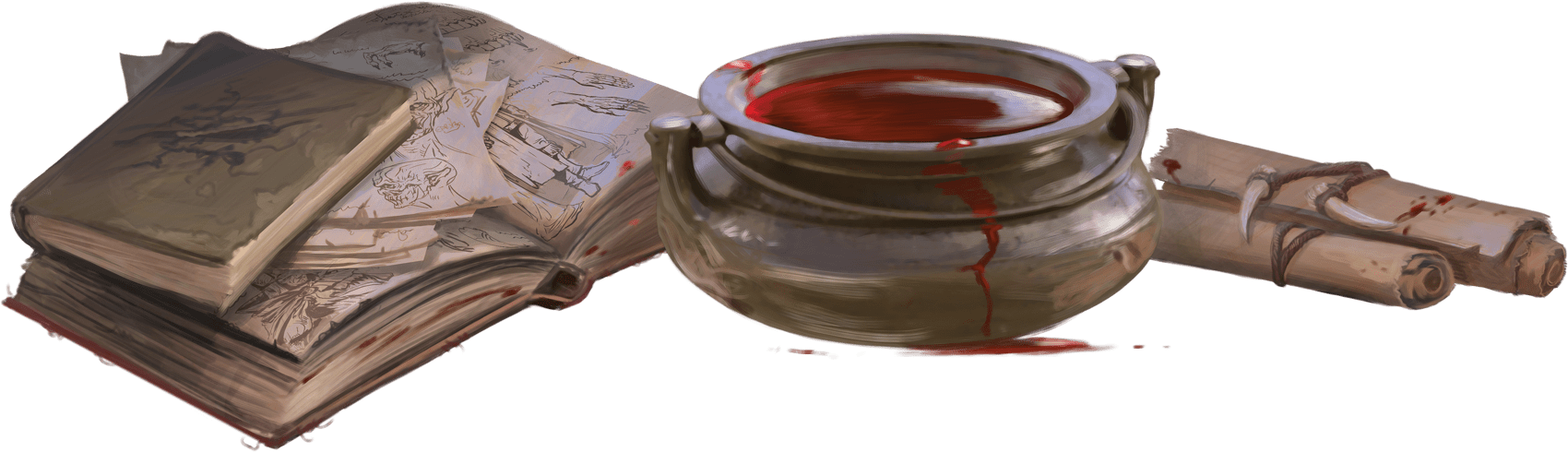
Comments