
Chapter 2: Classes & Subclasses
Chapter 2: Classes & Subclasses
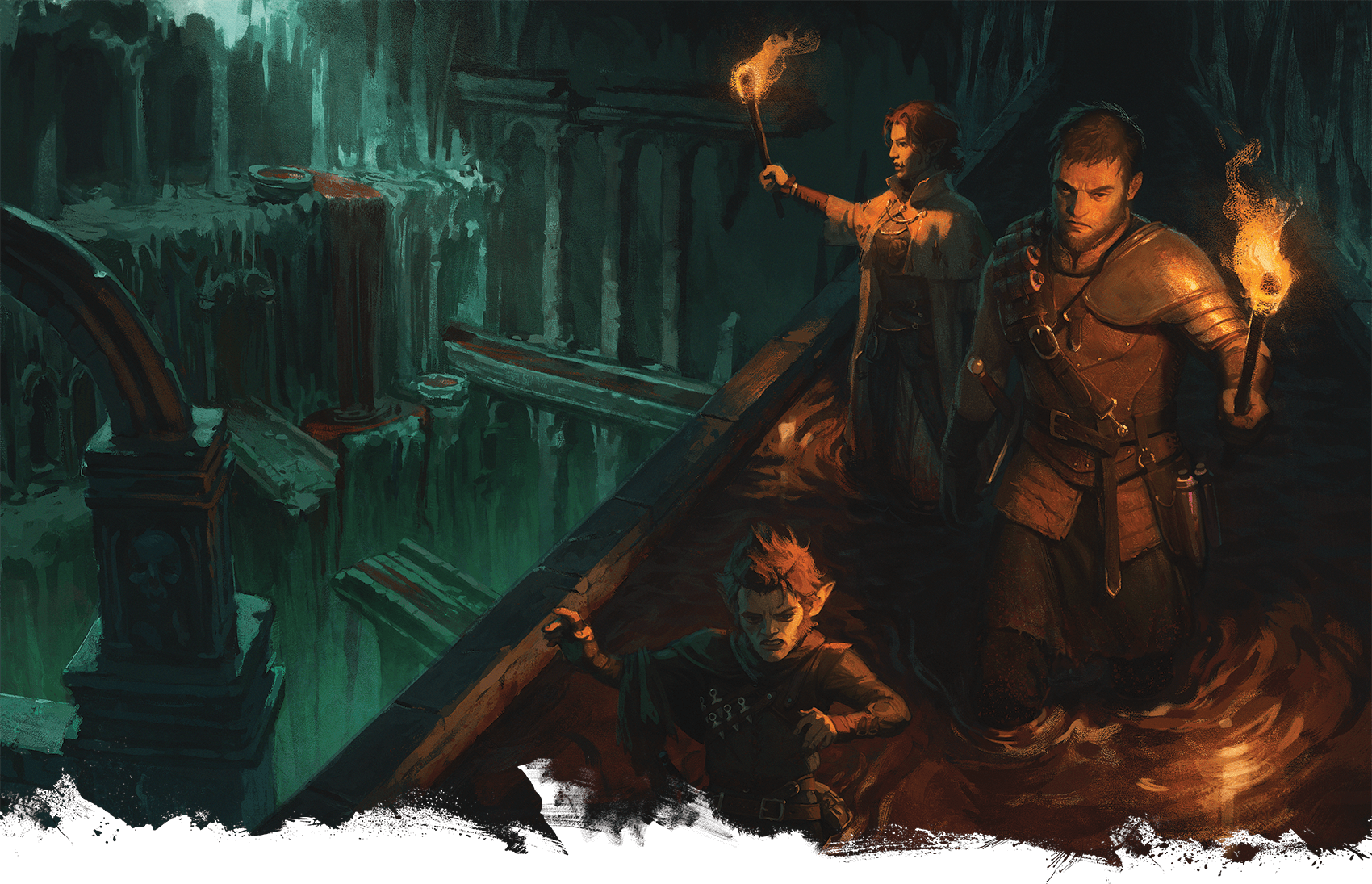
Adventurers specialize in their abilities and outlooks based on the culture in which they train and advance. Characters in the world of Etharis are influenced by dark and sometimes malevolent powers, delving into areas others might avoid.
The new class, the Monster Hunter and its subclasses, as well as the other subclasses here, reflect back onto the heroes and the world in which they live and fight. Some absorb into themselves the dangerous but powerful forces they fight. What that acceptance of terrible power means on the psyches of the adventurers can be varied; however, one cannot deny that delving into the darkness to find strength often comes at a steep and sometimes fatal cost.
As you play with these new player options, reflect on how the common folk that the characters interact with accept and react to them. Are these powers visible to bystanders when they are used? If so, do they mimic or even exemplify the types of powers used by the monsters that the commoners fear?
The new class and subclasses offer play that reflects not just the story of dark fantasy that is presented by Grim Hollow, but also an attention to detail and tactics that are promoted in a dark fantasy game. Monster Hunters specialize in hunting particular types of monsters. That means that the stories, plots, and tactics the characters use should reflect that. It matters when the characters are fighting Beasts as opposed to Monstrosities. This level of granularity is embraced rather than glossed over in the best dark fantasy games and stories. Lean into those stories—and that game play—to get the most out of the rules presented here.
Class & Subclass Overview
This chapter provides a wealth of character class options to explore in your Grim Hollow campaigns. You'll find the new Monster Hunter class along with four subclasses for your character to specialize in. Additionally, each of the standard Fifth Edition character classes is expanded with three Grim Hollow-themed subclasses, helping you explore the innumerable dark stories of Etharis.
Barbarian
Harness your primal power to tear through your enemies. Follow the Path of the …
- Fractured to split your personality.
- Primal Spirit to summon a spectral ally.
- Wrathful Dead to channel the restless dead.
Bard
Use your performing skills to harness magic and inspire your allies. Join the College of …
- Adventurers to use all the knowledge of adventuring.
- Fools to kill foes with laughter.
- Requiems to sing praises of the dead.
Cleric
Shape the lingering divine powers of Etharis to manifest its power. Then tap into the …
- Eldritch Domain to wield god-killing power.
- Inquisition Domain to cleanse the heretics.
- Purification Domain to purge sickness via suffering.
Druid
Open yourself up to the overwhelming power of the natural world. Find your focus within the Circle of …
- Blood to wreak gruesome havoc.
- Entropy to become an instrument of decay.
- Mutation to tap the power of change.
Fighter
Find your potential in training with weapons, armor, and shields. Then specialize as a …
- Bulwark Warrior to stand firm against onslaughts.
- Living Crucible to enhance fighting through alchemy.
- Nightwatcher to take back the night.
Monk
Train yourself, body and spirit, in the mechanics of martial arts. Hone your skills as a Warrior of …
- Leaden Crown to fight against the tyranny of power.
- Pride to make the best version of yourself.
- Regret to atone for past mistakes.
Monster Hunter
Use your knowledge and fighting prowess to specialize in monster hunting and join the …
- Carver Guild to fearlessly slay powerful beasts.
- Devourer Guild to consume monsters to gain power.
- Occultist Guild to fight magic with magic.
- Trapper Guild to employ traps to defeat monsters.
Paladin
Devote yourself to a cause greater than yourself. Take a binding pledge to the Oath of …
- Pestilence to gain strength through suffering.
- Slaughter to revel in unbridled violence.
- Zeal to spread ideological purity.
Ranger
Brave the forces of nature, surviving through brains and brawn. Become the embodiment of the …
- Green Reaperto slay with nature’s venom.
- Primordial Archer to channel nature’s wrath.
- Vermin Lord to overcome enemies through numbers.
Rogue
Navigate the dark parts of the mortal world before they strike you down. Follow the ways of the …
- Highway Rider to rob and thrive through banditry.
- Misfortune Bringer to curse foes.
- Sanguine Thief to defeat opponents with blood magic.
Sorcerer
Explore the magic within you to master its potential. Call forth the magic of …
- Apocalypse Sorcery to manipulate the apocalypse.
- Haunted Sorcery to commune with the dead.
- Wretched Bloodline Sorcery to wield curses.
Warlock
Utilize your magical connection to otherworldly powers. Finalize a pact with the …
- Coven to befuddle with hag magic.
- First Vampire to wield the power of undeath.
- Parasite to draw power from cosmic beings.
Wizard
Master the arcane arts and the powers they provide. Take your training in ways of the …
- Daemonologist to steal bits of immortal power.
- Plague Doctor to harness the power of disease.
- Sangromancer to spill blood for power.
New Class: Monster Hunter

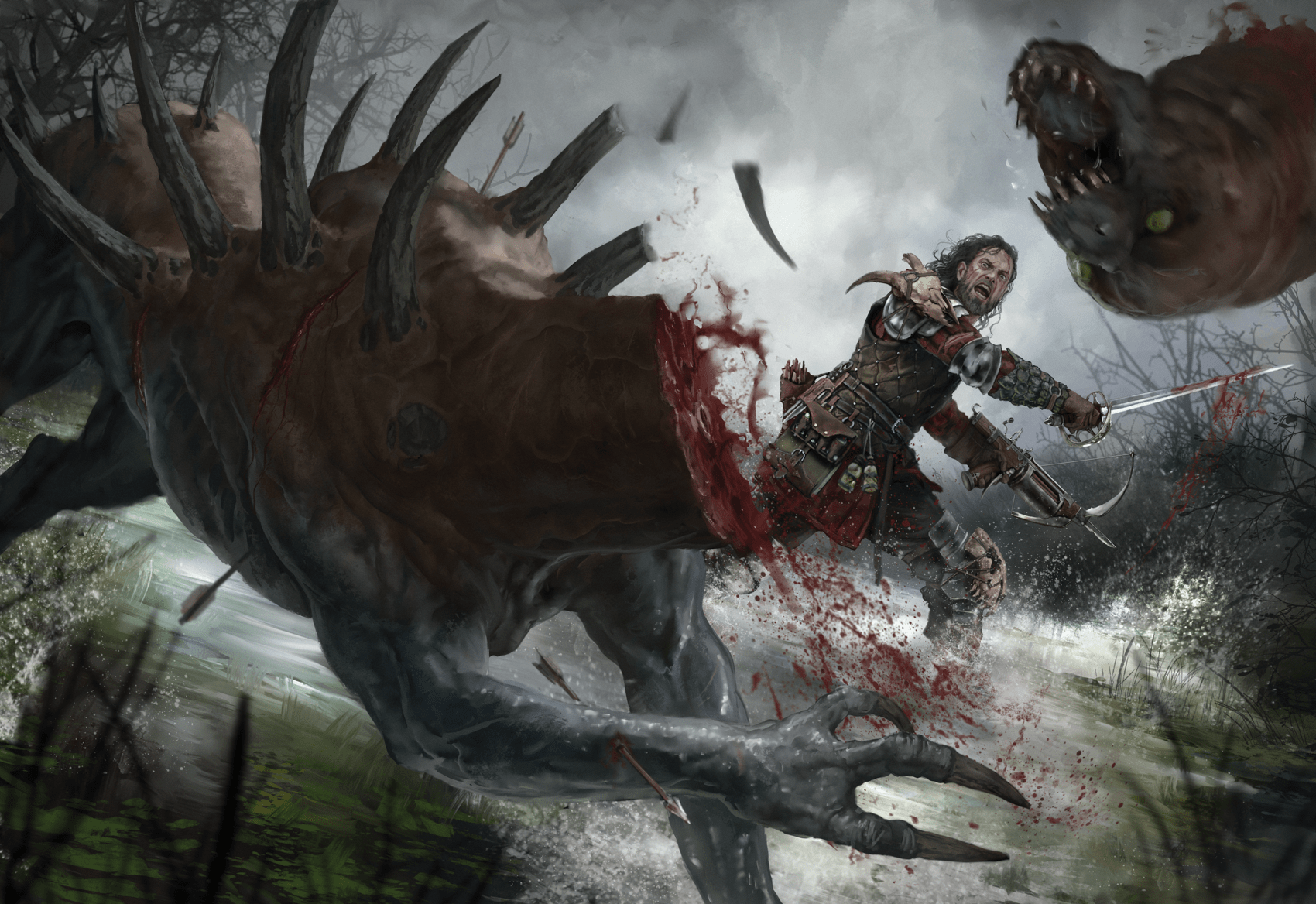
Monster Hunters are skilled professionals, specializing in identifying, tracking, and slaying monsters that threaten the lives and the livelihoods of the people of Etharis.
Each Monster Hunter trains in a different method for these tasks. Some hunters don heavy armor and carry shields to protect against crushing jaws and scything claws, others deploy cunning traps to keep a safe distance from the horrors they hunt, some assume the traits and powers of their enemies to better slay them, and others dabble in magic to supplement martial prowess with arcane wrath.
| Core Monster Hunter Traits | |
|---|---|
| Primary Ability | Strength or Dexterity, Intelligence |
| Hit Point Die | D10 per Monster Hunter level |
| Saving Throw Proficiencies | Dexterity and Intelligence |
| Skill Proficiencies | Choose 3: Athletics, History, Investigation, Medicine, Nature, Perception, Religion, and Survival |
| Weapon Proficiencies | Simple and Martial weapons |
| Armor Training | Light and Medium armor and Shields |
| Starting Equipment | Choose A, B, or C: (A) Scale Mail, Longsword, Light Crossbow, 20 Bolts, Dungeoneer’s Pack, and 5 GP; (B) Studded Leather Armor, Scimitar, Shortsword, Longbow, 20 Arrows, Quiver, Dungeoneer’s Pack, and 10 GP; or (C) 160 GP |

Becoming a Monster Hunter
As a Level 1 Character
- Gain all the traits in the Core Monster Hunter Traits table.
- Gain the Monster Hunter’s level 1 features, which are listed in the Monster Hunter Features table.
As a Multiclass Character
- Gain the following traits from the Core Monster Hunter Traits table: Hit Point Die, proficiency with Martial weapons, and training with Light and Medium armor and Shields.
- Gain the Monster Hunter’s level 1 features, which are listed in the Monster Hunter Features table.
Vollendorf’s a fine place, no safer city this side of the empire. A word of advice though: if you’ve got a weak stomach, steer clear of the Bazaar.
—Caravan Guard
| Level | Proficiency Bonus | Features | Weapon Mastery |
|---|---|---|---|
| 1 | +2 | Monster Grimoire, Weapon Mastery | 2 |
| 2 | +2 | Fighting Style, Studied Response | 2 |
| 3 | +2 | Monster Hunter Subclass: Hunting Guild | 2 |
| 4 | +2 | Ability Score Improvement | 2 |
| 5 | +3 | Expert Strike | 3 |
| 6 | +3 | Improved Monster Grimoire | 3 |
| 7 | +3 | Hunting Guild feature | 3 |
| 8 | +3 | Ability Score Improvement | 3 |
| 9 | +4 | Knowledgeable Defense | 3 |
| 10 | +4 | Hunting Guild feature | 3 |
| 11 | +4 | Extra Attack | 4 |
| 12 | +4 | Ability Score Improvement | 4 |
| 13 | +5 | Improved Monster Grimoire | 4 |
| 14 | +5 | Lair Sense | 4 |
| 15 | +5 | Hunting Guild feature | 4 |
| 16 | +5 | Ability Score Improvement | 4 |
| 17 | +6 | Slayer's Aid | 5 |
| 18 | +6 | Hunting Guild feature | 5 |
| 19 | +6 | Epic Boon | 5 |
| 20 | +6 | Grave Strike | 5 |
Monster Hunter Class Features
As a Monster Hunter, you gain the following class features when you reach the specified Monster Hunter levels. These features are listed in the Monster Hunter Features table.
Level 1: Monster Grimoire
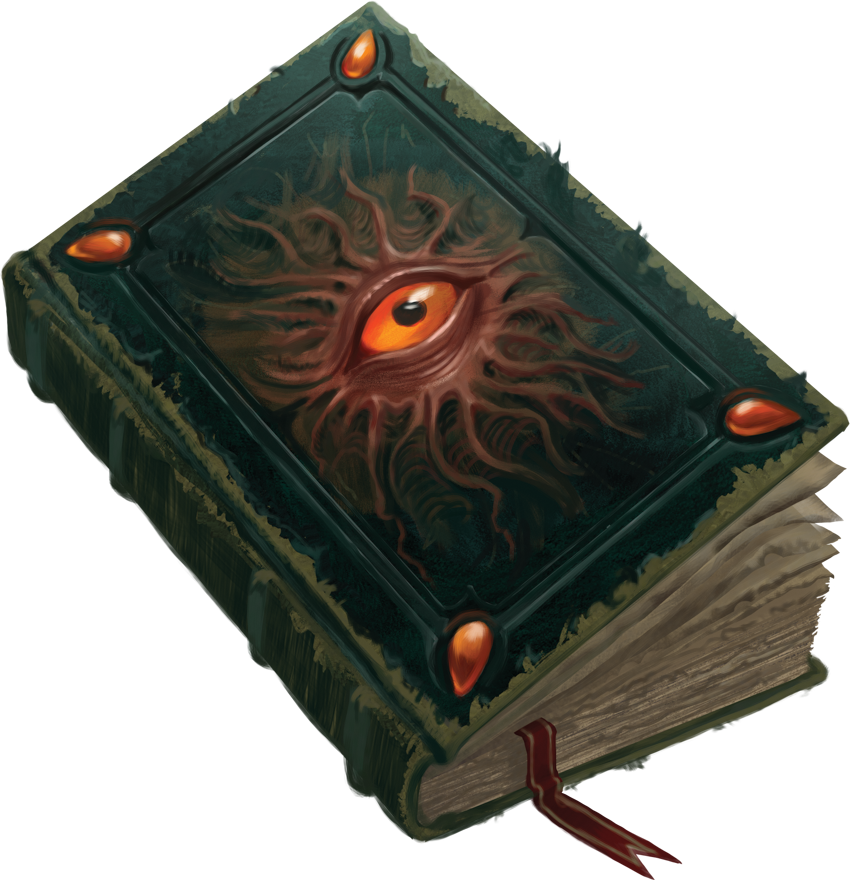
You create or inherit a repository of knowledge known as a Monster Grimoire. Each Monster Hunter carries a grimoire, a manual on dangerous creatures. A Monster Hunter’s grimoire is an object entirely unique to each hunter. It may be a leather tome recovered from a dusty library with notes made in the margins, a set of blood-stained scrolls inherited from a previous hunter, or a precious stone with a communing spirit held within.
If a Monster Hunter ever loses a grimoire, the hunter has retained enough knowledge to not suffer immediate drawbacks. However, the hunter can’t add to the grimoire until it is restored and therefore can’t take another Monster Hunter level until a lost grimoire has been replaced. A grimoire can be recreated by spending 8 hours and 50 GP worth of materials such as books, scrolls, and ink.
Choose two types of creatures that you are specialized in hunting from the following list: Aberrations, Beasts, Celestials, Constructs, Dragons, Elementals, Fey, Fiends, Giants, Monstrosities, Oozes, Plants, or Undead.
You add your Proficiency Bonus to Intelligence and Wisdom checks you make that relate to the creature types in your grimoire. For example, if Undead are in your grimoire, you add your Proficiency Bonus to an Intelligence (History) check to recall lore about an Undead creature you’re investigating or a Wisdom (Medicine) check to identify claw marks left on a corpse by an Undead creature. If you are already proficient in a skill when asked to make an Intelligence or Wisdom ability check relating to the monster types in your grimoire, you add double your Proficiency Bonus instead.
When you gain this feature, you also learn one language based on the chart below. (You can add languages to this chart based on your own campaign world.)
| Monster Type Language | |
|---|---|
| Monster Type | Languages |
| Aberration | Deep Speech or Undercommon |
| Beast | Sylvan |
| Celestial | Celestial |
| Construct | Draconic |
| Dragon | Draconic |
| Elemental | Primordial |
| Fey | Sylvan |
| Fiend | Abyssal or Infernal |
| Giant | Giant |
| Monstrosity | Deep Speech |
| Ooze | Deep Speech or Undercommon |
| Plant | Sylvan |
| Undead | Abyssal or Infernal |
Level 1: Weapon Mastery
Your training with weapons allows you to use the mastery properties of two kinds of weapons of your choice with which you have proficiency, such as Longbows and Longswords. Whenever you finish a Long Rest, you can practice weapon drills and change one of those weapon choices.
When you reach certain Monster Hunter levels, you gain the ability to use the mastery properties of more kinds of weapons, as shown in the Weapon Mastery column of the Monster Hunter Features table.
Level 2: Fighting Style
You gain a Fighting Style feat of your choice.
Level 2: Studied Response
You have learned the most effective way to slay a monster is to strike its most vulnerable area at the right moment. Too early, and your attack glances away. Too late, and the monster may eviscerate you.
When a creature you can see within 60 feet of you targets you or another creature with a melee or ranged attack, you can take a Reaction before the attack roll to make one attack with a weapon or an Unarmed Strike against that creature.
If the attack misses, you regain the use of your Reaction.
Level 3: Monster Hunter Subclass: Hunting Guild
You gain a Monster Hunter subclass of your choice. The Carver Guild, Devourer Guild, Occultist Guild, and Trapper Guild subclasses are detailed below. A subclass is a specialization that grants you features at certain Monster Hunter levels. The guild you choose grants you features when you reach Monster Hunter levels 3, 7, 10, 15, and 18.
Level 4: Ability Score Improvement
You gain the Ability Score Improvement feat or another feat of your choice for which you qualify. You gain this feature again at Monster Hunter levels 8, 12, 16, and 19.
Level 5: Expert Strike
You learn the weaknesses of monsters so that you know exactly where to strike to inflict the most damage. You can add your Intelligence modifier to the attack and damage rolls of your weapons and Unarmed Strikes.
Level 6: Improved Monster Grimoire
You have expanded your Monster Grimoire with your experience and knowledge.
You can select a third creature type to add to your Monster Grimoire from the following list: Aberrations, Beasts, Celestials, Constructs, Dragons, Elementals, Fey, Fiends, Giants, Monstrosities, Oozes, Plants, or Undead. You can’t choose a creature type you have chosen before. All the benefits you gain from your Monster Grimoire now also apply to this new type.
Additionally, your attack rolls with weapons and Unarmed Strikes against creature types in your Monster Grimoire can score a Critical Hit on a roll of 19 or 20 on the d20.
Level 9: Knowledgeable Defense
You can rely on your knowledge to anticipate a monster’s actions and summon your best defense.
Whenever a creature type in your Monster Grimoire forces you to make a saving throw, you can make an Intelligence saving throw in place of that saving throw instead.
Level 11: Extra Attack
You can attack twice instead of once whenever you take the Attack action on your turn.
Level 13: Improved Monster Grimoire
Your Monster Grimoire is further expanded by your encounters and studies.
You can select a fourth creature type to add to your Monster Grimoire from the following list: Aberrations, Beasts, Constructs, Celestials, Dragons, Elementals, Fey, Fiends, Giants, Monstrosities, Oozes, Plants, or Undead. You can’t choose a monster type you have chosen before. All the benefits you gain from your Monster Grimoire now also apply to this new monster type.
Level 14: Lair Sense
You are experienced at navigating the threats that arise near a monster’s lair. You have Advantage on saving throws and Resistance to the damage of lair actions and regional effects caused by creatures. In addition, you have Advantage on saving throws and Resistance to damage against the Legendary Actions of creature types in your Monster Grimoire.
Level 17: Slayer's Aid
You're able to coordinate with your allies to quickly slay dangerous monsters.
When you use Studied Response, choose a Friendly creature that can see or hear you. That creature can use its Reaction to make one attack with a weapon or Unarmed Strike against the creature that triggered your Studied Response. If the ally does not have their Reaction, they regain it but then must use it to make the attack. Your ally's attack occurs after yours but before the target creature rolls its own attack. This ability refreshes at the start of your turn.
Level 19: Epic Boon
You gain an Epic Boon feat or another feat of your choice for which you qualify.
Level 20: Grave Strike
You gain the ability to strike mortal blows against the creatures you have studied.
Your attack rolls with weapons and Unarmed Strikes against creature types in your Monster Grimoire can now score a Critical Hit on a roll of 18 through 20 on the d20.
When you score a Critical Hit against a creature type in your Monster Grimoire, the creature must make a Constitution saving throw. The DC equals the damage taken, up to a maximum DC of 30. On a failed save, the creature drops to 0 Hit Points. On a successful save, the creature takes the attack’s normal damage.
You can use this feature a number of times equal to your Intelligence modifier (minimum of once), and you regain all expended uses when you finish a Long Rest.
Monster Hunter Guilds
A Monster Hunter subclass is a specialization that grants you features at certain Monster Hunter levels, as specified in the subclass. This section presents the Carver Guild, Devourer Guild, Occultist Guild, and Trapper Guild subclasses.
Hunting guilds are groups of Monster Hunters who use the same teachings and techniques. Some guilds are formally organised like a mercenary company, while others are more loosely organized but have inherited similar knowledge.
Carver Guild
Slay Monsters Fearlessly and Recklessly
Since the beginning of time, the brave glared into danger’s ferocious eyes and fought monsters. Those who survived were the ones smart enough to arm themselves properly and know precisely where to strike—or those who knew when to flee and return with a new plan.
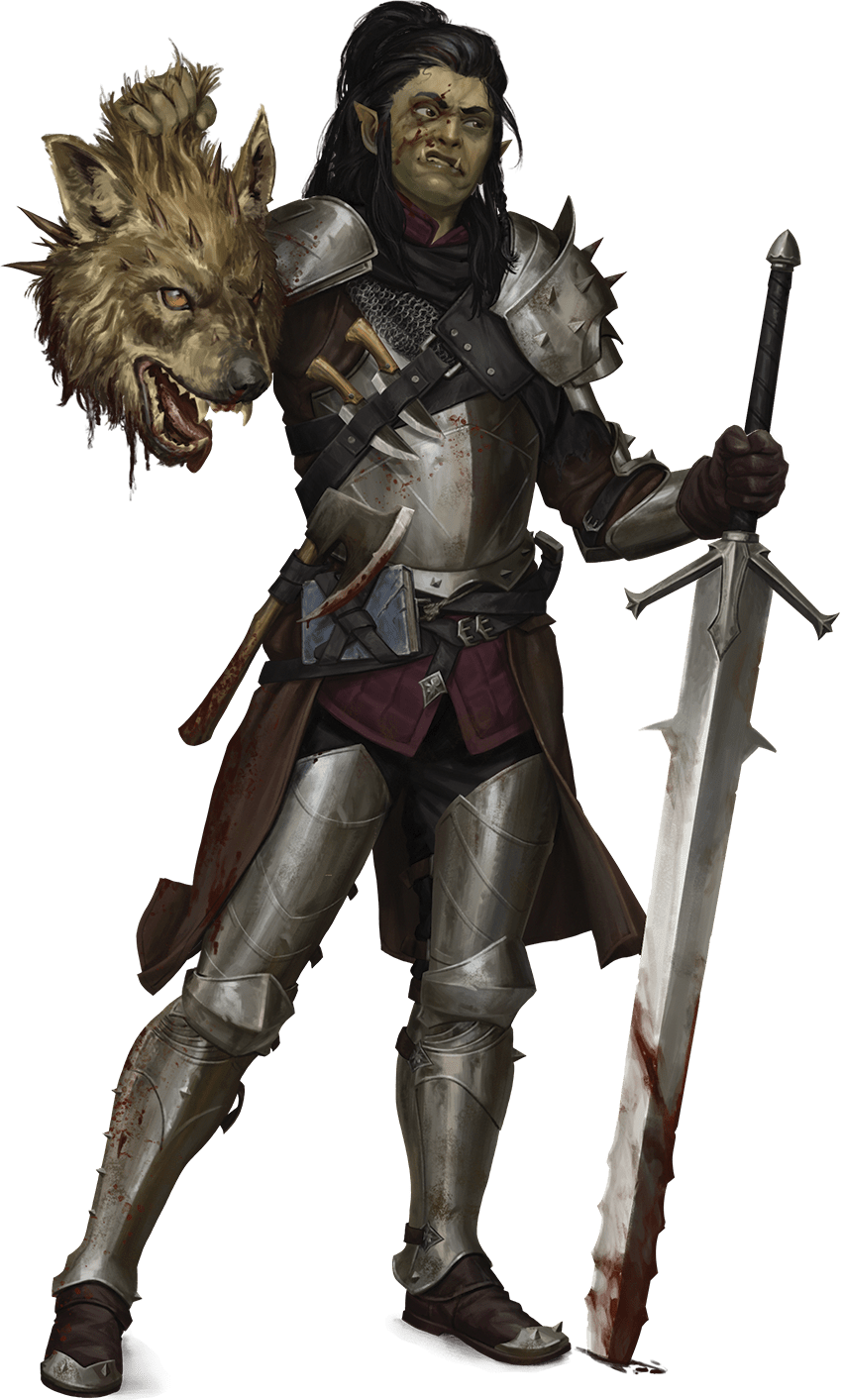
Members of the Carver Guild are the Monster Hunters typically called upon when immediate danger threatens a settlement and there is no army or militia available. Carvers stride unflinchingly toward death, armed with years of training and the knowledge passed down from those before them.
Level 3: Equipped for Battle
You gain training with Heavy armor.
Level 3: Close Quarters
Your skill in close combat enables you to inflict crushing blows while keeping your opponent off balance. When you hit a creature with an attack roll using a Melee weapon, you can take a Reaction to deal an extra 2d6 damage of the same type dealt by the weapon. That creature has Disadvantage on its next attack roll before the start of your next turn.
The damage becomes 4d6 when you reach Monster Hunter level 11.
Level 7: True Grit
You have Advantage on saving throws you make to avoid or end the Frightened condition, and you are immune to the Frightened condition caused by creature types in your Monster Grimoire.
Additionally, when you hit a creature with an attack as part of a Reaction, you can choose a Frightened creature within 60 feet that can see you (including yourself). The condition ends on that creature.
Level 10: Terrorize the Terrors
Your reputation has become such that monsters preying on the fearful have come to fear you. When you hit a creature with an attack as part of a Reaction, you can force the creature to make a Wisdom saving throw or have the Frightened condition until the end of your next turn. The DC for the saving throw equals 8 plus your Intelligence modifier and your Proficiency Bonus.
Level 15: Deadly Redirect
Your strikes have become even deadlier. The extra damage of your Close Quarters increases to 6d6.
In addition, if you deal damage to a creature with Close Quarters, the target has Disadvantage on all attack rolls until the end of your next turn.
Level 18: Controlled Footwork
You are such an effective combatant that you are always in control and never off balance. You can take a Reaction twice in a round instead of once.
Devourer Guild
Gain Power by Consuming Monster Flesh
Folk in Etharis don’t always speak highly of Monster Hunters, and many consider them to be just as depraved and inhuman as the evils they vanquish. Many of the appalling tales about Monster Hunters can be attributed, directly or indirectly, to the Devourer Guild, who are accused of being monstrous cannibals.
The truth is barely any better. Devourers have spent their days consuming the flesh and blood of the monsters they slay, and, over time, their metabolism has changed to tolerate this disgusting practice. Devourers adopt mutations shortly after consuming their prey.
Level 3: Alchemical Gastronomy
You gain proficiency with Alchemist’s Supplies and Cook’s Utensils.
Level 3: Transmuting Metabolism
You gain the ability to consume monster remains, which causes your body to adopt powerful and frightening mutations. These appear in the “Mutations” section later in the subclass’s description.
Salvaging Portions. As a Utilize action, you can harvest a single portion from the physical remains of a creature. Only one portion can be harvested from each creature. Record the monster’s creature type. A harvested portion lasts until you finish a Long Rest, at which point it loses its potency.

Consuming Portions. As a Bonus Action, you can consume a portion. After you consume the portion, you choose a mutation to gain, depending on the creature’s type. You can gain the benefits of consumed portions a number of times up to 1 plus your Intelligence modifier (minimum of 1). When you finish a Long Rest, you regain the ability to consume portions.
You can benefit from multiple portions simultaneously, but you can't gain the same mutation more than once at the same time.
Level 7: Synchronized Response
Your ingestion of monsters heightens your understanding of them and their behaviour. You gain this additional effect when you consume a monster portion: For 1 minute, when you make an attack as part of a Reaction, you deal an extra 1d6 damage. This damage has the same type as the weapon or Unarmed Strike used for the attack.
Level 10: Gnawing Hunger
Your hunger for your enemy allows you to partake of its essence during battle. When you deal damage to a creature with a melee attack using a weapon or Unarmed Strike, you gain Temporary Hit Points equal to half the damage dealt. If the target is a creature type in your Monster Grimoire, you instead gain Temporary Hit Points equal to the damage dealt instead.
You can use this feature a number of times equal to your Intelligence modifier (minimum of once). You regain all expended uses when you finish a Short or Long Rest.
Level 15: Alchemical Decoctions
You can spend 1 hour and 20 GP worth of alchemical ingredients (such as special herbs or monster salvage) to use your Alchemist’s Supplies to convert a monster portion into a decoction. A decoction is a magic potion that grants the benefits of a consumed monster portion. You can have 4 unconsumed decoctions active. You can destroy a decoction as a Utilize action.
A creature other than you can consume 1 decoction without adverse effects. A creature gains 1 Exhaustion level for each decoction it consumes after the first. A creature must finish a Long Rest before it regains the ability to safely consume a decoction.
Level 18: Acquired Taste
Your hunger for monster portions has increased to the point of being insatiable. You can now consume 1 additional portion safely. Additionally, for 1 minute when you consume a portion, you have Advantage, on attack rolls made as part of a Reaction.
Mutations
The mutations are presented here in alphabetical order, with required creature types shown in brackets after the mutation’s name.
Acid Blood (Aberration, Ooze, Plant). For 1 minute, your blood becomes acidic. Each time a creature hits you with an attack while within 5 feet of you, it takes 2d6 Acid damage.
Acumen (Celestial, Fiend, Fey). For 1 hour, you have Advantage on Wisdom (Insight) checks. Additionally, choose either Intimidation or Persuasion. You have Advantage on ability checks using the chosen skill.
Awareness (All). For 10 minutes, you know the location of creatures that are the same type as the creature you consumed within 60 feet of you that are not behind Total Cover.
Flight (Celestial, Dragon, Elemental). For 10 minutes, you grow leathery, feathery, or spectral wings from your back. You gain a Fly Speed equal to your Speed. You can’t benefit from this mutation while wearing Heavy armor.
Infused (Dragon, Elemental, Ooze). Choose one of the following damage types: Acid, Cold, Fire, Lightning, Poison, or Thunder. For 10 minutes, whenever you hit with an attack, you can cause it to deal the chosen type rather than its normal damage type.
Invisibility (Fey, Fiend, Undead). For 10 minutes, you have the Invisible condition. This effect ends early if you dismiss it (no action required), or you attack or cast a spell.
Might (Beast, Construct, Giant). For 1 minute, you have Advantage on Strength checks and saving throws. You also have Advantage on attack rolls using Strength, and you deal 1d6 extra damage to targets you hit with a Strength-based attack. The damage is the same type dealt by the attack.
Natural Weapons (Beast, Dragon, Monstrosity). For 1 hour, you gain natural weapons. You can roll 1d6 in place of the normal damage of your Unarmed Strike. This damage can be Piercing or Slashing. You choose each time you make an attack. You can also make an Unarmed Strike as a Bonus Action. You can use your Dexterity modifier instead of your Strength modifier for the attack and damage rolls of your Unarmed Strikes.
Regeneration (Beast, Giant, Monstrosity). You regain Hit Points equal to 2d8 plus your Monster Hunter level.
Resistance (Construct, Elemental, Undead). For 1 minute, you have Resistance to Bludgeoning, Piercing, and Slashing damage.
Telepathy (Aberration, Fiend, Plant). For 1 hour, you can speak telepathically to any creature you can see within 60 feet of yourself. Your telepathic utterances are in a language you know, and the creature understands you only if it knows that language. Additionally, you have resistance to Psychic damage.
Occultist Guild
Hunt Mages and Magical Adversaries
In Etharis, there are those who fear magic, and those who seek to understand it. Monster Hunters from the Occultist Guild know folk from both sides are equally dangerous. An Occultist investigates the arcane, the supernatural, and the uncanny, while avoiding the influence of superstition or ideology. Despite their reputation as mage hunters, Occultists don’t burn their enemies at the stake—Occultists put them to the sword, as that’s what swords are for.
Knowledge and magic give Occultists an edge over their mystical adversaries. Their spells are used to detect and defend against dangerous arcana, and, above all, magic is used to destroy monsters that can’t be harmed by steel.
Level 3: Acolyte of the Occult
You gain proficiency in the Arcana skill.
Level 3: Spellcasting
Your study of the occult gives you the ability to cast spells.

Cantrips. You learn two cantrips of your choice from the Wizard spell list. Whenever you gain a Monster Hunter level, you can replace one of these cantrips with another of your choice from the Wizard spell list.
When you reach Monster Hunter level 10, you learn another Wizard cantrip of your choice.
Spell Slots. The Occultist Spellcasting table shows how many spell slots you have to cast your level 1+ spells. You regain all expended spell slots when you finish a Long Rest.
Prepared Spells of Level 1+. You prepare the list of level 1+ spells that are available for you to cast with this feature. To start, choose three level 1 Wizard spells. Burning Hands, Detect Magic, and Protection from Evil and Good are recommended.
The number of spells on your list increases as you gain Monster Hunter levels, as shown in the Prepared Spells column of the Occultist Spellcasting table. Whenever that number increases, choose additional spells from the Wizard spell list until the number of spells on your list matches the number on the table. The chosen spells must be of a level for which you have spell slots. For example, if you’re a level 7 Monster Hunter, your list of prepared spells can include five Wizard spells of levels 1 and 2 in any combination.
Changing Your Prepared Spells. Whenever you gain a Monster Hunter level, you can replace one spell on your list with another Wizard spell.
Spellcasting Ability. Intelligence is your spellcasting ability for your Wizard spells.
Spellcasting Focus. You can use an Arcane Focus as Spellcasting Focus for your Wizard spells.
Level 3: Arcane Interference
You have Advantage on saving throws against spells cast by creature types in your Monster Grimoire. Additionally, when a creature you can see within 60 feet of you casts a spell or makes a spell attack, you can use Studied Response against that creature before the spell is cast.
Level 7: Mage Hunter
You consider Humanoids that can cast spells as being a creature type in your Monster Grimoire.
Additionally, when you damage a creature type in your Monster Grimoire that is concentrating, it has Disadvantage on the saving throw it makes to maintain its Concentration.
Say what you will about their methods. The results speak for themselves.
—Arcanist Inquisitor
Level 10: Occult Knowledge
Your knowledge of magic has increased so that you learn to cast Rituals. You can cast any spell as a Ritual if that spell has the Ritual tag and it’s a spell you have prepared.
In addition, you learn two spells of your choice. These spells can come from the Cleric, Druid, or Wizard spell list or any combination thereof (see a class’s section for its spell list). A spell you choose must have the Ritual tag.
When you reach Monster Hunter level 14, you can replace one of the spells you know from this feature with another spell of your choice from any spell list. The new spell must have the Ritual tag.
Level 15: Magical Aegis
You gain the ability to extend a protective charm. You radiate an unseeable aura in a 20-foot Emanation that originates from you. The aura is inactive while you have the Incapacitated condition. You and allies in your aura have Advantage on saving throws against spells cast by creature types in your Monster Grimoire.
Additionally, you always have the Counterspell spell prepared. You can cast Counterspell once without expending a spell slot. Once you cast the spell with this feature, you can’t do so in this way again until you finish a Long Rest.
Level 18: Arcane Response
You have learned to anticipate your enemies well enough to rapidly cast spells in response to their attacks. When you use Studied Response, you can cast a spell. The spell must have a casting time of an action and must target only that creature.
| Occultist Spellcasting | ||||||
|---|---|---|---|---|---|---|
| Level | Cantrips Known | Prepared Spells | Spell Slots per Spell Level | |||
| 1 | 2 | 3 | 4 | |||
| 3 | 2 | 3 | 2 | - | - | - |
| 4 | 2 | 4 | 3 | - | - | - |
| 5 | 2 | 4 | 3 | - | - | - |
| 6 | 2 | 4 | 3 | - | - | - |
| 7 | 2 | 5 | 4 | 2 | - | - |
| 8 | 2 | 6 | 4 | 2 | - | - |
| 9 | 2 | 6 | 4 | 2 | - | - |
| 10 | 3 | 7 | 4 | 3 | - | - |
| 11 | 3 | 8 | 4 | 3 | - | - |
| 12 | 3 | 8 | 4 | 3 | - | - |
| 13 | 3 | 9 | 4 | 3 | 2 | - |
| 14 | 3 | 10 | 4 | 3 | 2 | - |
| 15 | 3 | 10 | 4 | 3 | 2 | - |
| 16 | 3 | 11 | 4 | 3 | 2 | - |
| 17 | 3 | 11 | 4 | 3 | 3 | - |
| 18 | 3 | 11 | 4 | 3 | 3 | - |
| 19 | 3 | 12 | 4 | 3 | 3 | 1 |
| 20 | 3 | 13 | 4 | 3 | 3 | 1 |
Trapper Guild
Dispatch Monsters with Cunning Traps
Legends say that the founding members of the Trapper Guild were game hunters who had grown bored of stalking common elk and dreamed of taking down bigger game. Trappers take pride in their kills and the ingenuity exhibited when a trap works perfectly.
The legacy of the Trapper Guild is a consistent testament to the benefits of lying in wait. The element of surprise is paramount to the trapper, whose kit can flourish before the hunter and monster even meet. Preparation is key, and the resourceful trapper has devices to assist in bringing down even the strongest foes.
Level 3: Sneaky and Crafty
You gain proficiency in the Stealth skill and with Tinker’s Tools.
Level 3: Trapper Gadgets
You learn to create gadgets and mechanisms that help you during the hunt.

As part of a Long Rest, you can craft two Trapper Gadgets if you have materials and Tinker’s Tools on hand. Also, with 1 hour of work with such a kit and expending 20 GP worth of materials (such as equipment or monster salvage), you can create one Trapper Gadget from the list below.
Some Trapper Gadgets allow your target to make an ability check or saving throw to resist the gadget’s effects. The saving throw DC is calculated as follows:
Trapper Gadgets Save DC= 8 + your Intelligence modifier + your Proficiency Bonus
Trapper Gadgets
Trapper Gadgets are listed in alphabetical order.
Dread Venom. A foul-smelling blade oil that causes wounds to hemorrhage and refuse healing. Dread Venom can coat one Slashing or Piercing weapon or up to 10 pieces of Slashing or Piercing ammunition. Applying the oil takes 1 minute and the oil lasts 8 hours once applied. When a creature takes damage from the poisoned item, it can’t regain Hit Points until it finishes a Short or Long Rest.
Elemental Ammunition. The head of an arrow or bolt is tipped with poison, loaded with an acid vial, dipped in flammable oil, or coated with another substance. As a Bonus Action, you imbue with elemental power a single piece of ammunition that can be fired from a Longbow, Shortbow, or Crossbow as part of an Attack action. When a Elemental Ammunition is imbued, choose a damage type: Acid, Cold, Fire, Lightning, Poison, or Thunder. When a creature takes damage from the Elemental Ammunition, it takes an additional 2d6 damage of the chosen type.
Elemental Ammunition discharges its energy if it hits, and it can’t be recovered. If the attack misses, the Elemental Ammunition can be recovered and used again. Elemental Ammunition retains its power for 48 hours.
Runic Bomb. Runic Bombs are used to hunt creatures resilient to mundane weapons. As a Bonus Action, you can throw the runic bomb at a point within 60 feet that you can see, creating a 20-foot-radius Sphere centered on that point. The Sphere spreads around corners, and its area is Lightly Obscured. It lasts for 1 minute or until a strong wind (such as one created by Gust of Wind) disperses it.
Whenever Bludgeoning, Piercing, and Slashing damage is dealt to a creature inside the sphere, that damage is Force damage instead of its normal damage type.
A Runic Bomb is destroyed after a single use.
Scorpion Anchor. This weapon is intended to keep flying foes anchored to the ground or stop monsters from fleeing. The Scorpion Anchor can be fired from a Longbow, Shortbow, or Crossbow as part of an Attack action. When you hit a creature with an attack roll using a Scorpion Anchor, it has the Restrained condition. A creature Restrained by the Scorpion Anchor can take an action to make a Strength (Athletics) check against your Trapper Gadget save DC. If it succeeds, it is no longer Restrained.
A Scorpion Anchor is destroyed after the Restrained creature escapes or dies.
Terrain Cloak. Composed of local materials, a Terrain Cloak allows wearers to conceal themselves within the environment. Terrain Cloaks can be worn over Light or Medium armor and are donned and doffed with the speed of Light armor.
Creatures have Disadvantage on Wisdom (Perception) checks to see you.
The item lasts until you finish a Long Rest, at which point the item falls apart.
Weretrap. A Weretrap detonates when its fragile exterior is broken. You can take a Utilize action to set the Weretrap in an unoccupied space within 5 feet of you. A creature within 30 feet must succeed on a Wisdom (Perception) check against your Trapper Gadget DC to spot the trap. Creatures have Disadvantage on this check.
A creature that steps into a space containing a Weretrap triggers the trap and makes a Dexterity saving throw. On a failed save, the creature takes 3d10 Bludgeoning damage and has the Prone condition. On a successful save, the creature takes half as much damage only.
The Weretrap can also be used as a Light Ranged weapon with the Finesse and Thrown property. It has a normal range of 20 feet and a long range of 60 feet. On a hit, the Weretrap deals 3d10 Bludgeoning damage and the target has the Prone condition.
The Weretrap is destroyed after it is triggered or thrown, regardless of whether it hits or misses.
Level 7: Ambusher’s Advantage
You have become a ferocious ambusher. When you roll Initiative, you can add your Intelligence modifier to the roll. Additionally, you can’t be surprised by enemies that include creature types in your Monster Grimoire.
Level 10: Agile Response
You can leap aside to avoid enemies rushing toward you. When a creature makes a melee attack roll against you, you can take a Reaction to impose Disadvantage on that roll and use your Studied Response as part of the same Reaction. Whether the attack hits or misses, you can then move up to half your Speed. This movement doesn’t provoke Opportunity Attack action.
Level 15: Monster-Hide Armor
You have learned to craft a set of Light or Medium armor by using dragon scales, werewolf hide, troll leather, or a similar monster component. The armor takes on the appearance of your choice, reflecting the component it is made from.
The armor has the same properties as Light or Medium armor (your choice when the armor is crafted) and gains two modifications from the Armor Modifications list. Whenever you gain a Monster Hunter level, you can replace one of these modifications with another modification.
Modifications require the armor to be worn to function.
Armor Modifications
Armor modifications are listed in alphabetical order.
Damage Resistance. The monster hide used to craft your armor grants some resistances. You gain Resistance to two of the following damage types of your choice: Acid, Cold, Fire, Lightning, Poison, or Thunder.
Elemental Charge. You embed your armor with a Construct’s gemstone or infuse it with the power of an Elemental. Choose one of the following damage types: Acid, Cold, Fire, Lightning, Poison, or Thunder. When you hit a creature with an attack, you can cause it to deal the chosen damage type rather than its normal damage type, and the attack deals an extra 1d6 of that type.
Hardened Defense. Hardened scales or magical pelts make your armor difficult to pierce. While wearing your crafted armor, you gain a +2 bonus to Armor Class.
Phase Leap. You have powdered your armor with fey dust or sewn a pelt of a phase-shifting monstrosity into it. As a Bonus Action, you teleport up to 60 feet to an unoccupied space you can see.
You can use this feature three times, and you regain all expended uses when you finish a Long Rest.
Regeneration. You reinforce the armor with troll hide or soak it in vampire blood. You have a pool of six d10s. As a Bonus Action, you can expend a die from the pool, roll that die and add your Constitution modifier, and regain a number of Hit Points equal to the roll’s total.
You regain all the expended dice when you finish a Long Rest.
Stealthy. Your armor is draped with a shadowy cloak or made from hide as light as a feather. Your armor doesn’t impose Disadvantage on Dexterity (Stealth) checks, even if it would normally. While wearing your armor, creatures have Disadvantage on Wisdom (Perception) checks to see you, and you have Advantage on Wisdom (Perception) checks to notice creatures.

Level 18: Rapid Tinkerer
You have become capable of crafting trapper tools at a much faster rate. You can spend 1 minute to make a Trapper Gadget without spending GP or components.
You can use this feature twice, and you regain all expended uses when you finish a Long Rest.
Core Subclasses
Barbarian Subclasses

Mindless rage is an enticing offering provided by some of the darker forces of Etharis. Some barbarians embrace this, while others reject it, seeking aid from the spirits of nature or from deep within their own minds.
Path of the Fractured
Two Personalities Are Better than One
Barbarians are defined by their rage, channeling it to unleash brief but potent destruction. Few are brave or unwise enough to study esoteric psychological techniques that split their rage from the rest of their psyche, dividing their identity into two parts: ego and id. When their ego is in control, the Fractured—as these Barbarians are known—possess self-control and cunning beyond most other Barbarians. When they allow their id to take control, their countenance turns monstrous and their bodies swell with the power of rage made physically manifest.
Level 3: Face of Rage
When you activate your Rage, your countenance distorts and your body swells. Creatures that haven’t witnessed your transformation, now or previously, don’t recognize you. In addition, while your Rage is active, you gain the following benefits:
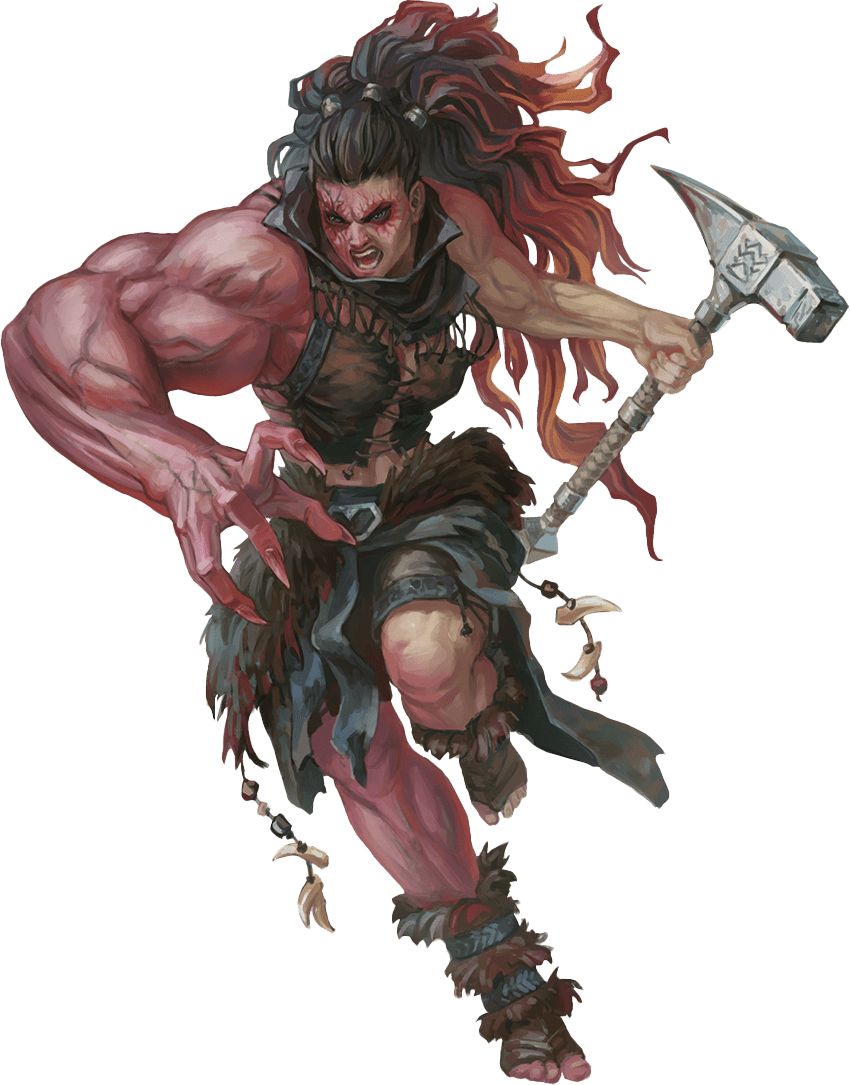
- You can roll 1d8 in place of the normal damage of your Unarmed Strike, and whenever you deal damage with an Unarmed Strike, it can deal your choice of Force damage or its normal damage type.
- When you hit a creature with an Unarmed Strike, you can push it 10 feet or force the creature to make a Constitution saving throw (DC 8 plus your Strength modifier and your Proficiency Bonus). On a failed save, the creature has the Prone condition.
- You count as one size larger when determining the success or failure of a Grapple, and when you make an Unarmed Strike, your reach is 5 feet greater than normal.
Level 3: Mask of Civility
You are proficient in one of the following skills of your choice: Arcana, History, Investigation, Medicine, Nature, Persuasion, or Religion. In addition, you gain proficiency with one type of Artisan’s Tools of your choice or you know one language of your choice.
Level 6: Brains and Brawn
While your Rage is not active, you have Resistance to Psychic damage. While your Rage is active, you have Resistance to every damage type except Force and Psychic.
Level 10: Cunning and Brutal
While your Rage is not active, you can take the Disengage or Help action as a Bonus Action. While your Rage is active, your attack rolls with Unarmed Strikes score a Critical Hit on a roll of 19 or 20 on the d20.
Level 14: Better Half
When you are reduced to 0 Hit Points and not killed outright, you can drop to 1 Hit Point instead, and you gain Temporary Hit Points equal to half your Hit Point maximum. In addition, if your Rage is active, your Rage ends. If your Rage was not active, you immediately activate your Rage (even if you have no remaining uses of your Rage). If any of these Temporary Hit Points remain after 1 minute, they vanish.
Once you use this feature, you can’t use it again until you finish a Long Rest.
Path of the Primal Spirit
Rage Alongside a Bestial Spirit
Many Barbarians are in tune with the natural world, but few are as mystically intertwined with it as those who walk the Path of the Primal Spirit. These Barbarians forge powerful connections with beasts and nature spirits, inspiring such ethereal beings to manifest and journey on far-flung adventures.
Barbarians who follow this path have a deep reverence for the cycle of the natural world. Such Barbarians are as likely to accept quests and pleas for aid from local wildlife as they are from people. This respect for animals and spirits doesn’t cross into naivety—few understand the delicate balance between the needs of predator and prey better than those who walk the Path of the Primal Spirit.

Level 3: Primal Companion
You magically summon a primal spirit that adopts the form of a beast and accompanies you on your adventures. Choose its stat block: Primal Guardian or Primal Striker. In addition, choose an environment that will modify the creature’s stat block: Land, Sea, or Sky. You also determine the kind of animal it is, choosing a kind appropriate for the stat block. Whatever companion you choose, it bears eldritch markings indicating its otherworldly origin.
The companion is Friendly to you and your allies and obeys your commands. It vanishes if you die.
The Beast in Combat. In combat, the companion acts during your turn. It can move and use its Reaction on its own, but the only action it takes is the Dodge action unless you take a Bonus Action to command it to take an action in its stat block or some other action. You can also sacrifice one of your attacks when you take the Attack action to command the beast to take the Beast’s Strike action. If you have the Incapacitated condition, the companion acts on its own and isn’t limited to the Dodge action.
Restoring or Replacing the Beast. If the companion has died within the last hour, you can take a Magic action to touch it and expend a use of your Rage. The companion returns to life immediately with all its Hit Points restored.
Whenever you finish a Long Rest, you can summon a different primal companion, which appears in an unoccupied space within 5 feet of you. You choose its stat block and appearance. If you already have a beast from this feature, the old one vanishes when the new one appears.
Level 3: Shared Rage
While your Rage is active, your primal companion has Resistance to Bludgeoning, Piercing, and Slashing damage.
Level 6: Kin to Beasts
You always have the Animal Friendship and Speak with Animals spells prepared. You can cast each of these spells without expending a spell slot. Once you cast either spell in this way, you can’t cast that spell in this way again until you finish a Short or Long Rest. You can also cast these spells using spell slots you have of the appropriate level. Constitution is your spellcasting ability for them.
Level 10: Skinrider’s Trance
You take a Magic action to enter a trance and choose your primal companion or one Beast currently under the effect of your Animal Friendship spell within 60 feet of yourself. For the duration of this trance, you possess the chosen creature.
Once you possess a creature’s body, you control it. Your Hit Points, Hit Point Dice, Strength, Dexterity, Constitution, Speed, and senses are replaced by the creature’s. You otherwise keep your game statistics. This possession ends if you choose to exit the trance (no action required by you), if the Beast you’re possessing is reduced to 0 Hit Points, or if you and the Beast are on different planes of existence.
While in this trance, your body falls into a catatonic state. You can’t move or take Reactions, and you’re unaware of your surroundings. You can remain in the trance for a number of hours up to half your Barbarian level plus your Constitution modifier.
Once you use this feature, you can’t use it again until you finish a Long Rest. You can also restore your use of it by expending one use of your Rage (no action required).
Level 14: Shape of the Wild
As a Bonus Action, you can choose a new form for your primal companion, causing it to transform instantaneously. When you cause your primal companion to transform in this way, its current Hit Points change to its new Hit Point maximum.
Once you use this feature, you can’t use it again until you finish a Short or Long Rest. You can also restore your use of it by expending one use of your Rage (no action required).
Primal Guardian
Medium (Large if Land or Sea) Beast, Neutral
AC 12 plus your Constitution modifier
HP 6 plus six times your Barbarian level (the beast has Hit Dice d10s equal to your Barbarian level)
Speed 30 ft.; Fly 40 ft. (Sky only Swim 40 ft. (Sea only)
| Ability | Score | Mod | Save |
|---|---|---|---|
| Str | 15 | +2 | +2 |
| Dex | 12 | +1 | +1 |
| Con | 16 | +3 | +3 |
| Ability | Score | Mod | Save |
|---|---|---|---|
| Int | 4 | -3 | -3 |
| Wis | 12 | +1 | +1 |
| Cha | 6 | -2 | -2 |
Senses Darkvision 60 ft., Passive Perception 11
Languages Understands the languages you know
CR None (XP 0; PB equals your Proficiency Bonus)
Traits
Protective Instinct. When the guardian becomes Bloodied, it gains Temporary Hit Points equal to half of its maximum Hit Points and is enraged for 10 minutes. While enraged, Hostile creatures within 5 feet have Disadvantage on attack rolls against creatures other than the guardian.
Vigilant. The guardian can’t be surprised.
Wild Bond. Add your Proficiency Bonus to any ability check, attack roll, or saving throw the beast makes.
Actions
Natural Weapon.Melee Attack Roll: Bonus equals your attack modifier using Strength, reach 5 ft. Hit: 1d4 + 2 plus your Rage Damage bonus Bludgeoning, Piercing, or Slashing damage (your choice when you summon the beast).
Reactions
Body Block. Trigger: When a creature the beast can see attacks a target other than itself that is within 5 feet of it. Response: The guardian takes the damage instead of the target.
Primal Striker
Medium Beast, Neutral
AC 12 plus your Constitution modifier
HP 5 plus four times your Barbarian level (the beast has Hit Dice d6s equal to your Barbarian level)
Speed 40 ft.; Fly 60 ft. (Sky only Swim 60 ft. (Sea only)
| Ability | Score | Mod | Save |
|---|---|---|---|
| Str | 15 | +2 | +2 |
| Dex | 15 | +2 | +2 |
| Con | 15 | +2 | +2 |
| Ability | Score | Mod | Save |
|---|---|---|---|
| Int | 4 | -3 | -3 |
| Wis | 12 | +1 | +1 |
| Cha | 7 | -2 | -2 |
Senses Darkvision 60 ft., Passive Perception 11
Languages Understands the languages you know
CR None (XP 0; PB equals your Proficiency Bonus)
Traits
Aquatic Assault (Sea Only). While the beast is submerged in water, it has Advantage on attack rolls against creatures without a Swim Speed submerged in water.
Enraged Strikes. While your Rage is active, the beast’s attack rolls have Advantage.
Flyby (Sky Only). The beast doesn’t provoke Opportunity Attack action when it flies out of an enemy’s reach.
Wild Bond. Add your Proficiency Bonus to any ability check, attack roll, or saving throw the beast makes.
Actions
Natural Weapon. Melee Attack Roll: Bonus equals your attack modifier using Strength, reach 5 ft. Hit: 1d8 + 2 plus your Rage Damage bonus Bludgeoning, Piercing, or Slashing damage (your choice when you summon the beast).
Reactions
Harry (Land Only). Trigger: When a creature the beast can see within 5 feet of it makes an attack roll. Response: The triggering attack roll has Advantage.
Path of the Wrathful Dead
Channel the Rage of the Unquiet Dead
Barbarians who walk the Path of the Wrathful Dead commune with the spirits of the deceased and channel their spectral powers. These Barbarians are often preoccupied with the dead whispering in their ears, which urge them to act upon the whims and emotions of the haunting spirits. Some who walk this path learn to master the powers gifted to them; others find they’ve become servants to the unending chorus clamoring for their attention.
Level 3: Rage of the Dead
Your Rage taps into the endless fury of the unquiet dead. While your Rage is active, you take on aspects of restless spirits and you gain the following benefits.
Shadow Form. You ignore Difficult Terrain. In addition, you can move through the space of any creature, but you can’t end your move in an occupied space.

Shadowy Sidestep. Your Speed increases by 10 feet, and Opportunity Attack action have Disadvantage against you.
Spectral Sight. You see creatures and objects within 120 feet that have the Invisible condition as if they were visible, and you can see into the Ethereal Plane.
Level 3: Final Night Catharsis
You are overcome by an emotion a nearby spirit experienced at its death. You gain one of the following options of your choice. Whenever you finish a Long Rest, you can change your choice.
Hate. When you miss with an attack roll against a creature, you have Advantage on the next attack roll you make against it before the end of your next turn.
Jealousy. When a creature you have Grappled is about to make an ability check to end the Grappled condition on itself, you can take a Reaction to impose Disadvantage on that roll.
Terror. While you are Bloodied, you can take a Bonus Action to take the Dash or Disengage action.
Level 6: Dark Doom Revisited
Once per active Rage, you can take a Magic action to channel a traumatic death. When you do, choose one of the following options.
Contamination. At the start of their turn, each creature of your choice in a 10-foot Emanation originating from you must make a Constitution saving throw (DC 8 plus your Constitution modifier and Proficiency Bonus) or take Poison damage and gain the Poisoned condition for 1 minute.
To determine the Poison damage, roll a number of d6s equal to your Rage Damage bonus, and add them together. An affected creature can use an action to end the Poisoned condition on itself.
Hypothermia. At the start of their turn, each creature of your choice in a 10-foot Emanation originating from you must make a Constitution saving throw (DC 8 plus your Strength modifier and Proficiency Bonus) or take Cold damage and have its Speed halved for 1 minute.
To determine the Cold damage, roll a number of d6s equal to your Rage Damage bonus, and add them together. A creature can use an action to end this effect on itself.
Immolation. At the start of their turn, each creature of your choice in a 15-foot Emanation originating from you must make a Dexterity saving throw (DC 8 plus your Constitution modifier and Proficiency Bonus) or take Fire damage.
To determine the Fire damage, roll a number of d6s equal to your Rage Damage bonus, and add them together. As an action, a creature can extinguish the fire on itself by giving itself the Prone condition and rolling on the ground. The fire also goes out if it is doused, submerged, or suffocated.
Level 10: Death Is but a Door
Your familiarity with death has left you resistant to its call. You gain the following benefits.
Hard to Kill. You have Advantage on Death Saving Throws. In addition, you must fail four Death Saving Throws to die instead of three as normal.
Return the Spirit. You can call the spirits of the deceased to restore life essence to a nearby creature. You can cast the Cure Wounds, Raise Dead, or Revivify spell without providing Material components. When you do, you gain 1 Exhaustion level for Cure Wounds, 2 Exhuastion levels for Revivify, and 3 Exhaustion levels for Raise Dead. Constitution is your spellcasting ability for this feature.
Once you use this feature, you can’t use it again until you finish a Long Rest unless you expend two uses of your Rage (no action required) to restore your use of it.
He’s a creepy fella, always muttering to himself and seeing things that just aren’t there. But there’s no one I’d rather have watching my back.
—Mercenary Veteran
Level 14: Powered by Pathos
Your Rage is empowered by the overwhelming emotions of the unquiet dead. Your Final Night Catharsis feature grants an additional effect based on the chosen emotion.
Hate. While your Rage is active, your attacks with weapons and Unarmed Strikes score a Critical Hit on a roll of 19 or 20 on the d20.
Jealousy. Whenever a creature you can see starts its turn within 30 feet of you while your Rage is active, you can take a Reaction to summon spectral assailants to Grapple the creature. The creature makes a Strength or Dexterity saving throw (DC 8 plus your Constitution modifier and Proficiency Bonus). On a failure, the creature has the Grappled condition until the end of its turn. On a successful save, the creature is not Grappled; however, each foot of movement costs 1 extra foot for that creature until the end of its turn.
Terror. Whenever a creature you can see starts its turn within 30 feet of you while your Rage is active, you can take a Reaction to make that creature terrified until the start of its next turn. A terrified creature’s Speed is halved and Opportunity Attack action against it have Advantage.
Bard Subclasses

Etharis is a realm rife with fear and danger, and the brave folk who face that darkness every day. Bards of the realm channel that bravery, either to bring hope to those on the brink of hopelessness, or to turn that darkness back onto their foes, dancing on the thin line between comedy and tragedy.
College of Adventurers
Be a Master of Classes
Bards from the College of Adventurers learn from heroes of old and stories of legend. Bards are jacks of all trades, and, for the College of Adventurers, this statement rings even truer. They combine all the skills of their companions into one, allowing them to be versatile and supportive. While not having a direct goal, many adventurer-studying Bards live to tell tales of other heroes or seek to create their own. Stories of great deeds, of desperate cunning, of magical anomalies, or of godly might fuel these Bards.
Level 3: Talented Adventurer
You learn an adventurer’s talent of your choice from the “Adventurer’s Talent Options” section later in this subclass’s description. You learn an additional adventurer’s talent of your choice when you reach Bard levels 6 and 14.
Level 3: Party Planner
While a creature has a Bardic Inspiration die from you, it can use a Bonus Action to take the Help action.

Level 6: Well-Rounded
You gain proficiency with one type of Artisan’s Tools of your choice, you gain proficiency in one skill of your choice, and you know one language of your choice.
Level 14: Improvisational Talent
When you finish a Long Rest, you can choose one adventurer’s talent you know and replace it with one you don’t.
Just show me what you can. I promise, I’m a quick study.
—Wandering Bard
Adventurer’s Talents
The adventurer’s talents are listed in alphabetical order:
Barbarian. You’ve learned to fight with primal ferocity. As a Bonus Action while you aren’t wearing Heavy armor, you can enter a rampage for 1 minute. During this time, you have Resistance to Bludgeoning, Piercing, and Slashing damage, and you can’t maintain Concentration. Your rampage ends early if you use a Bonus Action or have the Incapacitated condition.
Once you use this talent, you can’t use it again until you finish a Long Rest.
Cleric. You’ve gained the ability to channel divine energy directly from the gods, emboldening allies and sanctifying their attacks. As a Bonus Action, choose a creature within 30 feet of you. For 10 minutes, the target gains Temporary Hit Points equal to half your Bard level plus your Charisma modifier. While a creature has Temporary Hit Points granted by this talent, it can choose to lose all remaining Temporary Hit Points when it hits a creature with an attack made with a weapon or Unarmed Strike, dealing extra Radiant damage equal to the number of Temporary Hit Points lost.
Once you use this talent, you can’t use it again until you finish a Short or Long Rest.
Druid. You can cast the Polymorph spell without expending a spell slot. When you cast the Polymorph spell with this talent, you can target yourself only and the maximum Challenge Rating of the Beast you can transform into equals half your Bard level.
Once you cast the spell using this talent, you can’t do so again until you finish a Long Rest.
Fighter. You gain proficiency with Martial weapons and training with Shields. In addition, you gain a Fighting Style feat of your choice.
Monk. While you aren’t wearing armor or wielding a Shield, your base Armor Class equals 10 plus your Dexterity and Charisma modifiers. You can use your Dexterity modifier instead of your Strength modifier for the attack and damage rolls of your Unarmed Strikes, and you can roll 1d6 in place of the normal damage of your Unarmed Strike. In addition, after you cast a spell that has a casting time of an action or take the Attack action, you can make one attack with an Unarmed Strike as a Bonus Action.
Paladin. Once per turn, when you hit a creature with a melee attack using a weapon or Unarmed Strike, you can expend a spell slot to deal an extra 1d6 Radiant damage to the target, plus another 1d6 per level of the spell slot. The damage increases by 1d6 if the target is a Fiend or an Undead.
Once you use this talent, you must finish a Short or Long Rest before you can use it again.
Ranger. You always have the Hunter’s Mark spell prepared. You can cast this spell at level 5 without expending a spell slot.
Once you cast the spell using this talent, you can’t do so again until you finish a Long Rest.
Rogue. You’ve adopted the quick thinking of heroes who have outsmarted their foes. On your turn, you can take one of the following actions as a Bonus Action: Dash, Disengage, or Hide.
Sorcerer. Choose one of the following Metamagic Options available to the Sorcerer class: Careful Spell, Distant Spell, Empowered Spell, Extended Spell, Seeking Spell, Subtle Spell, or Transmuted Spell. When you cast a Bard spell, you can apply that Metamagic Option as if you had paid its Sorcery Point cost.
Once you use this talent, you can’t use it again until you finish a Short or Long Rest.
Warlock. You learn one Eldritch Invocation of your choice. If an invocation has a level requirement, use your Bard level. When you gain a level in this class, you can choose one of the invocations you know and replace it with another invocation for which you qualify.
Wizard. You prepare any two spells from the Wizard spell list that are of a level you can cast. These count as Bard spells for you but do not count against your number of Prepared Spells. When you gain a level in this class, you can choose one of the Wizard spells you have prepared and replace it with another spell from the Wizard spell list of a level you can cast.
College of Fools
Laugh at Your Foes’ Terror
It’s commonly believed the College of Fools is merely a front for a cult of Beleth. Bards in the College would say their relationship with the Arch Daemon of Fear is much more complicated. These Bards choose to laugh at Etharis’s many horrors rather than be dismayed by them—a whimsical, if ghoulish, philosophy. Their delight in other creatures’ terror encourages their obscene antics and cruel jests. One person’s trick is another person’s terror, after all.
Level 3: Antagonistic Antics
You know the Vicious Mockery cantrip. If you already know it, you learn a different Bard cantrip of your choice. The cantrip doesn’t count against your number of cantrips known. Additionally, you always have the Dissonant Whispers spell prepared.
In addition, when you take the Dash, Disengage, or Influence action on your turn, you can take a Bonus Action on the same turn to cast Vicious Mockery.

Level 3: Cruel Jest
When a creature that you can see or hear within 30 feet of yourself fails a D20 Test, you can take a Reaction to expend one use of your Bardic Inspiration; roll your Bardic Inspiration die and deal Psychic damage equal to the number rolled plus your Charisma modifier. In addition, the creature has Disadvantage on the next D20 Test it makes before the end of its next turn.
Level 6: Gallows Humor
When a creature that you can see within 60 feet of you is reduced to 0 Hit Points or killed outright, you can take a Reaction to regain an expended use of your Bardic Inspiration. When you do so, choose a creature within 30 feet of you that can hear and understand you. That creature must succeed on a Wisdom saving throw against your spell save DC or gain the Prone condition and have its Speed reduced to 0 until the end of its next turn. If the creature succeeds on the Wisdom saving throw, you regain the use of this ability. Otherwise, once you use this feature, you can’t use it again until you finish a Short or Long Rest.
Level 14: Last Laugh
When you become Bloodied or take damage while you are Bloodied, you can take a Reaction to regain all expended Bardic Inspiration dice and break out into a cackling fit of fatalistic glee at your own impending doom. For 1 minute, you have Resistance to all damage. Also, when a creature within 60 feet of you hits you with an attack roll, you can expend up to three Bardic Inspiration dice to force the attacker to make a Charisma saving throw against your spell save DC. On a failure, the creature takes Psychic damage equal to the total rolled on the Bardic Inspiration dice plus your Charisma modifier.
Once you use this feature, you can’t use it again until you finish a Long Rest.
College of Requiems
Sing the Songs of the Dead
Performing macabre melodies filled with grief-stricken chords and mournful refrains, the College of Requiems stirs the very bones of the dead. Requiem Bards weave necromantic magic into their funerary songs to control and empower a host of Undead minions.
Level 3: Chilling Melody
You learn two Necromancy cantrips of your choice. These count as Bard spells for you but don’t count against the number of cantrips you know.
Level 3: Pluck the Heartstrings
Your Bardic Inspiration can pluck at the tethers of life. Each creature that has a Bardic Inspiration die from you can use it for one of the following effects.
Defense. When the creature is reduced to 0 Hit Points and not killed outright, the creature can roll the Bardic Inspiration die to be reduced to a number of Hit Points rolled on the Bardic Inspiration die instead.
Offense. Immediately after the creature hits a target with an attack roll, the creature can roll the Bardic Inspiration die and add the number rolled as extra Necrotic damage dealt by the attack.

Level 6: Stir the Bones
You always have the Animate Dead spell prepared. It counts as a Bard spell for you.
When you expend a use of Bardic Inspiration, choose Undead creatures under your control within 60 feet of yourself, up to a number equal to your Charisma modifier (minimum of one creature). The chosen creatures each gain a Bardic Inspiration die. These extra Bardic Inspiration dice do not count against your limit.
When an Undead creature under your control expends a Bardic Inspiration die on an attack roll, it can also add the number rolled on the Bardic Inspiration die to the attack’s damage roll if that attack hits.
Level 14: Dual Death
When you cast a Necromancy spell that targets only one creature, you can have it target a second creature within range.
Once you use this feature, you can’t use it again until you finish a Long Rest. You can also restore your use of it by expending one use of your Bardic Inspiration dice (no action required).
Cleric Subclasses

In a world bereft of gods, clerics have to find strength wherever it presents itself. Some turn to even higher and more esoteric powers, while others focus on more worldly matters like driving out heretic mages and purging the unclean.
Eldritch Domain
Wield the Power that Killed the Gods
Even the most benevolent divine beings operate outside the bounds of mortal comprehension. These eldritch forces sing a siren song that calls to mortal worshippers through lucid dreams and terrible whispers. The Eldritch Domain empowers the followers of the unknown and distant forces of chaos, divine entities of eldritch oblivion, and dead gods.
Level 3: Eldritch Domain Spells
Your connection to this divine domain ensures you always have certain spells ready. When you reach a Cleric level specified in the Eldritch Domain Spells table, you thereafter always have the listed spells prepared.
| Eldritch Domain Spells | |
|---|---|
| Cleric Level | Prepared Spells |
| 3 | Detect Thoughts, Tasha's Hideous Laughter, See Invisibility, Sleep |
| 5 | Fear, Tongues |
| 7 | Confusion, Phantasmal Killer |
| 9 | Contact Other Plane, Dream |

Level 3: Eldritch Contagion
You’ve been gifted with the ability to impart a fleeting taste of the unknowable on others. When you take a Magic action to cast a spell using a spell slot that targets one or more creatures, you can force one target of the original spell to make a Wisdom saving throw against your spell save DC. On a failed save, roll on the Eldritch Effects table, and the target creature suffers that effect for 1 minute. At the end of each of its turns, the target repeats the save, ending the effect on itself on a success. This effect ends early if you use this feature again.
| Eldritch Effects | |
|---|---|
| D8 | Effect |
| 1 | The creature can’t speak or cast spells that have Verbal components. |
| 2 | The creature takes 1d6 Psychic damage at the start of each of its turns. |
| 3 | The creature is disoriented. If it uses more than 5 feet of its movement to do anything other than stand, it has the Prone condition. |
| 4 | The creature is distracted by visions and voices and has Disadvantage on attack rolls and Wisdom (Perception) checks. |
| 5 | The creature is unsure of itself. On its turns, it can take either an action or a Bonus Action, not both, and it can make only one attack if it takes the Attack action. |
| 6 | The creature is reckless. It has Advantage on attack rolls, but attack rolls against it have Advantage. |
| 7 | The creature has the Deafened condition and can’t see anything more than 30 feet away. |
| 8 | The creature has the Frightened condition. |
Level 3: Prophecy of Doom
As a Magic action, you expend a use of your Channel Divinity to choose a point within 120 feet of you that you can see and roll on the Eldritch Effects table. Each creature in a 15-foot-radius Sphere centered on that point must succeed on a Wisdom saving throw against your spell save DC or suffer the rolled effect for 1 minute. At the end of each of its turns, the target repeats the save, ending the effect on itself on a success.
Level 6: Otherworldly Calm
You have Resistance to Psychic damage and Advantage on saving throws to avoid or end the Charmed and Frightened conditions.
Additionally, your thoughts can’t be read by telepathy or other means unless you allow it. The attempt automatically fails, and the creature must succeed on a Wisdom saving throw against your spell save DC or take Psychic damage equal to your Cleric level.
Level 17: Sing the Song that Ends the World
When a creature fails a Wisdom saving throw against your Prophecy of Doom feature, you can deal 10d10 Psychic damage to it. Once a creature takes damage in this way, it is immune to this effect for 10 minutes, after which it can be affected again.
Inquisition Domain
Cleanse the Heretics
The Inquisition Domain reflects the order of the multiverse and the rejection of tainted magic—so far as certain celestial powers see it. Only the divine casters are pure and fit for use.
Since arcane magic is strong enough to challenge the gods, divine beings of this domain, such as the Arch Seraph Empyreus, demand magic-using mortals be kept in check. Most zealots root out all arcanists, while some strike fragile truces when complete removal isn’t feasible.
Level 3: Inquisition Domain Spells
Your connection to this divine domain ensures you always have certain spells ready. When you reach a Cleric level specified in the Inquisition Domain Spells table, you thereafter always have the listed spells prepared.
| Inquisition Domain Spells | |
|---|---|
| Cleric Level | Prepared Spells |
| 3 | See Invisibility, Silence |
| 5 | Dispel Magic, Remove Curse |
| 7 | Arcane Eye, Locate Creature |
| 9 | Creation, Hallow |

Level 3: Witch Hunter’s Strike
When you hit a creature with a weapon attack or Unarmed Strike, you can deal an extra 1d8 Force damage to the target. If the creature is concentrating on a spell, you deal an extra 2d8 Force damage instead. At Cleric level 14, the extra Force damage increases to 2d8, or 3d8 if the creature is concentrating on a spell.
If a creature fails its saving throw to maintain Concentration as a result of taking damage from this feature, you gain Temporary Hit Points equal to the extra Force damage dealt.
You can use this feature a number of times equal to your Wisdom modifier (minimum of once). You regain all expended uses when you finish a Long Rest.
Level 3: Spell Shield
As a Bonus Action, you can expend one use of your Channel Divinity to bestow a temporary resilience against arcane harm for 10 minutes. Choose a creature you can see (including yourself) within 30 feet of yourself. The chosen creature gains Temporary Hit Points equal to 1d10 plus your Cleric level. While a creature has Temporary Hit Points granted by your Spell Shield, the creature has Advantage on saving throws against spells, and it has Resistance to the damage of spells. If any of these Temporary Hit Points remain when Spell Shield ends, they vanish.
Level 6: Rebuke Invoker
As a Reaction in response to a creature you can see within 60 feet of yourself using a Magic action to cast a spell, you can force the creature to make a Constitution saving throw against your spell save DC. On a failed save, the creature takes 1d8 Force damage, plus another 1d8 per level of the spell slot the creature expended. Cantrips are considered level 1 spells for this ability. On a successful save, the creature takes half as much damage instead.
You can use this feature a number of times equal to your Wisdom modifier (minimum once). You regain all expended uses of this feature when you finish a Long Rest.
Level 17: Supernal Safeguard
Spell Shield can target a number of creatures up to your Wisdom modifier (minimum of one creature).
Purification Domain
Purge Sickness with Suffering
The Purification Domain believes sickness, mutation, and other forms of bodily corruption are signs of a corresponding spiritual malady. Virtue can’t exist alongside impurity. The wickedness of humanity and other mortal, sentient creatures is a contagion that manifests plagues such as the Weeping Pox. When there’s a risk of such corruption spreading, there’s only one surefire way to contain the rot and atone for the sins that led to this point: Burn it out.
Level 3: Cleanse with Fire
When you deal damage with a cantrip or an attack with a weapon or Unarmed Strike, you can deal an additional 1d8 Fire damage. You can use this feature a number of times equal to your Wisdom modifier plus your Proficiency Bonus (minimum of once), and you regain all expended uses when you finish a Short or Long Rest.
Level 3: Purification Domain Spells
Your connection to this divine domain ensures you always have certain spells ready. When you reach a Cleric level specified in the Purification Domain Spells table, you thereafter always have the listed spells prepared.

| Purification Domain Spells | |
|---|---|
| Cleric Level | Prepared Spells |
| 3 | Detect Poison and Disease, Flame Blade |
| 5 | Fear, Flash Fever |
| 7 | Aura of Purity, Wall of Fire |
| 9 | Flame Strike, Hold Monster |
Level 3: Unclean Brand
When you hit a creature with a melee attack with a weapon or Unarmed Strike, instead of dealing the strike’s normal damage, you can expend one use of your Channel Divinity to sear a symbol into the creature’s flesh, marking it with a glowing brand for 1 minute. During that time, the creature has Disadvantage on saving throws against your spells. Additionally, the creature gains Vulnerability to Fire damage you deal, even if it normally has Resistance or Immunity to Fire damage.
Level 6: Ward Against Corruption
You have Advantage on saving throws to avoid or end diseases and against any effect that would change your form, such as the Polymorph spell.
As a Magic action, you can touch a willing creature to grant this benefit, but the creature takes Fire damage equal to your Wisdom modifier (minimum of 1). This damage ignores Resistance and Immunity. Once you grant this benefit, it lasts for 1 hour or until you grant this benefit again.
Level 17: Sear Imperfections
You can cast Lesser Restoration and Greater Restoration on a willing creature without expending spell slots and without Material components, but the target takes 1d6 Fire damage for each level of the spell slot immediately after you cast it. This damage ignores Resistance and Immunity.
Druid Subclasses

The druids of Etharis are as violent and unforgiving as the realms and nature themselves. They are the twisted and disfigured monsters that chase trespassers from the woods, the stern wardens of death and entropy, or the haggard wretches offering living sacrifices under a crimson sky.
Circle of Blood
Wreak Bloody Havoc
The Circle of Blood is a keeper of the old ways. They remember how ancient Druids performed sacrificial rituals under a blood-red moon to appease the uncaring forces of nature. These Druids trade blood for life in a delicate balance to bolster their allies and destroy their enemies.
Level 3: Circle of Blood Spells
When you reach a Druid level specified in the Circle of Blood Spells table, you thereafter always have the listed spells prepared.
| Circle of Blood Spells | |
|---|---|
| Druid Level | Prepared Spells |
| 3 | Blood Rush, Crimson Lash, Sense Lifeblood |
| 5 | Blood Bond, Sanguine Poppet |
| 7 | Circle of Scarlet, Dark Sacrament |
| 9 | Dominate Person, Mortality |

Level 3: Rite of the Blood Moon
As a Bonus Action, you can expend a use of your Wild Shape to adopt the violent savagery of the Blood Moon for 10 minutes. During this time, you gain the following benefits:
Red Resilience. You gain Temporary Hit Points equal to three times your Druid level.
Speed Increased. Your Speed increases by 10 feet, and you can take the Dash action as a Bonus Action.
Violent Strikes. When you hit a creature with a weapon or Unarmed Strike, you can deal an extra 1d6 Necrotic damage to the target.
Level 6: Blood Boon
Whenever a creature you can see within 60 feet of you is reduced to 0 Hit Points, you can take a Reaction to claim the last vestiges of its vitality. You regain 1 spent Hit Die and grant a creature you can see within 60 feet of you Temporary Hit Points equal to your Druid level.
You can use this feature a number of times equal to your Wisdom modifier (minimum once). You regain one expended use when you finish a Short Rest, and you regain all expended uses when you finish a Long Rest.
Level 10: Blood Lust
While your Blood Moon is active, you gain the following benefits:
Improved Violent Strikes. The extra Necrotic damage from your Violent Strikes increases to 2d6.
Red Rage. You have Resistance to Bludgeoning, Piercing, and Slashing damage.
Level 14: Exsanguinate
When you use your Blood Boon, you regain spent Hit Dice equal to half your Druid level and give Temporary Hit Points equal to twice your Druid level to a number of creatures up to your Wisdom modifier (minimum of one creature) that you can see within 60 feet of yourself.
Once you use this feature, you can’t do so again until you finish a Long Rest.
Circle of Entropy
Become an Instrument of Decay and Ruin
Druids of the Circle of Entropy see doom as a constant of the natural world. Lives end, works erode, and the civilizations of Etharis ultimately come to ruin. The inevitable end of the old brings opportunity for the new. These fatalistic Druids see themselves as agents of ruin, ending those whose time has passed to make space for those whose time has yet to come.
Level 3: Catastrophic Power
You have mastered talents, both magical and martial, in your pursuit of the inevitable destruction of mortals and their works. When you finish a Short or Long Rest, you gain one of the following benefits until you finish your next Short or Long Rest.
Elemental Cataclysm. As a Magic action, you can expend a spell slot to cause elemental energy to burst in a 10-foot-radius Sphere centered on a point within 60 feet of yourself. Choose a damage type: Acid, Cold, Fire, or Lightning.

Each creature in the Sphere must make a Dexterity saving throw against your spell save DC. On a failed save, a creature takes 1d6 damage of the chosen type per level of the spell slot expended, and then has Vulnerability to that damage type for 1 minute. On a successful save, a creature takes half as much damage only. The target repeats the save at the end of each of its turns, ending the Vulnerability on a success.
Ruinous Smite. Once per turn when you deal damage with an attack with a weapon or an Unarmed Strike, you can choose to expend a spell slot to deal an extra 1d8 Necrotic damage, plus another 1d8 per level of the spell slot.
Weapon Mastery. Your supernatural connection to destruction allows you to use the mastery property of one kind of weapon of your choice with which you have proficiency, such as Shortbows or Quarterstaffs.
Whenever you finish a Long Rest, you can change the kind of weapon you choose. For example, you could switch to using the mastery property of Slings or Greatclubs.
Level 3: Ruin Incarnate
As a Bonus Action, you can expend a use of your Wild Shape to adopt an aspect of entropy and the inevitable end of all things for 10 minutes. You gain the following benefits.
All Things Pass. You have Advantage on attack rolls against Bloodied creatures.
Inexorable Onslaught. You can attack twice instead of once whenever you take the Attack action on your turn.
Ironskin Armor. Your base AC becomes 17 plus your Wisdom modifier (minimum of +1) if your AC is lower than that.
Level 6: Many Roads to Ruin
Your mystic connection to catastrophe and destruction grows stronger. You gain the following benefits.
Elemental Assault. While your Ruin Incarnate feature is active, whenever you hit with a weapon or an Unarmed Strike, you can cause it to deal your choice of Acid, Cold, Fire, Lightning, or Necrotic damage rather than its normal damage type.
Increased Might. While your Ruin Incarnate feature is active, you can add your Wisdom modifier (minimum bonus of +1) to your Strength and Dexterity saving throws.
Level 10: Shake the Earth
As a Magic action, you can strike the earth with a thunderous tremor and grow. When you do so, your size increases by one category (from Medium to Large, for example) for 10 minutes. In addition, each creature in a 30-foot Emanation originating from your new form must make a Dexterity saving throw against your spell save DC or have the Prone condition. The tremor deals Bludgeoning damage to each structure in contact with the ground in the area. To determine this damage, roll a number of d10s equal to your Druid level, and add them together.
While your size is increased by this feature, your attacks with weapons and Unarmed Strikes deal an extra 1d4 damage on a hit.
Once you use this feature, you can’t use it again until you finish a Long Rest.
Level 14: Entropy’s Apex
You have mastered the ability to hasten the inevitable slide toward entropy. You gain the following benefits.
Enhanced Ruinous Smite. Until the end of your next turn, any creature affected by your Ruinous Smite suffers a Critical Hit on a roll of 19-20 on the d20.
Improved Inexorable Onslaught. While your Ruin Incarnate feature is active, you can attack with a weapon or an Unarmed Strike three times instead of once whenever you take the Attack action on your turn.
World Breaker. You regain your use of your Shake the Earth feature when you finish a Short or Long Rest.
Circle of Mutation
Mutate Into an Apex Predator
Druids of the Circle of Mutation believe that nature should be improved in order to compete with the unnatural world. Their order hides in the darkest corners of swamps and forests, conducting experiments to warp the structure of their domain. They go unheard from for months, emerging from the wilds with twisted vines and mutated creatures at their side. These Druids have earned the scorn of other circles, discredited as those who have lost their way. In the eyes of these Druids, those who wish to preserve nature as it is simply fear what change brings.
Level 3: Circle Forms
You channel the endless possibilities of nature when you assume a Wild Shape form, granting you the benefits below.
Challenge Rating. The maximum Challenge Rating for the form equals your Druid level divided by 3 (rounded down).
Predator’s Strike. When you hit a creature with an attack roll using a Beast form’s attack in Wild Shape, you add +2 to the damage dealt.
Unpredictable. You can take the Dash, Disengage, or Influence action as a Bonus Action.
Level 3: Mutate Shape
When you assume a Wild Shape form, or as a Bonus Action while your Wild Shape is active, you can expend a spell slot to gain Mutation Points equal to the slot’s level. These Mutation Points last until they are spent, you gain additional Mutation Points, or you leave the form. While you have Mutation Points, you can spend them on your turn (no action required by you) to gain a Mutation from the list below. When you do, your body distends and reconstitutes in a gruesome display.
Mutations last until you leave the form or you expend a spell slot to gain Mutation Points.
Mutation Options
The following options are available to your Mutate Shape feature. The options are presented in alphabetical order.
Repeatable. A Mutation can be gained only once for each Wildshape use unless its description states otherwise in a “Repeatable” subsection.
Creature of the Sea
Cost: 1 Mutation Point
You gain a Swim Speed equal to your Speed, and you can breathe underwater. For an additional 1 Mutation Point, you gain a Swim Speed equal to twice your speed.
Creature of the Sky
Cost: 3 Mutation Points
You gain a Fly Speed of 30 feet. For an additional 2 Mutation Points, your Fly Speed increases to 60 feet.
Darkvision
Cost: 1 Mutation Point
You gain Darkvision with a range of 60 feet. If you already have Darkvision, its range increases by 60 feet.
Disquieting Voice
Cost: 1 Mutation Point
You can comprehend and verbally communicate with Beasts, and you can use any of the Influence action’s skill options with them.
Echolocation
Cost: 3 Mutation Points
You have Blindsight with a range of 30 feet while you don’t have the Deafened condition.
Enlarge
Cost: 2 Mutation Points
Your size increases by one category (from Medium to Large, for example). You can spend an additional 2 Mutation Points to increase your size by two categories instead (from Medium to Huge, for example), gaining the benefits of the spell again. See the Enlarge/Reduce spell to determine the benefits gained from this ability.
Manipulate Objects
Cost: 1 Mutation Point
As a Bonus Action, you can take the Utilize action.
Multiattack
Cost: 2 Mutation Points
You can attack twice with a Wild Shape form’s attack instead of once whenever you take the Attack action on your turn.
Natural Armor
Cost: 2 Mutation Points
You gain a +1 bonus to Armor Class.
Repeatable. You can gain this Mutation more than once, but no more than three times.
Reduce
Cost: 1 Mutation Point
Your size decreases by one category (from Medium to Small, for example). You can spend an additional 2 Mutation Points to decrease your size by two categories instead (from Medium to Tiny, for example). See the Enlarge/Reduce spell to determine the benefits gained from this ability.
Venomous Attacks
Cost: 2 Mutation Points
Once per turn, a creature you hit with a Wild Shape form’s attack takes an extra 2d6 Poison damage, and you can force a creature you hit with a Wild Shape form’s attack to make a Constitution saving throw against your spell save DC. On a failed save, the creature is Poisoned for 1 minute. It can repeat the saving throw at the end of each of its turns, ending the Poisoned condition on a success.
Repeatable. You can gain this Mutation more than once, but no more than three times. For each additional 2 Mutation points, the attack does an additional 2d6 Poison damage.
Wall Crawler
Cost: 1 Mutation Point
You gain a Climb Speed equal to your speed. For an additional 1 Mutation Point, you gain a Climb Speed equal to twice your Speed.
Level 6: Unnatural and Unnerving
When you expend a level 2+ spell slot to gain Mutation Points, you regain one expended spell slot. The slot you regain must be of a level lower than the slot you expended and can’t be higher than level 5.
In addition, while in Wild Shape form, you gain the following benefits.
Unnatural Attacks. Each of your attacks in Wild Shape form can deal its normal damage type or Force damage. You make this choice each time you hit with those attacks.
Unnerving Aura. You have Advantage on Charisma (Deception or Intimidation) and Wisdom (Animal Handling) checks.
Level 10: Endless Evolution
When you gain Mutation Points, you gain an additional number of Mutation Points equal to your Wisdom modifier (minimum 1). In addition, you can now spend your Mutation Points on the following Mutations.
Creature of Earth
Cost: 3 Mutation Points
You have Tremorsense with a range of 30 feet. You can spend 2 additional Mutation Points to gain a Burrow Speed equal to your Speed.
Elemental Inurement
Cost: 2 Mutation Points
You gain Resistance to one of the following damage types of your choice: Acid, Cold, Fire, Lightning, Poison, or Thunder.
Repeatable. You can gain this Mutation more than once, but you must choose a different Resistance each time.
Eldritch Assault
Cost: 2 Mutation Points
You gain a +1 bonus to attack rolls and damage rolls you make with your Wild Shape form’s attacks.
Repeatable. You can gain this Mutation more than once, but no more than three times.
Mystic Monster
Cost: 3 Mutation Points
You can cast spells while you’re in this Wild Shape form. If you have 18 or more Druid levels, creatures have Disadvantage on saving throws against spells you cast while this Mutation is active.
Rapid Regeneration
Cost: 5 Mutation Points
At the start of each of your turns, you regain Hit Points equal to your Wisdom modifier (minimum of 1 Hit Point regained).
Supernatural Hide
Cost: 5 Mutation Points
You have Resistance to Bludgeoning, Piercing, and Slashing damage.
Level 14: Apex Predator
Your mastery of mutation has made you an apex predator, granting you the following benefits.
Evolved Attacks. Once per turn, you can deal an extra 2d10 Force damage to a target you hit with a Wild Shape form’s attack.
Mutate Beasts. As a Magic action, you can touch a Beast and expend a spell slot, causing the target to mutate. You gain Mutation Points equal to the slot’s level, which you must immediately spend on Mutations for the Beast. Unspent Mutation Points are lost. Mutations remain until the Beast is targeted by this feature again. A Remove Curse, Greater Restoration or similar magic ends the Mutations.
Fighter Subclasses

Fighters in Etharis embody the staunch defiance of mortals. They range from seasoned warriors who have trained for years to be a shield against the dark, to commonfolk that have become competent combatants out of necessity. Among them there are even some who have turned to magic and experimental alchemy for the slightest edge in battling the constant danger that defines life in Etharis.
Bulwark Warrior
Provoke Your Enemies, Protect Your Allies
Those who learn the fighting prowess of the Bulwark Warriors protect their allies from certain death. Bulwark Warriors guard their allies by provoking their enemies. With endurance and strength as their primary skills, these warriors are prepared to take lethal strikes for their compatriots.
Level 3: Protective Taunt
Once per turn when you hit a creature with a melee attack using a weapon or Unarmed Strike, you can taunt it. Until the start of your next turn or until you have the Incapacitated condition, the target has Disadvantage on attack rolls against targets other than you. A creature can only be affected by one Taunt at a time.

Level 3: Weather the Storm
You have grown accustomed to being battered and bruised. As a Bonus Action, you toughen up for 1 minute. At the end of each of your turns, you gain Temporary Hit Points equal to your Fighter level plus your Constitution modifier.
Once you use this feature, you can’t use it again until you finish a Short or Long Rest.
Level 7: Threatening Presence
You can provoke your enemies into single-minded hatred of you. As a Magic action, each creature of your choice that can hear you in a 30-foot Emanation originating from you must make a Wisdom saving throw (DC 8 plus your Constitution modifier and Proficiency Bonus). On a failed save, the creature takes 5d6 Psychic damage and has Disadvantage on attack rolls against targets other than you. When you use this feature, you restore your use of Weather the Storm.
You can use this feature twice. You regain all expended uses when you finish a Long Rest.
When you reach Fighter level 15, you gain another use of this feature.
Level 10: Aggressive Defense
You know when to switch from defense to offense. Once on each of your turns when you hit a creature with an attack roll using a Melee weapon or Unarmed Strike, you can lose Temporary Hit Points equal to no more than half your Fighter level (round down) to deal extra damage to the target equal to the number of Temporary Hit Points lost in this way.
Level 15: Improved Second Wind
Your endurance is unrivaled. When you regain Hit Points from Second Wind, you gain a number of Temporary Hit Points equal to the roll’s total.
Level 18: Halt the Assault
When another creature you can see within 5 feet of you is hit by an attack roll, you can take a Reaction to change the target to yourself. You have Resistance to all damage against that attack.
Every so often you find one: a soldier ready and willing to put themselves in harm’s way for their comrades.
— General Leonidas Dawnglyph
Living Crucible
Enhance Your Martial Prowess with Alchemy
Fighters who become Living Crucibles have discovered an external means of power. While most Fighters train in martial traditions or study the art of war, Living Crucibles hone their craft of alchemy to endure compounds poisonous to others. In exchange for this rigorous physical and mental preparation, these Fighters are able to temporarily push their bodies past their natural limits. Under the influence of their alchemical compounds, these warriors can see in darkness, enhance their speed, inure themselves to magical attacks, and more.
Level 3: Compound Creator
You learn to create alchemical compounds toxic to others but empowering to you.
Compounds. You learn three compounds of your choice from the “Compound Options” section below. You learn two additional compounds of your choice when you reach Fighter levels 7, 10, and 15. Each time you learn new compounds, you can also replace one compound you know with a different one.

Creating. Whenever you finish a Long Rest while holding Alchemist’s Supplies, you can use that tool to magically produce any number of compounds. The compound appears in a vial, and the vial vanishes when the compound is consumed or poured out. If any compound remains when you finish a Long Rest, the compound and its vial vanish.
Consuming. As a Bonus Action, you can consume one compound. You can consume a number of compounds up to one plus your Constitution modifier (minimum of one). Once you reach this limit, you cannot benefit from more compounds until you finish a Long Rest.
You can benefit from multiple compounds at the same time, but consuming multiple vials of the same compound provides no additional effects.
Only you can benefit from your compounds. Any other creature that consumes a compound must succeed on a Constitution saving throw (DC 8 plus your Intelligence modifier plus Proficiency Bonus) or have the Poisoned condition for 1 minute.
Level 3: Student of Alchemy
You gain Alchemist’s Supplies, and you have proficiency with it. In addition, your Proficiency Bonus is doubled for ability checks with Alchemist’s Supplies.
Level 7: Living Cauldron
The number of compounds you can safely consume increases to three plus your Constitution modifier (minimum one).
At Fighter level 18, the number of compounds you can safely consume increases to five plus your Constitution modifier (minimum one).
Level 10: Rapid Consumption
When you use a Bonus Action to drink a compound, you can drink a second compound.
Level 15: Toxin Transmutation
You have Resistance to Poison damage. Also, as a Bonus Action, you can end the Poisoned condition on yourself.
When you end the Poisoned condition on yourself in this way, you can choose to gain Temporary Hit Points equal to your Fighter level. You regain the ability to gain these Temporary Hit Points after completing a Long Rest.
Level 18: Living Catalyst
When you finish a Long Rest, you can replace one compound you know with another one.
Compound Options
The compounds are presented here in alphabetical order.
Adrenal Injection. For 1 minute, your Speed increases by 10 feet. In addition, once on each of your turns, you can jump up to 30 feet by spending 10 feet of movement.
Allsense Injection. For 1 minute, you have Blindsight with a range of 30 feet.
Arcane Eye Oil. For 1 hour, you sense the presence of magical effects within 30 feet of yourself. If you sense such effects, you can take the Magic action to see a faint aura around any visible creature or object in the area that bears the magic, and if an effect was created by a spell, you learn the spell’s school of magic.
This sense is blocked by 1 foot of stone, dirt, or wood; 1 inch of metal; or a thin sheet of lead.
Draught of Bull’s Strength. For 10 minutes, you have Advantage on Strength checks and Strength saving throws.
Draught of Cat’s Grace. For 10 minutes, you have Advantage on Dexterity checks and Dexterity saving throws
Draught of Bear’s Endurance. For 10 minutes, you have Advantage on Constitution checks and Constitution saving throws.
Draught of Fox’s Cunning. For 10 minutes, you have Advantage on Intelligence checks and Intelligence saving throws.
Draught of Owl’s Wisdom. For 10 minutes, you have Advantage on Wisdom checks and Wisdom saving throws.
Draught of Eagle’s Splendor. For 10 minutes, you have Advantage on Charisma checks and Charisma saving throws.
Elfsight Oil. For 8 hours, you have Darkvision with a range of 120 feet.
Fleshknit Phosphate. For 1 minute, you regain Hit Points equal to your Proficiency Bonus at the start of each of your turns if you have at least 1 Hit Point.
Ironmind Injection. For 1 hour, you have Advantage on saving throws to avoid or end the Charmed or Frightened condition.
Liquid Courage. You gain Temporary Hit Points equal to twice your Fighter level plus your Constitution modifier. If any of these Temporary Hit Points remain after 1 minute, they vanish.
Liquid Rage. For 1 minute, your attacks with weapons and Unarmed Strikes deal an extra 1d4 damage on hit.
Presto Powder. For 10 minutes, you have Advantage on Initiative rolls and you can take the Dash or Disengage action as a Bonus Action.
Spellshine Ointment. For 1 minute, you have Resistance to Force, Necrotic, Psychic, and Radiant damage.
Steelskin Ointment. For 1 minute, you have Resistance to Bludgeoning, Piercing, and Slashing damage.
Tenmen Tincture. For 1 hour, you count as one size larger when determining your carrying capacity, and when you attack with a Melee weapon whose mastery property you can use, you can replace that property with the Topple property for that attack.
Nightwatcher
Take Back the Night
Nightwatchers come from humble origins, often toiling as guards or investigators. Undaunted by dangers in the darkness, they stand firm against the growing night. Ever vigilant, they use the darkness to surprise and overwhelm foes much greater than themselves.
Level 3: Skilled Guardian
Unraveling mysteries under the cover of night has honed your skills. You gain the following benefits.
Expertise. Choose one of your skill proficiencies with which you lack Expertise. You gain Expertise in that skill.
Skilled. You gain proficiency in two skills of your choice from the following list: Deception, History, Insight, Intimidation, Investigation, Perception, or Stealth.

Level 3: Ever Vigilant
Your long nights of vigilance have left your senses attuned to signs of danger, granting you the following benefits.
Darkvision. You gain Darkvision with a range of 60 feet. If you already have Darkvision when you gain this feature, its range increases by 60 feet.
Keen Senses. You have Advantage on Initiative rolls and Wisdom (Perception) checks.
Warning Shout. When you make an Initiative roll, you can take a Reaction to warn creatures of your choice within 30 feet of yourself that can see or hear you. Each creature can then take a Reaction to have Advantage on its Initiative roll and move up to half its Speed without provoking Opportunity Attack action.
Once you use this feature, you can’t use it again until you finish a Long Rest.
Level 7: Size Up
As a Bonus Action, you assess a creature you can see within 30 feet of you. Until the start of your next turn, when that creature makes an attack roll against you or another creature within 5 feet of you, you can take a Reaction to impose Disadvantage on that roll and give Resistance to that damage.
Level 10: Night Stalker
You are adept at tracking down enemies in the dead of night, giving you these benefits.
Blindsight. As a Bonus Action, you gain Blindsight with a range of 30 feet for 10 minutes. Once you use this benefit, you can’t use it again until you finish a Short or Long Rest.
Slippery. Opportunity Attack action have Disadvantage against you. While entirely within Dim Light or Darkness, your movement doesn’t provoke Opportunity Attack action.
Level 15: Ready for Action
When you make an Initiative roll, you can treat a d20 roll of 9 or lower as a 10. When you roll 18-20 on an Initiative roll, you can take one additional action, except the Magic action, on your first turn.
Level 18: Beat Down
Immediately after you miss a creature under the effect of your Size Up feature with an attack roll, you can take a Bonus Action or Reaction to make a melee attack against that creature if it’s within range. You have Advantage on the new attack roll against that creature.
Monk Subclasses

Monks in Etharis are varied and unique. Some seek discipline to atone for past sins or to root out corruption, while others embrace a less selfless path, displaying awe-inspiring feats of martial prowess for their own gain.
Warrior of the Leaden Crown
Harness the Will to Resist
In contrast to the esoteric ideals of other orders, Warriors of the Leaden Crown have practical aims: the self-governance of all people. These Monks see history as a series of clashes between groups of powerful beings where Humanoids are at best collateral damage and at worst disposable pawns. To break this cycle of dependence and destruction, Warriors of the Leaden Crown master mental abilities to fight against the otherworldly powers of the multiverse and protect Humanoid sovereignty.
One component of this plan involves training to do battle with powerful planar foes. The other equally important component is ensuring that Humanoid societies are prepared to overthrow those already dominating them. To that end, these Monks seek political positions that place them in or near decision-making roles where they can influence others to fight back against Arch Seraphs, Arch Daemons, and Primordials.
Level 3: Subtle Hand
Your martial arts are enhanced by a capacity for telekinetic strikes. During your turn, your reach is 5 feet greater with Unarmed Strikes. In addition, when you hit a creature with an Unarmed Strike as part of the Attack action on your turn, you can choose to have it deal your choice of Psychic damage or its normal damage type.

Level 3: Psionic Prowess
Your psychic powers have manifested in the ability to cast certain spells. You know the Mage Hand cantrip. You can cast it without Verbal or Somatic components, and you can make the spectral hand Invisible.
In addition, you can cast certain spells by expending Focus Points. You can take a Magic action and expend 1 Focus Point to cast Detect Evil and Good or Protection from Evil and Good. You can also take a Magic action and expend 2 Focus Points to cast Hold Person, Levitate, or Shatter. Wisdom is your spellcasting ability for these spells, and you can cast them without Material components.
Level 6: Unsubtle Strike
Once on each of your turns when you hit a creature with your Unarmed Strike or Monk weapon, you can force it to make a Strength saving throw against your Focus Point save DC. On a failed save, you can move the target up to 10 feet toward or away from you.
Level 11: Psychic Crush
Each time you hit a creature with an Unarmed Strike, it gains a Pressure Point. A creature loses all Pressure Points if you cause a different creature to gain a Pressure Point or after 1 minute, whichever comes first. As a Bonus Action, you can expend 1 Focus Point to telekinetically crush a creature with 1 or more of your Pressure Points. The creature loses all Pressure Points and must make a Strength saving throw against your Focus Point save DC. On a failed save, the creature takes 1d8 Force damage per Pressure Point, and it has the Restrained condition until the end of your next turn. On a successful save, the creature takes half as much damage only.
Level 17: Psionic Mastery
After much training, you have mastered the psionic disciplines necessary to defend mortals from planar threats. As a Magic action, you can spend 5 Focus Points to cast Dispel Evil and Good, Hold Monster, Telekinesis, or Wall of Force. Wisdom is your spellcasting ability for these spells, and you can cast them without Material components.
Warrior of Pride
Prove Your Superiority
Monks who become Warriors of Pride value themselves above all. These monks focus on mastering their form, ego, and their destructive power. They display monastic aesthetics publicly with the intention of gaining the respect and admiration of “lesser beings.”
The prideful traditions of this order include adorning themselves with jewelry, hiding their scars, and commanding respect from those who would oppose them.
Level 3: Tall Tales
You have gained a knack for telling embellished tales of your past achievements. You gain proficiency in one of the following skills of your choice: Deception, Intimidation, Performance, or Persuasion.
Level 3: Bruised Ego
Your ego strengthens you as you fight to prove your value. When you expend a Focus Point, you can also gain Temporary Hit Points equal to your Wisdom modifier (minimum of 1 Temporary Hit Point). While you are Bloodied, you gain twice that amount instead.

Level 3: Assertive Attacker
While you are Bloodied, you add your Wisdom modifier to the damage you deal with Unarmed Strikes and Monk weapons.
Level 6: Irrational Retaliation
Damage dealt to you is damage dealt to your pride, and that is something you simply can’t allow. Whenever a creature deals damage to you, you can take a Reaction and expend 1 Focus Point. You have Advantage on attack rolls against that creature until the end of your next turn.
Level 6: Redoubled Efforts
When you score a Critical Hit while you are Bloodied, you can roll one additional damage die when determining the extra damage dealt by the attack.
Level 11: Ever Prideful
When you are reduced to 0 Hit Points and not killed outright, you can expend 1 Focus Point to enter a trance.
While in this trance, you have the following effects:
- You are immune to the Unconscious condition.
- You can’t speak.
- You can’t cast or concentrate on spells.
- You suffer 1 Death Saving Throw failure from damage from a Critical Hit instead of 2.
Whenever you start your turn with 0 Hit Point, you must expend 1 Focus Point to maintain a trance, and you make Death Saving Throws as normal.
Level 17: Egotistical
Injuries to your pride enrage you. You are considered Bloodied if your current Hit Points are below your Hit Point maximum.
Warrior of Regret
Atone for Past Mistakes
No one is born intent on bringing evil into this world, yet many lives are transformed by the suffering inflicted upon them. Warriors of Regret are haunted by the shadows of evil deeds done.
Through training and reflection, Warriors of Regret accept their past can’t be erased. Instead, they focus on forging remorse and grief into a weapon against their foes. Though their misdeeds follow their every step, Warriors of Regret are not powerless to atone for them.
Level 3: Shade of Regret
Once per turn, on your turn, you can expend 1 Focus Point (no action required) to create a shade of yourself in an unoccupied space you can see within 10 feet of yourself. The shade is intangible and doesn’t occupy its space. It lasts until the end of your next turn, but it ends early if you dismiss it (no action required) or have the Incapacitated condition. While it persists, you gain the following benefits.

Shade Strike. When you use Flurry of Blows, you can have the attacks originate from the shade instead of you. Attacks originating from the shade deal Necrotic or Force damage (your choice) rather than their normal damage type.
Move. As a Bonus Action, you can move the shade up to 60 feet to an unoccupied space you can see that is within 60 feet of yourself.
Level 3: The Road Not Traveled
When you take the Dash action, instead of moving, you can teleport yourself or an ally within 60 feet of you to the location of your shade.
Level 6: Aid Not Given
You can take a Bonus Action to take the Help action or expend 1 Focus Point to touch a creature and restore a number of Hit Points equal to a roll of your Martial Arts die plus your Wisdom modifier.
Level 11: Crushing Guilt
You can expend 3 Focus Points to release your pent-up guilt in a crushing wave that drops your foes to their knees. Creatures of your choice in a 20-foot Emanation originating from you or your shade must make a Wisdom saving throw against your Focus Point save DC. On a failed save, a creature takes Psychic damage equal to three rolls of your Martial Arts die and has the Prone condition. On a successful save, a creature takes half as much damage only.
Level 17: Relive the Past
Your Shade of Regret now lasts for 10 minutes. After using Flurry of Blows, your Shade can make one additional Unarmed Strike as per Shade Strike. You can also use the Stunning Strike feature through the Shade Strike.
Paladin Subclasses

Most paladins in Etharis are beholden to an ideal rather than any higher power. Whether that is to spread disease and ruin, to root out and destroy heretics, or to kill for the simple love of bloodshed, these are warriors who fight mercilessly for their chosen cause.
Oath of Pestilence
Gain Strength Through Suffering
Clad in grime-soaked armor and wielding rusting weapons, Oath of Pestilence Paladins spread corruption, disease, and filth. Bound by an oath that infests their bodies with all manner of plagues, these heralds of decay lumber forward with unholy toughness and grim resolve.
These Paladins share the following tenets:
- Spread plague to foster strength in the survivors.
- There is nothing unnatural or immoral about the ending of life.
- Might makes right.
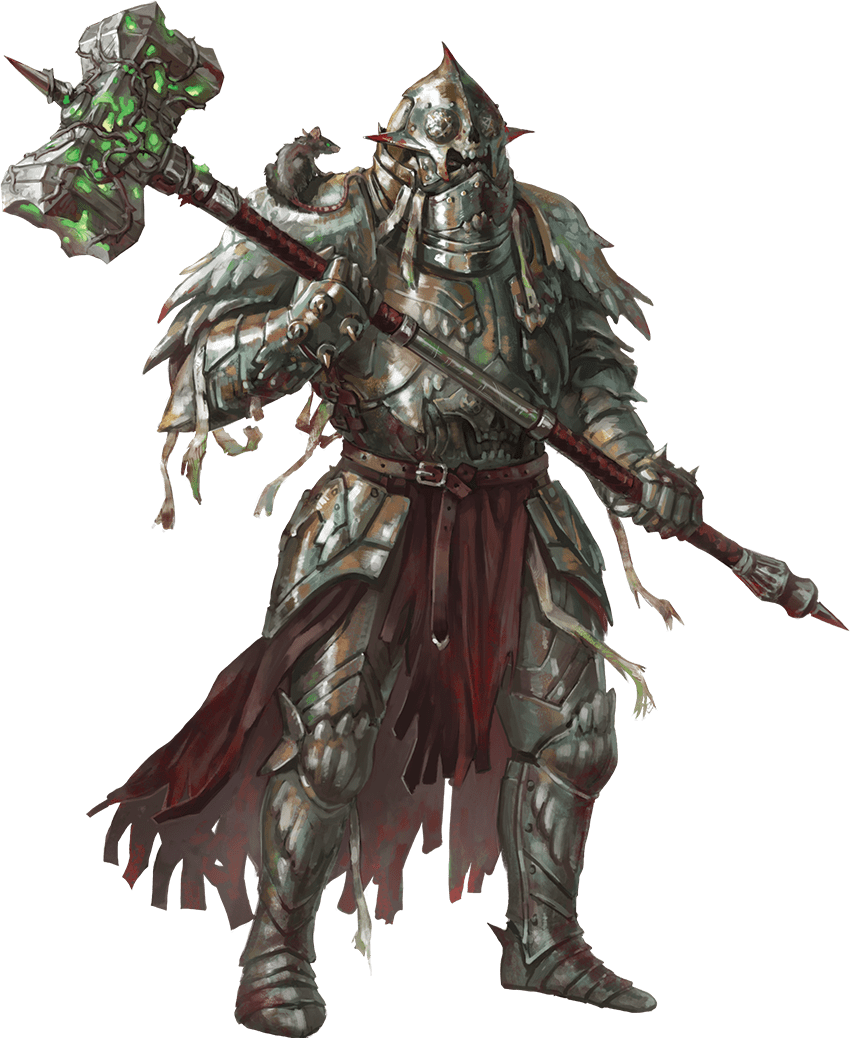
Level 3: Debilitating Fever
You can inflict disease upon a creature. When you hit a creature with an attack roll using a weapon or Unarmed Strike, you can expend one use of your Channel Divinity to give that creature the Poisoned condition for 1 minute. While Poisoned in this way, the target also has the Incapacitated condition. At the end of each of its turns, the Poisoned target makes a Constitution save, ending the effect on itself on a success.
Level 3: Entropic Infection
As a Magic action, you can expend one use of your Channel Divinity and select a creature you can see within 30 feet of yourself. For 1 minute, if you deal damage to the target, the target takes an extra 2d6 Necrotic damage. In addition, the target loses Resistance and Immunity to Necrotic damage. The target can make a Constitution save against the Paladin's spell save DC at the end of each of its turns, ending the effect on itself on a success.
Level 3: Oath of Pestilence Spells
The magic of your oath ensures you always have certain spells ready; when you reach a Paladin level specified in the Oath of Pestilence Spells table, you thereafter always have the listed spells prepared.
| Oath of Pestilence Spells | |
|---|---|
| Paladin Level | Spells |
| 3 | Bane, Inflict Wounds |
| 5 | Melf's Acid Arrow, Ray of Enfeeblement |
| 9 | Flash Fever, Stinking Cloud |
| 13 | Blight, Confusion |
| 17 | Contagion, Insect Plague |
Level 7: Aura of Rampant Sickness
You emit an aura of contagion and virulence. When a creature within your Aura of Protection is about to make a D20 Test, you can take a Reaction to impose Disadvantage on that D20 Test.
There are days when you can just make out the glint of their armor through the haze, like they’re waiting for something.
— Liesech Doctor
Level 15: Disgusting Resilience
When you are reduced to 0 Hit Points and not killed outright, you can spend any number of Hit Dice, roll them, and reduce the damage taken by the total rolled on those dice.
In addition, if you are killed, your corpse explodes in a shower of pus and gore. Each creature in a 20-foot Emanation originating from you makes Constitution saving throw against the Paladin's spell save DC, taking 8d6 Necrotic damage on a failed save or half as much damage on a successful one.
Level 20: Plaguebringer
As a Bonus Action, you gain the benefits below for 10 minutes, or until you end them (no action required). Once you use this feature, you can’t use it again until you finish a Long Rest. You can also restore your use of it by expending a level 5 spell slot (no action required).
One with Plague. You are immune to Poison damage and the Poisoned condition, and you have Resistance to Necrotic damage.
Bolstered by Rot. Your Hit Point maximum can’t be reduced.
Entropic Radiance. Whenever an enemy starts its turn within your Aura of Protection, it takes Necrotic damage equal to your Charisma modifier plus your Proficiency Bonus.
Oath of Slaughter
Revel in Unbridled Violence
The only truth of war is death. The only virtue is to kill. The only victory is to survive. Heroism, honor, and glory are illusions. This is the creed of Tormach, Arch Daemon of Wrath, but this philosophy rings true for all warriors who devote themselves, body and soul, to the thrill of combat and the delight of bloodshed. Such champions find themselves at the forefront of armies, using the most violent methods at their disposal to bring battles to a swift close … or drawing out the war to sate their own appetites.
Paladins who take the Oath of Slaughter share the following tenets:
- Violence is the end, not the means.
- Break the body to break the spirit.
- Revel in bloodshed, whether friend or foe.

Level 3: Frenzied Slaughter
You can harness the rush of battle to drive you to even greater acts of violence. As a Bonus Action, you can expend one use of your Channel Divinity to enter a battle frenzy. You gain the following benefits while this feature is active.
Reflexive Attack. When you miss with an attack roll using a Melee weapon or Unarmed Strike, you can take a Reaction to make another attack with the same weapon.
Condition Resistance. You have Advantage on saving throws to avoid or end the Charmed, Frightened, and Stunned conditions.
Duration. Frenzied Slaughter lasts until the end of your next turn, and it ends early if you have the Incapacitated condition. If your Frenzied Slaughter is still active on your next turn, you can extend it for another round by doing one of the following:
- Make an attack roll against an enemy.
- Force an enemy to make a saving throw.
- You are Bloodied at the end of your turn.
Each time Frenzied Slaughter is extended, it lasts until the end of your next turn. You can maintain it for up to 1 minute.
Level 3: Oath of Slaughter Spells
The magic of your oath ensures you always have certain spells ready; when you reach a Paladin level specified in the Oath of Slaughter Spells table, you thereafter always have the listed spells prepared.
| Oath of Slaughter Spells | |
|---|---|
| Paladin Level | Spells |
| 3 | Crimson Lash, Inflict Wounds |
| 5 | Bloodletter, Shatter |
| 9 | Fear, Suffocate |
| 13 | Consume Mind, Supernal Smite |
| 17 | Destructive Wave, Incite Riot |
Level 7: Bloodthirst Aura
Your lust for blood infects those around you. When a Bloodied ally within your Aura of Protection makes an attack with a weapon or an Unarmed Strike, it gains a bonus to damage. The bonus equals your Charisma modifier.
Additionally, when a Bloodied creature within your Aura of Protection makes a saving throw against a Sangromancy spell, you can take a Reaction to impose Disadvantage on the save.
We’re more similar than different to those paladins who revel in slaughter, I think. Though, they are a tad more…wasteful.
— Crimson Court Aristocrat
Level 15: Follow Through
When a creature in your Aura of Protection becomes Bloodied, you can take a Reaction to move up to half your Speed and make an attack with a Melee weapon or Unarmed Strike. This movement doesn’t provoke Opportunity Attack action, and you have Advantage on the attack roll.
Level 20: Blood Knight
Your bloodthirst imbues you with preternatural strength and resilience, allowing you to keep sowing slaughter. As a Bonus Action, you gain the benefits below for 10 minutes or until you end them (no action required). Once you use this feature, you can’t use it again until you finish a Long Rest. You can also restore your use of it by expending a level 5 spell slot (no action required).
Crimson Armor. When a creature within your Aura of Protection becomes Bloodied by an enemy, you gain 30 Temporary Hit Points.
Seeing Red. When a creature hits you with an attack roll, you can take a Reaction to make one melee attack against that creature, using a weapon or an Unarmed Strike.
Wanton Slaughter. When you hit a creature with a melee attack roll using a weapon or an Unarmed Strike, you can choose any number of creatures within 5 feet of the original target and within your reach. Each chosen creature takes Force damage equal to your Charisma modifier (minimum of +1) plus your Proficiency Bonus.
Oath of Zeal
Eliminate Threats to Ideological Purity
The Oath of Zeal is taken by paladins consumed by hatred for a specific group or ideology. Zealots, as these Paladins are sometimes called, pursue an inquisition against their enemies at all costs. They abandon compassion and honor as impediments to the more important work of ridding the world of those they deem dangerous or heretical.
These Paladins share the following tenets:
- Reveal heresy and destroy those who practice it.
- Show unwavering conviction and unflinching resolve.
- Perform any sacrifice necessary to stop wickedness.
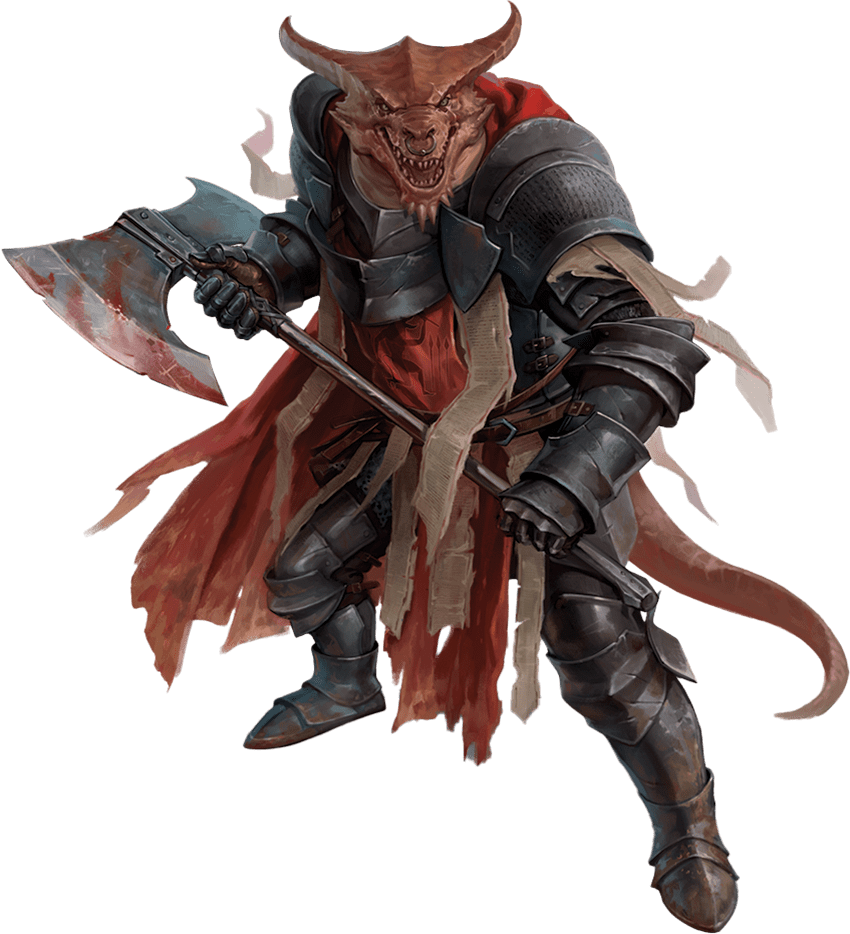
Level 3: Mark of the Heretic
As a Bonus Action, you can expend one use of your Channel Divinity to mark a creature you can see within 30 feet of yourself as a heretic.
For 1 minute, your weapon attacks and Unarmed Strikes against the chosen creature can score a Critical Hit on a roll of 19 or 20 on the d20. In addition, whenever the target starts its turn, you can take a Reaction to make a melee attack against that creature if it’s within reach.
Level 3: Oath of Zeal Spells
The magic of your oath ensures you always have certain spells ready; when you reach a Paladin level specified in the Oath of Zeal Spells table, you thereafter always have the listed spells prepared.
| Oath of Zeal Spells | |
|---|---|
| Paladin Level | Spells |
| 3 | Detect Evil and Good, Hunter’s Mark |
| 5 | Detect Thoughts, Knock |
| 9 | Fear, Tongues |
| 13 | Divination, Locate Creature |
| 17 | Insect Plague, Scrying |
Level 7: Aura of Clarity
You and your allies have Immunity to the Blinded condition while in your Aura of Protection. If a Blinded ally enters the aura, that condition has no effect on that ally while there. Additionally, you can see Invisible creatures within your Aura of Protection.
Level 15: Compel Confession
You can cast Zone of Truth without expending a spell slot. In addition, a creature that succeeds on its saving throw takes 1d6 Psychic damage at the start of each of its turns while in your Zone of Truth until it chooses to fail its saving throw instead.
Level 20: Apocalyptic Revelation
As a Bonus Action, you can reveal the true nature of your enemies for 1 minute. Once you use this feature, you can’t use it again until you finish a Long Rest. You can also restore your use of it by expending a level 5 spell slot (no action required). You gain the following benefits.
Blinding Glory. Enemies that start their turn within 5 feet of you must make a Constitution saving throw against the Paladin's spell save DC. On a failed save, the creature has the Blinded condition until the start of its next turn.
See the Truth. You have Truesight with a range of 60 feet.
Smite the Heretic. As a Bonus Action, you can choose a creature within 60 feet of yourself and reveal its weaknesses. You and your allies have Advantage on attack rolls against that creature.
Ranger Subclasses

Rangers in Etharis are skilled and knowledgeable warriors. Ranging from master assassins and poison experts to stalwart guardians of the natural world and commanders of vast armies of rodents and vermin, in many parts of the realm they are the last line of defense for the fading natural world.
Green Reaper
Slay with Nature’s Venom
Green Reapers are assassins who specialize in harnessing the toxic elements of flora and fauna. These Rangers often work as killers for hire utilizing their extensive knowledge to end lives discreetly or with gory panache, depending on the poison used and the client’s wishes. Green Reapers exhibit a morbid curiosity when encountering a toxin they’re unfamiliar with, typically followed by an enthusiastic application of the substance on their next foe.
Level 3: Envenomed Attack
As a Bonus Action, you can apply a poison dose to a weapon or up to 20 pieces of ammunition. Once applied, the poison retains its potency for 1 minute. Your attacks with the poisoned item deal an extra 1d4 Poison damage on a hit.
You can use this feature a number of times equal to your Wisdom modifier (minimum of once). You regain all expended uses when you finish a Long Rest.
At Ranger level 11, the extra Poison damage increases to 2d4, and you regain all expended uses when you finish a Short or Long Rest.

Level 3: Toxic Tradecraft
You gain a Poisoner’s Kit, and you have proficiency with it. In addition, your Proficiency Bonus is doubled for ability checks with a Poisoner’s Kit. If you lose the kit, you can harvest toxic flora and venomous fauna for 1 hour to magically create a replacement. This harvest can be performed during a Short or Long Rest, and it destroys the previous Poisoner’s Kit.
Once per turn when you deal Poison damage to a creature with a weapon attack, you can expend a spell slot (no action required). The attack deals an extra 1d6 Poison damage and the target gains the Poisoned condition until the end of your next turn. You may also add a Toxin Effect, chosen from the appropriate list below. All Toxin Effects last until the end of your next turn, unless its description states otherwise.
Level 3: Green Reaper Spells
When you reach a Ranger level specified in the Green Reaper Spells table, you thereafter always have the listed spells prepared.
| Green Reaper Spells | |
|---|---|
| Ranger Level | Spells |
| 3 | Detect Poison and Disease |
| 5 | Hold Person |
| 9 | Bestow Curse |
| 13 | Greater Invisibility |
| 17 | Cloudkill |
Level 7: Poison Control
You gain Resistance to Poison damage and have Advantage on saving throws to avoid or end the Poisoned condition.
In addition, you can cast the Protection from Poison spell without expending a spell slot. You can do so a number of times equal to your Wisdom modifier (minimum of once), and you regain all expended uses when you finish a Long Rest.
Level 11: Variegated Vexations
Whenever you would deal Poison damage with a weapon attack, you can change that damage to be either Acid or Necrotic instead.
Level 15: Pain Tolerance
You have learned to quickly inure yourself against harm. Immediately before you take damage from a creature you can see within 60 feet of yourself, you can take a Reaction to gain Temporary Hit Points equal to the damage you take. If any of these Temporary Hit Points remain at the end of your next turn, they vanish.
Toxin Effects
The following Toxin Effects are presented in order of spell slot level:
Level 1 Spell Slot Effects
When you expend a level 1+ spell slot, choose one of the following effects to add to the toxin.
Attenuate. While a creature has the Poisoned condition from this toxin, it has Disadvantage on Strength and Dexterity saving throws.
Befuddled. While a creature has the Poisoned condition from this toxin, it can’t speak, read, or write and it has Disadvantage on saving throws made to maintain Concentration on spells.
Uncoordinated. While a creature has the Poisoned condition from this toxin, it can’t take Reactions or the Disengage or Dodge action.
Level 2 Spell Slot Effects
When you expend a level 2+ spell slot, choose one of the following effects to add to the toxin.
Debilitate. For 1 minute, the creature can’t regain Hit Points.
Potent. For 1 minute, the creature loses Resistance to Poison damage.
Suffer. For 1 minute, the first time on each turn the creature takes Poison damage, it takes an extra 1d6 Poison damage.
Level 3 Spell Slot Effects
When you expend a level 3+ spell slot, choose one of the following effects to add to the toxin.
Lingering. Instead of ending at the end of your next turn, the creature has the Poisoned condition for 10 minutes. During this time it has Disadvantage on saving throws to end the Poisoned condition on itself. At the end of each of the creature’s turns, it can make a Constitution saving throw to end the Poisoned condition.
Supernatural. When you deal damage to a creature with a poisoned item, the creature loses Immunity to the Poisoned condition and then has the Poisoned condition for 1 minute. At the end of each of the creature’s turns, it can make a Constitution saving throw to end the Poisoned condition and regain its Immunity to the Poisoned condition.
Level 4 Spell Slot Effects
When you expend a level 4+ spell slot, choose one of the following effects to add to the toxin.
Flesh Eating. For 1 minute, the creature has the Poisoned condition. While a creature has the Poisoned condition from this toxin, it takes 2d6 Acid damage at the start of each of its turns.
Insensate. While a creature has the Poisoned condition from this toxin, it also has the Blinded and Deafened conditions.
Paraplegia. While a creature has the Poisoned condition from this toxin, its Speed is reduced to 0 and it has Disadvantage on Dexterity saving throws.
Level 5 Spell Slot Effects
When you expend a level 5 spell slot, choose one of the following effects to add to the toxin.
Enhanced. Apply one option from the Level 4 Spell Slot Effects list, and an additional option from either the Level 1 or Level 2 Spell Slot Effects list.
Stinging Application. For 1 minute, once per turn, when you hit a creature with a poisoned item, the attack deals an extra 5d6 damage. The damage type is your choice of Acid, Necrotic, or Poison.
Primordial Archer
Channel the Wrath of the Wilds
In the areas of Etharis where nature still holds sway, many cling to the ancient customs of woodland hunters and witches. Marking themselves with wild plants and bone needles, theirs is a tradition of cunning, cruelty, and reprisal against all trespassers. Unlike the Druids, these wood witches twist natural magic into hexes, imbuing their weapons with nature’s fury.
Level 3: Elemental Arrows
As a Bonus Action, you can imbue a Longbow or Shortbow with elemental energy for 1 minute. Choose one of the following damage types: Acid, Cold, Fire, Lightning, or Thunder. For the duration, the imbued weapon deals damage of the selected type instead of its normal type and deals an extra 1d6 damage of the chosen type when it hits. At the start of each of your turns, you can change this choice.
You can use this feature a number of times equal to your Wisdom modifier (minimum of once), and you regain all expended uses when you finish a Long Rest.
Level 3: Herbal Lore
You gain an Herbalism Kit and are proficient with it. You can use the Herbalism Kit as a Bonus Action to stabilize an Unconscious creature within 5 feet of you that has 0 Hit Points as if using a Healer’s Kit without needing to make a Wisdom (Medicine) check. If you take a Utilize action, an Unconscious creature within 5 feet of you that has 0 Hit Points gains 1 Hit Point instead.

Once you use this feature, you can’t do so again until you finish a Short or Long Rest.
Level 3: Primordial Archer Spells
When you reach a Ranger level specified in the Primordial Archer Spells table, you thereafter always have the listed spells prepared.
| Primordial Archer Spells | |
|---|---|
| Ranger Level | Spells |
| 3 | Hex |
| 5 | Blindness/Deafness |
| 9 | Call Lightning |
| 13 | Polymorph |
| 17 | Wall of Stone |
Level 7: Weave the Elements
With 1 hour of work or when you finish a Long Rest, you can use an Herbalism Kit to mark yourself with elemental patterns. You gain Resistance to one of the following damage types of your choice until you finish a Long Rest: Acid, Cold, Fire, Lightning, or Thunder.
Level 11: Witching Arrows
You gain the ability to imbue curses into your arrows. Once per turn when you hit a creature with a ranged attack using a Longbow or Shortbow, you can expend a level 1+ spell slot to choose one of the following effects (no action required). The listed damage increases by 2d6 for each spell slot above 1.
Arcing Shot. Electricity crackles around the arrow. Make a ranged attack roll with the same weapon against a second creature within 30 feet of the first that is also within your range. Each creature hit takes 2d6 Lightning damage.
Entangling Shot. The wooden shaft of the arrow sprouts tiny green leaves. The target must succeed on a Strength saving throw against your spell save DC. On a failed save, the target takes 2d6 Piercing damage and has the Restrained condition for 1 minute. On a successful save, the creature takes the damage only. A Restrained creature repeats the save at the end of each of its turns, ending the effect on itself on a success.
Hexing Shot. The magic surrounding your arrow clouds the mind of your target. The target must make a Wisdom saving throw against your spell save DC. On a failed save, the target takes 2d6 Psychic damage and gains the Charmed or Frightened condition for 1 minute (your choice). The creature can repeat the save at the end of each of its turns, ending the effect on a success. On a successful save, the creature takes half as much damage only.
Viper Shot. The arrow transforms into a hissing serpent. The target must make a Constitution saving throw against your spell save DC. On a failed save, the target takes 2d6 Poison damage and has the Poisoned condition for 1 minute. The creature can repeat the save at the end of each of its turns, ending the effect on a success. On a successful save, the creature takes half as much damage only.
Level 15: Primordial Magic
Taking damage can’t break your Concentration on any Ranger spells you cast.
In addition, you can take a Bonus Action to change the damage type you chose for the Weave the Elements feature to a different damage type in the list. When you do, you can choose a creature that you can see within 30 feet of yourself. That creature must succeed on a Constitution saving throw or take 6d6 damage of either damage type (your choice).
You can use this feature a number of times equal to your Wisdom modifier (minimum of once). You regain all expended uses when you finish a Long Rest.
Vermin Lord
Grow Powerful from Strength in Numbers
Vermin Lords cultivate loyal hordes of disease-bearing rodents to help them battle greater evils. For many of these Rangers, that greater evil is some kind of societal ill, but a rare few see their fellow Humanoids as an infestation that threatens the natural world. Regardless of their goal, they make their homes in sewers, slums, and other forgotten places where they are free to plot against their enemies and tend to their verminkin.
Level 3: Verminkin
You can comprehend and verbally communicate with Tiny Beasts.
As a Magic action, you can expend a spell slot to summon vermin swarms. You summon a number of swarms equal to the slot’s level for 1 hour. Each swarm is summoned to an unoccupied space you can see within 30 feet of yourself. A swarm uses the Swarm of Vermin stat block.
In combat, each swarm acts during your turn. It can move and use its Reaction on its own, but the only action it takes is the Dodge action unless you take a Bonus Action to command it to take an action in its stat block or some other action. You can command each swarm with a single Bonus Action.
Once you use this feature, you can’t use it again until you finish a Short or Long Rest.
Level 3: Swarming Strikes
As a Bonus Action, you can command all of your swarms to make an Attack action instead of just one. Alternatively, a single swarm can attack twice instead of once when it takes the Attack action.
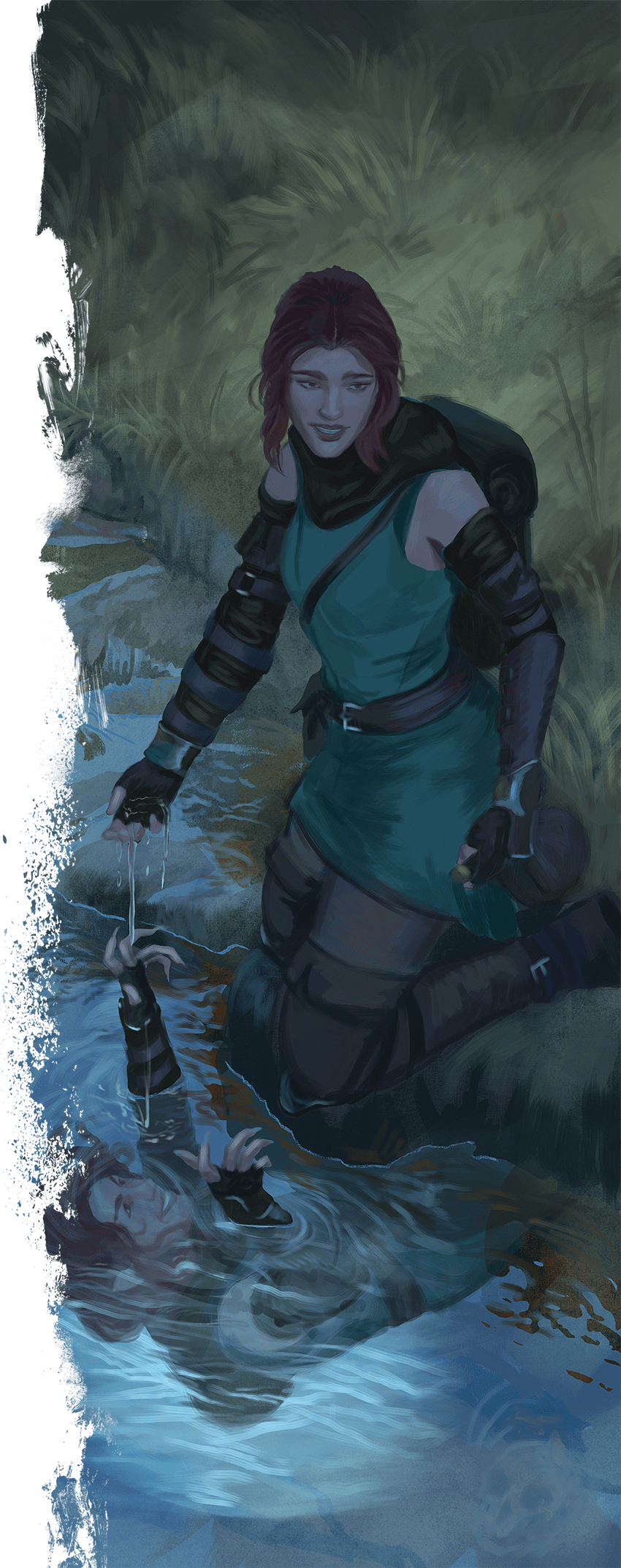
You can use this feature a number of times equal to your Wisdom modifier plus your Proficiency Bonus, and you regain all expended uses when you finish a Short or Long Rest.
Level 3: Vermin Lord Spells
When you reach a Ranger level specified in the Vermin Lord Spells table, you thereafter always have the listed spells prepared.
| Vermin Lord Spells | |
|---|---|
| Ranger Level | Spells |
| 3 | Consumption |
| 5 | Animal Messenger |
| 9 | Flash Fever |
| 13 | Freedom of Movement |
| 17 | Contagion |
Level 7: Filth and Fortitude
The time you’ve spent with plague-bearing rodents has rendered you immune to the Poisoned conditions. Additionally, you gain proficiency in Constitution saving throws.
Level 11: Infectious Spread
When you use Swarming Strikes, each swarm that takes the Attack action makes one additional attack. Each creature damaged by a swarm's attack during this action has the Poisoned condition until the start of your next turn.
We don’t have time to count all of them! Just write ‘hundreds of rodent bites.’
— Altenheim Investigator
Level 15: Strength of the Swarm
You can call on your rodent minions for defense. When you take damage from a creature you can see within 10 feet of yourself, you can take a Reaction to direct the damage toward a swarm you control you can see within 5 feet of yourself.
Swarm of Vermin
Medium Swarm of Tiny Beasts, Unaligned
AC 11 + the spell level
HP 5 + 10 per spell level (the swarm has Hit Dice d8s equal to the spell's level)
Speed 30 ft., Climb 30 ft.
| Ability | Score | Mod | Save |
|---|---|---|---|
| Str | 9 | -1 | -1 |
| Dex | 13 | +1 | +1 |
| Con | 12 | +1 | +1 |
| Ability | Score | Mod | Save |
|---|---|---|---|
| Int | 2 | -4 | -4 |
| Wis | 10 | +0 | +0 |
| Cha | 5 | -3 | -3 |
Resistances Bludgeoning, Piercing, Slashing
Immunities Charmed, Frightened, Grappled, Paralyzed, Petrified, Prone, Restrained, Stunned
Senses Darkvision 30 ft., Passive Perception 10
Languages Understands the languages you know
CR None (XP 0; PB equals your Proficiency Bonus)
Traits
Pack Tactics. The swarm has Advantage on an attack roll against a creature if at least one of the swarm’s allies is within 5 feet of the creature and the ally doesn’t have the Incapacitated condition.
Swarm. The swarm can enter and occupy the space of another creature and vice versa, and the swarm can move through any opening large enough for a Tiny Beast.
Actions
Bites. Melee Attack Roll: Bonus equals your spell attack modifier, reach 0 ft. Hit: 2d6 + 1 + the spell’s level Piercing damage.

Rogue Subclasses

From gunslinging highway bandits to skulking blood mages and walking jinxes capable of stealing luck itself, rogues in Etharis use cunning and deception to survive, and when that doesn’t work, a well-placed blade typically does the trick.
Highway Rider
A Steed Makes the Best Partner in Crime
Stalking the backroads, the Highway Rider strikes fear into the heart of every traveler and penny-pinching merchant. They run down their prize astride a swift and loyal steed—and then make a quick getaway.
Level 3: Hair Trigger
You gain proficiency with Blackpowder Pistols. In addition, when you roll Initiative and don’t have Disadvantage on that roll, you can immediately take a Reaction for one of the following options:
- Make one attack with a weapon or Unarmed Strike.
- Move up to your Speed without provoking Opportunity Attack action.
- A controlled mount moves up to its Speed without provoking Opportunity Attack action.
- Take the Dodge or Utilize action.

Level 3: Trusty Mount
You always have the Find Steed spell prepared. With this feature, you can cast it without a spell slot or components, and your spellcasting ability for it is Intelligence.
Once you cast the spell with this feature, you can’t do so in this way again until you finish a Long Rest.
Level 3: Ride Them Down
You don’t need Advantage on the attack roll to Sneak Attack if you or a controlled mount you ride moves at least 20 feet, and you don’t have Disadvantage on the attack roll.
Level 9: Horse Lord
You can spend 1 minute grooming and caring for your mount, at the end of which it gains a number of Temporary Hit Points equal to twice your Rogue level.
In addition, your cunning extends to your steed. While you control a mount, it can take one of the following actions as a Bonus Action: Dash, Disengage, or Dodge.
Level 13: True Grit
You gain proficiency in Constitution saving throws. In addition, when you are subjected to an effect that allows you to make a Constitution saving throw to take only half damage, you instead take no damage if you succeed on the saving throw, and only half damage if you fail.
Level 17: Desperado
When you are reduced to 0 Hit Points and not killed outright, you can use your Hair Trigger feature immediately before you fall Unconscious.
The back roads are getting too dangerous. Our carriage got held up and ransacked three times… today!
— Disgruntled Noble
Misfortune Bringer
Curse Those You’re About to Strike
You’ve matched your penchant for illicit activities with the ability to mark your enemies for mishap and misfortune. Whether you were imbued with magic by spending time among the Fey or you learned the art of cursing from a long line of hedge Wizards, you are a Misfortune Bringer. Although not universal, many Misfortune Bringers possess heterochromia iridum, eyes of two different colors, and they use only one when glaring at targets they intend to curse.
Level 3: Evil Eye
You can place a minor curse with a glance. As a Bonus Action, choose a creature you can see within 60 feet of yourself to be cursed by your Evil Eye. While a creature is cursed by your Evil Eye, you can deal Sneak Attack damage to the creature if you don’t have Disadvantage on the attack roll.
The creature remains cursed by your Evil Eye for 1 minute or until you curse a different creature with your Evil Eye, whichever comes first.
Level 3: Misfortunist
You learn Misfortunes that you can inflict on those cursed by your Evil Eye.
Misfortunes. You learn two Misfortunes of your choice, which are detailed under “Misfortunes” below.

You learn an additional Misfortune of your choice when you reach Rogue levels 9, 13, and 17. When you finish a Long Rest, you can replace one Misfortune you know with a different one.
Jinx Points. You have 4 Jinx Points. You gain 2 additional Jinx Points at Rogue level 13. To use a Misfortune option, you must spend the number of Jinx Points that it costs.
You regain all expended Jinx Points when you finish a Short or Long Rest.
Saving Throws. If a Misfortune requires a saving throw, the DC equals 8 + your Charisma or Intelligence modifier (your choice) + your Proficiency Bonus.
Level 9: Steal Luck
When a creature you can see within 30 feet of yourself is about to make a D20 Test with Advantage, you can take a Reaction to prevent the roll from being affected by Advantage. When you do so, you regain 1 expended Jinx Point.
Once you use this feature, you can’t do so again until you finish a Short or Long Rest.
Level 13: Curse Caster
You can take a Magic action and spend 3 Jinx Points to cast Bestow Curse.
Level 17: Improved Steal Luck
You can use your Steal Luck feature three times, and you regain all expended uses when you finish a Long Rest.
Misfortunes
The following options are available to your Misfortunist feature. The options are presented in alphabetical order.
Curse of the Befuddled
Cost: 2 Jinx Points
As a Magic action, choose a creature that you can see within 60 feet of yourself that is cursed by your Evil Eye and spend 2 Jinx Points. The target must make a Wisdom saving throw.
On a failed save, the creature has the Charmed condition for 10 minutes or until you or your allies damage it. When the effect ends, the target knows it was Charmed by you.
After you use this Misfortune, the creature is no longer cursed by your Evil Eye.
Curse of the Clumsy
Cost: 3 Jinx Points
When a creature cursed by your Evil Eye moves at least 5 feet on its turn, you can take a Reaction and spend 3 Jinx Points to cause the creature to have the Prone condition and have its Speed reduced to 0 until the end of its turn.
After you use this Misfortune, the creature is no longer cursed by your Evil Eye.
Curse of the Debilitated
Cost: 1 Jinx Point
When a creature cursed by your Evil Eye takes damage, you can take a Reaction and spend 1 Jinx point to roll 1d12. The creature takes Necrotic damage equal to the roll.
After you use this Misfortune, the creature is no longer cursed by your Evil Eye.
Curse of the Doomed
Cost: 1 Jinx Point
When you miss with an attack roll against a creature cursed by your Evil Eye, you can take a Reaction and spend 1 Jinx Point to reroll the attack. You must use the new roll.
After you use this Misfortune, the creature is no longer cursed by your Evil Eye.
Curse of the Fearful
Cost: 2 Jinx Points
As a Magic action, choose a creature that you can see within 60 feet of yourself that is cursed by your Evil Eye and spend 2 Jinx Points. The target must make a Wisdom saving throw.
On a failed save, the creature has the Frightened condition for 1 minute. At the end of each of its turns, the Frightened target repeats the save, ending the Misfortune on itself on a success.
After you use this Misfortune, the creature is no longer cursed by your Evil Eye.
Curse of the Inept
Cost: 1 Jinx Point
After a creature you can see that is cursed by your Evil Eye makes a D20 Test, you can take a Reaction and spend 1 Jinx Point to make the target reroll, and it must use the new roll.
After you use this Misfortune, the creature is no longer cursed by your Evil Eye.
Curse of the Insensate
Cost: 3 Jinx Points
As a Magic action, choose a creature that you can see that is cursed by your Evil Eye and spend 3 Jinx Points. The target must make a Wisdom saving throw.
On a failed save, the creature has the Blinded and Deafened conditions for 1 minute. At the end of each of its turns, the target repeats the save, ending the Misfortune on itself on a success.
After you use this Misfortune, the creature is no longer cursed by your Evil Eye.
Curse of the Maimed
Cost: 2 Jinx Points
When you hit a creature cursed by your Evil Eye with an attack roll using a weapon or Unarmed Strike and roll a 19 on the d20, you can take a Reaction and spend 2 Jinx Points to score a Critical Hit.
After you use this Misfortune, the creature is no longer cursed by your Evil Eye.
Curse of the Marked
Cost: 2 Jinx Points
As a Bonus Action, you can spend 2 Jinx Points to increase the duration of your Evil Eye to 1 hour or until you mark a different creature with your Evil Eye, whichever comes first.
Additionally, while a creature is affected by this curse, you always know the direction and distance to the creature while the two of you are on the same plane of existence.
Curse of the Plagued
Cost: 1 Jinx Point
When a creature you can see that is cursed by your Evil Eye would regain Hit Points, you can take a Reaction and spend 1 Jinx Point to halve the number of Hit Points regained. Afterward, the creature can’t regain Hit Points until the start of your next turn.
After you use this Misfortune, the creature is no longer cursed by your Evil Eye.
Curse of the Somnolent
Cost: 3 Jinx Points
As a Magic action, choose a creature you can see that is cursed by your Evil Eye and spend 3 Jinx Points. The target must make a Wisdom saving throw.
On a failed save, the creature has the Unconscious condition for 1 minute. The condition ends on a target if it takes damage or someone within 5 feet of it takes an action to shake it out of the Misfortune’s effect.
Creatures that don’t sleep, such as elves, or that have Immunity to the Exhaustion condition automatically succeed on saves against this Misfortune.
After you use this Misfortune, the creature is no longer cursed by your Evil Eye.
Curse of the Unlucky
Cost: 3 Jinx Points
As a Bonus Action, you can spend 3 Jinx Points to put a pox on a creature cursed by your Evil Eye. Whenever the creature is about to make an attack roll or saving throw, you can roll 1d4 and subtract the number rolled from the total. This Misfortune ends when the creature is no longer cursed by your Evil Eye.
No, I know better than to bet against you. Whatever you’ve got going on… its more than just luck.
— Bankrupted Gambler
Sanguine Thief
Eliminate Your Prey with Blood Magic
In dark alleyways across Etharis, deals are made in coin and blood, but a few enterprising Rogues have posed the question: “Why not both?” Sanguine Thieves are assassins who harness the power of Sangromancy to fuel their abilities, finding new and innovative ways to utilize the blood they see all too frequently in their line of work.
Sanguine Thieves learn to draw upon the vita of their victims, extending their ability to use blood magic beyond the limits of their own vitality. When cornered, Sanguine Thieves can unleash this power in a hail of crimson darts or fade before a foe’s blade, leaving nothing behind but a red mist.
Level 3: Spellcasting
You have learned to cast Wizard spells, as well as spells from the Sangromancy school. All Sangromancy spells and cantrips are treated as Wizard spells for the purposes of this subclass.
Cantrips. You know three cantrips from the Wizard spell list and from the list of Sangromancy spells. Whenever you gain a Rogue level, you can replace one of your cantrips with another Wizard cantrip of your choice.

When you reach Rogue level 10, you learn another Wizard cantrip of your choice.
Spell Slots. The Sanguine Thief Spellcasting table shows how many spell slots you have to cast your level 1+ spells. You regain all expended spell slots when you finish a Long Rest.
Prepared Spells of Level 1+. You prepare the list of level 1+ spells that are available for you to cast with this feature. To start, choose three level 1 Wizard spells.
The number of spells on your list increases as you gain Rogue levels, as shown in the Prepared Spells column of the Sanguine Thief Spellcasting table. Whenever that number increases, choose additional Wizard spells until the number of spells on your list matches the number in the Sanguine Thief Spellcasting table. The chosen spells must be of a level for which you have spell slots.
Changing Your Prepared Spells. Whenever you gain a Rogue level, you can replace one spell on your list with another Wizard spell for which you have spell slots.
Spellcasting Ability. Intelligence is your spellcasting ability for your Wizard spells.
Spellcasting Focus. You can use an Arcane Focus as a Spellcasting Focus for your Wizard spells.
| Sanguine Thief Spellcasting | |||||
|---|---|---|---|---|---|
| Rogue Level | Prepared Spells | Spell Slots per Spell Level | |||
| 1 | 2 | 3 | 4 | ||
| 3 | 3 | 2 | - | - | - |
| 4 | 4 | 3 | - | - | - |
| 5 | 4 | 3 | - | - | - |
| 6 | 4 | 3 | - | - | - |
| 7 | 5 | 4 | 2 | - | - |
| 8 | 6 | 4 | 2 | - | - |
| 9 | 6 | 4 | 2 | - | - |
| 10 | 7 | 4 | 3 | - | - |
| 11 | 8 | 4 | 3 | - | - |
| 12 | 8 | 4 | 3 | - | - |
| 13 | 9 | 4 | 3 | 2 | - |
| 14 | 10 | 4 | 3 | 2 | - |
| 15 | 10 | 4 | 3 | 2 | - |
| 16 | 11 | 4 | 3 | 3 | - |
| 17 | 11 | 4 | 3 | 3 | - |
| 18 | 11 | 4 | 3 | 3 | - |
| 19 | 12 | 4 | 3 | 3 | 1 |
| 20 | 13 | 4 | 3 | 3 | 1 |
Suspected Blood Mages should be considered especially dangerous. Approach with caution and eliminate without attempting to parley.
— Castinellan Inquisitor’s Ordinance
Level 3: Stolen Power
You draw magic from blood. It is represented by your Sangromancy Dice, which fuel powers you have from this subclass. You have a pool of d8s that you can use on Sanguine Thief features. The number of damage dice in the pool equals the number of damage dice as shown in the Sneak Attack column of the Rogue Features table. You can’t have more Sangromancy Dice than the number of damage dice shown in the Sneak Attack column for your level, unless you have Sangromancy Dice from a different source.
Blood Magic. You can spend Sangromancy Dice instead of Hit Dice when you cast Sangromancy spells.
Your pool regains all expended dice when you finish a Long Rest.
Level 3: Steal Blood
When you deal Sneak Attack damage, you can restore 1 Sangromancy Die.
If you are Bloodied, instead of restoring 1 Sangromancy Die when you deal Sneak Attack damage, you can immediately roll the die and regain a number of Hit Points equal to the roll’s total.
You can use this feature a number of times equal to your Intelligence modifier (minimum of once). You regain all expended uses when you finish a Long Rest.
Level 9: Bloody Blades
When you finish a Long Rest, you can spend up to 2 Hit Dice or Sangromancy Dice to create a number of Daggers equal to the number of dice spent in this way. Each Dagger counts as an Arcane Focus for your Sanguine Thief spells, and you can cast spells with Somatic components even if you wield these weapons in one or both hands.
Additionally, when you score a Critical Hit with this weapon, you can cause the weapon to deal extra damage to the target. The extra damage is a number of d8s equal to the number of Hit Dice or Sangromancy Dice spent on this feature. The extra damage is Necrotic.
The Daggers last until you finish a Long Rest.
Level 13: Bloodstitch
As a Magic action, you can spend 3 Hit Dice or Sangromancy Dice to fling a wave of needle-like blood shards. When you do so, each creature of your choice in a 30-foot Emanation originating from you must make a Dexterity saving throw against your spell save DC, taking 3d8 Necrotic damage on a failed save or half as much damage on a successful one. You regain 1 Hit Die or Sangromancy Die (your choice) for each creature reduced to 0 Hit Points by this feature.
Once you use this feature, you can’t do so again until you finish a Short or Long Rest.
Level 17: Bloody Exit
When a creature hits you with an attack roll, you can take a Reaction and spend 5 Hit Dice or Sangromancy Dice to turn into bloody mist. The attack automatically misses you, you can teleport up to 30 feet to an unoccupied space you can see, and you regain your normal form. As part of this Reaction, you can make an attack with a Melee weapon immediately after you teleport. On a hit, this attack deals an extra 5d8 Necrotic damage to the target.
Once you use this feature, you can’t use it again until you finish a Short or Long Rest.
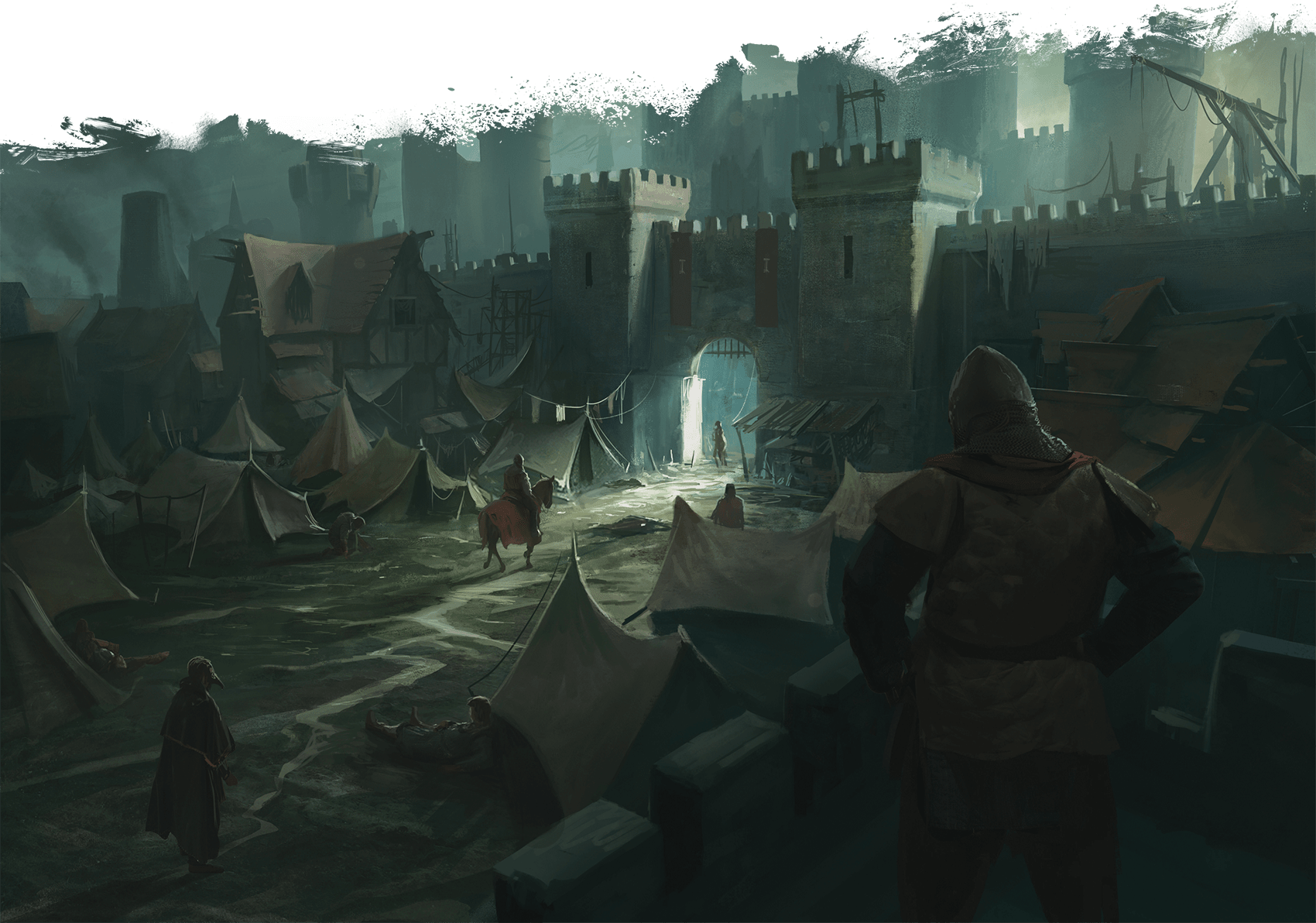
Sorcerer Subclasses

With so many otherworldly forces at play, there is no shortage of folks whose very beings have been infused with magic. Sorcerers in Etharis range from raving scholars plagued with visions of the end of days, to spirit-callers and those suffering curses for the sins of their ancestors.
Apocalypse Sorcery
Hasten or Stall the End of the World
Apocalypse Sorcerers have seen the shape of things to come. They may have visions of the Great Beast ushering in the end of Etharis or dreams of Gormadraug waking and devouring the land.
These prophecies besiege Apocalypse Sorcerers, plaguing and empowering in equal measure. Some find relief in putting these revelations into writing, producing texts that read as incoherent but slowly seep into the mind as sensible, even inevitable. When the apocalypse-bringer is freed to travel across Etharis unburdened, undoing the works of gods and men, magic will swell and pool, ripe for the taking. This sign of the end is also their gift.
Level 3: Apocalyptic Spells
When you reach a Sorcerer level specified in the Apocalyptic Spells table, you thereafter always have the listed spells prepared.

| Apocalyptic Spells | |
|---|---|
| Sorcerer Level | Spells |
| 3 | Augury, Comprehend Languages, Hellish Rebuke, Ray of Enfeeblement |
| 5 | Bestow Curse, Revivify |
| 7 | Banishment, Divination |
| 9 | Contagion, Insect Plague |
Level 3: Unhinged Asservations
You are obsessed with documenting your visions. You gain proficiency with Calligrapher’s Supplies and you can create Spell Scrolls in half the time and at half the cost in GP.
In addition, when you create a Spell Scroll, you can ensorcell it. When you ensorcell a Spell Scroll, you must expend a spell slot equal to or greater than the spell’s level and you can spend Sorcery Points to apply one of your Metamagic options. Any creature that knows at least one language can use your ensorcelled Spell Scroll, which casts the spell with the benefit of the Metamagic option you chose. The Spell Scroll remains ensorcelled until it is used or you finish a Long Rest.
Level 6: Bear Witness
You have prepared your entire life for the end of the world. While your Innate Sorcery feature is active, you gain the following benefits.
Apocalyptic Inurement. You have Resistance to Force damage.
Recite Scripture. Once per active Innate Sorcery, as a Bonus action you can use a Spell Scroll that has a spell with a casting time of Action.
Unflappable. You are immune to the Frightened condition.
Level 6: Arcane Apocrypha
Your obsessive reflections on the end of existence inspire your writing. Whenever you finish a Long Rest, you can create one Spell Scroll at no cost. It must be a spell of level 5 or lower that you can cast. This Spell Scroll disintegrates when you finish a Long Rest.
Level 14: Forbidden Magic
The end of Etharis is a time when magic is unbound and magical powers long hidden are unearthed. When you cast a Sorcerer spell using a spell slot, you can choose one option below.
Excessive. If the spell requires a Material component with a cost, you can cast the spell without the Material component. You take Force damage equal to four times the level of the spell slot immediately after you cast it. This damage ignores Resistance and Immunity.
Inexorable. Taking damage can’t break your Concentration on the spell. When the spell ends, you gain 1 Exhaustion level.
Pyrrhic. If the spell requires an attack roll, the spell automatically hits and the attack roll is a Critical Hit. Your Hit Point maximum is reduced by an amount equal to four times the level of the spell slot immediately after you cast it. When you finish a Long Rest, your Hit Point maximum returns to normal.
Level 18: The End is Nigh
You loudly proclaim what will come to pass when the world ends. As a Magic action, you describe the end of days. When you do so, each creature of your choice in a 30-foot Emanation originating from you must make a Wisdom saving throw against your spell save DC. On a failed save, a creature takes 6d6 Psychic damage and 6d6 Force damage and has the Frightened condition for 1 minute. On a successful save, the creature takes half as much damage only. A Frightened creature can repeat the saving throw at the end of each of its turns, ending the Frightened condition on a successful save. If this damage reduces a creature to 0 Hit Points, the creature can be revived only by a True Resurrection or a Wish spell.
Once you use this feature, you can’t do so again until you finish a Long Rest unless you spend 6 Sorcery Points (no action required) to restore your use of it.
Haunted Sorcery
Commune with the Dead
Unlike other Sorcerers, the circumstances of your birth were mundane and you have no arcane inheritance passed down from strange ancestors. Instead, you gained your sorcerous powers after you survived an experience that left you near death. Since that experience, you’ve had a preternatural sense for danger and a ghostly companion that either can’t, or won’t, leave you alone. Some Haunted, as Sorcerers who share your origin are called, develop cordial relationships with their phantom, while others find their spectral companion to be a relentless nuisance.
Level 3: Haunted Spells
When you reach a Sorcerer level specified in the Haunted Spells table, you thereafter always have the listed spells prepared.

| Haunted Spells | |
|---|---|
| Sorcerer Level | Spells |
| 3 | Bane, Chill Touch, Invisibility, See Invisibility, Unseen Servant |
| 5 | Fly, Speak with Dead |
| 7 | Death Ward, Greater Invisibility |
| 9 | Little Death, Telekinesis |
Level 3: Sixth Sense
When you roll Initiative, you can add your Charisma modifier to the roll.
Level 3: Phantom Companion
You learn the Find Familiar spell and can cast it as a Magic action without expending a spell slot.
The familiar takes the form of a Specter, though it is an Undead instead of a Celestial, Fey, or Fiend. As a Magic action, you can command your phantom companion to gain the Invisible condition until it attacks or you cast a spell through it. While Invisible, it leaves no physical evidence of its passage and can be tracked only by magic. Any equipment or objects it is holding remains visible.
Additionally, when you take the Attack action, you can forgo one of your own attacks to allow your familiar to make its Life Drain attack with its Reaction.
Level 6: Strength of Spirit
Your bond with your phantom companion empowers it. You gain the following benefits:
- Your familiar’s Hit Point maximum increases by four times your Sorcerer level.
- You can cast spells as if you were in the familiar’s space.
- When you use your action to cast a spell, you can use a Bonus Action to command your phantom companion to use its Life Drain attack with its Reaction.
Level 6: Deathly Pallor
You have Resistance to Necrotic damage, and when you cast a Sorcerer spell that deals damage, it can deal your choice of Necrotic damage or its normal damage type.
Level 14: Phantom Possession
As a Magic action, you can direct your phantom companion to possess a creature of your choice within 5 feet of your phantom. The target makes a Charisma saving throw against your spell save DC. On a failed save, your phantom companion enters the target’s body for 1 minute. On a successful save, the target resists the efforts to possess it, and your familiar can’t possess it again for 24 hours.
Once the phantom companion possesses a creature’s body, it controls that creature. The familiar’s Hit Points, Hit Point Dice, Strength, Dexterity, Constitution, Speed, and senses are replaced by the creature’s. The phantom companion otherwise keeps its game statistics.
While the target is possessed, you have a telepathic link with your phantom companion as long as the two of you are within 100 feet. You can use this telepathic link to issue commands to your phantom companion (no action required) unless you have the Incapacitated condition. Your phantom companion does its best to obey on its turn. If it completes an order and doesn’t receive further direction from you, the phantom companion acts and moves as it likes, focusing on protecting itself.
You can command the target to take a Reaction but must take your own Reaction to do so.
Whenever the target takes damage, it repeats the save, ending the possession on itself on a success, and your phantom companion reappears in the closest unoccupied space.
Once you use this feature, you can’t do so again until you finish a Short or Long Rest.
Level 18: Become Death
You can transmute your physical form into a spectral one when near death. When you are reduced to 0 Hit Points and not killed outright, you can drop to 1 Hit Point instead and gain Temporary Hit Points equal to half your Hit Point maximum. At the start of each of your turns, you lose 10 Temporary Hit Points and creatures of your choice within 30 feet of you take 10 Necrotic damage. While you have Temporary Hit Points granted by this feature, you have Resistance to all damage, a Fly Speed of 30 feet, can Hover, and you can move through occupied spaces as if they were Difficult Terrain. If you end your turn in such a space, you are shunted to the last unoccupied space you were in.
Once you use this feature, you can’t do so again until you finish a Long Rest.
It seems that under the right circumstances, an individual experiencing a haunting can leverage the spirit’s energy into arcane magic. Deeply troubling.
— Inquisitor’s field report
Wretched Bloodline Sorcery
Wield Your Curse Like a Weapon
With every promise whispered to a fairy, every contract signed with a devil, and every pact made with the dead, there’s a chance someone doesn’t keep their end of the bargain. The vengeance of immortal beings lasts much longer than one lifetime, and the lingering magic of these curses can affect the mortal’s descendants.
These inherited magical afflictions may manifest as a plague, deformity, or aversion to the sun. In such families, children may be born who learn to master the latent magic within their inherited curses, turning their banes into personal boons—these sorcerers are known collectively as the Wretched.
Level 3: Bad Luck Charm
You have the ability to cast a sliver of your curse onto another temporarily. As a Bonus Action, choose a creature you can see within 30 feet of yourself. The chosen creature has Disadvantage on the next D20 Test it makes before the start of your next turn.
Once you use this feature, you can’t do so again until you finish a Short or Long Rest unless you spend 1 Sorcery Point (no action required) to restore your use of it.

Level 3: Blood Ties
Your senses easily attune to the supernatural forces that caused your inherited affliction. You always have the Detect Evil and Good spell prepared and can cast it without expending a spell slot.
In addition, choose one of the following types of creatures as the being that cursed your ancestor: Fey, Fiend, or Undead. On each of your turns while you maintain Concentration on Detect Evil and Good, including the turn when you cast it, creatures of the chosen type have Disadvantage on attack rolls against you, and you can’t be possessed, Charmed, or Frightened by such creatures.
Once you cast the spell with this feature, you can’t do so in this way again until you finish a Short or Long Rest.
Level 3: Wretched Curse
You suffer from a curse inherited from an ancestor who failed to uphold their end of a bargain with an otherworldly power. Choose one of the following curses that was passed down to you.
Hulking. Your ancestor was cursed with a hulking frame. You have Disadvantage on Dexterity (Stealth) checks to escape notice by moving quietly. In addition, your Hit Point maximum increases by 1, and it increases by 1 whenever you gain another Sorcerer level. Finally, you count as one size larger when determining your carrying capacity.
Nocturnal. Your ancestor was cursed to shun the light of day. You have Disadvantage on Wisdom (Perception) checks that rely on sight while you are in sunlight. In addition, you can see normally in Dim Light and Darkness— both magical and nonmagical—within 120 feet of yourself.
Plaguebearer. Your ancestor was cursed with physical symptoms of a plague. You have Disadvantage on Charisma (Persuasion) checks made to influence an Indifferent Humanoid within 5 feet of yourself. In addition, you are Immune to the Poisoned condition and have Resistance to Necrotic damage.
Level 6: Share the Burden
You always have the Bestow Curse spell prepared. You can cast the spell by spending 3 Sorcery Points instead of a spell slot. When you cast the spell in this way, the spell doesn’t require Concentration, and its range changes to 60 feet for that casting.
Level 14: Terrifying Visage
As a Bonus Action, you can adopt the terrifying visage of the being that cursed your ancestor for 10 minutes. During this time, you can take a Magic action to cause creatures of your choice you can see you within 30 feet of yourself to make a Wisdom saving throw. On a failed save, the target has the Frightened condition until the end of your next turn. In addition, while your Terrifying Visage feature is active, you gain the following benefit based on the creature type chosen with your Blood Ties feature.
Fey. As a Bonus Action, you teleport up to 30 feet to an unoccupied space you can see.
Fiend. You have Resistance to Cold and Fire damage.
Undead. When you take damage of any type other than Radiant, you can take a Reaction to reduce the damage by half your Sorcerer level.
Once you use Terrifying Visage, you can’t use it again until you finish a Long Rest.
Level 18: Vengeful Summons
Your magic has become powerful enough that you can call and command a servant of those who cursed you. Choose one of the following creatures based on the choice you made with your Blood Ties feature: Lamia or Troll (Fey only), Barbed Devil, Incubus, or Succubus (Fiend only), Ghost or Wraith (Undead only).
You can take a Magic action and spend 5 Sorcery Points to summon your chosen creature. The creature appears in an unoccupied space you can see within 60 feet. It disappears when it drops to 0 Hit Points, you use this feature to summon another creature, or after 10 minutes have passed.
The creature is an ally to you and your allies. In combat, the creature shares your Initiative count, but it takes its turn immediately after yours. It obeys your verbal commands (no action required by you). If you don’t issue any, it takes the Dodge action and uses its movement to avoid danger.
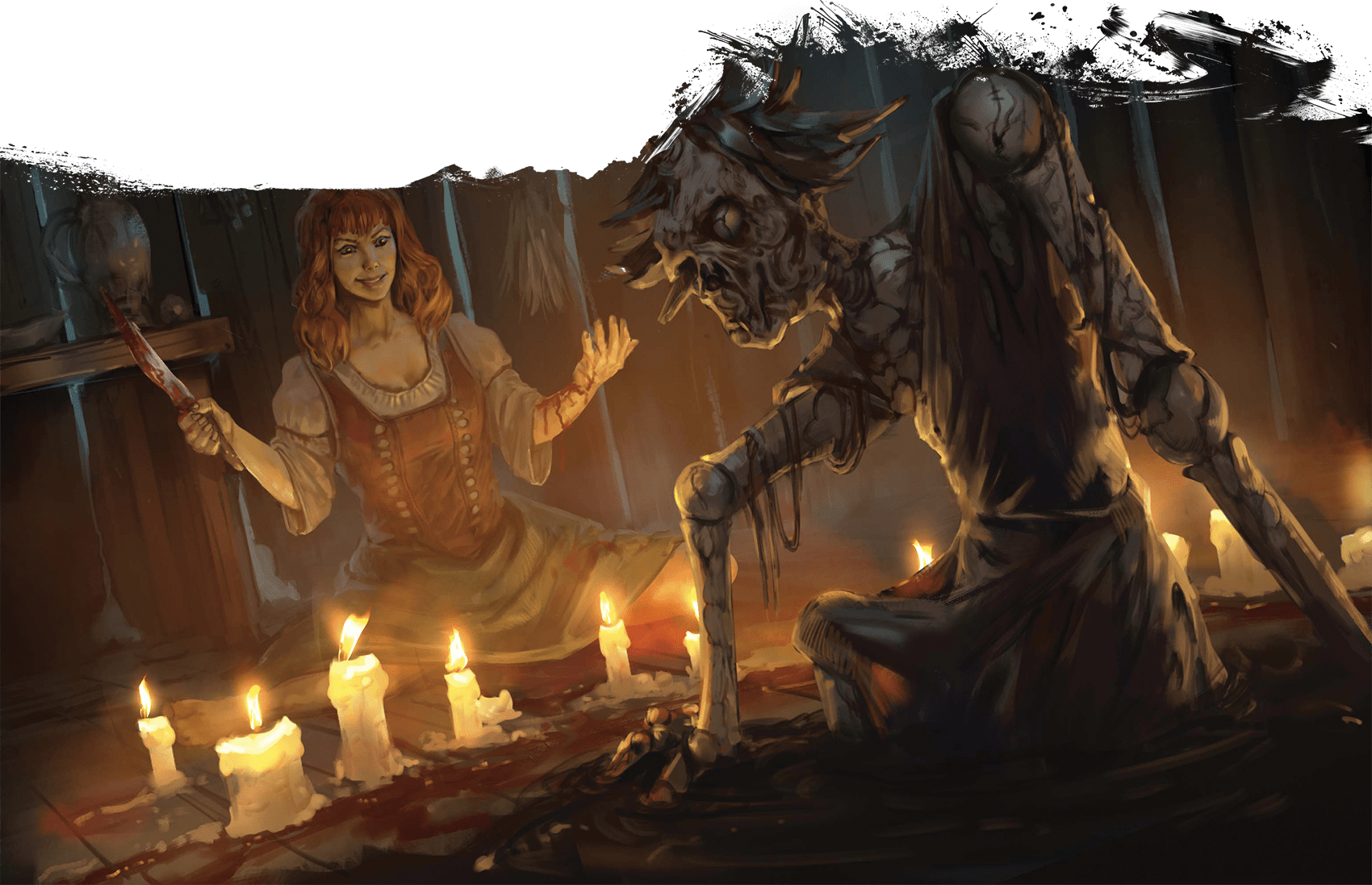
Warlock Subclasses

Whether the servant of scheming hags, ancient and powerful vampires, or unmentionable horrors from beyond the cosmos, warlocks in Etharis often find themselves pawns in the twisted machinations of some greater esoteric being. Whether they are content to play along or have plans of their own that take precedence is entirely up to their wishes and whim, the nature of their pacts, and their willingness to oppose such powerful beings.
The Coven
Curse and Befuddle with Hag Magic
Hags dwell in the deep places of Etharis, from the primordial forests of Valika to the putrid streets of Liesech. These creatures, though rarely benevolent, are willing to bargain with mortals in exchange for furthering their own capricious goals.
Warlocks often find themselves with a single Hag as a sponsor. Should this Hag have a coven, it can lead to the peculiar situation of Warlock agents acting against other Hags or their Warlocks within the coven. But such is the politics of the Realm of Faerie.
Level 3: Coven Spells
The magic of your patron ensures you always have certain spells ready; when you reach a Warlock level specified in the Coven Spells table, you thereafter always have the listed spells prepared.

| Coven Spells | |
|---|---|
| Warlock Level | Spells |
| 3 | Hold Person, Identify, Locate Object, Ray of Sickness |
| 5 | Bestow Curse, Counterspell |
| 7 | Phantasmal Killer, Polymorph |
| 9 | Divination, Locate Creature |
| 17 | Contact Other Plane, Scrying |
Level 3: Hag’s Eye
As an agent of a Hag, you have been gifted with a magical item known as a Hag’s Eye. Crafted from a real eye and fitted into a ring, pendant, or other accessory, this item can be used as an Arcane Focus for your Warlock spells. The Hag can see through the eye, and the destruction of the item can cause the Hag actual pain, so any pawn who loses this talisman often invokes the Hag’s ire.
While you possess the eye, you can cast Hex a number of times equal to your Charisma modifier (minimum of once) without expending a spell slot, and you regain all expended uses of this ability when you finish a Long Rest. In addition, when you reach Warlock level 10, you can use the eye to cast Bestow Curse once without expending a spell slot, and you regain the ability to do so once you finish a Long Rest.
Level 6: Hag’s Guile
Hags delight in deceiving and manipulating others, and you gain some of their skill in doing so. You know the Minor Illusion cantrip. If you already know it, you learn a different Warlock cantrip of your choice. The cantrip doesn’t count against your number of cantrips known.
Additionally, if a creature takes a Study action to examine an illusion you have created, you can take a Reaction to impose Disadvantage on the check.
Also, the first time a creature takes a Study action to examine an illusion spell you have cast and succeeds on the Intelligence (Investigation) check, you can cause the illusion to deal Psychic damage. The damage equals 1d6 plus 1d6 per level of the spell slot used to cast the spell.
You can do damage a number of times equal to your Charisma modifier (minimum of once). You regain all expended uses when you finish a Short or Long Rest.
Level 10: Hag’s Visage
As a Magic action, you twist your face into a horrifying mask resembling your Hag patron. It lasts for 1 minute, but it ends early if you dismiss it (no action required) or have the Incapacitated condition. While this effect lasts, you gain the benefits listed below.
Once you use this feature, you can’t use it again until you finish a Long Rest.
Horrifying Gaze. As a Bonus Action, choose one Humanoid that you can see and that can see you within 30 feet of you. The creature must make a Wisdom saving throw against your spell save DC or have the Frightened condition for 1 minute. The Frightened target repeats the save at the end of each of its turns, ending the effect on itself on a success. A creature that can see you has Disadvantage on this save.
Paralyzing Gaze. As a Magic Action, choose one Humanoid that you can see and that can see you within 30 feet of you that has the Frightened condition. The creature must make a Wisdom saving throw against your spell save DC or have the Paralyzed condition.
On a successful save, the creature takes Necrotic damage equal to your Warlock level, it is no longer Frightened, and it can’t be targeted by your Hag’s Visage again until you finish a Long Rest.
Death Gaze. As a Magic Action, choose one Humanoid that you can see and that can see you within 30 feet of you that has the Paralyzed condition. The creature must make a Wisdom saving throw with Advantage against your spell save DC or be reduced to 0 Hit Points.
On a successful save, the creature takes Necrotic damage equal to twice your Warlock level, it is no longer Paralyzed, and it can’t be targeted by your Hag’s Visage again until you finish a Long Rest.
Level 14: Hag’s Craft
The Hag imparts the knowledge to craft two magic items. You can temporarily turn a normal vessel into a Hag's Cauldron by expending a spell slot. This magical cauldron lasts for 10 minutes. During that time, you can take the Magic to pour out three Common, two Uncommon, or one Rare potion. The potions lose efficacy at the end of your next Short or Long Rest. You regain this ability at the end of a Long Rest.
Additionally, when you finish a Long Rest, you can expend a spell slot and imbue a gemstone worth at least 10 GP with magic, turning it into a Minor Heartstone. This magic item grants the bearer Immunity to the Poisoned condition and the ability to cast Blink once without expending a spell slot. The magic within the gemstone fades after 24 hours and the gem crumbles into dust.
The First Vampire Patron
Wield the Power of Undeath
You have made a pact with a powerful vampire cursed by the gods or born as a creature of the night. Hundreds of haunted beings serve this vampire, so why enter a pact with you? Because you can act in the light of day unhindered? To cull weaker vampires?
Level 3: Drain Life
You gain an innate power to drain life from the living. After you take the Attack or Magic action, you can use a Bonus Action to make an Unarmed Strike. On a hit, the Unarmed Strike deals Necrotic damage equal to 1d6 plus your Charisma modifier instead of its normal damage.
When you hit a creature with Drain Life, you can expend a Pact Magic spell slot to deal an extra 1d8 Necrotic damage to the target, plus another 1d8 per level of the spell slot. When you expend a spell slot in this way, you regain Hit Points equal to the amount of damage dealt.

Level 3: Nocturnal Predator
As a predator of the night, you have been blessed with enhanced vision in darkness. You have Darkvision with a range of 60 feet. If you already have Darkvision, its range increases by 60 feet.
Level 3: First Vampire Spells
The magic of your patron ensures you always have certain spells ready; when you reach a Warlock level specified in the First Vampire Spells table, you thereafter always have the listed spells prepared.
| First Vampire Spells | |
|---|---|
| Warlock Level | Spells |
| 3 | Bane, Command, False Life, Fog Cloud |
| 5 | Conjure Animals (bats, rats, or wolves only), Gaseous Form |
| 7 | Dominate Person, Seeming |
| 9 | Little Death, Telekinesis |
Level 6: Creature of the Night
You always have the Polymorph spell prepared. With this feature, you can cast it only on yourself without expending a spell slot and without Material components to transform into a Bat, Rat, or Wolf.
Your game statistics are replaced by the Beast’s stat block, but you retain your creature type; Hit Points; Hit Point Dice; Intelligence, Wisdom, and Charisma scores; class features; languages; and feats. You also retain your skill and saving throw proficiencies and use your Proficiency Bonus for them, in addition to gaining the proficiencies of the creature. If a skill or saving throw modifier in the Beast’s stat block is higher than yours, use the one in the stat block.
You can use this feature a number of times equal to your Charisma modifier (minimum of once). You regain all expended uses when you finish a Long Rest.
Level 10: Eldritch Appetite
When you reduce an enemy to 0 Hit Points with your Drain Life feature, you can take a Reaction to consume the last of its fleeting mortality. When you do so, you regain one of your expended Pact Magic spell slots.
Once you use this feature, you can’t use it again until you finish a Long Rest.
Level 14: Eternal Night
Your vampire patron grants you a taste of true immortality. You no longer age, and you gain Resistance to Necrotic damage.
As a Bonus Action, you gain the following benefits for 1 minute:
- At the start of each of your turns, you regain 1d6 Hit Points if you have at least 1 Hit Point and you aren’t in direct sunlight or running water. If you take Radiant damage, you don’t regain Hit Points from this feature at the start of your next turn.
- When you use your Drain Life feature, you can deal an extra 1d8 Necrotic damage without expending a spell slot.
Once you use this feature, you can’t use it again until you finish a Long Rest.
The Parasite Patron
Become One with a Cosmic Being
Your patron is a cosmic parasite, draining the vitality of entire peoples and worlds. Upon forging a pact with such a patron, you become host to one of its nascent offspring. As you grow in power, the boundary between your identity and the parasitic larva within blurs.
Level 3: Spell Siphon
Your patron has taught you to siphon magic from your enemies and make it your own. Immediately after a creature you can see within 60 feet of you casts a spell, you can take a Reaction to force the creature to make a Charisma saving throw. The DC equals your spell save DC. On a failed save, that creature can't cast the spell again until 8 hours have passed. While this effect lasts, if the spell was at least level 1 and of a level you can cast, you have that spell prepared.

The maximum number of spell levels you can have siphoned at once equals 1 plus your Charisma modifier (minimum of 1). If you have the Incapacitated condition or die, you lose all siphoned spells. When you finish a Long Rest, you lose all siphoned spells.
Level 3: Physical Specimen
Your patron has enhanced your physical form to improve your utility as a host and pawn. As a Bonus Action, once per Long Rest, choose a number of the following benefits up to your Charisma modifier (minimum of one) that lasts until you finish a Long Rest. Whenever you finish a Short Rest, you can choose one of your selected benefits and replace it with another from this list.
- Your Hit Point maximum increases by an amount equal to your Warlock level.
- You gain Darkvision with a range of 60 feet. If you already have Darkvision, its range increases by 60 feet.
- You Speed increases by 5 feet.
- You have Advantage on saving throws to avoid or end the Poisoned condition.
- Your jump distance is tripled, and you gain a Climb Speed equal to your Speed.
- Add your Charisma modifier to your Strength (Athletics) check or Dexterity (Acrobatics) checks.
Level 6: Symbiotic Sentinel
Your patron remains alert to threats to its host at all times. You can’t be surprised and you have Advantage on Initiative rolls. You also have Advantage on saving throws to avoid or end the Charmed and Frightened conditions.
Level 10: Spawn Pawn
You always have the Dominate Person spell prepared. You can also cast it once without a spell slot, and you regain the ability to do so when you finish a Long Rest.
In addition, taking damage can’t break your Concentration on Dominate Person. When a creature succeeds on its saving throw, it takes Psychic damage equal to your Warlock level.
Level 14: Larval Regeneration
When you die, a larval parasite bursts from your corpse. You control the parasite. The parasite uses the Rat stat block except it has your Hit Points; Hit Point Dice; Intelligence, Wisdom, and Charisma scores; class features; languages; and feats. It can’t cast spells. In addition, it has the following ability:
Burrowing Possession. As a Magic action, the parasite can cause a Humanoid within 5 feet of it to make a Strength or Dexterity saving throw (your choice) against your Warlock spell save DC. On a failed save, the parasite burrows into the creature, dealing Piercing damage equal to your Warlock level. While burrowed inside a creature, the parasite can’t take any action, Bonus Action, or Reaction, has Total Cover, and has Immunity to all damage except Psychic damage.
On each of the creature’s subsequent turns, it can use its action to make a Constitution saving throw against your Warlock spell save DC. If the creature succeeds, the parasite is ejected from its body and into an unoccupied space of the creature’s choice within 5 feet of it. If the parasite is burrowed inside the creature when the creature’s turn ends, the creature takes Necrotic damage equal to twice your Warlock level. If this damage reduces the creature to 0 Hit Points, it immediately dies, the parasite disappears, and you take over the body of the Humanoid as if you had been targeted by the Reincarnate spell and rolled the species the Humanoid had been.
If you are returned to life, such as by the Revivify spell, your parasite immediately disappears.
Once you use this feature, you can’t use it again until you finish a Long Rest.
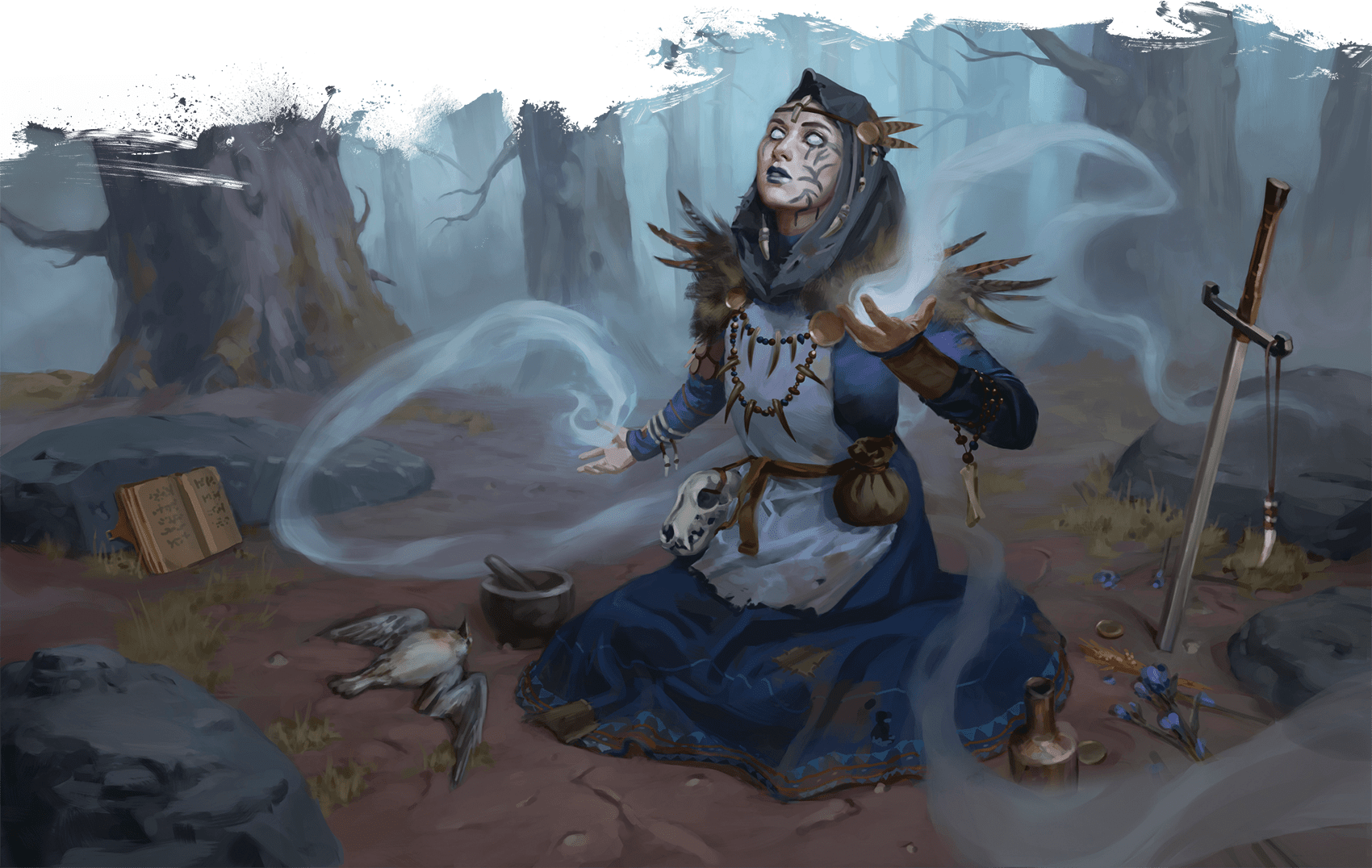
Wizard Subclasses

With the use of arcane magic becoming a taboo punishable by slow and painful death in certain parts of Etharis, Wizards have broadened the scope of their clandestine practices. Some have turned to unraveling the secrets of divinity, while others turned to more worldly magic, combining science and alchemy with the arcane to inflict and cure disease. Others have delved into even darker pursuits, becoming masters of blood magic.
Daemonologist
Steal Scraps of Divine and Infernal Power
Through theological study, or perhaps an induction into a secretive cabal, Daemonologists have learned to cast divine magic without the need for faith or bargains. Their spellbooks are scribed with prayer fragments and blasphemous hymns, enabling them to siphon scraps of power from both Arch Seraphs and Arch Daemons. From their heretical research, they’ve come to believe such otherworldly beings are two sides of the same divine kin.
Daemonology is rarely practiced. If the nature of their abilities is discovered, they risk being persecuted not only by superstitious folk but also by celestial and infernal powers.
Level 3: Fair and Foul
The spells listed below can be added to your spellbook for no cost when you reach the associated level.
Each time you finish a Long Rest, choose whether you are siphoning power from Arch Daemons or Arch Seraphs. Consult the table below that corresponds to your choice; you can prepare the spells listed for your Wizard level and lower, but you can’t prepare the ones for the opposite faction. For example, if you choose Arch Daemon as your siphoned power, you can’t prepare the spells listed in the Arch Seraph section.

| Arch Daemon | |
|---|---|
| Wizard Level | Spells |
| 3 | Bane, Toll the Dead |
| 5 | Fear |
| 7 | Dark Sacrament |
| 9 | Geas |
| Arch Seraph | |
|---|---|
| Wizard Level | Spells |
| 3 | Aid, Bless, Word of Radiance |
| 5 | Revivify |
| 7 | Guardian of Faith |
| 9 | Greater Restoration |
Level 3: Stolen Secrets
You have uncovered or stolen secret power from agents of the Arch Daemons and Arch Seraphs. You gain one Eldritch Invocation of your choice.
Prerequisites. If an invocation has a prerequisite, you must meet it to learn that invocation. If an invocation has a Warlock level prerequisite, you use your Wizard level instead. For example, if an invocation requires you to be a level 5+ Warlock, you can select the invocation once you reach Wizard level 5.
Replacing and Gaining Invocations. Whenever you gain a Wizard level, you can replace one of your invocations with another one for which you qualify. You can’t replace an invocation if it’s a prerequisite for another invocation that you have.
You gain an additional invocation when you reach Wizard levels 6 and 14.
You can’t pick the same invocation more than once unless its description says otherwise.
Intelligent Invocations. You can use your Intelligence modifier instead of your Charisma modifier for your invocations.
Level 6: Borrowed Tongues and Hides
Your ability to siphon power from Celestials and Fiends is enhanced. You gain the following benefits.
Arch Daemon Boon. While you are siphoning power from Arch Daemons, you have Resistance to Necrotic damage. In addition, Fiends that know languages can understand your speech and you can understand theirs, even if you do not share a language.
Arch Seraph Boon. While you are siphoning power from Arch Seraphs, you have Resistance to Radiant damage. In addition, Celestials that know languages can understand your speech and you can understand theirs, even if you do not share a language.
Switch Sides. As a Bonus Action, you can change which power you are siphoning from. Once you switch, you can’t do so again until you finish a Long Rest.
Level 10: Unearthly Countenance
As a Bonus Action, you adopt an infernal or celestial countenance for 10 minutes. For the duration, your appearance gains aspects of the power you choose. You gain the following benefits.
Commanding Presence. You have Advantage on Charisma checks.
Improved Spells. When you expend a spell slot to cast a spell from the Arch Daemon or Arch Seraph table, the spell is cast as if you had spent a spell slot of one level higher.
Unearthly Wings. You gain a Fly Speed of 60 feet.Once you use this feature, you can’t use it again until you finish a Long Rest. You can also restore your use of it by expending a level 5+ spell slot (no action required).
Level 14: Eternal War Eruption
You use the powers at your command to call forth warring celestials and infernals. As a Magic action, you summon a manifestation of the war between Arch Daemons and Arch Seraphs in a 30-foot-radius Sphere centered on a point within 120 feet of yourself.
Each creature in the Sphere must make a Charisma saving throw against your spell save DC. On a failed save, a creature takes 4d10 Necrotic damage, 4d10 Radiant damage, and has the Blinded condition until the end of its next turn. On a successful save, a creature takes half as much damage only.
As part of the same action, you can change the power you are siphoning from, and you also regain 1 Wizard spell slot of your choice of 5th level or lower.
Once you use this feature, you can’t use it again until you finish a Long Rest.
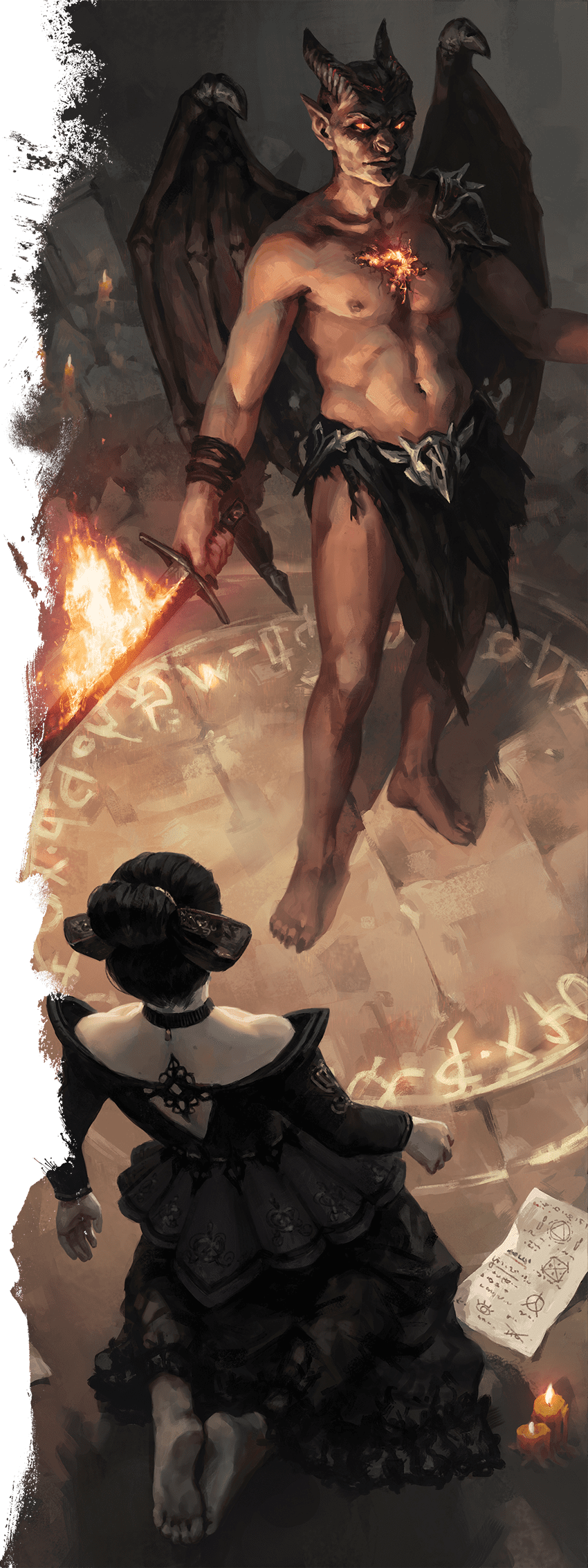
Plague Doctor
Plague Your Enemies with Magical Concoctions
Blending spellcasting with science, you distill your magic into concoctions that harm or heal. Plague Doctors often wear grotesque masks protecting them from their toxic ingredients. Many fearfully regard the mask as a sign of pestilence, making Plague Doctors a source of both hope and trepidation.
Level 3: Potion Craft
You gain proficiency in the Medicine skill and proficiency with the Herbalism Kit and Alchemist’s Supplies.
Additionally, you have learned to create magical potions.
Crafting. With 10 minutes of work or when you finish a Short or Long Rest, you can prepare magical potions if you have an Herbalism Kit or Alchemist’s Supplies. When you do so, you must expend a level 1+ spell slot for each potion you create and choose a spell from your spellbook that targets only one creature. The chosen spell must be of an equal or lower level than the expended spell slot.
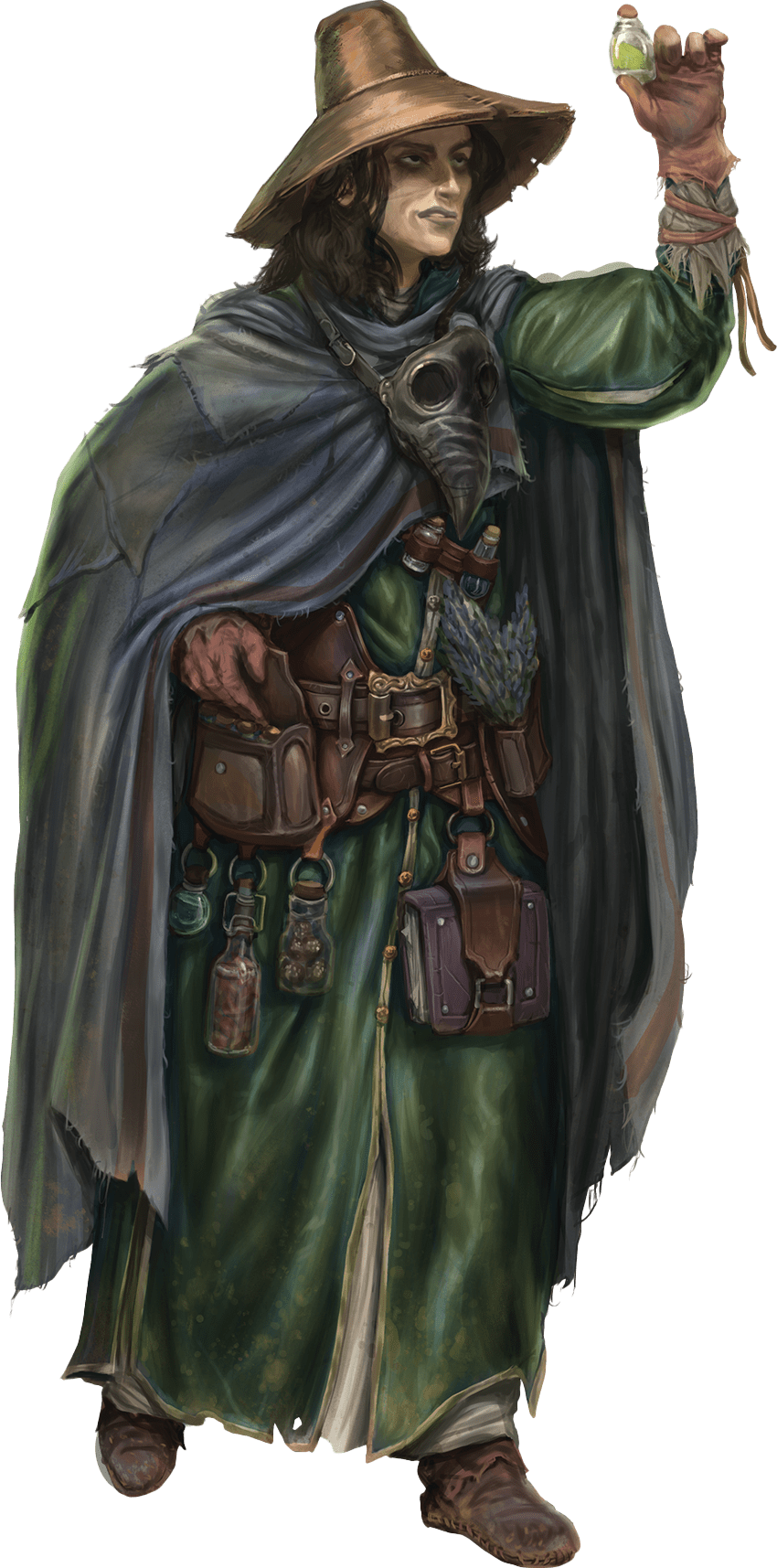
Consuming. As a Bonus Action, a creature can drink the potion or administer it to another creature within 5 feet of it. When a creature consumes the potion, it becomes the target of the spell as if you had cast it. If the spell requires Concentration, the creature that consumes the potion Concentrates on it.
Unconsumed potions last until you finish a Long Rest or until you use this feature again.
Level 3: Good Medicine
When you craft a potion, you can choose to expend a spell slot without choosing a spell to craft a dose of Good Medicine. As a Bonus Action, you can drink the dose or administer it to another creature within 5 feet of yourself. When Good Medicine is consumed, roll a number of d8s equal to the level of the spell slot expended, and the target regains Hit Points equal to the roll’s total. If you expended a level 3+ spell slot on this feature, Good Medicine also removes the Poisoned condition.
Level 6: Bad Medicine
When you craft a potion, you can choose to expend a spell slot without choosing a spell to craft a dose of Bad Medicine. When you create a dose, choose one effect per level of the spell slot expended.
- The creature has the Poisoned condition.
- The creature’s Speed is halved.
- The creature takes an extra 1d4 Necrotic damage the first time it takes damage each turn.
- The creature takes 1d6 Poison damage each time it takes an action, Bonus Action, or Reaction.
- The creature takes Acid damage equal to the level of the spell slot expended at the start of each of its turns.
As a Magic action, you can hurl a dose of Bad Medicine at a point you can see within 30 feet. Creatures within 10 feet of that point must make a Constitution saving throw against your spell save DC. On a failed save, the target suffers one of the chosen effects for 1 minute. On each of its turns, the target can take an action and repeat the save, ending the effect on itself on a success.
Level 10: Breathe It In
Being persistently exposed to the deadliest ailments known has given you some small measure of resistance. After you take Necrotic or Poison damage, you gain Temporary Hit Points equal to the damage taken. In addition, you are immune to the Poisoned condition.
Level 14: Medicinal Master
When Good Medicine restores Hit Points to a creature, that creature regains 2d8 additional Hit Points.
When Bad Medicine deals Acid damage to a creature, that creature takes 2d8 extra Acid damage. Additionally, target creatures have Disadvantage on their saving throw.
It’s amazing what one can manage with just a few herbs and decades of intense singleminded study.
— Tawnybruck Malore, Master Physician
Sangromancer
Spill Blood for Power
You study an uncommon school of magic known as Sangromancy or blood magic. Despite its dark reputation, there’s nothing inherently evil about the practice of Sangromancy, though its demands on its practitioners are gruesome. As a Sangromancer, your chosen magic demands more than knowledge: it demands sacrifice. Other Wizards may view you with skepticism or even outright hostility, but none can deny the potency of your art.
Level 3: Sangromancy Savant
Sangromancy spells count as Wizard spells for you. Choose two Sangromancy spells, each of which must be no higher than level 2, and add them to your spellbook for free.
In addition, whenever you gain access to a new level of spell slots in this class, you can add one Sangromancy spell to your spellbook for free. The chosen spell must be of a level for which you have spell slots.
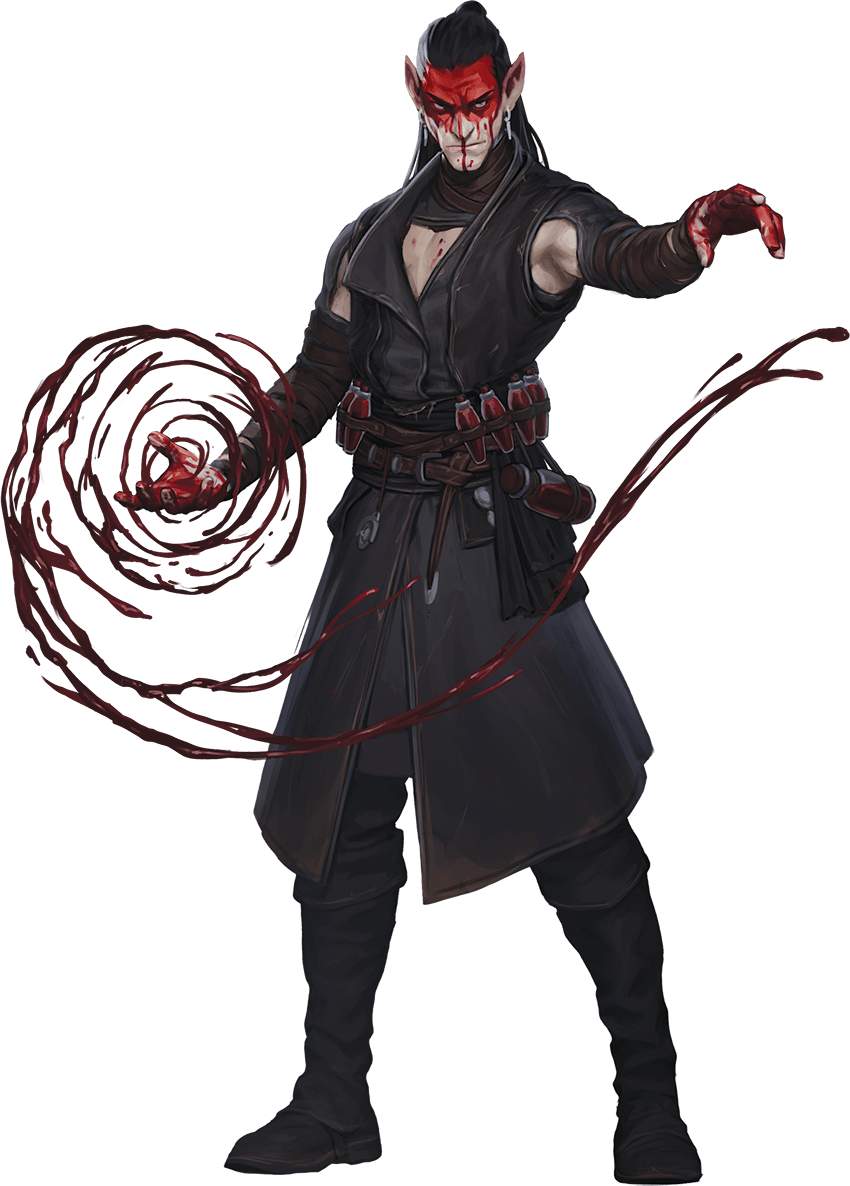
Level 3: Full-Blooded
You draw magic from blood. It is represented by your Sangromancy Dice, which fuel powers you have from this subclass. You have a pool of d12s that you can expend instead of a Hit Die when you cast Sangromancy spells. The number of dice in the pool equals 1 plus your Wizard level. You regain one expended Sangromancy Die when you finish a Short Rest, and you regain all expended Sangromancy Dice when you finish a Long Rest.
Level 6: Sanguine Vigor
Your Hit Point maximum increases by 6, and it increases by 1 whenever you gain another Wizard level. In addition, whenever you cast a Sangromancy spell with a spell slot, you regain Hit Points equal to the level of the spell slot.
Level 10: Blood for Blood
Once on each of your turns when you deal damage to one or more creatures with a Wizard spell you cast, you can spend a Hit Point Die or a Sangromancy Die, roll the die, and deal extra damage to one of those creatures equal to the roll. If the creature is Bloodied, you can roll twice and use the higher of the two rolls.
Level 14: Red Renewal
When you finish a Short Rest, you regain expended Hit Point Dice and Sangromancy Dice equal to half your Wizard level.
Once you use this feature, you can’t use it again until you finish a Long Rest.

Remember, you only have so much blood to use. Your opponents, on the other hand…
—The Red Book of Sangromancy
Comments