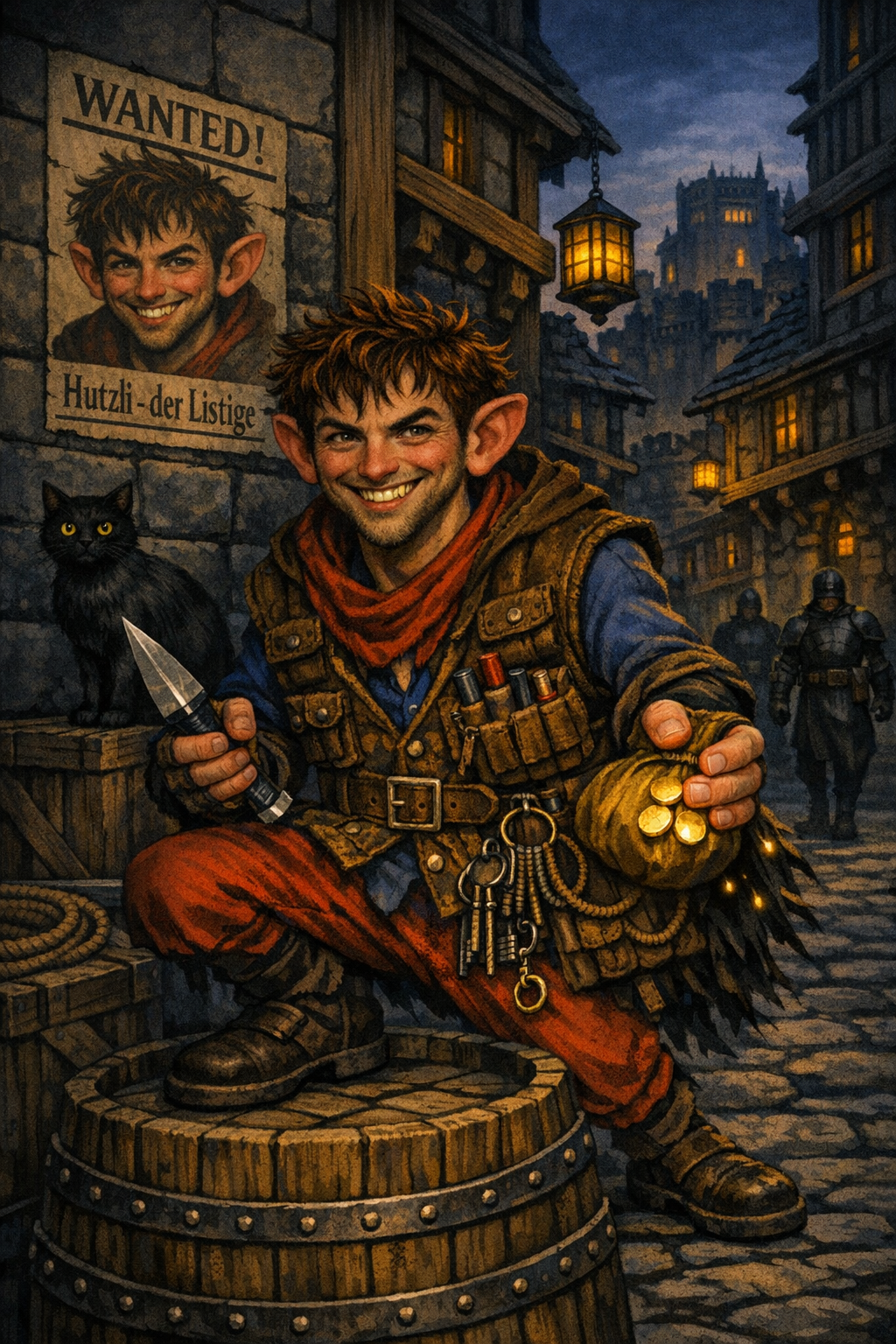
Hutzli - der Listige
(Halfling • Rogue • Criminal • Chaotic Good)
Description
Hutzliputzli—usually just “Hutzli,” and occasionally “der Listige” when he’s feeling theatrical—is a 34-year-old lightfoot halfling rogue with a round, freckled face, curly red-brown hair, and a grin that arrives before he does. His clothes look one size too big on purpose: a brown vest heavy with suspicious pockets over a blue shirt and red trousers, all arranged to make him seem harmless while his hands are already working. A single gold tooth flashes when he laughs, “found,” he insists, not stolen. He speaks quickly, a lot and can pivot in a heartbeat from wide-eyed innocence to indignant outrage, punctuating every sentence with gestures meant to distract the eye from whatever matters. Small, fast, and perpetually underestimated, Hutzli lives by charm, timing, and the famous luck of his folk—and he uses all three like blades when steel would be too loud.
Complete Backstory
Hutzli was born in Niederfeld, a sleepy halfling village where the pumpkin soup is famous, the hedges are trimmed, and news travels faster than feet. In a place where everyone knows everyone, privacy is a rumor—and for Hutzli, that closeness always felt like a latch on the door. He was raised mostly by his grandmother, Pippa: strict, warm at heart, and wary in the way of someone who has learned that smiles can hide knives. She taught him his letters and tried to steer him toward a quiet, respectable life. Hutzli gave the idea an honest attempt- briefly.
When he was nine, he stole the mayor’s seal chain and returned it without anyone noticing. He didn’t do it for money or malice; he did it to answer a single question: Can I? The answer thrilled him. After that, rules stopped feeling like boundaries and more like puzzles. His three older sisters grew into respectable lives with respectable spouses, and their disappointment in him became a steady background noise. A cousin who rose into local politics eventually decided the easiest way to manage Hutzli was to pretend he had never existed at all.
His real education waited beyond Niederfeld’s neat lanes. Pippa gave him reading and writing, the road gave him everything else. Traders, cardsharps, and petty swindlers taught him which laughs were sincere and which were bait. The one who mattered most was a thief known as “der lange Vitus,” who trained Hutzli in the old craft: how to listen without being seen, how to grab something without being suspected, and how to pick locks and disarm traps. Under Vitus, Hutzli learned thievery the way other halflings learn baking: patiently, daily, and with a quiet pride.
Talent draws attention, and attention draws offers. As a young adult, Hutzli was taken in by the Gilded Gallows, a thieves’ guild growing bold enough to spread its reach up and down The Sword Coast. Among the Gallows he refined the essentials: deception to talk his way out of trouble he absolutely caused, stealth to avoid the trouble he couldn’t, and thieves’ tools to make doors, chests, and promises give way. Somewhere in that underworld education he also picked up Goblin—partly because it was useful, partly because it bothered exactly the right people.
Then came the mistake that turned “restless” into “gone.” Hutzli opened the wrong crate from the wrong merchant. What was inside, he still won’t say—because he doesn’t want to, because he can’t, or because he truly never learned. What he does know is that three armed strangers began asking for him by name, and they never stopped. With Niederfeld suddenly too small to breathe in and the road behind him full of footsteps, Hutzli chose distance. When the Gilded Gallows pushed their expansion toward Neverwinter, he followed the guild’s shadowed path, telling himself that a bigger city meant bigger chances…and better hiding places.
Neverwinter treated him well—just not in the way he’d imagined. The coin was steady but never life-changing, and the richest thing he acquired was information: overheard conversations, crooked smiles across dice tables he “usually” won fairly, and the kind of friendships that only survive if both sides keep certain truths unspoken. He also learned where his line was. Hutzli is chaotic good in the most inconvenient way: he will steal without blinking, but cruelty—especially from guards, officials, toll collectors, and smug councillors—hooks his conscience and won’t let go. He offers his prayers to Avandra, goddess of luck and freedom, not with solemn ceremony but with a quick murmur right before he does something reckless.
For all the jokes, Hutzli carries a private weight. At twenty-eight, his favourite tavern burned to the ground because he forgot a candle. Three families were left without a home. No one proved it was him. No one even suspects. That ought to feel like luck—but the secret lives behind his gold-toothed grin like smoke trapped in a sealed room. He can laugh his way past most things. He cannot laugh his way past the fire.
He keeps his circle small and loud. His closest friend is Marga, a dwarven smith who believes none of his stories and still chooses to travel with him—proof, Hutzli claims, that dwarves have excellent judgment. His favorite rival is the elf Caeloril, who insists he’s the better thief (a claim Hutzli treats as a public service announcement). Hutzli has never married; he was once engaged for exactly three days before his fiancée kept the ring and he kept the lesson. And beneath all the swagger sits an absurd truth he guards like a crown jewel: Hutzli cannot swim.
Personal Goal
In Neverwinter, Hutzli heard the story that won’t let him sleep: a high-ranking member of the Gilded Gallows turned traitor, murdered their own partner, and vanished with a sovereign’s ransom. Most call it a tavern rumour. Hutzli has heard enough corroborating details to believe it’s real—and that the fortune is still out there, waiting for the right hands (preferably his) to find it.
The trail went cold, then warmed again with one name: Dragon’s Rest, a remote island cloister that holds a temple to Bahamut—patron of heroes and champion of justice—and a community of hermits, exactly the sort of place someone might flee to in order to bury a past. If the traitor is hiding there, Hutzli wants answers and maybe his head.





Social