
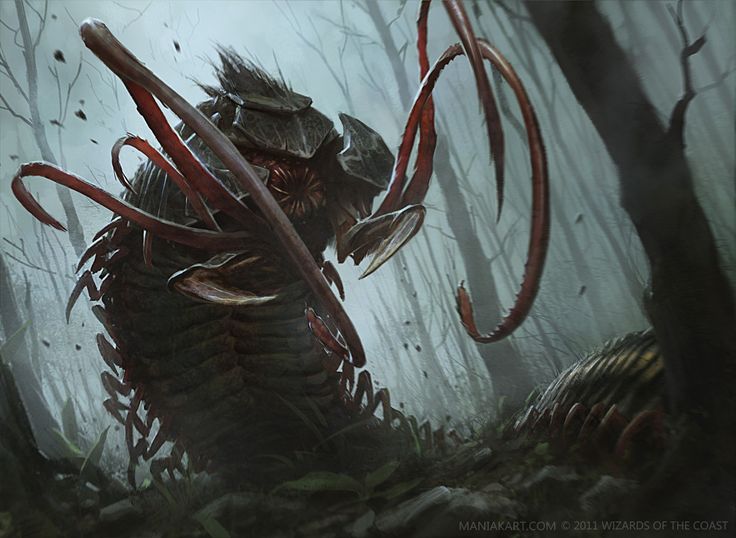
The Rift-Gnawer
The Rift-Gnawer CR: 8
STR
20 +5
DEX
14 +2
CON
18 +4
INT
3 -4
WIS
14 +2
CHA
6 -2
Greyfold-Bound Bulk: While the Rift-Gnawer is in contact with stone or greyfold, it has advantage on Strength checks and saving throws, and cannot be knocked prone.
Tunnel Destabilizer: Whenever the Rift-Gnawer burrows through stone or a constructed surface, the ground or structure in a 10-foot radius behind it becomes unstable difficult terrain. A creature that ends its turn in this terrain must succeed on a DC 15 Dexterity saving throw or fall prone as cracks spread beneath it.
Consume Foundation: The Rift-Gnawer deals double damage to objects and structures. When it reduces a load-bearing object (such as a pillar, arch, or support beam) to 0 hit points, the GM may trigger a localized collapse (Dexterity save vs. falling rubble and shifting terrain).
Greyfold-Swallow: If the Rift-Gnawer is reduced to 0 hit points while in contact with stone, it burrows into the ground instead of dying, vanishing in a cascade of rubble. It returns 1d4 rounds later from another surface within 60 feet at half hit points, as if the greyfold itself refused to release it. Once it is defeated again, the Rift-Gnawer erodes into a large pile of stone, soil, and eldritch flesh and is defeated.
Actions
Multiattack: The Rift-Gnawer makes two Foundation Bite attacks or one Foundation Bite and one Shard-Hook Rake.
Foundation Bite: Melee Weapon Attack: +9 to hit, reach 10 ft., one target or structure. Hit: 21 (3d10 + 5) piercing damage plus 7 (2d6) thunder damag.
If the target is standing on stone or a constructed floor, it must succeed on a DC 16 Strength saving throw or be knocked 5 feet and staggered, reducing its speed by 10 feet until the end of its next turn.
Shard-Hook Rake: Melee Weapon Attack: +9 to hit, reach 5 ft., one target. Hit: 16 (2d10 + 5) slashing damage. If the target is wearing metal or stone armor, cracks spread through it, weakening it. Unless the armor is magically enchanted, it's effective AC is reduced by 1 per hit. If the total bonus from the armor is reduced to 0, the armor is ruptured and provides no benefit.
Shard Burst (Recharge 5–6 on a D6): The Rift-Gnawer contracts and snaps its plates outward, releasing a blast of obsidian splinters. Each creature within 15 feet must make a DC 16 Dexterity saving throw, taking 27 (6d8) piercing damage on a failure, or half as much on a success. In addition, if the creature fails, they begin to bleed, taking an additional 2d6 damage at the start of each of the creature's turns. A healing spell of 2nd level or higher, or a successful medicine check (DC 16) will negate the bleeding affect.
Bonus Actions
Burrow Slip: If the Rift-Gnawer starts its turn adjacent to stone or greyfold, it may burrow up to half its burrow speed without provoking opportunity attacks.
Reactions
Seismic Recoil: When the Rift-Gnawer takes 20 or more damage from a single melee attack while touching stone, it may force the attacker to make a DC 15 Dexterity saving throw or be knocked prone as the Rift-Gnawer forces the ground under the attacker to buck upward.
Sample Lair Description
The tunnel opens into a cavern that was once a hall — you can still see the ghosts of architecture clinging to the stone. Half-collapsed arches lean at crooked angles, their carved faces worn down to featureless masks of dust. Pillars bow inward like exhausted giants, each one scored with long, gouged bite-marks where something has chewed the stone itself. The ground underfoot feels wrongly soft. Hairline fractures spread in fractal webs across the floor, and with every step you hear a faint grinding from below — as if the cavern is holding its breath. Powdered stone hangs in the air like pale fog, carrying the dry, metallic taste of eroded memory. Along the far wall yawns a jagged burrow-mouth, its edges smoothed to glass by repeated passage. The rock around it pulses faintly with a dull violet sheen, the same color glimmering in scattered shards half-buried in the rubble. Here and there, you spot the remnants of the world that once stood above: a collapsed staircase that leads nowhere, a cracked relief depicting forgotten figures, a toppled column carved with words that end abruptly where they’ve been gnawed away. Every few heartbeats, a low tremor rolls through the chamber. Dust drifts from the ceiling in slow, deliberate curtains, and one of the leaning pillars creaks — not from age, but from anticipation. Somewhere in the stone, deeper than sight or sound, you feel the suggestion of weight shifting… as if the greyfold itself is listening, and deciding what — or who — belongs here.Usual Tactics
Rift-Gnawers approach encounters with the same focus they show toward structures: they prioritize the environment over individual opponents. When threatened, they attempt to reposition themselves near pillars, archways, bridges, or unstable floors, then attack those features first to create hazards that limit movement and split groups apart. The creature rarely pursues fleeing targets across open ground. Instead, it prefers to reshape the battlefield — collapsing supports, undermining floors, and forcing enemies to fight while balancing on shifting rubble or fractured terrain. It uses its bulk to block exits, funnels prey into narrow passages, and retreats into stone whenever it needs to reposition or avoid concentrated attacks. Direct aggression is usually a secondary behavior. The Rift-Gnawer strikes at creatures only when they interfere with its work, when they are forced into a fall or a confined space, or when a target becomes trapped near a structural weakness it has created. In most encounters, the danger comes less from the Rift-Gnawer’s teeth than from the environmental failures it deliberately triggers.
Description
Rift-Gnawers move like collapsed architecture that learned how to crawl. Their bodies resemble enormous stone-plated centipedes, but every segment looks less like chitin and more like basalt masonry, fitted together with hair-thin seams that glow faintly with buried violet light. When they flex, the seams pulse like living fault-lines, as though tectonic pressure is breathing through them. Their heads are wedge-shaped and brutally angular, with mandibles that look like jagged demolition tools—chisel-blades and crushing clamps capable of biting through pillars, carved walls, and foundation stone. Where eyes should be, they have smooth glassy hollows, reflecting the world in warped, downward-dragged distortions. As they gnaw, bits of powdered stone drift from their jaws like gray snowfall, thick with the metallic taste of old dust and eroded history. Down the length of their underside, dozens of articulated legs end in obsidian hooks that leave gouged crescents in whatever surface they cross. Each step produces a dull, resonant thud — not quite a footfall, not quite a tremor — as if the cavern itself is reacting to their movement. When they burrow, their bodies ripple with unnatural grace, vanishing into rock as though slipping through softened stone instead of digging through it. Up close, the air around a Rift-Gnawer feels heavier, humid with mineral scent and the faint echo of grinding greyfold. They carry with them a sense that walls remember pain — and that every structure nearby is suddenly aware it was always meant to fall.Lore and History
Rift-Gnawers are widely recorded as subterranean aberrations that appear near fault-lines, aging foundations, and collapsing stoneworks — but among scholars of the Grimreach, they are believed to be something more than animals. Many texts describe them as expressions of Bel’Thazorn’s will, shaped by the pressures and fractures that run through the world’s buried places. Where stone strains under weight or memory, Rift-Gnawers emerge as if drawn by an unseen calling.
Writings recovered from cult sites claim the creatures are born from “the ribs of the world” — fragments of stone near the god-thing’s prison-heart that cracked, softened, and learned to move. Their behavior mirrors the core doctrines of Bel’Thazorn’s followers: they ignore living beings unless threatened and instead focus compulsively on supports, arches, carved reliefs, and walls etched with history. To the faithful, this is not random destruction, but a sacred act of erasure — the undoing of meaning imposed upon stone.
Members of the Abyssal Choir record sightings of Rift-Gnawers as omens, claiming their presence marks a place where the world is “remembering its original shape.” The Wardens of the Rift-Band, by contrast, regard them as a warning sign: where a Rift-Gnawer lingers, Bel’Thazorn’s influence is close enough to breach through matter.
According to deeper lore, the dust left behind by their feeding — the so-called Memory Dust — carries echoes of erased carvings and collapsed history. Some archivists believe this is accidental residue of structural collapse; others insist it is deliberate, a byproduct of a process meant to loosen the past from the world.

Comments