
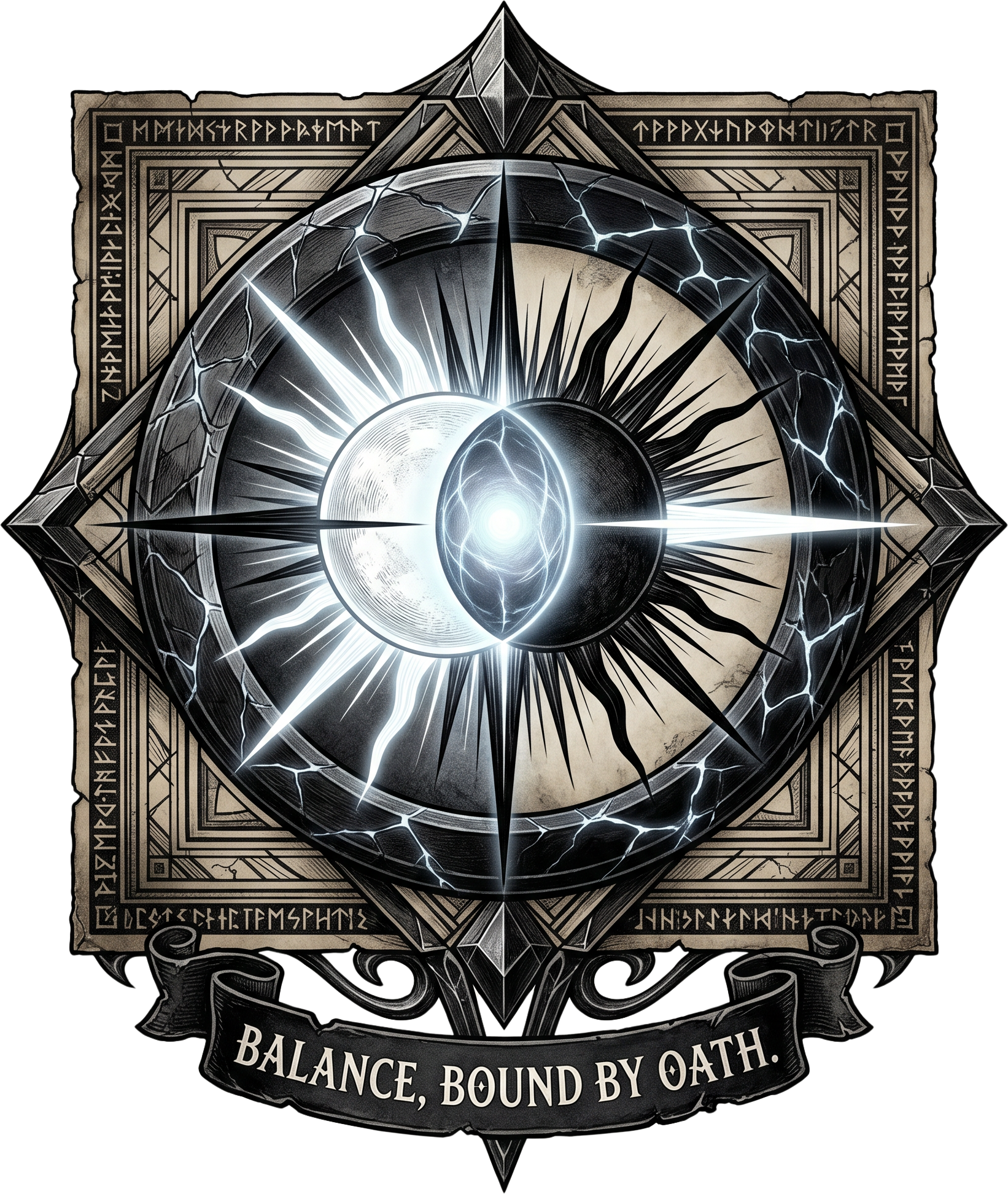
Undying Pact
Overview
The Undying Pact is not a guild. They have never claimed to be one, and they have refused every opportunity to become one. They are the first and only collective to formally sever ties with the Guilds Council of Overcity, and what drove them out, they will not fully say. What they built in leaving is not a faction in the usual sense. It is a union bound not by shared heritage, culture, or cause, but by oath; cold, precise, spirit-marked, and ruthlessly fair. Those who hold its marks are held by them in return. There is no room within the Pact for halfway answers. What is pledged, is pledged. To outsiders, they are often misread as rebels or exiles. They are neither. They are something the rest of Vesperfall has not yet found a comfortable name for.
Purpose & Beliefs
The Undying Pact do not claim to serve a cause higher than themselves. They do not pretend to speak for the land, or the divine, or the common people. What they serve is the oath, and what the oath serves is balance; not the gentle kind, but the kind enforced by contract, witnessed by spirit, and paid in full regardless of who comes to collect. They believe the world is being steered in a direction that should not be traveled. They do not say by whom, or toward what. They say only that they are not wrong. They believe: An oath taken is an oath held, across life and whatever follows
Power is not inherited; it is claimed, and then proven
Fairness is not kindness; it is the refusal to lie about the cost
Balance was always meant to be kept; someone has to keep it
Where other orders offer loyalty or faith, the Pact offers a binding. What is given to them is returned in kind. What is owed to them, they collect.
History & Founding
The Undying Pact formed when its founders could no longer reconcile what they saw with what they were told. They were members of the council, of the guilds, of the established orders. Then they were not. They did not leave loudly. They did not leave with grievance. They left with quiet certainty, and they took with them what they had learned; of the council, of its silences, of the directions it was beginning to choose. What they built in the aftermath was not a replacement for what they had left. It was an alternative to it, and a correction. The exact circumstances of their founding are not shared. Even among the Pact, the telling is measured. What is clear is that their departure was permanent, their reasons were sound, and their continued existence is a kind of testimony that none of the remaining guilds have entirely been able to answer.
Structure & Ranks
The Pact is built on a system of threes. Where other orders divide by rank alone, the Pact divides first by purpose; three branches, each representing one face of the balance the Pact exists to hold.
The Three Branches
Sun ; "Of the Light"
The Sun branch carries the Pact's forward edge. These are the voices that speak plainly, the hands that act openly, and the minds that think in terms of direct purpose. They are the Pact's strength when strength must be shown. In temperament, they lean toward action, protection, and confrontation; though always in service of the Pact's broader goal, not personal ambition.
Moon ; "Of the Night"
The Moon branch moves where the Sun does not reach. Quiet, patient, and precise, they handle the work that requires shadow; intelligence, subtlety, and the kind of protection that is never acknowledged aloud. They are not the Sun's opposite. They are its complement. What the Sun illuminates, the Moon watches from the edges.
Planet ; "Of Balance"
The Planet branch exists to hold the other two together. They are the voices of common ground, the ones who listen to both Light and Night and find the thread that connects them. In council, they bridge. In conflict, they mediate. In decisions that could tear the Pact apart, they are the reason it does not. Without the Planet, the Sun and Moon would drift into opposition. The Pact's founders understood this, and built accordingly.
Ranks Within Each Branch
Each branch holds three tiers of rank. The titles differ between branches, but the function mirrors across all three:
First Rank ; The Nine (3 per branch)
Sun: Prominence
Moon: Luminance
Planet: Equipoise
These are the sharpest and most proven members of the Pact. They take action upon the world, plan in secrecy, and carry the full weight of the Pact's purpose. Nine individuals across the three branches. When the largest decisions have been heard by all and deliberation is needed, these nine hold final council together.
Second Rank ; The Eighteen (6 per branch)
Sun: Flare
Moon: Selene
Planet: Axis
Intelligence, agency, and protection. The second rank handles the Pact's operational reach; carrying out the plans the first rank sets in motion, managing the networks and resources that keep the Pact alive, and serving as the bridge between leadership and the broader membership. They are brought into council when matters grow beyond the everyday.
Third Rank ; The Twenty-Seven (9 per branch)
Sun: Core
Moon: Regolith
Planet: Axle
The daily life of the Pact runs through its third rank. These are the members who operate the everyday; maintaining Nuesch Erasmus, handling trade and supply, tending to the practical demands of keeping a hidden collective alive. From each group of nine, one is chosen to speak, to represent, to carry the voice of their branch's foundation into any gathering that calls for it.
The Balance in Practice
All attend in decisions. All hold equal weight. The three branches do not compete; they counterbalance. No branch outranks another. No voice is dismissed because of which branch carries it. The system exists not to divide the Pact but to ensure that every decision is seen from three angles before it is made. Rank is earned, never given, and can be lost. Those who vote against what the collective has decided, who act against the Pact's purpose, or who fail to hold themselves above board in their actions may be removed from their position. Even those who mean well but act without transparency may find their rank reconsidered. The Pact does not punish failure. It removes imbalance. A member may hold rank in one branch for life, or may move between branches as they grow. The Sun, the Moon, and the Planet call to each person differently, and what calls to you at twenty may not be what calls at fifty. There is always a place for someone who has found their balance; and if your balance shifts, the Pact shifts with you.
Recruitment & Entry
The Pact does not recruit. They do not advertise, they do not send envoys, and they do not make promises to those who have not yet earned the right to hear them. Those who seek the Pact do so on rumor alone. The path to Nuesch Erasmus is not marked, and the valley that holds it is not easy to find. But those who search with genuine purpose tend to arrive, eventually; and many are tested long before they know they are being watched. The journey itself is the first measure. To reach the castle means you have already passed. What follows is quieter than most expect. A conversation. A shared meal. A discussion of common goals and what the seeker believes the world owes itself. No ceremony. No ritual of blood or binding; not yet. New members are introduced to all three branches before choosing one. They spend time with the Sun, the Moon, and the Planet, learning what each represents and how each operates. Some know immediately where they belong. Others need the full introduction before the answer becomes clear. The Pact asks only that you finish the process before deciding. Once a branch is chosen, the oath is taken. The oath is the same for all; Sun, Moon, and Planet alike. The spirit-marked contract binds equally, regardless of which face of balance you serve. What differs between branches is not the commitment. It is how that commitment is carried.
Culture & Identity
Life within the Pact is measured. Not cold, though it is often mistaken for cold. Members move through their obligations with the kind of care that comes from knowing exactly what has been promised, to whom, and for how long. The three branches lend the Pact a subtle internal texture that outsiders rarely see. Sun members tend toward directness; they say what they mean and expect the same in return. Moon members carry themselves with a quieter discipline, comfortable in patience and observation. Planet members are the connectors, often the ones smoothing a conversation that the other two branches have sharpened. These are tendencies, not rules. The branches shape culture the way a river shapes a valley; slowly, over time, and never the same way twice. A Sun member may be the quietest person in a room. A Moon member may be the loudest. What matters is not how they carry themselves, but where their purpose sits. There is no pageantry among the Pact. No banners carried for show, no ceremonies staged for witnesses. What they do, they do for the terms of the oath, and the terms of the oath are enough.
Strongholds & Territory
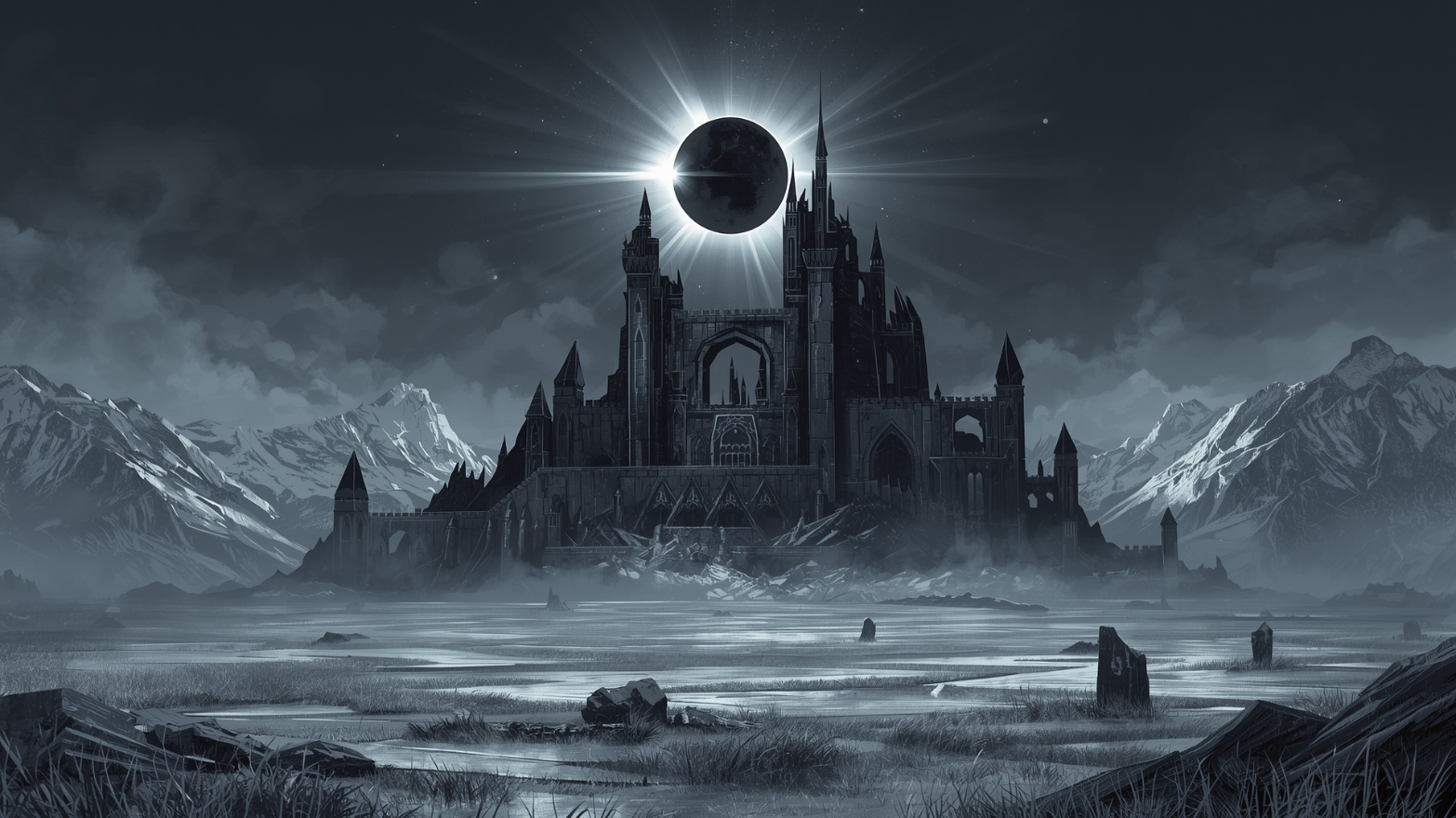
The Pact's seat is Nuesch Erasmus; a castle and surrounding settlement hidden deep within a serene mountain valley in the southwest. The valley itself is striking: alpine peaks rising on all sides, dense forest and clear water filling the basin between them, the kind of landscape that looks as though it was placed there deliberately by something older than any order. The castle is large, built with defense and quick departure in mind. Its architecture echoes the Pact's own nature; severe, functional, and unadorned, but solid enough to outlast anything thrown against it. The surrounding buildings sit within the valley floor, cleared only where necessary. The Pact took what the land offered and built in balance with it, not against it. Nuesch Erasmus is not a city. It is a stronghold that happens to house a community. The distinction matters to those who live there. Beyond the valley, the Pact's presence is felt more than seen. They maintain contacts, safe houses, and quiet relationships across Vesperfall, but they do not claim territory beyond what they hold. Their map footprint is small. Their reach is not.
Combat & Methodology
The Pact do not seek conflict, but they do not avoid it. When oath requires enforcement, they enforce it. When oath requires defense, they defend it. The distinction between the two, to them, is not always meaningful. The three-branch structure carries into how the Pact handles conflict: Sun provides direct engagement; the visible hand, the open confrontation when confrontation is required
Moon provides intelligence, preparation, and the work that happens before and after the visible action
Planet coordinates between the two, ensuring that what the Sun strikes and what the Moon prepared are aligned in purpose
Their methods favor: Precision and economy over overwhelming force
Binding magic woven with traditional combat
Debts collected exactly, without interest or excess
The willingness to finish what has been promised, however long it takes
They are not large in number. They have never needed to be. What the Pact take on, they take on with the understanding that it will be completed, and those who stand against a Pact in full obligation tend to learn this in ways they do not soon forget.
Role in the World
The Undying Pact occupy an unusual position in Vesperfall. They hold no seat on the council, answer to no higher authority, and claim no territory beyond what they have quietly taken and kept. To the council, they are an irritation; a reminder that the structures of Vesperfall are not as complete as the council prefers to believe. To the common people, they are a rumor; invoked when a contract absolutely must hold, or avoided when the cost of that holding seems too high. To those who know the world is turning wrong, they are something closer to an early warning; a collective that saw what was coming, and made their position clear before most had begun to look.
The Unknown Castle of Neusch Erasmus

Comments