
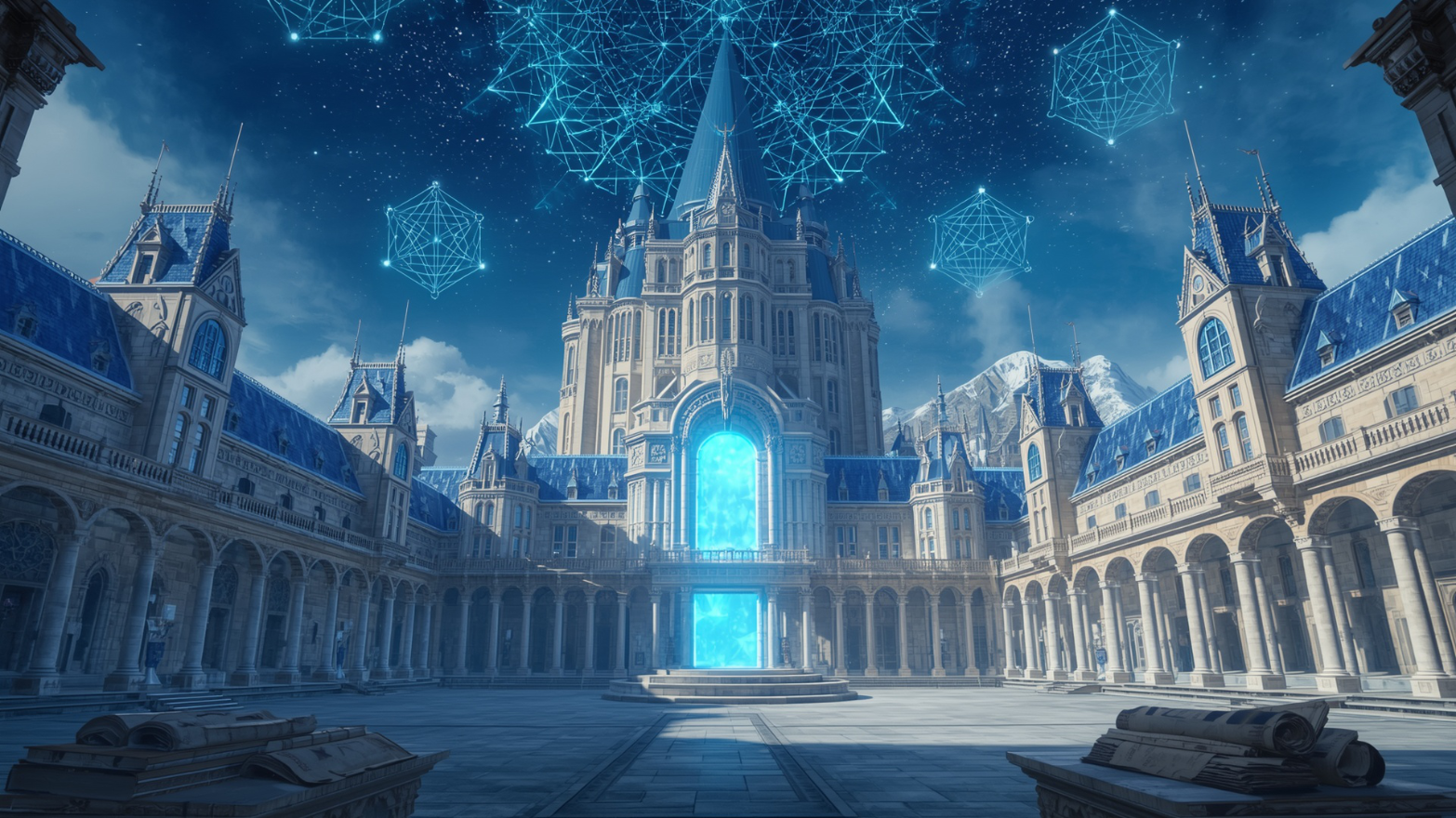
Aetherial Enforcers
Overview
The Aetherial Enforcers are the keepers of Vesperfall's written record, its formalized law, and the long scholarly traditions that predate most of the current orders. They are the measured left hand of the continent's order; the counterpart to the Dawnsteel Legion's more visible enforcement, and the reason so many of the laws the Legion upholds are laws at all. Where most factions define themselves by action, the Enforcers define themselves by study. Their halls are libraries. Their work is research, adjudication, and the careful preservation of knowledge across generations that have, more than once, tried to lose it. What they know has been earned. What they share has been decided. Scholars, judges, philosophers, and inventors fill their ranks. So do a great many Gravari; the long-lived tusked heritage whose patience and memory have made them the Enforcers' most enduring presence, and whose ivory has come to mark the order nearly as often as the books themselves.
Purpose & Beliefs
The Enforcers exist to safeguard knowledge, to uphold the ancient laws, and to preserve the relics and records that the rest of the continent has either forgotten or never known to keep. Their allegiance, as they have long declared, is to the peace of Vesperfall itself. Their relationship with the Angels is acknowledged, respected, and conducted on terms the Enforcers consider proper. Their approach to the divine is unusual among the orders. They do not worship. They study. What the Angels represent is, to the Enforcers, a subject; an immense and ongoing subject, approached with the same rigor the order applies to everything else it finds worth attention. The Enforcers believe: Knowledge is a trust held for those not yet born to need it
Law changes in its particulars, but not in what it remembers
Faith without study is belief looking for a mirror
What is preserved carefully will survive what is not
They are not warm about these beliefs. They hold them because they have tested them, and continue to test them, and the beliefs have continued to hold.
History & Founding
The Enforcers trace their origins to the early scholarly circles that gathered around the continent's first formal laws; those who recognized that law without memory was not law, and that memory without guardianship was not memory for long. What began as a small order of record-keepers expanded, over generations, into something considerably broader: an institution of scholars, jurists, inventors, and arcane practitioners whose collective work became inseparable from how the rest of Vesperfall understands itself. Many of the continent's statutes were written within their halls. Most of its relics pass through their care. A great deal of what is now considered common knowledge was, at some point, knowledge the Enforcers were the first to formalize. Their history is long. Their records of that history are considerably longer.
The Seven Pillars
The Enforcers organize their knowledge and practice into seven institutions, collectively known as the Pillars of Higher Law. Each Pillar is a school of study, a body of practitioners, and a philosophical position on what law, knowledge, and magic fundamentally are. Together they form the Academy of the Seven, housed within the city of Bodhi Avata. Each Pillar is led by a single Headmaster whose authority within their discipline is absolute. The law dictates. Rules rule. Not people. No Pillar is formally ranked above another, though in practice some carry more influence depending on the era and the questions being asked.
The Axiomatic Order
Focus: The fundamental laws of reality
The Axiomatic Order concerns itself with axioms; truths that cannot be broken, bent, or argued with. They define what is possible and what is not, establishing the boundaries within which all structured magic must operate. The Order does not study magic. It defines the rules magic must obey. Everything else the Enforcers do rests on the foundation the Axiomatic Order maintains.
The Calculus Arcanum
Focus: Mathematical magic
Spellcraft through formula, equation, and precision. The Calculus Arcanum treats magic as a system of inputs and outputs; energy balanced, costs calculated, efficiency perfected. Complex sigil geometry, structured casting sequences, and the relentless pursuit of precision define this Pillar's practitioners. Among the Calculus Arcanum, magic is not cast. It is solved.
The Tribunal of Binding
Focus: Law, contracts, and enforcement
The Tribunal handles the Enforcers' judicial function; magical law, oaths, bindings, and the enforcement of what the order considers universal law. When a binding is broken, the Tribunal determines consequence. When a violation occurs, the Tribunal does not debate it. It corrects it. Punishment, containment, and the execution of legal violations fall within the Tribunal's authority, and that authority is exercised without sentiment.
The Codex Mind
Focus: Logic, cognition, and mental discipline
The Codex Mind trains its practitioners to think with absolute clarity. Perfect recall, structured thought, the systematic removal of emotional interference from decision-making. Its methods are demanding and its results are measurable. A Codex Mind practitioner does not feel less than anyone else. They have simply learned to ensure that feeling does not dictate action. Emotion is noise. Thought must be clean.
The Continuum Archive
Focus: Time, causality, and sequence
The Continuum Archive studies the structure of time itself; not as a river to be navigated, but as an architecture to be understood. Cause and effect, the prevention of paradox, the recording of what must happen and what must not. Its practitioners are among the most careful in the Academy, because the consequences of carelessness in their discipline are not theoretical. Time is not a flow. It is a structure.
The Geometric Synod
Focus: Spatial law and structure
The Synod governs the Enforcers' understanding of space; dimensional alignment, teleportation precision, spatial anchoring, and the containment of things that should not move freely. Where the Continuum Archive concerns itself with when, the Geometric Synod concerns itself with where. Its practitioners ensure that the distances between things remain what they are supposed to be. Space is not empty. It is ordered.
The Null Chamber
Focus: Suppression, containment, and absolute control
The Null Chamber occupies the quietest and most unsettling corner of the Academy. Its practitioners study anti-magic; the suppression of wild or chaotic forces, the stabilizing power of nothingness, and the deliberate erasure of magical effects that have exceeded their intended scope. Where the other six Pillars build, define, and enforce, the Null Chamber exists for the moments when the only correct answer is silence. Where magic fails, truth remains.
Structure & Leadership
The Enforcers are governed by the seven Headmasters of the Pillars. Each Headmaster holds final authority within their own discipline; their word is law within their school, because the law itself is what they serve. Decisions that cross disciplines are deliberated among the Headmasters collectively, and deliberations can take considerable time. The Enforcers have rarely been rewarded for haste. No Headmaster outranks another by design. In practice, certain Pillars carry more weight depending on the matter at hand; the Tribunal speaks loudest on questions of enforcement, the Axiomatic Order on questions of foundational truth, the Null Chamber on questions no one else wants to answer. This informal influence shifts over time and is never formally acknowledged. Advancement within the order is earned through demonstrated competence, recorded contribution, and the long apprenticeship of practice. Titles are not inherited. Rank is not purchased. Those who attempt to move faster than the work allows are generally the ones who move slowest in the end. Membership is open to those who can demonstrate aptitude and commitment, though the demonstration is not brief.
Culture & Identity
Life within the Enforcers is ordered, scholarly, and exacting. Days are structured around study, adjudication, craft, and the teaching of those who will carry the work forward. Halls are quiet. Libraries are vast. Meals are taken with the same attention most orders reserve for ceremony. Among themselves, the Enforcers are not a warm order. Close friendships are uncommon. Trust is real but guarded, and tends to develop over decades rather than seasons. This is not taken as a flaw by those within. It is considered a reasonable cost of the work the order requires. The seven Pillars give the Academy an internal character that varies more than outsiders might expect. Calculus Arcanum practitioners tend toward precision in all things, including conversation. Codex Mind scholars can be difficult to read, by design. Null Chamber members are often avoided by their own colleagues, not out of dislike but out of a quiet discomfort that no one discusses openly. These differences do not divide the order. They texture it. The order's Gravari presence gives the Enforcers much of their distinctive cadence. Gravari lifespans stretch long, and their scholarship tends to move at the pace that lifespan allows. A Gravari scholar three tusk-curls into their studies is not to be hurried, and the Enforcers have built themselves around the understanding that this is a feature, not an inconvenience.
Strongholds & Territory
The Enforcers are headquartered in Bodhi Avata; a city of scholarship, law, and quiet authority in the northeastern reaches of Vesperfall. The city surrounds and serves the Academy of the Seven, which sits at its center like a spine the rest of the body has organized itself around. The architecture is cool, precise, and well-maintained. Great pale-stone halls serve as both library and fortress in roughly equal measure. Tall arched windows glow with the soft blue-white light of aetheric study. Archives extend beneath the visible structures to depths that are not discussed with visitors. The Academy's towers are crowned in royal blue, and on clear nights the geometric lattices of active study can be seen drifting in the air above them like luminous mathematics. Beyond Bodhi Avata, the Enforcers maintain outposts and representatives throughout Vesperfall; scholars on loan to other orders, jurists present where adjudication is needed, and keepers stationed wherever a relic or record requires careful hands. The Enforcers' reach is broad, though it is rarely loud.
Combat & Methodology
The Enforcers are not a martial order in the common sense, but they are not unprepared. Their mages are considerable, their arcane practitioners are experienced, and the tools of the order have been refined through long study of what the continent has thrown at them over the centuries. When the work calls for force, the order prefers: Prepared workings over improvised ones
Defensive craft that wears opponents down rather than engaging them head-on
Mage-lines that draw on the depth of arcane study the Enforcers have made their signature
The willingness to defer engagement until the timing is correct, regardless of how long correct takes
Each Pillar contributes differently. The Calculus Arcanum provides precision. The Tribunal of Binding provides enforcement authority. The Geometric Synod provides spatial control. The Null Chamber provides the option no one wants to use, and that no one wants used against them. Together, the Pillars fight the way they study; methodically, with overwhelming preparation, and with very little interest in being fair about it. They are, as a rule, underestimated by those whose impressions of the order have come from its public face alone. Those impressions have not historically held up well in practice.
Role in the World
The Enforcers hold a position of considerable standing within Vesperfall's formal structures. They sit on the council with consistent attendance. They arbitrate disputes that other orders are unwilling or unequipped to arbitrate. Their rulings carry weight. Their silences, when they offer them, carry almost as much. The Dawnsteel Legion, often referred to as the right hand of Vesperfall's order, operates with the Enforcers as counterpart more often than either institution would phrase it that way aloud. Where the Legion acts, the Enforcers frequently establish the framework within which that action is considered legitimate. The two orders have not always agreed. They have almost always remained in working proximity. To the common people, the Enforcers are respected more than they are known. Most citizens have never met one. Most citizens live under laws that the Enforcers helped to write.

The Academy of Bodhi Avata

Comments