

Warlock Homebrewed Class
Warlocks are scheming magic users who draw power from an otherworldly patron who bestows them with eldritch magic. Bound to their patrons through a pact or a deal, warlocks are unique for their special type of magic that is extremely potent, but are limited to only using this power in short bursts. Warlocks can channel their magic through their intelligence, from knowledge granted by their patron, or through their charisma, with their sly and devious allure, enhanced by their patron. Warlocks gain features that can shape and change their abilities to their own needs, which often leads to two warlocks never being the same.
A warlock often acts as their patron’s hand in the world. Through their gifts from their patrons, warlocks can fit any place in a party and draw from their potent magic to blast through their foes.
Quick Build:
You can make a warlock quickly by following these suggestions. First, Intelligence or Charisma should be your highest ability score, followed by Constitution, or Strength or Dexterity if you choose the Pact of the Blade. Second, choose an origin that increases your Intelligence or Charisma. Third, choose the Bone Chill cantrip, along with the following 1st-level spells: Bane, Charm Person, and Hex.
Pact Boon
You have struck a bargain with an otherworldly being chosen from the list of available patrons (as shown at the bottom of the page). Your otherworldly patron bestows upon you a gift to represent your pact and loyal service. You gain one of the following features of your choice, which determines the gift you receive.
Pact of the Blade
You can perform a special 1 hour ritual, which can be done during a short rest, to transform one weapon into your pact weapon. This special weapon is bonded to you and you are considered proficient with the weapon while bonded. The weapon counts as magical for the purpose of overcoming resistance and immunity to non-magical attacks and damage, if the weapon isn’t already magical. When you damage a creature with your pact weapon, you can add your Intelligence or Charisma modifier to the damage.
Your pact weapon disappears into an extradimensional space if it is more than 5 feet away from you for 1 minute or more. You can also dismiss the pact weapon into the extradimensional space, or cause it to return to your empty hand as a bonus action.
The weapon ceases being your pact weapon if you die, if you perform the 1-hour ritual on a different weapon, or if you use a 1-hour ritual to break your bond to it. The weapon appears at your feet if it is in the extradimensional space when the bond breaks.
Pact of the Chain
Your patron grants you the ability to summon an otherworldly creature to aid you. You learn the Find Familiar spell and can cast it as a ritual. This spell doesn’t count against your number of spells known, and when you cast this spell as a ritual, you can forgo the required material components.
When you cast the spell, you can choose one of the normal forms for your familiar or one of the following special forms: Faerie Dragon Familiar, Flameskull Familiar, Imp Familiar, Lantern Archon Familiar, Mephit Familiar, Pseudodragon Familiar, Quasit Familiar, Slaad Tadpole Familiar, or Sprite Familiar.
Additionally, you can telepathically communicate with your familiar at a range of 200ft instead of 100ft.
Pact of the Cloak
Your patron gives you a mystical cloak that protects you from harm. When you are hit with an attack, as a reaction your cloak swirls to protect you, granting you a +3 bonus to your AC and potentially causing the attack to miss. This bonus lasts until the start of your next turn.
If you lose the cloak, you can perform a 1-hour ceremony to receive a replacement from your patron. This ceremony can be performed during a short or long rest, and it destroys the previous one. The cloak turns to ash when you die. You can perform a ritual to convert one magical cloak or similar item into your pact cloak. You perform this special ritual while wearing this item over the course of 1 hour which can be done during a short rest.. The magic item loses your cloak properties if you die, if you perform the 1-hour ritual on a different magic item, or if you use a 1-hour ritual to break your bond to it.
Pact of the Crown
Your patron gives you a domineering crown that influences creatures around you. When you make a Charisma skill check to influence another creature, you can use this crown’s magic to add 1d6 to the check’s total. You can use this crown’s benefit a number of times equal to your Intelligence modifier or Charisma modifier, and regain all uses when you complete a long rest.
If you lose the crown, you can perform a 1-hour ceremony to receive a replacement from your patron. This ceremony can be performed during a short or long rest, and it destroys the previous one. The crown turns to ash when you die. You can perform a ritual to convert one magical piece of headgear to bear your crown on it. You perform this special ritual while wearing this headgear over the course of 1 hour which can be done during a short rest. The magic item loses your crown if you die, if you perform the 1-hour ritual on a different magic item, or if you use a 1-hour ritual to break your bond to it.
Pact of the Mark
Your patron gives you a magical symbol that takes the form of a tattoo or scar on your body. As a bonus action on your turn, you can use the symbol to curse an enemy within 30ft, causing the next attack roll it makes to have a -2 penalty to the attack roll. You can use this feature twice, and regain all expended uses when you complete a short or long rest.
Pact of the Relic
Your patron gives you an ancient relic that holds untold knowledge. This takes the form of a small or tiny object which you can fit in the palm of your hand. When you make an Intelligence skill check to learn or recall information, you can use this relic’s magic to add 1d6 to the check’s total. You can use this relic’s benefit a number of times equal to your Intelligence modifier or Charisma modifier, and regain all uses when you complete a long rest.
If you lose your ancient relic, you can perform a 1-hour ceremony to summon it back to your location. This ceremony can be performed during a short or long rest. The relic returns to your patron when you die.
Pact of the Tome
Your patron gives you a grimoire called a Book of Shadows. When you gain this feature, choose three cantrips from any class' spell list. The cantrips do not need to be from the same spell list. While the book is on your person, you can cast those cantrips at will. They don't count against your number of cantrips known. Any cantrip you cast with this feature is considered a warlock cantrip for you. If you lose your Book of Shadows, you can perform a 1-hour ceremony to receive a replacement from your patron. This ceremony can be performed during a short or long rest, and it destroys the previous book. The book turns to ash when you die.
Pact Magic
Your arcane research and the magic bestowed on you by your patron have given you facility with spells.
Cantrips
You know the Eldritch Blast cantrip, which doesn’t count against the number of cantrips you know, and one cantrip of your choice from the warlock spell list. You learn additional warlock cantrips of your choice at higher levels, learning another cantrip at 2nd level, another at 3rd level, another at 5th level, another at 10th level, and another at 16th level.
Spell Slots
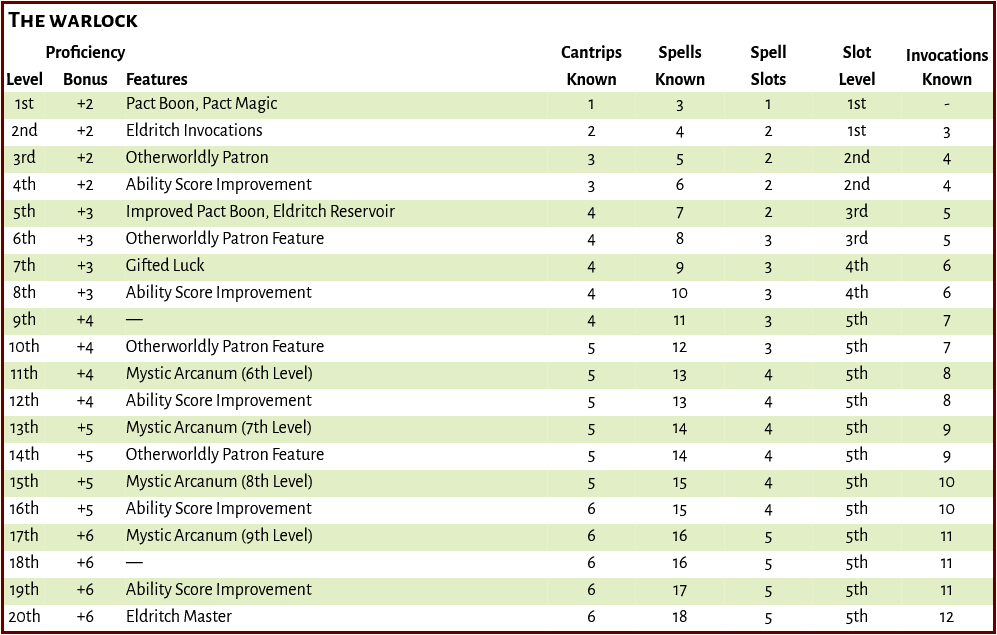
Your pact magic grants you spell slots which you have to cast your warlock spells of 1st through 5th level. These spell slots are different to the spell slots a character with the spellcasting feature would gain.
The Warlock table also shows what the level of those slots is; all of your spell slots are the same level. To cast one of your warlock spells of 1st level or higher, you must expend a spell slot. You regain all expended spell slots when you finish a short or long rest.
For example, when you are 5th level, you have two 3rd-level spell slots. To cast the 1st-level spell witch bolt, you must spend one of those slots, and you cast it as a 3rd-level spell.
Spells Known of 1st Level and Higher
At 1st level, you know three 1st-level spells of your choice from the warlock spell list.
The Spells Known column of the Warlock table shows when you learn more warlock spells of your choice of 1st level and higher. A spell you choose must be of a level no higher than what's shown in the table's Slot Level column for your level. When you reach 6th level, for example, you learn a new warlock spell, which can be 1st, 2nd, or 3rd level.
Additionally, when you gain a level in this class, you can choose one of the warlock spells you know and replace it with another spell from the warlock spell list, which also must be of a level for which you have spell slots.
Spellcasting Ability
Warlocks can vary in the spellcasting capabilities for their warlock spells. When you gain this feature, you must decide to use your Intelligence or Charisma to be your spellcasting ability. Whenever a spell or feature refers to your spellcasting ability, you use the ability you chose when you gained this feature. In addition, you use your spellcasting ability modifier when setting the saving throw DC for a warlock spell you cast and when making an attack roll with one.
Spell save DC = 8 + your proficiency bonus + your Intelligence modifier or Charisma modifier
Spell attack modifier = your proficiency bonus + your Intelligence modifier or Charisma modifier
Spellcasting Focus
You can use an arcane focus as a spellcasting focus for your warlock spells. If your warlock bears the Pact of the Blade, Pact of the Tome, Pact of the Cloak, Pact of the Crown, or Pact of the Relic, the gift your patron gives you from your pact can act as a spellcasting focus for you.
Eldritch Invocations
Starting at 2nd level, your study of occult lore has unearthed fragments of forbidden knowledge that imbue you with an abiding magical ability. You gain three eldritch invocations of your choice. When you gain certain warlock levels, you gain additional invocations of your choice, as shown in the Invocations Known column of the Warlock table.
Additionally, when you gain a level in this class, you can choose one of the invocations you know and replace it with another invocation that you could learn at that level.
If an eldritch invocation has prerequisites, you must meet them to learn it. You can learn the invocation at the same time that you meet its prerequisites. A level prerequisite refers to your level in this class.
Otherworldly Patron
Starting at 3rd level, your loyalty to your patron and mastery over your powers has allowed your patron to grant you additional power. Choose one of the available patrons from the list to represent the power you have been given. Your choice grants you features at 3rd level and again at 6th, 10th, and 14th level.
Improved Pact Boon
Beginning at 5th level, your patron rewards you with power that enhances the gift you were granted from the creation of your pact. You gain one of the following features, determined by which Pact Boon feature you chose:
Pact of the Blade
You can attack twice, instead of once, whenever you take the Attack action on your turn. Moreover, you can cast a cantrip with a casting time of an action in place of one of those attacks.
Pact of the Chain
When you cast Find Familiar, the familiar you cast is imbued with additional power, granting it the following benefits:
- Your familiar’s maximum hit points increases by an amount equal to 2 + your warlock level.
- Your familiar gains a bonus equal to half your proficiency bonus (rounded down) on all ability checks, attack rolls, saving throws, and its armour class.
Pact of the Cloak
While you wear your cloak granted by your pact, you have a +1 bonus to your AC.
Pact of the Crown
As a bonus action, you can use the otherworldly magic in the crown to charm a creature within 30 feet. The targeted creature must make a Wisdom saving throw against your Spell Save DC, and on a failed save, the creature becomes charmed by you. While charmed in this way, the creature adores you and sees you as a being of higher authority and power, and in combat, the creature will attempt to protect you from danger, however the creature will not willingly put itself in harm for you. This effect ends after 10 minutes, after the charmed creature takes damage, or after a creature uses an action to shake the charmed creature awake.
You can use this feature a number of times equal to your Intelligence modifier or Charisma modifier, and regain all expended uses when you complete a long rest.
Pact of the Mark
When you target a creature who is cursed by your mark with a spell that forces a saving throw, you can use the curse to cause the creature to have disadvantage on the saving throw against the spell. Once you use this benefit, you must complete a long rest before you can use this feature again.
Additionally, the attack roll penalty you apply on creatures increases to an amount equal to your proficiency bonus. For example, a proficiency bonus of +3, makes the penalty applied equal to -3.
Pact of the Relic
As a bonus action, you can use the hidden magic within the relic to reveal secrets to you. Choose one creature or object within 30 feet other than the relic, it must make an Intelligence saving throw against your Spell Save DC. On a failed saving throw, you learn one piece of useful information or a secret about the creature or object.
You can use this magic a number of times equal to your Intelligence modifier or Charisma modifier, and regain all expended uses when you complete a long rest.
Pact of the Tome
You can now inscribe magical rituals in your Book of Shadows. Choose two 1st-level spells that have the ritual tag from any class's spell list. The spells needn't be from the same spell list. The spells appear in the book and don't count against the number of spells you know. With your Book of Shadows in hand, you can cast the chosen spells as rituals. You can't cast the spells except as rituals, unless you've learned them by some other means. You can also cast a warlock spell you know as a ritual if it has the ritual tag.
On your adventures, you can add other ritual spells to your Book of Shadows. When you find such a spell, you can add it to the book if the spell's level is equal to or less than half your warlock level (rounded up) and if you can spare the time to transcribe the spell. For each level of the spell, the transcription process takes 2 hours and costs 50 gp for the rare inks needed to inscribe it.
Eldritch Reservoir
Starting at 5th level, you can draw on your inner reserve of mystical power to regain expended spell slots. As an action, you regain a number of expended pact slots equal to half your maximum number of spell slots (rounded down) from your Pact Magic feature.
You can use this feature a number of times equal to half your Intelligence modifier or Charisma modifier (rounded up), and regain all expended uses when you complete a long rest.
Gifted Luck
Starting at 7th level, you can call on your patron to alter fate in your favor. When you make an ability check, you can use this feature to add a d8 to your roll. You can do so after seeing the initial roll but before any of the roll's effects occur.
Once you use this feature, you can't use it again until you finish a short or long rest.
Mystic Arcanum (6th Level)
Starting at 11th level, your patron bestows upon you a magical secret called an arcanum. You choose one 6th-level spell from any class spell list to be linked to this arcanum. When you complete a long rest, you can change the linked spell with another 6th level spell from the any class spell list.
You can use your arcanum to cast the spell linked to the arcanum. If the spell has a material component, you must provide the required material. After you use this arcanum, you must complete a long rest before you can do so again.
Mystic Arcanum (7th Level)
Starting at 13th level, your patron grants you access to another arcanum. You choose one 7th-level spell from any class spell list to be linked to this arcanum. When you complete a long rest, you can change the linked spell with another 7th level spell from the any class spell list.
You can use your arcanum to cast the spell linked to the arcanum. If the spell has a material component, you must provide the required material. After you use this arcanum, you must complete a long rest before you can do so again.
Mystic Arcanum (8th Level)
Starting at 15th level, your patron grants you access to another arcanum. You choose one 8th-level spell from any class spell list to be linked to this arcanum. When you complete a long rest, you can change the linked spell with another 8th level spell from the any class spell list.
You can use your arcanum to cast the spell linked to the arcanum. If the spell has a material component, you must provide the required material. After you use this arcanum, you must complete a long rest before you can do so again.
Mystic Arcanum (9th Level)
Starting at 17th level, your patron grants you access to another arcanum. You choose one 9th-level spell from any class spell list to be linked to this arcanum. When you complete a long rest, you can change the linked spell with another 9th level spell from the any class spell list.
You can use your arcanum to cast the spell linked to the arcanum. If the spell has a material component, you must provide the required material. After you use this arcanum, you must complete a long rest before you can do so again.
Eldritch Master
Beginning at 20th level, your control over your patron’s otherworldly magic allows you to handle the full potential of your gained mystical power. Whenever you use your Eldritch Reservoir feature, you regain all your expended pact slots instead of half your maximum number. Additionally, your Eldritch Reservoir feature can now be used as a bonus action instead of an action.
Warlock Features:
As a Warlock, you gain the following class features:
Hit Points:
Hit Dice: 1d8 per Warlock level
Hit Points at 1st Level: 8 + your Constitution modifier
Hit Points at Higher Levels: 1d8 (or 5) + your Constitution modifier per Warlock level after 1st
Proficiencies:
Armour: Light Armour
Weapons: Simple Weapons
Tools: One set of Artisan Tools, or one Gaming set
Saving Throws: Wisdom, your spellcasting ability score.
Skills: Choose 3 from Arcana, Deception, History, Intimidation, Investigation, Nature, Persuasion, and Religion.
Starting Equipment:
Each character begins their journey with equipment to aid in their adventuring. Some classes will give you a choice between certain equipment, your options are shown with the letters (a), (b) etc. When given this choice, you can only take one option from the choices. Your character starts with the following items on them:
- (a) a simple melee weapon or (b) a light crossbow
- (a) arcane focus or (b) component pouch
- (a) burglar’s pack, (b) diplomat’s pack, (c) dungeoneer’s pack, (d) scholar’s pack
- Padded armour
- A dagger
List to Warlock Spell List here.
List to Warlock Invocation Options here.
Remove these ads. Join the Worldbuilders Guild

Comments