

Bard Homebrew Class
Bards revel in their sheer versatility, using their power to inspire their allies and hinder their opponents. Talented by nature, bards harbor a wide range of skills and knowledge that they can utilise, and still have the capability defend themselves with a weapon if necessary, using their bardic magic to bolster their abilities. Often storytellers, performers, or artists, they harness their magic through song, speech, and the act of self-expression.
Groups and commradery is important to a bard, as they're strongest when they have allies to encourage and support, however this doesn't make them weak on their own. Because of their versatility, a bard can fit in any role in a party, and thus, carry a wide range of talents they can master.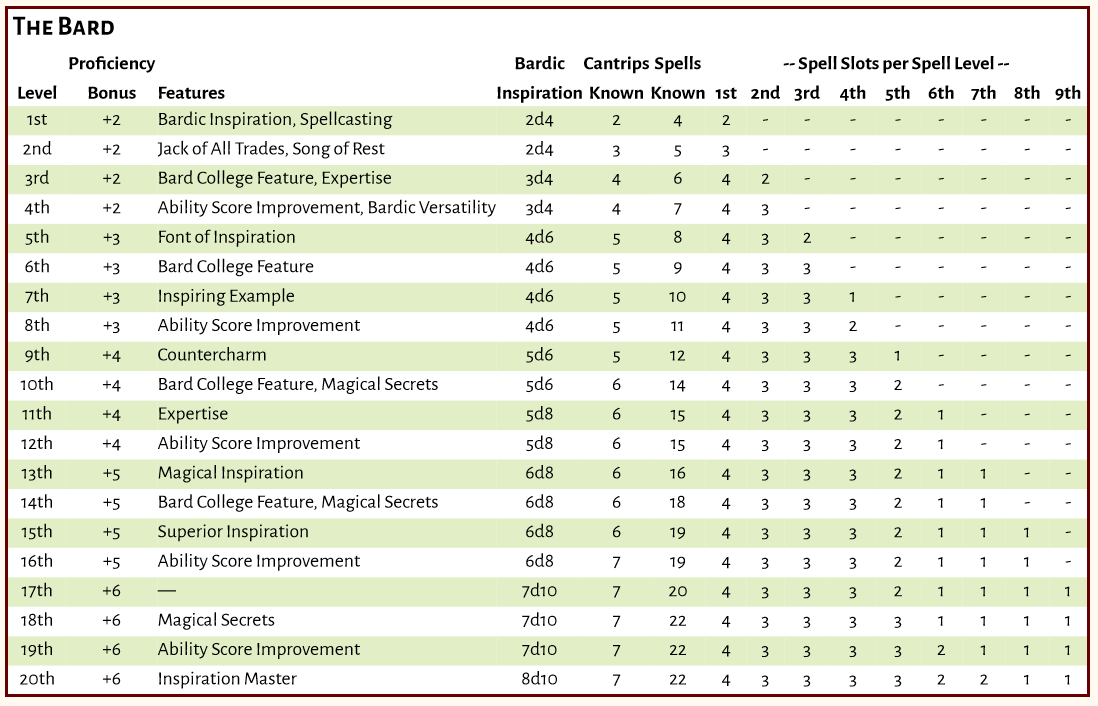
You can only have one creature inspired by this feature at a time. A creature loses its inspiration if you are incapacitated or unconscious, or they are deafened, incapacitated, or unconscious. You can use this feature a number of times as shown on the Bard table, and you regain all expended uses when you finish a short rest. Your Bardic Inspiration die changes when you reach certain levels in this class. The die becomes a d6 at 5th level, a d8 at 11th level, and a d10 at 17th level.
For example, if you know the 1st-level spell cure wounds and have a 1st-level and a 2nd-level spell slot available, you can cast cure wounds using either slot.
Additionally, when you gain a level in this class, you can choose one of the bard spells you know and replace it with another spell from the bard spell list, which also must be of a level for which you have spell slots.
At 11th level, you can choose another two skill proficiencies to gain this benefit.
You keep this pool of dice until all the dice have been used or until your inspiration on your allied creatures has ended.
Groups and commradery is important to a bard, as they're strongest when they have allies to encourage and support, however this doesn't make them weak on their own. Because of their versatility, a bard can fit in any role in a party, and thus, carry a wide range of talents they can master.
Quick Build
You can make a bard quickly by following these suggestions. First, put your highest ability score in Charisma, followed by Dexterity. Second, choose an origin that increases your Charisma or Dexterity. Third, choose the Dancing Lights and Vicious Mockery cantrip, and the following 1st-level spells: Charm Person, Detect Magic, Healing Word, and Thunderwave.Bardic Inspiration
You can inspire others through stirring performances. You can use a bonus action on your turn to choose one creature other than yourself within 60 feet of you who can hear you. That creature becomes inspired for 10 minutes. The inspired creature can roll 1d4 and add the number to an ability check, attack roll or saving throw it makes, but it can only use the die once, and regains the use of the die at the start of its next turn. The creature can wait until after it rolls the d20 before deciding to use the Bardic Inspiration die, but must decide before the DM says whether the roll succeeds or fails.You can only have one creature inspired by this feature at a time. A creature loses its inspiration if you are incapacitated or unconscious, or they are deafened, incapacitated, or unconscious. You can use this feature a number of times as shown on the Bard table, and you regain all expended uses when you finish a short rest. Your Bardic Inspiration die changes when you reach certain levels in this class. The die becomes a d6 at 5th level, a d8 at 11th level, and a d10 at 17th level.
Spellcasting
You have learned to untangle and reshape the fabric of reality in harmony with your wishes and performances. Your spells are part of your vast repertoire, magic that you can tune to different situations.Cantrips
You know two cantrips of your choice from the Bard Spell List. You learn additional bard cantrips of your choice at higher levels, learning a 3rd cantrip at 2nd level, a 4th at 3rd level, a 5th at 5th level, a 6th at 10th level, and a 7th at 16th level.Spell Slots
The Bard table shows how many spell slots you have to cast your Bard Spells of 1st level and higher. To cast one of these spells, you must expend a slot of the spell's level or higher. You regain all expended spell slots when you finish a long rest.For example, if you know the 1st-level spell cure wounds and have a 1st-level and a 2nd-level spell slot available, you can cast cure wounds using either slot.
Spells Known of 1st Level and Higher
You know four 1st-level spells of your choice from the Bard Spell List. You learn an additional bard spell of your choice at each level except 12th, 16th, 19th, and 20th. Each of these spells must be of a level for which you have spell slots. For instance, when you reach 3rd level in this class, you can learn one new spell of 1st or 2nd level.Additionally, when you gain a level in this class, you can choose one of the bard spells you know and replace it with another spell from the bard spell list, which also must be of a level for which you have spell slots.
Spellcasting Ability
Charisma is your spellcasting ability for your bard spells. Your magic comes from the heart and soul you pour into the performance of your music or oration. You use your Charisma whenever a spell refers to your spellcasting ability. In addition, you use your Charisma modifier when setting the saving throw DC for a bard spell you cast and when making an attack roll with one.Spell save DC = 8 + your proficiency bonus + your Charisma modifier
Spell attack modifier = your proficiency bonus + your Charisma modifier
Ritual Casting
You can cast any bard spell you know as a ritual if that spell has the ritual tag.Spellcasting Focus
You can use a musical instrument as a spellcasting focus for your bard spells.Jack of All Trades
Starting at 2nd level, your bardic ability makes you have a knack at almost everything you do. You can add half your proficiency bonus, rounded down, to any ability check you make that doesn't already include your proficiency bonus.Song of Rest
Beginning at 2nd level, you can use soothing music or performances to help revitalise your wounded allies during a short rest. If you or any friendly creatures who can hear your performance regain hit points by spending Hit Dice at the end of the short rest, each of those creatures regains hit points equal to 1d6 + your Charisma modifier. The extra hit points increase when you reach certain levels in this class: to 2d6 + your Charisma modifier at 9th level, and 3d6 + your Charisma modifier at 15th level.Bard College
At 3rd level, you delve into the advanced techniques of a bard college of your choice from the list of available colleges. Your choice grants you features at 3rd level and again at 6th, 10th, and 14th level.Expertise
At 3rd level, choose two of your skill or tool proficiencies. Your proficiency bonus is doubled for any ability check you make that uses either of the chosen proficiencies.At 11th level, you can choose another two skill proficiencies to gain this benefit.
Bardic Versatility
Starting at 4th level, your bardic magic slowly moulds itself to match your desires. After completing a long rest, you can replace one of your prepared bard spells with another spell on the Bard Spell list.Font of Inspiration
Beginning at 5th level, your inspiration bursts out like a fountain to others. You can now have multiple allies inspired at once. When you use a bonus action to inspire a creature, you can inspire a number of creatures equal to your Charisma modifier (minimum of one) that are in range. You must spend a use of your Bardic Inspiration for each creature you inspire. When you have more than one ally inspired, their inspiration lasts for 1 minute.Inspiring Example
Starting at 7th level, your inspiring magic flows through you and allows you to lead by example. When you inspire your allies, you gain a pool of dice which equals an amount of dice equal to the number of creatures you have inspired. The dice in this pool is the same die as your Bardic Inspiration. When you make an ability check, attack roll or saving throw, you can roll one die from this pool and add the number to the result. You can wait until after you roll the d20 before deciding to use a die from this pool, but before the DM says whether the roll succeeds or fails. After using a die from this pool, it is lost.You keep this pool of dice until all the dice have been used or until your inspiration on your allied creatures has ended.
Countercharm
At 9th level, you gain the ability to use musical notes or words of power to disrupt mind-influencing effects. As an action, you can perform to any number of creatures of your choice within 30ft of you that can hear you. Until the end of your next turn, you and each affected creature becomes immune to either the charmed or frightened condition (your choice). If you or a chosen creature is currently affected by the condition you choose when you take this action, that condition immediately ends. You can use this feature once before needing to complete a long rest to use it again.Magical Secrets
By 10th level, you learn to follow in the footsteps of other spellcasters. Your bardic ability of flexibility allows you to diversify your magical prowess. Choose two spells from any classes, including this one. A spell you choose must be of a level you can cast, as shown on the Bard table, or a cantrip. The chosen spells count as bard spells for you and are included in the number in the Spells Known column of the Bard table. You learn two additional spells from any classes at 14th level and again at 18th level.Expertise
At 11th level, you can choose another two skill or tool proficiencies. Your proficiency bonus is doubled for any ability check you make that uses either of the chosen proficiencies.Magical Inspiration
Starting at 13th level, your inspiration causes your magic to become stronger. If you cast a spell on a creature inspired by you that regains its hit points, you can add your bardic inspiration die + your Charisma modifier to the result. Additionally if you deal damage to a creature with a spell and an inspired creature is within 5ft of that creature, you can choose one of the following options:- You can deal extra damage equal to one roll of your Bardic inspiration die.
- That creature can use its reaction to make a melee weapon attack against that creature. If the attack hits it deals extra thunder damage equal to one roll of your Bardic Inspiration die.
Magical Secrets
At 14th level, choose two additional spells from any classes, including this one. A spell you choose must be of a level you can cast, as shown on the Bard table, or a cantrip. The chosen spells count as bard spells for you and are included in the number in the Spells Known column of the Bard table.Superior Inspiration
At 15th level, your inspiration becomes more reliable to those you inspire. Whenever a creature inspired by you rolls a 1 or a 2 on your Bardic Inspiration die, they get to reroll the die and must use the new roll, even if the new roll is a 1 or a 2.Magical Secrets
At 18th level, choose two additional spells from any class, including this one. A spell you choose must be of a level you can cast, as shown on the Bard table, or a cantrip. The chosen spells count as bard spells for you and are included in the number in the Spells Known column of the Bard table.Inspiration Master
At 20th level, your mastery of inspiration allows you to empower your allies even further. Creatures you inspire can now add your bardic inspiration die to any ability check, attack roll and saving throw they make. Additionally, if you start your turn without any uses of inspiration, you regain 1 expended use.Bard Features
As a Bard, you gain the following class features:
Hit Points at 1st Level: 8 + your Constitution Modifier
Hit Points at Higher Levels: 1d8 (or 5) + your Constitution modifier per Bard level after 1st
Weapons: Simple weapons, Hand crossbows, Longswords, Rapiers, Shortswords
Tools: Three musical instruments of your choice, Choose 1 from Disguise Kit, one Gaming Set, Painter's/Artist's Supplies, or Weaver's Tools
Saving Throws: Dexterity, Charisma
Skills: Choose any 4 skills.
Hit Points
Hit Dice: 1d8 per Bard levelHit Points at 1st Level: 8 + your Constitution Modifier
Hit Points at Higher Levels: 1d8 (or 5) + your Constitution modifier per Bard level after 1st
Proficiencies
Armour: Light Armour.Weapons: Simple weapons, Hand crossbows, Longswords, Rapiers, Shortswords
Tools: Three musical instruments of your choice, Choose 1 from Disguise Kit, one Gaming Set, Painter's/Artist's Supplies, or Weaver's Tools
Saving Throws: Dexterity, Charisma
Skills: Choose any 4 skills.
Starting Equipment
Each character begins their journey with equipment to aid in their adventuring. Some classes will give you a choice between certain equipment, your options are shown with the letters (a), (b) etc. When given this choice, you can only take one option from the choices. Your character starts with the following items on them:- (a) dagger or (b) shortsword
- (a) dagger or (b) sling
- (a) diplomat’s pack or (b) entertainer’s pack
- Padded armour
- One musical instrument
Remove these ads. Join the Worldbuilders Guild

Comments