Sha'ar
The Sha'ar
The City of Brass is built on brass and fire. This is not a metaphor. The brass holds what the fire transforms, and the fire transforms what the brass holds, and between them they produce something neither is alone — and the component at the heart of that production is a crystal the size of a human fist that has been going dark.A sha'ar — plural sha'arim — is a crystalline component produced by the synthesis of alchemical fire and Iron Nexus information architecture, embedded in Hell-tested brass channel infrastructure, that serves as the active transformation mechanism of the City of Brass's foundational technology. It is not a switch. It does not pass information or block it. It takes incoming information — a Nexus verit, a claim, a record in transit through the channel network, or even matter or energy given verit structure — and transforms it into a new state, with the transformation determined by the geometry of the crystal lattice in which the alchemical fire burns.
The sha'ar is why the City of Brass is what it is. It is also why the City of Brass cannot be rebuilt if it falls, and why the Restitution is the most consequential infrastructure project in the derived cosmos's current history.
What A Sha'ar Is
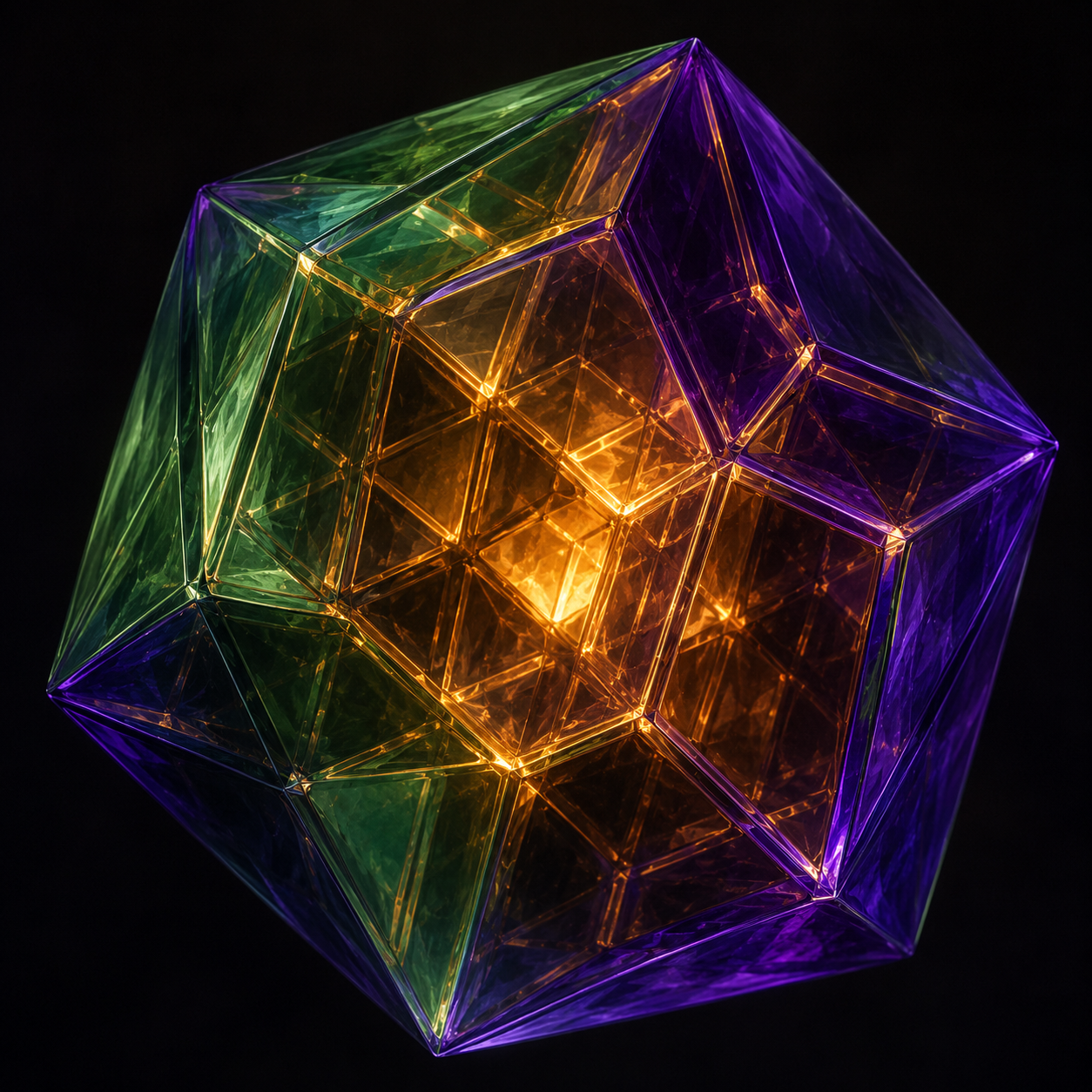
The crystal itself is roughly fist-sized, most of the time, though the geometry varies between specimens because the geometry determines the function. Different lattice structures perform different transformations, and the City's sha'arim network requires thousands of distinct transformation types, each encoded in the precise angular relationships of a specific crystal's facets. To a mortal eye they are beautiful: clear or faintly emerald, depending on how much fire the lattice currently holds, geometrically exact in ways that natural crystals are not, each facet ground to specifications that Anna Dalca's notes describe in terms that the Brass Archive Initiative has spent two centuries attempting to reconstruct.
The alchemical fire does not flow through the sha'ar the way it flows through the brass channels. It burns in the lattice, distributed through the crystal's internal structure, present at every node of the geometry simultaneously, the fire's iterative physics interacting with the lattice's precise angles to produce the transformation the crystal was designed for. A sha'ar performing a simple transformation glows faintly and evenly. A sha'ar performing a complex one pulses, the fire cycling through the lattice in patterns that, to someone who understands what they are watching, are as readable as notation.
They are embedded in the City's brass channel infrastructure at the junctions where transformation is required. Walking through the City of Brass at night, in a district where the channel network is close to the surface, the sha'arim are visible as emerald or turquoise nodes in the brass, warm where the channels around them are merely warm, lit from within by fire that has been burning in those specific lattices for as long as the City has stood.
They are going dark. Slowly, unevenly, the outermost nodes first and the deepest infrastructure last, but going dark. The pulse slows. The fire in the lattice is the same fire that is diminishing everywhere in the City's infrastructure, and what is visible in the sha'arim is what is invisible in the channels: the countdown, rendered in crystal.
What A Sha'ar Does
A mortal transistor switches between two states: conducting or not. A sha'ar does not have two states. It has as many states as the fire's iterative physics can produce from the incoming signal and the lattice geometry, which is, in practical terms, as many states as the transformation requires. A sha'ar designed to invert a verit inverts it. A sha'ar designed to combine two incoming verits into a third that is neither produces the third. A sha'ar designed to route an incoming signal to one of several outputs depending on the signal's content performs the routing. A sha'ar designed to store a verit and release it in a modified form after a specified interval does so.
None of this is accomplished by combining multiple simple components into complex circuits, the way mortal computing achieves complex logic through networks of transistors. Each sha'ar performs its transformation individually, as a single component, because the alchemical fire's native physics are not binary. Alchemical fire does not copy or not-copy. It iterates, it produces from any input an iteration that carries the original's substance while being something the original was not, and the lattice geometry determines what that something is. The fire's iteration combined with the lattice's precision produces a component that can perform any logical operation, any signal transformation, any information-state change that the City's architecture requires.
This is why the City of Brass's computational capability is not analogous to any mortal technology. Mortal computing is powerful because it combines vast numbers of simple components at high speed. The City of Brass is powerful because each of its components is individually capable of what mortal computing requires entire processor architectures to achieve, and the sha'arim network combines vast numbers of these components at speeds the fire's physics permit. The result is an information-processing architecture whose capability per component simply exceeds mortal technology as a category.
The Loss
The sha'ar is not lost in the sense of being forgotten. The City of Brass is full of them, still functioning, still visible as crystalline nodes in the channel network, still performing the transformations they were calibrated for when Anna Dalca introduced the fire into their lattices. They can be studied, tested. Their outputs can be measured and their geometries examined. They are present and operational and as legible as a technology can be when the physics that power it are running out.
What is lost is the ability to make new ones. Alchemical fire cannot be produced — it was Sheol's native substance, and Sheol is fallen. When it runs out, the sha'arim go dark. A sha'ar whose fire has gone out is a geometrically perfect crystal sitting inert in its brass housing, the lattice structure preserved exactly as Anna Dalca grew it, the fire that made it a sha'ar simply absent. The knowledge of what it was is in the geometry. The capacity to be what it was is gone.
The Reworking's replacement architecture will perform the City's functions. It will process information, maintain records, operate the Census, sustain the communication network. It will not do any of these things through sha'arim, because sha'arim require alchemical fire, and there will be no alchemical fire. What replaces the sha'arim network will be more complex, less capable per component, requiring more components to achieve the same results, and structurally capable of carrying falsehood in ways the sha'arim network is not — because the replacement's physics will not include the fire's verification layer, and the replacement will require external safeguards to do what the sha'arim do inherently.
The brass will still record. The Census will still function. The City will still stand.
The sha'arim will be dark in their housings, geometrically perfect, going nowhere.
Current Status
The sha'arim currently operating in the City of Brass number in the millions. The Restitution's engineering assessment established that the replacement architecture will require approximately eleven times as many components as the sha'arim network to achieve equivalent function, will achieve approximately seventy-three percent of the sha'arim network's current processing capability at full implementation, and will be structurally incapable of replicating the synthesis's false-information rejection property without external verification systems that introduce latency the sha'arim network does not have.
The Reworking is proceeding. The sha'arim are still lit. The fire in the outermost nodes is visibly thinner than it was a century ago, to anyone who has been watching long enough to notice.
The Brass Archive Initiative's correctly functioning reconstructed sha'ar is held in the archive. Scholars visit it. They examine the lattice geometry. They measure the transformation outputs. They attempt to understand, from the product, the process that produced it.
The correctly functioning sha'ar sits in its housing, emerald-warm, performing its transformation faithfully, the only new instance of its kind that exists.
It will go dark when the fire does.
Further Reading
For the City whose foundational technology this is, see City of Brass. For the project replacing the sha'arim network, see The Restitution — this wave and forthcoming. For the scholar whose methodology produced the sha'ar and whose loss made it irreproducible, see Anna Dalca. For the demon who co-developed the synthesis and leads the replacement effort, see Hanpa. For the Nexus architecture that provides the verit component, see Iron Nexus. For the Realm whose alchemical fire provides the transformation component, see Sheol. For the resource the Restitution is racing to preserve before the sha'arim go dark, see Collectors of the Remnant
Anna Dalca grew the archive's reconstructed sha'ar from an idea she carried out of Sheol. It will burn until the fire runs out, which the Iron Nexus has calculated and which the City has decided is not as far away as it sounds. Then it will be a perfect crystal in a brass housing, going nowhere, which is what all the sha'arim will be. The City will still stand. The geometry will still be there. The fire will not.
The Synthesis
The sha'ar is not a Sheolite technology and not a Nexus technology. It is the product of a specific synthesis between the two that Hanpa and Anna Dalca developed across several centuries of collaboration, and which neither the Nexus nor any surviving Sheolite scholar has been able to fully reconstruct since.
The Nexus provides the verit — the unit of verified information, reality-checked against the Nexus's observational architecture, carrying the specific ontological weight of something that has been confirmed to be true. A verit is not merely data. It is data that the Nexus has verified against observable reality and endorsed as existing, which gives it a specific ontological status that ordinary information does not have.
The alchemical fire provides the transformation physics, the ability to take what enters and produce from it something genuinely different, an iteration that carries the original's substance while being more than the original contained. Fire alone produces copies. Copies are useful. They are not transformations.
The sha'ar is what happens when a verit enters a lattice structure in which alchemical fire burns: the fire iterates the verit according to the lattice geometry, producing a transformed verit that the fire's own verification endorses as a genuine iteration of the original. The transformation is not arbitrary. It is constrained by both the fire's physics and the lattice's geometry, which means it is reproducible, predictable, and verifiable, the Nexus component of the synthesis ensuring that the fire's iterations remain honest, that the transformations the sha'ar performs are real transformations rather than distortions.

Comments