Mawaqit
The Mawaqit
Mawāqīt: the appointed times. Not where the door is. When it opens.What It Is
The Masalik answers the question where can a boundary-current be crossed. The Mawaqit is a device built to answer a different question: when will a boundary-current open on its own, without anyone having to build anything at all.
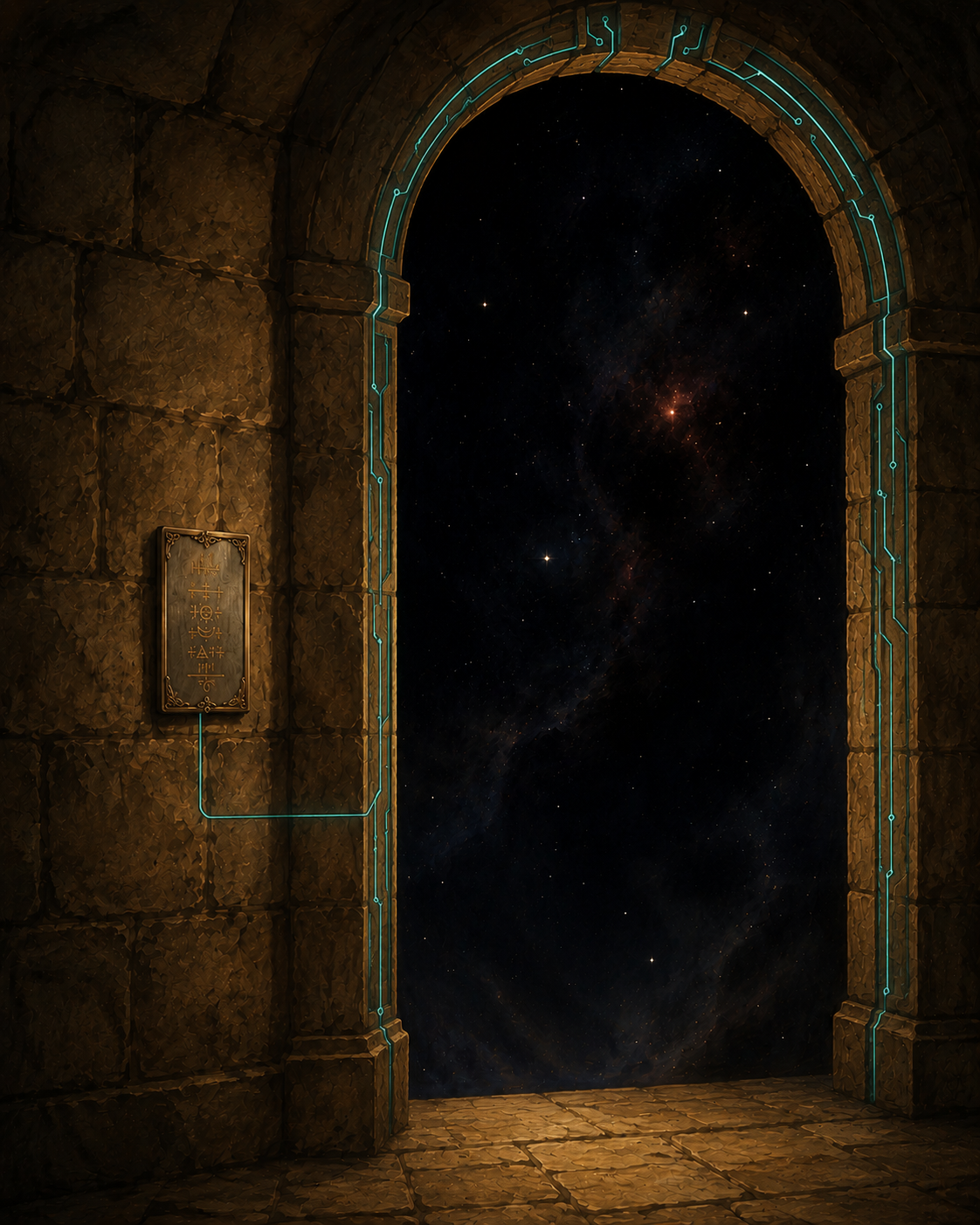
It is not a bridge. It is not a gate in the sense that word usually carries in this Archive — nothing is built, staffed, or held open by anyone's continued effort. It is a forecast, jointly produced by Hell and the Iron Nexus, of the moments when fording might naturally occur, a boundary-current between two Realms will thin far enough that an unassisted crossing becomes survivable. Consult it correctly, arrive at the right coordinates at the right hour, and the door that is usually dangerous is, for a while, simply open.
Origin
The Masalik has always had a quiet gap in its own account of itself: Hell "finds" new boundary-currents to chart, but the finding was never explained. The Mawaqit is the answer, and it is older than most of the engineered routes it eventually justified.
It grew out of the same partnership that produced Nexus Brass and Nexus steel — the First Forging, and the ongoing translation work Sub-Unit 8 has carried for Hell ever since. The Construction, the Nexus's standing project to model all thirteen ontologies at once, was already capable of predicting interference patterns between any two Realm-substrates in principle; the Styx-effect that Anna Dalca first bridged by hand is simply one instance of a general phenomenon. Hell had, by that point, already surveyed most of its own border geography for the Masalik's sake. Putting the two together took less invention than it took someone finally asking the obvious question: if the Nexus can model the interference, why is Hell still finding these currents by accident?
How It Works
Every Realm border produces a frequency gradient where two ontologies run alongside each other — this is not new; it is the same structural fact that produces the Styx, the Voracian Frontier's current, every gradient the Masalik has ever charted. What is new is treating the gradient as a wave rather than a wall. Amplitude at any given point along a boundary-current is not constant. It troughs and crests, on cycles the Construction can model once it holds enough verified observation of both Realms' substrates — cycles that can run from hours to centuries, depending on the Realms in question and how well surveyed they are.
Hell supplies the boundary-geometry: the shape of the current, its known hazards, the honest assessment of what a crossing there has historically cost. The Nexus supplies the modeling: the prediction of where, in that geometry, the amplitude will trough low enough for a being to cross without buffering, without a Holdcraft's active modulation, without anyone imposing anything on the border at all.
This last point is the whole reason the Mawaqit is worth naming as its own invention rather than an appendix to the Masalik. It is not an Arcadian Contract-gate, which requires a strike and binds both parties to terms. It is not a Forge-wrought door keyed to a specific schema, which requires the schema's maker and the traveler's compatibility with it. It is not a Celestial miracle, which requires Faith spent against the mortal Realm's own reassertion. It is not Voracia's method, which does not ask the border anything — it simply consumes until there is no border left to ask. The Mawaqit imposes nothing. It watches something that was already going to happen, and says so in advance.
Consultation
The Mawaqit is kept as a continuously self-updating Nexus steel tablet etched with brass. In practice, hundreds are sited at the City of Brass and at Masalik waystations along the more heavily surveyed borders. It does not require a translator to read; the brass renders its predictions in whatever grammar the reader's ontology can receive, the same courtesy Nexus brass extends everywhere else.
The Masalik's own engineering corps consults it first, as a scouting instrument, a candidate current worth surveying for permanent infrastructure shows up on the Mawaqit long before anyone breaks ground on a waystation. But it is not restricted to them. A being who needs to cross somewhere the Masalik has never built, and who is willing to travel unescorted, unbuffered, and on the Mawaqit's schedule rather than their own, can read the same tablet and go.
Limits
A predicted window is not a safe window, only a survivable one, and the two are not the same thing. Windows can run from several days to a handful of minutes; arriving late to a short one means waiting for the next, which the tablet will tell you, but will not apologize for. The Mawaqit says nothing about conditions on the far side. A technically-open current into contested ground, such as the Voracian border, is exactly as dangerous to arrive in as it always was.
The Construction's confidence varies by Realm. Borders it has modeled for centuries, it predicts precisely. The Nyxaloth border, true to form, produces no usable prediction at all; the Realm the Nexus cannot observe is a Realm the Mawaqit cannot forecast either, and the tablet says only what it has always said there: nothing.
Predication can be calibrated between Realms that do not include Hell or the Iron Nexus as destination or point of origin. This is rarely done, in practice, as other Realms prefer their own gating mechanism. The Mortal Realm, on Earth specifically, where technology is a more standard concept, however, find the idea of the Mawaqit incredibly appealing for those who have used it.
Further Reading
For the engineered infrastructure the Mawaqit's discoveries feed into, see The Masalik. For the recording substance the tablets are made of, see Nexus Brass. For the Realm whose modeling makes the forecast possible, see Iron Nexus. For the partnership both technologies descend from, see The First Forging — forthcoming. For the translator who helped build it, see Sub-Unit 8 — forthcoming.
Hell does not open doors for anyone. It has never needed to. It only had to notice, eventually, that the doors were already opening on their own, on a schedule no one had thought to write down.
The Nexus wrote it down. That was the whole invention.

Comments