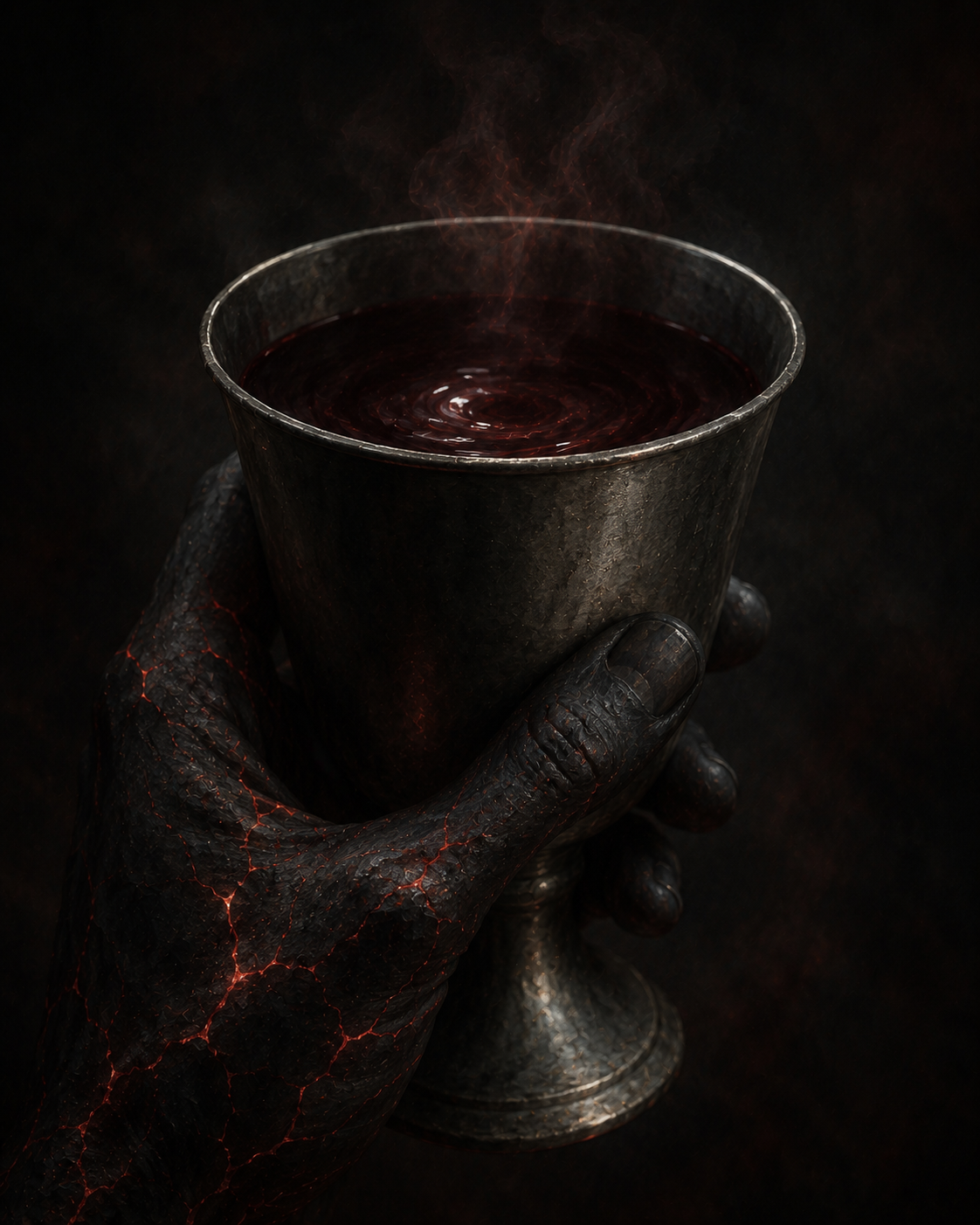
Devil's Toast
The Devil's Toast
A Tale from the Tavern
The following pages are reproduced from the private journal of Nadia Osei, recapping an evening's conversation with one of the Fallen and if there is Faith they still might take.
I asked him a stupid question, and he gave me an honest answer, which is the thing about Ashmedai that David and I still haven't found a polite way to put in print. Ask him something stupid and he does not deflect. He answers it. You are then responsible for what you now know.
What I asked was: is there anything in Hell that could still hurt you.
He was quiet long enough that I thought I'd finally found the edge of what he'd tell a journalist. Then he said, "Jack. The old cup, if you'd bring it out," and I understood that I had not found an edge. I had found a door, and he had decided, in the space of that quiet, to open it.
Jack brought it out from somewhere behind the bar I have never been permitted to see into — the same place, I assume, that holds whatever else this tavern keeps and does not serve. A plain cup. Pewter, or something that wanted to look like pewter. What was inside it was dark, and it moved the way wine moves, unhurried, catching the light along its surface in a slow fold.
It smelled like mulled wine. Like woodsmoke and old paper and, underneath that, something I could not name and kept trying to — something closer to being missed by someone than to any actual scent. I said this out loud, apologetically, the way you apologize for a description you know is inadequate.
"That is not what it smells like," Ashmedai said. "That is what reaches you. Whatever you're smelling is already the diminished translation — the same as everything I say to you arrives smaller than I said it. You are getting the part of it that survives the crossing. I would not want you to know the rest."
He told me what it was, and I am going to write it down the way he told it to me, because I don't trust myself to improve on it.
For two thousand years, he said, mortals have been afraid of a single Devil. Genuinely afraid — the old, useful, sacrificial kind of terror, the kind that built gods in the first place, long before anyone refined the arrangement into something gentler. Faith doesn't care what shape the fear takes. Dread generates it as reliably as awe does, sometimes more so.
The trouble, he said, is that there was never anybody to receive it. The Fallen are many, and none of them is Satan, because Satan was never one being to begin with — a fact I already knew, on paper, from the compiled-adversary research David dug up months ago. What I hadn't understood was where all that unclaimed terror actually goes. Faith is a flow. Flows don't stop just because the address is fictional. It comes looking for somewhere to land, and the nearest real place to "wherever the Devil lives" is the border of Hell itself. So it gathers there. Two millennia of it. Waiting.
"And Hell doesn't stop it at the door," I said, because it seemed like the obvious question.
"No," he said. "Heaven stops things at doors. That is not the mistake we came here to keep making."
I asked if it was poison. He said no, and the way he said it made the no worse than a yes would have been.
"It is real," he said. "That is the whole difficulty. It would feed me the way nothing has fed me in a very long time. I am not exaggerating that for your benefit. I do not need to. Faith is Faith, however it was shaped, and I am hungry in the specific way my kind is always a little hungry."
"Then why not drink it."
"Because of what it is shaped like." He turned the cup slightly, and the wine — I still think of it as wine — turned with it, unhurried. "It was shaped by two thousand years of people believing something cruel and singular was doing this to them. To drink it is not to be poisoned. It is to agree to be that, for a while. Cruel. Singular. A collector of what was never freely given. I have spent a very long time refusing to be the thing your traditions are so certain I am. This cup is an offer to stop refusing. Just once. Just to eat."
I asked, because I am who I am and could not stop myself, whether anyone ever had.
He didn't answer the way he answers most things — plainly, at length, with the patience of someone who has decided the questioner deserves the whole shape of it. He looked at the cup for a while instead.
"There is a document your scholars have half-noticed," he said finally. "Several real things, folded into one adversary, none of them coordinated, none of them claiming the name. Most of it is misattribution. I would not want to tell you that all of it is."
That was the entire answer. I have turned it over since, and I don't think I was meant to be able to close the door on it either way. That may have been the point.
Jack took the cup back before I could ask to hold it, which I hadn't realized until that moment I very much wanted to do. He didn't make a show of it. He set it back wherever it goes, the way he sets everything back, and refilled my glass with something considerably more ordinary, and did not comment on either.
I finished my actual drink. It tasted like nothing in particular, which I was, for once in my career, relieved about.
What I remember now isn't the fear, and it isn't even the answer he wouldn't quite give me. It's the smell — smoke and old paper and something that felt like being missed — and the fact that Ashmedai, a being who has spent ten thousand years being handed a name that isn't his, sat across from me and told me, without flinching, exactly what it would cost him to finally earn it.
Further Reading: For the Fallen general who showed me this, see Ashmedai. For the composite figure this substance feeds into and out of, see The Compiled Adversary. For the dispute over disclosure that explains why Hell lets it stand at all, see The Long War. For the tavern where it's kept, see Jack's Tavern.

Comments