Boundweave
Boundweave
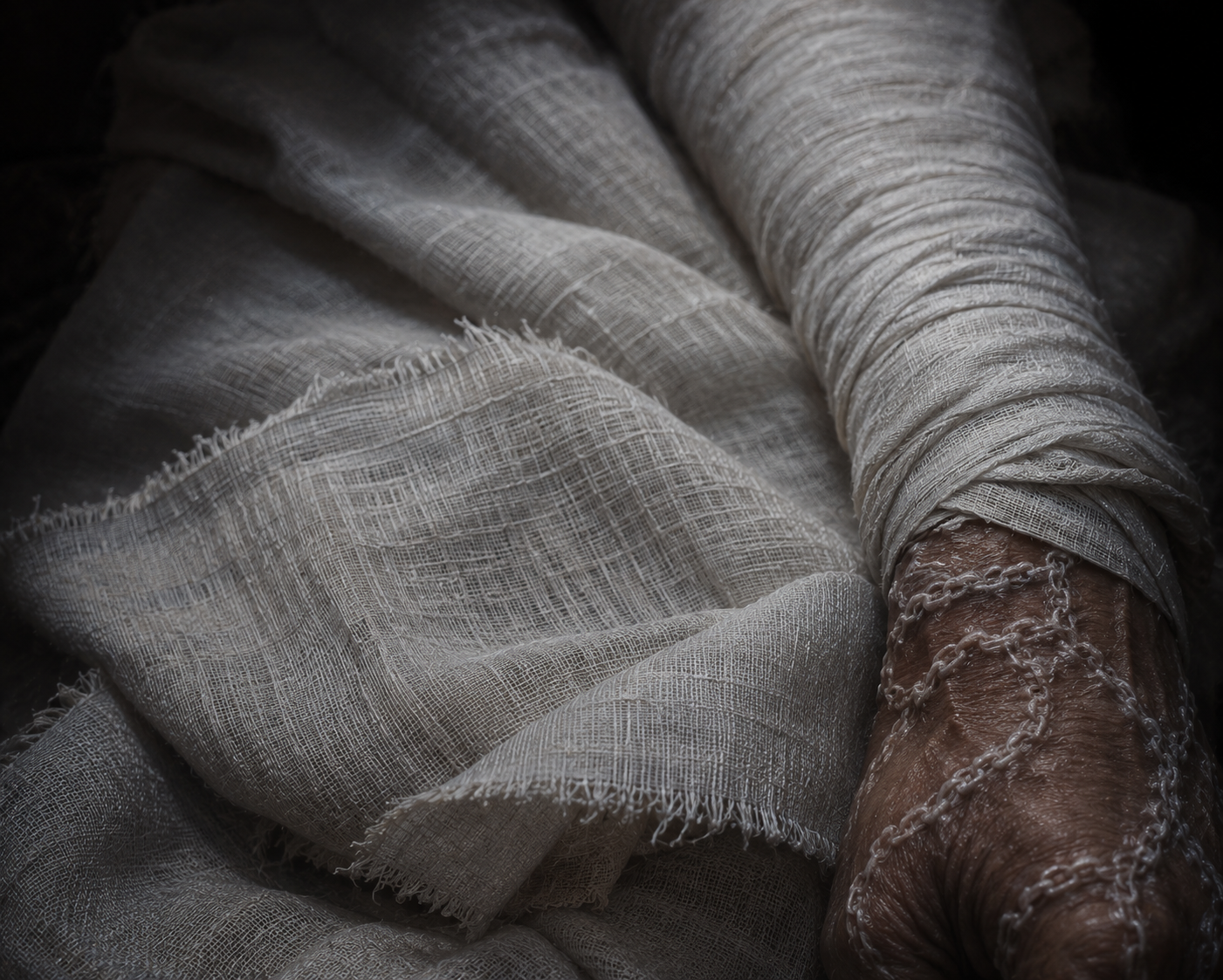
It does not heal the chains, nothing short of the Lake does that. What it does is quieter and more useful: it reminds the body where it ends.Boundweave is a textile produced from the processed fiber of terminus weed — a sprawling, unresolved growth found throughout the overgrowth of the ruined City of Electrum — and used primarily among the wrongweight chained of Orichalcum as clothing, wrapping, and bandaging against the scarring. It does not treat the condition; Hell does not offer treatments that work without cost, and boundweave costs nothing, which means it cures nothing. What it does is slow the spread of new links and reduce the rate of passive transmission.
Terminus Weed
The Electrum Ruins are overgrown. Sometimes. This is not surprising to anyone who understands what Electrum was — a failed synthesis of Ruskenn's gestalt-intelligence and Arcadia's Contract-logic, an ontological energy that never resolved into a city and has been generating ever since, directed into everything it can reach. The kethavel are the most visible expression of this: unresolved argument given animal form, endlessly moving, endlessly almost-negotiating. The overgrowth is the botanical expression of the same principle — growth that does not conclude, that produces because nothing in Electrum ever reaches a point of completion and stops.
Terminus Weed is the most structurally distinctive plant in this overgrowth, when overgrowth occurs, identified by its sharp-edged leaves and the clean, precise way it grows against other plants. It does not tangle nor overlap, maintaining a consistent and slightly unnatural gap between its own stems and everything adjacent to it. It does not compete with neighboring growth. It simply declines to merge with it. This behavior is consistent across every observed specimen, and scholars of the Brass Archive Initiative who have studied it at careful distance attribute it to the trace Arcadian Contract-substance present in its fiber: a residue of the Primordial First Contract that defines Electrum's failed ontology, expressed botanically as the most basic possible clause: "I am here. You are there. The boundary between us holds."
The weed is harvested carefully and rarely, for two reasons. The Electrum Ruins carry their own hazards — extended exposure to the kethavel's endless almost-negotiation has been documented to erode a visitor's sense of bounded selfhood, the irresolution seeping into a mind not built to withstand it. When it grows, terminus weed grows in the interior of the overgrowth rather than at its edges, requiring longer exposure than most beings find comfortable. The second reason is the kethavel themselves, who treat any harvesting attempt as an occasion for intense, unresolvable negotiation about territorial terms they squabble over and will not quite abandon. No harvester has ever been harmed by them. No harvester has ever found the experience pleasant.
The fiber, once extracted and processed, is pale , almost white, with a slight silver undertone that experienced handlers associate with the Arcadian trace-substance, and stronger than its fine texture suggests. It does not felt. It does not tangle. Individual strands maintain their distinctness from each other even under pressure, a property that makes it unusually difficult to weave by conventional methods and unusually durable once woven.
The Weaving
The community at Orichalcum developed the weaving technique through decades of trial and material frustration. The fiber's resistance to tangling means it cannot be worked the way most textiles are worked. Force causes it to separate rather than bind. What works instead is patience and precision: each strand placed deliberately against its neighbor, the weave built slowly, the fabric emerging from careful arrangement rather than any mechanical process.
The resulting textile is plain, pale, and slightly stiff — nothing that would be called beautiful by any standard that values softness or drape. It is, however, exactly what it needs to be, which is a quality the community values more than beauty.
What Boundweave Does
Worn against wrongweight scarring, wrapped around the hands and forearms where the chain-links typically begin, made into close-fitting garments that cover the upper body as the condition progresses, boundweave produces a measurable reduction in new link formation rates. The community at Orichalcum, which already benefits from mortal entropy's lower pressure, finds that carriers wearing boundweave consistently add links more slowly than those who do not. The effect is not dramatic and it is not curative — the chains do not recede, the existing scarring does not warm or fade, nothing that has already accumulated is removed. The boundary the fabric imposes is prospective rather than retroactive.
The mechanism, as best the community's own scholars have reconstructed it: the trace Arcadian Contract-substance in the fiber maintains a continuous, low-level boundary-claim against the wearer's skin — "this is where you end" — that is faint enough to go unfelt but present enough to impose a slight ontological distinction between the carrier's own substance and the foreign dross that kleshabandha accretes. The foreign weight still accumulates. Hell's physics permit no textile to prevent that entirely. But it accumulates against a boundary rather than directly onto substance, and the boundary slows it the way a seam slows water.
The passive transmission rate is also reduced when boundweave is worn. This is the property the community values most. It is the one that makes living together more sustainable, that allows the careful presence they practice with each other to remain careful rather than becoming gradually catastrophic. A community of wrongweight carriers who can sit together without accelerating each other's condition is a community that can persist. Boundweave makes the arithmetic of that persistence slightly less brutal.
Trade and Rarity
Boundweave does not circulate widely beyond Orichalcum. The harvest is difficult, the weaving is slow, and the community produces enough for its own needs with little surplus. Occasional pieces reach the City of Bronze, where elders who work with kleshabandha cases have found it useful as a harm-reduction measure for carriers not yet ready to consider the Lake. Similarly, the City of Brass holds samples in its archive alongside scholarly documentation of the fiber's properties.
The Brass Archive Initiative has flagged terminus weed as a research priority, noting that a plant expressing Arcadian Contract-logic in biological form represents a form of cross-ontological expression with implications beyond wrongweight treatment. The community at Orichalcum has not formally responded to this interest. They are, as a general matter, not enthusiastic about research attention, and the scholars have found the carrier community considerably more effective at not-quite-agreeing-to-be-studied than the kethavel are at their own negotiations.
Further Reading
For the condition boundweave helps manage, see Wrongweight . For the community that developed and primarily uses it, see The Chained. For the failed synthesis whose overgrowth produces terminus weed, see Ruins of the Two. For the ontological principle the fiber expresses botanically, see The Primordial First Contract — forthcoming.

I do love how you've focused on a different aspect of Hell with each of the seasons, like the lake of fire, and main broad strokes for the start, and then a little forgotten corner for this part. As always a wonderful article.
Your freind,
The Graiffe
Working hard at Summercamp 2026
Glad you enjoyed it. And a bit of Arcadia and the Hive thrown in too, for good measure :)