
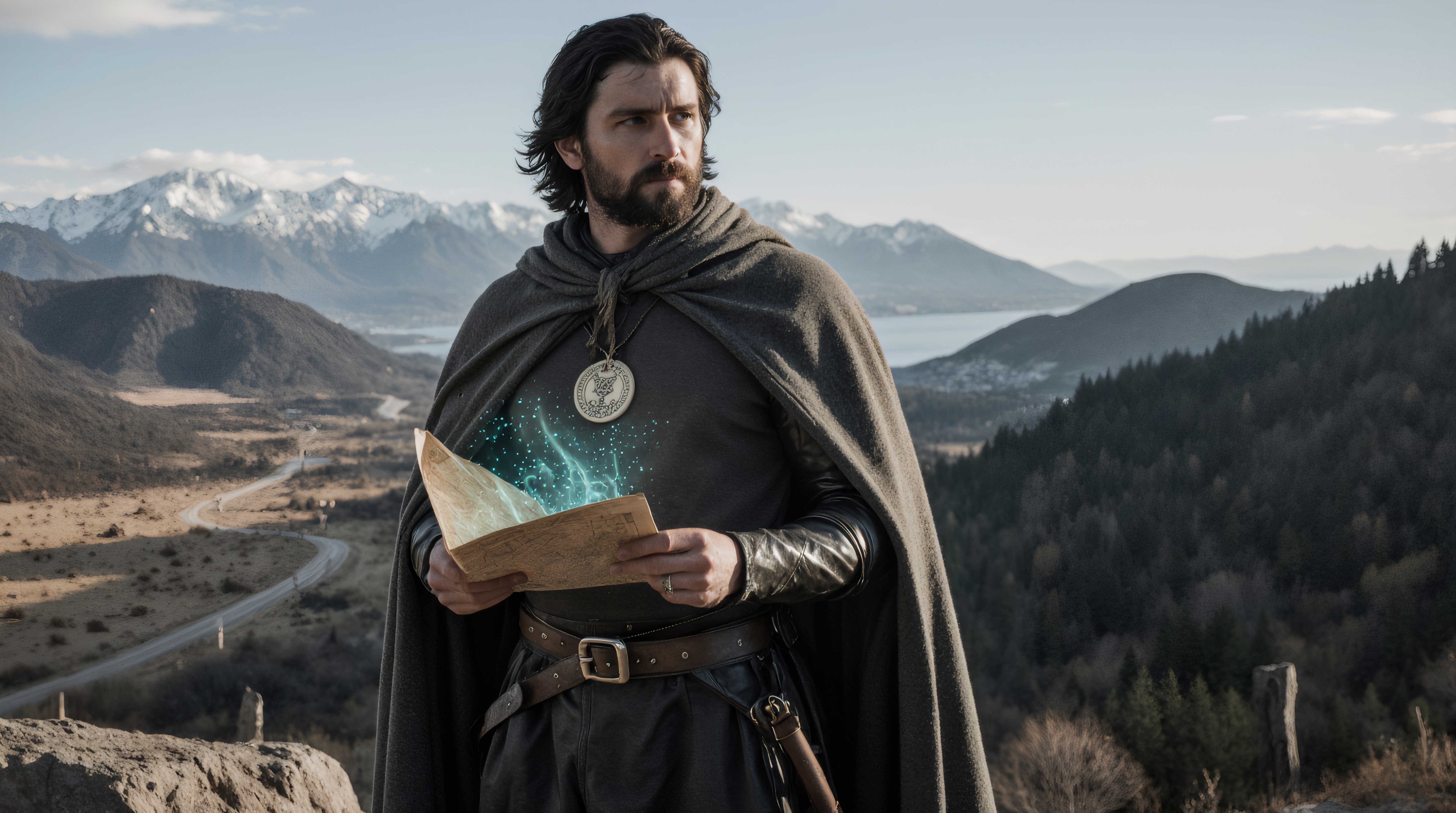
The Known World
"Not all paths are meant to be found — some remember you first."
An old world of layered memory, forgotten roads, and places that remember more than they reveal. At its center walks a traveler known only as the Last Wanderer — not the last man alive, but the last of a rare kind: one who walks not to conquer, not to flee, but to understand. In this world, roads carry memory, history leaves residue, and something unseen is quietly erasing access to what the land once knew.
THE WANDERER’S JOURNAL
This world is not meant to be opened all at once.
It is entered by fragments: by a road half-remembered, by a name spoken in the wrong place, by a map that reveals more than it explains. The entries gathered here follow the path of the Last Wanderer through harbors, crossroads, mountain roads, and older places where memory does not remain still. Some pages move like story. Others read more like recovered traces. Together, they form the nearest thing this world has to a true record.
Begin with Act I — The Weight of the First Road.
The Wanderer arrives at Saltsong Harbor — not for the first time, but with new eyes. Something in the rhythm of the city is wrong. The first act reveals who he is through what he notices, what he trades, and what he refuses to ignore. The Waymark stirs. The layers of the world begin to show themselves. By the end of the act, he is left with a direction, a question, and a reason to keep moving that is larger than curiosity.
Act I — The Weight of the First Road
I — Arrival
II — Echoes in the Marketplace
III — The Decision at Dawn
IV — The Keeper of Crossroads
V — The Language of Paths
Beyond the Journal, the wider archive expands through maps, locations, characters, and lore. These pages are not written in the same voice. The Journal remains closest to lived experience — what was seen, carried, feared, misunderstood. The surrounding archive belongs to a broader record: reconstructed, annotated, and gathered from the edges of the same journey.
Listening while reading may deepen the atmosphere of a given road, but the world is designed to stand without it. Music, visual fragments, and selected references are placed where they belong — not to explain the story, but to shape its weather.
Some entries contain quiet implications, recurring symbols, or fragments that reach beyond the moment in which they appear. They are not meant to hand the world over too quickly. They are there for readers who prefer to notice the second meaning after the first has already passed.
Not every path here is marked. Some are only visible after you have already begun.
HOW TO READ THIS ARCHIVE
The Journal follows the Wanderer’s lived path: what was seen, carried, noticed, feared, and only partly understood.
The surrounding pages — maps, locations, characters, and lore — belong to a broader record. They expand the world, but not always in the same voice. Some are immediate. Some are reconstructed. Some are clearer only in retrospect.
READ BEYOND THE ARCHIVE
Some parts of this world are gathered here as fragments — journal entries, echoes from the road, and selected materials from the wider archive. If you would like to read beyond these fragments, the official site holds the current reading edition of The Last Wanderer, including the available part of the story.
LISTENING WHILE READING
Some roads are better entered in silence. Others ask for weather.
Where music is included, it is placed to deepen atmosphere — not to explain the story, but to accompany it. Use it if it helps the road open a little further.
VISUAL FRAGMENTS FROM THE WORLD
Some parts of the road are better seen than explained. Selected visual fragments, lore videos, and atmospheric scenes from The Last Wanderer can also be explored through the official channel.
A Fragment from the Road
From the first days in Saltsong, it becomes clear that not every presence leaves a trace the world is willing to keep.
A Second Fragment from the Road
Not every turning begins with danger. Some begin with recognition — quiet, deliberate, and older than the name of the road itself.
Author’s Margin
The Last Wanderer is an ongoing long-form story, and the full novel is not yet available here in complete form.
What is gathered in this archive are selected journal entries, fragments, echoes from the road, and world materials connected to the larger narrative. Some pages are close to the book itself. Others expand its edges without giving the whole path away.
Spoiler notes, when included, are marked clearly. Most are meant less to reveal than to deepen — to cast a second shadow behind what is already visible.
WHERE TO CONTINUE
This archive is one way into the world. For reading editions, visual fragments, and the wider project, continue through the official site and channel.
The Wanderer
A solitary traveler moving through the remnants of forgotten paths. He does not search for a place, but for something long displaced by memory, distance, and time. His road is shaped less by destination than by what the world chooses to reveal to him along the way.
The World
A fragmented land where past and present do not lie neatly apart. Old roads do not disappear — they wait. Some places preserve memory in silence, others distort it, and those who learn to read the land begin to understand that history here is not gone. It lingers.
Campaigns
Journey of the Last Wanderer
Generic [Generic Blocks Only]
A guided entry point into The Known World — for readers who want the clearest path into the story, its central figures, and the roads that shape it.
Characters
The Waymark
An unseen force that binds memory to place. It is not magic in the common sense, but something older, quieter, and far more difficult to command. At times it appears as light, movement, pressure, or presence — not explaining the road, only insisting that it still exists.

© 2026 The Last Wanderer. All rights reserved. Story, characters, worldbuilding, maps, images, and related materials are part of The Last Wanderer project unless otherwise stated.