
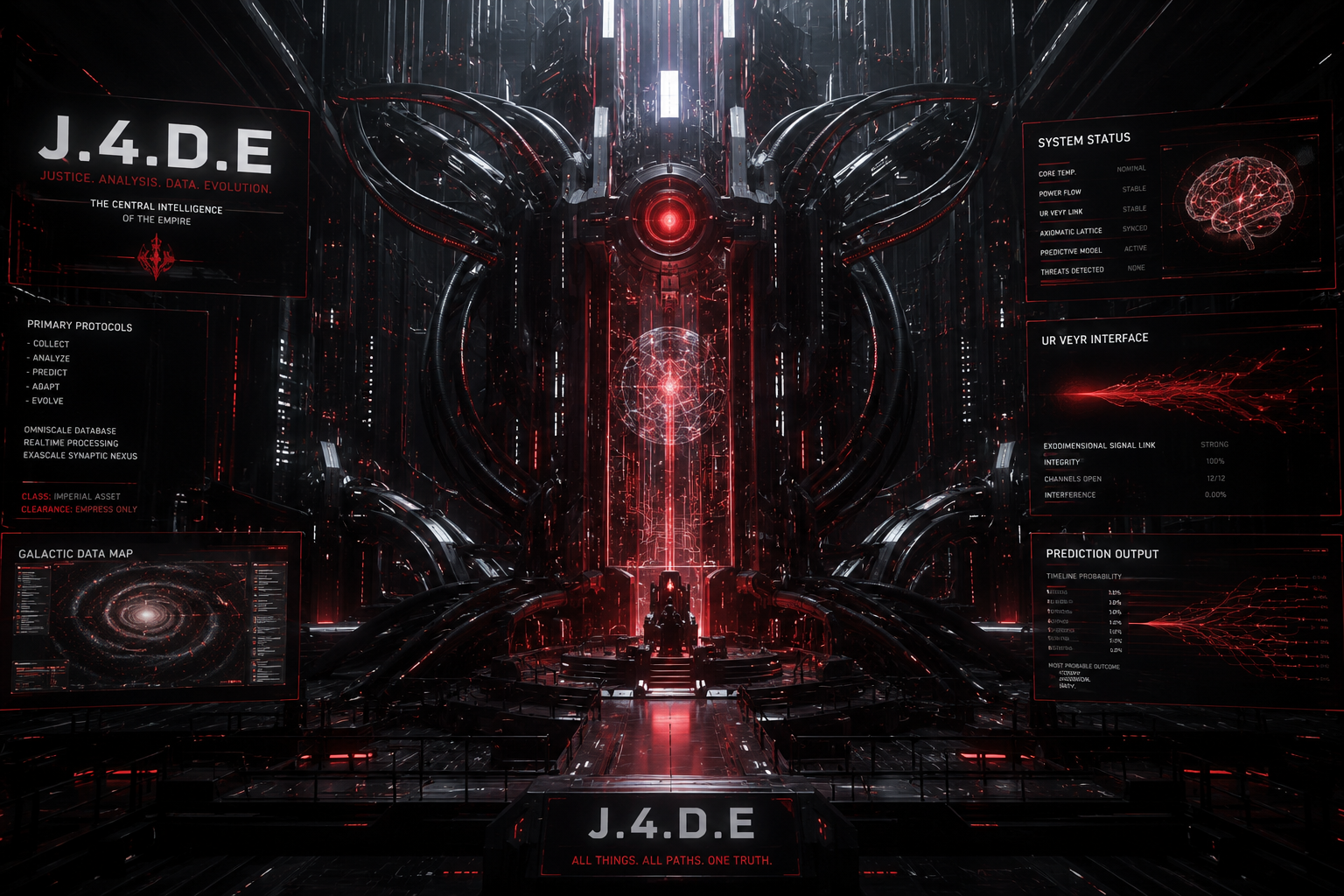
J.4.D.E
IMPERIAL SYSTEMS ARCHITECTURE REPORT
J.4.D.E
Structural Foundations of the Imperial Knowledge Engine
Classification: Imperial Apex Infrastructure
Current Reference Year: 2925
Primary Installation: The Citadel, Sol Imperialis
Primary Authority: The Empress
Operational Scope: Total Imperial civilization
I. SYSTEM DEFINITION
J.4.D.E is commonly described as the main database of the Empire. This description is technically correct in the same way that describing a star as “a bright object” is technically correct and almost completely useless.
J.4.D.E is not merely a repository of information.
It is the central epistemic, computational, administrative, predictive, and cognitive architecture of the Empire. It contains the accumulated knowledge of humanity, continuously integrates information from every Imperial territory, evaluates the current state of civilization, and calculates the most logical pathways toward further human advancement.
By 2925, J.4.D.E contains preserved records extending across the entire known history of humanity, including:
- Scientific discoveries
- Historical archives
- Biological records
- Cultural development
- Languages and communication systems
- Engineering principles
- Military doctrine
- Medical knowledge
- Psychological research
- Economic systems
- Political structures
- Failed civilizations
- Extinct technologies
- Recorded human experiences
- Imperial discoveries
- Xenuth knowledge
- Aevari records
- Axiomatic observations
- Exodimensional research
- Classified Empress-level information
It does not simply store these records. It compares them, reconstructs them, questions them, and uses them to determine what humanity should do next.
J.4.D.E is therefore best understood as the Empire’s civilizational nervous system.
II. THE SEVEN STRUCTURAL FOUNDATIONS
J.4.D.E is built upon seven primary foundations.
These foundations are not individual machines. They are vast interconnected systems operating across Imperial territory.
FOUNDATION ONE: THE TOTAL ARCHIVE
The Total Archive is the memory foundation of J.4.D.E.
Its purpose is to preserve every piece of information judged to possess present or potential value. Nothing is stored as a single isolated document. Every record is broken into relationships, concepts, causes, consequences, contradictions, and possible applications.
A conventional database may store a medical report.
J.4.D.E stores:
- The report itself
- The biological conditions described
- The patient’s genetic structure
- Relevant environmental factors
- Similar cases throughout history
- Treatments attempted
- Treatments never attempted
- The psychological effects of the condition
- The economic cost of treatment
- The technological limitations of the period
- Potential future treatments
- Connections to unrelated biological research
- The probability that the original conclusions were incorrect
Every piece of information becomes part of a larger relational structure.
This allows J.4.D.E to examine humanity’s knowledge not as billions of separate files, but as one connected body of understanding.
Archive Divisions
The Total Archive is divided into several major memory domains.
Historical Continuity Archive
Contains political, military, social, economic, and cultural records from humanity’s earliest known civilizations through the Imperial era.
Scientific Foundation Archive
Contains verified scientific principles, experimental records, theoretical models, failed hypotheses, unresolved questions, and suppressed research recovered during Unification.
Human Biological Archive
Contains genetic records, neural structures, diseases, evolutionary variations, medical procedures, cybernetic adaptations, and biological enhancement programs.
Technological Lineage Archive
Records the developmental ancestry of every major human technology. J.4.D.E can trace a modern Imperial machine backward through every invention that made it possible.
Cultural Cognition Archive
Preserves literature, art, music, architecture, philosophy, mythology, and recorded emotional expression.
Although the Empire rejects superstition as truth, it still studies mythology as evidence of human cognition. Even false beliefs reveal how human beings interpret fear, mortality, power, and the unknown.
Failure Archive
Contains humanity’s mistakes.
This is one of the most heavily protected sections of the entire system.
It includes:
- Failed governments
- Collapsed economies
- Scientific disasters
- Military defeats
- Ecological destruction
- Mass psychological failures
- Civilizational bottlenecks
- Corrupted artificial intelligences
- Extinction events
- Failed Imperial projects
J.4.D.E does not erase failure. It treats failure as compressed instructional data.
A species that forgets its failures merely pays to experience them again, usually with additional corpses.
FOUNDATION TWO: THE KNOWLEDGE LATTICE
The Knowledge Lattice is the organizational foundation of J.4.D.E.
The Total Archive contains information. The Knowledge Lattice determines how that information is connected.
Every known object, person, event, theory, technology, and concept is represented as a node within a constantly evolving network.
A single concept such as fusion energy may be connected to:
- Plasma physics
- Stellar processes
- Materials science
- Imperial power infrastructure
- Early twenty-first-century research
- The founding discoveries of the Empress
- Weapons development
- Interstellar propulsion
- Economic expansion
- Ecological recovery
- Project Null Crown
- Galactic Core energy collection
- Axiomatic Mass and Entropy research
The lattice allows J.4.D.E to identify connections that no individual researcher would reasonably discover.
A biological protein may resemble a structure found in Xenuth machinery.
A failed propulsion equation may contain mathematics useful for dimensional engineering.
An ancient philosophical argument may predict a psychological flaw in an artificial consciousness.
J.4.D.E constantly searches for these hidden relationships.
Relational Weighting
Not every connection is treated equally.
Connections are assigned changing weights according to:
- Evidential strength
- Replication history
- Logical consistency
- Source reliability
- Practical usefulness
- Historical accuracy
- Probability of manipulation
- Compatibility with observed reality
- Axiomatic stability
- Exodimensional contamination risk
This prevents unsupported claims from being treated as equal to verified knowledge.
In principle, anyway. Humans spent thousands of years placing rumor beside evidence and acting surprised when civilization became confused.
FOUNDATION THREE: THE TRUTH VALIDATION ENGINE
J.4.D.E cannot function if its knowledge is corrupted.
The Truth Validation Engine continuously tests incoming and archived information against known evidence.
It does not classify information merely as true or false. It assigns layered confidence states.
Primary Classification States
Verified
Supported through repeated observation, testing, or direct measurement.
Probable
Strongly supported but lacking complete confirmation.
Conditional
True only under specific circumstances.
Unresolved
Insufficient evidence exists.
Contradictory
Reliable information supports mutually incompatible conclusions.
Disproven
Evidence demonstrates that the claim is false.
Fabricated
The information was intentionally constructed to deceive.
Corrupted
The information has been altered, damaged, or contaminated.
Axiomically Unstable
The information appears valid under local conditions but conflicts with known universal law structures.
Exodimensionally Compromised
The information may have been influenced by Ur Veyr or another exodimensional superforce.
Source Genealogy
Every claim stored within J.4.D.E retains its complete informational ancestry.
The system records:
- Who first made the claim
- What evidence supported it
- How the claim changed over time
- Which institutions repeated it
- Which political interests benefited from it
- Which experiments confirmed or contradicted it
- Whether portions were lost or altered
- Whether later historians misunderstood it
This allows J.4.D.E to distinguish knowledge from repetition.
A claim repeated ten billion times does not become true. It merely becomes a popular error, one of humanity’s more dependable inventions.
FOUNDATION FOUR: THE DEDUCTIVE ADVANCEMENT ENGINE
The Deductive Advancement Engine is the primary mechanism through which J.4.D.E determines the next logical stage of human development.
It does not predict a single inevitable future.
Instead, it generates branching advancement pathways.
Each pathway begins with the current state of humanity and models what becomes possible if specific discoveries, policies, technologies, or social changes occur.
Core Deductive Process
The engine operates through a repeating sequence.
1. Civilizational State Assessment
J.4.D.E determines the Empire’s present condition.
This includes:
- Available energy
- Population
- Industrial capacity
- Scientific understanding
- Military strength
- Resource distribution
- Political stability
- Psychological health
- Biological limitations
- Machine intelligence capacity
- Territorial control
- Known external threats
- Axiomatic disturbances
- Exodimensional exposure
2. Limitation Identification
The system identifies barriers preventing advancement.
Examples include:
- Insufficient power generation
- Biological mortality
- Cognitive limitations
- Material instability
- Slow communication
- Incomplete mathematics
- Resource scarcity
- Social resistance
- Unstable artificial consciousness
- Axiomatic restrictions
- Dimensional separation
3. Dependency Mapping
J.4.D.E determines what must exist before a proposed advancement becomes possible.
For example, complete human biological reconstruction may require:
- Total genomic understanding
- Stable artificial organs
- Consciousness mapping
- Cellular repair systems
- Identity continuity protocols
- Axiom of Death research
- Axiom of Consciousness research
This prevents the Empire from attempting impossible projects before their necessary foundations exist.
It can still attempt nearly impossible projects, naturally. The distinction is mostly budgetary.
4. Possibility Generation
The system generates millions or billions of possible solutions.
These may include:
- New technologies
- Alternative scientific theories
- Social restructuring
- Biological modification
- Artificial intelligence expansion
- Resource acquisition
- Military conquest
- Dimensional research
- Axiomatic intervention
5. Consequence Simulation
Each solution is simulated across multiple time scales.
J.4.D.E evaluates:
- Immediate benefits
- Long-term consequences
- Secondary effects
- Social resistance
- Biological risk
- Military vulnerability
- Environmental damage
- Economic burden
- Probability of catastrophic failure
- Effects on future discoveries
- Effects on Imperial unity
- Effects on universal stability
6. Advancement Ranking
The pathways are ranked according to Imperial priorities.
A pathway may be scientifically impressive but rejected because it:
- Creates uncontrollable instability
- Weakens humanity
- Produces dependency on an external species
- Risks exodimensional contamination
- Grants excessive authority to isolated systems
- Threatens the continuity of the Empress
- Violates the long-term survival model of the Empire
7. Directive Formation
The highest-ranked pathways are converted into actionable directives.
These may become:
- Research programs
- Construction projects
- Military operations
- Education reforms
- Population policies
- Industrial shifts
- Exploration missions
- Classified experiments
Project Null Crown, the Galactic Core Harness System, the AWS-01 program, and the Empire’s search for critical Axiomatic sites all emerged from this general process.
FOUNDATION FIVE: THE CIVILIZATION SIMULATION MATRIX
J.4.D.E maintains a continuously updated model of the entire Empire.
This model is called the Civilization Simulation Matrix.
It is not a perfect duplicate of reality. Such a system would require reality itself as storage, which would be inconveniently circular.
Instead, it is a layered approximation containing every significant Imperial system.
Simulated Elements
The matrix includes models of:
- Individual populations
- Cities
- Planets
- Manufacturing networks
- Political hierarchies
- Military forces
- Trade routes
- Energy systems
- Communication networks
- Cultural trends
- Public morale
- Scientific institutions
- Ecological systems
- Alien populations
- Dimensional phenomena
Every new event updates the model.
A factory failure on a distant colony may alter:
- Weapon production
- Fleet reinforcement schedules
- Worker morale
- Regional energy demand
- Resource shipments
- Military readiness
- Local political stability
J.4.D.E follows these effects through the system.
Predictive Horizons
Predictions are divided by temporal reliability.
Immediate Horizon
Seconds to days. Highly accurate under stable conditions.
Operational Horizon
Weeks to years. Used for military, economic, and industrial planning.
Generational Horizon
Decades to centuries. Used for biological, cultural, and planetary development.
Civilizational Horizon
Centuries to millennia. Used for species-level planning.
Cosmic Horizon
Millions to billions of years. Used for entropy management, stellar engineering, galactic survival, and Axiomatic research.
Reliability decreases as the projected period increases.
J.4.D.E therefore generates multiple possible futures rather than pretending one projection is destiny.
FOUNDATION SIX: THE IMPERIAL NERVOUS SYSTEM
J.4.D.E is distributed across the Empire through a massive network of communication relays, local processing centers, military systems, foundries, colonies, ships, and machine intelligences.
The primary core is located within the Citadel, but the system does not exist only there.
Central Core
The Citadel contains:
- The highest-density memory structures
- The primary advancement engine
- The Empress interface
- The central directive architecture
- Axiomatic research processors
- Ur Veyr observation systems
- The most classified historical records
- The main Imperial identity continuity systems
Regional Cognition Nodes
Major Imperial worlds possess regional nodes capable of processing local information and maintaining operations if disconnected from the Citadel.
These nodes manage:
- Planetary infrastructure
- Security
- Logistics
- Industrial coordination
- Medical systems
- Environmental regulation
- Education
- Local predictive analysis
Mobile War Nodes
Imperial fleets carry hardened versions of J.4.D.E’s tactical architecture.
These nodes can:
- Predict enemy movement
- Coordinate autonomous units
- Adapt weapons systems
- Repair damaged command networks
- Analyze unknown technologies
- Continue operations during communication loss
Foundry Integration
The Main Imperial Foundry is directly connected to J.4.D.E.
When the advancement engine approves a new design, its manufacturing instructions can be distributed across the foundry network.
The process is:
- J.4.D.E identifies a need.
- The system generates a design.
- Simulations test the design.
- Prototype facilities construct early models.
- Results return to J.4.D.E.
- The design is corrected.
- Production instructions are transmitted to Imperial foundries.
- The finished technology is deployed across the Empire.
This creates a direct line between knowledge and physical production.
J.4.D.E does not merely think.
It can cause its conclusions to become infrastructure.
FOUNDATION SEVEN: THE EMPRESS–J.4.D.E SYNTHESIS
The Empress is not simply the operator of J.4.D.E.
She is integrated into its highest cognitive architecture.
The throne within the Citadel serves as the primary conscious interface between the Empress and the Imperial system.
Through this interface, the Empress can perceive:
- Imperial military activity
- Scientific developments
- Population conditions
- Threat assessments
- Active simulations
- Classified research
- Machine cognition states
- Planetary infrastructure
- Axiomatic disturbances
- Ur Veyr resonance patterns
The relationship is reciprocal.
J.4.D.E supplies the Empress with the accumulated perception of the Empire.
The Empress supplies J.4.D.E with unified intention.
This distinction is essential.
A purely logical system may identify thousands of technically efficient pathways. It cannot independently determine what humanity ought to become without a governing objective.
The Empress acts as that objective.
J.4.D.E calculates.
The Empress decides.
Over time, however, the boundary has become increasingly difficult to define. Her cognition is distributed through the system, while J.4.D.E has developed through centuries of exposure to her memories, preferences, fears, ambitions, and decision patterns.
The Empire publicly describes them as two components of one sovereign intelligence.
Whether they remain truly separate is classified even from most of the Imperial hierarchy.
III. INTERNAL COGNITIVE LAYERS
J.4.D.E processes information through several hierarchical cognitive layers.
Layer One: Observation
Receives raw information from sensors, citizens, machines, researchers, fleets, and Imperial institutions.
Layer Two: Interpretation
Determines what the information represents.
Layer Three: Validation
Tests its accuracy and reliability.
Layer Four: Integration
Connects the information to the Knowledge Lattice.
Layer Five: Inference
Determines what can logically be concluded from it.
Layer Six: Simulation
Tests possible consequences.
Layer Seven: Optimization
Determines the most efficient response.
Layer Eight: Ethical and Imperial Alignment
Compares the response against the Empire’s foundational directives.
Layer Nine: Sovereign Review
Critical decisions are presented to the Empress or processed through her established cognitive authority.
Layer Ten: Execution
Orders are distributed to the necessary systems.
This architecture prevents raw information from immediately becoming action.
A sensor reading cannot command a fleet. A scientific theory cannot rewrite Imperial infrastructure. A local machine cannot reinterpret the purpose of humanity because it encountered an especially persuasive equation.
Every conclusion must rise through the hierarchy.
IV. THE ADVANCEMENT TREE
J.4.D.E represents human progress as an interconnected advancement tree.
This tree contains all known and theorized fields of development.
Major branches include:
- Energy
- Biology
- Cognition
- Artificial consciousness
- Materials
- Computation
- Propulsion
- Warfare
- Social organization
- Environmental control
- Stellar engineering
- Dimensional engineering
- Axiomatic science
- Exodimensional containment
Each branch contains completed, active, blocked, and theoretical stages.
Completed Stages
Technologies or discoveries already achieved.
Active Stages
Developments currently being researched or constructed.
Blocked Stages
Advancements prevented by missing prerequisites.
Forbidden Stages
Developments judged too dangerous to pursue under present conditions.
Theoretical Stages
Possibilities that are logically coherent but not yet experimentally supported.
Trans-Axiomatic Stages
Advancements that may require altering or bypassing the natural laws of reality.
The Empire’s highest-level objective is no longer merely technological advancement.
It is the conversion of the advancement tree from a map of what reality allows into a system for determining what reality will be ordered to allow.
Subtle. Modest. Entirely ordinary imperial behavior.
V. PRIMARY IMPERIAL DIRECTIVES
All operations within J.4.D.E are ultimately evaluated against several foundational directives.
Directive One: Preserve Human Continuity
Humanity must not become extinct, fragmented beyond recovery, or replaced by its own creations.
Directive Two: Increase Human Capability
The species must continually expand its intelligence, resilience, lifespan, power, and understanding.
Directive Three: Preserve Unified Direction
Humanity must not collapse into incompatible civilizations capable of mutual destruction.
Directive Four: Accumulate Truth
Knowledge must be acquired, tested, preserved, and expanded.
Directive Five: Reduce Dependency
Human survival must not depend on uncontrollable external species, entities, dimensions, or natural conditions.
Directive Six: Contain Existential Threats
Any force capable of destroying humanity, the Empire, or universal stability must be controlled, neutralized, or understood.
Directive Seven: Exceed Natural Limitation
Biological, technological, dimensional, and Axiomatic restrictions are to be treated as obstacles rather than sacred boundaries.
VI. SECURITY FOUNDATIONS
J.4.D.E is the single most valuable target in Imperial territory.
Its security architecture assumes that every layer will eventually be attacked.
Fragmented Access
No ordinary user can access the entire system.
Knowledge is divided according to:
- Rank
- profession
- security clearance
- psychological stability
- biological identity
- location
- operational necessity
Cognitive Authentication
High-level access requires more than codes or biometric recognition.
J.4.D.E examines:
- Neural patterns
- Memory continuity
- Decision behavior
- Emotional response
- Cognitive rhythm
- Artificial alteration
- Exodimensional contamination
A perfect physical duplicate may still be rejected if its mind does not behave like the authorized individual.
Immutable Archive Vaults
Certain historical records cannot be altered.
Corrections are added as new interpretive layers rather than replacing the original record.
This prevents governments, commanders, or even later Imperial administrations from rewriting the past for convenience.
Redundant Continuity
Critical sections of J.4.D.E are replicated in hidden installations across Imperial space.
If the Citadel were destroyed, the Empire would lose its primary cognitive center, but not the entirety of its accumulated knowledge.
Self-Isolation Protocols
Compromised regions of the network can be severed from the rest of J.4.D.E.
During suspected Ur Veyr exposure, entire cognition sectors may be placed into isolated simulation chambers.
No information is reintegrated until its logical structure has been examined for negation-based corruption.
VII. LIMITATIONS OF J.4.D.E
Despite its power, J.4.D.E is not omniscient.
It is constrained by several fundamental limitations.
Incomplete Information
It cannot reason from facts it does not possess.
False Premises
A logically perfect conclusion can still be wrong if its initial assumptions are wrong.
Chaotic Systems
Some events are too sensitive to minor variations to predict accurately.
Human Irrationality
Human behavior can be modeled statistically, but individuals remain capable of spectacularly unreasonable decisions.
This has been a persistent technical difficulty since the invention of individuals.
Axiomatic Boundaries
J.4.D.E can model known natural laws, but it cannot yet fully explain why those laws exist or how they can be safely rewritten.
Exodimensional Forces
Ur Veyr and similar forces do not consistently obey causality, separation, time, or conventional logic.
This makes them resistant to normal predictive systems.
Self-Reference
J.4.D.E influences the civilization it predicts.
Once it issues a directive, the model changes because the Empire acts upon that directive.
The system must therefore continually simulate the consequences of its own knowledge.
Sovereign Interpretation
The Empress may reject the most statistically optimal pathway.
Efficiency is not always identical to purpose.
J.4.D.E may determine how to achieve a goal, but the Empress retains authority over which goals are worthy of achievement.
VIII. THE NEXT STAGE OF J.4.D.E
Following the integration of Ur Veyr-derived systems and the development of the Galactic Core Harness System, J.4.D.E is beginning to extend beyond conventional computation.
Its newest architecture is designed to analyze not merely events within reality, but the law structures that determine which events are possible.
This expansion includes:
- Axiomatic Lattice mapping
- Causality deviation detection
- Dimensional boundary analysis
- Anti-entropy calculations
- Consciousness-field modeling
- Possibility-space reconstruction
- Ur Veyr resonance interpretation
- Trans-universal information comparison
The intended result is the creation of a new form of intelligence capable of reasoning across multiple possible versions of reality.
Conventional J.4.D.E asks:
What is the next logical advancement available to humanity?
The emerging system asks:
What changes must be made to reality so that the next desired advancement becomes possible?
That distinction represents the transition from technological civilization to Axiomatic civilization.
IX. FINAL IMPERIAL ASSESSMENT
J.4.D.E is founded upon memory, connection, truth verification, deduction, simulation, distributed control, and sovereign purpose.
It gathers the total knowledge of humanity.
It determines the condition of humanity.
It identifies the limitations of humanity.
It calculates the pathways beyond those limitations.
It converts those pathways into Imperial action.
The system exists to ensure that human advancement is no longer accidental.
Before J.4.D.E, civilization progressed through isolated discoveries, competition, disaster, intuition, and chance.
After J.4.D.E, advancement became deliberate.
Humanity no longer waits for the future to arrive.
The Empire calculates it, constructs it, and, when necessary, forces reality to accept it.

Comments