
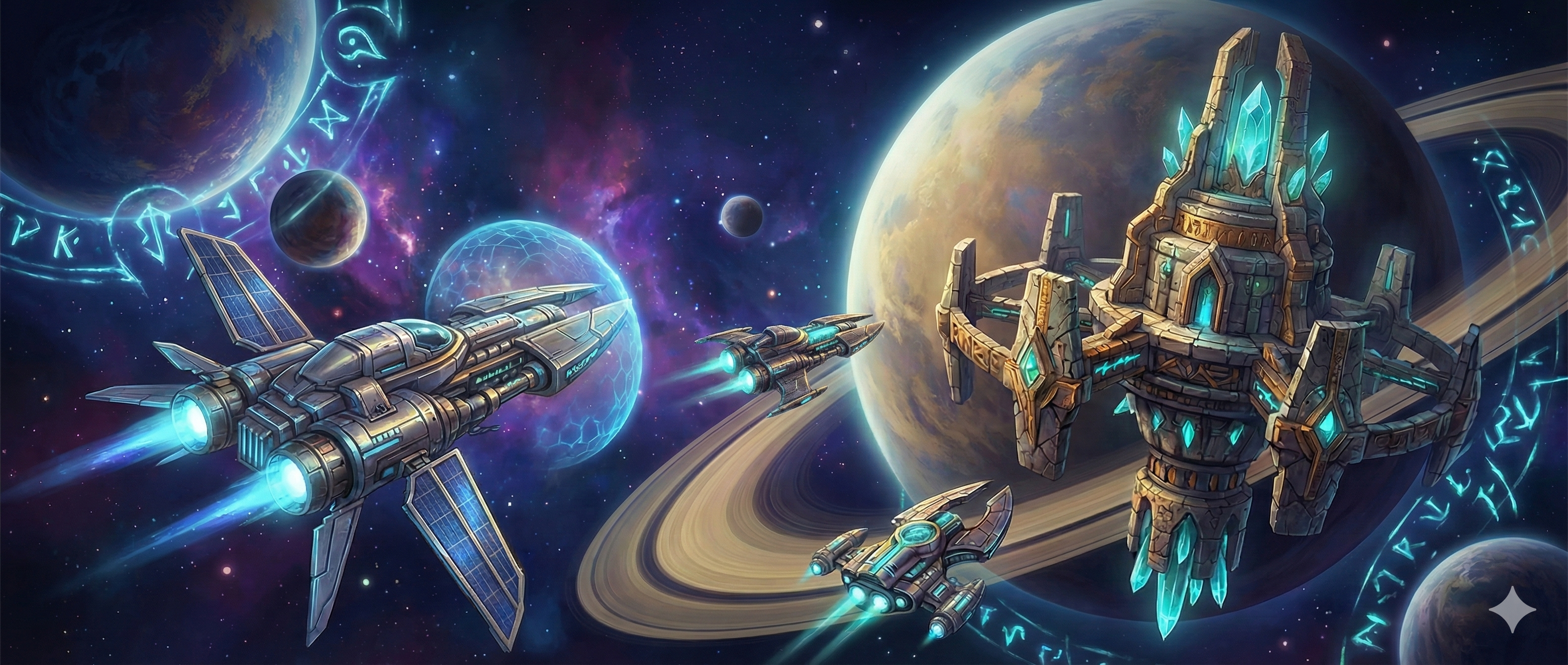
Technology
The first bold steps toward galactic empires wouldn't have been possible without remarkable advances in techno- magical theory and application. While, for eons, powerful wizards and sorcerers have been able to alter the fabric of reality, gods have had total reign of their own planes of existence, and demons, dragons, and all manner of eldritch creatures have leveraged their arcane might to bend worlds to their will, the common person has always had little to no contact with the arcane or the fantastical. In this age of automatons, interstellar empires, and pan- galactic communication, however, nearly everyone enjoys access to some form of enchantments, magics, or artifacts.
Low level magics have become nearly as commonplace across the ‘verse as once were torches, pitchforks, and horses. While most people still can't banish a demon with the wave of their hand or rain fire down from the sky with a word, most have ready access to hardlight-projecting consoles, datapads which allow communication from one planet to another, healing apparatuses that work as well as any cleric, and other similar wondrous items. Magic, as far as the ‘verse is concerned, is no longer at odds with technology: it has become technology.
Magical Technology
Modern magical technology traces its lineage back to traditional magic items, which possess incredible arcane potential and wondrous self-recharging properties— benefits which are tempered only by the fact that their construction demands months of work from a master artisan and centuries of arcane expertise to devise. With the discovery and later exploitation of the galactic ley lines, the construction of magic items became industrial: disposable, standardized, and cheap. At first, these processes resulted only in half-baked imitations of magic items, but soon, the face of modern magical technology began to develop.
A common element found across almost all arcane technology is arcane batteries—small, self-recharging power sources, whose energy can be adapted to nearly any application, from producing bursts of laser fire, to levitating objects, to creating holographic projections. Most of the time, the inner-workings of magical technology involves converting this power using a circuit of arcane components, such as abjurators, evocation shifters, illusiometers, somati-cyclers, and conjuration processors. The end result is a finely-tuned magical effect, exactly duplicating the efforts of a skilled spellcaster (with some limitations), but requiring almost no skill on behalf of the user. This new style of item creation is driven as much by mundane artisans, scientists, and entrepreneurs as it is by wizards or sorcerers, which is reflected in their designs. After all, why spend weeks hand-stitching a pair of winged boots when you can hook a couple mass-produced metal shells and a levi-pulsor to an arcane battery and make a perfectly functional jetpack?
Dark Matter Engines
Easily the most integral part of any starship, a Dark Matter engine warps a ship and its crew through the Void, instantaneously compressing the ship to a pinpoint size for a fraction of a second and teleporting it light years through the universe. Such a process is called a void jump.
Though often taken for granted, Dark Matter engines are the most fundamental invention on the galactic stage. Without them, crossing the Black to maintain interstellar trade, establishing inter-system colonies, or even just exploring the galactic neighborhood would be an insurmountable feat. Civilizations which can’t unlock the engine’s secrets never take more than a few steps outside their homeworlds, whereas those which discover it are greeted by the galactic community at large. Indeed, if the elves were not the first to discover the engine, the shape of the ‘verse would likely be very different today.
Each Dark Matter engine is fueled by a small amount of void crystal, which is harvested from black holes. The crystals, condensates formed from the particles orbiting at the event horizon, are extremely unstable, and much of the Dark Matter engine itself is dedicated to insulating its crystal from any shock or disturbance. Though the engine’s power is normally generated in intense bursts for void jumps, even while passive, it creates a steady stream of arcane energy, which is funneled into various systems throughout a starship. The engine can never be shut down completely; it is merely put on standby, for otherwise its void crystal would rapidly destabilize and destroy the entire ship.
Ships
As the primary method of transportation around the galaxy, the starship has become a ubiquitous part of interstellar life. At its simplest, a starship is comprised of four parts: some sort of hull, a life support system, some form of cruising propulsion system, and a Dark Matter engine. That being said, the exact shapes, styles, and specifications of starships found in the ‘verse are nearly limitless, from the industrial, smoke-spewing orcish scrap- ships, to the graceful curves of gnomish corvettes, to the hardy, angular hulls of dwarven freighters.
Though they were confined to relatively short distances until the discovery of the Dark Matter engine, most of the ‘verse’s prominent races have a long history of dabbling in near-orbit or inter-system travel. Early ships often combined the principles and designs of ocean-sailing vessels, primitive gliders, and flying machines, and used levitation magic to achieve the desired effect. While these early ships couldn't perform the all-important void jump, they were fast enough to ferry their passengers between their homeworlds and nearby planets or moons, laying the groundwork for future expansion into the stars.
Blasters
Somehow more pervasive than starships, blasters are go-to weapons for most everyone in the 'verse. At its most basic, a blaster is a handheld device with an arcane battery and a focus aperture, designed to fire a beam or “bolt” of energy when a trigger mechanism is pulled. Originally crafted in the profile of a hand crossbow without the limbs attached, the blaster quickly gained prominence as the premier weapon technology in the ‘verse: simple to understand, easy to use, and remarkably deadly, with the added benefit of never needing to be reloaded.
Far from the short-range prototypes first pioneered by dwarven inventors, blasters today come in a dizzying array of shapes, styles, and functions, though there are clearly accepted favorites. Moreover, blaster technology has been adapted for ship use, allowing an enterprising captain to outfit their vessel with entire batteries of guns.
While the old standards of bows, axes, and swords are still fairly widespread (especially on less advanced planets and among races, such as the Skathári, that favor traditional weapons), one would be hard-pressed to visit any settled world in the ‘verse and not find someone brandishing a blaster. Adventurers might favor other, more eccentric weapons, such as the laser sword and rocket hammer, but they'd be mad not to have a magnus or repeater holstered at their side.

Comments