
Milky Way
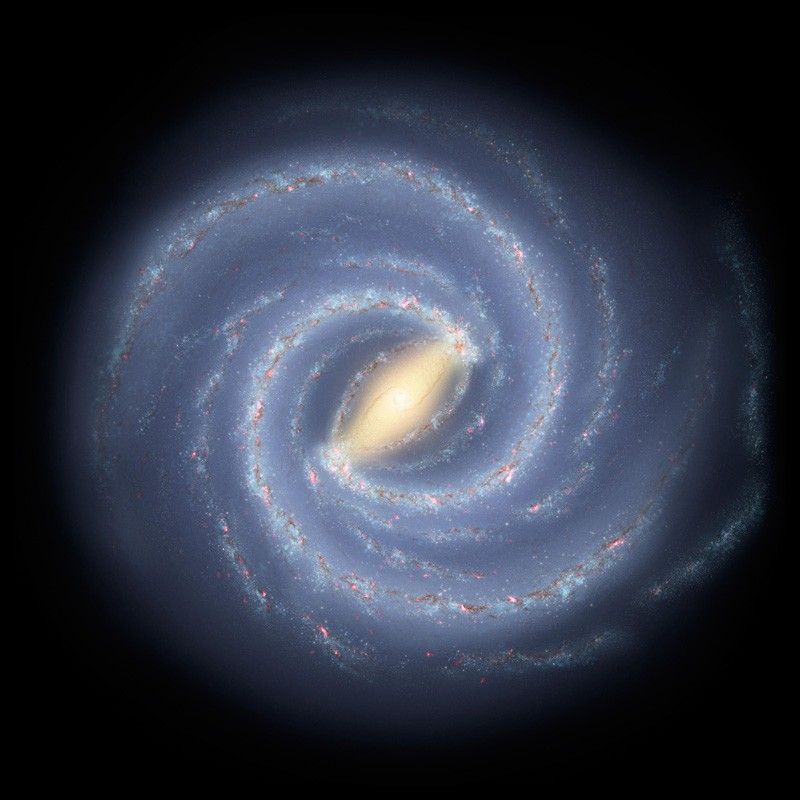
Our home galaxy is called the Milky Way. It’s a spiral galaxy with a disk of stars spanning more than 100,000 light-years. Earth is located along one of the galaxy’s spiral arms, about halfway from the center. Our solar system takes about 240 million years to orbit the Milky Way just once.
From our perspective on Earth, the Milky Way looks like a faint, milky band of light arcing across the entire sky, which is how it got its name. This feature marks the central disk of our home galaxy seen edge on.
The Milky Way sits in a neighborhood with over 50 other galaxies called the Local Group. Its members range in size from dwarf galaxies (smaller galaxies with up to a few billion stars) to Andromeda, our nearest large galactic neighbor.
The Local Group sits just off the edge of the Virgo cluster and is part of the Laniakea supercluster.
ESA - The best Milky Way animation, by Gaia
NASA - The Milky Way Galaxy and our Location
Location
Basic characteristics

Comments